INTEGERS 
MADE BY – 
DEEPANSHA SINGH 
CLASS – VI A 
ROLL NO. - 13
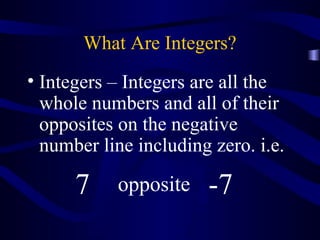
What Are Integers? 
• Integers – Integers are all the 
whole numbers and all of their 
opposites on the negative 
number line including zero. i.e. 
7 opposite -7
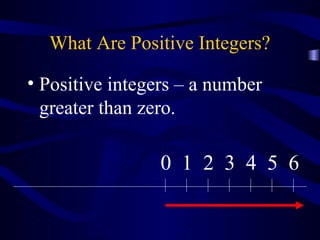
What Are Positive Integers? 
• Positive integers – a number 
greater than zero. 
0 1 2 3 4 5 6
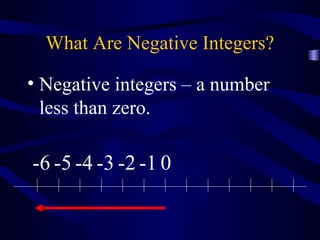
What Are Negative Integers? 
• Negative integers – a number 
less than zero. 
-6 -5 -4 -3 -2 -1 0
What Is A Number Line? 
Number line - 
• A line with arrows on both ends that show 
the integers with slash marks 
• Arrows show the line goes to infinity in 
both directions ( + and -) 
• Uses a negative sign (-) with negative 
numbers but no positive sign (+) 
with positive numbers 
• Zero is the origin and is neither 
negative nor positive
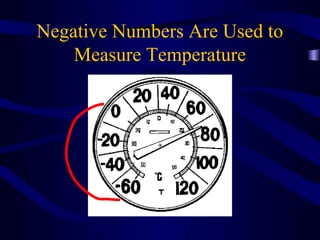
Negative Numbers Are Used to 
Measure Temperature
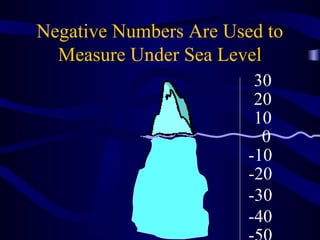
Negative Numbers Are Used to 
Measure Under Sea Level 
30 
20 
10 
0 
-10 
-20 
-30 
-40 
-50
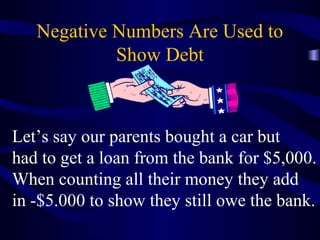
Negative Numbers Are Used to 
Show Debt 
Let’s say our parents bought a car but 
had to get a loan from the bank for $5,000. 
When counting all their money they add 
in -$5.000 to show they still owe the bank.
Positive & Negative Numbers 
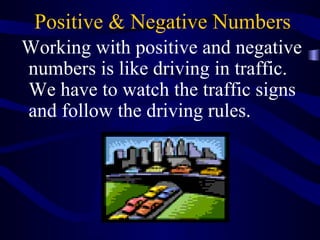
Working with positive and negative 
numbers is like driving in traffic. 
We have to watch the traffic signs 
and follow the driving rules.
Hint 
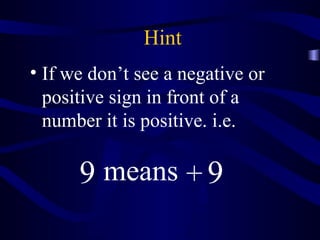
• If we don’t see a negative or 
positive sign in front of a 
number it is positive. i.e. 
9 means + 9
What Can We Do to Integers? 
• Integers are numbers, so we can add, 
subtract, multiply, and divide them 
• Each operation has different rules to follow
Adding Rules – Same Signs 
• If the integers have the SAME signs: ADD 
the numbers & keep the same sign! 
• Positive + Positive = Positive Answer 
• Negative + Negative = Negative Answer 
Examples: -3 + (-10) = ? ? = -13 
• 6 + (8) = ? ? = 14
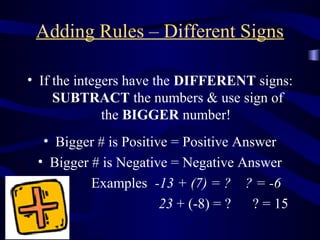
Adding Rules – Different Signs 
• If the integers have the DIFFERENT signs: 
SUBTRACT the numbers & use sign of 
the BIGGER number! 
• Bigger # is Positive = Positive Answer 
• Bigger # is Negative = Negative Answer 
Examples: -13 + (7) = ? ? = -6 
• 23 + (-8) = ? ? = 15
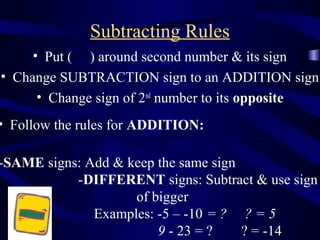
Subtracting Rules 
• Put ( ) around second number & its sign 
• Change SUBTRACTION sign to an ADDITION sign 
• Change sign of 2nd number to its opposite 
• Follow the rules for ADDITION: 
-SAME signs: Add & keep the same sign 
-DIFFERENT signs: Subtract & use sign 
of bigger 
Examples: -5 – -10 = ? ? = 5 
9 - 23 = ? ? = -14
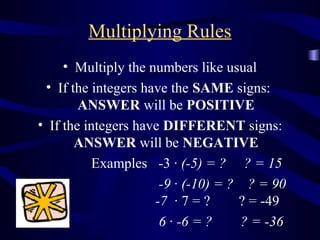
Multiplying Rules 
• Multiply the numbers like usual 
• If the integers have the SAME signs: 
ANSWER will be POSITIVE 
• If the integers have DIFFERENT signs: 
ANSWER will be NEGATIVE 
Examples: -3 · (-5) = ? ? = 15 
• -9 · (-10) = ? ? = 90 
-7 · 7 = ? ? = -49 
• 6 · -6 = ? ? = -36
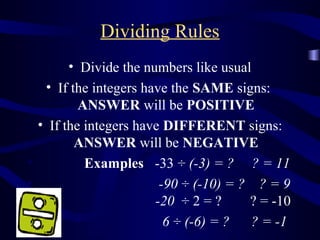
Dividing Rules 
• Divide the numbers like usual 
• If the integers have the SAME signs: 
ANSWER will be POSITIVE 
• If the integers have DIFFERENT signs: 
ANSWER will be NEGATIVE 
• Examples: -33 ÷ (-3) = ? ? = 11 
• -90 ÷ (-10) = ? ? = 9 
-20 ÷ 2 = ? ? = -10 
• 6 ÷ (-6) = ? ? = -1
THE END

Integers

  • 1.
    INTEGERS MADE BY– DEEPANSHA SINGH CLASS – VI A ROLL NO. - 13
  • 2.
    What Are Integers? • Integers – Integers are all the whole numbers and all of their opposites on the negative number line including zero. i.e. 7 opposite -7
  • 3.
    What Are PositiveIntegers? • Positive integers – a number greater than zero. 0 1 2 3 4 5 6
  • 4.
    What Are NegativeIntegers? • Negative integers – a number less than zero. -6 -5 -4 -3 -2 -1 0
  • 5.
    What Is ANumber Line? Number line - • A line with arrows on both ends that show the integers with slash marks • Arrows show the line goes to infinity in both directions ( + and -) • Uses a negative sign (-) with negative numbers but no positive sign (+) with positive numbers • Zero is the origin and is neither negative nor positive
  • 6.
    Negative Numbers AreUsed to Measure Temperature
  • 7.
    Negative Numbers AreUsed to Measure Under Sea Level 30 20 10 0 -10 -20 -30 -40 -50
  • 8.
    Negative Numbers AreUsed to Show Debt Let’s say our parents bought a car but had to get a loan from the bank for $5,000. When counting all their money they add in -$5.000 to show they still owe the bank.
  • 9.
    Positive & NegativeNumbers Working with positive and negative numbers is like driving in traffic. We have to watch the traffic signs and follow the driving rules.
  • 10.
    Hint • Ifwe don’t see a negative or positive sign in front of a number it is positive. i.e. 9 means + 9
  • 11.
    What Can WeDo to Integers? • Integers are numbers, so we can add, subtract, multiply, and divide them • Each operation has different rules to follow
  • 12.
    Adding Rules –Same Signs • If the integers have the SAME signs: ADD the numbers & keep the same sign! • Positive + Positive = Positive Answer • Negative + Negative = Negative Answer Examples: -3 + (-10) = ? ? = -13 • 6 + (8) = ? ? = 14
  • 13.
    Adding Rules –Different Signs • If the integers have the DIFFERENT signs: SUBTRACT the numbers & use sign of the BIGGER number! • Bigger # is Positive = Positive Answer • Bigger # is Negative = Negative Answer Examples: -13 + (7) = ? ? = -6 • 23 + (-8) = ? ? = 15
  • 14.
    Subtracting Rules •Put ( ) around second number & its sign • Change SUBTRACTION sign to an ADDITION sign • Change sign of 2nd number to its opposite • Follow the rules for ADDITION: -SAME signs: Add & keep the same sign -DIFFERENT signs: Subtract & use sign of bigger Examples: -5 – -10 = ? ? = 5 9 - 23 = ? ? = -14
  • 15.
    Multiplying Rules •Multiply the numbers like usual • If the integers have the SAME signs: ANSWER will be POSITIVE • If the integers have DIFFERENT signs: ANSWER will be NEGATIVE Examples: -3 · (-5) = ? ? = 15 • -9 · (-10) = ? ? = 90 -7 · 7 = ? ? = -49 • 6 · -6 = ? ? = -36
  • 16.
    Dividing Rules •Divide the numbers like usual • If the integers have the SAME signs: ANSWER will be POSITIVE • If the integers have DIFFERENT signs: ANSWER will be NEGATIVE • Examples: -33 ÷ (-3) = ? ? = 11 • -90 ÷ (-10) = ? ? = 9 -20 ÷ 2 = ? ? = -10 • 6 ÷ (-6) = ? ? = -1
  • 17.