

Subject-Mathematics
Class-IV
Chapter-1: Place Value
SYLLABUS
• 5-Digit numbers
• 6-Digit numbers
• Place Value
• Comparing numbers
• Forming numbers
• Rounding off numbers
• Roman numbers
Learning Objectives
To recall the concepts of place value with respect to 4-digit
numbers.
To develop an understanding of periods, places, reading and
writing 5-digit and 6-digit numbers
To develop the concept of expanding numbers
To acquire the knowledge of expanding numbers and place value
To learn rounding off numbers to the nearest 10, 100 and 1000
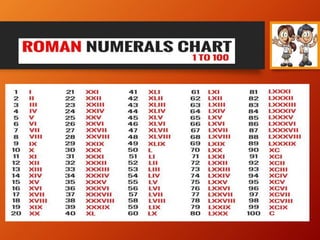
To understand the rules of writing Roman numbers till 100
Learning Outcomes
• Students Know the terms thousand, ten thousand
and lakh
• Students are able to read and write number
names and numerals according to Indian place
value system
• Students are able to write period, place and
place value of underlined digits
• Students can read, write and order numbers up
to lakh in figures and words.
• Students can recognise, read and position whole
numbers on a number line
• Students can identify and write Roman numerals
up to 100
Recapitulation
Do you remember numbers
up to 9,999
Can you give answer of the
following questions?
• What is the smallest 4-digit numeral?
• What is the successor of 9,999?
• How many thousands are there in one lakh?
• How many zeros are there in one lakh?
• 40,000+5,000+800+90+5 = __________
• What is the greatest 5-digit number?
Lets Start!
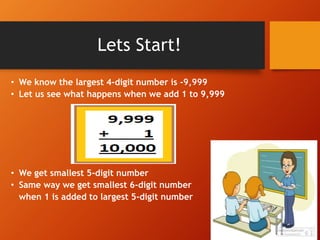
• We know the largest 4-digit number is -9,999
• Let us see what happens when we add 1 to 9,999
• We get smallest 5-digit number
• Same way we get smallest 6-digit number
when 1 is added to largest 5-digit number
Indian Place Value Chart
e.g. 1,489
One thousand four hundred eighty nine
Place Value Chart for 5-Digit Numbers
10,000: Ten thousands
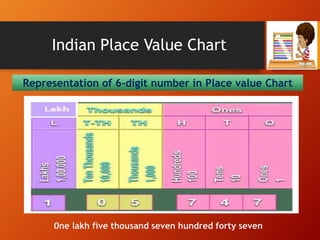
Indian Place Value Chart
Representation of 6-digit number in Place value Chart
0ne lakh five thousand seven hundred forty seven
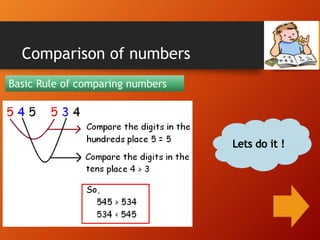
Comparison of numbers
Basic Rule of comparing numbers
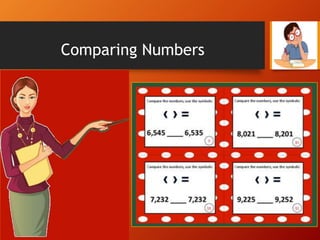
Comparing Numbers
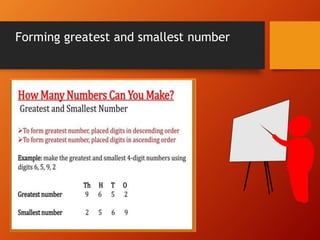
Forming greatest and smallest number
Now You Do !
• Write down the smallest and greatest 5-digit
numeral.
• Write down the smallest and greatest 6-digit
numeral.
• Form a greatest and smallest 6-digit number
from the given numbers:
(i) 0,6,8,9,3,1
(ii) 2,7,6,5,1,0
Remember these relations
• 10 ones = 1 ten
• 10 tens = 1 hundred
• 10 hundreds = 1 thousand
• 10 thousands = 1 ten thousand
• 10 ten thousands = 1 lakh
Rounding off Numbers
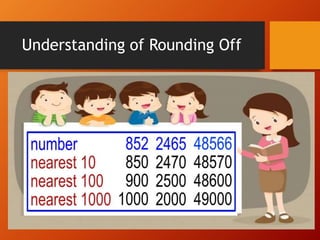
Rounding off to the nearest 10:
• For Rounding off to the nearest 10 ( Tens ). we will
first check if the ones digit is greater than or lesser
than 5.
• If the one’s digit is greater than 5, we will increase tens
digit by 1, and replace ones digit by 0.
• If one’s digit is lesser than 5, we will replace ones digit by
0, and other digits remain same.
Rounding off to the nearest 100
• In order to rounding off to the nearest 100 we will first
check if the tens digit is greater than or lesser than 5
• If the ten’s digit is greater than 5, we will increase
hundreds digit by 1 and replace tens or ones digit by 0.
• If the ten’s digit is lesser than 5, we will replace tens
or ones digit by 0, and other digits remain same.
Rounding off to the nearest 1000
• In order to round off a given number to the
nearest thousands we will first check if the
hundreds digit is greater than or lesser than 5
• If the hundred’s digit is greater than 5, we will
increase thousands digit by 1 and replace
hundreds, tens and ones digit by 0.
• If the hundred’s digit is lesser than 5, we will
replace hundreds, tens and ones digits by 0, and
other digits remain same.
Understanding of Rounding Off
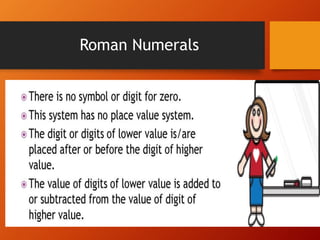
Roman Numerals
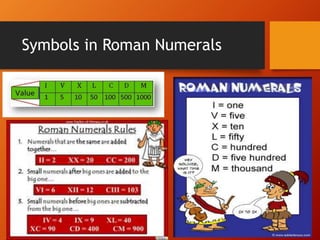
Symbols in Roman Numerals
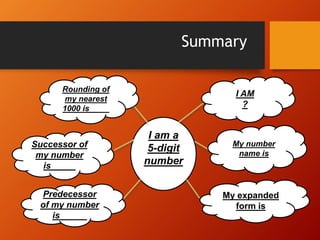
I am a
5-digit
number
I AM
?
My number
name is
My expanded
form is
Predecessor
of my number
is _____
Successor of
my number
is_____
Rounding of
my nearest
1000 is ____
Summary
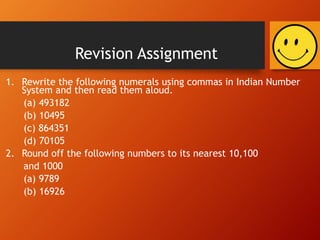
Revision Assignment
1. Rewrite the following numerals using commas in Indian Number
System and then read them aloud.
(a) 493182
(b) 10495
(c) 864351
(d) 70105
2. Round off the following numbers to its nearest 10,100
and 1000
(a) 9789
(b) 16926
Thank You !

Class 4 ch-1 ppt

  • 1.
  • 2.
    SYLLABUS • 5-Digit numbers •6-Digit numbers • Place Value • Comparing numbers • Forming numbers • Rounding off numbers • Roman numbers
  • 3.
    Learning Objectives To recallthe concepts of place value with respect to 4-digit numbers. To develop an understanding of periods, places, reading and writing 5-digit and 6-digit numbers To develop the concept of expanding numbers To acquire the knowledge of expanding numbers and place value To learn rounding off numbers to the nearest 10, 100 and 1000 To understand the rules of writing Roman numbers till 100
  • 4.
    Learning Outcomes • StudentsKnow the terms thousand, ten thousand and lakh • Students are able to read and write number names and numerals according to Indian place value system • Students are able to write period, place and place value of underlined digits • Students can read, write and order numbers up to lakh in figures and words. • Students can recognise, read and position whole numbers on a number line • Students can identify and write Roman numerals up to 100
  • 5.
    Recapitulation Do you remembernumbers up to 9,999
  • 6.
    Can you giveanswer of the following questions? • What is the smallest 4-digit numeral? • What is the successor of 9,999? • How many thousands are there in one lakh? • How many zeros are there in one lakh? • 40,000+5,000+800+90+5 = __________ • What is the greatest 5-digit number?
  • 7.
    Lets Start! • Weknow the largest 4-digit number is -9,999 • Let us see what happens when we add 1 to 9,999 • We get smallest 5-digit number • Same way we get smallest 6-digit number when 1 is added to largest 5-digit number
  • 8.
    Indian Place ValueChart e.g. 1,489 One thousand four hundred eighty nine Place Value Chart for 5-Digit Numbers 10,000: Ten thousands
  • 9.
    Indian Place ValueChart Representation of 6-digit number in Place value Chart 0ne lakh five thousand seven hundred forty seven
  • 10.
    Comparison of numbers BasicRule of comparing numbers
  • 11.
  • 12.
    Forming greatest andsmallest number
  • 13.
    Now You Do! • Write down the smallest and greatest 5-digit numeral. • Write down the smallest and greatest 6-digit numeral. • Form a greatest and smallest 6-digit number from the given numbers: (i) 0,6,8,9,3,1 (ii) 2,7,6,5,1,0
  • 14.
    Remember these relations •10 ones = 1 ten • 10 tens = 1 hundred • 10 hundreds = 1 thousand • 10 thousands = 1 ten thousand • 10 ten thousands = 1 lakh
  • 15.
    Rounding off Numbers Roundingoff to the nearest 10: • For Rounding off to the nearest 10 ( Tens ). we will first check if the ones digit is greater than or lesser than 5. • If the one’s digit is greater than 5, we will increase tens digit by 1, and replace ones digit by 0. • If one’s digit is lesser than 5, we will replace ones digit by 0, and other digits remain same.
  • 16.
    Rounding off tothe nearest 100 • In order to rounding off to the nearest 100 we will first check if the tens digit is greater than or lesser than 5 • If the ten’s digit is greater than 5, we will increase hundreds digit by 1 and replace tens or ones digit by 0. • If the ten’s digit is lesser than 5, we will replace tens or ones digit by 0, and other digits remain same.
  • 17.
    Rounding off tothe nearest 1000 • In order to round off a given number to the nearest thousands we will first check if the hundreds digit is greater than or lesser than 5 • If the hundred’s digit is greater than 5, we will increase thousands digit by 1 and replace hundreds, tens and ones digit by 0. • If the hundred’s digit is lesser than 5, we will replace hundreds, tens and ones digits by 0, and other digits remain same.
  • 18.
  • 19.
  • 20.
  • 22.
    I am a 5-digit number IAM ? My number name is My expanded form is Predecessor of my number is _____ Successor of my number is_____ Rounding of my nearest 1000 is ____ Summary
  • 23.
    Revision Assignment 1. Rewritethe following numerals using commas in Indian Number System and then read them aloud. (a) 493182 (b) 10495 (c) 864351 (d) 70105 2. Round off the following numbers to its nearest 10,100 and 1000 (a) 9789 (b) 16926
  • 24.