Developing Fraction
Concept
Zaiba Tariq : 2020-3029
Tehreem Fatima : 2020-3012
Nayab ashraf : 2020-3019
TEACHING OF MATHEMATICS IN ELEMENTARY SCHOOL
Contents
• Meaning of fraction
• Models for fraction
• Concept of fractional parts
• Using Fraction Language and Symbols
• Estimating with Fractions
• Equivalent-Fraction Concept
• Teaching Considerations for fraction Concepts
Developing fraction concepts
Developing fraction concepts refers to the process by which
individuals, typically students in primary or elementary school,
gradually gain an understanding of fractions and how they represent
parts of a whole.
• Identification and Recognition
• Comparison
• Operations
• Application and Problem Solving
• Connection to Decimals and Percentages
Meaning of fraction
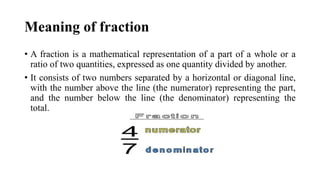
• A fraction is a mathematical representation of a part of a whole or a
ratio of two quantities, expressed as one quantity divided by another.
• It consists of two numbers separated by a horizontal or diagonal line,
with the number above the line (the numerator) representing the part,
and the number below the line (the denominator) representing the
total.
Models for fraction
• A fraction area model shows a whole shape split into equal parts.
• The three major categories of fraction models are the area model,
length model, and set model.
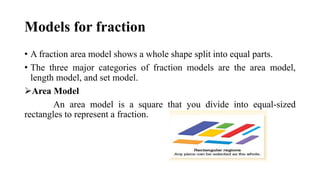
Area Model
An area model is a square that you divide into equal-sized
rectangles to represent a fraction.
Conti..
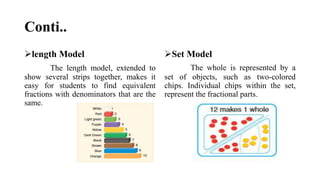
length Model
The length model, extended to
show several strips together, makes it
easy for students to find equivalent
fractions with denominators that are the
same.
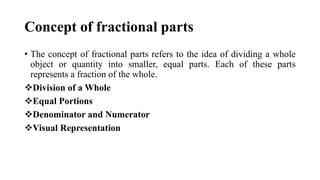
Set Model
The whole is represented by a
set of objects, such as two-colored
chips. Individual chips within the set,
represent the fractional parts.
Concept of fractional parts
• The concept of fractional parts refers to the idea of dividing a whole
object or quantity into smaller, equal parts. Each of these parts
represents a fraction of the whole.
Division of a Whole
Equal Portions
Denominator and Numerator
Visual Representation
Using Fraction Language and Symbols
• Using fraction language and symbols involves effectively
communicating and representing fractional quantities, relationships,
and operations using mathematical notation and terminology.
Counting Fraction Parts
Fraction Notation
Fractions Greater Than 1
Proper, Improper, and Mixed Fractions
Fraction Language
Estimating with Fractions
• The simplest way to estimate fractions is to use the closest whole
number, 1/2 or 1/4. For example, 18/19 is pretty much 1, 7/10 is close
to 3/4 and 9/16 is very nearly 1/2.
• Rounding
• Common Denominator
• Equal Parts
• Operations with Fractions
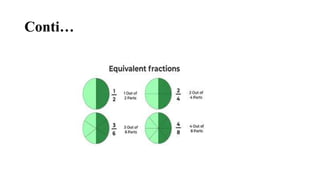
Equivalent-Fraction Concept
• Equivalent fractions are the fractions that have different numerators
and denominators but are equal to the same value.
• For example, 2/4 and 3/6 are equivalent fractions, because they both
are equal to the ½.
• A fraction is a part of a whole. Equivalent fractions represent the same
portion of the whole.
Conti…
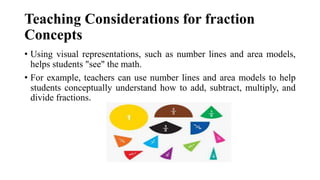
Teaching Considerations for fraction
Concepts
• Using visual representations, such as number lines and area models,
helps students "see" the math.
• For example, teachers can use number lines and area models to help
students conceptually understand how to add, subtract, multiply, and
divide fractions.
Conclusion
• This developmental process, children build on their understanding
incrementally, moving from concrete manipulations and visual
representations to more abstract symbolic representations. Teachers
and educators play a crucial role in providing appropriate instructional
strategies and experiences to support children's learning and
development of fraction concepts. By the end of their education,
students should have a solid understanding of fractions that allows
them to tackle more advanced mathematical concepts and applications.
Teaching in Mathematics Developing Fraction Concepts PPT.

Teaching in Mathematics Developing Fraction Concepts PPT.

  • 1.
    Developing Fraction Concept Zaiba Tariq: 2020-3029 Tehreem Fatima : 2020-3012 Nayab ashraf : 2020-3019 TEACHING OF MATHEMATICS IN ELEMENTARY SCHOOL
  • 2.
    Contents • Meaning offraction • Models for fraction • Concept of fractional parts • Using Fraction Language and Symbols • Estimating with Fractions • Equivalent-Fraction Concept • Teaching Considerations for fraction Concepts
  • 3.
    Developing fraction concepts Developingfraction concepts refers to the process by which individuals, typically students in primary or elementary school, gradually gain an understanding of fractions and how they represent parts of a whole. • Identification and Recognition • Comparison • Operations • Application and Problem Solving • Connection to Decimals and Percentages
  • 4.
    Meaning of fraction •A fraction is a mathematical representation of a part of a whole or a ratio of two quantities, expressed as one quantity divided by another. • It consists of two numbers separated by a horizontal or diagonal line, with the number above the line (the numerator) representing the part, and the number below the line (the denominator) representing the total.
  • 5.
    Models for fraction •A fraction area model shows a whole shape split into equal parts. • The three major categories of fraction models are the area model, length model, and set model. Area Model An area model is a square that you divide into equal-sized rectangles to represent a fraction.
  • 6.
    Conti.. length Model The lengthmodel, extended to show several strips together, makes it easy for students to find equivalent fractions with denominators that are the same. Set Model The whole is represented by a set of objects, such as two-colored chips. Individual chips within the set, represent the fractional parts.
  • 7.
    Concept of fractionalparts • The concept of fractional parts refers to the idea of dividing a whole object or quantity into smaller, equal parts. Each of these parts represents a fraction of the whole. Division of a Whole Equal Portions Denominator and Numerator Visual Representation
  • 8.
    Using Fraction Languageand Symbols • Using fraction language and symbols involves effectively communicating and representing fractional quantities, relationships, and operations using mathematical notation and terminology. Counting Fraction Parts Fraction Notation Fractions Greater Than 1 Proper, Improper, and Mixed Fractions Fraction Language
  • 9.
    Estimating with Fractions •The simplest way to estimate fractions is to use the closest whole number, 1/2 or 1/4. For example, 18/19 is pretty much 1, 7/10 is close to 3/4 and 9/16 is very nearly 1/2. • Rounding • Common Denominator • Equal Parts • Operations with Fractions
  • 10.
    Equivalent-Fraction Concept • Equivalentfractions are the fractions that have different numerators and denominators but are equal to the same value. • For example, 2/4 and 3/6 are equivalent fractions, because they both are equal to the ½. • A fraction is a part of a whole. Equivalent fractions represent the same portion of the whole.
  • 11.
  • 12.
    Teaching Considerations forfraction Concepts • Using visual representations, such as number lines and area models, helps students "see" the math. • For example, teachers can use number lines and area models to help students conceptually understand how to add, subtract, multiply, and divide fractions.
  • 13.
    Conclusion • This developmentalprocess, children build on their understanding incrementally, moving from concrete manipulations and visual representations to more abstract symbolic representations. Teachers and educators play a crucial role in providing appropriate instructional strategies and experiences to support children's learning and development of fraction concepts. By the end of their education, students should have a solid understanding of fractions that allows them to tackle more advanced mathematical concepts and applications.