

Click to start
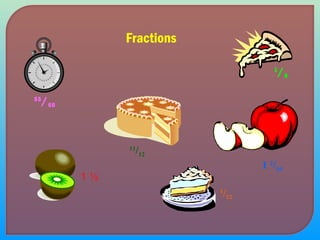
Fractions 
1 2/10 
1/12 
1/8 
1 ½ 
11/12 
55/60
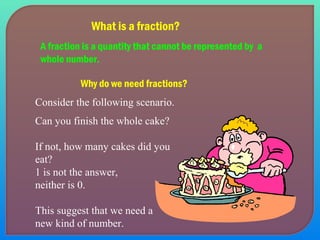
What is a fraction? 
A fraction is a quantity that cannot be represented by a 
whole number. 
Why do we need fractions? 
Consider the following scenario. 
Can you finish the whole cake? 
If not, how many cakes did you 
eat? 
1 is not the answer, 
neither is 0. 
This suggest that we need a 
new kind of number.
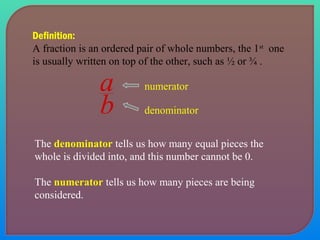
Definition: 
A fraction is an ordered pair of whole numbers, the 1st one 
is usually written on top of the other, such as ½ or ¾ . 
numerator 
a 
b denominator 
The denominator tells us how many equal pieces the 
whole is divided into, and this number cannot be 0. 
The numerator tells us how many pieces are being 
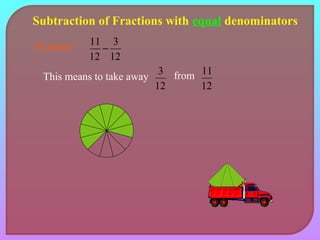
considered.
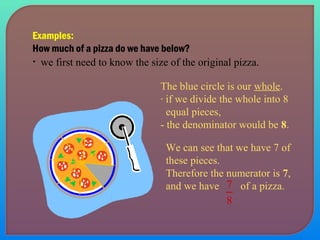
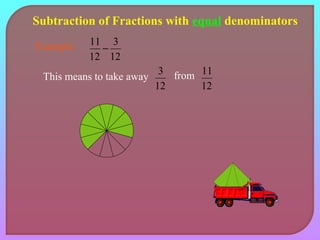
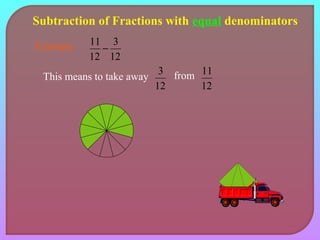
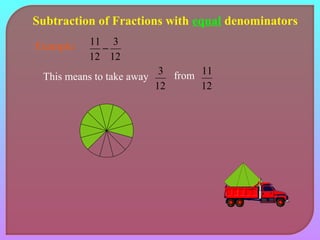
Examples: 
How much of a pizza do we have below? 
• we first need to know the size of the original pizza. 
The blue circle is our whole. 
- if we divide the whole into 8 
equal pieces, 
- the denominator would be 8. 
We can see that we have 7 of 
these pieces. 
Therefore the numerator is 7, 
and we have 7 
of a pizza. 
8
Equivalent fractions 
a fraction can have many different appearances, these 
are called equivalent fractions 
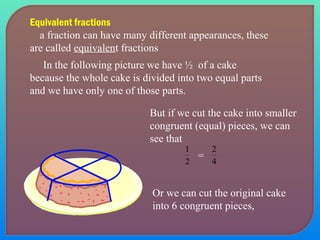
In the following picture we have ½ of a cake 
because the whole cake is divided into two equal parts 
and we have only one of those parts. 
But if we cut the cake into smaller 
congruent (equal) pieces, we can 
see that 
1 = 2 
2 
4 
Or we can cut the original cake 
into 6 congruent pieces,
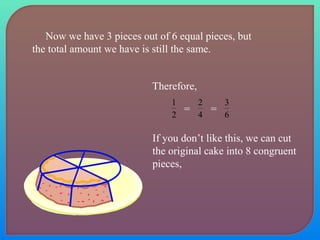
Now we have 3 pieces out of 6 equal pieces, but 
the total amount we have is still the same. 
Therefore, 
1 2 
= 4 
2 = 6 
3 
If you don’t like this, we can cut 
the original cake into 8 congruent 
pieces,
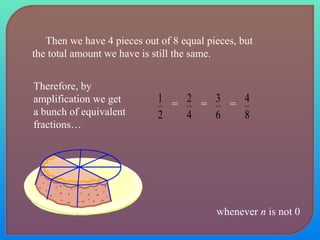
Then we have 4 pieces out of 8 equal pieces, but 
the total amount we have is still the same. 
1 = 
2 
2 = 
4 
3 = 
6 
4 
8 
whenever n is not 0 
Therefore, by 
amplification we get 
a bunch of equivalent 
fractions…
How do we know that two fractions are the same? 
we cannot tell whether two fractions are the same until 
we reduce them to their simplest form. 
A fraction is in its simplest form (or is reduced) if we 
cannot find a whole number (other than 1) that can divide 
into both its numerator and denominator. 
Examples: 
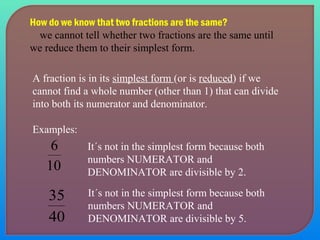
It´s not in the simplest form because both 
numbers NUMERATOR and 
DENOMINATOR are divisible by 2. 
It´s not in the simplest form because both 
numbers NUMERATOR and 
DENOMINATOR are divisible by 5. 
6 
10 
35 
40
How do we know that two fractions are the same? 
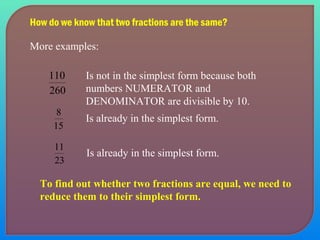
More examples: 
Is not in the simplest form because both 
numbers NUMERATOR and 
DENOMINATOR are divisible by 10. 
Is already in the simplest form. 
110 
260 
8 
15 
11 
23 
To find out whether two fractions are equal, we need to 
reduce them to their simplest form.
How do we know that two fractions are the same? 
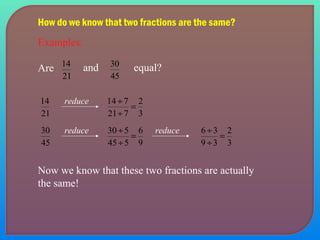
Examples: 
Are 
14 and 
21 
30 equal? 
45 
14 reduce 
21 
2 
3 
¸ 
14 7 = 
¸ 
21 7 
30 reduce 
45 
¸ 6 
reduce 
9 
30 5 = 
¸ 
45 5 
2 
3 
¸ 
6 3 = 
¸ 
9 3 
Now we know that these two fractions are actually 
the same!
How do we know that two fractions are the same? 
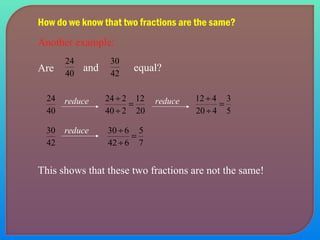
Another example: 
Are 24 
and equal? 
40 
reduce 
reduce 
30 
42 
24 
40 
30 
42 
¸ 12 
reduce 
20 
24 2 = 
¸ 
40 2 
3 
5 
¸ 
12 4 = 
¸ 
20 4 
5 
7 
¸ 
30 6 = 
¸ 
42 6 
This shows that these two fractions are not the same!
Improper Fractions and Mixed Numbers 
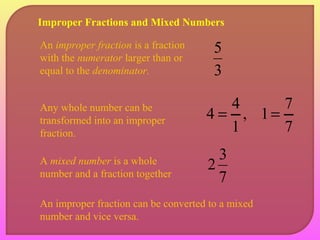
An improper fraction is a fraction 5 
with the numerator larger than or 
equal to the denominator. 
3 
4 = 4 
2 3 
Any whole number can be 
transformed into an improper 
fraction. 
A mixed number is a whole 
number and a fraction together 7 
, 
1 
An improper fraction can be converted to a mixed 
number and vice versa. 
1 = 7 
7
Improper Fractions and Mixed Numbers 
1 2 
3 
5 = 
3 
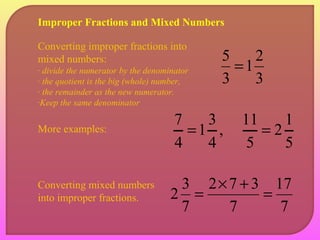
Converting improper fractions into 
mixed numbers: 
- divide the numerator by the denominator 
- the quotient is the big (whole) number, 
- the remainder as the new numerator. 
-Keep the same denominator 
2 1 
17 
7 
1 3 
More examples: 7 = 
11 = 
Converting mixed numbers 
into improper fractions. 
2 3 = 2 ´ 7 + 3 
= 7 
7 
, 
4 
4 
5 
5
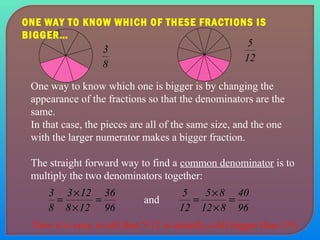
ONE WAY TO KNOW WHICH OF THESE FRACTIONS IS 
BIGGER… 
3 
5 
One way to know which one is bigger is by changing the 
appearance of the fractions so that the denominators are the 
same. 
In that case, the pieces are all of the same size, and the one 
with the larger numerator makes a bigger fraction. 
The straight forward way to find a common denominator is to 
multiply the two denominators together: 
36 
= ´ and 
96 
3 3 12 
= 
8 12 
8 
´ 
40 
96 
5 = 5 ´ 
8 
= 
12 8 
12 
´ 
8 
12 
Now it is easy to tell that 5/12 is actually a bit bigger than 3/8.
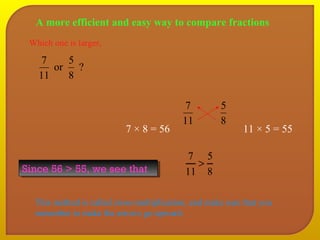
A more efficient and easy way to compare fractions 
7 
11 
5 
8 
7 × 8 = 56 11 × 5 = 55 
Which one is larger, 
or 5 
? 
8 
7 
11 
SSiinnccee 5566 >> 5555,, wwee sseeee tthhaatt 
5 
8 
7 > 
11 
This method is called cross-multiplication, and make sure that you 
remember to make the arrows go upward.
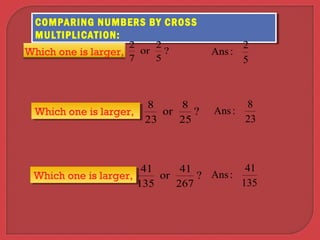
COMPARING NUMBERS BY CROSS 
MULTIPLICATION: 
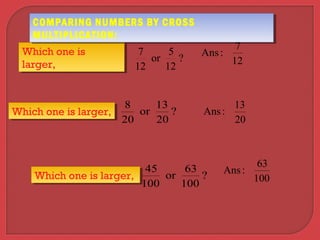
Which one is larger, ? 
COMPARING NUMBERS BY CROSS 
MULTIPLICATION: 
2 
or 2 
7 
5 
or 8 
8 
WWhhiicchh oonnee iiss llaarrggeerr,, ? 
25 
23 
or 41 
41 
WWhhiicchh oonnee iiss llaarrggeerr,, ? 
267 
135 
Ans : 2 
5 
Ans : 8 
23 
Ans : 41 
135
COMPARING NUMBERS BY CROSS 
MULTIPLICATION: 
or 5 
7 
Which one is 
larger, ? 
Which one is 
larger, 
12 
12 
or 13 
8 
WWhhiicchh oonnee iiss llaarrggeerr,, ? 
20 
20 
or 63 
45 
Ans : 7 
12 
Ans : 13 
WWhhiicchh oonnee iiss llaarrggeerr,, ? 
100 
100 
Ans : 63 
100 
20 
COMPARING NUMBERS BY CROSS 
MULTIPLICATION:
Addition of Fractions 
- Addition means combining objects in two or 
more sets. 
- The objects must be of the same type, i.e. we 
combine chickens with chickens and cows 
with cows. 
- In fractions, we can only combine pieces of the 
same size. In other words, the denominators 
must be the same.
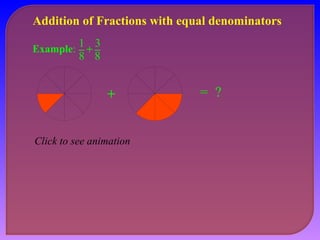
Addition of Fractions with equal denominators 
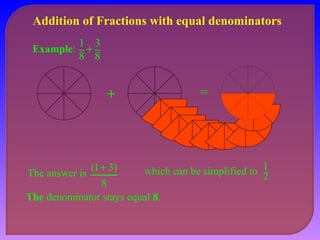
+ = ? 
3 
8 1 
+ 
Example: 8 
Click to see animation
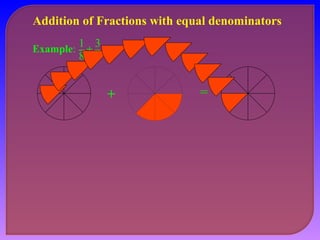
Addition of Fractions with equal denominators 
3 
8 1 
+ 
Example: 8 
+ =
Addition of Fractions with equal denominators 
+ = 
3 
8 1 
+ 
Example: 8 
The answer is 
(1+ 3) which can be simplified to 2 
8 
The denominator stays equal 8. 
1
Addition of Fractions with equal denominators 
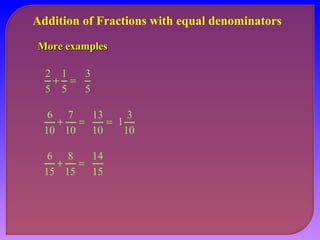
MMoorree eexxaammpplleess 
1 
+ = 
5 
2 
5 
3 
5 
6 7 
= 
+ = 
10 
10 
13 
10 
1 3 
10 
8 
+ = 
15 
6 
15 
14 
15
Addition of Fractions with 
different or unlikely denominators 
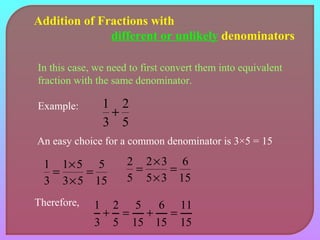
In this case, we need to first convert them into equivalent 
fraction with the same denominator. 
Example: 
= ´ 
2 
2 2 3 
= 
1 + 
= ´ 5 
15 
15 
1 1 5 
= 
3 5 
3 
´ 
6 
5 3 
5 
´ 
5 
3 
An easy choice for a common denominator is 3×5 = 15 
Therefore, 
11 
15 
1 + = + 6 
= 
15 
5 
15 
2 
5 
3
Addition of Fractions with 
different or unlike denominators 
Remark: When we have more than 2 denominators , we 
need to find the least common denominator (LCM) by 
PRIME FACTORIZATION. 
When there are only 2 denominators, then the easiest way 
is multiply the denominators, to make them equal. 
Also, you can use amplification to make the denominat
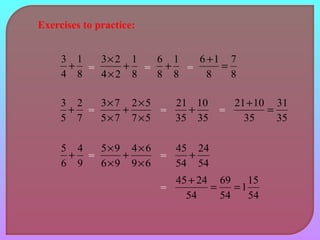
Exercises to practice: 
1 
8 
´ 
3 2 + 
´ 
4 2 
1 
8 
3 + 
4 
2 
7 
3 + 
5 
4 
9 
5 + 
6 
= 
= 
= 
+ ´ 
2 5 
7 5 
´ 
3 7 
5 7 
´ 
´ 
+ ´ 
4 6 
9 6 
´ 
5 9 
6 9 
´ 
´ 
= 
6 +1 = 
6 + = 8 
= 
= 
1 
8 
8 
7 
8 
10 
35 
21 + 
35 
31 
35 
21+10 = 
35 
= 
24 
54 
45 + 
54 
115 
54 
45+ 24 = 69 
= 
54 
54 
=
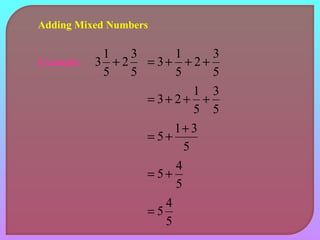
Adding Mixed Numbers 
Example: 
2 3 
5 
3 1 + 
5 
= 3+ 1 + + 
2 3 
5 
5 
3 
5 
= 3+ 2 + 1 + 
5 
= 5 + 1+ 3 
5 
= 5 + 4 
5 
= 5 4 
5
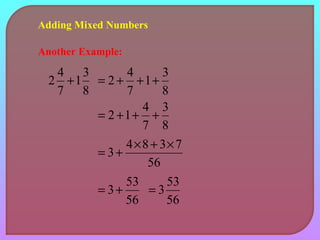
Adding Mixed Numbers 
Another Example: 
13 
8 
2 4 + 
7 
= 2 + 4 + + 
1 3 
8 
7 
3 
8 
= 2 +1+ 4 + 
7 
= 3+ 4´8 + 3´7 
56 
= 3+ 53 
56 
= 3 53 
56
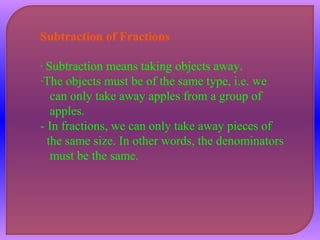
Subtraction of Fractions 
- Subtraction means taking objects away. 
-The objects must be of the same type, i.e. we 
can only take away apples from a group of 
apples. 
- In fractions, we can only take away pieces of 
the same size. In other words, the denominators 
must be the same.
Subtraction of Fractions with equal or like 
denominators 
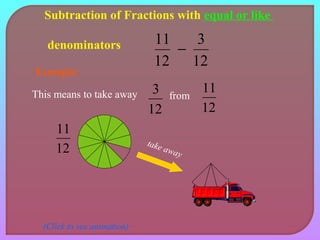
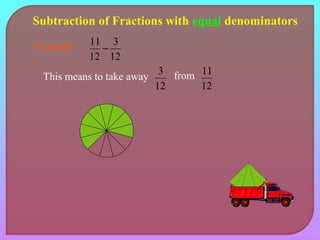
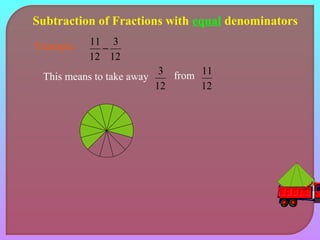
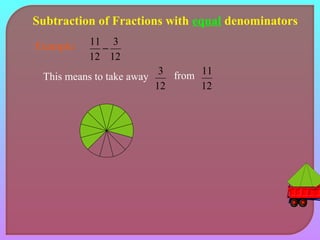
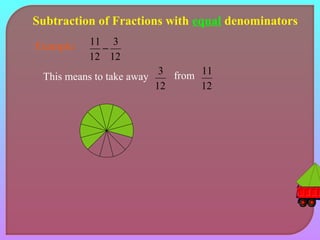
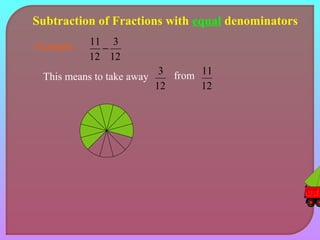
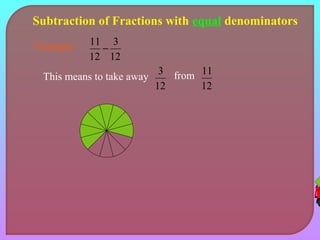
11 - 
3 
12 
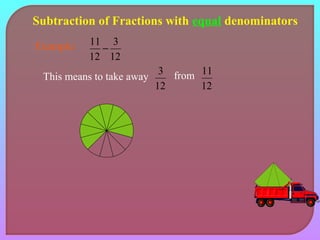
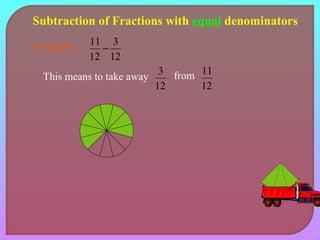
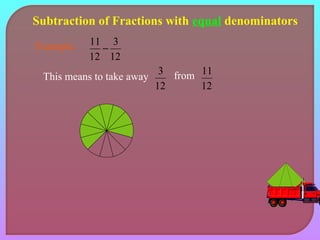
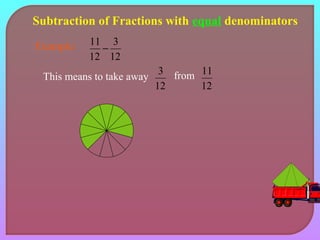
12 
Example: 
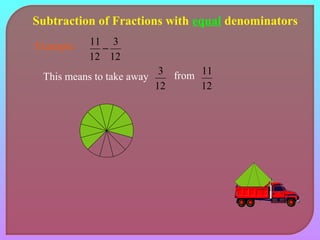
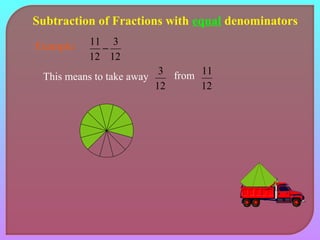
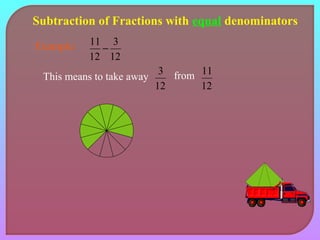
This means to take away 
3 from 
12 
11 
12 
11 take away 
12 
(Click to see animation)
Subtraction of Fractions with equal denominators 
Example: 
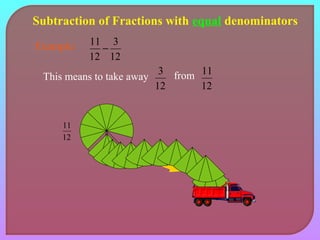
3 
12 
11 - 
12 
This means to take away 
11 
12 
3 from 
12 
11 
12
Subtraction of Fractions with equal denominators 
Example: 
3 
12 
11 - 
12 
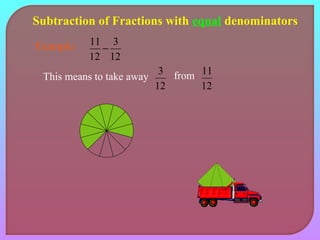
This means to take away 
3 from 
12 
11 
12
Subtraction of Fractions with equal denominators 
Example: 
3 
12 
11 - 
12 
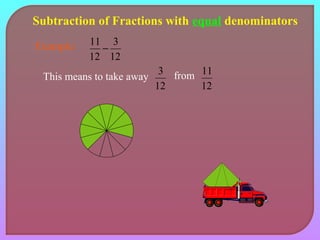
This means to take away 
3 from 
12 
11 
12
Subtraction of Fractions with equal denominators 
Example: 
3 
12 
11 - 
12 
This means to take away 
3 from 
12 
11 
12
Subtraction of Fractions with equal denominators 
Example: 
3 
12 
11 - 
12 
This means to take away 
3 from 
12 
11 
12
Subtraction of Fractions with equal denominators 
Example: 
3 
12 
11 - 
12 
This means to take away 
3 from 
12 
11 
12
Subtraction of Fractions with equal denominators 
Example: 
3 
12 
11 - 
12 
This means to take away 
3 from 
12 
11 
12
Subtraction of Fractions with equal denominators 
Example: 
3 
12 
11 - 
12 
This means to take away 
3 from 
12 
11 
12
Subtraction of Fractions with equal denominators 
Example: 
3 
12 
11 - 
12 
This means to take away 
3 from 
12 
11 
12
Subtraction of Fractions with equal denominators 
Example: 
3 
12 
11 - 
12 
This means to take away 
3 from 
12 
11 
12
Subtraction of Fractions with equal denominators 
Example: 
3 
12 
11 - 
12 
This means to take away 
3 from 
12 
11 
12
Subtraction of Fractions with equal denominators 
Example: 
3 
12 
11 - 
12 
This means to take away 
3 from 
12 
11 
12
Subtraction of Fractions with equal denominators 
Example: 
3 
12 
11 - 
12 
This means to take away 
3 from 
12 
11 
12
Subtraction of Fractions with equal denominators 
Example: 
3 
12 
11 - 
12 
This means to take away 
3 from 
12 
11 
12
Subtraction of Fractions with equal denominators 
Example: 
3 
12 
11 - 
12 
This means to take away 
3 from 
12 
11 
12
Subtraction of Fractions with equal denominators 
Example: 
3 
12 
11 - 
12 
This means to take away 
3 from 
12 
11 
12
Subtraction of Fractions with equal denominators 
Example: 
3 
12 
11 - 
12 
This means to take away 
3 from 
12 
11 
12
Subtraction of Fractions with equal denominators 
Example: 
3 
12 
11 - 
12 
This means to take away 
3 from 
12 
11 
12
Subtraction of Fractions with equal denominators 
Example: 
3 
12 
11 - 
12 
This means to take away 
3 from 
12 
11 
12
Subtraction of Fractions with equal denominators 
Example: 
3 
12 
11 - 
12 
This means to take away 
3 from 
12 
11 
12
Subtraction of Fractions with equal denominators 
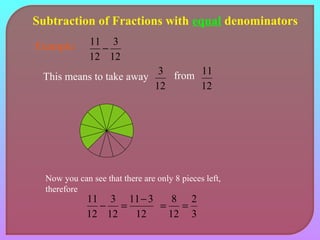
Example: 
3 
12 
11 - 
12 
3 from 
11 
Now you can see that there are only 8 pieces left, 
therefore 
11 - = - 
11 3 
12 
3 
12 
12 
2 
3 
= 8 = 
12 
This means to take away 
12 
12
Subtraction of Fractions 
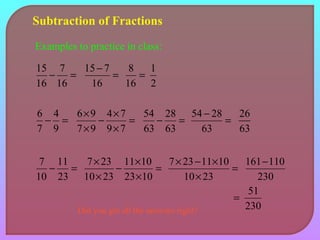
Examples to practice in class: 
15 7 
- = 
- = 
16 
16 
15 7 
16 
1 
2 
8 = 
16 
- ´ 
´ 
6 4 
= 
- = 
9 
7 
54 - = 
6 9 4 7 
- = 
´ 
´ 
9 7 
7 9 
28 
63 
63 
54 28 26 
63 
63 
- ´ 
´ 
7 11 
= 
- = 
23 
10 
´ - ´ 
10 23 
7 23 11 10 
= 
´ 
´ 
23 10 
10 23 
7 23 11 10 
´ 
161-110 
230 
= 51 
230 
Did you get all the answers right?
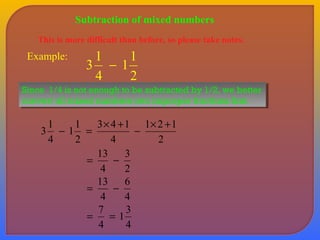
Subtraction of mixed numbers 
This is more difficult than before, so please take notes. 
Example: 
11 
2 
3 1 - 
4 
Since 1/4 is not enough to be subtracted by 1/2, we better 
convert all mixed numbers into improper fractions first. 
Since 1/4 is not enough to be subtracted by 1/2, we better 
convert all mixed numbers into improper fractions first. 
3 1 - = ´ + - ´ + 
1 2 1 
2 
3 4 1 
4 
11 
2 
4 
3 
2 
= 13 - 
4 
6 
4 
= 13 - 
4 
1 3 
4 
= 7 = 
4

Introduction to fractions and concepts

  • 1.
  • 2.
    Fractions 1 2/10 1/12 1/8 1 ½ 11/12 55/60
  • 3.
    What is afraction? A fraction is a quantity that cannot be represented by a whole number. Why do we need fractions? Consider the following scenario. Can you finish the whole cake? If not, how many cakes did you eat? 1 is not the answer, neither is 0. This suggest that we need a new kind of number.
  • 4.
    Definition: A fractionis an ordered pair of whole numbers, the 1st one is usually written on top of the other, such as ½ or ¾ . numerator a b denominator The denominator tells us how many equal pieces the whole is divided into, and this number cannot be 0. The numerator tells us how many pieces are being considered.
  • 5.
    Examples: How muchof a pizza do we have below? • we first need to know the size of the original pizza. The blue circle is our whole. - if we divide the whole into 8 equal pieces, - the denominator would be 8. We can see that we have 7 of these pieces. Therefore the numerator is 7, and we have 7 of a pizza. 8
  • 6.
    Equivalent fractions afraction can have many different appearances, these are called equivalent fractions In the following picture we have ½ of a cake because the whole cake is divided into two equal parts and we have only one of those parts. But if we cut the cake into smaller congruent (equal) pieces, we can see that 1 = 2 2 4 Or we can cut the original cake into 6 congruent pieces,
  • 7.
    Now we have3 pieces out of 6 equal pieces, but the total amount we have is still the same. Therefore, 1 2 = 4 2 = 6 3 If you don’t like this, we can cut the original cake into 8 congruent pieces,
  • 8.
    Then we have4 pieces out of 8 equal pieces, but the total amount we have is still the same. 1 = 2 2 = 4 3 = 6 4 8 whenever n is not 0 Therefore, by amplification we get a bunch of equivalent fractions…
  • 9.
    How do weknow that two fractions are the same? we cannot tell whether two fractions are the same until we reduce them to their simplest form. A fraction is in its simplest form (or is reduced) if we cannot find a whole number (other than 1) that can divide into both its numerator and denominator. Examples: It´s not in the simplest form because both numbers NUMERATOR and DENOMINATOR are divisible by 2. It´s not in the simplest form because both numbers NUMERATOR and DENOMINATOR are divisible by 5. 6 10 35 40
  • 10.
    How do weknow that two fractions are the same? More examples: Is not in the simplest form because both numbers NUMERATOR and DENOMINATOR are divisible by 10. Is already in the simplest form. Is already in the simplest form. 110 260 8 15 11 23 To find out whether two fractions are equal, we need to reduce them to their simplest form.
  • 11.
    How do weknow that two fractions are the same? Examples: Are 14 and 21 30 equal? 45 14 reduce 21 2 3 ¸ 14 7 = ¸ 21 7 30 reduce 45 ¸ 6 reduce 9 30 5 = ¸ 45 5 2 3 ¸ 6 3 = ¸ 9 3 Now we know that these two fractions are actually the same!
  • 12.
    How do weknow that two fractions are the same? Another example: Are 24 and equal? 40 reduce reduce 30 42 24 40 30 42 ¸ 12 reduce 20 24 2 = ¸ 40 2 3 5 ¸ 12 4 = ¸ 20 4 5 7 ¸ 30 6 = ¸ 42 6 This shows that these two fractions are not the same!
  • 13.
    Improper Fractions andMixed Numbers An improper fraction is a fraction 5 with the numerator larger than or equal to the denominator. 3 4 = 4 2 3 Any whole number can be transformed into an improper fraction. A mixed number is a whole number and a fraction together 7 , 1 An improper fraction can be converted to a mixed number and vice versa. 1 = 7 7
  • 14.
    Improper Fractions andMixed Numbers 1 2 3 5 = 3 Converting improper fractions into mixed numbers: - divide the numerator by the denominator - the quotient is the big (whole) number, - the remainder as the new numerator. -Keep the same denominator 2 1 17 7 1 3 More examples: 7 = 11 = Converting mixed numbers into improper fractions. 2 3 = 2 ´ 7 + 3 = 7 7 , 4 4 5 5
  • 15.
    ONE WAY TOKNOW WHICH OF THESE FRACTIONS IS BIGGER… 3 5 One way to know which one is bigger is by changing the appearance of the fractions so that the denominators are the same. In that case, the pieces are all of the same size, and the one with the larger numerator makes a bigger fraction. The straight forward way to find a common denominator is to multiply the two denominators together: 36 = ´ and 96 3 3 12 = 8 12 8 ´ 40 96 5 = 5 ´ 8 = 12 8 12 ´ 8 12 Now it is easy to tell that 5/12 is actually a bit bigger than 3/8.
  • 16.
    A more efficientand easy way to compare fractions 7 11 5 8 7 × 8 = 56 11 × 5 = 55 Which one is larger, or 5 ? 8 7 11 SSiinnccee 5566 >> 5555,, wwee sseeee tthhaatt 5 8 7 > 11 This method is called cross-multiplication, and make sure that you remember to make the arrows go upward.
  • 17.
    COMPARING NUMBERS BYCROSS MULTIPLICATION: Which one is larger, ? COMPARING NUMBERS BY CROSS MULTIPLICATION: 2 or 2 7 5 or 8 8 WWhhiicchh oonnee iiss llaarrggeerr,, ? 25 23 or 41 41 WWhhiicchh oonnee iiss llaarrggeerr,, ? 267 135 Ans : 2 5 Ans : 8 23 Ans : 41 135
  • 18.
    COMPARING NUMBERS BYCROSS MULTIPLICATION: or 5 7 Which one is larger, ? Which one is larger, 12 12 or 13 8 WWhhiicchh oonnee iiss llaarrggeerr,, ? 20 20 or 63 45 Ans : 7 12 Ans : 13 WWhhiicchh oonnee iiss llaarrggeerr,, ? 100 100 Ans : 63 100 20 COMPARING NUMBERS BY CROSS MULTIPLICATION:
  • 19.
    Addition of Fractions - Addition means combining objects in two or more sets. - The objects must be of the same type, i.e. we combine chickens with chickens and cows with cows. - In fractions, we can only combine pieces of the same size. In other words, the denominators must be the same.
  • 20.
    Addition of Fractionswith equal denominators + = ? 3 8 1 + Example: 8 Click to see animation
  • 21.
    Addition of Fractionswith equal denominators 3 8 1 + Example: 8 + =
  • 22.
    Addition of Fractionswith equal denominators + = 3 8 1 + Example: 8 The answer is (1+ 3) which can be simplified to 2 8 The denominator stays equal 8. 1
  • 23.
    Addition of Fractionswith equal denominators MMoorree eexxaammpplleess 1 + = 5 2 5 3 5 6 7 = + = 10 10 13 10 1 3 10 8 + = 15 6 15 14 15
  • 24.
    Addition of Fractionswith different or unlikely denominators In this case, we need to first convert them into equivalent fraction with the same denominator. Example: = ´ 2 2 2 3 = 1 + = ´ 5 15 15 1 1 5 = 3 5 3 ´ 6 5 3 5 ´ 5 3 An easy choice for a common denominator is 3×5 = 15 Therefore, 11 15 1 + = + 6 = 15 5 15 2 5 3
  • 25.
    Addition of Fractionswith different or unlike denominators Remark: When we have more than 2 denominators , we need to find the least common denominator (LCM) by PRIME FACTORIZATION. When there are only 2 denominators, then the easiest way is multiply the denominators, to make them equal. Also, you can use amplification to make the denominat
  • 26.
    Exercises to practice: 1 8 ´ 3 2 + ´ 4 2 1 8 3 + 4 2 7 3 + 5 4 9 5 + 6 = = = + ´ 2 5 7 5 ´ 3 7 5 7 ´ ´ + ´ 4 6 9 6 ´ 5 9 6 9 ´ ´ = 6 +1 = 6 + = 8 = = 1 8 8 7 8 10 35 21 + 35 31 35 21+10 = 35 = 24 54 45 + 54 115 54 45+ 24 = 69 = 54 54 =
  • 27.
    Adding Mixed Numbers Example: 2 3 5 3 1 + 5 = 3+ 1 + + 2 3 5 5 3 5 = 3+ 2 + 1 + 5 = 5 + 1+ 3 5 = 5 + 4 5 = 5 4 5
  • 28.
    Adding Mixed Numbers Another Example: 13 8 2 4 + 7 = 2 + 4 + + 1 3 8 7 3 8 = 2 +1+ 4 + 7 = 3+ 4´8 + 3´7 56 = 3+ 53 56 = 3 53 56
  • 29.
    Subtraction of Fractions - Subtraction means taking objects away. -The objects must be of the same type, i.e. we can only take away apples from a group of apples. - In fractions, we can only take away pieces of the same size. In other words, the denominators must be the same.
  • 30.
    Subtraction of Fractionswith equal or like denominators 11 - 3 12 12 Example: This means to take away 3 from 12 11 12 11 take away 12 (Click to see animation)
  • 31.
    Subtraction of Fractionswith equal denominators Example: 3 12 11 - 12 This means to take away 11 12 3 from 12 11 12
  • 32.
    Subtraction of Fractionswith equal denominators Example: 3 12 11 - 12 This means to take away 3 from 12 11 12
  • 33.
    Subtraction of Fractionswith equal denominators Example: 3 12 11 - 12 This means to take away 3 from 12 11 12
  • 34.
    Subtraction of Fractionswith equal denominators Example: 3 12 11 - 12 This means to take away 3 from 12 11 12
  • 35.
    Subtraction of Fractionswith equal denominators Example: 3 12 11 - 12 This means to take away 3 from 12 11 12
  • 36.
    Subtraction of Fractionswith equal denominators Example: 3 12 11 - 12 This means to take away 3 from 12 11 12
  • 37.
    Subtraction of Fractionswith equal denominators Example: 3 12 11 - 12 This means to take away 3 from 12 11 12
  • 38.
    Subtraction of Fractionswith equal denominators Example: 3 12 11 - 12 This means to take away 3 from 12 11 12
  • 39.
    Subtraction of Fractionswith equal denominators Example: 3 12 11 - 12 This means to take away 3 from 12 11 12
  • 40.
    Subtraction of Fractionswith equal denominators Example: 3 12 11 - 12 This means to take away 3 from 12 11 12
  • 41.
    Subtraction of Fractionswith equal denominators Example: 3 12 11 - 12 This means to take away 3 from 12 11 12
  • 42.
    Subtraction of Fractionswith equal denominators Example: 3 12 11 - 12 This means to take away 3 from 12 11 12
  • 43.
    Subtraction of Fractionswith equal denominators Example: 3 12 11 - 12 This means to take away 3 from 12 11 12
  • 44.
    Subtraction of Fractionswith equal denominators Example: 3 12 11 - 12 This means to take away 3 from 12 11 12
  • 45.
    Subtraction of Fractionswith equal denominators Example: 3 12 11 - 12 This means to take away 3 from 12 11 12
  • 46.
    Subtraction of Fractionswith equal denominators Example: 3 12 11 - 12 This means to take away 3 from 12 11 12
  • 47.
    Subtraction of Fractionswith equal denominators Example: 3 12 11 - 12 This means to take away 3 from 12 11 12
  • 48.
    Subtraction of Fractionswith equal denominators Example: 3 12 11 - 12 This means to take away 3 from 12 11 12
  • 49.
    Subtraction of Fractionswith equal denominators Example: 3 12 11 - 12 This means to take away 3 from 12 11 12
  • 50.
    Subtraction of Fractionswith equal denominators Example: 3 12 11 - 12 This means to take away 3 from 12 11 12
  • 51.
    Subtraction of Fractionswith equal denominators Example: 3 12 11 - 12 3 from 11 Now you can see that there are only 8 pieces left, therefore 11 - = - 11 3 12 3 12 12 2 3 = 8 = 12 This means to take away 12 12
  • 52.
    Subtraction of Fractions Examples to practice in class: 15 7 - = - = 16 16 15 7 16 1 2 8 = 16 - ´ ´ 6 4 = - = 9 7 54 - = 6 9 4 7 - = ´ ´ 9 7 7 9 28 63 63 54 28 26 63 63 - ´ ´ 7 11 = - = 23 10 ´ - ´ 10 23 7 23 11 10 = ´ ´ 23 10 10 23 7 23 11 10 ´ 161-110 230 = 51 230 Did you get all the answers right?
  • 53.
    Subtraction of mixednumbers This is more difficult than before, so please take notes. Example: 11 2 3 1 - 4 Since 1/4 is not enough to be subtracted by 1/2, we better convert all mixed numbers into improper fractions first. Since 1/4 is not enough to be subtracted by 1/2, we better convert all mixed numbers into improper fractions first. 3 1 - = ´ + - ´ + 1 2 1 2 3 4 1 4 11 2 4 3 2 = 13 - 4 6 4 = 13 - 4 1 3 4 = 7 = 4