1. gain knowledge on measuring capacity
2. convert unit of volume measure to
another unit
3. recognize the different units of
measure for volume/capacity.
4. appreciate the knowledge application
in real life
There are two most common measurements for
capacity / volume:
• milliliters (mL)
• Liters (L)
A
(mili + liter = milliliter)
• a very small amount of
liquid.
• it doesn’t even fill the
teaspoon
milliliter in a teaspoon
If you collect about 20 drops of water,
you will have 1 milliliter.
A teaspoon can hold about five .
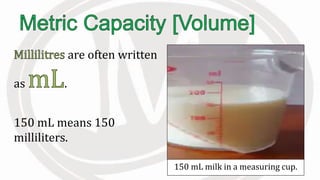
are often written
as .
150 mL means 150
milliliters.
150 mL milk in a measuring cup.
A is a bunch of
milliliter put all together.
• 1000 mL = 1 Liter
• Liters are often written as
for short.
• milk, soda, & other drinks
are often sold in liters.
A jug that has 1L of water in it.
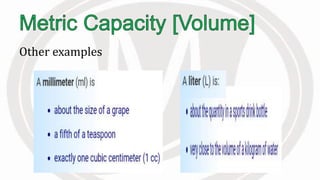
Other examples
is used for measuring length
*came from the greek word metron, “to measure”
is used for determining mass
(weight)
is the metric unit for volume [capacity]
Word Symbol Meaning
kiloliter
hectoliter
dekaliter
liter
deciliter
centiliter
milliliter
kL
hL
daL
L
dL
cL
mL
1000 liter
100 liter
10 liter
1 liter
0.1 liter
0.01 liter
0.001 liter
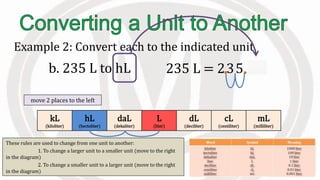
These rules are used to change from one volume unit to
another:
1. To change a larger unit to a smaller unit (move to
the right in the diagram)
2. To change a smaller unit to a larger unit (move to
the right in the diagram)
Guide:
kL
(kiloliter)
hL
(hectoliter)
daL
(dekaliter)
L
(liter)
dL
(deciliter)
cL
(centiliter)
mL
(milliliter)
kL
(kiloliter)
hL
(hectoliter)
daL
(dekaliter)
L
(liter)
dL
(deciliter)
cL
(centiliter)
mL
(milliliter)
These rules are used to change from one unit to another:
1. To change a larger unit to a smaller unit (move to the right
in the diagram)
2. To change a smaller unit to a larger unit (move to the right
in the diagram)
Example 1: Convert each to the indicated unit.
a. 0.24 kL to L
kL
(kiloliter)
hL
(hectoliter)
daL
(dekaliter)
L
(liter)
dL
(deciliter)
cL
(centiliter)
mL
(milliliter)
These rules are used to change from one unit to another:
1. To change a larger unit to a smaller unit (move to the right
in the diagram)
2. To change a smaller unit to a larger unit (move to the right
in the diagram)
Example 1: Convert each to the indicated unit.
a. 0.24 kL to L
move 3 places to the right
0.24 kL = 0.240 L
decimal point
0.24 kL = 0.240 L
kL
(kiloliter)
hL
(hectoliter)
daL
(dekaliter)
L
(liter)
dL
(deciliter)
cL
(centiliter)
mL
(milliliter)
These rules are used to change from one unit to another:
1. To change a larger unit to a smaller unit (move to the right
in the diagram)
2. To change a smaller unit to a larger unit (move to the right
in the diagram)
Example 1: Convert each to the indicated unit.
a. 0.24 kL to L
move 3 places to the right
kL
(kiloliter)
hL
(hectoliter)
daL
(dekaliter)
L
(liter)
dL
(deciliter)
cL
(centiliter)
mL
(milliliter)
These rules are used to change from one unit to another:
1. To change a larger unit to a smaller unit (move to the right
in the diagram)
2. To change a smaller unit to a larger unit (move to the right
in the diagram)
Example 1: Convert each to the indicated unit.
a. 0.24 kL to L
move 3 places to the right
0.24 kL = 240 L
These rules are used to change from one unit to another:
1. To change a larger unit to a smaller unit (move to the right
in the diagram)
2. To change a smaller unit to a large r unit (move to the right
in the diagram)
Example 2: Convert each to the indicated unit.
b. 235 L to hL
kL
(kiloliter)
hL
(hectoliter)
daL
(dekaliter)
L
(liter)
dL
(deciliter)
cL
(centiliter)
mL
(milliliter)
kL
(kiloliter)
hL
(hectoliter)
daL
(dekaliter)
L
(liter)
dL
(deciliter)
cL
(centiliter)
mL
(milliliter)
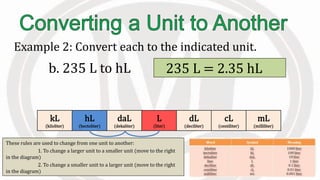
b. 235 L to hL
Example 2: Convert each to the indicated unit.
235 L = 235 hL
These rules are used to change from one unit to another:
1. To change a larger unit to a smaller unit (move to the right
in the diagram)
2. To change a smaller unit to a larger unit (move to the right
in the diagram)
move 2 places to the left
decimal point
kL
(kiloliter)
hL
(hectoliter)
daL
(dekaliter)
L
(liter)
dL
(deciliter)
cL
(centiliter)
mL
(milliliter)
b. 235 L to hL
Example 2: Convert each to the indicated unit.
235 L = 235 hL
These rules are used to change from one unit to another:
1. To change a larger unit to a smaller unit (move to the right
in the diagram)
2. To change a smaller unit to a larger unit (move to the right
in the diagram)
move 2 places to the left
kL
(kiloliter)
hL
(hectoliter)
daL
(dekaliter)
L
(liter)
dL
(deciliter)
cL
(centiliter)
mL
(milliliter)
b. 235 L to hL
Example 2: Convert each to the indicated unit.
235 L = 2.35 hL
These rules are used to change from one unit to another:
1. To change a larger unit to a smaller unit (move to the right
in the diagram)
2. To change a smaller unit to a larger unit (move to the right
in the diagram)
These rules are used to change from one unit to another:
1. To change a larger unit to a smaller unit (move to the right
in the diagram)
2. To change a smaller unit to a large r unit (move to the right
in the diagram)
Example 3: Convert each to the indicated unit.
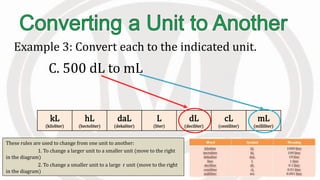
C. 500 dL to mL
kL
(kiloliter)
hL
(hectoliter)
daL
(dekaliter)
L
(liter)
dL
(deciliter)
cL
(centiliter)
mL
(milliliter)
500 dL = 50000 mL
These rules are used to change from one unit to another:
1. To change a larger unit to a smaller unit (move to the right
in the diagram)
2. To change a smaller unit to a large r unit (move to the right
in the diagram)
Example 3: Convert each to the indicated unit.
C. 500 dL to mL
kL
(kiloliter)
hL
(hectoliter)
daL
(dekaliter)
L
(liter)
dL
(deciliter)
cL
(centiliter)
mL
(milliliter)
move
2
places
to the
right
decimal point
500 dL = 50000 mL
These rules are used to change from one unit to another:
1. To change a larger unit to a smaller unit (move to the right
in the diagram)
2. To change a smaller unit to a large r unit (move to the right
in the diagram)
Example 3: Convert each to the indicated unit.
C. 500 dL to mL
kL
(kiloliter)
hL
(hectoliter)
daL
(dekaliter)
L
(liter)
dL
(deciliter)
cL
(centiliter)
mL
(milliliter)
move
2
places
to the
right
500 dL = 50000 mL
These rules are used to change from one unit to another:
1. To change a larger unit to a smaller unit (move to the right
in the diagram)
2. To change a smaller unit to a large r unit (move to the right
in the diagram)
Example 3: Convert each to the indicated unit.
C. 500 dL to mL
kL
(kiloliter)
hL
(hectoliter)
daL
(dekaliter)
L
(liter)
dL
(deciliter)
cL
(centiliter)
mL
(milliliter)
move
2
places
to the
right
question
s?
1. 9, 000L = kL
2. 25.5cL = mL
3. 0.324dL = daL
4. 10.36mL = L
5. 0.00052hL = cL
9
255
0.00324
0.01036
5.2
These rules are used to change from one unit to another:
1. To change a larger unit to a smaller unit (move to the right
in the diagram)
2. To change a smaller unit to a large r unit (move to the right
in the diagram)
12 inches (in.) = 1 foot (ft.)
36 inches (in.) = 1 yard (yd.)
3 feet (ft.) = 1 yard (yd.)
5 280 feet (ft.) = 1 mile (mi.)
8 fluid ounces (fl. oz) = 1 cup
2 c = 1 pint (pt.)
2 pt. = 1 quart (qt.)
4 qt = 1 gallon (gal.)
Example 1:
Complete each
𝑎. 50𝑞𝑡. = gal.
50𝑞𝑡. =
50𝑞𝑡
1
∙
1 𝑔𝑎𝑙.
4𝑞𝑡
Eliminate
and introduce
=
50𝑔𝑎𝑙.
4
CANCEL.. SIMPLIFY
12.5 𝑔𝑎𝑙.=
12.5
12 inches (in.) = 1 foot (ft.)
36 inches (in.) = 1 yard (yd.)
3 feet (ft.) = 1 yard (yd.)
5 280 feet (ft.) = 1 mile (mi.)
8 fluid ounces (fl. oz) = 1 cup
2 c = 1 pint (pt.)
2 pt. = 1 quart (qt.)
4 qt = 1 gallon (gal.)
Example 2:
Complete each
𝑎. 5𝑞𝑡. = _____ pt.
5𝑞𝑡. =
5 𝑞𝑡.
1
∙
2 𝑝𝑡.
1𝑞𝑡
Eliminate
and introduce
=
10pt.
1
CANCEL.. SIMPLIFY
10 𝑝𝑡.=
10
12 inches (in.) = 1 foot (ft.)
36 inches (in.) = 1 yard (yd.)
3 feet (ft.) = 1 yard (yd.)
5 280 feet (ft.) = 1 mile (mi.)
8 fluid ounces (fl. oz) = 1 cup
2 c = 1 pint (pt.)
2 pt. = 1 quart (qt.)
4 qt = 1 gallon (gal.)
Example 3:
Complete each
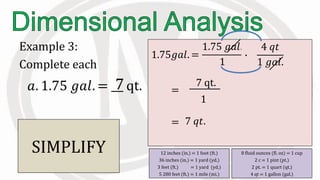
𝑎. 1.75 𝑔𝑎𝑙. = qt.
1.75𝑔𝑎𝑙. =
1.75 𝑔𝑎𝑙.
1
∙
4 𝑞𝑡
1 𝑔𝑎𝑙.
Eliminate
and introduce
.
=
7 qt.
1
CANCEL.. SIMPLIFY
7 𝑞𝑡.=
7
12 inches (in.) = 1 foot (ft.)
36 inches (in.) = 1 yard (yd.)
3 feet (ft.) = 1 yard (yd.)
5 280 feet (ft.) = 1 mile (mi.)
8 fluid ounces (fl. oz) = 1 cup
2 c = 1 pint (pt.)
2 pt. = 1 quart (qt.)
4 qt = 1 gallon (gal.)
question
s?
E-Math 7
Practice and Application
Test I and II
Page 97
question
s?

Lesson 2.3 measuring capacity

  • 3.
    1. gain knowledgeon measuring capacity 2. convert unit of volume measure to another unit
  • 4.
    3. recognize thedifferent units of measure for volume/capacity. 4. appreciate the knowledge application in real life
  • 6.
    There are twomost common measurements for capacity / volume: • milliliters (mL) • Liters (L)
  • 8.
    A (mili + liter= milliliter) • a very small amount of liquid. • it doesn’t even fill the teaspoon milliliter in a teaspoon
  • 9.
    If you collectabout 20 drops of water, you will have 1 milliliter.
  • 10.
    A teaspoon canhold about five .
  • 11.
    are often written as. 150 mL means 150 milliliters. 150 mL milk in a measuring cup.
  • 13.
    A is abunch of milliliter put all together. • 1000 mL = 1 Liter • Liters are often written as for short. • milk, soda, & other drinks are often sold in liters. A jug that has 1L of water in it.
  • 14.
  • 16.
    is used formeasuring length *came from the greek word metron, “to measure” is used for determining mass (weight) is the metric unit for volume [capacity]
  • 17.
  • 19.
    These rules areused to change from one volume unit to another: 1. To change a larger unit to a smaller unit (move to the right in the diagram) 2. To change a smaller unit to a larger unit (move to the right in the diagram) Guide: kL (kiloliter) hL (hectoliter) daL (dekaliter) L (liter) dL (deciliter) cL (centiliter) mL (milliliter)
  • 20.
    kL (kiloliter) hL (hectoliter) daL (dekaliter) L (liter) dL (deciliter) cL (centiliter) mL (milliliter) These rules areused to change from one unit to another: 1. To change a larger unit to a smaller unit (move to the right in the diagram) 2. To change a smaller unit to a larger unit (move to the right in the diagram) Example 1: Convert each to the indicated unit. a. 0.24 kL to L
  • 21.
    kL (kiloliter) hL (hectoliter) daL (dekaliter) L (liter) dL (deciliter) cL (centiliter) mL (milliliter) These rules areused to change from one unit to another: 1. To change a larger unit to a smaller unit (move to the right in the diagram) 2. To change a smaller unit to a larger unit (move to the right in the diagram) Example 1: Convert each to the indicated unit. a. 0.24 kL to L move 3 places to the right 0.24 kL = 0.240 L decimal point
  • 22.
    0.24 kL =0.240 L kL (kiloliter) hL (hectoliter) daL (dekaliter) L (liter) dL (deciliter) cL (centiliter) mL (milliliter) These rules are used to change from one unit to another: 1. To change a larger unit to a smaller unit (move to the right in the diagram) 2. To change a smaller unit to a larger unit (move to the right in the diagram) Example 1: Convert each to the indicated unit. a. 0.24 kL to L move 3 places to the right
  • 23.
    kL (kiloliter) hL (hectoliter) daL (dekaliter) L (liter) dL (deciliter) cL (centiliter) mL (milliliter) These rules areused to change from one unit to another: 1. To change a larger unit to a smaller unit (move to the right in the diagram) 2. To change a smaller unit to a larger unit (move to the right in the diagram) Example 1: Convert each to the indicated unit. a. 0.24 kL to L move 3 places to the right 0.24 kL = 240 L
  • 24.
    These rules areused to change from one unit to another: 1. To change a larger unit to a smaller unit (move to the right in the diagram) 2. To change a smaller unit to a large r unit (move to the right in the diagram) Example 2: Convert each to the indicated unit. b. 235 L to hL kL (kiloliter) hL (hectoliter) daL (dekaliter) L (liter) dL (deciliter) cL (centiliter) mL (milliliter)
  • 25.
    kL (kiloliter) hL (hectoliter) daL (dekaliter) L (liter) dL (deciliter) cL (centiliter) mL (milliliter) b. 235 Lto hL Example 2: Convert each to the indicated unit. 235 L = 235 hL These rules are used to change from one unit to another: 1. To change a larger unit to a smaller unit (move to the right in the diagram) 2. To change a smaller unit to a larger unit (move to the right in the diagram) move 2 places to the left decimal point
  • 26.
    kL (kiloliter) hL (hectoliter) daL (dekaliter) L (liter) dL (deciliter) cL (centiliter) mL (milliliter) b. 235 Lto hL Example 2: Convert each to the indicated unit. 235 L = 235 hL These rules are used to change from one unit to another: 1. To change a larger unit to a smaller unit (move to the right in the diagram) 2. To change a smaller unit to a larger unit (move to the right in the diagram) move 2 places to the left
  • 27.
    kL (kiloliter) hL (hectoliter) daL (dekaliter) L (liter) dL (deciliter) cL (centiliter) mL (milliliter) b. 235 Lto hL Example 2: Convert each to the indicated unit. 235 L = 2.35 hL These rules are used to change from one unit to another: 1. To change a larger unit to a smaller unit (move to the right in the diagram) 2. To change a smaller unit to a larger unit (move to the right in the diagram)
  • 28.
    These rules areused to change from one unit to another: 1. To change a larger unit to a smaller unit (move to the right in the diagram) 2. To change a smaller unit to a large r unit (move to the right in the diagram) Example 3: Convert each to the indicated unit. C. 500 dL to mL kL (kiloliter) hL (hectoliter) daL (dekaliter) L (liter) dL (deciliter) cL (centiliter) mL (milliliter)
  • 29.
    500 dL =50000 mL These rules are used to change from one unit to another: 1. To change a larger unit to a smaller unit (move to the right in the diagram) 2. To change a smaller unit to a large r unit (move to the right in the diagram) Example 3: Convert each to the indicated unit. C. 500 dL to mL kL (kiloliter) hL (hectoliter) daL (dekaliter) L (liter) dL (deciliter) cL (centiliter) mL (milliliter) move 2 places to the right decimal point
  • 30.
    500 dL =50000 mL These rules are used to change from one unit to another: 1. To change a larger unit to a smaller unit (move to the right in the diagram) 2. To change a smaller unit to a large r unit (move to the right in the diagram) Example 3: Convert each to the indicated unit. C. 500 dL to mL kL (kiloliter) hL (hectoliter) daL (dekaliter) L (liter) dL (deciliter) cL (centiliter) mL (milliliter) move 2 places to the right
  • 31.
    500 dL =50000 mL These rules are used to change from one unit to another: 1. To change a larger unit to a smaller unit (move to the right in the diagram) 2. To change a smaller unit to a large r unit (move to the right in the diagram) Example 3: Convert each to the indicated unit. C. 500 dL to mL kL (kiloliter) hL (hectoliter) daL (dekaliter) L (liter) dL (deciliter) cL (centiliter) mL (milliliter) move 2 places to the right
  • 32.
  • 34.
    1. 9, 000L= kL 2. 25.5cL = mL 3. 0.324dL = daL 4. 10.36mL = L 5. 0.00052hL = cL 9 255 0.00324 0.01036 5.2 These rules are used to change from one unit to another: 1. To change a larger unit to a smaller unit (move to the right in the diagram) 2. To change a smaller unit to a large r unit (move to the right in the diagram)
  • 36.
    12 inches (in.)= 1 foot (ft.) 36 inches (in.) = 1 yard (yd.) 3 feet (ft.) = 1 yard (yd.) 5 280 feet (ft.) = 1 mile (mi.) 8 fluid ounces (fl. oz) = 1 cup 2 c = 1 pint (pt.) 2 pt. = 1 quart (qt.) 4 qt = 1 gallon (gal.)
  • 38.
    Example 1: Complete each 𝑎.50𝑞𝑡. = gal. 50𝑞𝑡. = 50𝑞𝑡 1 ∙ 1 𝑔𝑎𝑙. 4𝑞𝑡 Eliminate and introduce = 50𝑔𝑎𝑙. 4 CANCEL.. SIMPLIFY 12.5 𝑔𝑎𝑙.= 12.5 12 inches (in.) = 1 foot (ft.) 36 inches (in.) = 1 yard (yd.) 3 feet (ft.) = 1 yard (yd.) 5 280 feet (ft.) = 1 mile (mi.) 8 fluid ounces (fl. oz) = 1 cup 2 c = 1 pint (pt.) 2 pt. = 1 quart (qt.) 4 qt = 1 gallon (gal.)
  • 39.
    Example 2: Complete each 𝑎.5𝑞𝑡. = _____ pt. 5𝑞𝑡. = 5 𝑞𝑡. 1 ∙ 2 𝑝𝑡. 1𝑞𝑡 Eliminate and introduce = 10pt. 1 CANCEL.. SIMPLIFY 10 𝑝𝑡.= 10 12 inches (in.) = 1 foot (ft.) 36 inches (in.) = 1 yard (yd.) 3 feet (ft.) = 1 yard (yd.) 5 280 feet (ft.) = 1 mile (mi.) 8 fluid ounces (fl. oz) = 1 cup 2 c = 1 pint (pt.) 2 pt. = 1 quart (qt.) 4 qt = 1 gallon (gal.)
  • 40.
    Example 3: Complete each 𝑎.1.75 𝑔𝑎𝑙. = qt. 1.75𝑔𝑎𝑙. = 1.75 𝑔𝑎𝑙. 1 ∙ 4 𝑞𝑡 1 𝑔𝑎𝑙. Eliminate and introduce . = 7 qt. 1 CANCEL.. SIMPLIFY 7 𝑞𝑡.= 7 12 inches (in.) = 1 foot (ft.) 36 inches (in.) = 1 yard (yd.) 3 feet (ft.) = 1 yard (yd.) 5 280 feet (ft.) = 1 mile (mi.) 8 fluid ounces (fl. oz) = 1 cup 2 c = 1 pint (pt.) 2 pt. = 1 quart (qt.) 4 qt = 1 gallon (gal.)
  • 41.
  • 42.
    E-Math 7 Practice andApplication Test I and II Page 97
  • 45.