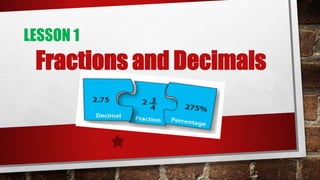
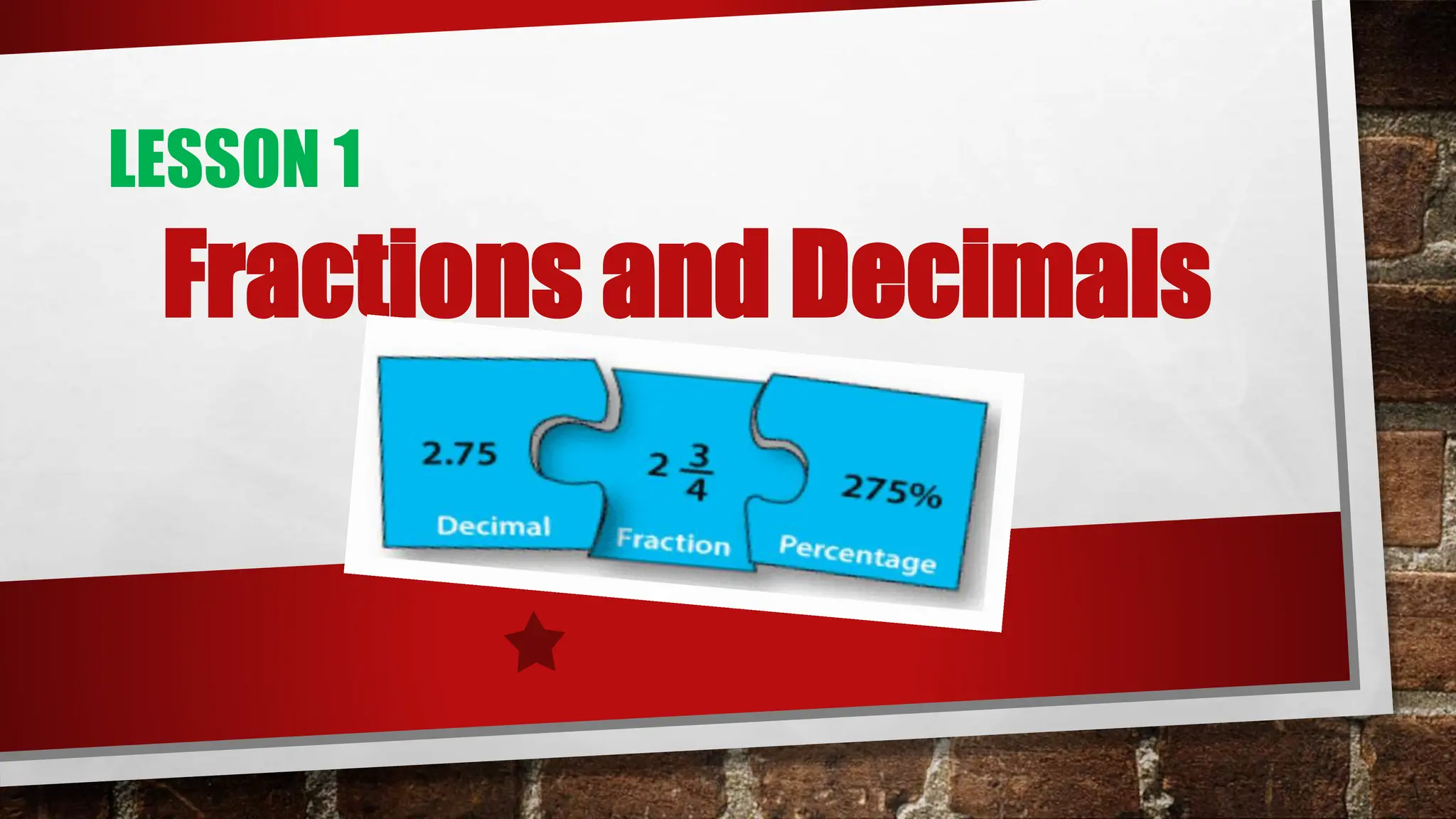
Fractions and Decimals
LESSON 1
Parts of a Fraction
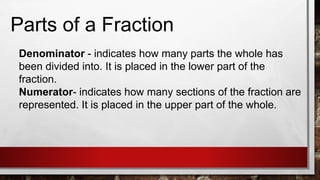
Denominator - indicates how many parts the whole has
been divided into. It is placed in the lower part of the
fraction.
Numerator- indicates how many sections of the fraction are
represented. It is placed in the upper part of the whole.
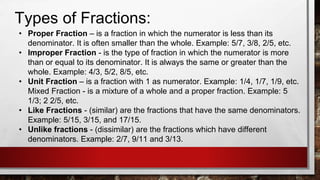
Types of Fractions:
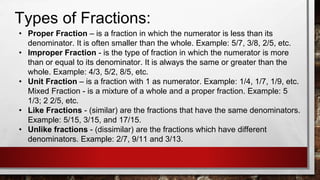
• Proper Fraction – is a fraction in which the numerator is less than its
denominator. It is often smaller than the whole. Example: 5/7, 3/8, 2/5, etc.
• Improper Fraction - is the type of fraction in which the numerator is more
than or equal to its denominator. It is always the same or greater than the
whole. Example: 4/3, 5/2, 8/5, etc.
• Unit Fraction – is a fraction with 1 as numerator. Example: 1/4, 1/7, 1/9, etc.
Mixed Fraction - is a mixture of a whole and a proper fraction. Example: 5
1/3; 2 2/5, etc.
• Like Fractions - (similar) are the fractions that have the same denominators.
Example: 5/15, 3/15, and 17/15.
• Unlike fractions - (dissimilar) are the fractions which have different
denominators. Example: 2/7, 9/11 and 3/13.
Types of Fractions:
• Proper Fraction – is a fraction in which the numerator is less than its
denominator. It is often smaller than the whole. Example: 5/7, 3/8, 2/5, etc.
• Improper Fraction - is the type of fraction in which the numerator is more
than or equal to its denominator. It is always the same or greater than the
whole. Example: 4/3, 5/2, 8/5, etc.
• Unit Fraction – is a fraction with 1 as numerator. Example: 1/4, 1/7, 1/9, etc.
Mixed Fraction - is a mixture of a whole and a proper fraction. Example: 5
1/3; 2 2/5, etc.
• Like Fractions - (similar) are the fractions that have the same denominators.
Example: 5/15, 3/15, and 17/15.
• Unlike fractions - (dissimilar) are the fractions which have different
denominators. Example: 2/7, 9/11 and 3/13.
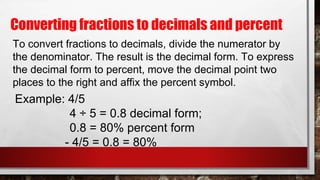
Converting fractions to decimals and percent
To convert fractions to decimals, divide the numerator by
the denominator. The result is the decimal form. To express
the decimal form to percent, move the decimal point two
places to the right and affix the percent symbol.
Example: 4/5
4 ÷ 5 = 0.8 decimal form;
0.8 = 80% percent form
- 4/5 = 0.8 = 80%
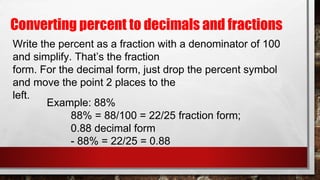
Converting percent to decimals and fractions
Write the percent as a fraction with a denominator of 100
and simplify. That’s the fraction
form. For the decimal form, just drop the percent symbol
and move the point 2 places to the
left.
Example: 88%
88% = 88/100 = 22/25 fraction form;
0.88 decimal form
- 88% = 22/25 = 0.88
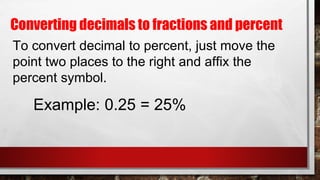
Converting decimals to fractions and percent
To convert decimal to percent, just move the
point two places to the right and affix the
percent symbol.
Example: 0.25 = 25%
Converting decimals to fractions and percent
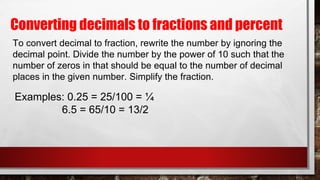
To convert decimal to fraction, rewrite the number by ignoring the
decimal point. Divide the number by the power of 10 such that the
number of zeros in that should be equal to the number of decimal
places in the given number. Simplify the fraction.
Examples: 0.25 = 25/100 = ¼
6.5 = 65/10 = 13/2
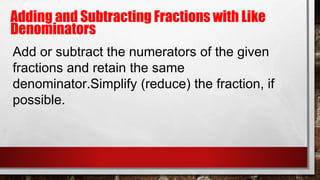
Adding and Subtracting Fractions with Like
Denominators
Add or subtract the numerators of the given
fractions and retain the same
denominator.Simplify (reduce) the fraction, if
possible.
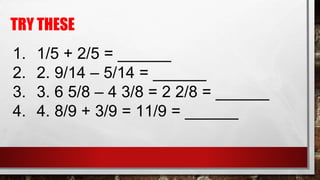
TRY THESE
1. 1/5 + 2/5 = ______
2. 2. 9/14 – 5/14 = ______
3. 3. 6 5/8 – 4 3/8 = 2 2/8 = ______
4. 4. 8/9 + 3/9 = 11/9 = ______
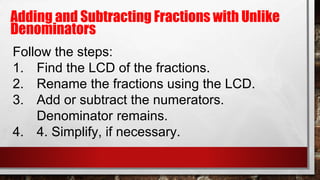
Adding and Subtracting Fractions with Unlike
Denominators
Follow the steps:
1. Find the LCD of the fractions.
2. Rename the fractions using the LCD.
3. Add or subtract the numerators.
Denominator remains.
4. 4. Simplify, if necessary.
TRY THESE
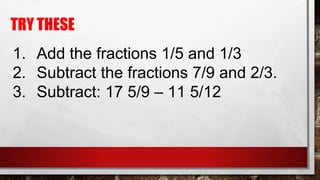
1. Add the fractions 1/5 and 1/3
2. Subtract the fractions 7/9 and 2/3.
3. Subtract: 17 5/9 – 11 5/12
Multiplying Fractions
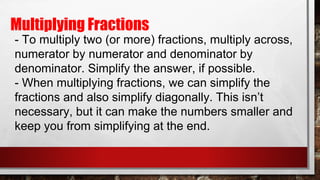
- To multiply two (or more) fractions, multiply across,
numerator by numerator and denominator by
denominator. Simplify the answer, if possible.
- When multiplying fractions, we can simplify the
fractions and also simplify diagonally. This isn’t
necessary, but it can make the numbers smaller and
keep you from simplifying at the end.
TRY THESE
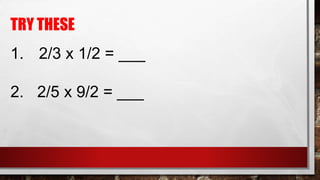
1. 2/3 x 1/2 = ___
2. 2/5 x 9/2 = ___
Dividing Fractions
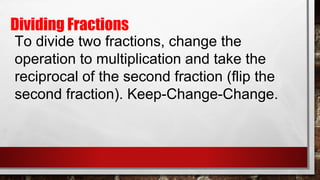
To divide two fractions, change the
operation to multiplication and take the
reciprocal of the second fraction (flip the
second fraction). Keep-Change-Change.
TRY THESE
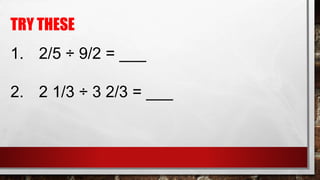
1. 2/5 ÷ 9/2 = ___
2. 2 1/3 ÷ 3 2/3 = ___
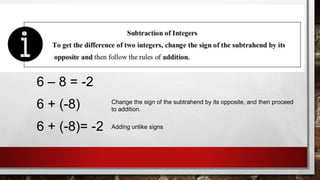
6 – 8 = -2
Change the sign of the subtrahend by its opposite, and then proceed
to addition.
6 + (-8)
6 + (-8)= -2 Adding unlike signs
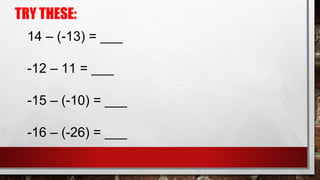
TRY THESE:
14 – (-13) = ___
-12 – 11 = ___
-15 – (-10) = ___
-16 – (-26) = ___
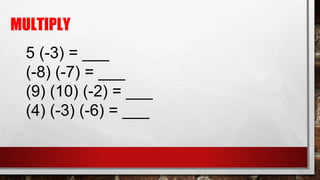
MULTIPLY
5 (-3) = ___
(-8) (-7) = ___
(9) (10) (-2) = ___
(4) (-3) (-6) = ___
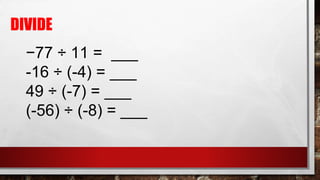
DIVIDE
−77 ÷ 11 = ___
-16 ÷ (-4) = ___
49 ÷ (-7) = ___
(-56) ÷ (-8) = ___

Lesson 1_Fractions and Decimals numbers.pptx

  • 1.
  • 2.
    Parts of aFraction Denominator - indicates how many parts the whole has been divided into. It is placed in the lower part of the fraction. Numerator- indicates how many sections of the fraction are represented. It is placed in the upper part of the whole.
  • 3.
    Types of Fractions: •Proper Fraction – is a fraction in which the numerator is less than its denominator. It is often smaller than the whole. Example: 5/7, 3/8, 2/5, etc. • Improper Fraction - is the type of fraction in which the numerator is more than or equal to its denominator. It is always the same or greater than the whole. Example: 4/3, 5/2, 8/5, etc. • Unit Fraction – is a fraction with 1 as numerator. Example: 1/4, 1/7, 1/9, etc. Mixed Fraction - is a mixture of a whole and a proper fraction. Example: 5 1/3; 2 2/5, etc. • Like Fractions - (similar) are the fractions that have the same denominators. Example: 5/15, 3/15, and 17/15. • Unlike fractions - (dissimilar) are the fractions which have different denominators. Example: 2/7, 9/11 and 3/13.
  • 4.
    Types of Fractions: •Proper Fraction – is a fraction in which the numerator is less than its denominator. It is often smaller than the whole. Example: 5/7, 3/8, 2/5, etc. • Improper Fraction - is the type of fraction in which the numerator is more than or equal to its denominator. It is always the same or greater than the whole. Example: 4/3, 5/2, 8/5, etc. • Unit Fraction – is a fraction with 1 as numerator. Example: 1/4, 1/7, 1/9, etc. Mixed Fraction - is a mixture of a whole and a proper fraction. Example: 5 1/3; 2 2/5, etc. • Like Fractions - (similar) are the fractions that have the same denominators. Example: 5/15, 3/15, and 17/15. • Unlike fractions - (dissimilar) are the fractions which have different denominators. Example: 2/7, 9/11 and 3/13.
  • 5.
    Converting fractions todecimals and percent To convert fractions to decimals, divide the numerator by the denominator. The result is the decimal form. To express the decimal form to percent, move the decimal point two places to the right and affix the percent symbol. Example: 4/5 4 ÷ 5 = 0.8 decimal form; 0.8 = 80% percent form - 4/5 = 0.8 = 80%
  • 6.
    Converting percent todecimals and fractions Write the percent as a fraction with a denominator of 100 and simplify. That’s the fraction form. For the decimal form, just drop the percent symbol and move the point 2 places to the left. Example: 88% 88% = 88/100 = 22/25 fraction form; 0.88 decimal form - 88% = 22/25 = 0.88
  • 7.
    Converting decimals tofractions and percent To convert decimal to percent, just move the point two places to the right and affix the percent symbol. Example: 0.25 = 25%
  • 8.
    Converting decimals tofractions and percent To convert decimal to fraction, rewrite the number by ignoring the decimal point. Divide the number by the power of 10 such that the number of zeros in that should be equal to the number of decimal places in the given number. Simplify the fraction. Examples: 0.25 = 25/100 = ¼ 6.5 = 65/10 = 13/2
  • 9.
    Adding and SubtractingFractions with Like Denominators Add or subtract the numerators of the given fractions and retain the same denominator.Simplify (reduce) the fraction, if possible.
  • 10.
    TRY THESE 1. 1/5+ 2/5 = ______ 2. 2. 9/14 – 5/14 = ______ 3. 3. 6 5/8 – 4 3/8 = 2 2/8 = ______ 4. 4. 8/9 + 3/9 = 11/9 = ______
  • 11.
    Adding and SubtractingFractions with Unlike Denominators Follow the steps: 1. Find the LCD of the fractions. 2. Rename the fractions using the LCD. 3. Add or subtract the numerators. Denominator remains. 4. 4. Simplify, if necessary.
  • 12.
    TRY THESE 1. Addthe fractions 1/5 and 1/3 2. Subtract the fractions 7/9 and 2/3. 3. Subtract: 17 5/9 – 11 5/12
  • 13.
    Multiplying Fractions - Tomultiply two (or more) fractions, multiply across, numerator by numerator and denominator by denominator. Simplify the answer, if possible. - When multiplying fractions, we can simplify the fractions and also simplify diagonally. This isn’t necessary, but it can make the numbers smaller and keep you from simplifying at the end.
  • 14.
    TRY THESE 1. 2/3x 1/2 = ___ 2. 2/5 x 9/2 = ___
  • 15.
    Dividing Fractions To dividetwo fractions, change the operation to multiplication and take the reciprocal of the second fraction (flip the second fraction). Keep-Change-Change.
  • 16.
    TRY THESE 1. 2/5÷ 9/2 = ___ 2. 2 1/3 ÷ 3 2/3 = ___
  • 17.
    6 – 8= -2 Change the sign of the subtrahend by its opposite, and then proceed to addition. 6 + (-8) 6 + (-8)= -2 Adding unlike signs
  • 18.
    TRY THESE: 14 –(-13) = ___ -12 – 11 = ___ -15 – (-10) = ___ -16 – (-26) = ___
  • 20.
    MULTIPLY 5 (-3) =___ (-8) (-7) = ___ (9) (10) (-2) = ___ (4) (-3) (-6) = ___
  • 21.
    DIVIDE −77 ÷ 11= ___ -16 ÷ (-4) = ___ 49 ÷ (-7) = ___ (-56) ÷ (-8) = ___