The Early Development and Impact of 4G Technology  VISHALYA
Outline  •  Previous Technologies -1G, 2G, 3G (CDMA, GSM, UMTS) –  Multiplexing; Frequency, Time & Code •  Reasons for New Research  •  How 4G Works  -  Architecture, AdHoc, IP core, OFDM •  Impact of 4G  -  economic, socio-cultural, political
1G Technology
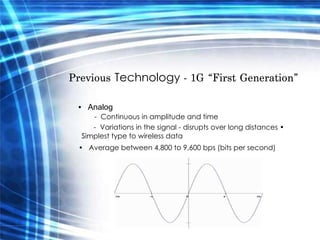
Previous  Technology  - 1G “First Generation”  •  Analog   -  Continuous in amplitude and time  -  Variations in the signal - disrupts over long distances •  Simplest type to wireless data  •  Average between 4,800 to 9,600 bps (bits per second)
2G Technology
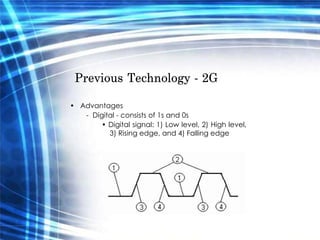
Previous Technology - 2G  •  Advantages  -  Digital - consists of 1s and 0s  •  Digital signal: 1) Low level, 2) High level, 3) Rising edge, and 4) Falling edge
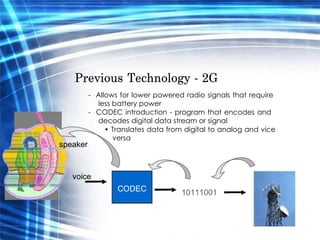
Previous Technology - 2G  -  Allows for lower powered radio signals that require less battery power  -  CODEC introduction - program that encodes and decodes digital data stream or signal  •  Translates data from digital to analog and vice versa  speaker  voice  CODEC  10111001
Previous Technology - 2G  •  Advantages  -  The digital voice encoding allows digital error checking  •  increase sound quality • lowers the noise level  -  Going all-digital allowed for the introduction of digital data transfer  •  SMS - “short message service” • E-mail
3G Technology
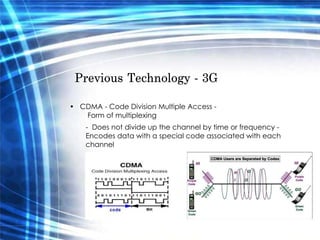
Previous Technology - 3G  •  CDMA - Code Division Multiple Access -  Form of multiplexing  -  Does not divide up the channel by time or frequency -  Encodes data with a special code associated with each channel
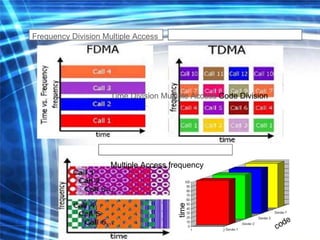
Types of Multiplexing  •  FDMA - Each phone call is allocated one frequency for the entire duration of the call.  •  TDMA - Each phone call is allocated a spot in the frequency for a small amount of time, and "takes turns" being transmitted.  •  CDMA -  Each phone call is uniquely encoded and transmitted across the entire spectrum, in a manner known as spread spectrum transmission.
Frequency Division Multiple Access  Time Division Multiple Access  Code Division Multiple Access frequency
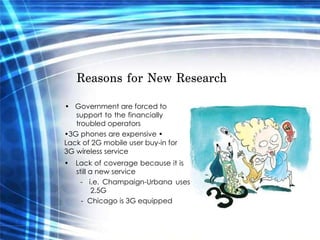
Reasons for New Research  •  Government are forced to  support to the financially troubled operators  • 3G phones are expensive •  Lack of 2G mobile user buy-in for 3G wireless service  •  Lack of coverage because it is still a new service  -  i.e. Champaign-Urbana uses 2.5G  -  Chicago is 3G equipped
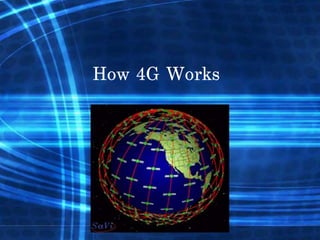
How 4G Works
What is 4G?  •  Fourth Generation Technology •  Faster and more reliable  -100 Mb/s  (802.11g wireless = 54Mb/s,  3G = 2Mb/s) •  Lower cost than previous generations •  Multi-standard wireless system -  Bluetooth, Wired, Wireless (802.11x) •  Ad Hoc Networking  •  IPv6 Core  •  OFDM used instead of CDMA •  Potentially IEEE standard 802.11n -  Most information is proprietary
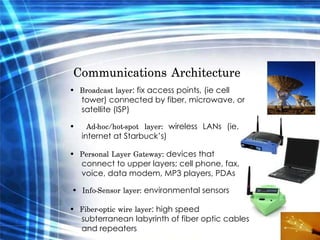
Communications Architecture  •   Broadcast layer : fix access points, (ie cell tower) connected by fiber, microwave, or satellite (ISP)  •   Ad-hoc/hot-spot layer:  wireless LANs (ie. internet at Starbuck’s)  •   Personal Layer Gateway:  devices that connect to upper layers; cell phone, fax, voice, data modem, MP3 players, PDAs  •   Info-Sensor layer:  environmental sensors  •   Fiber-optic wire layer : high speed subterranean labyrinth of fiber optic cables and repeaters
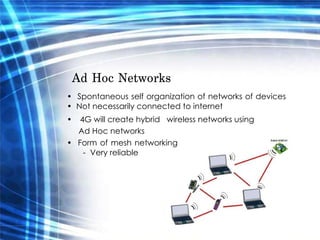
Ad Hoc Networks  •  Spontaneous self organization of networks of devices •  Not necessarily connected to internet  •  4G will create hybrid  wireless networks using  Ad Hoc networks  •  Form of mesh networking -  Very reliable
When?  •  China Mobile, KPN, NTT DoCoMo, Orange, Intel, Motorola, Sprint Nextel, T-Mobile and Vodafone already doing research on 4G  •  Much of this information is proprietary at this time •  Expected release of 4G services as early as 2008. •  Majority of companies expect widespread use of 4G systems by 2010.  •  Lifecycle of 4G is estimated to be 15 years.


early development of 4g technology

  • 1.
    The Early Developmentand Impact of 4G Technology VISHALYA
  • 2.
    Outline • Previous Technologies -1G, 2G, 3G (CDMA, GSM, UMTS) – Multiplexing; Frequency, Time & Code • Reasons for New Research • How 4G Works - Architecture, AdHoc, IP core, OFDM • Impact of 4G - economic, socio-cultural, political
  • 3.
  • 4.
    Previous Technology - 1G “First Generation” • Analog - Continuous in amplitude and time - Variations in the signal - disrupts over long distances • Simplest type to wireless data • Average between 4,800 to 9,600 bps (bits per second)
  • 5.
  • 6.
    Previous Technology -2G • Advantages - Digital - consists of 1s and 0s • Digital signal: 1) Low level, 2) High level, 3) Rising edge, and 4) Falling edge
  • 7.
    Previous Technology -2G - Allows for lower powered radio signals that require less battery power - CODEC introduction - program that encodes and decodes digital data stream or signal • Translates data from digital to analog and vice versa speaker voice CODEC 10111001
  • 8.
    Previous Technology -2G • Advantages - The digital voice encoding allows digital error checking • increase sound quality • lowers the noise level - Going all-digital allowed for the introduction of digital data transfer • SMS - “short message service” • E-mail
  • 9.
  • 10.
    Previous Technology -3G • CDMA - Code Division Multiple Access - Form of multiplexing - Does not divide up the channel by time or frequency - Encodes data with a special code associated with each channel
  • 11.
    Types of Multiplexing • FDMA - Each phone call is allocated one frequency for the entire duration of the call. • TDMA - Each phone call is allocated a spot in the frequency for a small amount of time, and "takes turns" being transmitted. • CDMA - Each phone call is uniquely encoded and transmitted across the entire spectrum, in a manner known as spread spectrum transmission.
  • 12.
    Frequency Division MultipleAccess Time Division Multiple Access Code Division Multiple Access frequency
  • 13.
    Reasons for NewResearch • Government are forced to support to the financially troubled operators • 3G phones are expensive • Lack of 2G mobile user buy-in for 3G wireless service • Lack of coverage because it is still a new service - i.e. Champaign-Urbana uses 2.5G - Chicago is 3G equipped
  • 14.
  • 15.
    What is 4G? • Fourth Generation Technology • Faster and more reliable -100 Mb/s (802.11g wireless = 54Mb/s, 3G = 2Mb/s) • Lower cost than previous generations • Multi-standard wireless system - Bluetooth, Wired, Wireless (802.11x) • Ad Hoc Networking • IPv6 Core • OFDM used instead of CDMA • Potentially IEEE standard 802.11n - Most information is proprietary
  • 16.
    Communications Architecture • Broadcast layer : fix access points, (ie cell tower) connected by fiber, microwave, or satellite (ISP) • Ad-hoc/hot-spot layer: wireless LANs (ie. internet at Starbuck’s) • Personal Layer Gateway: devices that connect to upper layers; cell phone, fax, voice, data modem, MP3 players, PDAs • Info-Sensor layer: environmental sensors • Fiber-optic wire layer : high speed subterranean labyrinth of fiber optic cables and repeaters
  • 17.
    Ad Hoc Networks • Spontaneous self organization of networks of devices • Not necessarily connected to internet • 4G will create hybrid wireless networks using Ad Hoc networks • Form of mesh networking - Very reliable
  • 18.
    When? • China Mobile, KPN, NTT DoCoMo, Orange, Intel, Motorola, Sprint Nextel, T-Mobile and Vodafone already doing research on 4G • Much of this information is proprietary at this time • Expected release of 4G services as early as 2008. • Majority of companies expect widespread use of 4G systems by 2010. • Lifecycle of 4G is estimated to be 15 years.
  • 19.
  • 20.