Fundamentals of Mechanical
Engineering (BME-101/201)
UNIT-2
4-STROKE ENGINE
PREPARED BY
ER. PEEYUSH CHAUHAN
ASSISTANT PROFESSOR
DEPARTMENT OF MECHANICAL ENGINEERING
“A 4-stroke engine is a type of internal combustion engine that
completes a power cycle with four strokes of the piston during only two
crankshaft revolution.”
Two Stroke engine are classified as-
1. 4-stroke petrol engine
2. 4-stroke diesel engine
INTRODUCTION
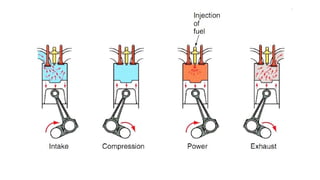
• There are following strokes in 4-stroke engine
1. Suction Stroke
2. Compression Stroke
3. Working/Power/ Expansion Stroke
4. Exhaust Stroke
• In 4-stroke engines valves are use instead of ports.
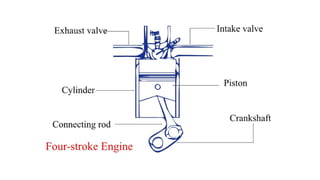
1. Piston- The piston transfers the expanding force of gases to the
mechanical rotation of the crankshaft through a connecting rod.
2. Connecting Rod- It transfers motion from a piston to the crankshaft
and acts as a lever arm.
3. Crankshaft- It converts the reciprocating motion to rotational
motion.
4. Flywheel – It is a mechanical device that is used to store energy.
Construction of A Two-Stroke Engine
5. Spark Plug – It delivers electric current to the combustion chamber
and in turn ignites the air-fuel mixture leading to abrupt expansion of
gases.
6. Counter Weight – Counterweight on the crankshaft is used to
reduce the vibrations due to imbalances in the rotating assembly.
7. Inlet and Outlet valves – These Valves allow fresh air with fuel to
enter and exit from the cylinder.
8. Fuel Injector: It’s used for injecting the fuel.
4-Stroke
Petrol Engine
1. Intake Stroke (Suction Stroke)
• Piston move from top dead center (TDC) to bottom dead center
(BDC).
• Intake valve is open and the exhaust valve is shut.
• Downward motion of the piston creates a vacuum (i.e., negative air
pressure), which draws the air-fuel mixture into the engine through
the open intake valve.
• Crankshaft rotate 00
to 1800
.
Working of A 4-Stroke Petrol Engine
2. Compression Stroke-
• Piston moves up the cylinder bore from BDC to TDC.
• Both Intake and exhaust valves are closed.
• Upward motion of the piston compresses the air-fuel mixture in the
combustion chamber.
• Crankshaft rotate 1800
to 3600
.
3. Power/Expansion/working Stroke-
• Spark plug fires and ignites the compressed air-fuel mixture just
before the end of the compression (i.e., previous) stroke.
• This ignition/combustion forces the piston down the cylinder bore
and rotates the crankshaft, propelling the vehicle forward.
• Piston moves down the cylinder bore from TDC to BDC.
• Intake and exhaust valves are both closed.
• Crankshaft rotate 3600
to 5400
.
4. Exhaust Stroke-
• Piston moves up the cylinder bore from BDC to TDC. The
momentum created by the power stroke keeps the crankshaft moving
and the other three strokes going in sequence.
• Intake valve is closed and the exhaust valve is open.
• Final stroke pushes the spent gases and exhausts out of the cylinder.
The cycle is now complete and the piston is ready to begin the intake
stroke.
4-Stroke
Diesel Engine
1. Intake Stroke (Suction Stroke)
• Piston move from top dead center (TDC) to bottom dead center
(BDC).
• Intake valve is open and the exhaust valve is shut (Close).
• Downward motion of the piston creates a vacuum (i.e., negative air
pressure), which draws the air into the engine through the open intake
valve.
• Crankshaft rotate 00
to 1800
.
Working of A 4-Stroke Diesel Engine
2. Compression Stroke-
• Piston moves up the cylinder bore from BDC to TDC.
• Both Intake and exhaust valves are closed.
• Upward motion of the piston compresses the air in the combustion
chamber.
• Crankshaft rotate 1800
to 3600
.
3. Power/Expansion/working Stroke-
• Fuel is injected by fuel injector and burn the compressed air just
before the end of the compression (i.e., previous) stroke.
• This combustion forces the piston down the cylinder bore and rotates
the crankshaft, propelling the vehicle forward.
• Piston moves down the cylinder bore from TDC to BDC.
• Intake and exhaust valves are both closed.
• Crankshaft rotate 3600
to 5400
.
4. Exhaust Stroke-
• Piston moves up the cylinder bore from BDC to TDC. The
momentum created by the power stroke keeps the crankshaft moving
and the other three strokes going in sequence.
• Intake valve is closed and the exhaust valve is open.
• Final stroke pushes the spent gases and exhausts out of the cylinder.
The cycle is now complete and the piston is ready to begin the intake
stroke.
1. 4-stroke engines always make extra torque than 2-stroke engine at
low RPM.
2. 4-stroke engines have greater fuel efficiency than 2-stroke ones
because fuel is consumed once every 4-strokes.
3. 4-stroke engine produces less pollution.
4. Only the moving parts need lubrication intermediately. No extra oil
or lubricant is added to fuel.
5. More durable.
6. Produce less vibration & noise.
7. Less wear & tear due to good lubricating system.
Advantages of 4-Stroke Engine
1. A 4-stroke engine has complex valve mechanisms operated &
controlled by gears & chain.
2. As power gets delivered once every 2 rotations of crankshaft (4
strokes), hence 4-stroke is less powerful.
3. A four stroke engine has much more parts than 2-stroke engine. So
they often require repairs which leads to greater expense.
Disadvantages of 4-Stroke Engine
4-stroke engines are still found in a variety of applications, such as-
• Automobile industries.
• Bus, trucks and other transportation vehicles.
• Pumping system.
• Mobile electric generators.
• Aircraft and marine engines.
• Diesel engines find application in pump sets, construction machinery,
air compressor, drilling rigs, etc.
Applications of 4-Stroke Engine
4-STROKE INTERNAL COMBUSTION ENGINE.pptx

4-STROKE INTERNAL COMBUSTION ENGINE.pptx

  • 1.
    Fundamentals of Mechanical Engineering(BME-101/201) UNIT-2 4-STROKE ENGINE PREPARED BY ER. PEEYUSH CHAUHAN ASSISTANT PROFESSOR DEPARTMENT OF MECHANICAL ENGINEERING
  • 2.
    “A 4-stroke engineis a type of internal combustion engine that completes a power cycle with four strokes of the piston during only two crankshaft revolution.” Two Stroke engine are classified as- 1. 4-stroke petrol engine 2. 4-stroke diesel engine INTRODUCTION
  • 3.
    • There arefollowing strokes in 4-stroke engine 1. Suction Stroke 2. Compression Stroke 3. Working/Power/ Expansion Stroke 4. Exhaust Stroke • In 4-stroke engines valves are use instead of ports.
  • 7.
    1. Piston- Thepiston transfers the expanding force of gases to the mechanical rotation of the crankshaft through a connecting rod. 2. Connecting Rod- It transfers motion from a piston to the crankshaft and acts as a lever arm. 3. Crankshaft- It converts the reciprocating motion to rotational motion. 4. Flywheel – It is a mechanical device that is used to store energy. Construction of A Two-Stroke Engine
  • 8.
    5. Spark Plug– It delivers electric current to the combustion chamber and in turn ignites the air-fuel mixture leading to abrupt expansion of gases. 6. Counter Weight – Counterweight on the crankshaft is used to reduce the vibrations due to imbalances in the rotating assembly. 7. Inlet and Outlet valves – These Valves allow fresh air with fuel to enter and exit from the cylinder. 8. Fuel Injector: It’s used for injecting the fuel.
  • 9.
  • 10.
    1. Intake Stroke(Suction Stroke) • Piston move from top dead center (TDC) to bottom dead center (BDC). • Intake valve is open and the exhaust valve is shut. • Downward motion of the piston creates a vacuum (i.e., negative air pressure), which draws the air-fuel mixture into the engine through the open intake valve. • Crankshaft rotate 00 to 1800 . Working of A 4-Stroke Petrol Engine
  • 12.
    2. Compression Stroke- •Piston moves up the cylinder bore from BDC to TDC. • Both Intake and exhaust valves are closed. • Upward motion of the piston compresses the air-fuel mixture in the combustion chamber. • Crankshaft rotate 1800 to 3600 . 3. Power/Expansion/working Stroke- • Spark plug fires and ignites the compressed air-fuel mixture just before the end of the compression (i.e., previous) stroke. • This ignition/combustion forces the piston down the cylinder bore and rotates the crankshaft, propelling the vehicle forward.
  • 13.
    • Piston movesdown the cylinder bore from TDC to BDC. • Intake and exhaust valves are both closed. • Crankshaft rotate 3600 to 5400 . 4. Exhaust Stroke- • Piston moves up the cylinder bore from BDC to TDC. The momentum created by the power stroke keeps the crankshaft moving and the other three strokes going in sequence. • Intake valve is closed and the exhaust valve is open. • Final stroke pushes the spent gases and exhausts out of the cylinder. The cycle is now complete and the piston is ready to begin the intake stroke.
  • 14.
  • 15.
    1. Intake Stroke(Suction Stroke) • Piston move from top dead center (TDC) to bottom dead center (BDC). • Intake valve is open and the exhaust valve is shut (Close). • Downward motion of the piston creates a vacuum (i.e., negative air pressure), which draws the air into the engine through the open intake valve. • Crankshaft rotate 00 to 1800 . Working of A 4-Stroke Diesel Engine
  • 18.
    2. Compression Stroke- •Piston moves up the cylinder bore from BDC to TDC. • Both Intake and exhaust valves are closed. • Upward motion of the piston compresses the air in the combustion chamber. • Crankshaft rotate 1800 to 3600 . 3. Power/Expansion/working Stroke- • Fuel is injected by fuel injector and burn the compressed air just before the end of the compression (i.e., previous) stroke. • This combustion forces the piston down the cylinder bore and rotates the crankshaft, propelling the vehicle forward.
  • 19.
    • Piston movesdown the cylinder bore from TDC to BDC. • Intake and exhaust valves are both closed. • Crankshaft rotate 3600 to 5400 . 4. Exhaust Stroke- • Piston moves up the cylinder bore from BDC to TDC. The momentum created by the power stroke keeps the crankshaft moving and the other three strokes going in sequence. • Intake valve is closed and the exhaust valve is open. • Final stroke pushes the spent gases and exhausts out of the cylinder. The cycle is now complete and the piston is ready to begin the intake stroke.
  • 20.
    1. 4-stroke enginesalways make extra torque than 2-stroke engine at low RPM. 2. 4-stroke engines have greater fuel efficiency than 2-stroke ones because fuel is consumed once every 4-strokes. 3. 4-stroke engine produces less pollution. 4. Only the moving parts need lubrication intermediately. No extra oil or lubricant is added to fuel. 5. More durable. 6. Produce less vibration & noise. 7. Less wear & tear due to good lubricating system. Advantages of 4-Stroke Engine
  • 21.
    1. A 4-strokeengine has complex valve mechanisms operated & controlled by gears & chain. 2. As power gets delivered once every 2 rotations of crankshaft (4 strokes), hence 4-stroke is less powerful. 3. A four stroke engine has much more parts than 2-stroke engine. So they often require repairs which leads to greater expense. Disadvantages of 4-Stroke Engine
  • 22.
    4-stroke engines arestill found in a variety of applications, such as- • Automobile industries. • Bus, trucks and other transportation vehicles. • Pumping system. • Mobile electric generators. • Aircraft and marine engines. • Diesel engines find application in pump sets, construction machinery, air compressor, drilling rigs, etc. Applications of 4-Stroke Engine