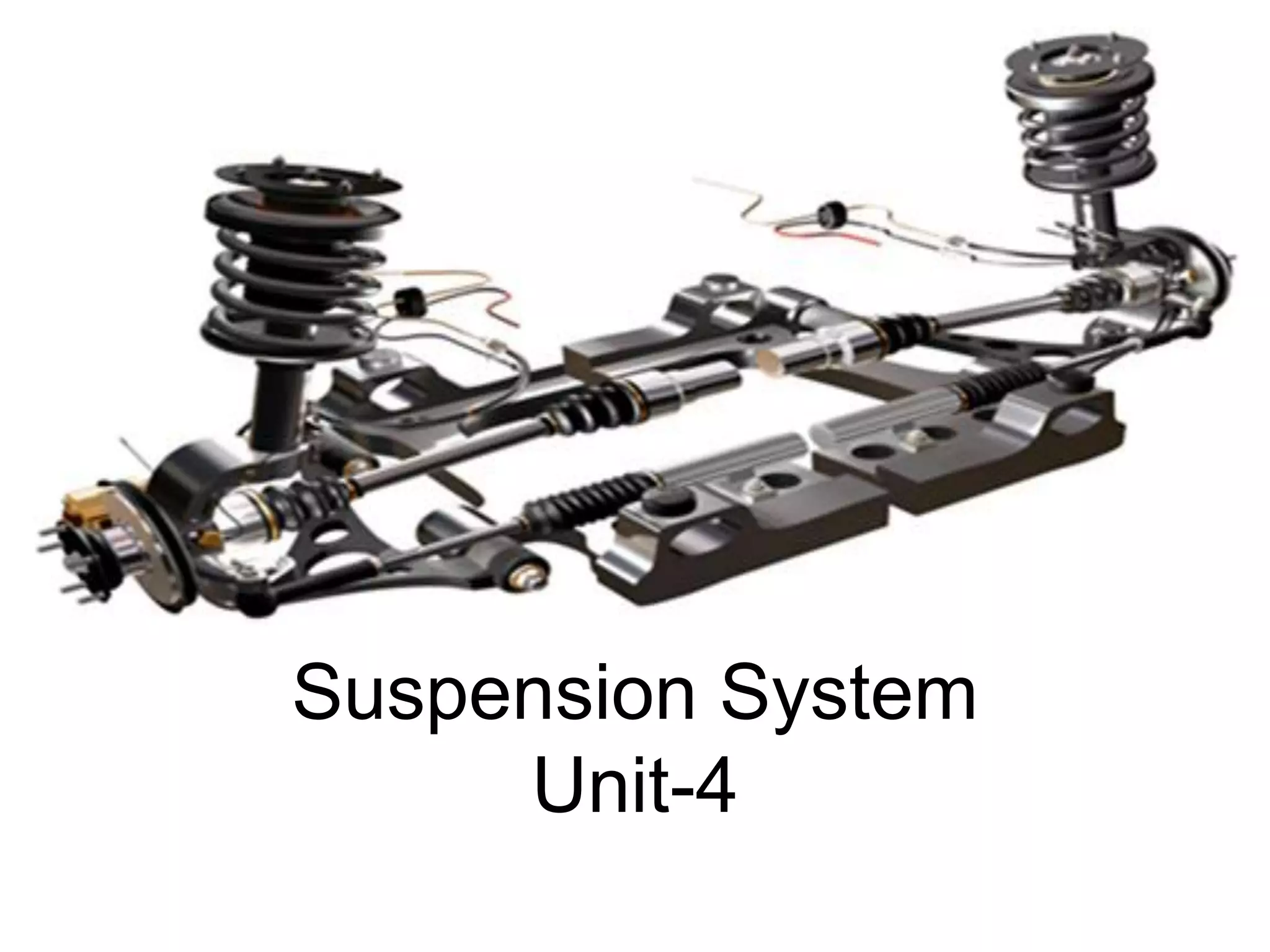
Suspension System
Unit-4
What is suspension system?
• Suspension is the term given to the system of springs, shock
absorbers and linkages that connects a vehicle to its wheels
• Serve a dual purpose – contributing to the car's handling and
braking.
• Protects the vehicle itself and any cargo or luggage from
damage and wear
Functions of suspension system:
1. It prevents the vehicle body and frame from road shocks.
2. It gives stability of the vehicle.
3. It safeguards the passengers and goods from road shocks.
4. It gives the good road holding while driving, cornering and
braking.
5. It gives cushioning effect.
6. It provides comfort.
Requirements of suspension system:
1. There should be minimum deflection.
2. It should be of low initial cost.
3. It should be of minimum weight.
4. It should have low maintenance and low operating cost.
5. It should have minimum tyre wear.
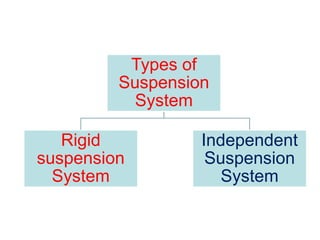
Rigid
suspension
System
Independent
Suspension
System
Types of
Suspension
System
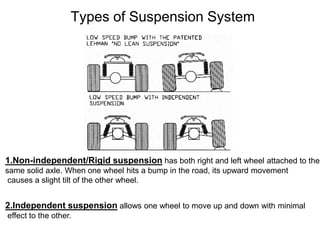
Types of Suspension System
1.Non-independent/Rigid suspension has both right and left wheel attached to the
same solid axle. When one wheel hits a bump in the road, its upward movement
causes a slight tilt of the other wheel.
2.Independent suspension allows one wheel to move up and down with minimal
effect to the other.
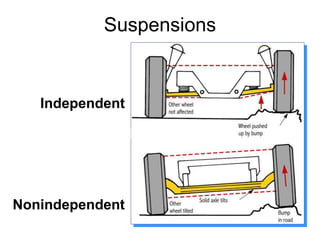
Suspensions
Independent
Nonindependent
8 of 12
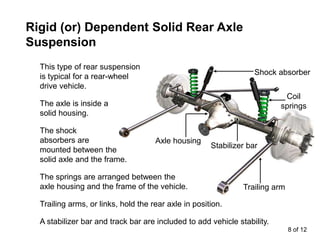
Rigid (or) Dependent Solid Rear Axle
Suspension
This type of rear suspension
is typical for a rear-wheel
drive vehicle.
The axle is inside a
solid housing.
The shock
absorbers are
mounted between the
solid axle and the frame.
The springs are arranged between the
axle housing and the frame of the vehicle.
Trailing arms, or links, hold the rear axle in position.
A stabilizer bar and track bar are included to add vehicle stability.
Axle housing
Shock absorber
Coil
springs
Stabilizer bar
Trailing arm
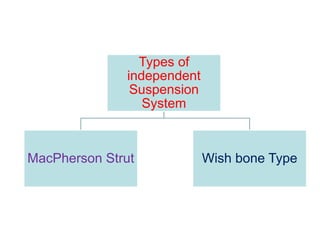
MacPherson Strut Wish bone Type
Types of
independent
Suspension
System
10 of 12
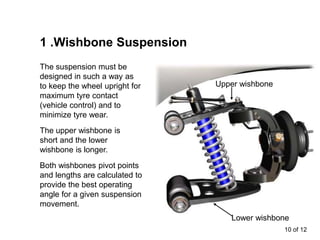
1 .Wishbone Suspension
The upper wishbone is
short and the lower
wishbone is longer.
Both wishbones pivot points
and lengths are calculated to
provide the best operating
angle for a given suspension
movement.
The suspension must be
designed in such a way as
to keep the wheel upright for
maximum tyre contact
(vehicle control) and to
minimize tyre wear.
Upper wishbone
Lower wishbone
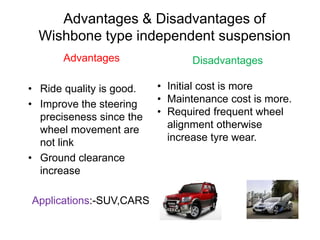
Advantages & Disadvantages of
Wishbone type independent suspension
Advantages
• Ride quality is good.
• Improve the steering
preciseness since the
wheel movement are
not link
• Ground clearance
increase
Disadvantages
• Initial cost is more
• Maintenance cost is more.
• Required frequent wheel
alignment otherwise
increase tyre wear.
Applications:-SUV,CARS
12 of 12
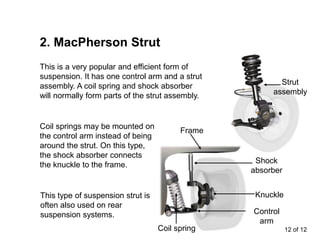
2. MacPherson Strut
This is a very popular and efficient form of
suspension. It has one control arm and a strut
assembly. A coil spring and shock absorber
will normally form parts of the strut assembly.
Coil springs may be mounted on
the control arm instead of being
around the strut. On this type,
the shock absorber connects
the knuckle to the frame.
This type of suspension strut is
often also used on rear
suspension systems.
Coil spring
Strut
assembly
Frame
Shock
absorber
Control
arm
Knuckle
13 of 12
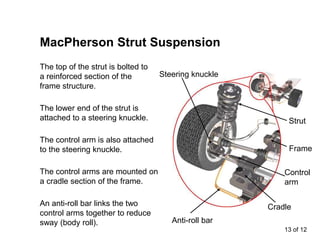
MacPherson Strut Suspension
The top of the strut is bolted to
a reinforced section of the
frame structure.
The lower end of the strut is
attached to a steering knuckle.
The control arm is also attached
to the steering knuckle.
The control arms are mounted on
a cradle section of the frame.
An anti-roll bar links the two
control arms together to reduce
sway (body roll).
Steering knuckle
Control
arm
Cradle
Anti-roll bar
Frame
Strut
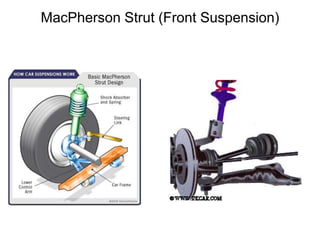
MacPherson Strut (Front Suspension)
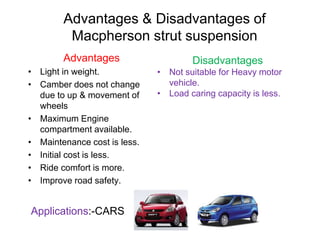
Advantages & Disadvantages of
Macpherson strut suspension
Advantages
• Light in weight.
• Camber does not change
due to up & movement of
wheels
• Maximum Engine
compartment available.
• Maintenance cost is less.
• Initial cost is less.
• Ride comfort is more.
• Improve road safety.
Disadvantages
• Not suitable for Heavy motor
vehicle.
• Load caring capacity is less.
Applications:-CARS
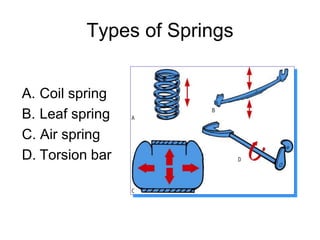
Types of Springs
A. Coil spring
B. Leaf spring
C. Air spring
D. Torsion bar
Suspension System
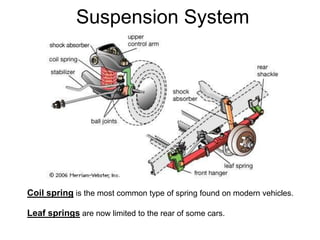
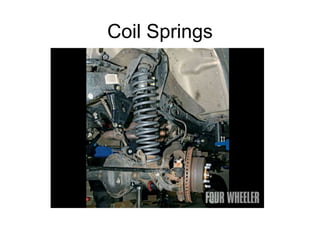
Coil spring is the most common type of spring found on modern vehicles.
Leaf springs are now limited to the rear of some cars.
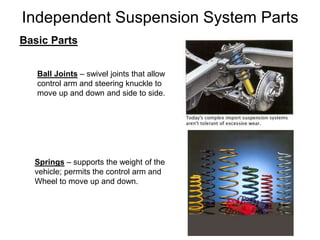
Independent Suspension System Parts
Basic Parts
Ball Joints – swivel joints that allow
control arm and steering knuckle to
move up and down and side to side.
Springs – supports the weight of the
vehicle; permits the control arm and
Wheel to move up and down.
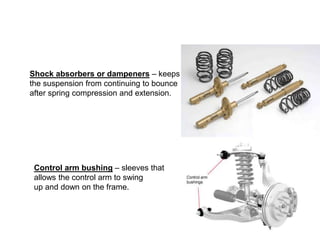
Shock absorbers or dampeners – keeps
the suspension from continuing to bounce
after spring compression and extension.
Control arm bushing – sleeves that
allows the control arm to swing
up and down on the frame.
Coil Springs
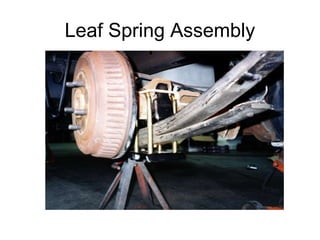
Leaf Spring Assembly
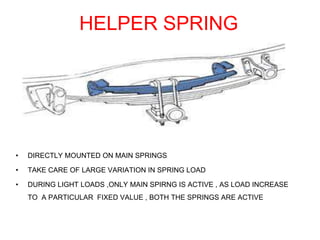
HELPER SPRING
• DIRECTLY MOUNTED ON MAIN SPRINGS
• TAKE CARE OF LARGE VARIATION IN SPRING LOAD
• DURING LIGHT LOADS ,ONLY MAIN SPIRNG IS ACTIVE , AS LOAD INCREASE
TO A PARTICULAR FIXED VALUE , BOTH THE SPRINGS ARE ACTIVE
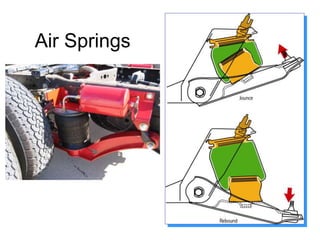
Air Springs
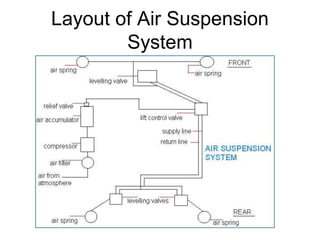
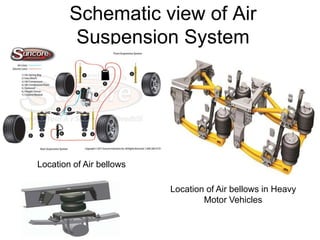
Layout of Air Suspension
System
Schematic view of Air
Suspension System
Location of Air bellows
Location of Air bellows in Heavy
Motor Vehicles
Advantages & Disadvantages of Air
suspension
Advantages
• Variable space for wheel
deflection is put for optimum
use for automatic height
control
• Head light alignment does
not vary due to different
loading condition.
• It improve the ride comfort.
• Reduce noise in suspension
system.
Disadvantages
• Higher initial cost
• Occupies more space.
• Maintenance cost is more
• Due lack of friction damping is
necessary due road shock
Applications:- Volvo Buses
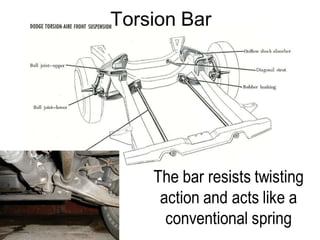
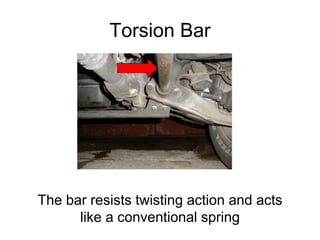
Torsion Bar
The bar resists twisting action and acts
like a conventional spring
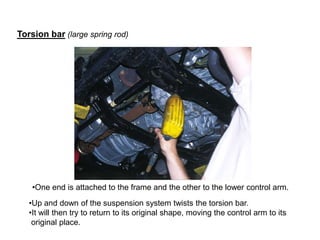
Torsion bar (large spring rod)
•One end is attached to the frame and the other to the lower control arm.
•Up and down of the suspension system twists the torsion bar.
•It will then try to return to its original shape, moving the control arm to its
original place.
Advantages & Disadvantages of Torsion
bar suspension
Advantages
• Light in weight.
• Less space
occupies .
• Its maintenance cost
is less.
• Initial cost is less.
• Ride comfort is
more.
Disadvantages
• It does not take accelerate &
Braking thrust so required
additional linkages
• Due lack of friction damping is
necessary due road shock
•
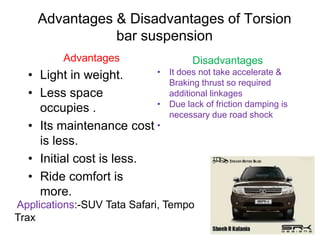
Applications:-SUV Tata Safari, Tempo
Trax
Suspension System
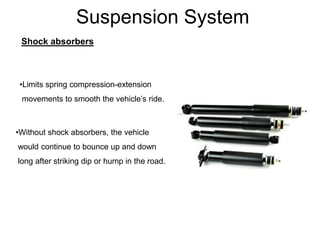
Shock absorbers
•Limits spring compression-extension
movements to smooth the vehicle’s ride.
•Without shock absorbers, the vehicle
would continue to bounce up and down
long after striking dip or hump in the road.
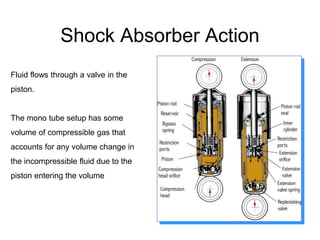
Shock Absorber Action
Fluid flows through a valve in the
piston.
The mono tube setup has some
volume of compressible gas that
accounts for any volume change in
the incompressible fluid due to the
piston entering the volume
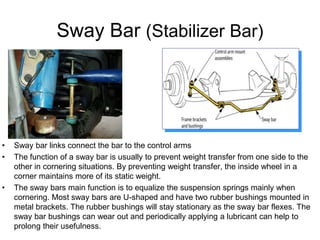
Sway Bar (Stabilizer Bar)
• Sway bar links connect the bar to the control arms
• The function of a sway bar is usually to prevent weight transfer from one side to the
other in cornering situations. By preventing weight transfer, the inside wheel in a
corner maintains more of its static weight.
• The sway bars main function is to equalize the suspension springs mainly when
cornering. Most sway bars are U-shaped and have two rubber bushings mounted in
metal brackets. The rubber bushings will stay stationary as the sway bar flexes. The
sway bar bushings can wear out and periodically applying a lubricant can help to
prolong their usefulness.
Suspension System
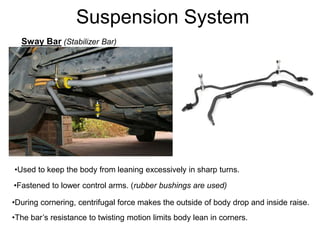
Sway Bar (Stabilizer Bar)
•Used to keep the body from leaning excessively in sharp turns.
•Fastened to lower control arms. (rubber bushings are used)
•During cornering, centrifugal force makes the outside of body drop and inside raise.
•The bar’s resistance to twisting motion limits body lean in corners.
Advantages of stabilizer bar
• It prevent the road shocks
• To provide safe guard to occupied & passenger.
• To provide stability to vehicle during rolling, pitching, bouncing
and yawing.

suspension system.ppt

  • 1.
  • 2.
    What is suspensionsystem? • Suspension is the term given to the system of springs, shock absorbers and linkages that connects a vehicle to its wheels • Serve a dual purpose – contributing to the car's handling and braking. • Protects the vehicle itself and any cargo or luggage from damage and wear
  • 3.
    Functions of suspensionsystem: 1. It prevents the vehicle body and frame from road shocks. 2. It gives stability of the vehicle. 3. It safeguards the passengers and goods from road shocks. 4. It gives the good road holding while driving, cornering and braking. 5. It gives cushioning effect. 6. It provides comfort.
  • 4.
    Requirements of suspensionsystem: 1. There should be minimum deflection. 2. It should be of low initial cost. 3. It should be of minimum weight. 4. It should have low maintenance and low operating cost. 5. It should have minimum tyre wear.
  • 5.
  • 6.
    Types of SuspensionSystem 1.Non-independent/Rigid suspension has both right and left wheel attached to the same solid axle. When one wheel hits a bump in the road, its upward movement causes a slight tilt of the other wheel. 2.Independent suspension allows one wheel to move up and down with minimal effect to the other.
  • 7.
  • 8.
    8 of 12 Rigid(or) Dependent Solid Rear Axle Suspension This type of rear suspension is typical for a rear-wheel drive vehicle. The axle is inside a solid housing. The shock absorbers are mounted between the solid axle and the frame. The springs are arranged between the axle housing and the frame of the vehicle. Trailing arms, or links, hold the rear axle in position. A stabilizer bar and track bar are included to add vehicle stability. Axle housing Shock absorber Coil springs Stabilizer bar Trailing arm
  • 9.
    MacPherson Strut Wishbone Type Types of independent Suspension System
  • 10.
    10 of 12 1.Wishbone Suspension The upper wishbone is short and the lower wishbone is longer. Both wishbones pivot points and lengths are calculated to provide the best operating angle for a given suspension movement. The suspension must be designed in such a way as to keep the wheel upright for maximum tyre contact (vehicle control) and to minimize tyre wear. Upper wishbone Lower wishbone
  • 11.
    Advantages & Disadvantagesof Wishbone type independent suspension Advantages • Ride quality is good. • Improve the steering preciseness since the wheel movement are not link • Ground clearance increase Disadvantages • Initial cost is more • Maintenance cost is more. • Required frequent wheel alignment otherwise increase tyre wear. Applications:-SUV,CARS
  • 12.
    12 of 12 2.MacPherson Strut This is a very popular and efficient form of suspension. It has one control arm and a strut assembly. A coil spring and shock absorber will normally form parts of the strut assembly. Coil springs may be mounted on the control arm instead of being around the strut. On this type, the shock absorber connects the knuckle to the frame. This type of suspension strut is often also used on rear suspension systems. Coil spring Strut assembly Frame Shock absorber Control arm Knuckle
  • 13.
    13 of 12 MacPhersonStrut Suspension The top of the strut is bolted to a reinforced section of the frame structure. The lower end of the strut is attached to a steering knuckle. The control arm is also attached to the steering knuckle. The control arms are mounted on a cradle section of the frame. An anti-roll bar links the two control arms together to reduce sway (body roll). Steering knuckle Control arm Cradle Anti-roll bar Frame Strut
  • 14.
  • 15.
    Advantages & Disadvantagesof Macpherson strut suspension Advantages • Light in weight. • Camber does not change due to up & movement of wheels • Maximum Engine compartment available. • Maintenance cost is less. • Initial cost is less. • Ride comfort is more. • Improve road safety. Disadvantages • Not suitable for Heavy motor vehicle. • Load caring capacity is less. Applications:-CARS
  • 16.
    Types of Springs A.Coil spring B. Leaf spring C. Air spring D. Torsion bar
  • 17.
    Suspension System Coil springis the most common type of spring found on modern vehicles. Leaf springs are now limited to the rear of some cars.
  • 18.
    Independent Suspension SystemParts Basic Parts Ball Joints – swivel joints that allow control arm and steering knuckle to move up and down and side to side. Springs – supports the weight of the vehicle; permits the control arm and Wheel to move up and down.
  • 19.
    Shock absorbers ordampeners – keeps the suspension from continuing to bounce after spring compression and extension. Control arm bushing – sleeves that allows the control arm to swing up and down on the frame.
  • 20.
  • 21.
  • 22.
    HELPER SPRING • DIRECTLYMOUNTED ON MAIN SPRINGS • TAKE CARE OF LARGE VARIATION IN SPRING LOAD • DURING LIGHT LOADS ,ONLY MAIN SPIRNG IS ACTIVE , AS LOAD INCREASE TO A PARTICULAR FIXED VALUE , BOTH THE SPRINGS ARE ACTIVE
  • 23.
  • 24.
    Layout of AirSuspension System
  • 25.
    Schematic view ofAir Suspension System Location of Air bellows Location of Air bellows in Heavy Motor Vehicles
  • 26.
    Advantages & Disadvantagesof Air suspension Advantages • Variable space for wheel deflection is put for optimum use for automatic height control • Head light alignment does not vary due to different loading condition. • It improve the ride comfort. • Reduce noise in suspension system. Disadvantages • Higher initial cost • Occupies more space. • Maintenance cost is more • Due lack of friction damping is necessary due road shock Applications:- Volvo Buses
  • 28.
    Torsion Bar The barresists twisting action and acts like a conventional spring
  • 29.
    Torsion bar (largespring rod) •One end is attached to the frame and the other to the lower control arm. •Up and down of the suspension system twists the torsion bar. •It will then try to return to its original shape, moving the control arm to its original place.
  • 30.
    Advantages & Disadvantagesof Torsion bar suspension Advantages • Light in weight. • Less space occupies . • Its maintenance cost is less. • Initial cost is less. • Ride comfort is more. Disadvantages • It does not take accelerate & Braking thrust so required additional linkages • Due lack of friction damping is necessary due road shock • Applications:-SUV Tata Safari, Tempo Trax
  • 31.
    Suspension System Shock absorbers •Limitsspring compression-extension movements to smooth the vehicle’s ride. •Without shock absorbers, the vehicle would continue to bounce up and down long after striking dip or hump in the road.
  • 32.
    Shock Absorber Action Fluidflows through a valve in the piston. The mono tube setup has some volume of compressible gas that accounts for any volume change in the incompressible fluid due to the piston entering the volume
  • 33.
    Sway Bar (StabilizerBar) • Sway bar links connect the bar to the control arms • The function of a sway bar is usually to prevent weight transfer from one side to the other in cornering situations. By preventing weight transfer, the inside wheel in a corner maintains more of its static weight. • The sway bars main function is to equalize the suspension springs mainly when cornering. Most sway bars are U-shaped and have two rubber bushings mounted in metal brackets. The rubber bushings will stay stationary as the sway bar flexes. The sway bar bushings can wear out and periodically applying a lubricant can help to prolong their usefulness.
  • 34.
    Suspension System Sway Bar(Stabilizer Bar) •Used to keep the body from leaning excessively in sharp turns. •Fastened to lower control arms. (rubber bushings are used) •During cornering, centrifugal force makes the outside of body drop and inside raise. •The bar’s resistance to twisting motion limits body lean in corners.
  • 35.
    Advantages of stabilizerbar • It prevent the road shocks • To provide safe guard to occupied & passenger. • To provide stability to vehicle during rolling, pitching, bouncing and yawing.