GOOD MORNING
EVERYONE!
REPORTER:
ARNEL DELA CRUZ
SHEILA MARIE MIGUEL
CHAPTER 4:
Assessment in the
Affective Domain
Learning Objective:
a.To explain the importance of the affective domain in
the assessment of learning
b. To explain the taxonomy in the affective domain.
c. To define motivation.
d. To discuss the need theories on motivation.
e. To define and explain self-report, rating scale,
Thurstone scale, Lickert scale, semantic differential
scale and checklist.
Affective Domain
Describes the way we
deal with the thing
emotionally.
Kratwohl &Bloom
1964
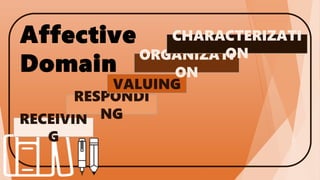
Taxonomy of affective
domain describes the five
categories or level of active
learning.
RECEIVIN
G
RESPONDI
NG
VALUING
ORGANIZATI
ON
CHARACTERIZATI
ON
Affective
Domain
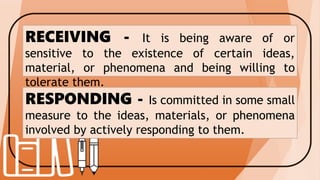
RECEIVING - It is being aware of or
sensitive to the existence of certain ideas,
material, or phenomena and being willing to
tolerate them.
RESPONDING - Is committed in some small
measure to the ideas, materials, or phenomena
involved by actively responding to them.
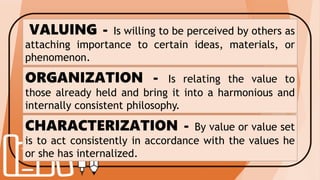
VALUING - Is willing to be perceived by others as
attaching importance to certain ideas, materials, or
phenomenon.
ORGANIZATION - Is relating the value to
those already held and bring it into a harmonious and
internally consistent philosophy.
CHARACTERIZATION - By value or value set
is to act consistently in accordance with the values he
or she has internalized.
Affective Learning
Competencies
Affective desired learning
competencies are often stated
in the form of instructional
objective.
WHAT IS INSTRUCTION
OBJECTIVES?
1 . I n s t r u c t i o n a l o b j e c t i v e a r e S P E C I F I C ,
M E A S U R A B L E , O B S E RVA B L E S T U D E N T
B E H AV I O R S .
2 . O b j e c t i v e a r e t h e f o u n d a t i o n u p o n
w h i c h y o u c a n b u i l d l e s s o n a n d
a s se ss m en t t h a t yo u ca n p r o ve m eet
y o u r o v e r a l l l e s s o n g o a l
WHAT IS INSTRUCTION
OBJECTIVES?
3. Think of objective as tools you use to make
sure you reach your goal. They are arrows you
shoot towards your target.
4. The purpose of the objective is to ensure
that learning is focused clearly enough that
both student and teacher know what is going
on and so learning can be objectively
measure.
Focal
Concept:
ATTITU
DE MOTIVATI
ONSELF-
Attitude
Defined as a mental
predisposition to act that is
expressed by evaluating a
particular entity with some
degree of favor and disfavor
4 Components of
Attitude
1. Cognition
2. Affective
3. Behavioral Intentions
4. Evaluation
Motivation
Is a reason or set of reasons
for engaging in a particular
behavior INTRINSICALLY or
EXTRINSICALLY.
Self-Efficacy
 Is an impression that one is capable of
performing in a manner or attaining
goals.
 It is a belief that one has the capabilities
to execute the courses of actions
required to manage prospective
situations.
Development of Assessment
tools
Assessment tools in the affective
domain, in particular, those which
are used to assess attitudes,
interests, motivations, and self-
efficacy.
Self Report
It is the most common measurement
tool in the affective domain.
It essentially requires an individual to
provide an account of his/her
attitude or feelings toward a concept
or idea or people.
Rating Scales
Is a set of categories designed
to elicit information about a
quantitative attribute in social
science
Rating Scales
The Semantic Differential (SD) tries
to assess an individual’s reaction to
specific words, ideas or concepts in
terms of ratings on bipolar scales
defined with contrasting adjectives at
each end.
Rating Scales
 Thurstone and Likert Scale
• Louis Thurstone is considered the “The
father of attitude measurement”.
• He address the issue on how favorable
an individual is with regard to a given
issue.
• He developed an attitude continuum to
determine the position of favorability on
the issue.
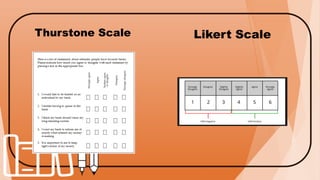
Thurstone Scale Likert Scale
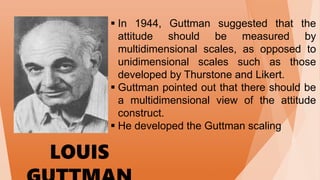
LOUIS
 In 1944, Guttman suggested that the
attitude should be measured by
multidimensional scales, as opposed to
unidimensional scales such as those
developed by Thurstone and Likert.
 Guttman pointed out that there should be
a multidimensional view of the attitude
construct.
 He developed the Guttman scaling
Checklist
The most common and
perhaps the easiest instrument
in the affective domain is to
construct the checklist.
Thank You!
Thank You!
 1. The most common and perhaps the easiest instrument in the affective
domain is to construct the _______.CHECKLIST
 2. He developed the Guttman scaling. LOUIS GUTTMAN
 3. Is a set of categories designed to elicit information about a quantitative
attribute in social science . RATING SCALE
 4. It is tries to assess an individual’s reaction to specific words, ideas or
concepts in terms of ratings on bipolar scales defined with contrasting
adjectives at each end. SEMANTIC DIFFERENTIAL
 5. He is considered the “The father of attitude measurement”. LOUIS
THURSTONE
 6. It is the most common measurement tool in the affective domain. SELF
REPORT
 7. It is a belief that one has the capabilities to execute the courses of actions
required to manage prospective situations. SELF-EFFICACY
 8. Defined as a mental predisposition to act that is expressed by evaluating a
particular entity with some degree of favor and disfavor ATTITUDE

Chapter 4 - Assessment in the Affectiive Domain.pptx

  • 1.
  • 3.
    CHAPTER 4: Assessment inthe Affective Domain
  • 4.
    Learning Objective: a.To explainthe importance of the affective domain in the assessment of learning b. To explain the taxonomy in the affective domain. c. To define motivation. d. To discuss the need theories on motivation. e. To define and explain self-report, rating scale, Thurstone scale, Lickert scale, semantic differential scale and checklist.
  • 5.
    Affective Domain Describes theway we deal with the thing emotionally.
  • 6.
    Kratwohl &Bloom 1964 Taxonomy ofaffective domain describes the five categories or level of active learning.
  • 7.
  • 8.
    RECEIVING - Itis being aware of or sensitive to the existence of certain ideas, material, or phenomena and being willing to tolerate them. RESPONDING - Is committed in some small measure to the ideas, materials, or phenomena involved by actively responding to them.
  • 9.
    VALUING - Iswilling to be perceived by others as attaching importance to certain ideas, materials, or phenomenon. ORGANIZATION - Is relating the value to those already held and bring it into a harmonious and internally consistent philosophy. CHARACTERIZATION - By value or value set is to act consistently in accordance with the values he or she has internalized.
  • 10.
    Affective Learning Competencies Affective desiredlearning competencies are often stated in the form of instructional objective.
  • 11.
    WHAT IS INSTRUCTION OBJECTIVES? 1. I n s t r u c t i o n a l o b j e c t i v e a r e S P E C I F I C , M E A S U R A B L E , O B S E RVA B L E S T U D E N T B E H AV I O R S . 2 . O b j e c t i v e a r e t h e f o u n d a t i o n u p o n w h i c h y o u c a n b u i l d l e s s o n a n d a s se ss m en t t h a t yo u ca n p r o ve m eet y o u r o v e r a l l l e s s o n g o a l
  • 12.
    WHAT IS INSTRUCTION OBJECTIVES? 3.Think of objective as tools you use to make sure you reach your goal. They are arrows you shoot towards your target. 4. The purpose of the objective is to ensure that learning is focused clearly enough that both student and teacher know what is going on and so learning can be objectively measure.
  • 13.
  • 14.
    Attitude Defined as amental predisposition to act that is expressed by evaluating a particular entity with some degree of favor and disfavor
  • 15.
    4 Components of Attitude 1.Cognition 2. Affective 3. Behavioral Intentions 4. Evaluation
  • 16.
    Motivation Is a reasonor set of reasons for engaging in a particular behavior INTRINSICALLY or EXTRINSICALLY.
  • 17.
    Self-Efficacy  Is animpression that one is capable of performing in a manner or attaining goals.  It is a belief that one has the capabilities to execute the courses of actions required to manage prospective situations.
  • 18.
    Development of Assessment tools Assessmenttools in the affective domain, in particular, those which are used to assess attitudes, interests, motivations, and self- efficacy.
  • 19.
    Self Report It isthe most common measurement tool in the affective domain. It essentially requires an individual to provide an account of his/her attitude or feelings toward a concept or idea or people.
  • 20.
    Rating Scales Is aset of categories designed to elicit information about a quantitative attribute in social science
  • 21.
    Rating Scales The SemanticDifferential (SD) tries to assess an individual’s reaction to specific words, ideas or concepts in terms of ratings on bipolar scales defined with contrasting adjectives at each end.
  • 22.
    Rating Scales  Thurstoneand Likert Scale • Louis Thurstone is considered the “The father of attitude measurement”. • He address the issue on how favorable an individual is with regard to a given issue. • He developed an attitude continuum to determine the position of favorability on the issue.
  • 23.
  • 24.
    LOUIS  In 1944,Guttman suggested that the attitude should be measured by multidimensional scales, as opposed to unidimensional scales such as those developed by Thurstone and Likert.  Guttman pointed out that there should be a multidimensional view of the attitude construct.  He developed the Guttman scaling
  • 25.
    Checklist The most commonand perhaps the easiest instrument in the affective domain is to construct the checklist.
  • 26.
  • 27.
     1. Themost common and perhaps the easiest instrument in the affective domain is to construct the _______.CHECKLIST  2. He developed the Guttman scaling. LOUIS GUTTMAN  3. Is a set of categories designed to elicit information about a quantitative attribute in social science . RATING SCALE  4. It is tries to assess an individual’s reaction to specific words, ideas or concepts in terms of ratings on bipolar scales defined with contrasting adjectives at each end. SEMANTIC DIFFERENTIAL  5. He is considered the “The father of attitude measurement”. LOUIS THURSTONE  6. It is the most common measurement tool in the affective domain. SELF REPORT  7. It is a belief that one has the capabilities to execute the courses of actions required to manage prospective situations. SELF-EFFICACY  8. Defined as a mental predisposition to act that is expressed by evaluating a particular entity with some degree of favor and disfavor ATTITUDE