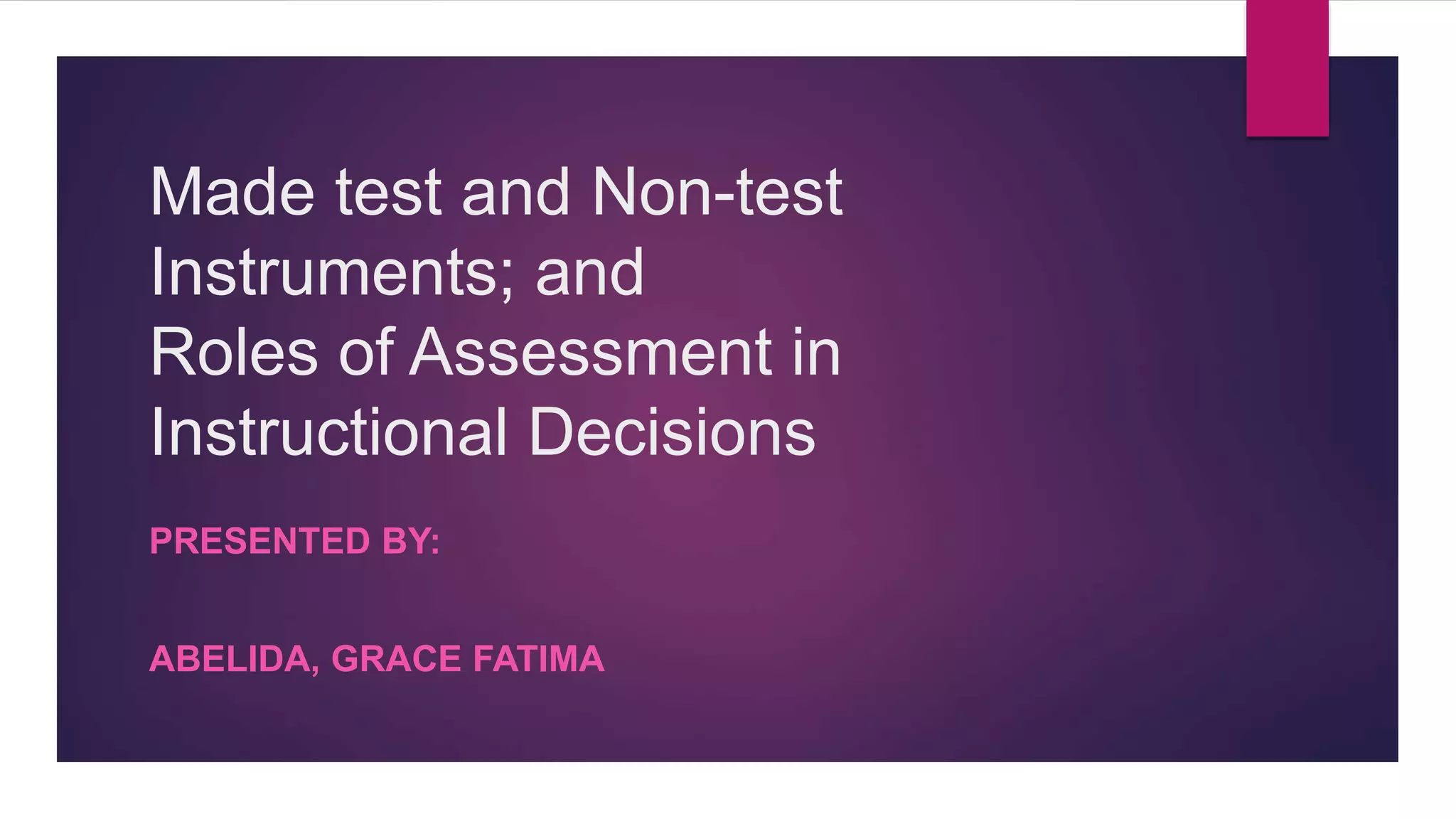



Made test and Non-test
Instruments; and
Roles of Assessment in
Instructional Decisions
PRESENTED BY:
ABELIDA, GRACE FATIMA
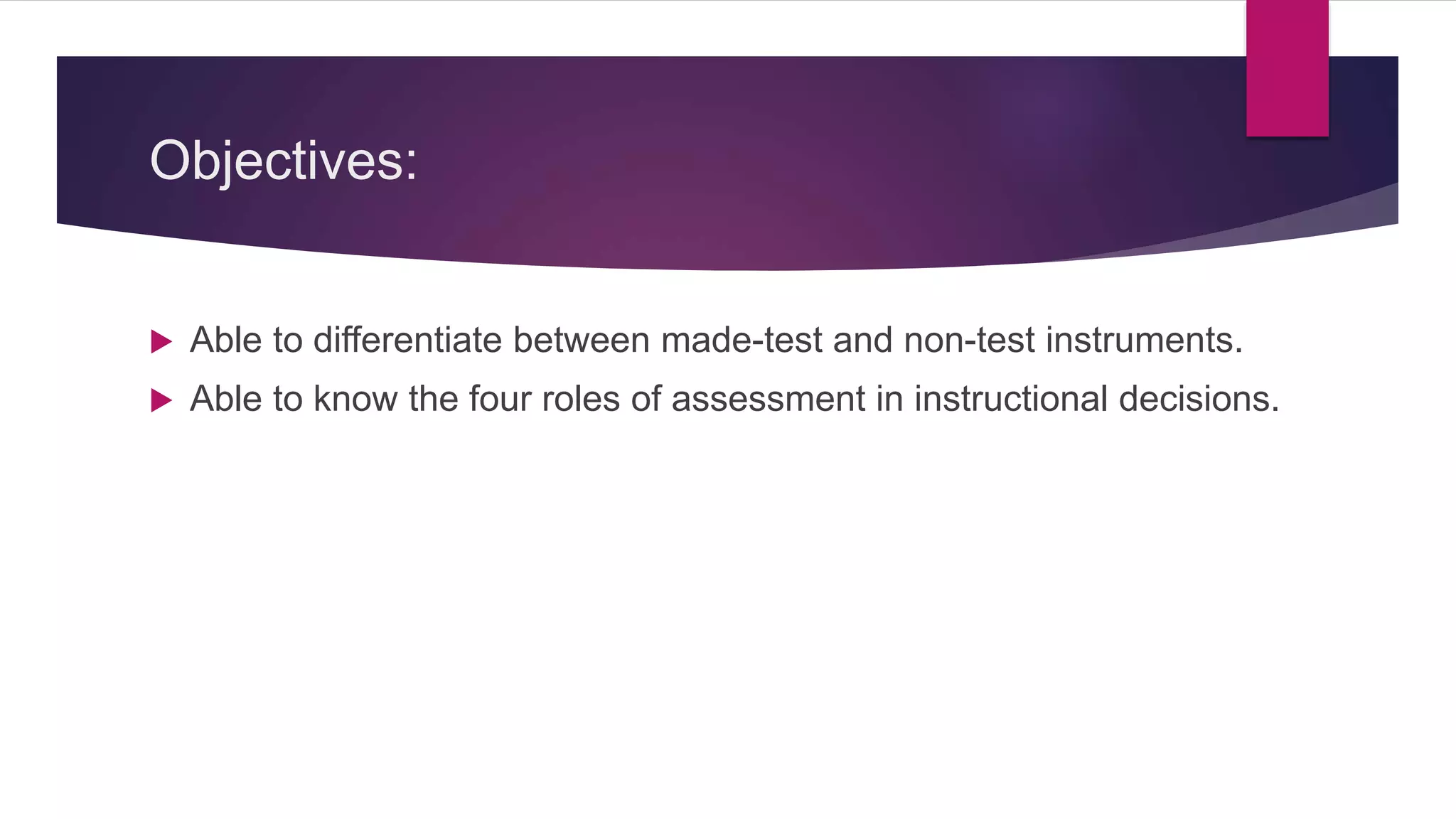
Objectives:
 Able to differentiate between made-test and non-test instruments.
 Able to know the four roles of assessment in instructional decisions.
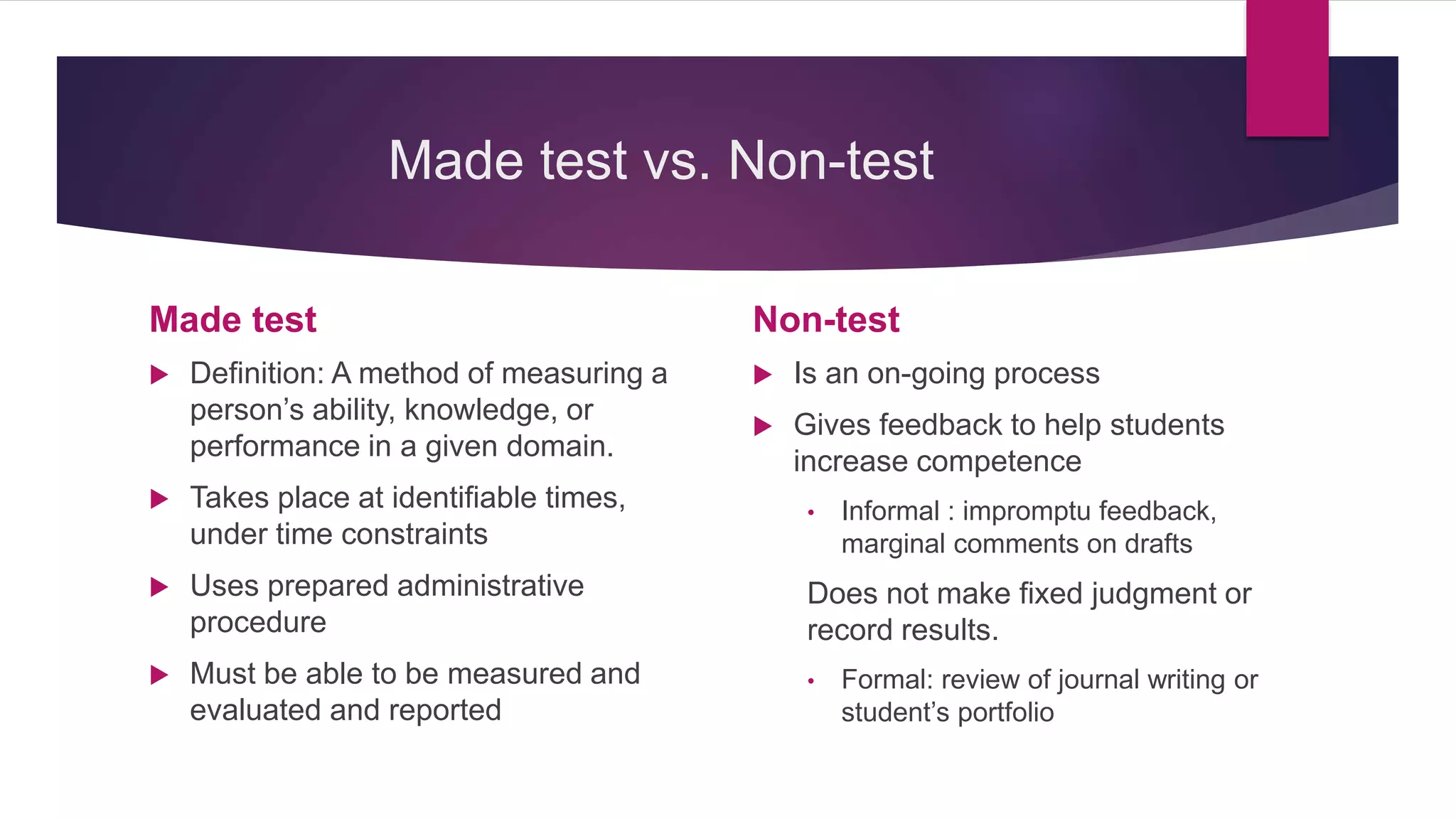
Made test vs. Non-test
Made test
 Definition: A method of measuring a
person’s ability, knowledge, or
performance in a given domain.
 Takes place at identifiable times,
under time constraints
 Uses prepared administrative
procedure
 Must be able to be measured and
evaluated and reported
Non-test
 Is an on-going process
 Gives feedback to help students
increase competence
• Informal : impromptu feedback,
marginal comments on drafts
Does not make fixed judgment or
record results.
• Formal: review of journal writing or
student’s portfolio
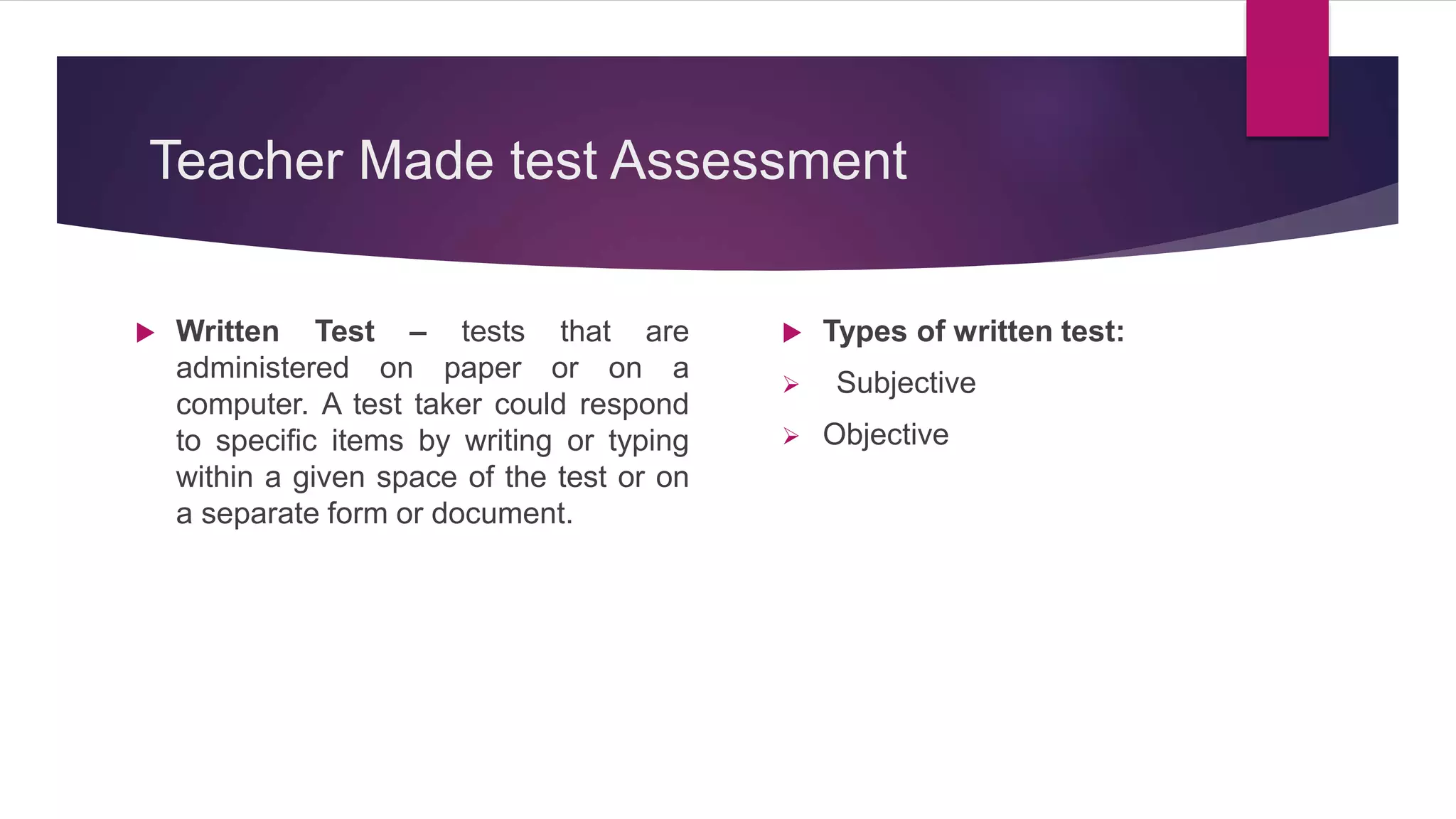
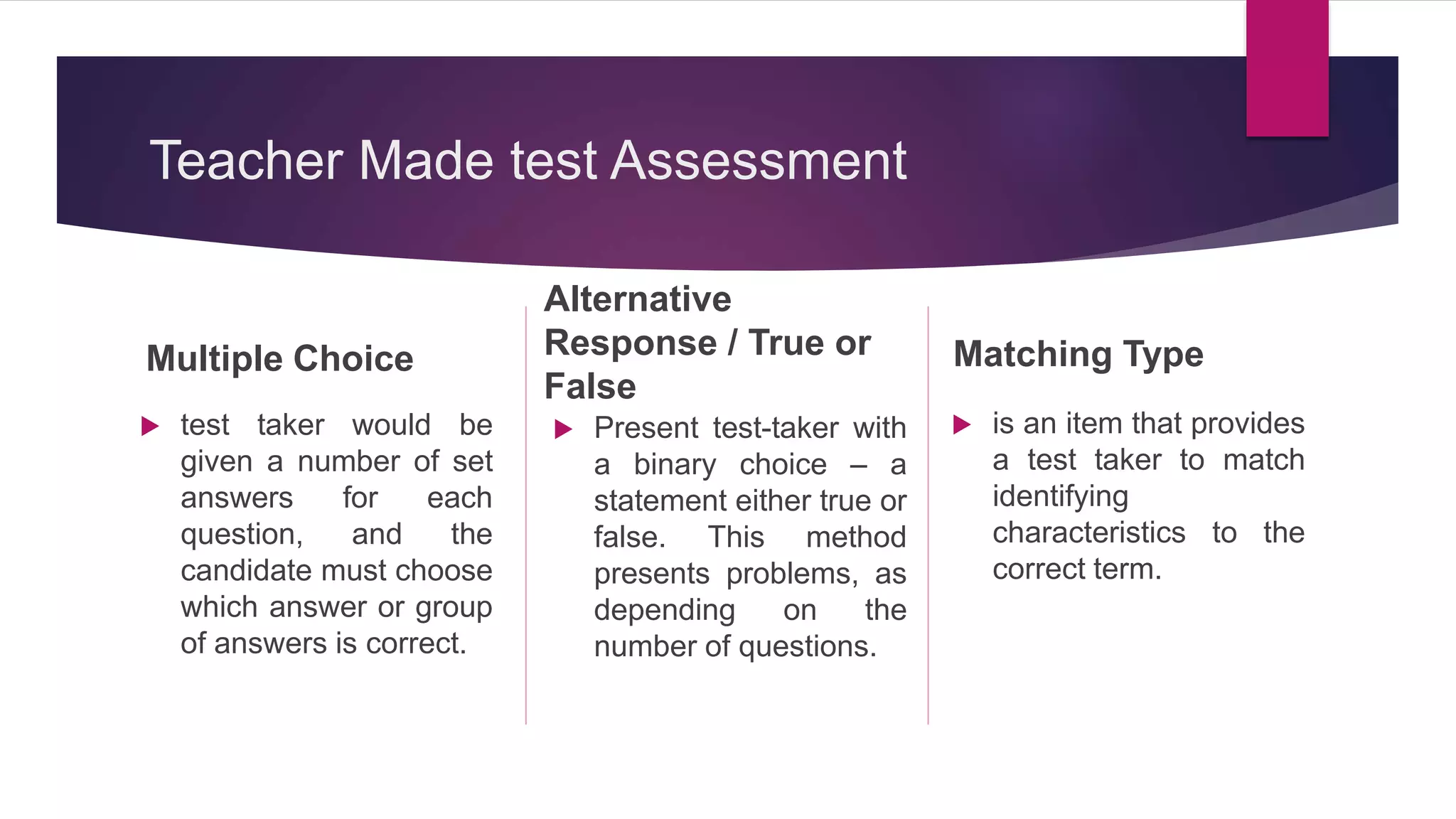
Teacher Made test Assessment
 Written Test – tests that are
administered on paper or on a
computer. A test taker could respond
to specific items by writing or typing
within a given space of the test or on
a separate form or document.
 Types of written test:
 Subjective
 Objective
Teacher Made test Assessment
Multiple Choice
 test taker would be
given a number of set
answers for each
question, and the
candidate must choose
which answer or group
of answers is correct.
Alternative
Response / True or
False
 Present test-taker with
a binary choice – a
statement either true or
false. This method
presents problems, as
depending on the
number of questions.
Matching Type
 is an item that provides
a test taker to match
identifying
characteristics to the
correct term.
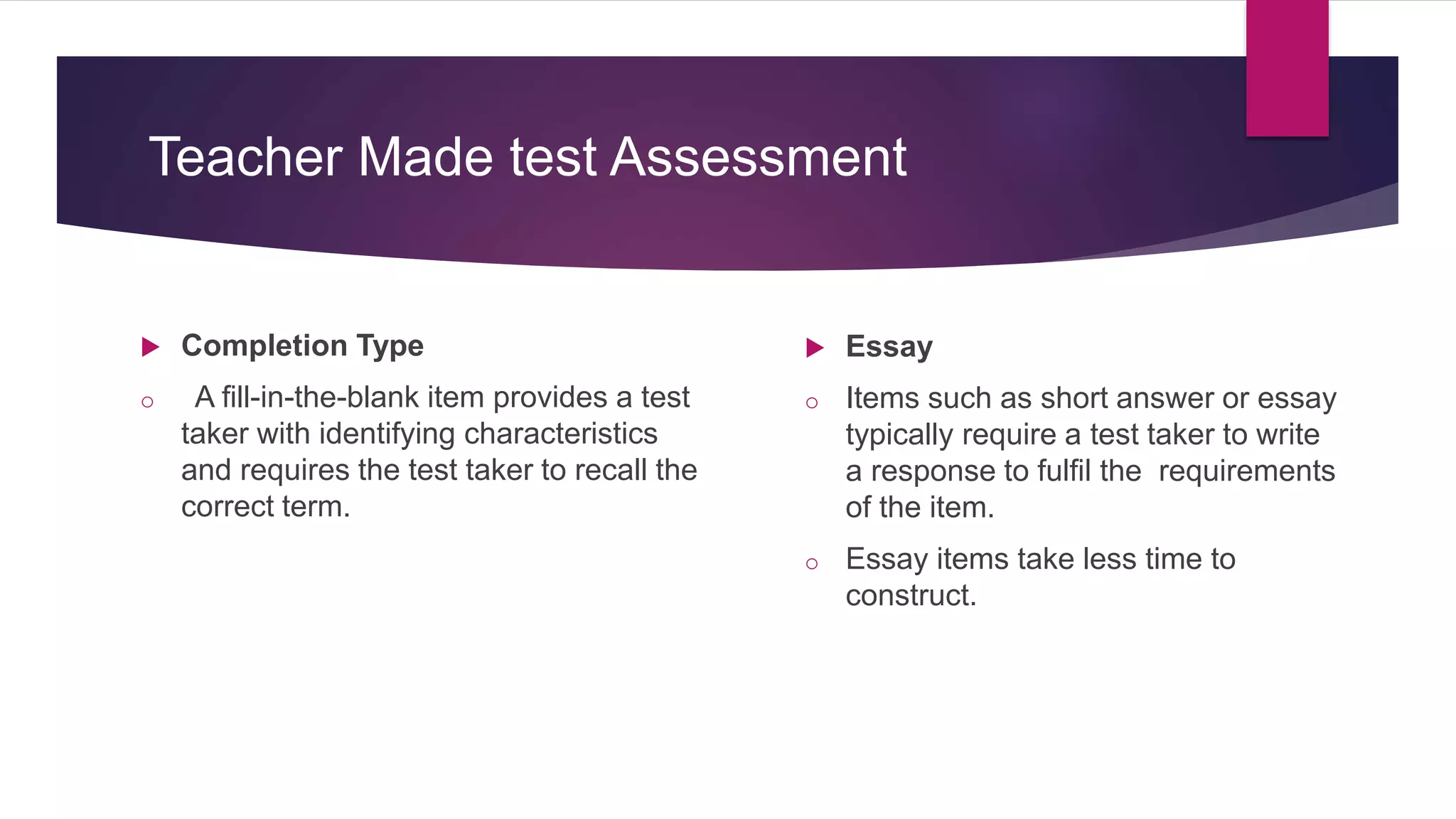
 Completion Type
o A fill-in-the-blank item provides a test
taker with identifying characteristics
and requires the test taker to recall the
correct term.
 Essay
o Items such as short answer or essay
typically require a test taker to write
a response to fulfil the requirements
of the item.
o Essay items take less time to
construct.
Teacher Made test Assessment
Non-test Assessment Techniques
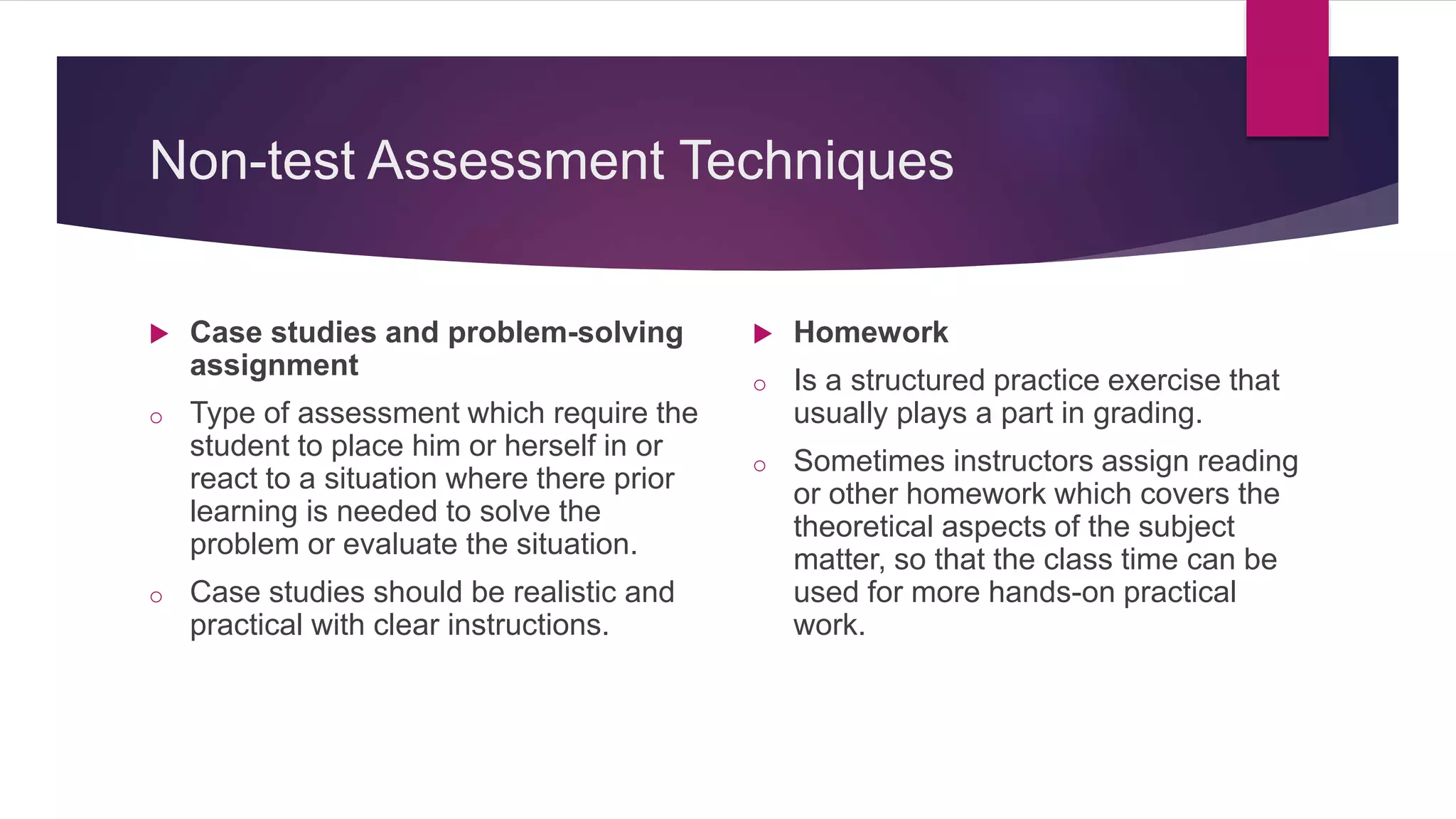
 Case studies and problem-solving
assignment
o Type of assessment which require the
student to place him or herself in or
react to a situation where there prior
learning is needed to solve the
problem or evaluate the situation.
o Case studies should be realistic and
practical with clear instructions.
 Homework
o Is a structured practice exercise that
usually plays a part in grading.
o Sometimes instructors assign reading
or other homework which covers the
theoretical aspects of the subject
matter, so that the class time can be
used for more hands-on practical
work.
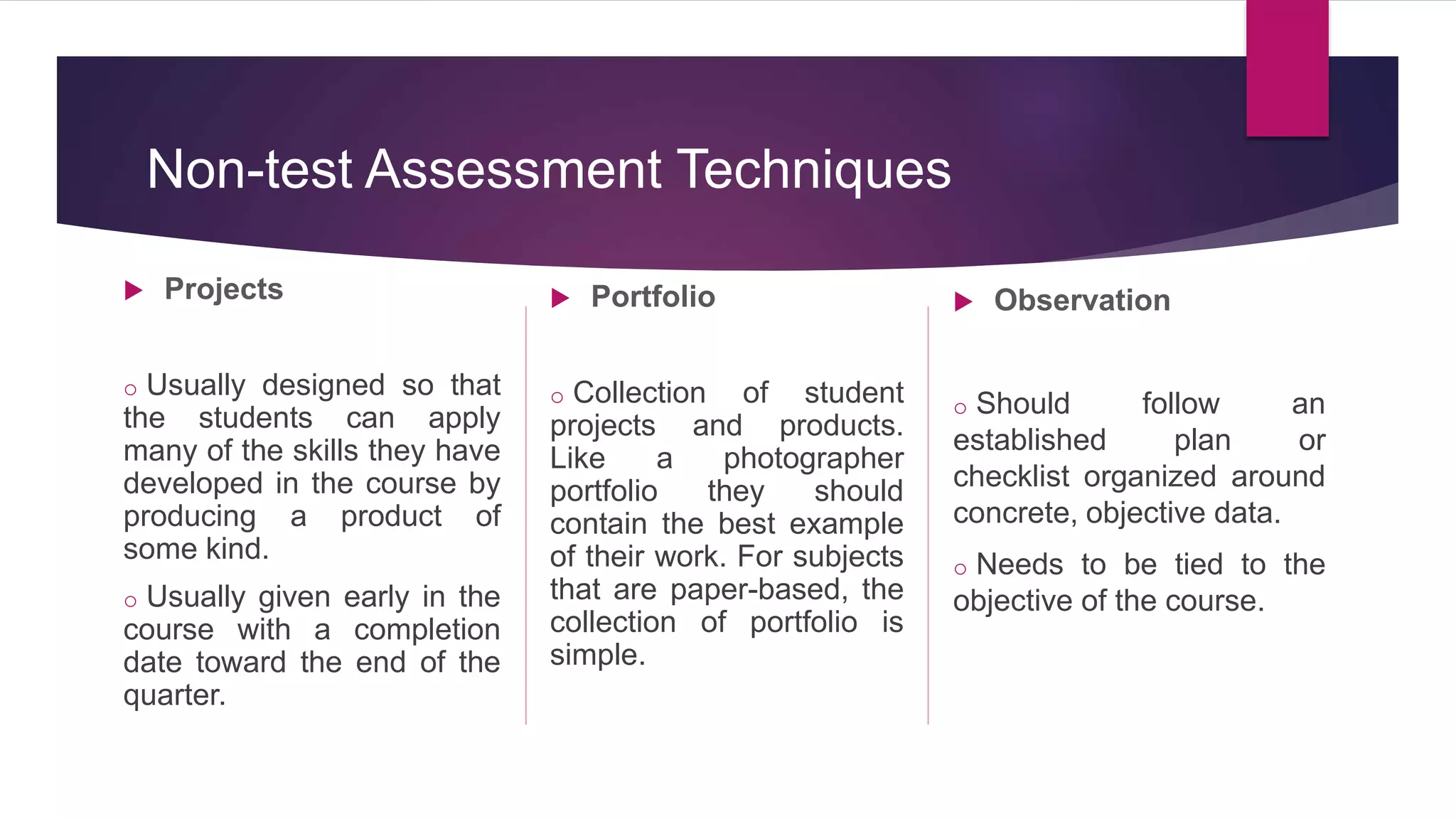
 Projects
o Usually designed so that
the students can apply
many of the skills they have
developed in the course by
producing a product of
some kind.
o Usually given early in the
course with a completion
date toward the end of the
quarter.
 Portfolio
o Collection of student
projects and products.
Like a photographer
portfolio they should
contain the best example
of their work. For subjects
that are paper-based, the
collection of portfolio is
simple.
 Observation
o Should follow an
established plan or
checklist organized around
concrete, objective data.
o Needs to be tied to the
objective of the course.
Non-test Assessment Techniques
 Anecdotal Record
o Provide information regarding a
student’s development over a period
of time.
o Provide ongoing records about
individual instructional needs
o Captures observations of significant
behaviour that might otherwise be
lost
o Provide ongoing documentation of
learning that may shared with
students, parents and teacher.
 Anecdotal record is a record of
some significant item of conduct, a
record of an episode in the life of
students, a word picture of the
student in action, a word snapshot at
the moment of the incident, any
narration of events in which may be
significant about his personality. -
Randall
 Checklists
o Contains a list of behaviours or
specific steps, which can be
marked as Present/Absent,
Complete/Incomplete, Yes/No,
etc.
o Used to record observations of
an individual, a group or a whole
class.
 Rating Scale
o Allow teacher to indicate the
degree of frequency of the
behaviours, skills and strategies
displayed by the learner.
o Used to record the quality of the
student’s performance at a given
time or within a given process.
Roles of Assessment in Instructional
Decisions
 Placement
 Diagnostic
 Formative
 Summative
Placement
 Used to determine the entry behaviour of the pupils.
 Used to determine the performance at the beginning of the instruction.
 GOAL: to determine the position in instructional sequence and the mode of
evaluation.
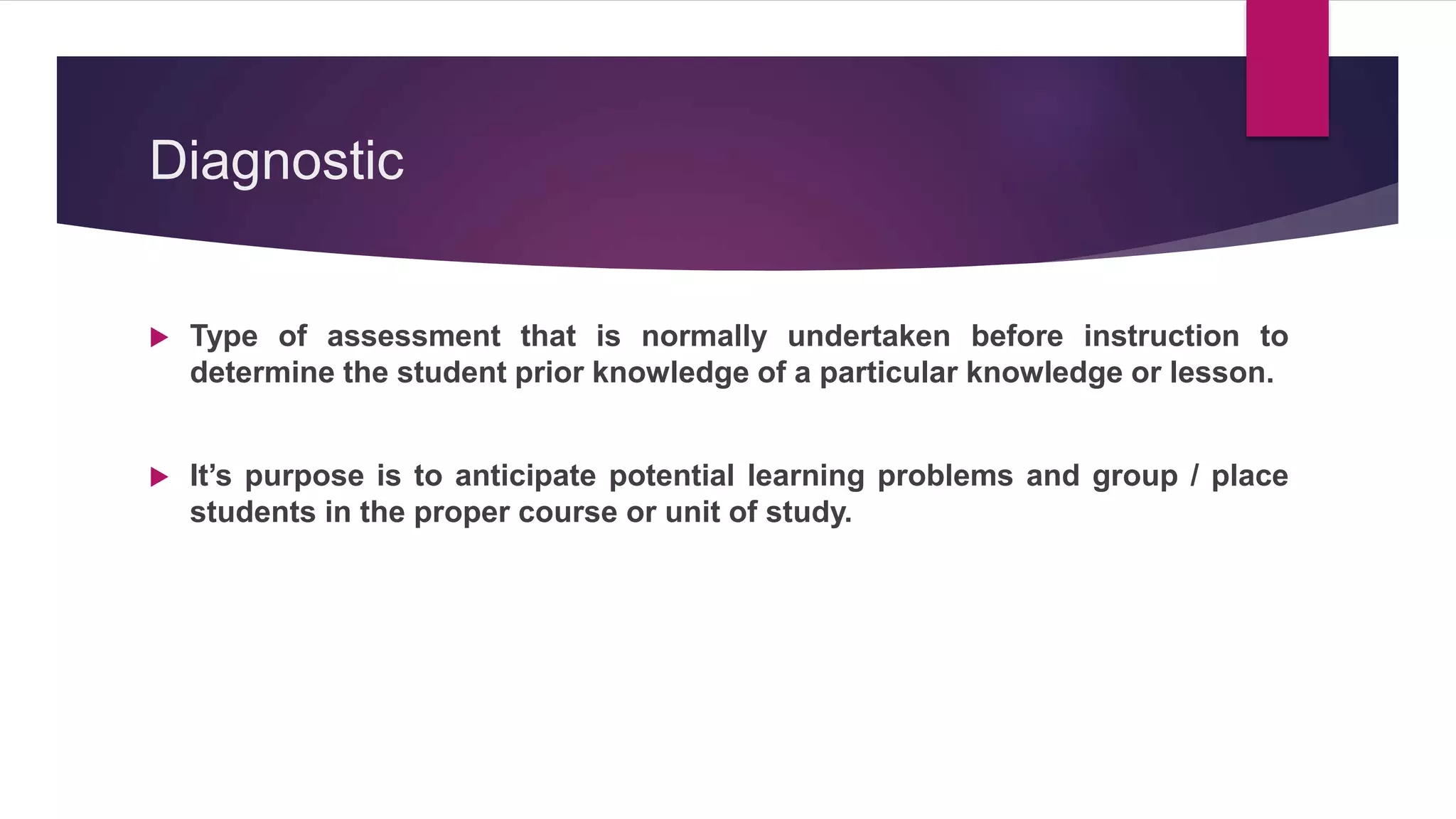
Diagnostic
 Type of assessment that is normally undertaken before instruction to
determine the student prior knowledge of a particular knowledge or lesson.
 It’s purpose is to anticipate potential learning problems and group / place
students in the proper course or unit of study.
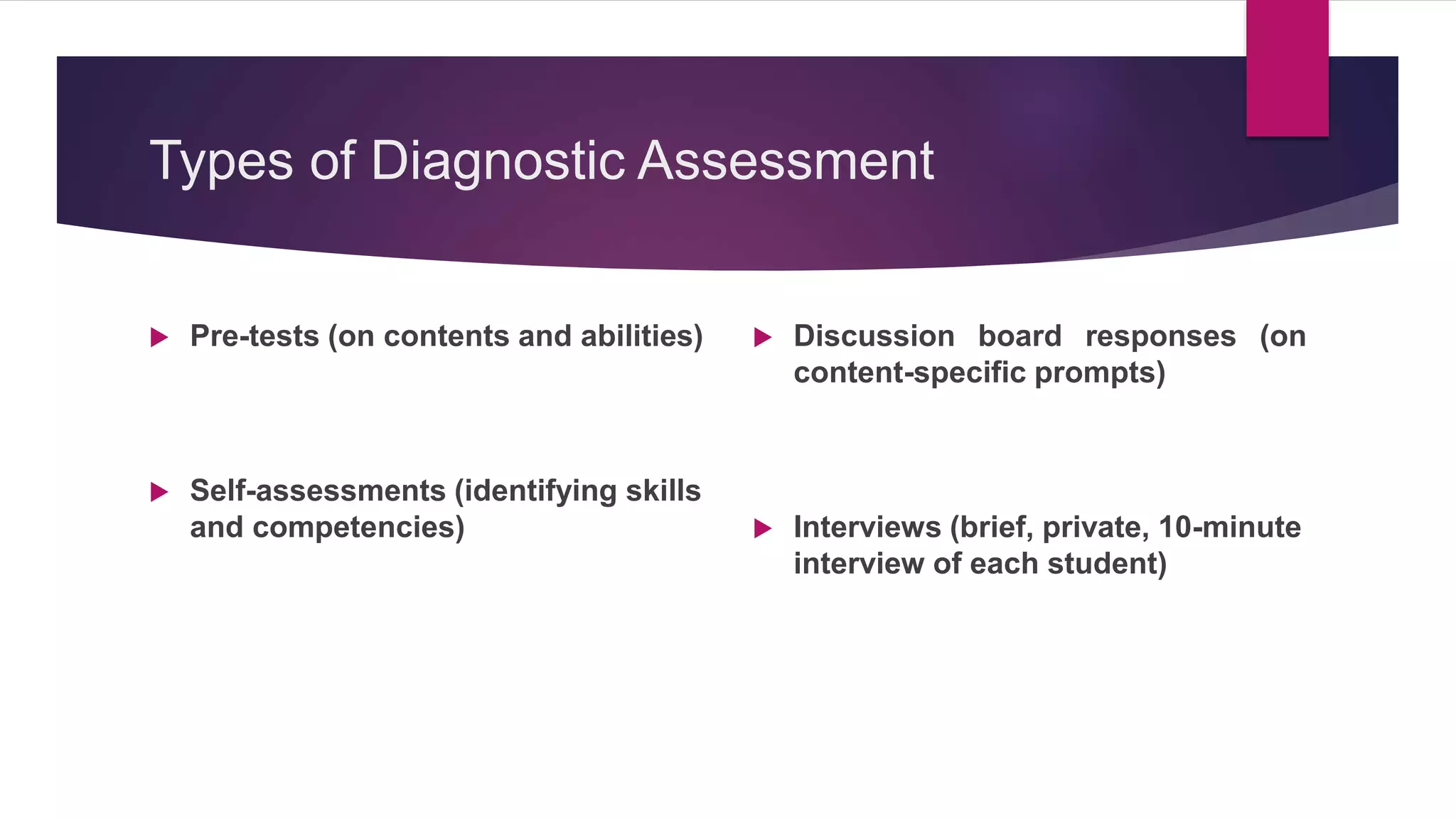
Types of Diagnostic Assessment
 Pre-tests (on contents and abilities)
 Self-assessments (identifying skills
and competencies)
 Discussion board responses (on
content-specific prompts)
 Interviews (brief, private, 10-minute
interview of each student)
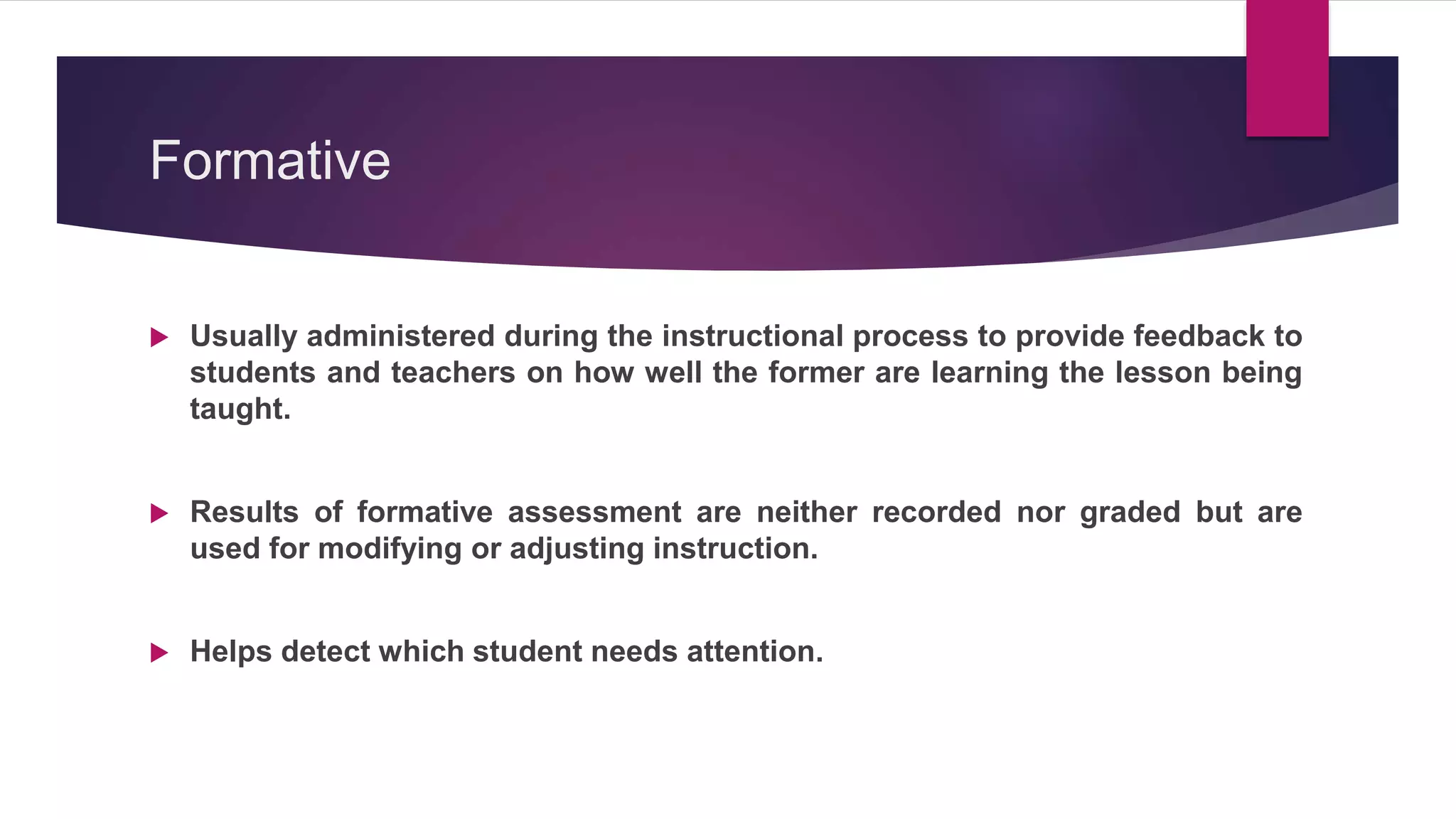
Formative
 Usually administered during the instructional process to provide feedback to
students and teachers on how well the former are learning the lesson being
taught.
 Results of formative assessment are neither recorded nor graded but are
used for modifying or adjusting instruction.
 Helps detect which student needs attention.
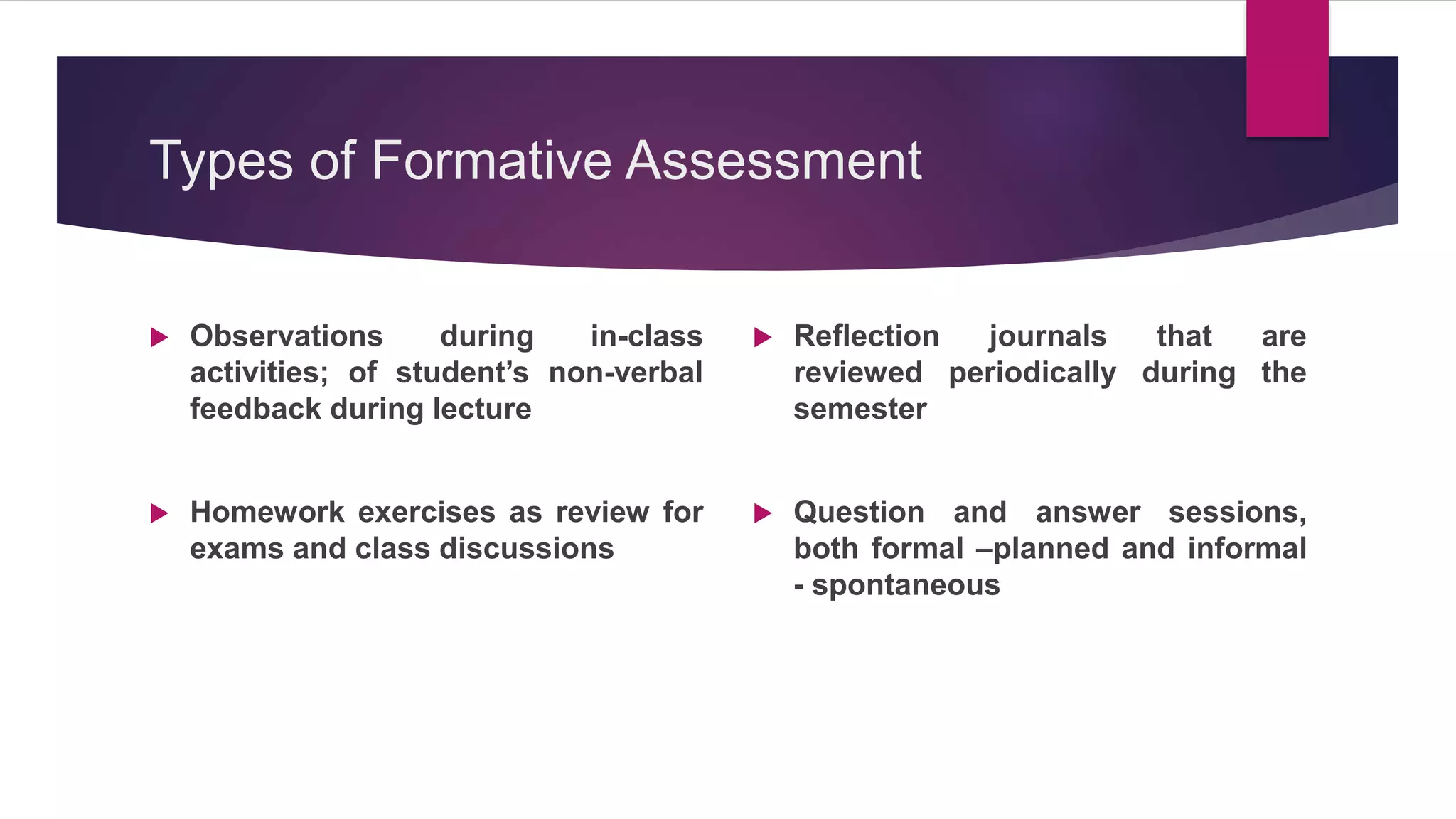
Types of Formative Assessment
 Observations during in-class
activities; of student’s non-verbal
feedback during lecture
 Homework exercises as review for
exams and class discussions
 Reflection journals that are
reviewed periodically during the
semester
 Question and answer sessions,
both formal –planned and informal
- spontaneous
Summative Role
 This type of assessment is undertaken to determine student
achievement for grading purposes.
 To determine the mastery at the end of the course.
 Overall assessment.
Types of Summative Assessment
 Examinations (major, high-stakes
exam)
 Final Examination (a truly
summative assessment)
 Term Paper (drafts submitted
throughout the semester would be
a formative assessment)
 Projects (project phases submitted
at various completion points could
be formatively assessed)
 Portfolios (could also be assessed
during it’s development as a
formative assessment)
 Performances
 Student evaluation of the course
(teaching effectiveness)
Made Test and Non-test Instruments and Roles of Assessment

Made Test and Non-test Instruments and Roles of Assessment

  • 1.
    Made test andNon-test Instruments; and Roles of Assessment in Instructional Decisions PRESENTED BY: ABELIDA, GRACE FATIMA
  • 3.
    Objectives:  Able todifferentiate between made-test and non-test instruments.  Able to know the four roles of assessment in instructional decisions.
  • 4.
    Made test vs.Non-test Made test  Definition: A method of measuring a person’s ability, knowledge, or performance in a given domain.  Takes place at identifiable times, under time constraints  Uses prepared administrative procedure  Must be able to be measured and evaluated and reported Non-test  Is an on-going process  Gives feedback to help students increase competence • Informal : impromptu feedback, marginal comments on drafts Does not make fixed judgment or record results. • Formal: review of journal writing or student’s portfolio
  • 5.
    Teacher Made testAssessment  Written Test – tests that are administered on paper or on a computer. A test taker could respond to specific items by writing or typing within a given space of the test or on a separate form or document.  Types of written test:  Subjective  Objective
  • 6.
    Teacher Made testAssessment Multiple Choice  test taker would be given a number of set answers for each question, and the candidate must choose which answer or group of answers is correct. Alternative Response / True or False  Present test-taker with a binary choice – a statement either true or false. This method presents problems, as depending on the number of questions. Matching Type  is an item that provides a test taker to match identifying characteristics to the correct term.
  • 7.
     Completion Type oA fill-in-the-blank item provides a test taker with identifying characteristics and requires the test taker to recall the correct term.  Essay o Items such as short answer or essay typically require a test taker to write a response to fulfil the requirements of the item. o Essay items take less time to construct. Teacher Made test Assessment
  • 8.
    Non-test Assessment Techniques Case studies and problem-solving assignment o Type of assessment which require the student to place him or herself in or react to a situation where there prior learning is needed to solve the problem or evaluate the situation. o Case studies should be realistic and practical with clear instructions.  Homework o Is a structured practice exercise that usually plays a part in grading. o Sometimes instructors assign reading or other homework which covers the theoretical aspects of the subject matter, so that the class time can be used for more hands-on practical work.
  • 9.
     Projects o Usuallydesigned so that the students can apply many of the skills they have developed in the course by producing a product of some kind. o Usually given early in the course with a completion date toward the end of the quarter.  Portfolio o Collection of student projects and products. Like a photographer portfolio they should contain the best example of their work. For subjects that are paper-based, the collection of portfolio is simple.  Observation o Should follow an established plan or checklist organized around concrete, objective data. o Needs to be tied to the objective of the course. Non-test Assessment Techniques
  • 10.
     Anecdotal Record oProvide information regarding a student’s development over a period of time. o Provide ongoing records about individual instructional needs o Captures observations of significant behaviour that might otherwise be lost o Provide ongoing documentation of learning that may shared with students, parents and teacher.  Anecdotal record is a record of some significant item of conduct, a record of an episode in the life of students, a word picture of the student in action, a word snapshot at the moment of the incident, any narration of events in which may be significant about his personality. - Randall
  • 11.
     Checklists o Containsa list of behaviours or specific steps, which can be marked as Present/Absent, Complete/Incomplete, Yes/No, etc. o Used to record observations of an individual, a group or a whole class.  Rating Scale o Allow teacher to indicate the degree of frequency of the behaviours, skills and strategies displayed by the learner. o Used to record the quality of the student’s performance at a given time or within a given process.
  • 12.
    Roles of Assessmentin Instructional Decisions  Placement  Diagnostic  Formative  Summative
  • 13.
    Placement  Used todetermine the entry behaviour of the pupils.  Used to determine the performance at the beginning of the instruction.  GOAL: to determine the position in instructional sequence and the mode of evaluation.
  • 14.
    Diagnostic  Type ofassessment that is normally undertaken before instruction to determine the student prior knowledge of a particular knowledge or lesson.  It’s purpose is to anticipate potential learning problems and group / place students in the proper course or unit of study.
  • 15.
    Types of DiagnosticAssessment  Pre-tests (on contents and abilities)  Self-assessments (identifying skills and competencies)  Discussion board responses (on content-specific prompts)  Interviews (brief, private, 10-minute interview of each student)
  • 16.
    Formative  Usually administeredduring the instructional process to provide feedback to students and teachers on how well the former are learning the lesson being taught.  Results of formative assessment are neither recorded nor graded but are used for modifying or adjusting instruction.  Helps detect which student needs attention.
  • 17.
    Types of FormativeAssessment  Observations during in-class activities; of student’s non-verbal feedback during lecture  Homework exercises as review for exams and class discussions  Reflection journals that are reviewed periodically during the semester  Question and answer sessions, both formal –planned and informal - spontaneous
  • 18.
    Summative Role  Thistype of assessment is undertaken to determine student achievement for grading purposes.  To determine the mastery at the end of the course.  Overall assessment.
  • 19.
    Types of SummativeAssessment  Examinations (major, high-stakes exam)  Final Examination (a truly summative assessment)  Term Paper (drafts submitted throughout the semester would be a formative assessment)  Projects (project phases submitted at various completion points could be formatively assessed)  Portfolios (could also be assessed during it’s development as a formative assessment)  Performances  Student evaluation of the course (teaching effectiveness)