
4 LEGGED WALKING ROBOT
By:- V.RAVI KUMAR
TITLE AND CONTENT
• What is robot?
• Why and when we need a robot ?
• About project?
• Hardware and software specifications
• What is an Arduino
• Arduino IDE 1.0.1
• Servo Motor
• Summary
• The Gallery
WHAT IS A ROBOT?
• A robot is a machine designed to execute one or
more tasks automatically with speed and precision.
There are as many different types of robots as
there are tasks for them to perform.
• An autonomous robot acts as a stand-alone
system, complete with its own computer.
• The most advanced example is the smart robot,
which has a built-in artificial intelligence system
that can learn from its environment and its
experience and build on its capabilities based on
that knowledge.
WHY AND WHEN WE NEED A ROBOT ?
• Robots work without breaks or the need to sleep or eat, allowing manufactures to
streamline processes and improve output.
• The world needs robots for a countless number of reasons, including hazardous jobs
and automated manufacturing.
• Robots are employed in roles ranging from cleaning up dangerous waste and
chemical spills to disarming bombs and protecting soldiers in the field.
• New, humanoid robots and "exo-suits," originally designed for military use, are now
being developed in the private sector for uses ranging from manual labor to helping
those with handicaps and mobility issues.
ABOUT PROJECT?
• This project design of the leg drive mechanisms, hardware architecture and the leg control
methods for walking machines. The body of knowledge that applies robots is quite well
developed.
• The difficulty factor in building a legged robot is also considerably higher than that for a
wheeled robot.
• In designing a walking robot, a power supply issue must be considered, which is the
required power to generate movement of the joint using a servomotor and the required of a
suitable algorithm to enable the robot to move.
• In addition, the use of suitable devices to allow users to move the robot also should be
considered. The objective of this study is to develop the walking robot using minimum
number of servomotor.
• The minimum number of servomotor allows the walking robot to minimize the power
consumption while construct a program that can produce coordination of multi-degree of
freedom for the movement of the robot.
HARDWARE AND SOFTWARE SPECIFICATIONS
• ARDUINO UNO
• Servo Motor
• Power Supply/Battery
• ARDUINO IDE Software
• Servo Motor
WHAT IS ARDUINO ?
• Arduino is an open-source electronics prototyping platform/environment .
• The Arduino is built for designers and artists—people with little technical expertise.
• The Arduino Uno can be programmed with the Arduino software IDE .
• The Atmega328 on the Arduino Uno comes preburned with a Bootloader that allows
you to upload new code to it without the use of an external hardware programmer.
• You can also bypass the Bootloader and program the microcontroller through the
ICSP (In-Circuit Serial Programming) header.
• Arduino IDE works on windows , linux as well as Mac lion X platforms.
BRIEF HISTORY OF ARDUINO
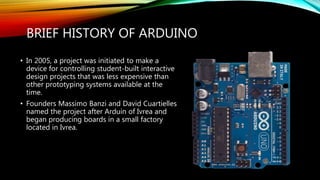
• In 2005, a project was initiated to make a
device for controlling student-built interactive
design projects that was less expensive than
other prototyping systems available at the
time.
• Founders Massimo Banzi and David Cuartielles
named the project after Arduin of Ivrea and
began producing boards in a small factory
located in Ivrea.
ARDUINO MICROCONTROLLER
POWER SUPPLY CIRCUIT
• An AC source, a transformer, and a bridge
rectifier (full diode bridge) can turn an AC "wall"
source into a usable DC source for low-voltage
electronics.
• A rectifier is a device that converts an AC signal
into DC signal.
• For rectification purpose we use a diode, a
diode is a device that allows current to pass
only in one direction i.e. when the anode of the
diode is positive with respect to the cathode
also called as forward biased condition &
blocks current in the reversed biased condition.
ARDUINO IDE 1.0.1
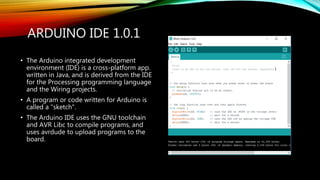
• The Arduino integrated development
environment (IDE) is a cross-platform app.
written in Java, and is derived from the IDE
for the Processing programming language
and the Wiring projects.
• A program or code written for Arduino is
called a "sketch".
• The Arduino IDE uses the GNU toolchain
and AVR Libc to compile programs, and
uses avrdude to upload programs to the
board.
SERVO MOTOR
• Servo Connector:
 Black – Vss
 Red – Vdd or Vin
 White – Signal
• Servos are controlled by sending them a pulse of
variable width. The control wire is used to send this
pulse.
• The parameters for this pulse are that it has a
minimum pulse, a maximum pulse, and a repetition
rate. Given the rotation constraints of the servo,
neutral is defined to be the position where the
servo has exactly the same amount of potential
rotation in the clockwise direction as it does in the
counter clockwise direction.
• It is important to note that different servos will have
different constraints on their rotation but they all
have a neutral position, and that position is always
around 1.5 milliseconds (ms).
SUMMARY
• The pantograph leg design has proven popular for a number of different legged
robots appearing in the literature. The pantograph mechanism consists of a simple
four bar parallelogram mechanism.
• This simplifies the kinematics associated with the mechanism and thereby reduces
the computational complexity of the control (see figure below). The workspace of
the leg shows that with this configuration there is still some coupling of the end
effecter motion, which results in the curved trajectories of the foot evident in the
figure. It simplifies geometry.
• walking especially is now a focus of fore front research as it poses a challenge in
front of the technological capabilities of man. In developing robots to work in
human environments, human like walking seems the most appropriate form of
locomotion as the robot has to move around in an environment with obstacles and
climb up and down stairs.
THE GALLERY
4 legged walking robot

4 legged walking robot

  • 1.
    4 LEGGED WALKINGROBOT By:- V.RAVI KUMAR
  • 2.
    TITLE AND CONTENT •What is robot? • Why and when we need a robot ? • About project? • Hardware and software specifications • What is an Arduino • Arduino IDE 1.0.1 • Servo Motor • Summary • The Gallery
  • 3.
    WHAT IS AROBOT? • A robot is a machine designed to execute one or more tasks automatically with speed and precision. There are as many different types of robots as there are tasks for them to perform. • An autonomous robot acts as a stand-alone system, complete with its own computer. • The most advanced example is the smart robot, which has a built-in artificial intelligence system that can learn from its environment and its experience and build on its capabilities based on that knowledge.
  • 4.
    WHY AND WHENWE NEED A ROBOT ? • Robots work without breaks or the need to sleep or eat, allowing manufactures to streamline processes and improve output. • The world needs robots for a countless number of reasons, including hazardous jobs and automated manufacturing. • Robots are employed in roles ranging from cleaning up dangerous waste and chemical spills to disarming bombs and protecting soldiers in the field. • New, humanoid robots and "exo-suits," originally designed for military use, are now being developed in the private sector for uses ranging from manual labor to helping those with handicaps and mobility issues.
  • 5.
    ABOUT PROJECT? • Thisproject design of the leg drive mechanisms, hardware architecture and the leg control methods for walking machines. The body of knowledge that applies robots is quite well developed. • The difficulty factor in building a legged robot is also considerably higher than that for a wheeled robot. • In designing a walking robot, a power supply issue must be considered, which is the required power to generate movement of the joint using a servomotor and the required of a suitable algorithm to enable the robot to move. • In addition, the use of suitable devices to allow users to move the robot also should be considered. The objective of this study is to develop the walking robot using minimum number of servomotor. • The minimum number of servomotor allows the walking robot to minimize the power consumption while construct a program that can produce coordination of multi-degree of freedom for the movement of the robot.
  • 6.
    HARDWARE AND SOFTWARESPECIFICATIONS • ARDUINO UNO • Servo Motor • Power Supply/Battery • ARDUINO IDE Software • Servo Motor
  • 7.
    WHAT IS ARDUINO? • Arduino is an open-source electronics prototyping platform/environment . • The Arduino is built for designers and artists—people with little technical expertise. • The Arduino Uno can be programmed with the Arduino software IDE . • The Atmega328 on the Arduino Uno comes preburned with a Bootloader that allows you to upload new code to it without the use of an external hardware programmer. • You can also bypass the Bootloader and program the microcontroller through the ICSP (In-Circuit Serial Programming) header. • Arduino IDE works on windows , linux as well as Mac lion X platforms.
  • 8.
    BRIEF HISTORY OFARDUINO • In 2005, a project was initiated to make a device for controlling student-built interactive design projects that was less expensive than other prototyping systems available at the time. • Founders Massimo Banzi and David Cuartielles named the project after Arduin of Ivrea and began producing boards in a small factory located in Ivrea.
  • 9.
  • 11.
    POWER SUPPLY CIRCUIT •An AC source, a transformer, and a bridge rectifier (full diode bridge) can turn an AC "wall" source into a usable DC source for low-voltage electronics. • A rectifier is a device that converts an AC signal into DC signal. • For rectification purpose we use a diode, a diode is a device that allows current to pass only in one direction i.e. when the anode of the diode is positive with respect to the cathode also called as forward biased condition & blocks current in the reversed biased condition.
  • 12.
    ARDUINO IDE 1.0.1 •The Arduino integrated development environment (IDE) is a cross-platform app. written in Java, and is derived from the IDE for the Processing programming language and the Wiring projects. • A program or code written for Arduino is called a "sketch". • The Arduino IDE uses the GNU toolchain and AVR Libc to compile programs, and uses avrdude to upload programs to the board.
  • 13.
    SERVO MOTOR • ServoConnector:  Black – Vss  Red – Vdd or Vin  White – Signal • Servos are controlled by sending them a pulse of variable width. The control wire is used to send this pulse. • The parameters for this pulse are that it has a minimum pulse, a maximum pulse, and a repetition rate. Given the rotation constraints of the servo, neutral is defined to be the position where the servo has exactly the same amount of potential rotation in the clockwise direction as it does in the counter clockwise direction. • It is important to note that different servos will have different constraints on their rotation but they all have a neutral position, and that position is always around 1.5 milliseconds (ms).
  • 14.
    SUMMARY • The pantographleg design has proven popular for a number of different legged robots appearing in the literature. The pantograph mechanism consists of a simple four bar parallelogram mechanism. • This simplifies the kinematics associated with the mechanism and thereby reduces the computational complexity of the control (see figure below). The workspace of the leg shows that with this configuration there is still some coupling of the end effecter motion, which results in the curved trajectories of the foot evident in the figure. It simplifies geometry. • walking especially is now a focus of fore front research as it poses a challenge in front of the technological capabilities of man. In developing robots to work in human environments, human like walking seems the most appropriate form of locomotion as the robot has to move around in an environment with obstacles and climb up and down stairs.
  • 15.