By: Khemant Kumar Naik
Roll No: 08635
Guide: Banchha Nidhi Das
INTRODUCTION
• Self healing robots have ability to heal minor injuries.
• A robot is able to study its own structure through self
directed exploration.
• The concept used is multiple competing internal models and
generation of actions
THE STARFISH ROBOT-CHARACTERIZING
THE TARGET SYSTEM
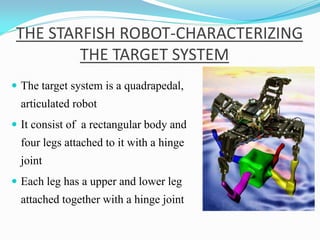
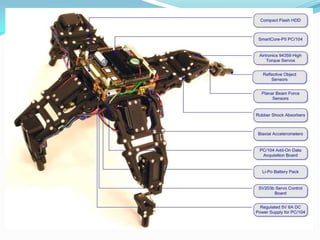
 The target system is a quadrapedal,
articulated robot
 It consist of a rectangular body and
four legs attached to it with a hinge
joint
 Each leg has a upper and lower leg
attached together with a hinge joint
• All eight hinge joints are actuated with high torque
servomotors
• Servo drives capable of producing max 200 ounceinches
of torque and 60o per second speed
• Robot can automatically synthesize predictive models of
its own topology
• Equipped with suite of different sensors
SELF MODELLING CHALLENGES
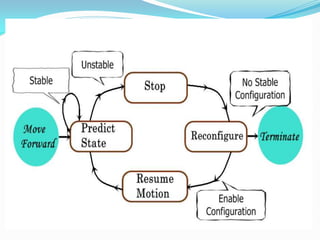
• Robots depend on internal maps and sensory data to
update their location
• In a changing environment the robot has to navigate with
uncertainty
• Situation becomes even worse if the robot’s own shape
and configuration can change
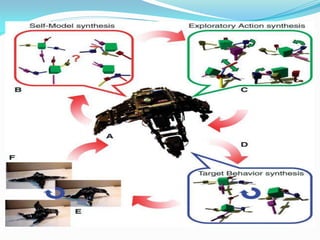
PHASES IN SELF HEALING
 Self –Model synthesis
 Exploratory Action synthesis
 Target Behaviour synthesis
STEPS INVOLVED….
 Exploration phase: Controller evolution
 Physical robot failure
 Estimation Phase: Damage hypothesis evolution
EXPERIMENTAL SETUP
 The quadrapedal robot has eight degrees of freedom
 Two one degree of freedom rotational joints per leg:
one at the shoulder and one at knee
 It has 4 binary touch sensors and also 4 angle sensors
 All joints are actuated by a torsional motor
THE CONTROLLERS
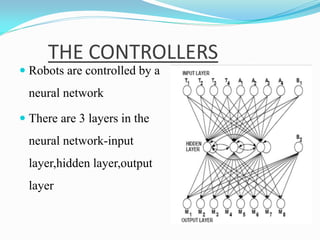
 Robots are controlled by a
neural network
 There are 3 layers in the
neural network-input
layer,hidden layer,output
layer
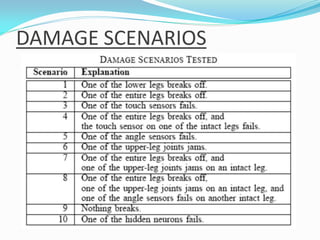
DAMAGE SCENARIOS
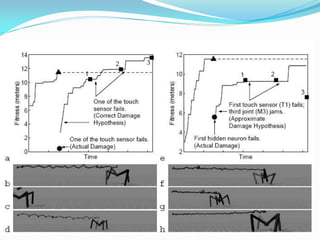
DAMAGE RECOVERIES
Disadvantages …
 Creation of working model is costly
 Designing is complex and time taking
 Yet a perfect industrial model is not produced
Conclusion
 Although the possibility of autonomous self-modeling
has been suggested, it has much to perfect
 The robot's abilities suggest a similarity to human
thinking as the robot tries out various actions to figure
out the shape of its world.
 This suggests that future machines may be able to
continually detect changes in their own morphology or
structure
Reference …
 www.jyoti.debashish.info
 www.scribd.com
 http://en.wikipedia.org/wiki/Self-Reconfiguring_
Modular_Robotics
 http://ccsl.mae.cornell.edu/research/selfmodels/
Thank You
Any Queries ?

Self healing robots

  • 1.
    By: Khemant KumarNaik Roll No: 08635 Guide: Banchha Nidhi Das
  • 2.
    INTRODUCTION • Self healingrobots have ability to heal minor injuries. • A robot is able to study its own structure through self directed exploration. • The concept used is multiple competing internal models and generation of actions
  • 3.
    THE STARFISH ROBOT-CHARACTERIZING THETARGET SYSTEM  The target system is a quadrapedal, articulated robot  It consist of a rectangular body and four legs attached to it with a hinge joint  Each leg has a upper and lower leg attached together with a hinge joint
  • 4.
    • All eighthinge joints are actuated with high torque servomotors • Servo drives capable of producing max 200 ounceinches of torque and 60o per second speed • Robot can automatically synthesize predictive models of its own topology • Equipped with suite of different sensors
  • 5.
    SELF MODELLING CHALLENGES •Robots depend on internal maps and sensory data to update their location • In a changing environment the robot has to navigate with uncertainty • Situation becomes even worse if the robot’s own shape and configuration can change
  • 6.
    PHASES IN SELFHEALING  Self –Model synthesis  Exploratory Action synthesis  Target Behaviour synthesis
  • 9.
    STEPS INVOLVED….  Explorationphase: Controller evolution  Physical robot failure  Estimation Phase: Damage hypothesis evolution
  • 10.
    EXPERIMENTAL SETUP  Thequadrapedal robot has eight degrees of freedom  Two one degree of freedom rotational joints per leg: one at the shoulder and one at knee  It has 4 binary touch sensors and also 4 angle sensors  All joints are actuated by a torsional motor
  • 12.
    THE CONTROLLERS  Robotsare controlled by a neural network  There are 3 layers in the neural network-input layer,hidden layer,output layer
  • 13.
  • 14.
  • 15.
    Disadvantages …  Creationof working model is costly  Designing is complex and time taking  Yet a perfect industrial model is not produced
  • 16.
    Conclusion  Although thepossibility of autonomous self-modeling has been suggested, it has much to perfect  The robot's abilities suggest a similarity to human thinking as the robot tries out various actions to figure out the shape of its world.  This suggests that future machines may be able to continually detect changes in their own morphology or structure
  • 17.
    Reference …  www.jyoti.debashish.info www.scribd.com  http://en.wikipedia.org/wiki/Self-Reconfiguring_ Modular_Robotics  http://ccsl.mae.cornell.edu/research/selfmodels/
  • 18.