The hexapod robot project aims to develop a six-legged robot capable of traversing rough terrain and operated via Bluetooth, providing applications in disaster zones and hostile environments. The presentation covers the robot's design, including leg mechanics, components, and programming using an Arduino microcontroller to control servomotors for movement. The project emphasizes enhanced stability and functionality compared to traditional wheeled robots, showcasing their utility in various challenging scenarios.
1
HEXAPOD ROBOT
PROJECT PRESENTATION
ELECTRONICSENGINEERING DEPARTMENT
GUIDED BY: PRESENTED BY
Er. POOJA GUPTA GROUP NO. 13:
SHIV KUMAR RAI (1505232039)
SHUBHAM SINGH (1505232041)
SHWETA YADAV (1505232043)
2.
CONTENTS
2
OBJECTIVE
INTRODUCTION
SCHEMATIC OF HEXAPOD
LEG DESIGN
COMPONENTS REQUIRED
BLOCK DIAGRAM
WORKING
ARDUINO UNO
SERVOMOTOR
SERVOMOTOR WORKING AND PROGRAMMING
CONCLUSION
MAIN PROGRAM
OPERATION VIDEOS
REFERENCES
3.
OBJECTIVE
3
To createa base hexapod platform which can traverse on rough
terrain
Purpose of the project - Six legged walking robot
The hexapod robot is to be controlled by Bluetooth
Hexapod can be very useful in the zones of natural disasters and
also in the after effects of the war scenario
LEG DESIGN
5
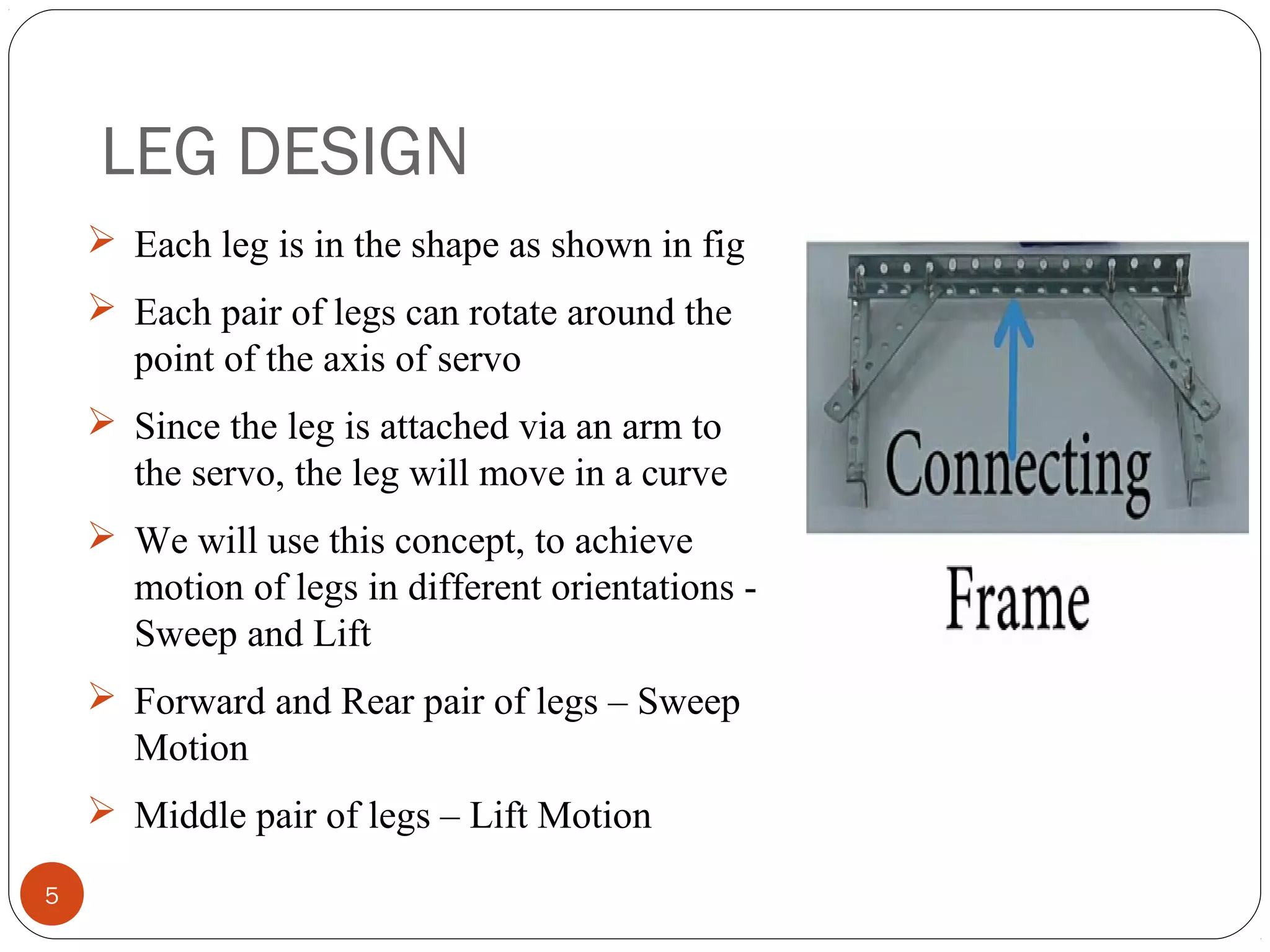
Eachleg is in the shape as shown in fig
Each pair of legs can rotate around the
point of the axis of servo
Since the leg is attached via an arm to
the servo, the leg will move in a curve
We will use this concept, to achieve
motion of legs in different orientations -
Sweep and Lift
Forward and Rear pair of legs – Sweep
Motion
Middle pair of legs – Lift Motion
6.
COMPONENTS REQUIRED
6
Controller: AVR(ATMEGA 328) 8 bit controller
Memory type : Control by using EEPROM in CPU
Servo Motors
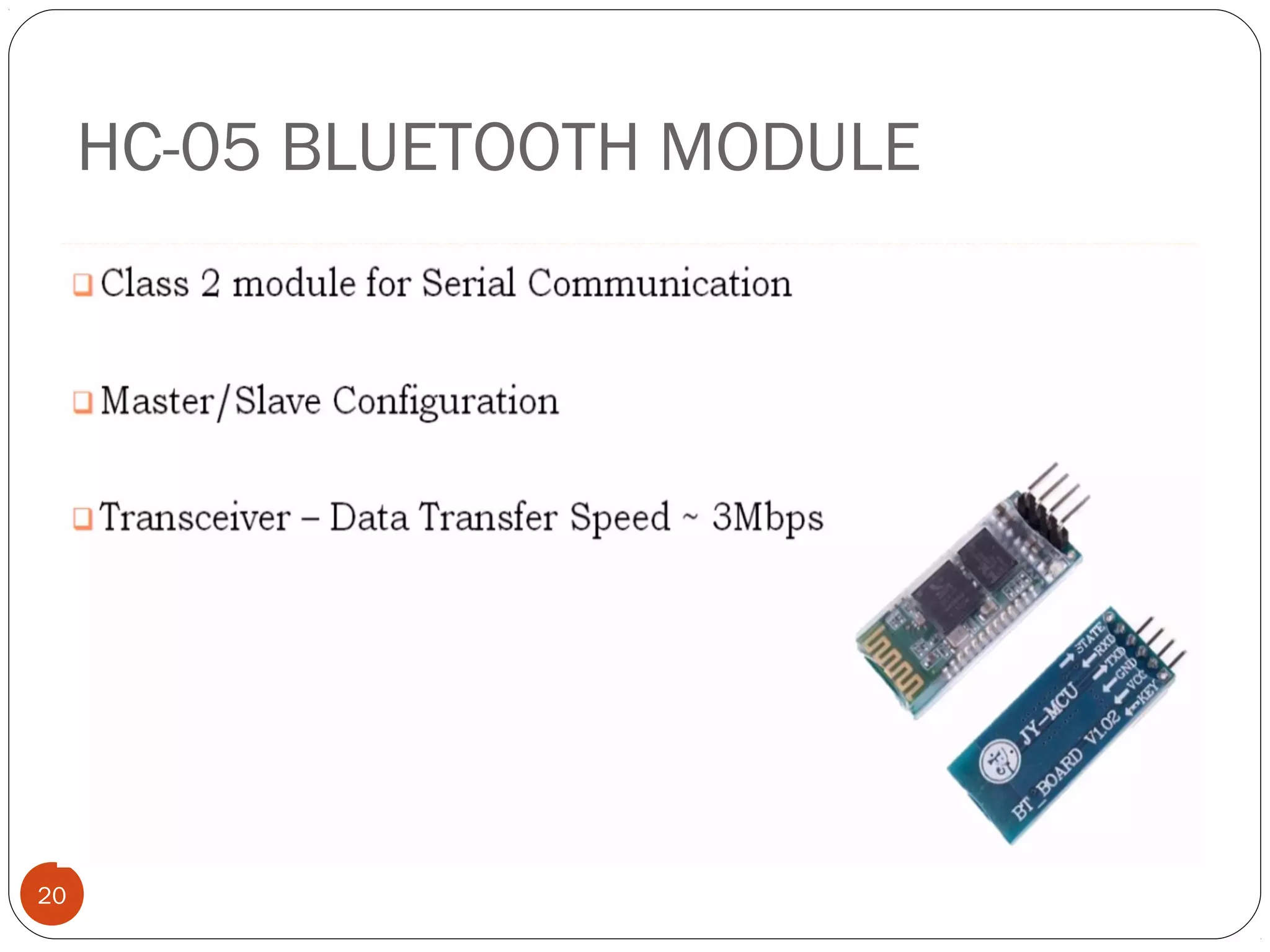
Bluetooth module
External Power supply
WORKING
8
The systemfor controlling the robot relies on the interaction
of three main elements
o Operator
o Physical robot
o Software
A mobile pairs with the Bluetooth
Receives the Commands and sends them to the master
processor
The processor contains all the necessary algorithms such as
Direct Servo control
9.
Arduino UNO
9
Arduinois an open source electronic platform
It is a combination of microcontroller based Arduino board,
Arduino programming language and Arduino software for
development and compilation
The Arduino Uno is a microcontroller board based on the
ATmega328
It has 14 digital input/output pins (of which 6 can be used
as PWM outputs), 6 analog inputs, a 16 MHz crystal
oscillator, a USB connection, a power jack, and a reset
button
10.
Arduino UNO Specifications
10
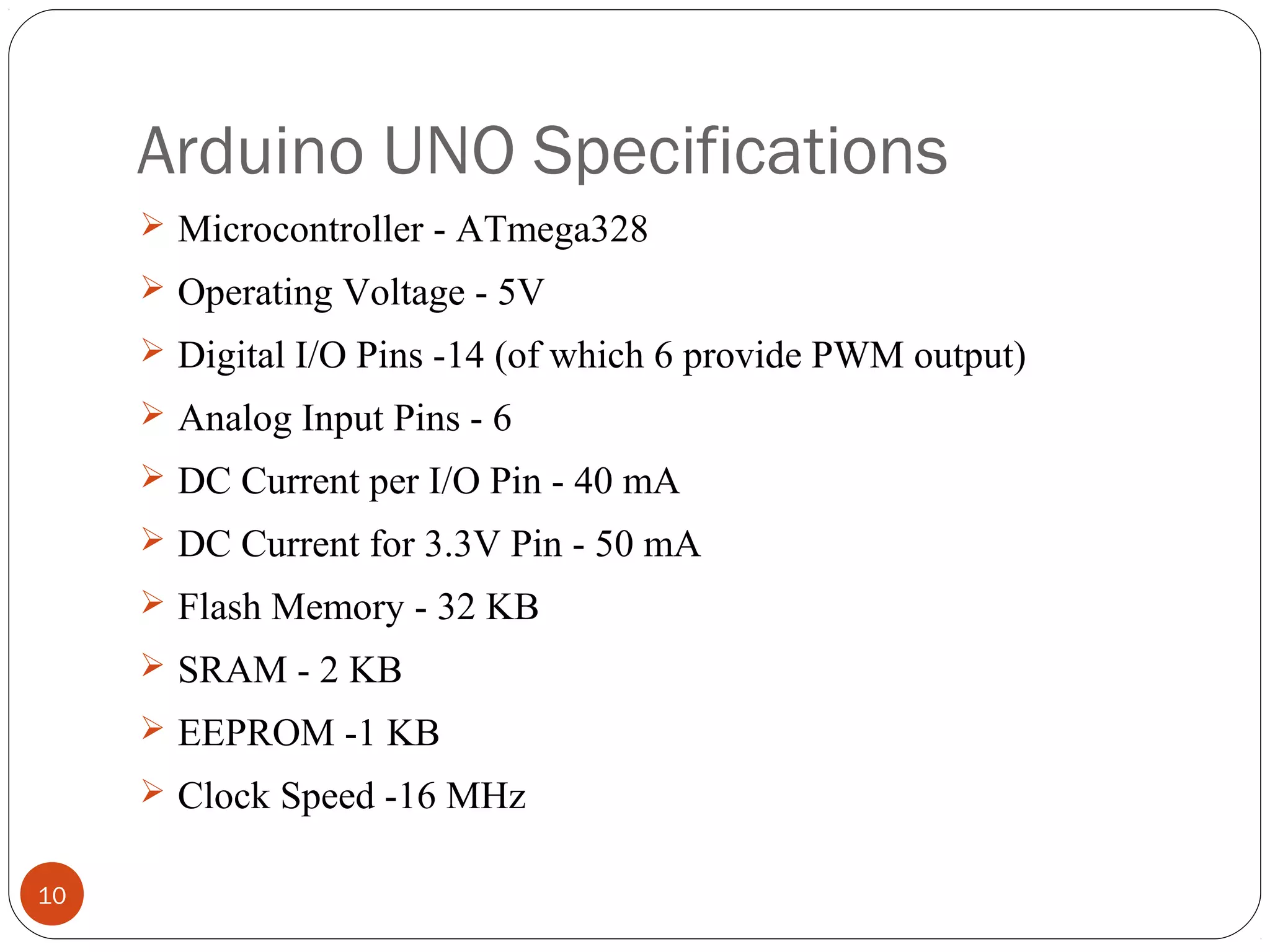
Microcontroller - ATmega328
Operating Voltage - 5V
Digital I/O Pins -14 (of which 6 provide PWM output)
Analog Input Pins - 6
DC Current per I/O Pin - 40 mA
DC Current for 3.3V Pin - 50 mA
Flash Memory - 32 KB
SRAM - 2 KB
EEPROM -1 KB
Clock Speed -16 MHz
ARDUINO PROGRAMMING
12
Codefor Arduino are known as Sketches
Written in C++
Every sketch needs two void type functions :
• Setup()
• Loop()
Void function does not return a value
SERVOMOTOR
14
A servomotoris a rotary actuator that allows for precise control of
angular position
Follows a closed-loop servomechanism that uses position feedback
to control its initial motion and final position
15.
PWM SIGNAL
15
PWMis a modulation technique used to encode
message into pulse form
The width of the pulses vary so that average of the
pulses over different time interval varies like an analog
signal
This technique used for digital device to communicate
with device that uses analog input
PROGRAMMING LOGIC
22
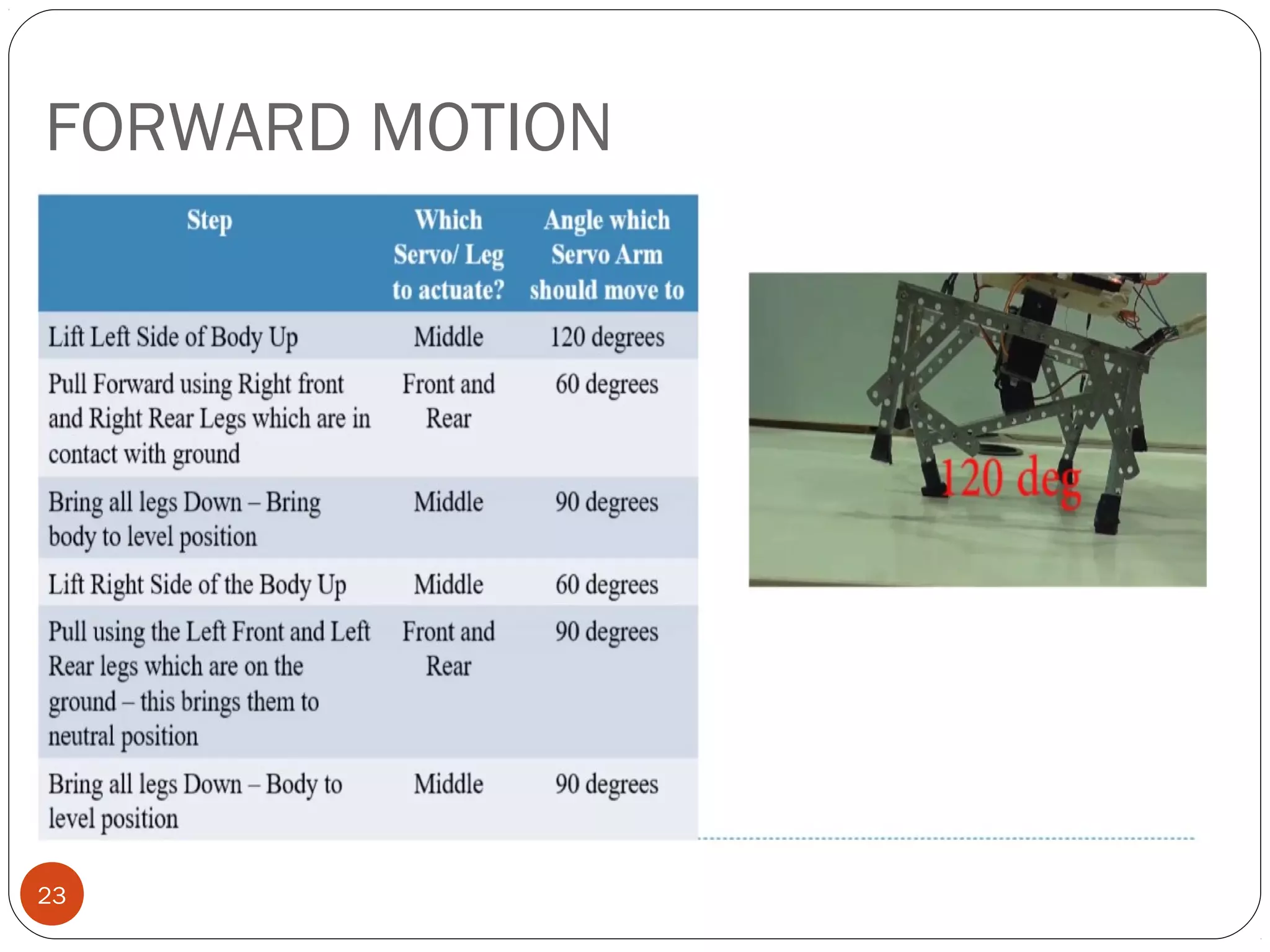
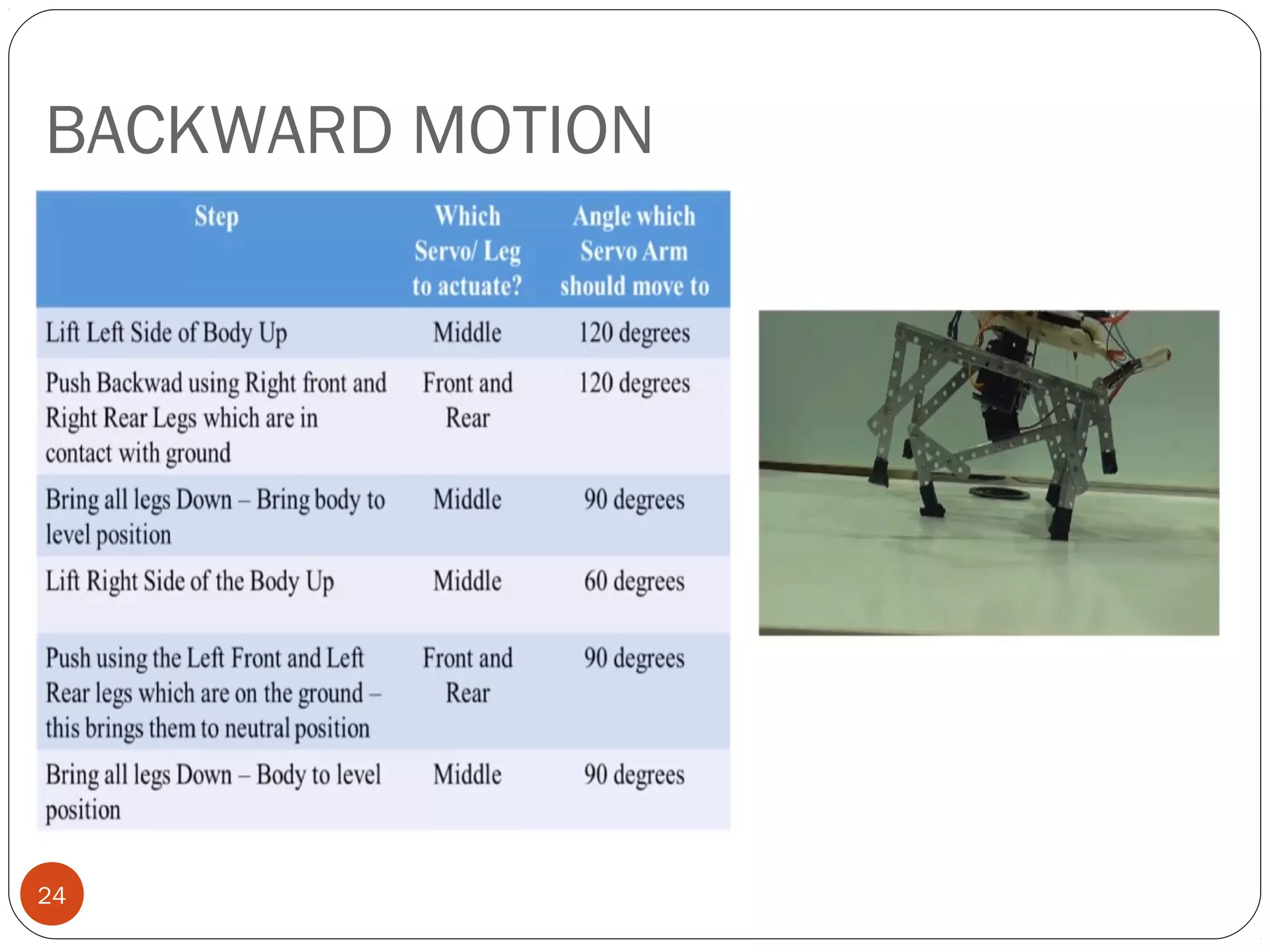
Allof the motions are achieved by a series of steps
Each step is basically a movement of one or more of the servomotors to a
certain angle
Convert crawling strategy into servomotor angles at each step
Write program to move servomotors to those angles
Determine the angles which servomotors should move to in each step
All servos are at 90 degrees to begin with(Zero Setting – initial
condition)
Delay commands needed
APPLICATION
25
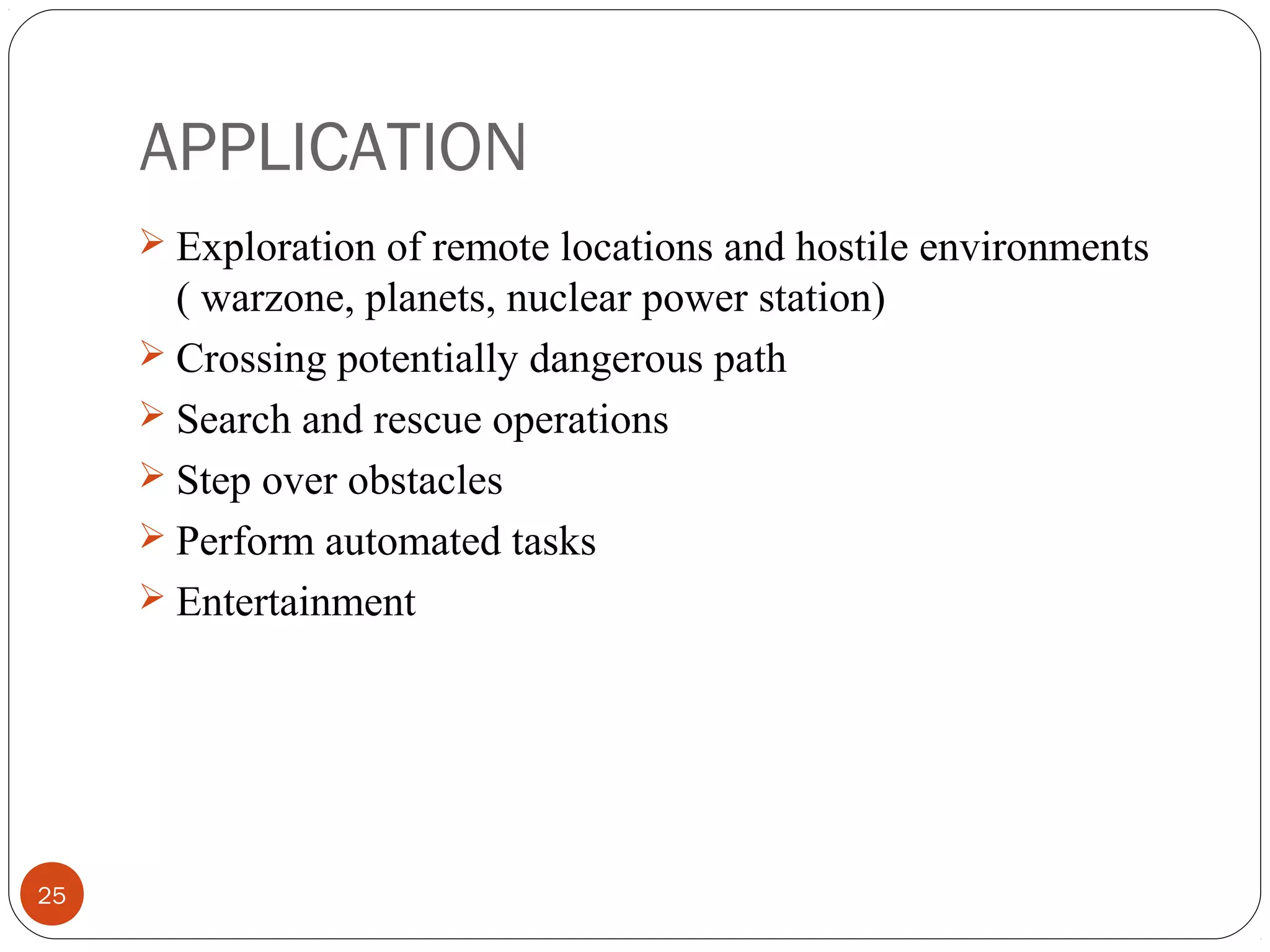
Exploration ofremote locations and hostile environments
( warzone, planets, nuclear power station)
Crossing potentially dangerous path
Search and rescue operations
Step over obstacles
Perform automated tasks
Entertainment
26.
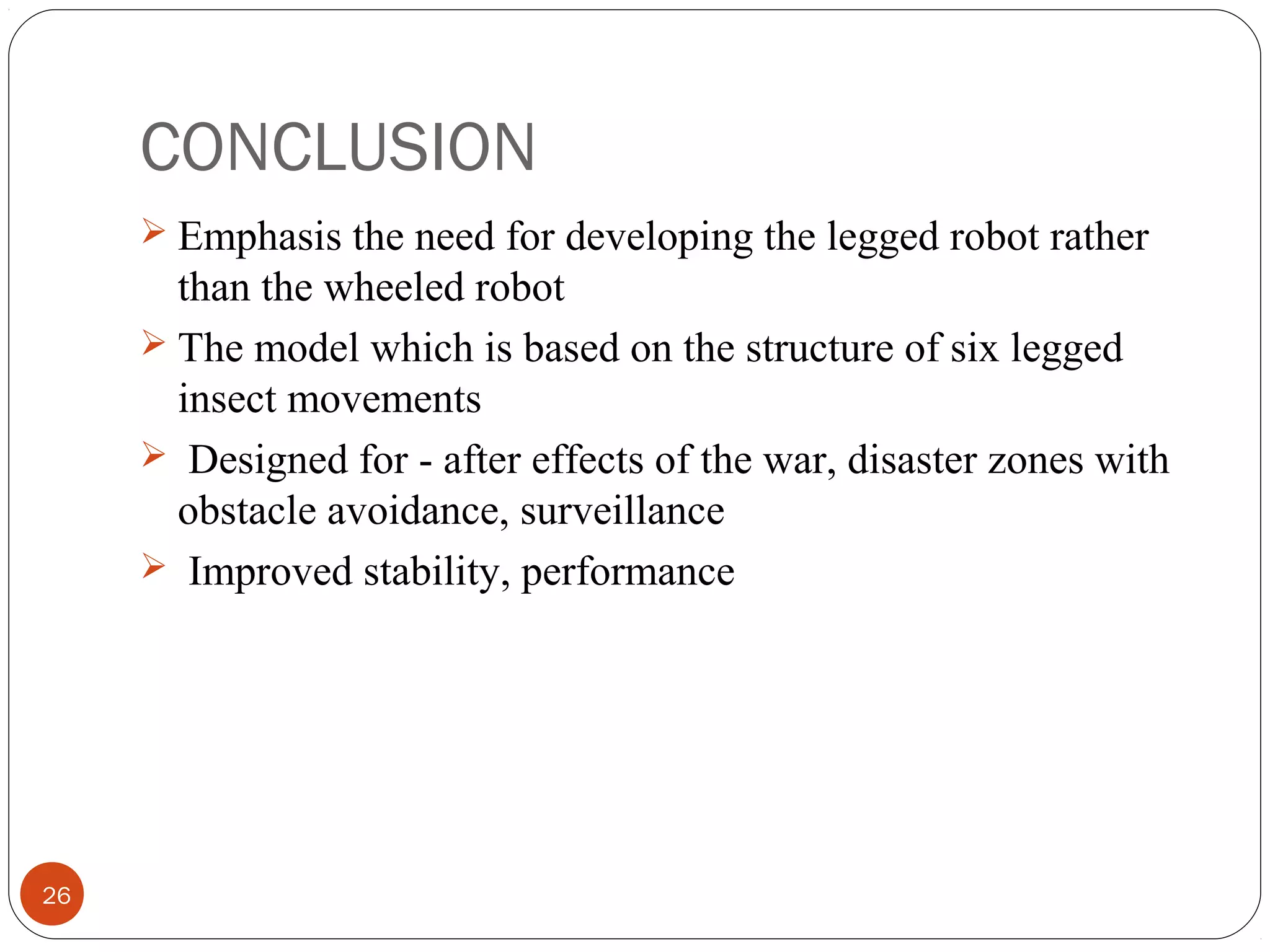
CONCLUSION
26
Emphasis theneed for developing the legged robot rather
than the wheeled robot
The model which is based on the structure of six legged
insect movements
Designed for - after effects of the war, disaster zones with
obstacle avoidance, surveillance
Improved stability, performance
27.
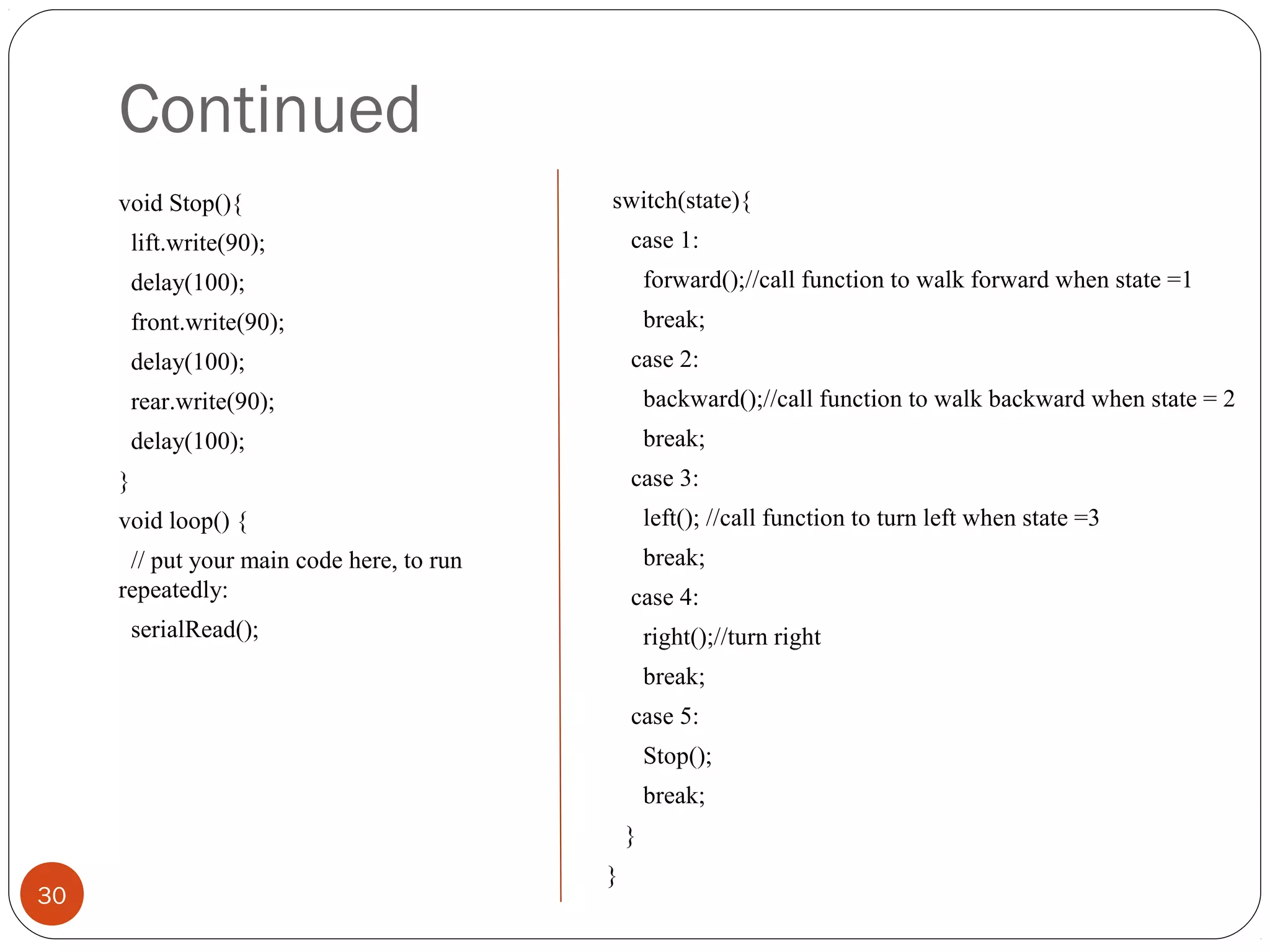
PROGRAM
27
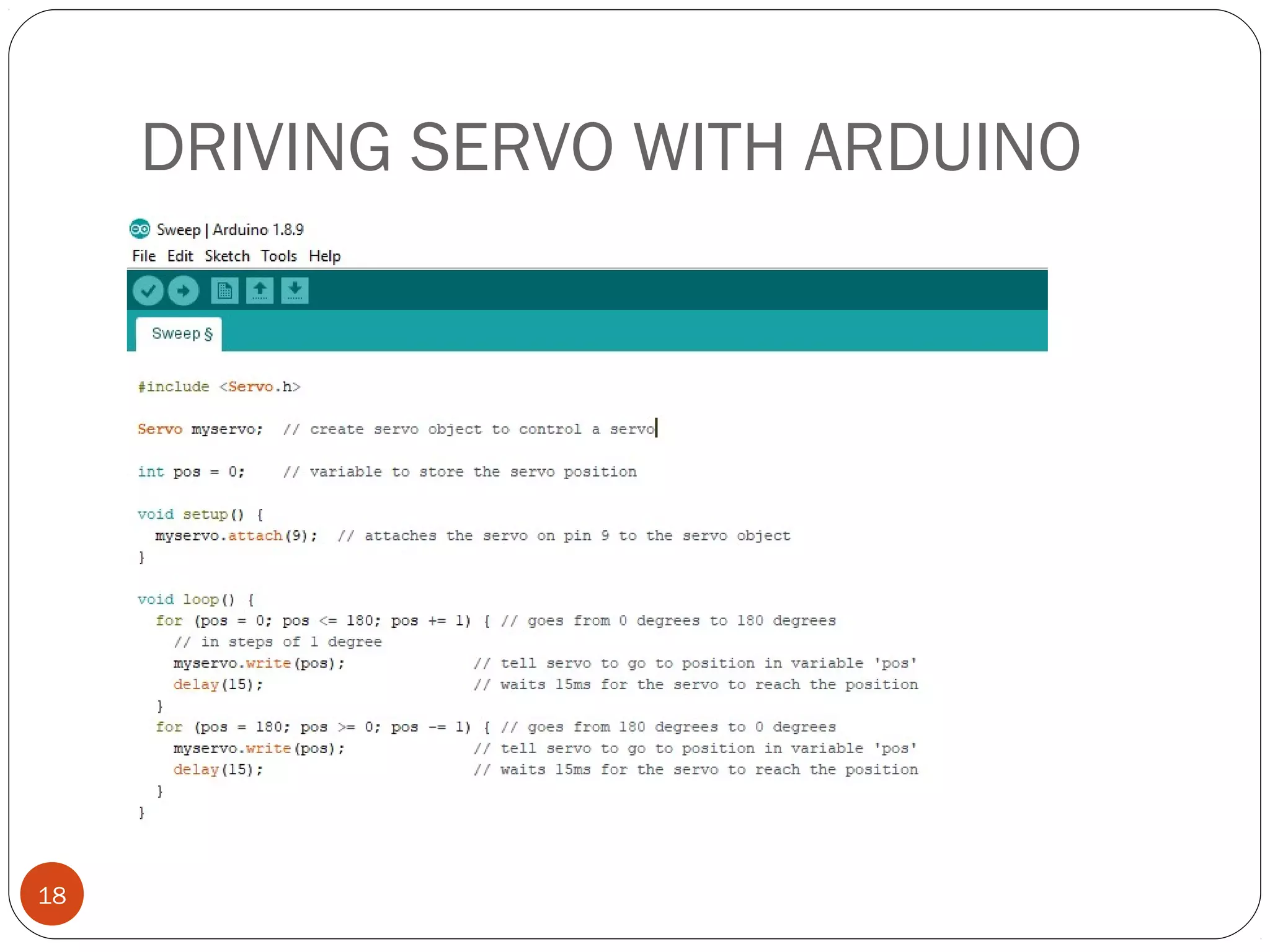
#include <Servo.h>
#include <SoftwareSerial.h>
SoftwareSerialBT(12,13);//TX,RX
respectively
Servo lift;
Servo front;
Servo rear;
String response;
int state;
void setup() {
// put your setup code here, to run once:
Serial.begin(9600);
BT.begin(9600);
lift.attach(10);
rear.attach(11);
front.attach(9);
lift.write(90);
rear.write(90);
front.write(90);
delay(2000);
}
REFERENCE
33
1) Guoliang Zhong,member, Long Chen and Hua Deng, “A performance
oriented novel design of hexapod robot”, IEEE/ASME Transactions on
Mechatronics, VOL. 22, NO, 3 JUNE 2017
2) Z.Song, H. Ren, J. Zang, and S.S.Ge, “Kinematic analysis and motion control
of wheeled mobile robots in cylindrical workspaces”, IEEE Trans.Autom. Sci.
Eng., vol. 13,no. 2, pp. 1207-1214, Apr. 2016.
3) Tolga Karakurt, Akif Durdu, and Nihat Yilmaz, “Design of Six Legged Spider
Robot and Evolving Walking Algorithms”, International Journal of Machine
Learning and Computing, Vol. 5, No. 2, April 2015
4) M. Z. A. Rashid, M. S. M. Aras, A. A. Radzak, A. M. Kassim and A. Jamali,
“Development of Hexapod Robot with Maneuverable Wheel”, International
Journal of Advanced Science and Technology, Vol. 49. Dec 2012.
5) https://www.skyfilabs.com/online-courses/hexapod-arduino?v1

















![Vibe Coding vs. Spec-Driven Development [Free Meetup]](https://cdn.slidesharecdn.com/ss_thumbnails/vibecodingvsspecdrivendevelopment-251209105622-43f455e7-thumbnail.jpg?width=640&height=640&fit=bounds)


