IEO 2014
Mario Sideri
Ginecologia Preventiva
IEO
Microinvasive and
early invasive
cervical cancer
IEO 2014
Standard treatment for invasive cervical
cancer traditionally includes radical
hysterectomy and pelvic limphoadenectomy.
The rationale of the treatment is the
extirpation of the tumour, with clear
margins, and of the lumphatic vessels.
IEO 2014
There are early tumours with a small
volume in wihich the removal of the
parametrium can be omitted;
in addition in some instances the tumour
volume can be so small that the risk of
lymphnode metastasis is limited, and
pelvic lymphadenectomy can also be
omitted
IEO 2014
Volume  is expressed as lenght and
depth of infiltration of the neoplasia
Categories where conservative approach
is feasible:
IA1 3 mm in depth, 7 mm in lenght, no LVSI
IA2 5 mm in depth, 7 mm in lenght, neg. nodes
IB1< 2 cm in largest diameter neg. nodes
IB1 >2<3 cm in largest diameter, neg. nodes
IEO 2014
Volume  is expressed as lenght and
depth of infiltration of the neoplasia
The measures that define “micoinvasive”
cervical cancer can only be obtained from a
surgical specimen containing the whole lesion.
Colposcopy is critical to help excise all the
lesion in order to define the diagnosis
IEO 2014
Main reasons for cervical cancer
declining mortality:
• Cervical cancer screening programs
• Intraepithelial lesions (CIN) detection
• CIN therapy
IEO 2014
Conservative therapy
Accurate pre-surgical
evaluation of the lesion
Chappatte, Gynecol. Oncol. 1991
IEO 2014
Citology,Colposcopy,Histology
Key role in:
• Grading
• Size definition of the lesion
• Identification of early invasive
disease
IEO 2014
Failure after excisional CIN
treatment
Incorrect assessment of
the lesion
Luesley, Br. J. Obstet. Gynecol. 1985
Buxton, Br. J. Obstet. Gynecol. 1991
IEO 2014
END POINT
To verify the predictive value of
multiple tests in CIN pre-surgical
assessment
• avoid under/over treatment
• schedule proper follow-up
• prevent risk for disease persistence
IEO 2014
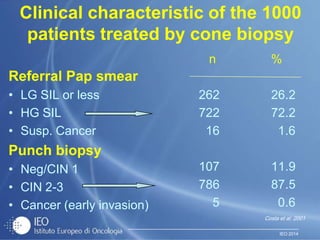
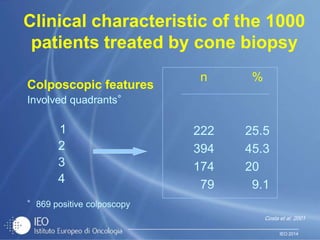
Clinical characteristic of the 1000
patients treated by cone biopsy
Referral Pap smear
• LG SIL or less
• HG SIL
• Susp. Cancer
Punch biopsy
• Neg/CIN 1
• CIN 2-3
• Cancer (early invasion)
n %
262 26.2
722 72.2
16 1.6
107 11.9
786 87.5
5 0.6
Costa et al. 2001
IEO 2014
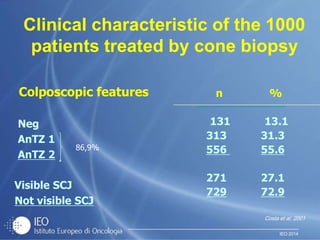
Clinical characteristic of the 1000
patients treated by cone biopsy
Colposcopic features
Neg
AnTZ 1
AnTZ 2
Visible SCJ
Not visible SCJ
n %
131 13.1
313 31.3
556 55.6
271 27.1
729 72.9
86,9%
Costa et al. 2001
IEO 2014
Clinical characteristic of the 1000
patients treated by cone biopsy
Colposcopic features
Involved quadrants°
1
2
3
4
°869 positive colposcopy
n %
222 25.5
394 45.3
174 20
79 9.1
Costa et al. 2001
IEO 2014
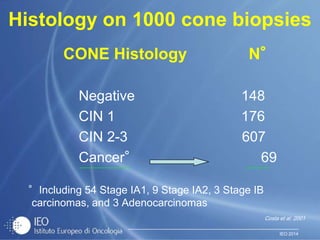
Histology on 1000 cone biopsies
CONE Histology N°
Negative 148
CIN 1 176
CIN 2-3 607
Cancer° 69
°Including 54 Stage IA1, 9 Stage IA2, 3 Stage IB
carcinomas, and 3 Adenocarcinomas
Costa et al. 2001
IEO 2014
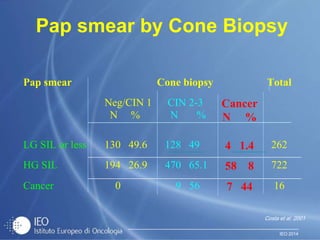
Pap smear by Cone Biopsy
Pap smear Cone biopsy Total
Neg/CIN 1
N %
CIN 2-3
N %
Cancer
N %
LG SIL or less 130 49.6 128 49 4 1.4 262
HG SIL 194 26.9 470 65.1 58 8 722
Cancer 0 9 56 7 44 16
Costa et al. 2001
IEO 2014
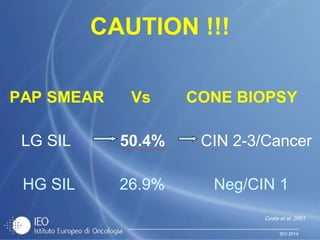
CAUTION !!!
PAP SMEAR Vs CONE BIOPSY
LG SIL 50.4% CIN 2-3/Cancer
HG SIL 26.9% Neg/CIN 1
Costa et al. 2001
IEO 2014
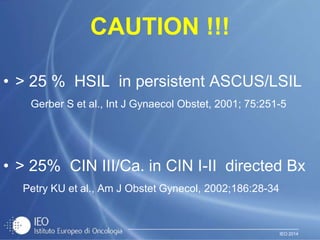
CAUTION !!!
• > 25 % HSIL in persistent ASCUS/LSIL
Gerber S et al., Int J Gynaecol Obstet, 2001; 75:251-5
• > 25% CIN III/Ca. in CIN I-II directed Bx
Petry KU et al., Am J Obstet Gynecol, 2002;186:28-34
IEO 2014
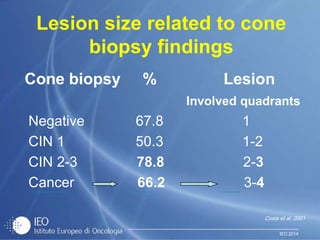
Lesion size related to cone
biopsy findings
Cone biopsy % Lesion
Involved quadrants
Negative 67.8 1
CIN 1 50.3 1-2
CIN 2-3 78.8 2-3
Cancer 66.2 3-4
Costa et al. 2001
IEO 2014
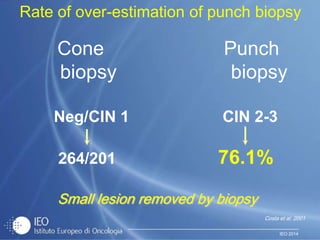
Cone Punch
biopsy biopsy
Neg/CIN 1 CIN 2-3
264/201 76.1%
Small lesion removed by biopsy
Rate of over-estimation of punch biopsy
Costa et al. 2001
IEO 2014
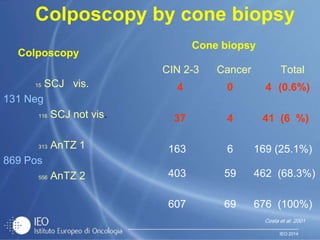
Colposcopy by cone biopsy
Colposcopy
15 SCJ vis.
131 Neg
116 SCJ not vis.
313 AnTZ 1
869 Pos
556 AnTZ 2
Cone biopsy
CIN 2-3 Cancer Total
4 0 4 (0.6%)
37 4 41 (6 %)
163 6 169 (25.1%)
403 59 462 (68.3%)
607 69 676 (100%)
Costa et al. 2001
IEO 2014
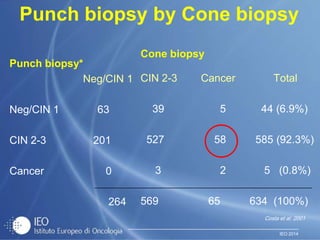
Punch biopsy by Cone biopsy
Punch biopsy*
Neg/CIN 1
Neg/CIN 1 63
CIN 2-3 201
Cancer 0
264
Cone biopsy
CIN 2-3 Cancer Total
39 5 44 (6.9%)
527 58 585 (92.3%)
3 2 5 (0.8%)
569 65 634 (100%)
Costa et al. 2001
IEO 2014
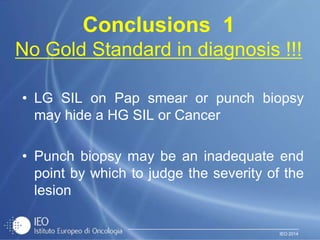
Conclusions 1
No Gold Standard in diagnosis !!!
• LG SIL on Pap smear or punch biopsy
may hide a HG SIL or Cancer
• Punch biopsy may be an inadequate end
point by which to judge the severity of the
lesion
IEO 2014
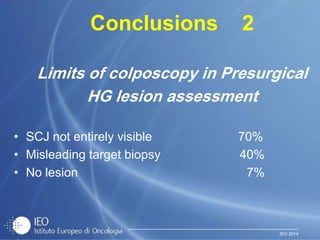
Conclusions 2
Limits of colposcopy in Presurgical
HG lesion assessment
• SCJ not entirely visible 70%
• Misleading target biopsy 40%
• No lesion 7%
IEO 2014
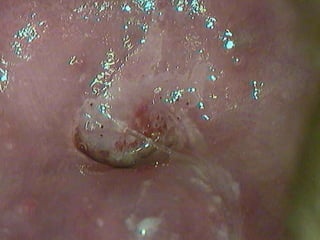
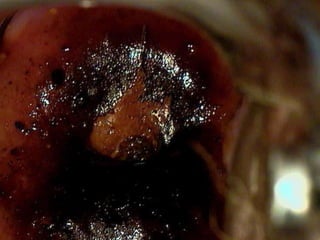
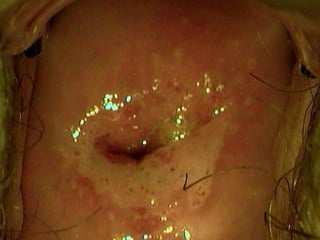
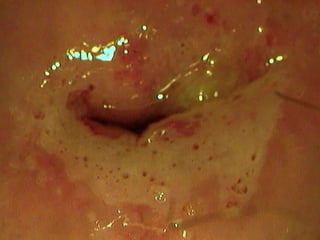
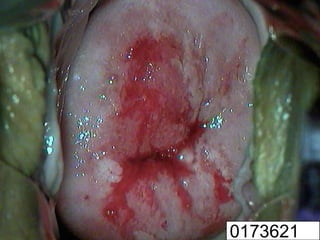
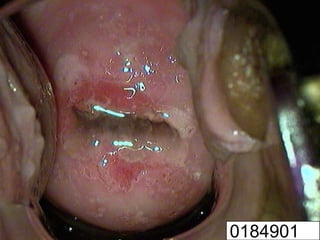
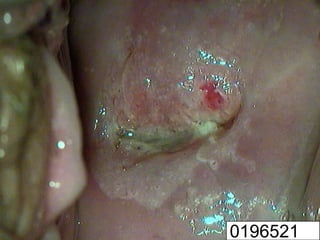
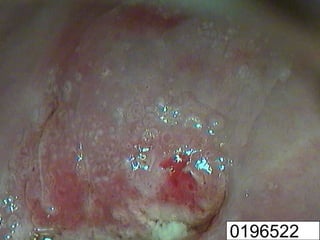
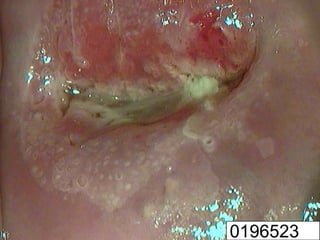
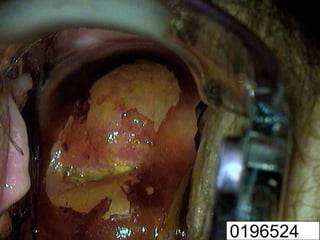
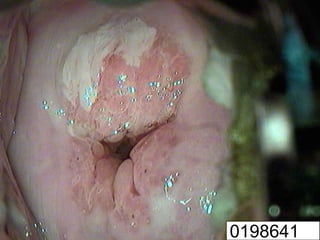
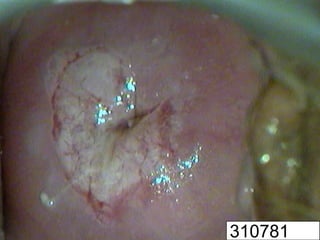
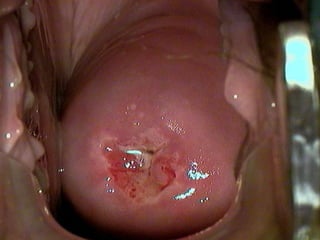
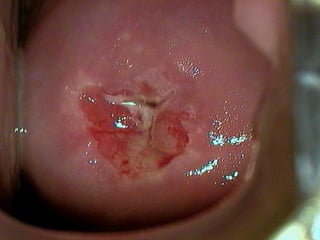
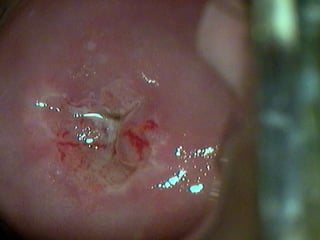
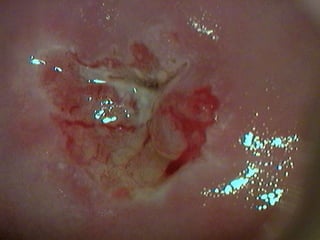
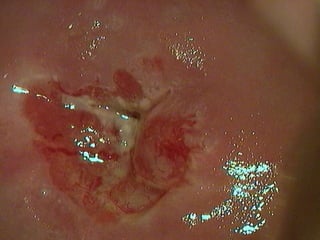
H-SIL and microinvasive
cervical cancers
IEO 2014
IEO 2014
IEO 2014
IEO 2014
IEO 20140173621
IEO 20140184901
IEO 20140196521
IEO 20140196522
IEO 20140196523
IEO 20140196524
IEO 20140198641
IEO 2014310781
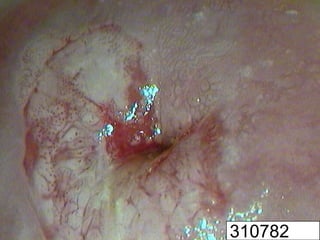
IEO 2014310782
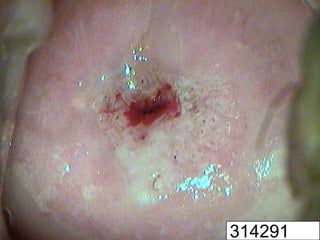
IEO 2014314291
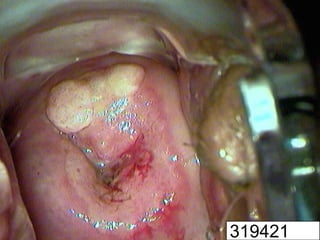
IEO 2014319421
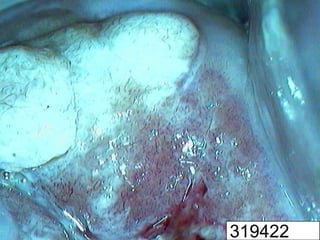
IEO 2014319422
IEO 2014
IEO 2014
IEO 2014
IEO 2014
IEO 2014
IEO 2014
Open Question
In stage Ib1 cervical cancer is
the removal of parametria
always necessary even in case
of minimal involvement?
IEO 2014
IEO 2014
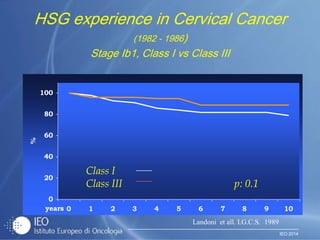
HSG experience in Cervical Cancer
(1982 - 1986)
Stage Ib1, Class I vs Class III
0
20
40
60
80
100
0 1 2 3 4 5 6 7 8 9 10years
%
Class I
Class III p: 0.1
Landoni et all. I.G.C.S. 1989
IEO 2014
0
20
40
60
80
100
0 1 2 3 4 5 6 7 8 9 10years
%
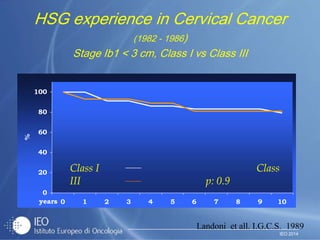
Class I Class
III p: 0.9
Landoni et all. I.G.C.S. 1989
HSG experience in Cervical Cancer
(1982 - 1986)
Stage Ib1 < 3 cm, Class I vs Class III
IEO 2014
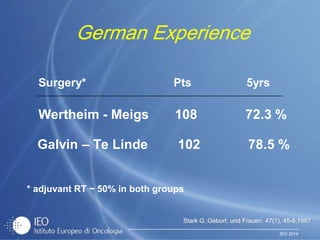
German Experience
Surgery* Pts 5yrs
Wertheim - Meigs 108 72.3 %
Galvin – Te Linde 102 78.5 %
* adjuvant RT ~ 50% in both groups
Stark G.:Geburt. und Frauen. 47(1), 45-8,1987
IEO 2014
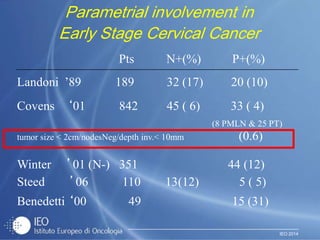
Pts N+(%) P+(%)
Landoni ’89 189 32 (17) 20 (10)
Covens ‘01 842 45 ( 6) 33 ( 4)
(8 PMLN & 25 PT)
tumor size < 2cm/nodesNeg/depth inv.< 10mm (0.6)
Winter ’01 (N-) 351 44 (12)
Steed ’06 110 13(12) 5 ( 5)
Benedetti ‘00 49 15 (31)
Parametrial involvement in
Early Stage Cervical Cancer
IEO 2014
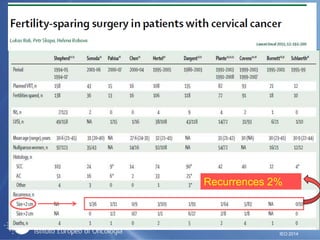
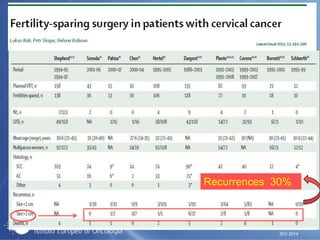
Recurrences 2%
IEO 2014
Recurrences 30%
IEO 2014
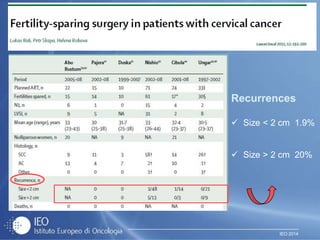
Recurrences
 Size < 2 cm 1.9%
 Size > 2 cm 20%
IEO 2014
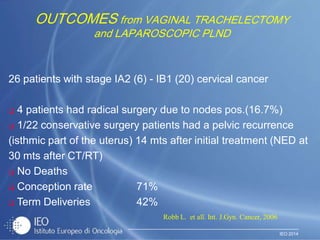
26 patients with stage IA2 (6) - IB1 (20) cervical cancer
 4 patients had radical surgery due to nodes pos.(16.7%)
 1/22 conservative surgery patients had a pelvic recurrence
(isthmic part of the uterus) 14 mts after initial treatment (NED at
30 mts after CT/RT)
 No Deaths
 Conception rate 71%
 Term Deliveries 42%
OUTCOMES from VAGINAL TRACHELECTOMY
and LAPAROSCOPIC PLND
Robb L. et all. Int. J.Gyn. Cancer, 2006
IEO 2014
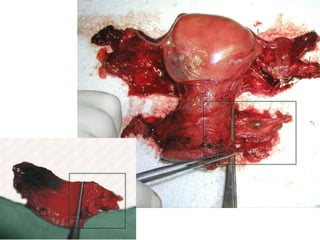
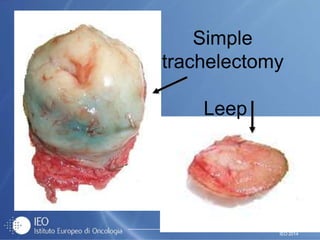
Simple
trachelectomy
Leep
IEO 2014
IEO Study Design
Conservative treatment for Stage IA2-IB1
cervical cancer patients
IEO 2014
IEO Study design
Patients will be stratified in two categories based
on the tumor diameter
Patients with tumor diameter < 2cm
Patients with tumor diameter >2cm<3cm
IEO 2014
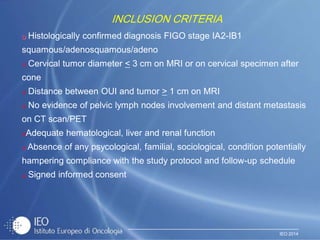
 Histologically confirmed diagnosis FIGO stage IA2-IB1
squamous/adenosquamous/adeno
 Cervical tumor diameter < 3 cm on MRI or on cervical specimen after
cone
 Distance between OUI and tumor > 1 cm on MRI
 No evidence of pelvic lymph nodes involvement and distant metastasis
on CT scan/PET
Adequate hematological, liver and renal function
 Absence of any psycological, familial, sociological, condition potentially
hampering compliance with the study protocol and follow-up schedule
 Signed informed consent
INCLUSION CRITERIA
IEO 2014
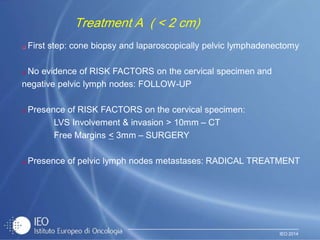
 First step: cone biopsy and laparoscopically pelvic lymphadenectomy
 No evidence of RISK FACTORS on the cervical specimen and
negative pelvic lymph nodes: FOLLOW-UP
 Presence of RISK FACTORS on the cervical specimen:
LVS Involvement & invasion > 10mm – CT
Free Margins < 3mm – SURGERY
 Presence of pelvic lymph nodes metastases: RADICAL TREATMENT
Treatment A ( < 2 cm)
IEO 2014
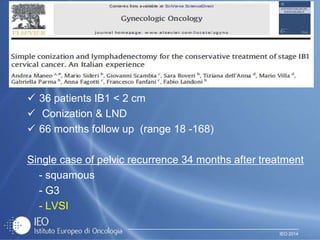
 36 patients IB1 < 2 cm
 Conization & LND
 66 months follow up (range 18 -168)
Single case of pelvic recurrence 34 months after treatment
- squamous
- G3
- LVSI
IEO 2014
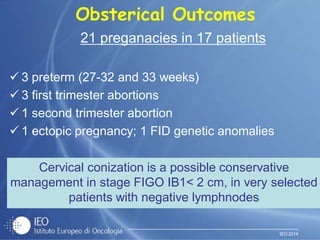
21 preganacies in 17 patients
 3 preterm (27-32 and 33 weeks)
 3 first trimester abortions
 1 second trimester abortion
 1 ectopic pregnancy; 1 FID genetic anomalies
Obsterical Outcomes
Cervical conization is a possible conservative
management in stage FIGO IB1< 2 cm, in very selected
patients with negative lymphnodes
IEO 2014
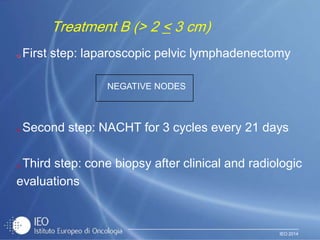
 First step: laparoscopic pelvic lymphadenectomy
NEGATIVE NODES
 Second step: NACHT for 3 cycles every 21 days
 Third step: cone biopsy after clinical and radiologic
evaluations
Treatment B (> 2 < 3 cm)
IEO 2014
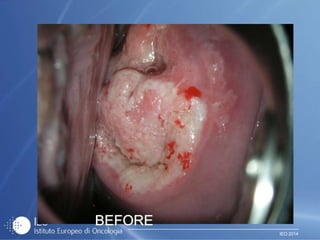
BEFORE
IEO 2014
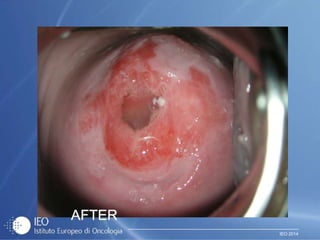
AFTER

4 dr mario sideri m k

  • 1.
    IEO 2014 Mario Sideri GinecologiaPreventiva IEO Microinvasive and early invasive cervical cancer
  • 2.
    IEO 2014 Standard treatmentfor invasive cervical cancer traditionally includes radical hysterectomy and pelvic limphoadenectomy. The rationale of the treatment is the extirpation of the tumour, with clear margins, and of the lumphatic vessels.
  • 3.
    IEO 2014 There areearly tumours with a small volume in wihich the removal of the parametrium can be omitted; in addition in some instances the tumour volume can be so small that the risk of lymphnode metastasis is limited, and pelvic lymphadenectomy can also be omitted
  • 4.
    IEO 2014 Volume is expressed as lenght and depth of infiltration of the neoplasia Categories where conservative approach is feasible: IA1 3 mm in depth, 7 mm in lenght, no LVSI IA2 5 mm in depth, 7 mm in lenght, neg. nodes IB1< 2 cm in largest diameter neg. nodes IB1 >2<3 cm in largest diameter, neg. nodes
  • 5.
    IEO 2014 Volume is expressed as lenght and depth of infiltration of the neoplasia The measures that define “micoinvasive” cervical cancer can only be obtained from a surgical specimen containing the whole lesion. Colposcopy is critical to help excise all the lesion in order to define the diagnosis
  • 6.
    IEO 2014 Main reasonsfor cervical cancer declining mortality: • Cervical cancer screening programs • Intraepithelial lesions (CIN) detection • CIN therapy
  • 7.
    IEO 2014 Conservative therapy Accuratepre-surgical evaluation of the lesion Chappatte, Gynecol. Oncol. 1991
  • 8.
    IEO 2014 Citology,Colposcopy,Histology Key rolein: • Grading • Size definition of the lesion • Identification of early invasive disease
  • 9.
    IEO 2014 Failure afterexcisional CIN treatment Incorrect assessment of the lesion Luesley, Br. J. Obstet. Gynecol. 1985 Buxton, Br. J. Obstet. Gynecol. 1991
  • 10.
    IEO 2014 END POINT Toverify the predictive value of multiple tests in CIN pre-surgical assessment • avoid under/over treatment • schedule proper follow-up • prevent risk for disease persistence
  • 11.
    IEO 2014 Clinical characteristicof the 1000 patients treated by cone biopsy Referral Pap smear • LG SIL or less • HG SIL • Susp. Cancer Punch biopsy • Neg/CIN 1 • CIN 2-3 • Cancer (early invasion) n % 262 26.2 722 72.2 16 1.6 107 11.9 786 87.5 5 0.6 Costa et al. 2001
  • 12.
    IEO 2014 Clinical characteristicof the 1000 patients treated by cone biopsy Colposcopic features Neg AnTZ 1 AnTZ 2 Visible SCJ Not visible SCJ n % 131 13.1 313 31.3 556 55.6 271 27.1 729 72.9 86,9% Costa et al. 2001
  • 13.
    IEO 2014 Clinical characteristicof the 1000 patients treated by cone biopsy Colposcopic features Involved quadrants° 1 2 3 4 °869 positive colposcopy n % 222 25.5 394 45.3 174 20 79 9.1 Costa et al. 2001
  • 14.
    IEO 2014 Histology on1000 cone biopsies CONE Histology N° Negative 148 CIN 1 176 CIN 2-3 607 Cancer° 69 °Including 54 Stage IA1, 9 Stage IA2, 3 Stage IB carcinomas, and 3 Adenocarcinomas Costa et al. 2001
  • 15.
    IEO 2014 Pap smearby Cone Biopsy Pap smear Cone biopsy Total Neg/CIN 1 N % CIN 2-3 N % Cancer N % LG SIL or less 130 49.6 128 49 4 1.4 262 HG SIL 194 26.9 470 65.1 58 8 722 Cancer 0 9 56 7 44 16 Costa et al. 2001
  • 16.
    IEO 2014 CAUTION !!! PAPSMEAR Vs CONE BIOPSY LG SIL 50.4% CIN 2-3/Cancer HG SIL 26.9% Neg/CIN 1 Costa et al. 2001
  • 17.
    IEO 2014 CAUTION !!! •> 25 % HSIL in persistent ASCUS/LSIL Gerber S et al., Int J Gynaecol Obstet, 2001; 75:251-5 • > 25% CIN III/Ca. in CIN I-II directed Bx Petry KU et al., Am J Obstet Gynecol, 2002;186:28-34
  • 18.
    IEO 2014 Lesion sizerelated to cone biopsy findings Cone biopsy % Lesion Involved quadrants Negative 67.8 1 CIN 1 50.3 1-2 CIN 2-3 78.8 2-3 Cancer 66.2 3-4 Costa et al. 2001
  • 19.
    IEO 2014 Cone Punch biopsybiopsy Neg/CIN 1 CIN 2-3 264/201 76.1% Small lesion removed by biopsy Rate of over-estimation of punch biopsy Costa et al. 2001
  • 20.
    IEO 2014 Colposcopy bycone biopsy Colposcopy 15 SCJ vis. 131 Neg 116 SCJ not vis. 313 AnTZ 1 869 Pos 556 AnTZ 2 Cone biopsy CIN 2-3 Cancer Total 4 0 4 (0.6%) 37 4 41 (6 %) 163 6 169 (25.1%) 403 59 462 (68.3%) 607 69 676 (100%) Costa et al. 2001
  • 21.
    IEO 2014 Punch biopsyby Cone biopsy Punch biopsy* Neg/CIN 1 Neg/CIN 1 63 CIN 2-3 201 Cancer 0 264 Cone biopsy CIN 2-3 Cancer Total 39 5 44 (6.9%) 527 58 585 (92.3%) 3 2 5 (0.8%) 569 65 634 (100%) Costa et al. 2001
  • 22.
    IEO 2014 Conclusions 1 NoGold Standard in diagnosis !!! • LG SIL on Pap smear or punch biopsy may hide a HG SIL or Cancer • Punch biopsy may be an inadequate end point by which to judge the severity of the lesion
  • 23.
    IEO 2014 Conclusions 2 Limitsof colposcopy in Presurgical HG lesion assessment • SCJ not entirely visible 70% • Misleading target biopsy 40% • No lesion 7%
  • 24.
    IEO 2014 H-SIL andmicroinvasive cervical cancers
  • 25.
  • 26.
  • 27.
  • 28.
  • 29.
  • 30.
  • 31.
  • 32.
  • 33.
  • 34.
  • 35.
  • 36.
  • 37.
  • 38.
  • 39.
  • 40.
  • 41.
  • 42.
  • 43.
  • 44.
  • 45.
  • 46.
    IEO 2014 Open Question Instage Ib1 cervical cancer is the removal of parametria always necessary even in case of minimal involvement?
  • 47.
  • 48.
    IEO 2014 HSG experiencein Cervical Cancer (1982 - 1986) Stage Ib1, Class I vs Class III 0 20 40 60 80 100 0 1 2 3 4 5 6 7 8 9 10years % Class I Class III p: 0.1 Landoni et all. I.G.C.S. 1989
  • 49.
    IEO 2014 0 20 40 60 80 100 0 12 3 4 5 6 7 8 9 10years % Class I Class III p: 0.9 Landoni et all. I.G.C.S. 1989 HSG experience in Cervical Cancer (1982 - 1986) Stage Ib1 < 3 cm, Class I vs Class III
  • 50.
    IEO 2014 German Experience Surgery*Pts 5yrs Wertheim - Meigs 108 72.3 % Galvin – Te Linde 102 78.5 % * adjuvant RT ~ 50% in both groups Stark G.:Geburt. und Frauen. 47(1), 45-8,1987
  • 51.
    IEO 2014 Pts N+(%)P+(%) Landoni ’89 189 32 (17) 20 (10) Covens ‘01 842 45 ( 6) 33 ( 4) (8 PMLN & 25 PT) tumor size < 2cm/nodesNeg/depth inv.< 10mm (0.6) Winter ’01 (N-) 351 44 (12) Steed ’06 110 13(12) 5 ( 5) Benedetti ‘00 49 15 (31) Parametrial involvement in Early Stage Cervical Cancer
  • 52.
  • 53.
  • 54.
    IEO 2014 Recurrences  Size< 2 cm 1.9%  Size > 2 cm 20%
  • 55.
    IEO 2014 26 patientswith stage IA2 (6) - IB1 (20) cervical cancer  4 patients had radical surgery due to nodes pos.(16.7%)  1/22 conservative surgery patients had a pelvic recurrence (isthmic part of the uterus) 14 mts after initial treatment (NED at 30 mts after CT/RT)  No Deaths  Conception rate 71%  Term Deliveries 42% OUTCOMES from VAGINAL TRACHELECTOMY and LAPAROSCOPIC PLND Robb L. et all. Int. J.Gyn. Cancer, 2006
  • 56.
  • 57.
    IEO 2014 IEO StudyDesign Conservative treatment for Stage IA2-IB1 cervical cancer patients
  • 58.
    IEO 2014 IEO Studydesign Patients will be stratified in two categories based on the tumor diameter Patients with tumor diameter < 2cm Patients with tumor diameter >2cm<3cm
  • 59.
    IEO 2014  Histologicallyconfirmed diagnosis FIGO stage IA2-IB1 squamous/adenosquamous/adeno  Cervical tumor diameter < 3 cm on MRI or on cervical specimen after cone  Distance between OUI and tumor > 1 cm on MRI  No evidence of pelvic lymph nodes involvement and distant metastasis on CT scan/PET Adequate hematological, liver and renal function  Absence of any psycological, familial, sociological, condition potentially hampering compliance with the study protocol and follow-up schedule  Signed informed consent INCLUSION CRITERIA
  • 60.
    IEO 2014  Firststep: cone biopsy and laparoscopically pelvic lymphadenectomy  No evidence of RISK FACTORS on the cervical specimen and negative pelvic lymph nodes: FOLLOW-UP  Presence of RISK FACTORS on the cervical specimen: LVS Involvement & invasion > 10mm – CT Free Margins < 3mm – SURGERY  Presence of pelvic lymph nodes metastases: RADICAL TREATMENT Treatment A ( < 2 cm)
  • 61.
    IEO 2014  36patients IB1 < 2 cm  Conization & LND  66 months follow up (range 18 -168) Single case of pelvic recurrence 34 months after treatment - squamous - G3 - LVSI
  • 62.
    IEO 2014 21 preganaciesin 17 patients  3 preterm (27-32 and 33 weeks)  3 first trimester abortions  1 second trimester abortion  1 ectopic pregnancy; 1 FID genetic anomalies Obsterical Outcomes Cervical conization is a possible conservative management in stage FIGO IB1< 2 cm, in very selected patients with negative lymphnodes
  • 63.
    IEO 2014  Firststep: laparoscopic pelvic lymphadenectomy NEGATIVE NODES  Second step: NACHT for 3 cycles every 21 days  Third step: cone biopsy after clinical and radiologic evaluations Treatment B (> 2 < 3 cm)
  • 64.
  • 65.