FIGO report 2018-cancer cervix
• cervical cancer continues to be one of the
most common cancers among females, being
the fourth most common after breast ,
colorectal, and lung cancer.
• The cervix, which is the lowermost part of the uterus, is a
cylindrical-shaped structure composed of stroma and
epithelium. The intravaginal part, the ectocervix, projects
into the vagina and is lined by squamous epithelium.
• The endocervical canal extends from the internal os at the
junction with the uterus to the external os which opens
into the vagina and is lined by columnar epithelium.
• Almost all cases of cervical carcinoma originate in the
transformation zone from the ecto -or endocervical
mucosa.
• The transformation zone is the area of the cervix between
the old and new squamocolumnar junction.
• 90% of incident HPV infections are not detectable
within a period of 2 years from the acquisition of
infection and persist only in a small proportion.
• Persistent HPV infection denotes the presence of
the same type-specific HPV DNA on repeated
sampling after 6–12 months.
• Only one-tenth of all infections become
persistent, and these women could develop
cervical precancerous lesions.
• The estimated cross-sectional HPV prevalence
worldwide among healthy women is around 11.7%,
with the highest in Sub-Saharan Africa at around 24%,
and country-specific prevalence ranging between 2%
and 42% globally
• Age-specific cross-sectional HPV prevalence peaks at
25% in women aged less than 25 years, which suggests
that the infection is predominantly transmitted
through the sexual route following sexual debut.
• Thus, prophylactic HPV vaccination as a preventive
strategy should target women before initiation of
sexual activity, focusing on girls aged 10–14 years.
• prophylactic HPV vaccines can be used in females
and males from the age of 9 years for the
prevention of premalignant lesions and cancers
affecting the cervix, vulva, vagina, and anus caused
by high-risk HPV types.
• bivalent vaccine(cervarix) targets- HPV16,18
quadrivalent vaccine(guardasil) - HPV6,11,16,18;
• nonavalent vaccine for HPV types 6,11,16,18,31, 33,
45, 52, and 58
• The last two vaccines target anogenital warts
caused by HPV 6 and 11 in addition to malignant
and premalignant lesions.
• All the vaccines are recombinant vaccines composed of
virus-like particles (VLPs) and are not infectious since they
do not contain viral DNA.
• For girls and boys aged 9–14 years, a two-dose schedule
(0.5 mL at 0 and 5–13 months) is recommended.
• If the second vaccine dose is administered earlier than 5
months after the first dose, a third dose is recommended.
• For those aged 15 years and above, and for
immunocompromised patients irrespective of age, the
recommendation is for three doses (0.5 mL at 0, 1, 6
months).
• WHO has concluded that there is no safety concern
regarding HPV vaccines.
VIA-Visual inspection with acetic acid
• VIA involves detection of acetowhite lesions
on the cervix 1 minute after application of
3%–5% freshly prepared acetic acid.
• In view of its feasibility, VIA screening has
been widely implemented in opportunistic
settings in many low-income countries in Sub-
Saharan Africa
• Cervical cancer spreads by direct extension into the parametrium,
vagina, uterus and adjacent organs, i.e., bladder and rectum.
• It also spreads along the lymphatic channels to the regional lymph
nodes, namely, obturator, external iliac and internal iliac, and
thence to the common iliac and para-aortic nodes.
• Distant metastasis to lungs,liver, and skeleton by the hematogenous
route is a late phenomenon.
• Until now, the FIGO staging was based mainly on clinical
examination with the addition of certain procedures that were
allowed by FIGO to change the staging.
• In 2018, this has been revised by the FIGO Gynecologic Oncology
Committee to allow imaging and pathological findings, where
available, to assign the stage. The revised staging was presented at
the FIGO XXII World Congress of Gynecology and Obstetrics.
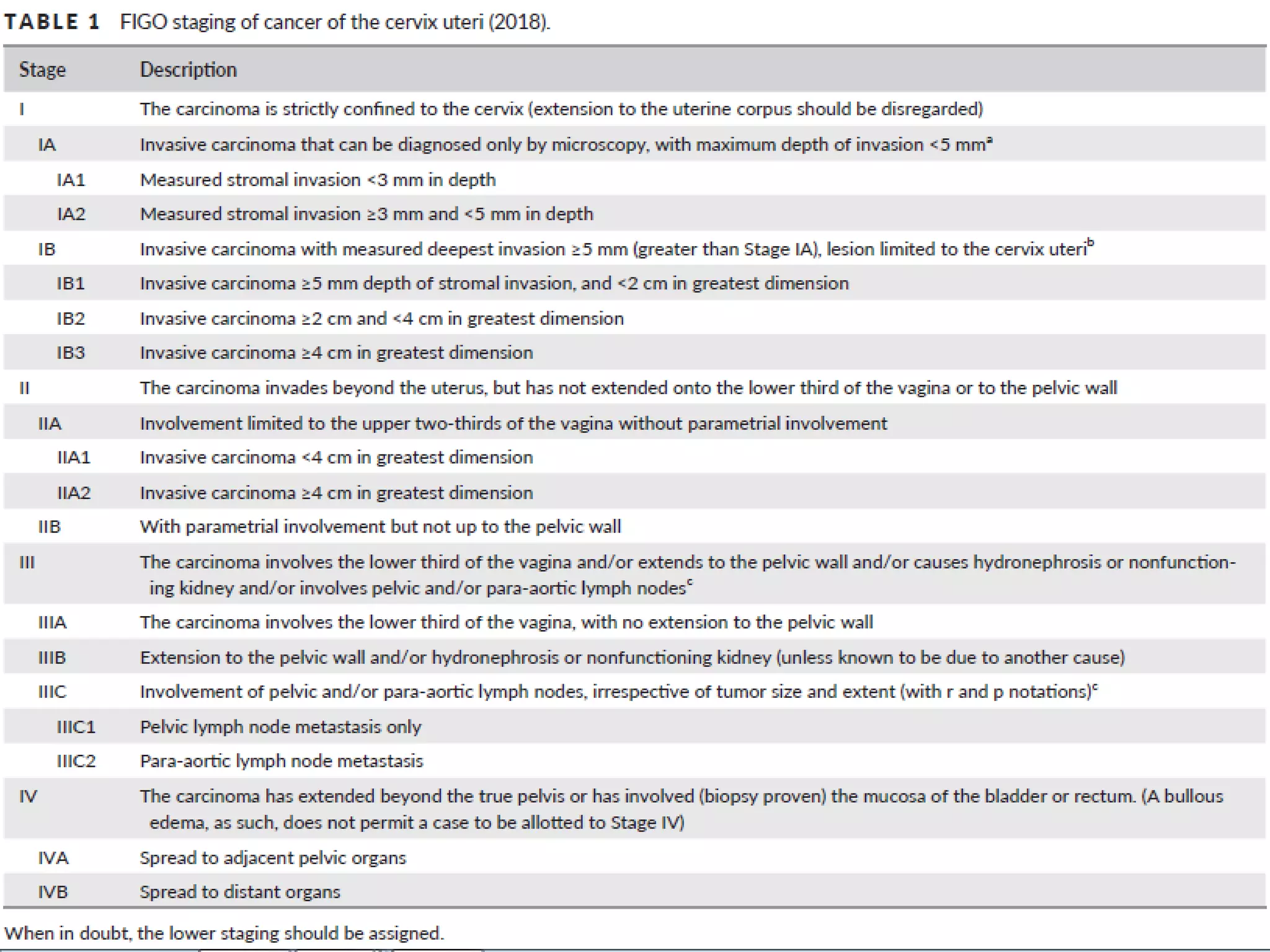
• When in doubt, the lower staging should be assigned.
• a - Imaging and pathology can be used, where available,
to supplement clinical findings with respect to tumor
size and extent, in all stages.
• b - The involvement of vascular/lymphatic spaces does
not change the staging. The lateral extent of the lesion is
no longer considered.
• c - Adding notation of r (imaging) and p (pathology) to
indicate the findings that are used to allocate the case
to Stage IIIC. Example: If imaging indicates pelvic lymph
node metastasis, the stage allocation would be Stage
IIIC1r, and if confirmed by pathologic findings, it would
be Stage IIIC1p.
• The type of imaging modality or pathology technique
used should always be documented.
• The horizontal dimension is no longer
considered in the 2018 revision as it is subject
to many artefactual errors.
• If the margins of the cone biopsy are positive
for invasive cancer, the patient is allocated to
Stage IB1.
1B 1
• FIGO Stage IB1-low risk
• Mx: type C radical hysterectomy, but modified radical
hysterectomy may also be considered.
• Pelvic lymphadenectomy should always be included on
account of the high frequency of lymph node
involvement.
• A pelvic nerve-sparing surgical procedure is
recommended so far as radical curability is maintained,
as intrapelvic injuries to the autonomic nerves (i.e.
hypogastric nerve, splanchnic nerve, and pelvic plexus)
often lead to impairment of urination, defecation, and
sexual function, and consequent deterioration of the
postoperative quality of life (QOL).
Radical trachelectomy
• Indicated for Stage IA2–IB1
• The cervix along with the parametrium is removed followed by
anastomosis of the uterus with the vaginal end.
• Trachelectomy can be done by:
– Open abdominal
– Vaginal
– minimally invasive routes.
• When a vaginal approach is planned, the pelvic nodes are first
removed laparoscopically and sent for frozen section to confirm
node negativity and then proceed with the radical trachelectomy
vaginally.
• Alternatively, the nodes may be first be assessed by conventional
pathologic methods and the radical trachelectomy done as a second
surgery after 1 week.
• FIGO no longer mandates any biochemical investigations or
investigative procedures;
• In patients with frank invasive carcinoma,a chest X-ray,and
assessment of hydronephrosis (with renal ultrasound, intravenous
pyelography, CT, or MRI) should be done.
• The bladder and rectum are evaluated by cystoscopy and
sigmoidoscopy only if the patient is clinically symptomatic.
• Cystoscopy is also recommended in cases of a barrel-shaped
endocervical growth and in cases where the growth has extended
to the anterior vaginal wall.
• Suspected bladder or rectal involvement should be confirmed by
biopsy and histologic evidence.
• Bullous edema alone does not warrant a case to be allocated to
Stage IV.
• 1. Squamous cell carcinoma (keratinizing; non-keratinizing;
papillary, basaloid,warty, verrucous, squamotransitional,
lymphoepithelioma-like)
• 2. Adenocarcinoma (endocervical; mucinous, villoglandular,
endometrioid)
• 3. Clear cell adenocarcinoma
• 4. Serous carcinoma
• 5. Adenosquamous carcinoma
• 6. Glassy cell carcinoma
• 7. Adenoid cystic carcinoma
• 8. Adenoid basal carcinoma
• 9. Small cell carcinoma
• 10. Undifferentiated carcinoma
Stage IA1
• The treatment is completed with cervical conization
unless there is lymphovascular space invasion (LVSI) or
tumor cells are present at the surgical margin.
• In women who have completed childbearing or elderly
women, total extrafascial hysterectomy
(abdominal,vaginal, or laparoscopic)may also be
recommended.
• When LVSI is evident, pelvic lymphadenectomy should
be considered, along with modified radical
hysterectomy.
• If fertility is desired, cervical conization with close
follow-up will be adequate.
Stage IA2
• Since there is a small risk of lymph node
metastases in I A2,pelvic lymphadenectomy is
performed in addition to type B radical
hysterectomy or more radical surgery.
• In low risk cases, simple hysterectomy or
trachelectomy, with either pelvic
lymphadenectomy or sentinel lymph node
assessment, may be adequate surgical treatment.
• When the patient desires fertility
– (1) cervical conization with laparoscopic(or
extraperitoneal) pelvic lymphadenectomy
– (2) radical abdominal, vaginal, or laparoscopic
trachelectomy with pelvic lymphadenectomy.
Post-treatment follow-up
• Follow-up with 3-monthly Pap smears for 2
years, then 6-monthly for the next 3 years is
recommended after treatment of
microinvasive carcinoma.
• With normal follow-up at 5 years, the patient
can return to the routine screening schedule
according to the national guidelines
• FIGO Stage IB1 is considered as low risk with the
following criteria:
– largest tumor diameter less than 2 cm
– cervical stromal invasion less than 50%
– no suspicious lymph nodes on imaging.
• The standard management is a type C radical
hysterectomy, but modified radical hysterectomy
may be considered in these cases.
• Pelvic lymphadenectomy should always be
included on account of the high frequency of
lymph node involvement
• In young women desiring fertility sparing, a radical trachelectomy
may be performed, indicated for Stage IA2–IB1 tumors measuring
less than or equal to 2 cm in largest diameter.
• The cervix along with the parametrium is removed followed by
anastomosis of the uterus with the vaginal end.
• Trachelectomy can be done by open abdominal, vaginal, or by
minimally invasive routes.
• When a vaginal approach is planned, the pelvic nodes are first
removed laparoscopically and sent for frozen section to confirm
node negativity and then proceed with the radical trachelectomy
vaginally.
• Alternatively, the nodes may be first be assessed by conventional
pathologic methods and the radical trachelectomy done as a second
surgery after 1 week.
• The advantages of surgery:
– (1) it is feasible to determine the postoperative
stage precisely on the basis of histopathologic
findings
– (2) that it is possible to treat cancers that are likely
to be resistant to radiotherapy
– (3) it is possible to conserve ovarian function.
• Type C radical hysterectomy represents a basic procedure
for the treatment of cervical cancer, consisting of removal
of the uterus, parametrium, upper vagina, and a part of the
paracolpium, along with pelvic lymphadenectomy.
• As for the adjacent connective tissues, the anterior
vesicouterine ligament (anterior and posterior leaf), lateral
cardinal ligaments, and posterior sacrouterine and
rectovaginal ligaments are cut from the uterus at sufficient
distances from their attachments to the uterus.
• Lymphadenectomy constitutes one of the bases of this
surgical procedure, and the extent of regional lymph node
excision includes the parametrial nodes, obturator nodes,
external, internal,and common iliac nodes.
LACC trial (Laparoscopic Approach to
Cervical Cancer)
• It compared the overall survival with open surgery versus
laparoscopy or robotic surgery in early stage cervical cancer
and showed a decreased overall survival (3 of 312 vs 19 of
319, HR 6.00, 95% CI, 1.48–20.3, P=0.004).
• Disease-free survival events showed a three-fold increase in
the minimally invasive surgery group (7 of 312 vs 27 of 319,
HR 3.74, 95% CI, 1.63–8.58; P=0.002).
• Rates of intraoperative complications did not differ by
treatment received (11% in both).
• They concluded that hysterectomy by a minimally invasive
route was associated with higher rates of recurrence than
the open approach in early-stage cervical cancer patients.
IB2 and IIA1
• surgery or radiotherapy can be chosen as the
primary treatment depending on other
patient factors and local resources, as both
have similar outcomes.
• The preservation of ovarian and sexual
function makes surgery the preferred mode in
younger women.
Stage IB3 and IIA2,
• These tumors are larger and the likelihood of high risk factors such
as +ve lymph nodes, +ve parametria, or +ve surgical margins that
increase the risk of recurrence and require adjuvant RT after
surgery are high.
• Other risk factors that increase the risk of pelvic recurrence even
when nodes are not involved include:
– largest tumor diameter greater than 4 cm
– LVSI
– invasion of outer one-third of the cervical stroma.
• In such cases, adjuvant whole pelvic irradiation reduces the local
failure rate and improves progression-free survival compared with
patients treated with surgery alone.
• Dual modality treatment increases the risk of major morbidity to
the patient.
• Concurrent platinum-based chemoradiation
(CCRT) is the preferred treatment option for
Stage IB3 to IIA2 lesions.
Stage IA, IB1, IB2, and IIA1
• Although surgery is preferred for early stage disease, in
cases with contraindications for surgery or anesthesia, RT
provides equally good results in terms of local control and
survival.
• Patients with microinvasive disease have been treated by
intracavitary radiation therapy (ICRT) alone with good
results if surgery is contraindicated owing to medical
problems.
• Selected patients with very small Stage IB1 disease (less
than 1 cm) may also be treated with ICRT alone, particularly
if there are relative contraindications to EBRT.
• A dose of 60–65 Gy equivalent is usually prescribed to Point
A. Combination of EBRT and ICRT is also an option for such
patients.
Landoni et al
• Randomized patients with IB or IIA cervical cancer to
surgery with or without postoperative radiotherapy (PORT)
versus definitive RT alone.
• PORT was administered to 64% of patients in the surgery
arm.
• The two treatment arms resulted in similar overall survival
(83%) and disease-free survival (74%); severe morbidity
was higher in the surgery arm (28% vs 12%), likely due to
contributions from both treatment modalities.
• An update of the same trial with 20-year follow-up data has
shown marginally better results with radiotherapy
compared with surgery (77% vs 72%, P=0.280)
GOG 109 trial
• High-risk disease includes patients with either
– +ve surgical margins or
– LN metastases or
– parametrial spread
• such patients should be offered PORT with
chemotherapy since the GOG 109 trial has
shown overall survival advantage.
Intermediate-risk
• patients with any two of three factors
• tumor size > 4 cm,
• lymphovascular invasion
• deep stromal invasion require PORT and no
chemotherapy should be offered to these
patients
Gemer et al.
• tumor size more than 2 cm is a risk factor.
• tumor size of more than 2 cm has been taken
as the first cut-off in the 2018 revision of the
FIGO staging system.
• PORT consists of whole pelvic EBRT to cover
the tumor bed and draining lymph node areas.
A dose of 45–50 Gy is usually prescribed.
• Intensity modulated radiation therapy (IMRT),
an advanced and refined technique of
irradiation, has been explored in the
postoperative setting to reduce the toxicity
• The role of vaginal brachytherapy boost following EBRT
is not clear.
• It may be considered for patients with close or +ve
margins, large or deeply invasive tumors, parametrial
or vaginal involvement, or extensive LVSI.
• Vaginal cuff brachytherapy is usually delivered by
ovoids or cylinders to the upper 1/3rd of the residual
vagina and should include 2 weekly fractions of (HDR)
brachytherapy of 6 Gy each prescribed to 5 mm from
the vaginal cylinder/ovoid surface.
Stage IB3 and IIA2
• combined modality treatment(Sx + CCRT) will
unnecessarily overburden the surgical and
radiation facilities, which are already
inadequate in low-resource countries
• CCRT is the standard of care for Stage IB3 and
IIA2 disease.
• CCRT includes external radiation and
intracavitary brachytherapy.
FIGO Stage IIB–IVA
• Concurrent chemoradiation is considered the
standard treatment for patients with locally
advanced cervical cancer (LACC).
• The chemotherapy regimen is i.v.
administration of weekly cisplatin during the
course of EBRT.
BENEFIT OF CCRT???
• CCRT had a significant survival advantage of 10%–
15% at 5 years after treatment compared with RT
alone.
• A subsequent meta-analysis showed maximum
benefit of CCRT of 6% in Stage IB2 (now termed
IB3) to Stage IIB and only 3% benefit in Stage IIIB
patients.
• CCRT also reduced local and distant recurrence,
and improved disease-free survival.
• A once-weekly infusion of cisplatin (40 mg/m2
weekly with appropriate hydration) for 5–6
cycles EBRT is a commonly used CCRT
regimen.
• For patients who are unable to receive
platinum chemotherapy, 5–FU-based
regimens are an acceptable alternative.
• Data on the toxicity associated with CCRT and
extended field irradiation are limited.
OUTBACK Trial
• Additional adjuvant chemotherapy after
concurrent chemoradiotherapy is being
explored in an international randomized
controlled trial (OUTBACK Trial).
• The primary goal of EBRT is to sterilize local
disease and to shrink the tumor to facilitate
subsequent ICRT.
• Standard EBRT should deliver a dose of 45–50
Gy to the whole pelvis by 2 or 4 field box
technique encompassing uterus, cervix,
adnexal structures, parametria, and pelvic
lymph nodes
ICRT
• With an LDR system, a dose of 30–40 Gy is
prescribed in 1 or 2 sessions.
• With HDR, various dose fraction schedules are
used, employing a dose of 5.5–8 Gy by 3–5
weekly fractions.
• The total combined dose with EBRT and ICRT
should be in the range of 80–90 Gy.
Interstitial brachytherapy
• If ICRT is not feasible either due to distorted
anatomy or inadequate dosimetry, then
interstitial brachytherapy should be considered.
• Interstitial brachytherapy consists of insertion of
multiple needles/ catheters into the primary
tumor and parametria through the perineum
with the help of a template.
• Due to the risk of trauma to normal structures
like bowel and bladder, use of ultrasound imaging
(especially transrectal) is suggested during the
implant procedure.
• Currently the recommendation is to complete
the entire protocol of EBRT and brachytherapy
within 8 weeks.
Stage IVB/distant metastases
• Presentation with distant metastatic disease is
rare, reported in about 2% of cases.
• A management plan should consider that the
median duration of survival with distant
metastatic disease is approx. 7 months.
• Despite limited response rates, cisplatin has been
the standard chemotherapy used in the setting of
distant metastatic disease.
• Carboplatin-paclitaxel combination has also been
successful in these cases.
GOG 240
• GOG 240 studied the efficacy of
antiangiogenic therapy with bevacizumab, a
humanized anti-VEGF monoclonal antibody.
• When incorporated in the treatment of
recurrent and metastatic cervical cancer, it
showed increased overall survival (17.0
months vs 13.3 months, HR for death 0.71,
98% CI 0.54–0.95, P=0.004 in a one-sidedtest).
• Currently there is no role for prophylactic
extended field radiotherapy (EFRT) in locally
advanced cervical cancer.
Post-treatment follow-up
• Median time to recurrence ranged from 7 to 36
months after primary treatment.
• Close clinical follow-up in the 2–3 years after
treatment may be important.
• Routine follow-up visits are recommended every
3–4 months for the first 2–3 years, then 6-
monthly until 5 years, and then annually for life.
• At each visit, history taking and clinical
examination are carried out to detect treatment
complications and psychosexual morbidity, as
well as assess for recurrent disease.
• Routine imaging is not indicated.
• Frequent vaginal vault cytology does not
significantly improve the detection of early
disease recurrence.
• Patients should return to annual population-
based screening after 5 years of disease-free
survival
• Most recurrences are seen within 3 years and the prognosis
is poor, as most patients die from progressive disease with
uremia being the most common terminal event.
• When the pelvic relapse follows primary surgery, it may be
treated by either radical CCRT or pelvic exenteration.
• Confirmation of recurrence with a pathologic specimen
obtained by biopsy is essential prior to therapy.
• Radical irradiation with or without concurrent CT may
result in 5-year disease-free survival rates of 45%–74% with
isolated pelvic failure after primary surgery.
• The extent of recurrent disease and involvement of pelvic
L.N are prognostic factors for survival
Pelvic exenteration
• Pelvic exenteration may be feasible in some
patients in whom there is no evidence of
intraperitoneal or extrapelvic spread, and
there is a clear tumor-free space between the
recurrent disease and the pelvic sidewall
• The 2nd most common site of recurrence is in
the para-aortic L.Ns
• In isolated para-aortic nodal recurrence,
curative-intent RT or CCRT, can achieve long-
term survival in approximately 30% of cases.
• Common symptoms of advanced cervical
cancer include:
– Pain
– ureteric obstruction causing renal failure
– Hemorrhage
– malodorous vaginal discharge
– Lymphedema
– fistulae
• Short course radiotherapy is very effective in
palliation of such symptoms.
• A dose of 20 Gy in five fractions over 1 week
or 30 Gy in 10 fractions over 2 weeks is
commonly practiced
• Psychosocial care and support for their families
and caregivers.
• Access to oral morphine is improving within
LMICs and is an important aspect of palliative
care.
• The availability of home care teams in many
region and involvement of nongovernmental
organizations can help minimize the need to
transport the patient to hospital and save costs.
Cervical cancer during pregnancy
• A multidisciplinary team effort.
• The plan must be discussed with the patient
and, preferably, her partner, as their wishes are
to be respected.
• Before 16–20 weeks of pregnancy, patients are
treated without delay.
• The mode of therapy can be either surgery or
CCRT depending on the stage of the disease.
• Radiation often results in spontaneous abortion
of the conceptus.
• From the late 2nd trimester onward, surgery and CT can be
used in selected cases while preserving the pregnancy.
• When the diagnosis is made after 20 weeks, delaying
definitive treatment is a valid option for Stages IA2 and IB1
and 1B2, which has not been shown to have any negative
impact on the prognosis compared with nonpregnant
controls.
• When delivered at a tertiary center with appropriate
neonatal care, delivery by classical cesarean and radical
hysterectomy at the same time is undertaken not later than
34 weeks of pregnancy.
• For more advanced disease, the impact of treatment delay
on survival is not known.
• Neoadjuvant CT may be administered to prevent disease
progression in women with locally advanced cervical cancer
when a treatment delay is planned.
FIGO 2018 Cancer Cervix

FIGO 2018 Cancer Cervix

  • 1.
  • 2.
    • cervical cancercontinues to be one of the most common cancers among females, being the fourth most common after breast , colorectal, and lung cancer.
  • 3.
    • The cervix,which is the lowermost part of the uterus, is a cylindrical-shaped structure composed of stroma and epithelium. The intravaginal part, the ectocervix, projects into the vagina and is lined by squamous epithelium. • The endocervical canal extends from the internal os at the junction with the uterus to the external os which opens into the vagina and is lined by columnar epithelium. • Almost all cases of cervical carcinoma originate in the transformation zone from the ecto -or endocervical mucosa. • The transformation zone is the area of the cervix between the old and new squamocolumnar junction.
  • 4.
    • 90% ofincident HPV infections are not detectable within a period of 2 years from the acquisition of infection and persist only in a small proportion. • Persistent HPV infection denotes the presence of the same type-specific HPV DNA on repeated sampling after 6–12 months. • Only one-tenth of all infections become persistent, and these women could develop cervical precancerous lesions.
  • 5.
    • The estimatedcross-sectional HPV prevalence worldwide among healthy women is around 11.7%, with the highest in Sub-Saharan Africa at around 24%, and country-specific prevalence ranging between 2% and 42% globally • Age-specific cross-sectional HPV prevalence peaks at 25% in women aged less than 25 years, which suggests that the infection is predominantly transmitted through the sexual route following sexual debut. • Thus, prophylactic HPV vaccination as a preventive strategy should target women before initiation of sexual activity, focusing on girls aged 10–14 years.
  • 6.
    • prophylactic HPVvaccines can be used in females and males from the age of 9 years for the prevention of premalignant lesions and cancers affecting the cervix, vulva, vagina, and anus caused by high-risk HPV types. • bivalent vaccine(cervarix) targets- HPV16,18 quadrivalent vaccine(guardasil) - HPV6,11,16,18; • nonavalent vaccine for HPV types 6,11,16,18,31, 33, 45, 52, and 58 • The last two vaccines target anogenital warts caused by HPV 6 and 11 in addition to malignant and premalignant lesions.
  • 7.
    • All thevaccines are recombinant vaccines composed of virus-like particles (VLPs) and are not infectious since they do not contain viral DNA. • For girls and boys aged 9–14 years, a two-dose schedule (0.5 mL at 0 and 5–13 months) is recommended. • If the second vaccine dose is administered earlier than 5 months after the first dose, a third dose is recommended. • For those aged 15 years and above, and for immunocompromised patients irrespective of age, the recommendation is for three doses (0.5 mL at 0, 1, 6 months). • WHO has concluded that there is no safety concern regarding HPV vaccines.
  • 8.
    VIA-Visual inspection withacetic acid • VIA involves detection of acetowhite lesions on the cervix 1 minute after application of 3%–5% freshly prepared acetic acid. • In view of its feasibility, VIA screening has been widely implemented in opportunistic settings in many low-income countries in Sub- Saharan Africa
  • 9.
    • Cervical cancerspreads by direct extension into the parametrium, vagina, uterus and adjacent organs, i.e., bladder and rectum. • It also spreads along the lymphatic channels to the regional lymph nodes, namely, obturator, external iliac and internal iliac, and thence to the common iliac and para-aortic nodes. • Distant metastasis to lungs,liver, and skeleton by the hematogenous route is a late phenomenon. • Until now, the FIGO staging was based mainly on clinical examination with the addition of certain procedures that were allowed by FIGO to change the staging. • In 2018, this has been revised by the FIGO Gynecologic Oncology Committee to allow imaging and pathological findings, where available, to assign the stage. The revised staging was presented at the FIGO XXII World Congress of Gynecology and Obstetrics.
  • 11.
    • When indoubt, the lower staging should be assigned. • a - Imaging and pathology can be used, where available, to supplement clinical findings with respect to tumor size and extent, in all stages. • b - The involvement of vascular/lymphatic spaces does not change the staging. The lateral extent of the lesion is no longer considered. • c - Adding notation of r (imaging) and p (pathology) to indicate the findings that are used to allocate the case to Stage IIIC. Example: If imaging indicates pelvic lymph node metastasis, the stage allocation would be Stage IIIC1r, and if confirmed by pathologic findings, it would be Stage IIIC1p. • The type of imaging modality or pathology technique used should always be documented.
  • 12.
    • The horizontaldimension is no longer considered in the 2018 revision as it is subject to many artefactual errors. • If the margins of the cone biopsy are positive for invasive cancer, the patient is allocated to Stage IB1.
  • 13.
    1B 1 • FIGOStage IB1-low risk • Mx: type C radical hysterectomy, but modified radical hysterectomy may also be considered. • Pelvic lymphadenectomy should always be included on account of the high frequency of lymph node involvement. • A pelvic nerve-sparing surgical procedure is recommended so far as radical curability is maintained, as intrapelvic injuries to the autonomic nerves (i.e. hypogastric nerve, splanchnic nerve, and pelvic plexus) often lead to impairment of urination, defecation, and sexual function, and consequent deterioration of the postoperative quality of life (QOL).
  • 14.
    Radical trachelectomy • Indicatedfor Stage IA2–IB1 • The cervix along with the parametrium is removed followed by anastomosis of the uterus with the vaginal end. • Trachelectomy can be done by: – Open abdominal – Vaginal – minimally invasive routes. • When a vaginal approach is planned, the pelvic nodes are first removed laparoscopically and sent for frozen section to confirm node negativity and then proceed with the radical trachelectomy vaginally. • Alternatively, the nodes may be first be assessed by conventional pathologic methods and the radical trachelectomy done as a second surgery after 1 week.
  • 15.
    • FIGO nolonger mandates any biochemical investigations or investigative procedures; • In patients with frank invasive carcinoma,a chest X-ray,and assessment of hydronephrosis (with renal ultrasound, intravenous pyelography, CT, or MRI) should be done. • The bladder and rectum are evaluated by cystoscopy and sigmoidoscopy only if the patient is clinically symptomatic. • Cystoscopy is also recommended in cases of a barrel-shaped endocervical growth and in cases where the growth has extended to the anterior vaginal wall. • Suspected bladder or rectal involvement should be confirmed by biopsy and histologic evidence. • Bullous edema alone does not warrant a case to be allocated to Stage IV.
  • 16.
    • 1. Squamouscell carcinoma (keratinizing; non-keratinizing; papillary, basaloid,warty, verrucous, squamotransitional, lymphoepithelioma-like) • 2. Adenocarcinoma (endocervical; mucinous, villoglandular, endometrioid) • 3. Clear cell adenocarcinoma • 4. Serous carcinoma • 5. Adenosquamous carcinoma • 6. Glassy cell carcinoma • 7. Adenoid cystic carcinoma • 8. Adenoid basal carcinoma • 9. Small cell carcinoma • 10. Undifferentiated carcinoma
  • 18.
    Stage IA1 • Thetreatment is completed with cervical conization unless there is lymphovascular space invasion (LVSI) or tumor cells are present at the surgical margin. • In women who have completed childbearing or elderly women, total extrafascial hysterectomy (abdominal,vaginal, or laparoscopic)may also be recommended. • When LVSI is evident, pelvic lymphadenectomy should be considered, along with modified radical hysterectomy. • If fertility is desired, cervical conization with close follow-up will be adequate.
  • 19.
    Stage IA2 • Sincethere is a small risk of lymph node metastases in I A2,pelvic lymphadenectomy is performed in addition to type B radical hysterectomy or more radical surgery. • In low risk cases, simple hysterectomy or trachelectomy, with either pelvic lymphadenectomy or sentinel lymph node assessment, may be adequate surgical treatment. • When the patient desires fertility – (1) cervical conization with laparoscopic(or extraperitoneal) pelvic lymphadenectomy – (2) radical abdominal, vaginal, or laparoscopic trachelectomy with pelvic lymphadenectomy.
  • 20.
    Post-treatment follow-up • Follow-upwith 3-monthly Pap smears for 2 years, then 6-monthly for the next 3 years is recommended after treatment of microinvasive carcinoma. • With normal follow-up at 5 years, the patient can return to the routine screening schedule according to the national guidelines
  • 21.
    • FIGO StageIB1 is considered as low risk with the following criteria: – largest tumor diameter less than 2 cm – cervical stromal invasion less than 50% – no suspicious lymph nodes on imaging. • The standard management is a type C radical hysterectomy, but modified radical hysterectomy may be considered in these cases. • Pelvic lymphadenectomy should always be included on account of the high frequency of lymph node involvement
  • 22.
    • In youngwomen desiring fertility sparing, a radical trachelectomy may be performed, indicated for Stage IA2–IB1 tumors measuring less than or equal to 2 cm in largest diameter. • The cervix along with the parametrium is removed followed by anastomosis of the uterus with the vaginal end. • Trachelectomy can be done by open abdominal, vaginal, or by minimally invasive routes. • When a vaginal approach is planned, the pelvic nodes are first removed laparoscopically and sent for frozen section to confirm node negativity and then proceed with the radical trachelectomy vaginally. • Alternatively, the nodes may be first be assessed by conventional pathologic methods and the radical trachelectomy done as a second surgery after 1 week.
  • 23.
    • The advantagesof surgery: – (1) it is feasible to determine the postoperative stage precisely on the basis of histopathologic findings – (2) that it is possible to treat cancers that are likely to be resistant to radiotherapy – (3) it is possible to conserve ovarian function.
  • 24.
    • Type Cradical hysterectomy represents a basic procedure for the treatment of cervical cancer, consisting of removal of the uterus, parametrium, upper vagina, and a part of the paracolpium, along with pelvic lymphadenectomy. • As for the adjacent connective tissues, the anterior vesicouterine ligament (anterior and posterior leaf), lateral cardinal ligaments, and posterior sacrouterine and rectovaginal ligaments are cut from the uterus at sufficient distances from their attachments to the uterus. • Lymphadenectomy constitutes one of the bases of this surgical procedure, and the extent of regional lymph node excision includes the parametrial nodes, obturator nodes, external, internal,and common iliac nodes.
  • 25.
    LACC trial (LaparoscopicApproach to Cervical Cancer) • It compared the overall survival with open surgery versus laparoscopy or robotic surgery in early stage cervical cancer and showed a decreased overall survival (3 of 312 vs 19 of 319, HR 6.00, 95% CI, 1.48–20.3, P=0.004). • Disease-free survival events showed a three-fold increase in the minimally invasive surgery group (7 of 312 vs 27 of 319, HR 3.74, 95% CI, 1.63–8.58; P=0.002). • Rates of intraoperative complications did not differ by treatment received (11% in both). • They concluded that hysterectomy by a minimally invasive route was associated with higher rates of recurrence than the open approach in early-stage cervical cancer patients.
  • 26.
    IB2 and IIA1 •surgery or radiotherapy can be chosen as the primary treatment depending on other patient factors and local resources, as both have similar outcomes. • The preservation of ovarian and sexual function makes surgery the preferred mode in younger women.
  • 27.
    Stage IB3 andIIA2, • These tumors are larger and the likelihood of high risk factors such as +ve lymph nodes, +ve parametria, or +ve surgical margins that increase the risk of recurrence and require adjuvant RT after surgery are high. • Other risk factors that increase the risk of pelvic recurrence even when nodes are not involved include: – largest tumor diameter greater than 4 cm – LVSI – invasion of outer one-third of the cervical stroma. • In such cases, adjuvant whole pelvic irradiation reduces the local failure rate and improves progression-free survival compared with patients treated with surgery alone. • Dual modality treatment increases the risk of major morbidity to the patient.
  • 28.
    • Concurrent platinum-basedchemoradiation (CCRT) is the preferred treatment option for Stage IB3 to IIA2 lesions.
  • 29.
    Stage IA, IB1,IB2, and IIA1 • Although surgery is preferred for early stage disease, in cases with contraindications for surgery or anesthesia, RT provides equally good results in terms of local control and survival. • Patients with microinvasive disease have been treated by intracavitary radiation therapy (ICRT) alone with good results if surgery is contraindicated owing to medical problems. • Selected patients with very small Stage IB1 disease (less than 1 cm) may also be treated with ICRT alone, particularly if there are relative contraindications to EBRT. • A dose of 60–65 Gy equivalent is usually prescribed to Point A. Combination of EBRT and ICRT is also an option for such patients.
  • 30.
    Landoni et al •Randomized patients with IB or IIA cervical cancer to surgery with or without postoperative radiotherapy (PORT) versus definitive RT alone. • PORT was administered to 64% of patients in the surgery arm. • The two treatment arms resulted in similar overall survival (83%) and disease-free survival (74%); severe morbidity was higher in the surgery arm (28% vs 12%), likely due to contributions from both treatment modalities. • An update of the same trial with 20-year follow-up data has shown marginally better results with radiotherapy compared with surgery (77% vs 72%, P=0.280)
  • 31.
    GOG 109 trial •High-risk disease includes patients with either – +ve surgical margins or – LN metastases or – parametrial spread • such patients should be offered PORT with chemotherapy since the GOG 109 trial has shown overall survival advantage.
  • 32.
    Intermediate-risk • patients withany two of three factors • tumor size > 4 cm, • lymphovascular invasion • deep stromal invasion require PORT and no chemotherapy should be offered to these patients
  • 33.
    Gemer et al. •tumor size more than 2 cm is a risk factor. • tumor size of more than 2 cm has been taken as the first cut-off in the 2018 revision of the FIGO staging system.
  • 34.
    • PORT consistsof whole pelvic EBRT to cover the tumor bed and draining lymph node areas. A dose of 45–50 Gy is usually prescribed. • Intensity modulated radiation therapy (IMRT), an advanced and refined technique of irradiation, has been explored in the postoperative setting to reduce the toxicity
  • 35.
    • The roleof vaginal brachytherapy boost following EBRT is not clear. • It may be considered for patients with close or +ve margins, large or deeply invasive tumors, parametrial or vaginal involvement, or extensive LVSI. • Vaginal cuff brachytherapy is usually delivered by ovoids or cylinders to the upper 1/3rd of the residual vagina and should include 2 weekly fractions of (HDR) brachytherapy of 6 Gy each prescribed to 5 mm from the vaginal cylinder/ovoid surface.
  • 36.
    Stage IB3 andIIA2 • combined modality treatment(Sx + CCRT) will unnecessarily overburden the surgical and radiation facilities, which are already inadequate in low-resource countries • CCRT is the standard of care for Stage IB3 and IIA2 disease. • CCRT includes external radiation and intracavitary brachytherapy.
  • 37.
    FIGO Stage IIB–IVA •Concurrent chemoradiation is considered the standard treatment for patients with locally advanced cervical cancer (LACC). • The chemotherapy regimen is i.v. administration of weekly cisplatin during the course of EBRT.
  • 38.
    BENEFIT OF CCRT??? •CCRT had a significant survival advantage of 10%– 15% at 5 years after treatment compared with RT alone. • A subsequent meta-analysis showed maximum benefit of CCRT of 6% in Stage IB2 (now termed IB3) to Stage IIB and only 3% benefit in Stage IIIB patients. • CCRT also reduced local and distant recurrence, and improved disease-free survival.
  • 39.
    • A once-weeklyinfusion of cisplatin (40 mg/m2 weekly with appropriate hydration) for 5–6 cycles EBRT is a commonly used CCRT regimen. • For patients who are unable to receive platinum chemotherapy, 5–FU-based regimens are an acceptable alternative. • Data on the toxicity associated with CCRT and extended field irradiation are limited.
  • 40.
    OUTBACK Trial • Additionaladjuvant chemotherapy after concurrent chemoradiotherapy is being explored in an international randomized controlled trial (OUTBACK Trial).
  • 41.
    • The primarygoal of EBRT is to sterilize local disease and to shrink the tumor to facilitate subsequent ICRT. • Standard EBRT should deliver a dose of 45–50 Gy to the whole pelvis by 2 or 4 field box technique encompassing uterus, cervix, adnexal structures, parametria, and pelvic lymph nodes
  • 43.
    ICRT • With anLDR system, a dose of 30–40 Gy is prescribed in 1 or 2 sessions. • With HDR, various dose fraction schedules are used, employing a dose of 5.5–8 Gy by 3–5 weekly fractions. • The total combined dose with EBRT and ICRT should be in the range of 80–90 Gy.
  • 44.
    Interstitial brachytherapy • IfICRT is not feasible either due to distorted anatomy or inadequate dosimetry, then interstitial brachytherapy should be considered. • Interstitial brachytherapy consists of insertion of multiple needles/ catheters into the primary tumor and parametria through the perineum with the help of a template. • Due to the risk of trauma to normal structures like bowel and bladder, use of ultrasound imaging (especially transrectal) is suggested during the implant procedure.
  • 45.
    • Currently therecommendation is to complete the entire protocol of EBRT and brachytherapy within 8 weeks.
  • 47.
    Stage IVB/distant metastases •Presentation with distant metastatic disease is rare, reported in about 2% of cases. • A management plan should consider that the median duration of survival with distant metastatic disease is approx. 7 months. • Despite limited response rates, cisplatin has been the standard chemotherapy used in the setting of distant metastatic disease. • Carboplatin-paclitaxel combination has also been successful in these cases.
  • 48.
    GOG 240 • GOG240 studied the efficacy of antiangiogenic therapy with bevacizumab, a humanized anti-VEGF monoclonal antibody. • When incorporated in the treatment of recurrent and metastatic cervical cancer, it showed increased overall survival (17.0 months vs 13.3 months, HR for death 0.71, 98% CI 0.54–0.95, P=0.004 in a one-sidedtest).
  • 49.
    • Currently thereis no role for prophylactic extended field radiotherapy (EFRT) in locally advanced cervical cancer.
  • 50.
    Post-treatment follow-up • Mediantime to recurrence ranged from 7 to 36 months after primary treatment. • Close clinical follow-up in the 2–3 years after treatment may be important. • Routine follow-up visits are recommended every 3–4 months for the first 2–3 years, then 6- monthly until 5 years, and then annually for life. • At each visit, history taking and clinical examination are carried out to detect treatment complications and psychosexual morbidity, as well as assess for recurrent disease.
  • 51.
    • Routine imagingis not indicated. • Frequent vaginal vault cytology does not significantly improve the detection of early disease recurrence. • Patients should return to annual population- based screening after 5 years of disease-free survival
  • 52.
    • Most recurrencesare seen within 3 years and the prognosis is poor, as most patients die from progressive disease with uremia being the most common terminal event. • When the pelvic relapse follows primary surgery, it may be treated by either radical CCRT or pelvic exenteration. • Confirmation of recurrence with a pathologic specimen obtained by biopsy is essential prior to therapy. • Radical irradiation with or without concurrent CT may result in 5-year disease-free survival rates of 45%–74% with isolated pelvic failure after primary surgery. • The extent of recurrent disease and involvement of pelvic L.N are prognostic factors for survival
  • 53.
    Pelvic exenteration • Pelvicexenteration may be feasible in some patients in whom there is no evidence of intraperitoneal or extrapelvic spread, and there is a clear tumor-free space between the recurrent disease and the pelvic sidewall
  • 54.
    • The 2ndmost common site of recurrence is in the para-aortic L.Ns • In isolated para-aortic nodal recurrence, curative-intent RT or CCRT, can achieve long- term survival in approximately 30% of cases.
  • 55.
    • Common symptomsof advanced cervical cancer include: – Pain – ureteric obstruction causing renal failure – Hemorrhage – malodorous vaginal discharge – Lymphedema – fistulae
  • 56.
    • Short courseradiotherapy is very effective in palliation of such symptoms. • A dose of 20 Gy in five fractions over 1 week or 30 Gy in 10 fractions over 2 weeks is commonly practiced
  • 57.
    • Psychosocial careand support for their families and caregivers. • Access to oral morphine is improving within LMICs and is an important aspect of palliative care. • The availability of home care teams in many region and involvement of nongovernmental organizations can help minimize the need to transport the patient to hospital and save costs.
  • 58.
    Cervical cancer duringpregnancy • A multidisciplinary team effort. • The plan must be discussed with the patient and, preferably, her partner, as their wishes are to be respected. • Before 16–20 weeks of pregnancy, patients are treated without delay. • The mode of therapy can be either surgery or CCRT depending on the stage of the disease. • Radiation often results in spontaneous abortion of the conceptus.
  • 59.
    • From thelate 2nd trimester onward, surgery and CT can be used in selected cases while preserving the pregnancy. • When the diagnosis is made after 20 weeks, delaying definitive treatment is a valid option for Stages IA2 and IB1 and 1B2, which has not been shown to have any negative impact on the prognosis compared with nonpregnant controls. • When delivered at a tertiary center with appropriate neonatal care, delivery by classical cesarean and radical hysterectomy at the same time is undertaken not later than 34 weeks of pregnancy. • For more advanced disease, the impact of treatment delay on survival is not known. • Neoadjuvant CT may be administered to prevent disease progression in women with locally advanced cervical cancer when a treatment delay is planned.