HPV SCREENING & CO TESTING
Dr. Niranjan Chavan
MD, FCPS, DGO, DFP, MICOG, DICOG , FICOG
Professor and Unit Chief, L.T.M.M.C & L.T.M.G.H
Chairperson, FOGSI Oncology and TT Committee (2012-2014)
Treasurer, MOGS (2017- 2018)
Chair and Convener, FOGSI Cell- Violence against Doctors (2015-2016)
Chief Editor, AFG Times (2015-2017)
Editorial Board, European Journal of Gynecologic Oncology
Editor of FOGSI FOCUS, MOGS, AFG & IAGE Newsletters
Member, Managing Committee, IAGE (2013-2017)
Member , Oncology Committee, AOFOG (2013 -2015)
Recipient of 6 National & International Awards
Author of 15 Research Papers and 19 Scientific Chapters
Course Co-Ordinator, of 11 batches, of MUHS recognized Certificate Course of
Basic Infertility Management Including Endoscopy (BIMIE) at LTMGH
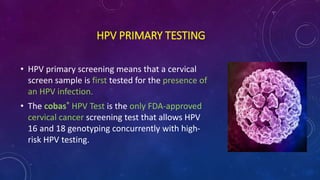
HPV PRIMARY TESTING
• HPV primary screening means that a cervical
screen sample is first tested for the presence of
an HPV infection.
• The cobas® HPV Test is the only FDA-approved
cervical cancer screening test that allows HPV
16 and 18 genotyping concurrently with high-
risk HPV testing.
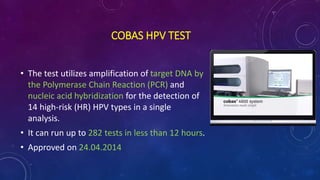
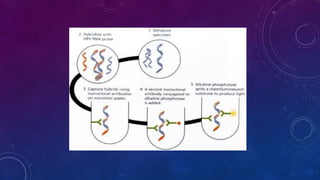
COBAS HPV TEST
• It individually identifies
genotypes 16 and 18,
the two highest-risk
HPV genotypes while
simultaneously
detecting 12 other high
risk HPV genotypes.
COBAS HPV TEST
• The test utilizes amplification of target DNA by
the Polymerase Chain Reaction (PCR) and
nucleic acid hybridization for the detection of
14 high-risk (HR) HPV types in a single
analysis.
• It can run up to 282 tests in less than 12 hours.
• Approved on 24.04.2014
ATHENA TRIAL
• The ATHENA HPV trial was a large, prospective
clinical study evaluating the performance of the
cobas® HPV Test in three relevant populations:
1. Women with ASC-US cervical cytology
2. Women with normal cervical cytology
3. An overall screening population (25+ years)
• Over 47,000 women were enrolled.
HPV primary screening in women ≥25years is as effective as a hybrid
screening strategy that uses cytology if 25-29years and co testing if
≥30years.
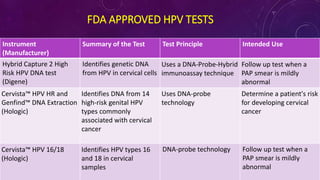
FDA APPROVED HPV TESTS
Instrument
(Manufacturer)
Summary of the Test Test Principle Intended Use
Hybrid Capture 2 High
Risk HPV DNA test
(Digene)
Identifies genetic DNA
from HPV in cervical cells
Uses a DNA-Probe-Hybrid
immunoassay technique
Follow up test when a
PAP smear is mildly
abnormal
Cervista™ HPV HR and
Genfind™ DNA Extraction
(Hologic)
Identifies DNA from 14
high-risk genital HPV
types commonly
associated with cervical
cancer
Uses DNA-probe
technology
Determine a patient's risk
for developing cervical
cancer
Cervista™ HPV 16/18
(Hologic)
Identifies HPV types 16
and 18 in cervical
samples
DNA-probe technology Follow up test when a
PAP smear is mildly
abnormal
FDA APPROVED HPV TESTS
Instrument
(Manufacturer)
Summary of the Test Test Principle Intended Use
Cobas® HPV test (Roche
Molecular Systems)
Used on the cobas® 4800
system to identify DNA
from 14 high-risk genital
HPV types commonly
associated with cervical
cancers.
Uses fluorescent labelled
DNA probes
Primary HPV testing
PTIMA® HPV Assay (Gen-
Probe)
Used with the Tigris DTS
system to identify RNA
from 14 high-risk HPV
types. Detects messenger
RNA from two HPV viral
oncogenes, E6 and E7
Uses RNA capture and
amplification of HPV RNA
Used for women age 30
and over or any age with
borderline cytology
results to determine the
need for additional
follow up procedures
ISSUES WITH CYTOLOGY BASED SCREENING
• Highly subjective test: substantial inter-laboratory (as well as
intralaboratory) variability and limited reproducibility.
• Unable to identify those women who are at future risk of
developing cervical cancer precursors.
• Unclear how cytology will perform as HPV vaccination rates
increase.
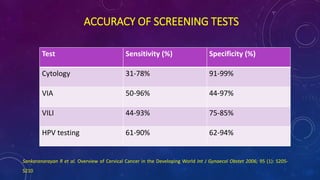
ACCURACY OF SCREENING TESTS
Test Sensitivity (%) Specificity (%)
Cytology 31-78% 91-99%
VIA 50-96% 44-97%
VILI 44-93% 75-85%
HPV testing 61-90% 62-94%
Sankaranarayan R et al. Overview of Cervical Cancer in the Developing World Int J Gynaecol Obstet 2006; 95 (1): S205-
S210
Screening test Strengths Limitations
HPV DNA  Automated &standardized
 Objective result
 High sensitivity, good
specificity
 More effective in
postmenopausal women
 Potential for self sampling
 Requires lab support
 Cost
 Lag can contribute to
loss to F/U and delay.
OVERVIEW OF PRIMARY SCREENING TOOLS FOR CERVICAL CANCER
CLINICAL UTILITY OF HPV TESTING
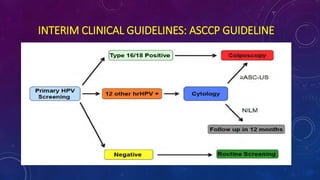
• Preferred method as co-testing (age>30 years) or as
primary screening (age >25 years)
Huh W K etal. Use of Primary High-Risk Human Papillomavirus Testing for Cervical Cancer
Screening:
Interim Clinical Guidance J Low Genit Tract Dis 2015. 19(2); 91-96
• In the management of women with ASCUS cytology
– triage
ASCCP Guidelines , J Low Genit Tract Dis,2013; ACOG,2016
CLINICAL UTILITY OF HPV TESTING
• Following treatment for CIN- HPV testing is more sensitive but less
specific than cytology in post treatment follow-up and it may result in
earlier diagnosis of persistent or recurrent disease
KockenM et al. Hr HPV testing versus cytology in predicting post-treatment disease in women treated for high- grade
cervical disease: a systematic review and meta-analysis. Gynecol Oncol 2012 ;125(2):500-7
AGE TO
START
SCREENING
Primary HPV
screening should not
be initiated prior to
age 25.
OPTIMAL INTERVAL FOR PRIMARY HPV
SCREENING
• Rescreening after a negative screen should occur no
sooner than every 3 years.
• In the ATHENA trial, the incidence of CIN 3 over 3
years was less than 1%.
• European trials have used 3 year screening
intervals. Until further US data is available,
screening no sooner than 3 years is recommended.
INTERIM CLINICAL GUIDELINES: ASCCP GUIDELINE
POTENTIAL BENEFITS OF ADOPTING HPV PRIMARY
SCREENING
• Decrease in cervical cancer incidence and
mortality
• Better detection of risk of precancerous cervical
cell changes
• Providing a more effective test for women who
have had the HPV vaccine as well as those who
have not
• Safe but less frequent screening (every five years
rather than every three).
RCTS OF HPV TESTING IN SCREENING
• BC RCT (HPV FOCAL): Canada (Ogilvie et al, BJC 2012)
• ATHENA Trial: United States
• Indian Trial (Osmanabad) (Sankaranarayanan et al. NEJM 2009)
• ARTISTIC trial: UK (Kitchener et al. Lancet Oncol 2009)
• NTCC Italian Study (Ronco et al., Lancet Oncol, 2006; JNCI 2006)
• SWEDESCREEN: Swedish trial (Elfgren et al. AJOG 2005; Naucleret al., NEJM
2007; JNCI 2009)
• Finnish RCT (Kotaniemi et al., BJC 2005; Eur J Cancer 2008; IJC2008;
Leinonen et al., JNCI 2009)
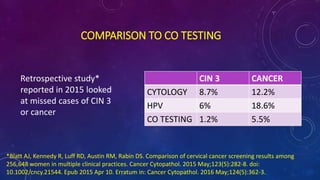
COMPARISON TO CO TESTING
CIN 3 CANCER
CYTOLOGY 8.7% 12.2%
HPV 6% 18.6%
CO TESTING 1.2% 5.5%
*Blatt AJ, Kennedy R, Luff RD, Austin RM, Rabin DS. Comparison of cervical cancer screening results among
256,648 women in multiple clinical practices. Cancer Cytopathol. 2015 May;123(5):282-8. doi:
10.1002/cncy.21544. Epub 2015 Apr 10. Erratum in: Cancer Cytopathol. 2016 May;124(5):362-3.
Retrospective study*
reported in 2015 looked
at missed cases of CIN 3
or cancer
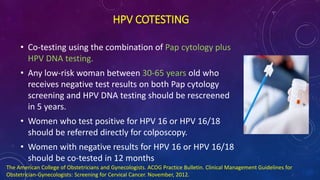
HPV COTESTING
• Co-testing using the combination of Pap cytology plus
HPV DNA testing.
• Any low-risk woman between 30-65 years old who
receives negative test results on both Pap cytology
screening and HPV DNA testing should be rescreened
in 5 years.
• Women who test positive for HPV 16 or HPV 16/18
should be referred directly for colposcopy.
• Women with negative results for HPV 16 or HPV 16/18
should be co-tested in 12 months
The American College of Obstetricians and Gynecologists. ACOG Practice Bulletin. Clinical Management Guidelines for
Obstetrician-Gynecologists: Screening for Cervical Cancer. November, 2012.
PROPOSED DEFINITION OF SETTING ACCORDING TO AVAILABILITY OF RESOURCES
Setting Screening Options Management
Options
Type of Health care
Facility – example
Type of Service
Provider
Maximal
(No resource
constraints)
HPV DNA test
Cytology
(+ HPV Genotyping &
newer modalities for
triaging*)
Colposcopy
LEEP
Conization
Cryotherapy
+Thermocoagulation
Tertiary care centres
Multispecialty hospitals
Private clinics with access to
hospital
Trained Gynaecologist
Enhanced** Cytology, VIA
Colposcopy
LEEP
Conization
Cryotherapy
+Thermocoagulation
Tertiary care centres
Hospitals
Nursing homes
Trained Gynaecologist
Limited** VIA
Colposcopy
Cryotherapy
LEEP
+ Conization
+ Thermocoagulation
CHCs
District hospitals
Nursing homes
Trained
Gynaecologist/
Doctors
Basic** VIA Cryotherapy
+Thermocoagulation
Public health service
(PHC, subcentre, small clinics)
Trained
Gynaecologist/
Doctors/ Nurses/
Health workers
PROPOSED RESOURCE STRATIFIED PROTOCOL FOR CERVICAL CANCER
SCREENING
Resource setting Maximal Enhanced Limited Basic
Target Age Group
(years)
25-65 25-65 30-65 30-65
(In postmenopausal
women, screening with
VIA may not be as
effective)
Age to start (years) Cytology -25
HPV Testing - 30
25 30 30
Modality HPV DNA testing
• Primary HPV testing
• Co-testing (HPV &
Cytology)
Cytology
Colposcopy and biopsy
Cytology
Colposcopy and biopsy
VIA
Colposcopy ± Biopsy
VIA
Frequency Primary HPV Testing or
Co-testing -every 5
year
Cytology – every 3
years
Every 3 years Every 5 years Every 5 years
(at least 1-3 times in life
time )
Facility based Maximal Enhanced Limited Basic
Triage HPV genotyping/
Cytology
Colposcopy/ VIA Colposcopy/
Treatment
Treatment
Age to stop
(years)
- 65 with consistent negative results in last 15 years
-women with no prior screening should undergo tests once at 65
years and if negative they should exit screening.
Follow up
method after
treatment and
interval
HPV DNA
testing,
12 months
Cytology,
12 months
VIA,
12 months
VIA,
12 months
PROPOSED RESOURCE STRATIFIED PROTOCOL FOR CERVICAL CANCER
SCREENING
CONCLUSION
• All the guidelines recommend co testing as the modality of choice
for cervical cancer screening.
• However, Cobas test was approved by FDA as primary screening
modality in 2014.
• ATHENA Trial proved the efficacy and sensitivity of Cobas test.
• Currently, ASCCP provided an interim guideline for HPV Primary
test.
CONCLUSION
• Govt of Australia and New Zealand has even implemented HPV
primary screening since 1 Dec 2017
• Even the pilot run in England seems promising.
• To conclude, HPV primary screening is effective, sensitive and easy
screening tool for cervical cancer and advent of this new
technology warrants a change in the screening guidelines.
REFERENCES
• Public Health England; NHS Cancer Screening Programmes, 2015. HPV Primary Screening Protocol
Algorithm.www.gov.uk/government/uploads/system/uploads/attachment_data/file/437976/hpvps-
flowchart-jan15.pdf.
• Blatt AJ, Kennedy R, Luff RD, Austin RM, Rabin DS. Comparison of cervical cancer screening results
among 256,648 women in multiple clinical practices. Cancer Cytopathol. 2015 May;123(5):282-8. doi:
10.1002/cncy.21544. Epub 2015 Apr 10. Erratum in: Cancer Cytopathol. 2016 May;124(5):362-3.
• The American College of Obstetricians and Gynecologists. ACOG Practice Bulletin. Clinical Management
Guidelines for Obstetrician-Gynecologists: Screening for Cervical Cancer. November, 2012.
• Stoler MH, Wright TC, Sharma A, et al. High-risk human papillomavirus testing in women with ASC-US
cytology: results from the ATHENA HPV study. Am J Clin Pathol. 2011;135(3):468-475.
• KockenM et al. Hr HPV testing versus cytology in predicting post-treatment disease in women treated
for high- grade cervical disease: a systematic review and meta-analysis. Gynecol Oncol 2012 ;125(2):500-
7
HPV SCREENING & CO TESTING

HPV SCREENING & CO TESTING

  • 1.
    HPV SCREENING &CO TESTING
  • 2.
    Dr. Niranjan Chavan MD,FCPS, DGO, DFP, MICOG, DICOG , FICOG Professor and Unit Chief, L.T.M.M.C & L.T.M.G.H Chairperson, FOGSI Oncology and TT Committee (2012-2014) Treasurer, MOGS (2017- 2018) Chair and Convener, FOGSI Cell- Violence against Doctors (2015-2016) Chief Editor, AFG Times (2015-2017) Editorial Board, European Journal of Gynecologic Oncology Editor of FOGSI FOCUS, MOGS, AFG & IAGE Newsletters Member, Managing Committee, IAGE (2013-2017) Member , Oncology Committee, AOFOG (2013 -2015) Recipient of 6 National & International Awards Author of 15 Research Papers and 19 Scientific Chapters Course Co-Ordinator, of 11 batches, of MUHS recognized Certificate Course of Basic Infertility Management Including Endoscopy (BIMIE) at LTMGH
  • 3.
    HPV PRIMARY TESTING •HPV primary screening means that a cervical screen sample is first tested for the presence of an HPV infection. • The cobas® HPV Test is the only FDA-approved cervical cancer screening test that allows HPV 16 and 18 genotyping concurrently with high- risk HPV testing.
  • 4.
    COBAS HPV TEST •It individually identifies genotypes 16 and 18, the two highest-risk HPV genotypes while simultaneously detecting 12 other high risk HPV genotypes.
  • 5.
    COBAS HPV TEST •The test utilizes amplification of target DNA by the Polymerase Chain Reaction (PCR) and nucleic acid hybridization for the detection of 14 high-risk (HR) HPV types in a single analysis. • It can run up to 282 tests in less than 12 hours. • Approved on 24.04.2014
  • 6.
    ATHENA TRIAL • TheATHENA HPV trial was a large, prospective clinical study evaluating the performance of the cobas® HPV Test in three relevant populations: 1. Women with ASC-US cervical cytology 2. Women with normal cervical cytology 3. An overall screening population (25+ years) • Over 47,000 women were enrolled.
  • 8.
    HPV primary screeningin women ≥25years is as effective as a hybrid screening strategy that uses cytology if 25-29years and co testing if ≥30years.
  • 9.
    FDA APPROVED HPVTESTS Instrument (Manufacturer) Summary of the Test Test Principle Intended Use Hybrid Capture 2 High Risk HPV DNA test (Digene) Identifies genetic DNA from HPV in cervical cells Uses a DNA-Probe-Hybrid immunoassay technique Follow up test when a PAP smear is mildly abnormal Cervista™ HPV HR and Genfind™ DNA Extraction (Hologic) Identifies DNA from 14 high-risk genital HPV types commonly associated with cervical cancer Uses DNA-probe technology Determine a patient's risk for developing cervical cancer Cervista™ HPV 16/18 (Hologic) Identifies HPV types 16 and 18 in cervical samples DNA-probe technology Follow up test when a PAP smear is mildly abnormal
  • 10.
    FDA APPROVED HPVTESTS Instrument (Manufacturer) Summary of the Test Test Principle Intended Use Cobas® HPV test (Roche Molecular Systems) Used on the cobas® 4800 system to identify DNA from 14 high-risk genital HPV types commonly associated with cervical cancers. Uses fluorescent labelled DNA probes Primary HPV testing PTIMA® HPV Assay (Gen- Probe) Used with the Tigris DTS system to identify RNA from 14 high-risk HPV types. Detects messenger RNA from two HPV viral oncogenes, E6 and E7 Uses RNA capture and amplification of HPV RNA Used for women age 30 and over or any age with borderline cytology results to determine the need for additional follow up procedures
  • 11.
    ISSUES WITH CYTOLOGYBASED SCREENING • Highly subjective test: substantial inter-laboratory (as well as intralaboratory) variability and limited reproducibility. • Unable to identify those women who are at future risk of developing cervical cancer precursors. • Unclear how cytology will perform as HPV vaccination rates increase.
  • 12.
    ACCURACY OF SCREENINGTESTS Test Sensitivity (%) Specificity (%) Cytology 31-78% 91-99% VIA 50-96% 44-97% VILI 44-93% 75-85% HPV testing 61-90% 62-94% Sankaranarayan R et al. Overview of Cervical Cancer in the Developing World Int J Gynaecol Obstet 2006; 95 (1): S205- S210
  • 13.
    Screening test StrengthsLimitations HPV DNA  Automated &standardized  Objective result  High sensitivity, good specificity  More effective in postmenopausal women  Potential for self sampling  Requires lab support  Cost  Lag can contribute to loss to F/U and delay. OVERVIEW OF PRIMARY SCREENING TOOLS FOR CERVICAL CANCER
  • 15.
    CLINICAL UTILITY OFHPV TESTING • Preferred method as co-testing (age>30 years) or as primary screening (age >25 years) Huh W K etal. Use of Primary High-Risk Human Papillomavirus Testing for Cervical Cancer Screening: Interim Clinical Guidance J Low Genit Tract Dis 2015. 19(2); 91-96 • In the management of women with ASCUS cytology – triage ASCCP Guidelines , J Low Genit Tract Dis,2013; ACOG,2016
  • 16.
    CLINICAL UTILITY OFHPV TESTING • Following treatment for CIN- HPV testing is more sensitive but less specific than cytology in post treatment follow-up and it may result in earlier diagnosis of persistent or recurrent disease KockenM et al. Hr HPV testing versus cytology in predicting post-treatment disease in women treated for high- grade cervical disease: a systematic review and meta-analysis. Gynecol Oncol 2012 ;125(2):500-7
  • 17.
    AGE TO START SCREENING Primary HPV screeningshould not be initiated prior to age 25.
  • 18.
    OPTIMAL INTERVAL FORPRIMARY HPV SCREENING • Rescreening after a negative screen should occur no sooner than every 3 years. • In the ATHENA trial, the incidence of CIN 3 over 3 years was less than 1%. • European trials have used 3 year screening intervals. Until further US data is available, screening no sooner than 3 years is recommended.
  • 19.
  • 20.
    POTENTIAL BENEFITS OFADOPTING HPV PRIMARY SCREENING • Decrease in cervical cancer incidence and mortality • Better detection of risk of precancerous cervical cell changes • Providing a more effective test for women who have had the HPV vaccine as well as those who have not • Safe but less frequent screening (every five years rather than every three).
  • 21.
    RCTS OF HPVTESTING IN SCREENING • BC RCT (HPV FOCAL): Canada (Ogilvie et al, BJC 2012) • ATHENA Trial: United States • Indian Trial (Osmanabad) (Sankaranarayanan et al. NEJM 2009) • ARTISTIC trial: UK (Kitchener et al. Lancet Oncol 2009) • NTCC Italian Study (Ronco et al., Lancet Oncol, 2006; JNCI 2006) • SWEDESCREEN: Swedish trial (Elfgren et al. AJOG 2005; Naucleret al., NEJM 2007; JNCI 2009) • Finnish RCT (Kotaniemi et al., BJC 2005; Eur J Cancer 2008; IJC2008; Leinonen et al., JNCI 2009)
  • 22.
    COMPARISON TO COTESTING CIN 3 CANCER CYTOLOGY 8.7% 12.2% HPV 6% 18.6% CO TESTING 1.2% 5.5% *Blatt AJ, Kennedy R, Luff RD, Austin RM, Rabin DS. Comparison of cervical cancer screening results among 256,648 women in multiple clinical practices. Cancer Cytopathol. 2015 May;123(5):282-8. doi: 10.1002/cncy.21544. Epub 2015 Apr 10. Erratum in: Cancer Cytopathol. 2016 May;124(5):362-3. Retrospective study* reported in 2015 looked at missed cases of CIN 3 or cancer
  • 23.
    HPV COTESTING • Co-testingusing the combination of Pap cytology plus HPV DNA testing. • Any low-risk woman between 30-65 years old who receives negative test results on both Pap cytology screening and HPV DNA testing should be rescreened in 5 years. • Women who test positive for HPV 16 or HPV 16/18 should be referred directly for colposcopy. • Women with negative results for HPV 16 or HPV 16/18 should be co-tested in 12 months The American College of Obstetricians and Gynecologists. ACOG Practice Bulletin. Clinical Management Guidelines for Obstetrician-Gynecologists: Screening for Cervical Cancer. November, 2012.
  • 24.
    PROPOSED DEFINITION OFSETTING ACCORDING TO AVAILABILITY OF RESOURCES Setting Screening Options Management Options Type of Health care Facility – example Type of Service Provider Maximal (No resource constraints) HPV DNA test Cytology (+ HPV Genotyping & newer modalities for triaging*) Colposcopy LEEP Conization Cryotherapy +Thermocoagulation Tertiary care centres Multispecialty hospitals Private clinics with access to hospital Trained Gynaecologist Enhanced** Cytology, VIA Colposcopy LEEP Conization Cryotherapy +Thermocoagulation Tertiary care centres Hospitals Nursing homes Trained Gynaecologist Limited** VIA Colposcopy Cryotherapy LEEP + Conization + Thermocoagulation CHCs District hospitals Nursing homes Trained Gynaecologist/ Doctors Basic** VIA Cryotherapy +Thermocoagulation Public health service (PHC, subcentre, small clinics) Trained Gynaecologist/ Doctors/ Nurses/ Health workers
  • 25.
    PROPOSED RESOURCE STRATIFIEDPROTOCOL FOR CERVICAL CANCER SCREENING Resource setting Maximal Enhanced Limited Basic Target Age Group (years) 25-65 25-65 30-65 30-65 (In postmenopausal women, screening with VIA may not be as effective) Age to start (years) Cytology -25 HPV Testing - 30 25 30 30 Modality HPV DNA testing • Primary HPV testing • Co-testing (HPV & Cytology) Cytology Colposcopy and biopsy Cytology Colposcopy and biopsy VIA Colposcopy ± Biopsy VIA Frequency Primary HPV Testing or Co-testing -every 5 year Cytology – every 3 years Every 3 years Every 5 years Every 5 years (at least 1-3 times in life time )
  • 26.
    Facility based MaximalEnhanced Limited Basic Triage HPV genotyping/ Cytology Colposcopy/ VIA Colposcopy/ Treatment Treatment Age to stop (years) - 65 with consistent negative results in last 15 years -women with no prior screening should undergo tests once at 65 years and if negative they should exit screening. Follow up method after treatment and interval HPV DNA testing, 12 months Cytology, 12 months VIA, 12 months VIA, 12 months PROPOSED RESOURCE STRATIFIED PROTOCOL FOR CERVICAL CANCER SCREENING
  • 27.
    CONCLUSION • All theguidelines recommend co testing as the modality of choice for cervical cancer screening. • However, Cobas test was approved by FDA as primary screening modality in 2014. • ATHENA Trial proved the efficacy and sensitivity of Cobas test. • Currently, ASCCP provided an interim guideline for HPV Primary test.
  • 28.
    CONCLUSION • Govt ofAustralia and New Zealand has even implemented HPV primary screening since 1 Dec 2017 • Even the pilot run in England seems promising. • To conclude, HPV primary screening is effective, sensitive and easy screening tool for cervical cancer and advent of this new technology warrants a change in the screening guidelines.
  • 30.
    REFERENCES • Public HealthEngland; NHS Cancer Screening Programmes, 2015. HPV Primary Screening Protocol Algorithm.www.gov.uk/government/uploads/system/uploads/attachment_data/file/437976/hpvps- flowchart-jan15.pdf. • Blatt AJ, Kennedy R, Luff RD, Austin RM, Rabin DS. Comparison of cervical cancer screening results among 256,648 women in multiple clinical practices. Cancer Cytopathol. 2015 May;123(5):282-8. doi: 10.1002/cncy.21544. Epub 2015 Apr 10. Erratum in: Cancer Cytopathol. 2016 May;124(5):362-3. • The American College of Obstetricians and Gynecologists. ACOG Practice Bulletin. Clinical Management Guidelines for Obstetrician-Gynecologists: Screening for Cervical Cancer. November, 2012. • Stoler MH, Wright TC, Sharma A, et al. High-risk human papillomavirus testing in women with ASC-US cytology: results from the ATHENA HPV study. Am J Clin Pathol. 2011;135(3):468-475. • KockenM et al. Hr HPV testing versus cytology in predicting post-treatment disease in women treated for high- grade cervical disease: a systematic review and meta-analysis. Gynecol Oncol 2012 ;125(2):500- 7