FIGO classification for Cervical Cancer
(Revised 2018)
Presenter: Teo Wan Sim (O&G Trainee)
Supervisor: Dr. Teh Beng Hock (Consultant Gynaeoncologist)
Why revised?
To allow the incorporation of the imaging and pathological
findings and clinical assessment of the tumour size and
disease extent.
Reviews of literature and consensus view of the FIGO
Gynecologic Oncology Committee and related societies
and organization were used for revision.
FIGO 2009
FIGO 2018
Comments (Stage I & II)
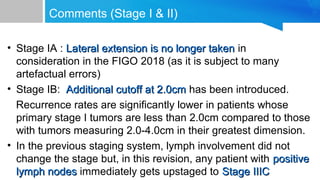
• Stage IA : Lateral extension is no longer takenLateral extension is no longer taken in
consideration in the FIGO 2018 (as it is subject to many
artefactual errors)
• Stage IB: Additional cutoff at 2.0cmAdditional cutoff at 2.0cm has been introduced.
Recurrence rates are significantly lower in patients whose
primary stage I tumors are less than 2.0cm compared to those
with tumors measuring 2.0-4.0cm in their greatest dimension.
• In the previous staging system, lymph involvement did not
change the stage but, in this revision, any patient with positivepositive
lymph nodeslymph nodes immediately gets upstaged to Stage IIICStage IIIC
Continuation
Comments (Stage III and IV)
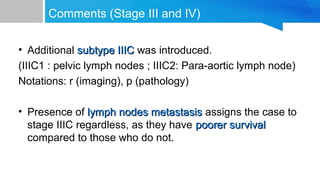
• Additional subtype IIICsubtype IIIC was introduced.
(IIIC1 : pelvic lymph nodes ; IIIC2: Para-aortic lymph node)
Notations: r (imaging), p (pathology)
• Presence of lymph nodes metastasislymph nodes metastasis assigns the case to
stage IIIC regardless, as they have poorer survivalpoorer survival
compared to those who do not.
Management (Surgery)
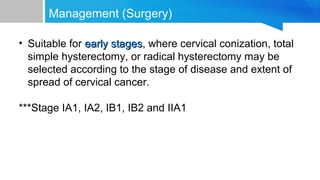
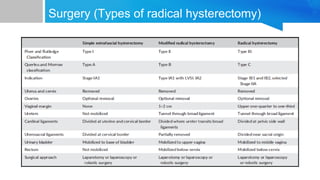
• Suitable for early stagesearly stages, where cervical conization, total
simple hysterectomy, or radical hysterectomy may be
selected according to the stage of disease and extent of
spread of cervical cancer.
***Stage IA1, IA2, IB1, IB2 and IIA1
Surgery (Types of radical hysterectomy)
Management (Radiation/Chemotherapy)
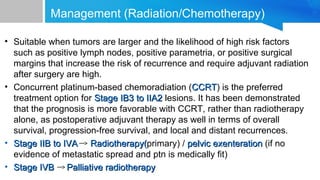
• Suitable when tumors are larger and the likelihood of high risk factors
such as positive lymph nodes, positive parametria, or positive surgical
margins that increase the risk of recurrence and require adjuvant radiation
after surgery are high.
• Concurrent platinum-based chemoradiation (CCRTCCRT) is the preferred
treatment option for Stage IB3 to IIA2Stage IB3 to IIA2 lesions. It has been demonstrated
that the prognosis is more favorable with CCRT, rather than radiotherapy
alone, as postoperative adjuvant therapy as well in terms of overall
survival, progression-free survival, and local and distant recurrences.
• Stage IIB to IVAStage IIB to IVA Radiotherapy(Radiotherapy(primary) / pelvic exenterationpelvic exenteration (if no
evidence of metastatic spread and ptn is medically fit)
• Stage IVBStage IVB Palliative radiotherapyPalliative radiotherapy
Managemant (NACT)
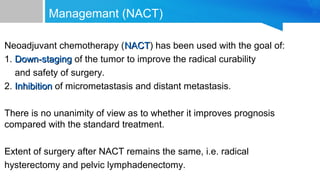
Neoadjuvant chemotherapy (NACTNACT) has been used with the goal of:
1. Down-stagingDown-staging of the tumor to improve the radical curability
and safety of surgery.
2. InhibitionInhibition of micrometastasis and distant metastasis.
There is no unanimity of view as to whether it improves prognosis
compared with the standard treatment.
Extent of surgery after NACT remains the same, i.e. radical
hysterectomy and pelvic lymphadenectomy.
Management (PREGNANCY)
• MDT
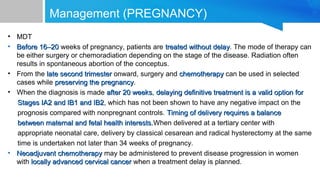
• Before 16–20Before 16–20 weeks of pregnancy, patients are treated without delaytreated without delay. The mode of therapy can
be either surgery or chemoradiation depending on the stage of the disease. Radiation often
results in spontaneous abortion of the conceptus.
• From the late second trimesterlate second trimester onward, surgery and chemotherapychemotherapy can be used in selected
cases while preserving the pregnancypreserving the pregnancy.
• When the diagnosis is made after 20 weeksafter 20 weeks, delaying definitive treatment is a valid option fordelaying definitive treatment is a valid option for
Stages IA2 and IB1 and IB2Stages IA2 and IB1 and IB2, which has not been shown to have any negative impact on the
prognosis compared with nonpregnant controls. Timing of delivery requires a balanceTiming of delivery requires a balance
between maternal and fetal health interests.between maternal and fetal health interests.When delivered at a tertiary center with
appropriate neonatal care, delivery by classical cesarean and radical hysterectomy at the same
time is undertaken not later than 34 weeks of pregnancy.
• Neoadjuvant chemotherapyNeoadjuvant chemotherapy may be administered to prevent disease progression in women
with locally advanced cervical cancerlocally advanced cervical cancer when a treatment delay is planned.
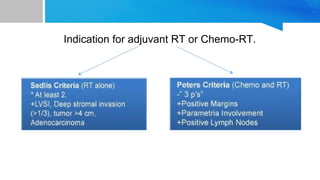
Indication for adjuvant RT or Chemo-RT.
Latest Figo Classification for Cervical Cancer

Latest Figo Classification for Cervical Cancer

  • 1.
    FIGO classification forCervical Cancer (Revised 2018) Presenter: Teo Wan Sim (O&G Trainee) Supervisor: Dr. Teh Beng Hock (Consultant Gynaeoncologist)
  • 2.
    Why revised? To allowthe incorporation of the imaging and pathological findings and clinical assessment of the tumour size and disease extent. Reviews of literature and consensus view of the FIGO Gynecologic Oncology Committee and related societies and organization were used for revision.
  • 3.
  • 4.
  • 5.
    Comments (Stage I& II) • Stage IA : Lateral extension is no longer takenLateral extension is no longer taken in consideration in the FIGO 2018 (as it is subject to many artefactual errors) • Stage IB: Additional cutoff at 2.0cmAdditional cutoff at 2.0cm has been introduced. Recurrence rates are significantly lower in patients whose primary stage I tumors are less than 2.0cm compared to those with tumors measuring 2.0-4.0cm in their greatest dimension. • In the previous staging system, lymph involvement did not change the stage but, in this revision, any patient with positivepositive lymph nodeslymph nodes immediately gets upstaged to Stage IIICStage IIIC
  • 6.
  • 7.
    Comments (Stage IIIand IV) • Additional subtype IIICsubtype IIIC was introduced. (IIIC1 : pelvic lymph nodes ; IIIC2: Para-aortic lymph node) Notations: r (imaging), p (pathology) • Presence of lymph nodes metastasislymph nodes metastasis assigns the case to stage IIIC regardless, as they have poorer survivalpoorer survival compared to those who do not.
  • 8.
    Management (Surgery) • Suitablefor early stagesearly stages, where cervical conization, total simple hysterectomy, or radical hysterectomy may be selected according to the stage of disease and extent of spread of cervical cancer. ***Stage IA1, IA2, IB1, IB2 and IIA1
  • 9.
    Surgery (Types ofradical hysterectomy)
  • 10.
    Management (Radiation/Chemotherapy) • Suitablewhen tumors are larger and the likelihood of high risk factors such as positive lymph nodes, positive parametria, or positive surgical margins that increase the risk of recurrence and require adjuvant radiation after surgery are high. • Concurrent platinum-based chemoradiation (CCRTCCRT) is the preferred treatment option for Stage IB3 to IIA2Stage IB3 to IIA2 lesions. It has been demonstrated that the prognosis is more favorable with CCRT, rather than radiotherapy alone, as postoperative adjuvant therapy as well in terms of overall survival, progression-free survival, and local and distant recurrences. • Stage IIB to IVAStage IIB to IVA Radiotherapy(Radiotherapy(primary) / pelvic exenterationpelvic exenteration (if no evidence of metastatic spread and ptn is medically fit) • Stage IVBStage IVB Palliative radiotherapyPalliative radiotherapy
  • 11.
    Managemant (NACT) Neoadjuvant chemotherapy(NACTNACT) has been used with the goal of: 1. Down-stagingDown-staging of the tumor to improve the radical curability and safety of surgery. 2. InhibitionInhibition of micrometastasis and distant metastasis. There is no unanimity of view as to whether it improves prognosis compared with the standard treatment. Extent of surgery after NACT remains the same, i.e. radical hysterectomy and pelvic lymphadenectomy.
  • 12.
    Management (PREGNANCY) • MDT •Before 16–20Before 16–20 weeks of pregnancy, patients are treated without delaytreated without delay. The mode of therapy can be either surgery or chemoradiation depending on the stage of the disease. Radiation often results in spontaneous abortion of the conceptus. • From the late second trimesterlate second trimester onward, surgery and chemotherapychemotherapy can be used in selected cases while preserving the pregnancypreserving the pregnancy. • When the diagnosis is made after 20 weeksafter 20 weeks, delaying definitive treatment is a valid option fordelaying definitive treatment is a valid option for Stages IA2 and IB1 and IB2Stages IA2 and IB1 and IB2, which has not been shown to have any negative impact on the prognosis compared with nonpregnant controls. Timing of delivery requires a balanceTiming of delivery requires a balance between maternal and fetal health interests.between maternal and fetal health interests.When delivered at a tertiary center with appropriate neonatal care, delivery by classical cesarean and radical hysterectomy at the same time is undertaken not later than 34 weeks of pregnancy. • Neoadjuvant chemotherapyNeoadjuvant chemotherapy may be administered to prevent disease progression in women with locally advanced cervical cancerlocally advanced cervical cancer when a treatment delay is planned.
  • 13.
    Indication for adjuvantRT or Chemo-RT.