



Practical tips
colposcopic treatment
modalities
in cervical lesions
DR. KAWITA BAPAT
Bapat hospital
One Day hysterectomy


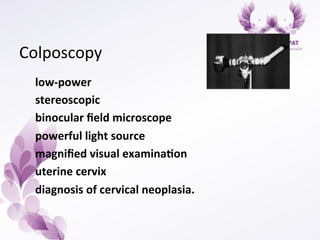
Colposcopy	
  	
  
low-­‐power	
  
stereoscopic	
  
binocular	
  field	
  microscope	
  
powerful	
  light	
  source	
  
magnified	
  visual	
  examina9on	
  
uterine	
  cervix	
  	
  
diagnosis	
  of	
  cervical	
  neoplasia.	


Welcome	
  	
  
to	
  One	
  Centre	
  for	
  
Gynaecological	
  Excellence	
  
Technologic advances!!
•  New optical lenses
•  fiber optic light cables
•  video cameras
•  Computer technology
•  with digital computer enhancement
Screening colposcopy
•  Feasible procedure
•  More sensitive
•  Cost effective than cytological screening.
•  When access to cytopathology difficult
•  an alternative (Cecchini et al,1997).
Current indications of colposcopy
•  Part of any gynecologic examination
•  Primary screening for cervical cancer
•  Clinically suspicious cervix
•  Abnormal Pap smear
•  Evaluation & treatment of CIN
•  Follow up after conservative therapy of CIN
•  Postcoital bleeding.
•  Patients with external vulval warts
•  Evaluation of sexual assault victims.
•  Patients with history of DES exposure
The key ingredients
•  colposcopic examination
Observation cervical epithelium after application of
1.  normal saline
2.  3-5% dilute acetic acid
3.  Lugol’s iodine solution in successive steps.
Assessment of colposcopy
1.  Vascular pattern
2.  Inercapillary distance
3.  Contour
4.  Color
5.  Clarity of demarcation
6.  Appearance of gland opening
7.  Whiteness after acetic acid
8.  Negativity after iodine test
9.  Surface extent of the lesion
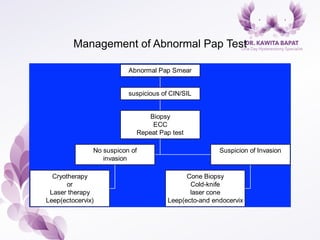
Management of Abnormal Pap Test
Cryotherapy
or
Laser therapy
Leep(ectocervix)
No suspicon of
invasion
Cone Biopsy
Cold-knife
laser cone
Leep(ecto-and endocervix
Suspicion of Invasion
Biopsy
ECC
Repeat Pap test
suspicious of CIN/SIL
Abnormal Pap Smear
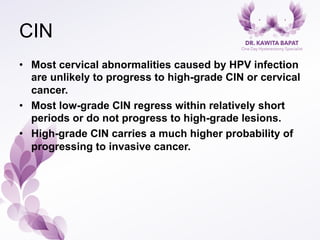
CIN
•  Most cervical abnormalities caused by HPV infection
are unlikely to progress to high-grade CIN or cervical
cancer.
•  Most low-grade CIN regress within relatively short
periods or do not progress to high-grade lesions.
•  High-grade CIN carries a much higher probability of
progressing to invasive cancer.


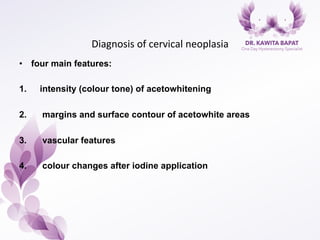
Diagnosis	
  of	
  cervical	
  neoplasia	
  
•  four main features:
1.  intensity (colour tone) of acetowhitening
2.  margins and surface contour of acetowhite areas
3.  vascular features
4.  colour changes after iodine application
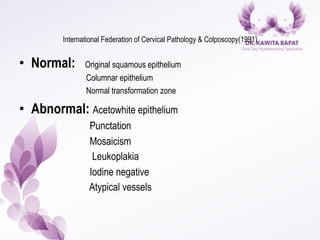
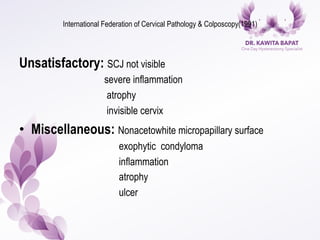
International Federation of Cervical Pathology & Colposcopy(1991)
•  Normal: Original squamous epithelium
Columnar epithelium
Normal transformation zone
•  Abnormal: Acetowhite epithelium
Punctation
Mosaicism
Leukoplakia
Iodine negative
Atypical vessels
International Federation of Cervical Pathology & Colposcopy(1991)
Unsatisfactory: SCJ not visible
severe inflammation
atrophy
invisible cervix
•  Miscellaneous: Nonacetowhite micropapillary surface
exophytic condyloma
inflammation
atrophy
ulcer
One Day hysterectomy
Eligibility criteria for LEEP
•  CIN confirmed cirvical bispsy
•  Lesion involves and extents into endocervical
•  There is no evidence of
PID ,cervicitis,vaginaltrichonomoniasis ,bacterial
vaginosis,angonitel ulcer or bleeding disorder
•  If the women is recently delivered
•  She should be leased 3 months postmortem
•  Without hypertension
One Day hysterectomy
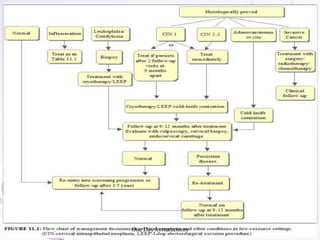
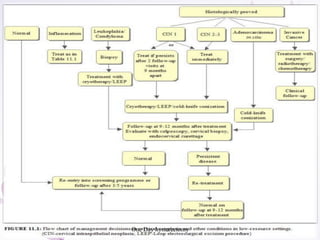
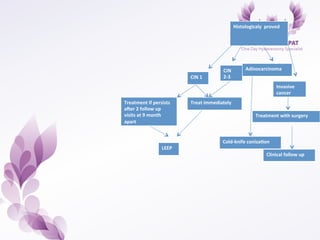
Histologicaly	
  	
  proved	
  	
  
CIN	
  1	
  
CIN	
  
2-­‐3	
  
Adinocarcinoma	
  	
  
Invasive	
  
cancer	
  	
  
Treatment	
  if	
  persists	
  
aEer	
  2	
  follow	
  up	
  	
  
visits	
  at	
  9	
  month	
  
apart	
  	
  
Treat	
  immediately	
  	
  
Cold-­‐knife	
  coniza9on	
  	
  
Treatment	
  with	
  surgery	
  	
  
Clinical	
  follow	
  up	
  
LEEP	
  
One Day hysterectomy
Removal of polyp
One Day hysterectomy
Ablative Techniques
Cryotherapy
•  Freezing to about -60C to -80C
•  depth of 4 to 5 millimeters
•  With a liquid NO2 probe
•  Use a three minute freeze
•  Five minute thaw
•  Another three minute freeze.
•  Least expensive
•  Easiest treatment to perform.
•  Limited evidence suppress hpv.
•  Local anesthetic not necesscary
•  Less painful.
One Day hysterectomy
Laser
•  removes diseased tissue with a CO2 laser.
•  Energy is converted into light which is focused by mirrors and lenses on a
small area where it vaporizes the tissue.
•  precise to the problem area,
•  measured depth of about 6 to 7millimeters.
•  possible to do a contoured conization
•  rapid healing
•  less disagreeable discharge,
•  better visibility of the SCJ after the procedure.
•  Laser is used for the vulva and vagina
•  best for multifocal cervical disease,
•  lesions wide on the cervix, or if the vagina is involved.
• 
One Day hysterectomy
Excisional Techniques
Loop Electrocautery Excision Procedure (LEEP)
Large Loop Excision of the Transformation Zone (LLETZ),
•  cuts off the surface of the cervix
•  depth of six to ten millimeters
•  with a low voltage,
•  high frequency radio signal in a tungsten wire.
•  blended cutting and coagulation,
•  area is cauterized as well.
•  all of the transformation zone is removed
•  easier to learn,
•  easier to perform
•  faster than ablative laser therapy
•  cold-knife or laser conization.
• 
• 
One Day hysterectomy
See and treat
•  expert colposcopists may diagnose
and treat HSIL at the same visit
•  but there is a significant chance of over
treatment so this should be limited to
women with clear evidence of CIN-3.
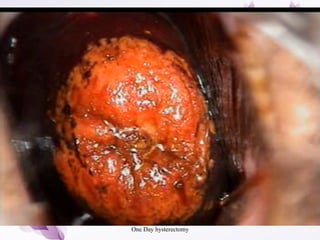
•  Conization usually gives a complete tissue sample for
microscopic analysis.
•  The pathologic evaluation of the cone specimen is again
subjective and also subject to sampling error, since selected
blocks are taken from the specimen for pathological analysis.
•  Both laser and LEEP cones have a significant risk of thermal
damage sufficient to impede the pathologic diagnosis.
•  LEEP cone usually results in several pieces making it harder
to evaluate the margins for residual disease.
•  The cure rate for HSIL and probably even microinvasive
cancer is as good or better than hysterectomy.
•  Cold-knife cone has a better cure rate than LEEP and is
preferred for possible AIS, cancer, and adenocarcinoma.
However, no conization by any method (or other treatment)
will "cure" HPV infection.
One Day hysterectomy
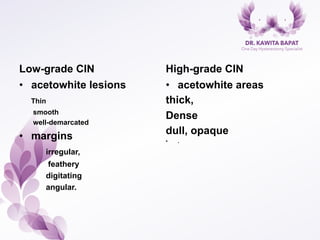
Low-grade CIN
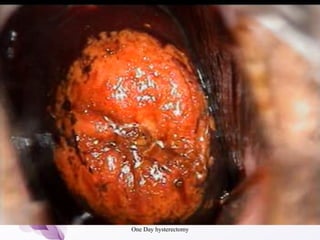
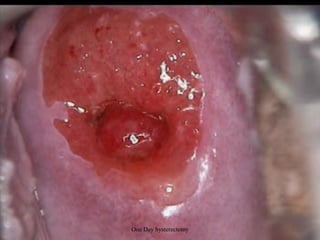
•  acetowhite lesions
Thin
smooth
well-demarcated
•  margins
irregular,
feathery
digitating
angular.
High-grade CIN
•  acetowhite areas
thick,
Dense
dull, opaque
•  .
•  The characteristics of acetowhite
changes, if any, on the cervix following
the application of dilute acetic acid are
useful in colposcopic interpretation
and in directing biopsies.
•  The most common indication of referral
for colposcopy is positive screening
tests (e.g., positive cytology, positive
on visual inspection with acetic acid
(VIA) etc.).
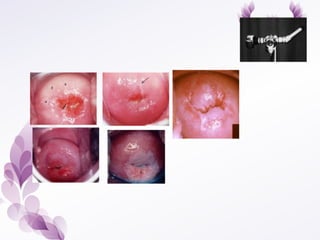
•  The colour changes in the cervix
•  following the application of Lugol’s iodine solution,
•  depends on the presence or absence of glycogen in the
epithelial cells.
•  Areas containing glycogen turn brown or black
•  Areas lacking glycogen remain colourless
•  Pale or turn mustard or saffron yellow.
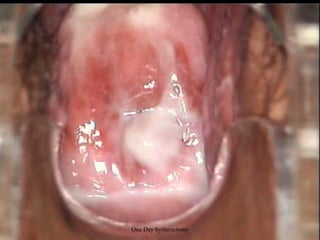
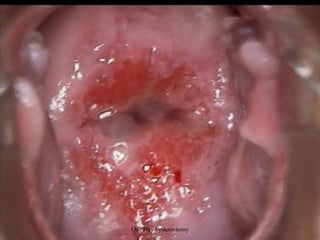
•  The observation of well-demarcated
•  dense,
•  opaque,
•  acetowhite area(s) in the transformation zone
•  close to or
•  abutting the squamocolumnar junction
•  is the hallmark of colposcopic diagnosis of CIN.
See and treat lesions
Height of cost cutting
One Day hysterectomy
Sufficiently	
  advanced	
  
technology	
  is	
  
indis>nguishable	
  from	
  
magic	


Thankyou	
  
Take Care
•  Care must be taken to avoid
exploitation of patients with expensive
unnecessary tests
Concept to keep in mind
A simplified approach will lead to a
significant reduction in both the time
and cost of investigating patients
(Strandell 2000)
Practical tips colposcopic  treatment  modalities

Practical tips colposcopic treatment modalities

  • 1.
    Practical tips colposcopic treatment modalities incervical lesions DR. KAWITA BAPAT Bapat hospital One Day hysterectomy
  • 2.
          Colposcopy     low-­‐power   stereoscopic   binocular  field  microscope   powerful  light  source   magnified  visual  examina9on   uterine  cervix     diagnosis  of  cervical  neoplasia.    
  • 3.
    Welcome     to  One  Centre  for   Gynaecological  Excellence  
  • 5.
    Technologic advances!! •  Newoptical lenses •  fiber optic light cables •  video cameras •  Computer technology •  with digital computer enhancement
  • 6.
    Screening colposcopy •  Feasibleprocedure •  More sensitive •  Cost effective than cytological screening. •  When access to cytopathology difficult •  an alternative (Cecchini et al,1997).
  • 7.
    Current indications ofcolposcopy •  Part of any gynecologic examination •  Primary screening for cervical cancer •  Clinically suspicious cervix •  Abnormal Pap smear •  Evaluation & treatment of CIN •  Follow up after conservative therapy of CIN •  Postcoital bleeding. •  Patients with external vulval warts •  Evaluation of sexual assault victims. •  Patients with history of DES exposure
  • 8.
    The key ingredients • colposcopic examination Observation cervical epithelium after application of 1.  normal saline 2.  3-5% dilute acetic acid 3.  Lugol’s iodine solution in successive steps.
  • 9.
    Assessment of colposcopy 1. Vascular pattern 2.  Inercapillary distance 3.  Contour 4.  Color 5.  Clarity of demarcation 6.  Appearance of gland opening 7.  Whiteness after acetic acid 8.  Negativity after iodine test 9.  Surface extent of the lesion
  • 10.
    Management of AbnormalPap Test Cryotherapy or Laser therapy Leep(ectocervix) No suspicon of invasion Cone Biopsy Cold-knife laser cone Leep(ecto-and endocervix Suspicion of Invasion Biopsy ECC Repeat Pap test suspicious of CIN/SIL Abnormal Pap Smear
  • 11.
    CIN •  Most cervicalabnormalities caused by HPV infection are unlikely to progress to high-grade CIN or cervical cancer. •  Most low-grade CIN regress within relatively short periods or do not progress to high-grade lesions. •  High-grade CIN carries a much higher probability of progressing to invasive cancer.
  • 12.
          Diagnosis  of  cervical  neoplasia   •  four main features: 1.  intensity (colour tone) of acetowhitening 2.  margins and surface contour of acetowhite areas 3.  vascular features 4.  colour changes after iodine application
  • 13.
    International Federation ofCervical Pathology & Colposcopy(1991) •  Normal: Original squamous epithelium Columnar epithelium Normal transformation zone •  Abnormal: Acetowhite epithelium Punctation Mosaicism Leukoplakia Iodine negative Atypical vessels
  • 14.
    International Federation ofCervical Pathology & Colposcopy(1991) Unsatisfactory: SCJ not visible severe inflammation atrophy invisible cervix •  Miscellaneous: Nonacetowhite micropapillary surface exophytic condyloma inflammation atrophy ulcer
  • 15.
  • 16.
    Eligibility criteria forLEEP •  CIN confirmed cirvical bispsy •  Lesion involves and extents into endocervical •  There is no evidence of PID ,cervicitis,vaginaltrichonomoniasis ,bacterial vaginosis,angonitel ulcer or bleeding disorder •  If the women is recently delivered •  She should be leased 3 months postmortem •  Without hypertension One Day hysterectomy
  • 17.
  • 18.
  • 19.
    Histologicaly    proved     CIN  1   CIN   2-­‐3   Adinocarcinoma     Invasive   cancer     Treatment  if  persists   aEer  2  follow  up     visits  at  9  month   apart     Treat  immediately     Cold-­‐knife  coniza9on     Treatment  with  surgery     Clinical  follow  up   LEEP  
  • 20.
  • 21.
    Removal of polyp OneDay hysterectomy
  • 22.
  • 23.
  • 24.
  • 25.
  • 26.
  • 27.
    Ablative Techniques Cryotherapy •  Freezingto about -60C to -80C •  depth of 4 to 5 millimeters •  With a liquid NO2 probe •  Use a three minute freeze •  Five minute thaw •  Another three minute freeze. •  Least expensive •  Easiest treatment to perform. •  Limited evidence suppress hpv. •  Local anesthetic not necesscary •  Less painful. One Day hysterectomy
  • 28.
    Laser •  removes diseasedtissue with a CO2 laser. •  Energy is converted into light which is focused by mirrors and lenses on a small area where it vaporizes the tissue. •  precise to the problem area, •  measured depth of about 6 to 7millimeters. •  possible to do a contoured conization •  rapid healing •  less disagreeable discharge, •  better visibility of the SCJ after the procedure. •  Laser is used for the vulva and vagina •  best for multifocal cervical disease, •  lesions wide on the cervix, or if the vagina is involved. •  One Day hysterectomy
  • 29.
    Excisional Techniques Loop ElectrocauteryExcision Procedure (LEEP) Large Loop Excision of the Transformation Zone (LLETZ), •  cuts off the surface of the cervix •  depth of six to ten millimeters •  with a low voltage, •  high frequency radio signal in a tungsten wire. •  blended cutting and coagulation, •  area is cauterized as well. •  all of the transformation zone is removed •  easier to learn, •  easier to perform •  faster than ablative laser therapy •  cold-knife or laser conization. •  •  One Day hysterectomy
  • 30.
    See and treat • expert colposcopists may diagnose and treat HSIL at the same visit •  but there is a significant chance of over treatment so this should be limited to women with clear evidence of CIN-3.
  • 31.
    •  Conization usuallygives a complete tissue sample for microscopic analysis. •  The pathologic evaluation of the cone specimen is again subjective and also subject to sampling error, since selected blocks are taken from the specimen for pathological analysis. •  Both laser and LEEP cones have a significant risk of thermal damage sufficient to impede the pathologic diagnosis. •  LEEP cone usually results in several pieces making it harder to evaluate the margins for residual disease. •  The cure rate for HSIL and probably even microinvasive cancer is as good or better than hysterectomy. •  Cold-knife cone has a better cure rate than LEEP and is preferred for possible AIS, cancer, and adenocarcinoma. However, no conization by any method (or other treatment) will "cure" HPV infection. One Day hysterectomy
  • 32.
  • 33.
    Low-grade CIN •  acetowhitelesions Thin smooth well-demarcated •  margins irregular, feathery digitating angular. High-grade CIN •  acetowhite areas thick, Dense dull, opaque •  .
  • 34.
    •  The characteristicsof acetowhite changes, if any, on the cervix following the application of dilute acetic acid are useful in colposcopic interpretation and in directing biopsies.
  • 35.
    •  The mostcommon indication of referral for colposcopy is positive screening tests (e.g., positive cytology, positive on visual inspection with acetic acid (VIA) etc.).
  • 36.
    •  The colourchanges in the cervix •  following the application of Lugol’s iodine solution, •  depends on the presence or absence of glycogen in the epithelial cells. •  Areas containing glycogen turn brown or black •  Areas lacking glycogen remain colourless •  Pale or turn mustard or saffron yellow.
  • 38.
    •  The observationof well-demarcated •  dense, •  opaque, •  acetowhite area(s) in the transformation zone •  close to or •  abutting the squamocolumnar junction •  is the hallmark of colposcopic diagnosis of CIN.
  • 39.
    See and treatlesions Height of cost cutting One Day hysterectomy
  • 40.
    One Day hysterectomy Sufficiently  advanced   technology  is   indis>nguishable  from   magic     Thankyou  
  • 41.
    Take Care •  Caremust be taken to avoid exploitation of patients with expensive unnecessary tests
  • 42.
    Concept to keepin mind A simplified approach will lead to a significant reduction in both the time and cost of investigating patients (Strandell 2000)