August 6, 2009 1
Operators
August 6, 2009 2
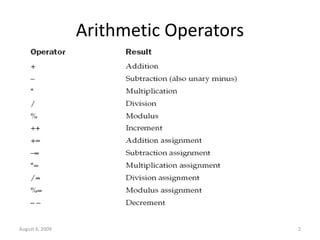
Arithmetic Operators
August 6, 2009 3
class BasicMath {
public static void main(String args[]) {
// arithmetic using integers
System.out.println("Integer Arithmetic");
int a = 1 + 1; int b = a * 3;
int c = b / 4;
int d = c - a;
int e = -d;
System.out.println("a = " + a);
System.out.println("b = " + b);
System.out.println("c = " + c);
System.out.println("d = " + d);
System.out.println("e = " + e);
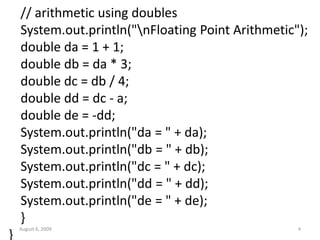
// arithmetic using doubles
System.out.println("nFloating Point Arithmetic");
double da = 1 + 1;
double db = da * 3;
double dc = db / 4;
double dd = dc - a;
double de = -dd;
System.out.println("da = " + da);
System.out.println("db = " + db);
System.out.println("dc = " + dc);
System.out.println("dd = " + dd);
System.out.println("de = " + de);
}
}
August 6, 2009 4
August 6, 2009 5
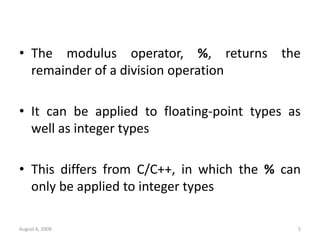
• The modulus operator, %, returns the
remainder of a division operation
• It can be applied to floating-point types as
well as integer types
• This differs from C/C++, in which the % can
only be applied to integer types
August 6, 2009 6
class Modulus {
public static void main(String args[]) {
int x = 42;
double y = 42.25;
System.out.println("x mod 10 = " + x % 10);
System.out.println("y mod 10 = " + y % 10);
}
}
When you run this program you will get the following
output:
x mod 10 = 2
y mod 10 = 2.25
August 6, 2009 7
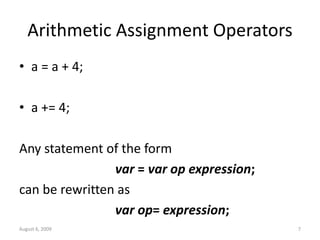
Arithmetic Assignment Operators
• a = a + 4;
• a += 4;
Any statement of the form
var = var op expression;
can be rewritten as
var op= expression;
August 6, 2009 8
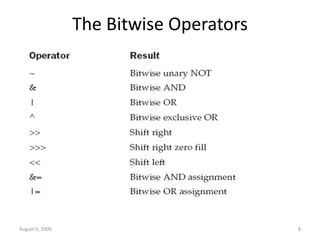
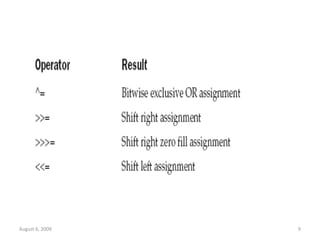
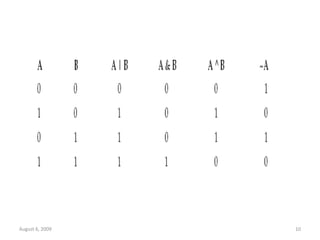
The Bitwise Operators
August 6, 2009 9
August 6, 2009 10
August 6, 2009 13
The Left Shift
It has this general form:
value << num
• If you left-shift a byte value, that value will first be
promoted to int and then shifted
• This means that you must discard the top three bytes
of the result if what you want is the result of a
shifted byte value
• The easiest way to do this is to simply cast the result
back into a byte
August 6, 2009 14
class ByteShift {
public static void main(String args[]) {
byte a = 64, b;
int i;
i = a << 2;
b = (byte) (a << 2);
System.out.println("Original value of a: " + a);
System.out.println("i and b: " + i + " " + b);
}
}
Output:
Original value of a: 64
i and b: 256 0
August 6, 2009 15
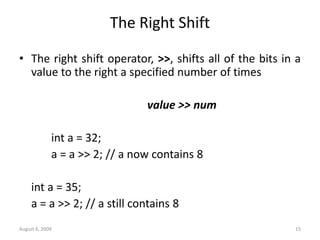
The Right Shift
• The right shift operator, >>, shifts all of the bits in a
value to the right a specified number of times
value >> num
int a = 32;
a = a >> 2; // a now contains 8
int a = 35;
a = a >> 2; // a still contains 8
August 6, 2009 16
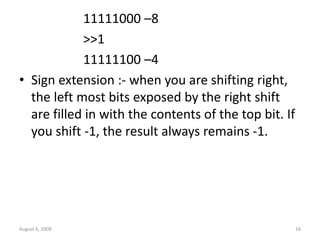
11111000 –8
>>1
11111100 –4
• Sign extension :- when you are shifting right,
the left most bits exposed by the right shift
are filled in with the contents of the top bit. If
you shift -1, the result always remains -1.
August 6, 2009 17
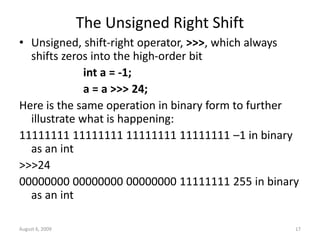
The Unsigned Right Shift
• Unsigned, shift-right operator, >>>, which always
shifts zeros into the high-order bit
int a = -1;
a = a >>> 24;
Here is the same operation in binary form to further
illustrate what is happening:
11111111 11111111 11111111 11111111 –1 in binary
as an int
>>>24
00000000 00000000 00000000 11111111 255 in binary
as an int
August 6, 2009 18
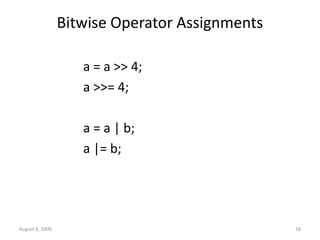
Bitwise Operator Assignments
a = a >> 4;
a >>= 4;
a = a | b;
a |= b;
class OpBitEquals {
public static void main(String args[]) {
int a = 1; int b = 2;
int c = 3; a |= 4;
b >>= 1; c <<= 1;
a ^= c;
System.out.println("a = " + a);
System.out.println("b = " + b);
System.out.println("c = " + c);
} }
• The output of this program is shown here:
a = 3
b = 1
c = 6
August 6, 2009 20
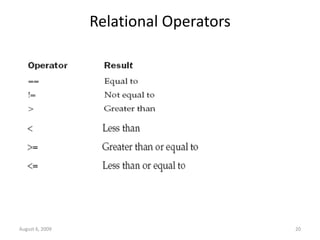
Relational Operators
August 6, 2009 21
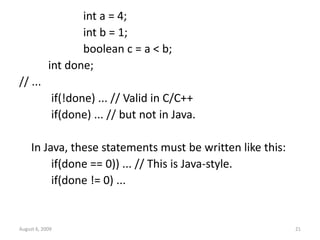
int a = 4;
int b = 1;
boolean c = a < b;
int done;
// ...
if(!done) ... // Valid in C/C++
if(done) ... // but not in Java.
In Java, these statements must be written like this:
if(done == 0)) ... // This is Java-style.
if(done != 0) ...
August 6, 2009 22
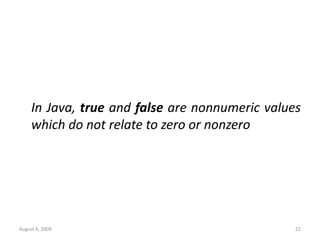
In Java, true and false are nonnumeric values
which do not relate to zero or nonzero
August 6, 2009 23
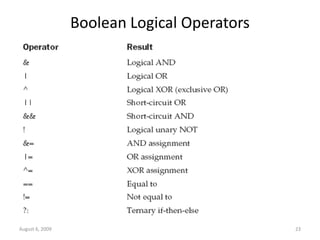
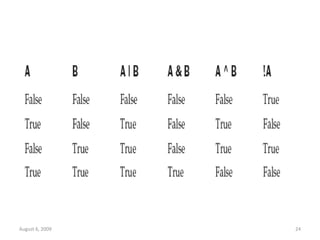
Boolean Logical Operators
August 6, 2009 24
August 6, 2009 25
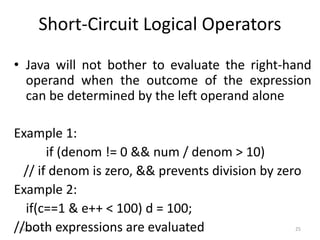
Short-Circuit Logical Operators
• Java will not bother to evaluate the right-hand
operand when the outcome of the expression
can be determined by the left operand alone
Example 1:
if (denom != 0 && num / denom > 10)
// if denom is zero, && prevents division by zero
Example 2:
if(c==1 & e++ < 100) d = 100;
//both expressions are evaluated
August 6, 2009 26
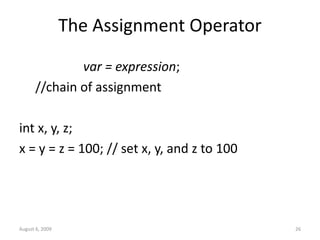
The Assignment Operator
var = expression;
//chain of assignment
int x, y, z;
x = y = z = 100; // set x, y, and z to 100
August 6, 2009 27
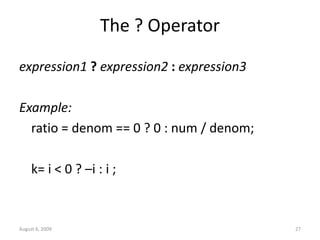
The ? Operator
expression1 ? expression2 : expression3
Example:
ratio = denom == 0 ? 0 : num / denom;
k= i < 0 ? –i : i ;
August 6, 2009 28
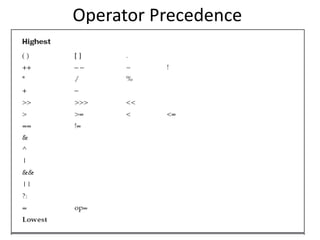
Operator Precedence
August 6, 2009 29
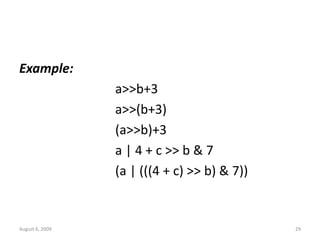
Example:
a>>b+3
a>>(b+3)
(a>>b)+3
a | 4 + c >> b & 7
(a | (((4 + c) >> b) & 7))
August 6, 2009 30
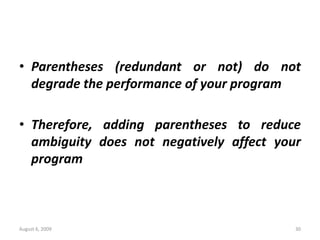
• Parentheses (redundant or not) do not
degrade the performance of your program
• Therefore, adding parentheses to reduce
ambiguity does not negatively affect your
program

3.OPERATORS_MB.ppt .

  • 1.
    August 6, 20091 Operators
  • 2.
    August 6, 20092 Arithmetic Operators
  • 3.
    August 6, 20093 class BasicMath { public static void main(String args[]) { // arithmetic using integers System.out.println("Integer Arithmetic"); int a = 1 + 1; int b = a * 3; int c = b / 4; int d = c - a; int e = -d; System.out.println("a = " + a); System.out.println("b = " + b); System.out.println("c = " + c); System.out.println("d = " + d); System.out.println("e = " + e);
  • 4.
    // arithmetic usingdoubles System.out.println("nFloating Point Arithmetic"); double da = 1 + 1; double db = da * 3; double dc = db / 4; double dd = dc - a; double de = -dd; System.out.println("da = " + da); System.out.println("db = " + db); System.out.println("dc = " + dc); System.out.println("dd = " + dd); System.out.println("de = " + de); } } August 6, 2009 4
  • 5.
    August 6, 20095 • The modulus operator, %, returns the remainder of a division operation • It can be applied to floating-point types as well as integer types • This differs from C/C++, in which the % can only be applied to integer types
  • 6.
    August 6, 20096 class Modulus { public static void main(String args[]) { int x = 42; double y = 42.25; System.out.println("x mod 10 = " + x % 10); System.out.println("y mod 10 = " + y % 10); } } When you run this program you will get the following output: x mod 10 = 2 y mod 10 = 2.25
  • 7.
    August 6, 20097 Arithmetic Assignment Operators • a = a + 4; • a += 4; Any statement of the form var = var op expression; can be rewritten as var op= expression;
  • 8.
    August 6, 20098 The Bitwise Operators
  • 9.
  • 10.
  • 11.
    August 6, 200913 The Left Shift It has this general form: value << num • If you left-shift a byte value, that value will first be promoted to int and then shifted • This means that you must discard the top three bytes of the result if what you want is the result of a shifted byte value • The easiest way to do this is to simply cast the result back into a byte
  • 12.
    August 6, 200914 class ByteShift { public static void main(String args[]) { byte a = 64, b; int i; i = a << 2; b = (byte) (a << 2); System.out.println("Original value of a: " + a); System.out.println("i and b: " + i + " " + b); } } Output: Original value of a: 64 i and b: 256 0
  • 13.
    August 6, 200915 The Right Shift • The right shift operator, >>, shifts all of the bits in a value to the right a specified number of times value >> num int a = 32; a = a >> 2; // a now contains 8 int a = 35; a = a >> 2; // a still contains 8
  • 14.
    August 6, 200916 11111000 –8 >>1 11111100 –4 • Sign extension :- when you are shifting right, the left most bits exposed by the right shift are filled in with the contents of the top bit. If you shift -1, the result always remains -1.
  • 15.
    August 6, 200917 The Unsigned Right Shift • Unsigned, shift-right operator, >>>, which always shifts zeros into the high-order bit int a = -1; a = a >>> 24; Here is the same operation in binary form to further illustrate what is happening: 11111111 11111111 11111111 11111111 –1 in binary as an int >>>24 00000000 00000000 00000000 11111111 255 in binary as an int
  • 16.
    August 6, 200918 Bitwise Operator Assignments a = a >> 4; a >>= 4; a = a | b; a |= b;
  • 17.
    class OpBitEquals { publicstatic void main(String args[]) { int a = 1; int b = 2; int c = 3; a |= 4; b >>= 1; c <<= 1; a ^= c; System.out.println("a = " + a); System.out.println("b = " + b); System.out.println("c = " + c); } } • The output of this program is shown here: a = 3 b = 1 c = 6
  • 18.
    August 6, 200920 Relational Operators
  • 19.
    August 6, 200921 int a = 4; int b = 1; boolean c = a < b; int done; // ... if(!done) ... // Valid in C/C++ if(done) ... // but not in Java. In Java, these statements must be written like this: if(done == 0)) ... // This is Java-style. if(done != 0) ...
  • 20.
    August 6, 200922 In Java, true and false are nonnumeric values which do not relate to zero or nonzero
  • 21.
    August 6, 200923 Boolean Logical Operators
  • 22.
  • 23.
    August 6, 200925 Short-Circuit Logical Operators • Java will not bother to evaluate the right-hand operand when the outcome of the expression can be determined by the left operand alone Example 1: if (denom != 0 && num / denom > 10) // if denom is zero, && prevents division by zero Example 2: if(c==1 & e++ < 100) d = 100; //both expressions are evaluated
  • 24.
    August 6, 200926 The Assignment Operator var = expression; //chain of assignment int x, y, z; x = y = z = 100; // set x, y, and z to 100
  • 25.
    August 6, 200927 The ? Operator expression1 ? expression2 : expression3 Example: ratio = denom == 0 ? 0 : num / denom; k= i < 0 ? –i : i ;
  • 26.
    August 6, 200928 Operator Precedence
  • 27.
    August 6, 200929 Example: a>>b+3 a>>(b+3) (a>>b)+3 a | 4 + c >> b & 7 (a | (((4 + c) >> b) & 7))
  • 28.
    August 6, 200930 • Parentheses (redundant or not) do not degrade the performance of your program • Therefore, adding parentheses to reduce ambiguity does not negatively affect your program

Editor's Notes

  • #4 a=2 b=6 c=1 d=-1 e=1
  • #5 da=2 .0 db=6.0 dc=1.5 dd=-0.5 de=0.5
  • #12 g=~a & 0x0f or 0xf or ox000f are same. Otherwise g becomes -4(11111111111111111111111111111100) instead of 12(1100)