



Facilities planning: location
 Site selection is an important activity which decides
the fate of the business. A good location reduces the
cost of production and distribution to a considerable
extent.
Need for selecting a good location
may arise in following conditions
(i) While starting a new factory
(ii) During the expansion of existing plant
(iii) Where the existing plant is to be relocated at some
other place, to remove the drawbacks of the present
location or to gain the benefits of a still better
location.
Problem of location
The problem of site selection of a factory can be solved
in following three stages:
(i) Selection of region
(ii) Selection of locality
(iii) Selection of actual site.
Selection of region
 Generally, the geographical area is divided on the basis
of natural regions or political boundaries within the
nation. The suitability of various regions is considered
on the basis of comparative cost advantage available
out of the possible regions.
Selection of locality
(i) Urban area
(ii) Rural area
(iii) Suburban area
Selection of site
 While selecting the site, the type of development of
land, cost of leveling etc., possibility of plant
expansions and other infrastructure facilities like
transport, banking, power, communication, postal
facilities etc. are considered.
Factors affecting size of firm
(i) Availability of capital
(ii) Entrepreneurial ability and efficiency
(iii) Risk of uncertanities:
It is of four types
(a)Permanent change
(b)Cyclical change
(c)Seasonal fluctuations
(d)Erratic fluctuations
(iv) Type of organization
(v) Availability of inputs
(vi) Nature of products
(vii) Law of returns
(viii)Government regulation
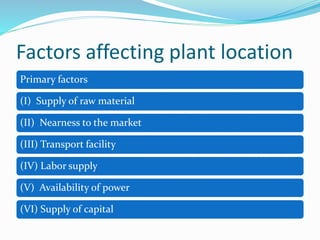
Factors affecting plant location
Primary factors
(I) Supply of raw material
(II) Nearness to the market
(III) Transport facility
(IV) Labor supply
(V) Availability of power
(VI) Supply of capital
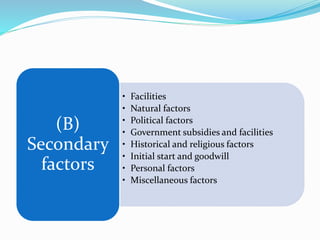
• Facilities
• Natural factors
• Political factors
• Government subsidies and facilities
• Historical and religious factors
• Initial start and goodwill
• Personal factors
• Miscellaneous factors
(B)
Secondary
factors
Selection of actual site
Availability of cheap land to build and expand this plant
Cost of land development
Repair facilities
Facility for housing the workers and if necessary their transport from the place of
residence of work site
Cost of laying the water supply and providing sewage and disposal of waste
Post and telegraph facility
Cheap facilities for disposing of trade waste
Any restriction imposed by the town planning department, local bye laws
Taxes, fire protection etc
Economic survey of site selection
Computation of investment and cost of production and distribution
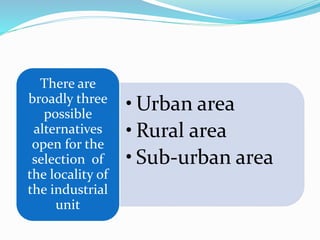
• Urban area
• Rural area
• Sub-urban area
There are
broadly three
possible
alternatives
open for the
selection of
the locality of
the industrial
unit
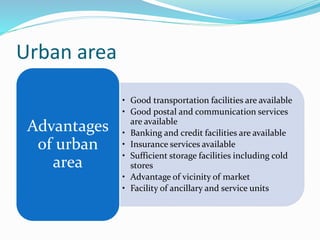
Urban area
• Good transportation facilities are available
• Good postal and communication services
are available
• Banking and credit facilities are available
• Insurance services available
• Sufficient storage facilities including cold
stores
• Advantage of vicinity of market
• Facility of ancillary and service units
Advantages
of urban
area
Ample availability of skilled and unskilled workers
Sufficient passenger transport facility
Educational medical and recreational facilities
Water supply, drainage and fire fighting facilities available
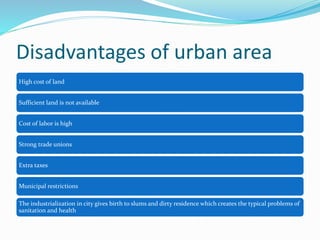
Disadvantages of urban area
High cost of land
Sufficient land is not available
Cost of labor is high
Strong trade unions
Extra taxes
Municipal restrictions
The industrialization in city gives birth to slums and dirty residence which creates the typical problems of
sanitation and health
Rural areas:- Advantages
Land is available at cheaper rates
Sufficient land availability
Cheap labor
Low rate of labor turnover
No local taxes
No municipal restrictions
No slums and dirty residence
No danger of fire as there is no congestion
No danger of bombardment in war time
Limitations of rural areas
Lack of transport facilities
Lack of postage and telegraph services
Lack of banking and credit facilities
Absence of insurance services
Storing and warehousing facility not available
Passenger transport facility not available
Lack of ancillary and service units
High cost of distribution
Lack of skilled workers
Absence of recreational facilities, good educational institutes etc
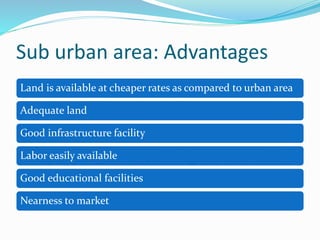
Sub urban area: Advantages
Land is available at cheaper rates as compared to urban area
Adequate land
Good infrastructure facility
Labor easily available
Good educational facilities
Nearness to market
Limitations of sub urban area
It may get converted
into urban area through
development process
and we may face the
same difficulties as in
the case of urban areas.
Recent trends in the location of
industries
Priority to the suburban areas
Industrial development in notified backward areas
Establishment of industrial estate
Decentralization of industry
Increased role of govt. in location decision of industry
The end

3.facilities planning

  • 2.
    Facilities planning: location Site selection is an important activity which decides the fate of the business. A good location reduces the cost of production and distribution to a considerable extent.
  • 3.
    Need for selectinga good location may arise in following conditions (i) While starting a new factory (ii) During the expansion of existing plant (iii) Where the existing plant is to be relocated at some other place, to remove the drawbacks of the present location or to gain the benefits of a still better location.
  • 4.
    Problem of location Theproblem of site selection of a factory can be solved in following three stages: (i) Selection of region (ii) Selection of locality (iii) Selection of actual site.
  • 5.
    Selection of region Generally, the geographical area is divided on the basis of natural regions or political boundaries within the nation. The suitability of various regions is considered on the basis of comparative cost advantage available out of the possible regions.
  • 6.
    Selection of locality (i)Urban area (ii) Rural area (iii) Suburban area
  • 7.
    Selection of site While selecting the site, the type of development of land, cost of leveling etc., possibility of plant expansions and other infrastructure facilities like transport, banking, power, communication, postal facilities etc. are considered.
  • 8.
    Factors affecting sizeof firm (i) Availability of capital (ii) Entrepreneurial ability and efficiency (iii) Risk of uncertanities: It is of four types (a)Permanent change (b)Cyclical change (c)Seasonal fluctuations (d)Erratic fluctuations
  • 9.
    (iv) Type oforganization (v) Availability of inputs (vi) Nature of products (vii) Law of returns (viii)Government regulation
  • 10.
    Factors affecting plantlocation Primary factors (I) Supply of raw material (II) Nearness to the market (III) Transport facility (IV) Labor supply (V) Availability of power (VI) Supply of capital
  • 11.
    • Facilities • Naturalfactors • Political factors • Government subsidies and facilities • Historical and religious factors • Initial start and goodwill • Personal factors • Miscellaneous factors (B) Secondary factors
  • 12.
    Selection of actualsite Availability of cheap land to build and expand this plant Cost of land development Repair facilities Facility for housing the workers and if necessary their transport from the place of residence of work site Cost of laying the water supply and providing sewage and disposal of waste Post and telegraph facility
  • 13.
    Cheap facilities fordisposing of trade waste Any restriction imposed by the town planning department, local bye laws Taxes, fire protection etc Economic survey of site selection Computation of investment and cost of production and distribution
  • 14.
    • Urban area •Rural area • Sub-urban area There are broadly three possible alternatives open for the selection of the locality of the industrial unit
  • 15.
    Urban area • Goodtransportation facilities are available • Good postal and communication services are available • Banking and credit facilities are available • Insurance services available • Sufficient storage facilities including cold stores • Advantage of vicinity of market • Facility of ancillary and service units Advantages of urban area
  • 16.
    Ample availability ofskilled and unskilled workers Sufficient passenger transport facility Educational medical and recreational facilities Water supply, drainage and fire fighting facilities available
  • 17.
    Disadvantages of urbanarea High cost of land Sufficient land is not available Cost of labor is high Strong trade unions Extra taxes Municipal restrictions The industrialization in city gives birth to slums and dirty residence which creates the typical problems of sanitation and health
  • 18.
    Rural areas:- Advantages Landis available at cheaper rates Sufficient land availability Cheap labor Low rate of labor turnover No local taxes No municipal restrictions No slums and dirty residence No danger of fire as there is no congestion No danger of bombardment in war time
  • 19.
    Limitations of ruralareas Lack of transport facilities Lack of postage and telegraph services Lack of banking and credit facilities Absence of insurance services Storing and warehousing facility not available Passenger transport facility not available Lack of ancillary and service units High cost of distribution Lack of skilled workers Absence of recreational facilities, good educational institutes etc
  • 20.
    Sub urban area:Advantages Land is available at cheaper rates as compared to urban area Adequate land Good infrastructure facility Labor easily available Good educational facilities Nearness to market
  • 21.
    Limitations of suburban area It may get converted into urban area through development process and we may face the same difficulties as in the case of urban areas.
  • 22.
    Recent trends inthe location of industries Priority to the suburban areas Industrial development in notified backward areas Establishment of industrial estate Decentralization of industry Increased role of govt. in location decision of industry
  • 23.