

Introduction
 One of the critical tasks of service companies is service
  quality management. Quality means the degree of
  excellence in service performance. Consumers perceive
  the quality of service by experiencing the consumption
  process and by comparing the experience with their
  expectations.
How service quality is perceived
 When service organisations understand how services
  are evaluated by consumers in terms of quality, it is
  possible to design strategies to manage these
  evaluations and influence them in desired direction.
  In a service encounter, buyer seller interaction takes
  place in large no. and leaves an impact. Thus a
  methodology is necessary to understand how
  customers perceive quality.
 Gronross has identified two dimensions of service
  quality in relation to quality perception by customers.
  They are technical quality and functional quality.
 Technical quality: what is offered to the customer from
  the organisation and what customers receive in their
  interactions with the service firm is called technical
  product. In other words it speaks of the technical
  quality of blueprinting and its execution. Technical
  quality moulds the first impression of customers.
 Functional quality: research study indicate that
  customers will be influenced mostly by the way
  technical quality is transferred to them.
Expected quality vs experienced
quality
 Generally consumers get influenced by four important
  factors while forming expectations.
 Market communication: service firms
  communicate, through direct and indirect channels, to
  the target market relating to the features and
  specialties of BSP. This is a promise the service
  provider makes with the customer.
 Image: the image of service firm at the corporate level
  as well as the local level influence the expectations of
  the customer. It pervades various dimensions.
 Word of mouth communication: This is an informal and
  strongest communication channel. Consumers often take
  advise from others whom they consider friend rather than
  service provider.
 Customer needs: besides the three factors mentioned
  above, the need intensity of customers influence the
  expectations. A relaxed customer may expect quality of
  high level compared to a customer who is hard pressed for
  time. For example in the case of health care services, at the
  time of emergency, people expect better and quicker
  response than in normal conditions.
Total perceived quality
 The total perceived quality of customer can be
 calculated by comparing expected quality with
 experienced quality. If the two are same consumer
 feels satisfied with service.
Determinants of service quality
      Alfrecht and zemke identified four factors that
      influence the perceived service quality. They are:
(I) Care and concern
(II) Spontaneity
(III) Problem solving
(IV) Recovery
 A comprehensive study was carried out by Parasuraman, Zeithmal and
   Berry to identify the determinants of perceived service quality. They
   have identified ten determinants of service quality.
(I) Reliability
(II) Responsiveness
(III) Competence
(IV) Access
(V) Courtesy
(VI) Communication
(VII) Credibility
(VIII)Security
(IX) Understanding the customer
(X) tangibles
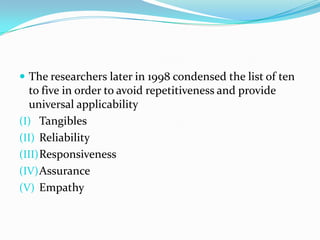
 The researchers later in 1998 condensed the list of ten
  to five in order to avoid repetitiveness and provide
  universal applicability
(I) Tangibles
(II) Reliability
(III) Responsiveness
(IV) Assurance
(V) Empathy
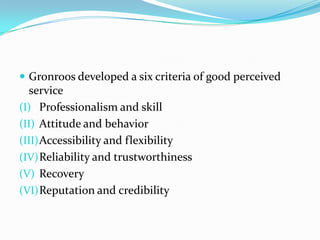
 Gronroos developed a six criteria of good perceived
  service
(I) Professionalism and skill
(II) Attitude and behavior
(III) Accessibility and flexibility
(IV) Reliability and trustworthiness
(V) Recovery
(VI) Reputation and credibility
Managerial process for service
quality
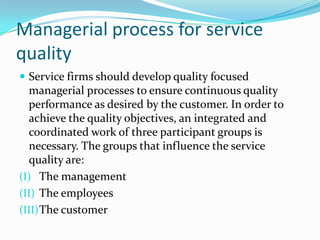
 Service firms should develop quality focused
  managerial processes to ensure continuous quality
  performance as desired by the customer. In order to
  achieve the quality objectives, an integrated and
  coordinated work of three participant groups is
  necessary. The groups that influence the service
  quality are:
(I) The management
(II) The employees
(III) The customer

5. gap model of service

  • 2.
    Introduction  One ofthe critical tasks of service companies is service quality management. Quality means the degree of excellence in service performance. Consumers perceive the quality of service by experiencing the consumption process and by comparing the experience with their expectations.
  • 3.
    How service qualityis perceived  When service organisations understand how services are evaluated by consumers in terms of quality, it is possible to design strategies to manage these evaluations and influence them in desired direction. In a service encounter, buyer seller interaction takes place in large no. and leaves an impact. Thus a methodology is necessary to understand how customers perceive quality.  Gronross has identified two dimensions of service quality in relation to quality perception by customers. They are technical quality and functional quality.
  • 4.
     Technical quality:what is offered to the customer from the organisation and what customers receive in their interactions with the service firm is called technical product. In other words it speaks of the technical quality of blueprinting and its execution. Technical quality moulds the first impression of customers.  Functional quality: research study indicate that customers will be influenced mostly by the way technical quality is transferred to them.
  • 5.
    Expected quality vsexperienced quality  Generally consumers get influenced by four important factors while forming expectations.  Market communication: service firms communicate, through direct and indirect channels, to the target market relating to the features and specialties of BSP. This is a promise the service provider makes with the customer.  Image: the image of service firm at the corporate level as well as the local level influence the expectations of the customer. It pervades various dimensions.
  • 6.
     Word ofmouth communication: This is an informal and strongest communication channel. Consumers often take advise from others whom they consider friend rather than service provider.  Customer needs: besides the three factors mentioned above, the need intensity of customers influence the expectations. A relaxed customer may expect quality of high level compared to a customer who is hard pressed for time. For example in the case of health care services, at the time of emergency, people expect better and quicker response than in normal conditions.
  • 7.
    Total perceived quality The total perceived quality of customer can be calculated by comparing expected quality with experienced quality. If the two are same consumer feels satisfied with service.
  • 8.
    Determinants of servicequality Alfrecht and zemke identified four factors that influence the perceived service quality. They are: (I) Care and concern (II) Spontaneity (III) Problem solving (IV) Recovery
  • 9.
     A comprehensivestudy was carried out by Parasuraman, Zeithmal and Berry to identify the determinants of perceived service quality. They have identified ten determinants of service quality. (I) Reliability (II) Responsiveness (III) Competence (IV) Access (V) Courtesy (VI) Communication (VII) Credibility (VIII)Security (IX) Understanding the customer (X) tangibles
  • 10.
     The researcherslater in 1998 condensed the list of ten to five in order to avoid repetitiveness and provide universal applicability (I) Tangibles (II) Reliability (III) Responsiveness (IV) Assurance (V) Empathy
  • 11.
     Gronroos developeda six criteria of good perceived service (I) Professionalism and skill (II) Attitude and behavior (III) Accessibility and flexibility (IV) Reliability and trustworthiness (V) Recovery (VI) Reputation and credibility
  • 12.
    Managerial process forservice quality  Service firms should develop quality focused managerial processes to ensure continuous quality performance as desired by the customer. In order to achieve the quality objectives, an integrated and coordinated work of three participant groups is necessary. The groups that influence the service quality are: (I) The management (II) The employees (III) The customer