FACILITY
MANAGEMENT
SASIKUMAR NATARAJAN
HOSPITALITY TRAINER
WHAT IS FACILITY MANAGEMENT
Business operate in larger spaces with more people that are constantly implementing new
processes and technology to reach defined business goals. Facilities management works
in the background to maximize business performance and ensure that the physical
environment in no way hinders employee productivity.
Facility management encompasses a huge range of responsibilities and it is vital for
sustainable business growth. As such, it has to be approached strategically. The goal of
this guide is to explain the scope of facility management, discuss the tools and resources
it needs to function properly, and show how it fits into an overall organizational
structure. Facilities management is defined as the physical maintenance and operation
of buildings or the business place.
SASIKUMAR NATARAJAN - EDUCATIONALIST & HOSPITALITY TRAINER
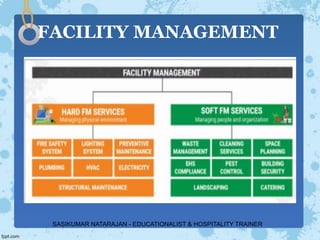
TYPES OF FACILITIES MANAGEMENT
There are two basic areas:
Hard Facilities Management (Hard FM)
Soft Facilities Management (Soft FM).
• Hard FM deals with physical assets such as plumbing, wiring, elevators,
and heating and cooling.
• Soft FM focuses on tasks performed by people such as custodial services,
lease accounting, catering, security, and groundskeeping.
SASIKUMAR NATARAJAN - EDUCATIONALIST & HOSPITALITY TRAINER
FACILITY MANAGEMENT
SASIKUMAR NATARAJAN - EDUCATIONALIST & HOSPITALITY TRAINER
INTEGRATED FACILITIES MANAGEMENT
Many smaller organizations may still manage their facilities internally, The burgeoning
trend in the industry is to offer bundled services. Known as Integrated Facilities
Management, this comprehensive scope of services adds value and drives better quality.
Facilities management company that bundles these ancillary services benefit in several
measurable ways.
• Improved efficiencies: A single point of contact and the elimination of duplicate
functions streamlines communication and workflow processes.
• Higher productivity: Facilities management includes maintenance strategies to
prevent breakdowns that too often bring production to a halt.
• Increased expertise: Outsourced FM employees already have the technical
know-how, saving companies from expending unnecessary time and resources on
training in-house.
• Reduced costs: In addition to spending less on training, companies save on
staffing, employee benefit, payroll expenses, inventory and more.
• Better quality control: with proven systems already in place, FM ensures
consistency and reliability.
SASIKUMAR NATARAJAN - EDUCATIONALIST & HOSPITALITY TRAINER
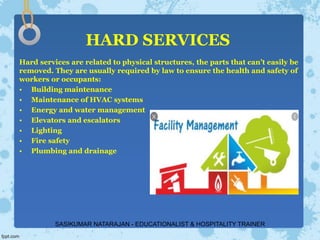
HARD SERVICES
Hard services are related to physical structures, the parts that can’t easily be
removed. They are usually required by law to ensure the health and safety of
workers or occupants:
• Building maintenance
• Maintenance of HVAC systems
• Energy and water management
• Elevators and escalators
• Lighting
• Fire safety
• Plumbing and drainage
SASIKUMAR NATARAJAN - EDUCATIONALIST & HOSPITALITY TRAINER
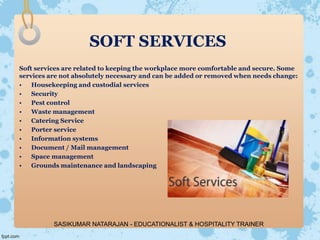
SOFT SERVICES
Soft services are related to keeping the workplace more comfortable and secure. Some
services are not absolutely necessary and can be added or removed when needs change:
• Housekeeping and custodial services
• Security
• Pest control
• Waste management
• Catering Service
• Porter service
• Information systems
• Document / Mail management
• Space management
• Grounds maintenance and landscaping
SASIKUMAR NATARAJAN - EDUCATIONALIST & HOSPITALITY TRAINER
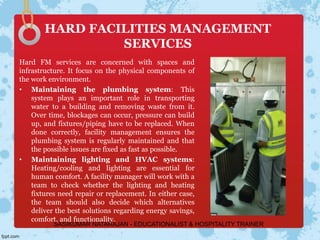
HARD FACILITIES MANAGEMENT
SERVICES
Hard FM services are concerned with spaces and
infrastructure. It focus on the physical components of
the work environment.
• Maintaining the plumbing system: This
system plays an important role in transporting
water to a building and removing waste from it.
Over time, blockages can occur, pressure can build
up, and fixtures/piping have to be replaced. When
done correctly, facility management ensures the
plumbing system is regularly maintained and that
the possible issues are fixed as fast as possible.
• Maintaining lighting and HVAC systems:
Heating/cooling and lighting are essential for
human comfort. A facility manager will work with a
team to check whether the lighting and heating
fixtures need repair or replacement. In either case,
the team should also decide which alternatives
deliver the best solutions regarding energy savings,
comfort, and functionality.
SASIKUMAR NATARAJAN - EDUCATIONALIST & HOSPITALITY TRAINER
HARD FACILITIES MANAGEMENT
SERVICES
• Staying in compliance with fire safety
regulations: Fire safety systems are a
mandatory add on in most countries and
should be regularly maintained and checked
for compliance issues.
• Maintaining mechanical & electrical
systems: It is self-explanatory how the
electrical system enables most other building
operations. The same goes for mechanical
systems such as elevators and water pumps.
FM is here to ensure they work properly and
do not cause safety incidents.
• Structural maintenance: Regular usage
or even poor design can lead to structural
issues over time. As a part of facility
management, there should be a structural
maintenance plan in place to identify,
classify, and deal with possible structural
problems.
SASIKUMAR NATARAJAN - EDUCATIONALIST & HOSPITALITY TRAINER
SOFT FACILITIES MANAGEMENT
SERVICES
Soft facility management is concerned with people and
organizations. It includes services that create a more
comfortable, healthier, safer, and visually appealing
environment.
• Waste management: When waste is not managed,
garbage bins become overloaded and things become
smelly. This is not the scenario one wants to see. Waste
management ensures that garbage is put in the correct
bins and sent away at regular intervals to satisfy
regulatory requirements and prevent trash
overcrowding.
• Cleaning services: Cleaning teams are usually called at
regular intervals to clean common areas and perform
other janitorial duties. A lot of bigger facilities will have
an in-house cleaning team, but it is not especially hard
to find competent companies to outsource to.
• Space planning: Space planning and management is an
important part of FM. Whenever a business hires more
people, expands to a new floor, buys new assets that
take a big chunk of space, wants to do some remodeling
of the existing space, and similar, facility managers are
here to help organize the space in a way that it remains
comfortable, safe, and functional.
SOFT FACILITIES MANAGEMENT
SERVICES
• Landscaping: Well-maintained grounds improve curb
appeal and signal proper property management.
Facility management takes care of the seasonal and
non-seasonal changes, such as planting flowers in the
spring, trimming the grass during the summer,
removing falling leaves during the autumn, or
removing excess snow from the walkway in the winter.
• Pest control: Facility management should be
concerned with scheduling yearly pest controls and
manage pest outbreaks if they ever happen.
• Building security: Refers to having control of people
going in and out of the facility. May also involve the
control of restricted access areas inside the facility.
• EHS (environment, health and safety) compliance:
Defining and maintaining acceptable standards of
comfort that might include temperature, noise, sitting
standards, and visual cues. For example, selecting
specific chairs that guarantee employee comfort for
desk workers. Ensuring that instructions regarding
services, installations, and amenities are followed to
avoid harmful incidents.
SASIKUMAR NATARAJAN - EDUCATIONALIST & HOSPITALITY TRAINER
SOFTWARE SOLUTIONS FOR FACILITY
MANAGEMENT
• CMMS (Computerized maintenance management system)
• CAFM (Computer-aided facilities management)
• EAM (Enterprise asset management )
• IWMS ( Integrated workplace management system)
SASIKUMAR NATARAJAN - EDUCATIONALIST & HOSPITALITY TRAINER
BMS/BAS/BEMS
• BMS = building management system
• BAS = building automation system
• BEMS = building energy management system
• BMS and BAS are often used interchangeably because they serve basically the
same purpose. They use a combination of hardware and software solutions to
control different building systems like lighting, heating, HVAC, access control,
etc. They can also be used to measure the performance and energy consumption
of HVAC systems and other assets.
• FM should monitor on energy consumption because it accounts for a big chunk
of their facility’s operational costs. Building energy management systems help
them measure energy consumption across the whole facility and find
problematic systems and assets.
• While BEMS and BMS can come together, they are usually standalone systems
that are implemented separately. That being said, they do work very well
together. BMS/BAM primary function is to control building systems and assets
while BEMS primary role is to collect and analyze energy consumption data (it
can track everything from device electricity usage to water, gas, and steam
consumption).
SASIKUMAR NATARAJAN - EDUCATIONALIST & HOSPITALITY TRAINER
IMPORTANCE OF FACILITIES MANAGEMENT
SERVICES
1. Ensures that the premises and customers are safe
• FM Team will ensure that all equipment is functioning safely, that scheduled care and upkeep is
followed through with, that all surfaces and systems are prepared for weather, and more.
Overall, a good facility management program makes sure that your space is maintained at a level
that keeps your tenants and employees safe and happy.
2. Maintains top efficiency in property systems and services
• The importance of facilities management services extends beyond just ensuring the day-to-day;
the best facility management professionals will incorporate maintenance and upkeep, as well.
which means that your facility management services will include preventative maintenance of
your systems. This will keep your equipment operating at top efficiency and reduce the
likelihood of breakdowns.
3. Minimizes the cost of running a space
• Why is facilities management important? Because it brings all of your facilities services under one
management head. When you have one person running all of your day-to-day activities (and
managing the vendors who complete them), you have one main pair of eyes on your expenses
and budget. Overlap and redundancy of services can be eliminated, and your bottom line will
reflect this new efficiency.
SASIKUMAR NATARAJAN - EDUCATIONALIST & HOSPITALITY TRAINER
IMPORTANCE OF FACILITIES MANAGEMENT
SERVICES
4. Streamlines responsibilities and tailors services to individual needs
• Facilities management who takes your needs and goals into account for a single service. Working
with a facilities manager allows you to be involved in creating an overall facilities management
plan, which will be tailored to your property or organization. You will have the benefit of knowing
that your facilities are managed by someone with a deep understanding of your space and what it
really needs to succeed.
5. Allows property or business managers to focus on what is important to them
• Finally, one of the biggest benefits of facilities management is the opportunity it gives property and
business managers to focus on their own responsibilities — without the added stress of maintaining
day-to-day facility operations. Instead of stressing about the more complicated aspects of facility
management, they can rest easy knowing those are handled by an experienced professional.
6. Strategic Planning
• Strategic planning provides a clear direction for your business and will help you to evaluate your
progress as time goes on. A facilities manager will help to define long-term and short-term
objectives, such as cutting costs and boosting productivity, as well as help you meet these goals.
Strategic planning will get you from where you are now to where you want to be. Therefore,
strategic planning is essential to the successful and manageable growth of your business.
SASIKUMAR NATARAJAN - EDUCATIONALIST & HOSPITALITY TRAINER
FACILITY MANAGEMENT CHALLENGES
1. ManagingTime
Time wasted is money lost. Save time by actively inspecting equipment, and reporting
wear and tear with digital documentation for historical reference. Organize digital
documentation with metadata and quickly pull information in the future. Utilize a
CMMS system for tracking processes.
2. Maintaining Aging Equipment & Facilities
• Proper planning is essential in extending the life of existing assets. Use the Planning
Report function on your CMMS system to check the availability of parts and
technicians for future dates when work orders are due so that you can reorder parts in
advance.
3. Keeping up with Changing Regulatory and Compliance Standards
• OSHA, the EPA, and the CDC constantly share updated guidelines and infographics for
employers and facility managers, it’s up to facility managers training now saves time
and money later. While scheduling in the CMMS system, set aside time each week for
employees to train on any updated compliancy mandates. Facilitate discussions and
drills to make changes less of a challenge for employees.
SASIKUMAR NATARAJAN - EDUCATIONALIST & HOSPITALITY TRAINER
FACILITY MANAGEMENT CHALLENGES
4. Adhering to your Organization’s Progressive, Eco-Friendly Policies
• The demand is increasing for conscientious Facility Managers who are capable of
implementing strategies that reduce their organization’s carbon footprint and their soaring
energy bill. Two of the biggest areas of concern that Facility Managers come to us for are waste
management and energy consumption. Our clients want to know which cleaning and
disinfecting products are aggressive and earth friendly without breaking the bank.For a
cleaning and disinfecting product to be effective, it must be used properly. Take an inventory
of all the surface types found throughout your facilities and equipment. Next, allocate eco-
friendly products that are effective on those specific surface types.
5. Managing the Use of Space within Facilities
• Keeping workspaces as minimal as possible saves everyone time, money, frustration, and
possibly even injury. Instead of investing capital on expanding spaces, we encourage clients we
work with to focus on optimizing the space they already have.
SASIKUMAR NATARAJAN - EDUCATIONALIST & HOSPITALITY TRAINER
FACILITY MANAGEMENT
SOURCE : Enotes
Limble website
THANK YOU
SASIKUMAR NATARAJAN - EDUCATIONALIST & HOSPITALITY TRAINER

Facility Management

  • 1.
  • 2.
    WHAT IS FACILITYMANAGEMENT Business operate in larger spaces with more people that are constantly implementing new processes and technology to reach defined business goals. Facilities management works in the background to maximize business performance and ensure that the physical environment in no way hinders employee productivity. Facility management encompasses a huge range of responsibilities and it is vital for sustainable business growth. As such, it has to be approached strategically. The goal of this guide is to explain the scope of facility management, discuss the tools and resources it needs to function properly, and show how it fits into an overall organizational structure. Facilities management is defined as the physical maintenance and operation of buildings or the business place. SASIKUMAR NATARAJAN - EDUCATIONALIST & HOSPITALITY TRAINER
  • 3.
    TYPES OF FACILITIESMANAGEMENT There are two basic areas: Hard Facilities Management (Hard FM) Soft Facilities Management (Soft FM). • Hard FM deals with physical assets such as plumbing, wiring, elevators, and heating and cooling. • Soft FM focuses on tasks performed by people such as custodial services, lease accounting, catering, security, and groundskeeping. SASIKUMAR NATARAJAN - EDUCATIONALIST & HOSPITALITY TRAINER
  • 4.
    FACILITY MANAGEMENT SASIKUMAR NATARAJAN- EDUCATIONALIST & HOSPITALITY TRAINER
  • 5.
    INTEGRATED FACILITIES MANAGEMENT Manysmaller organizations may still manage their facilities internally, The burgeoning trend in the industry is to offer bundled services. Known as Integrated Facilities Management, this comprehensive scope of services adds value and drives better quality. Facilities management company that bundles these ancillary services benefit in several measurable ways. • Improved efficiencies: A single point of contact and the elimination of duplicate functions streamlines communication and workflow processes. • Higher productivity: Facilities management includes maintenance strategies to prevent breakdowns that too often bring production to a halt. • Increased expertise: Outsourced FM employees already have the technical know-how, saving companies from expending unnecessary time and resources on training in-house. • Reduced costs: In addition to spending less on training, companies save on staffing, employee benefit, payroll expenses, inventory and more. • Better quality control: with proven systems already in place, FM ensures consistency and reliability. SASIKUMAR NATARAJAN - EDUCATIONALIST & HOSPITALITY TRAINER
  • 6.
    HARD SERVICES Hard servicesare related to physical structures, the parts that can’t easily be removed. They are usually required by law to ensure the health and safety of workers or occupants: • Building maintenance • Maintenance of HVAC systems • Energy and water management • Elevators and escalators • Lighting • Fire safety • Plumbing and drainage SASIKUMAR NATARAJAN - EDUCATIONALIST & HOSPITALITY TRAINER
  • 7.
    SOFT SERVICES Soft servicesare related to keeping the workplace more comfortable and secure. Some services are not absolutely necessary and can be added or removed when needs change: • Housekeeping and custodial services • Security • Pest control • Waste management • Catering Service • Porter service • Information systems • Document / Mail management • Space management • Grounds maintenance and landscaping SASIKUMAR NATARAJAN - EDUCATIONALIST & HOSPITALITY TRAINER
  • 8.
    HARD FACILITIES MANAGEMENT SERVICES HardFM services are concerned with spaces and infrastructure. It focus on the physical components of the work environment. • Maintaining the plumbing system: This system plays an important role in transporting water to a building and removing waste from it. Over time, blockages can occur, pressure can build up, and fixtures/piping have to be replaced. When done correctly, facility management ensures the plumbing system is regularly maintained and that the possible issues are fixed as fast as possible. • Maintaining lighting and HVAC systems: Heating/cooling and lighting are essential for human comfort. A facility manager will work with a team to check whether the lighting and heating fixtures need repair or replacement. In either case, the team should also decide which alternatives deliver the best solutions regarding energy savings, comfort, and functionality. SASIKUMAR NATARAJAN - EDUCATIONALIST & HOSPITALITY TRAINER
  • 9.
    HARD FACILITIES MANAGEMENT SERVICES •Staying in compliance with fire safety regulations: Fire safety systems are a mandatory add on in most countries and should be regularly maintained and checked for compliance issues. • Maintaining mechanical & electrical systems: It is self-explanatory how the electrical system enables most other building operations. The same goes for mechanical systems such as elevators and water pumps. FM is here to ensure they work properly and do not cause safety incidents. • Structural maintenance: Regular usage or even poor design can lead to structural issues over time. As a part of facility management, there should be a structural maintenance plan in place to identify, classify, and deal with possible structural problems. SASIKUMAR NATARAJAN - EDUCATIONALIST & HOSPITALITY TRAINER
  • 10.
    SOFT FACILITIES MANAGEMENT SERVICES Softfacility management is concerned with people and organizations. It includes services that create a more comfortable, healthier, safer, and visually appealing environment. • Waste management: When waste is not managed, garbage bins become overloaded and things become smelly. This is not the scenario one wants to see. Waste management ensures that garbage is put in the correct bins and sent away at regular intervals to satisfy regulatory requirements and prevent trash overcrowding. • Cleaning services: Cleaning teams are usually called at regular intervals to clean common areas and perform other janitorial duties. A lot of bigger facilities will have an in-house cleaning team, but it is not especially hard to find competent companies to outsource to. • Space planning: Space planning and management is an important part of FM. Whenever a business hires more people, expands to a new floor, buys new assets that take a big chunk of space, wants to do some remodeling of the existing space, and similar, facility managers are here to help organize the space in a way that it remains comfortable, safe, and functional.
  • 11.
    SOFT FACILITIES MANAGEMENT SERVICES •Landscaping: Well-maintained grounds improve curb appeal and signal proper property management. Facility management takes care of the seasonal and non-seasonal changes, such as planting flowers in the spring, trimming the grass during the summer, removing falling leaves during the autumn, or removing excess snow from the walkway in the winter. • Pest control: Facility management should be concerned with scheduling yearly pest controls and manage pest outbreaks if they ever happen. • Building security: Refers to having control of people going in and out of the facility. May also involve the control of restricted access areas inside the facility. • EHS (environment, health and safety) compliance: Defining and maintaining acceptable standards of comfort that might include temperature, noise, sitting standards, and visual cues. For example, selecting specific chairs that guarantee employee comfort for desk workers. Ensuring that instructions regarding services, installations, and amenities are followed to avoid harmful incidents. SASIKUMAR NATARAJAN - EDUCATIONALIST & HOSPITALITY TRAINER
  • 12.
    SOFTWARE SOLUTIONS FORFACILITY MANAGEMENT • CMMS (Computerized maintenance management system) • CAFM (Computer-aided facilities management) • EAM (Enterprise asset management ) • IWMS ( Integrated workplace management system) SASIKUMAR NATARAJAN - EDUCATIONALIST & HOSPITALITY TRAINER
  • 13.
    BMS/BAS/BEMS • BMS =building management system • BAS = building automation system • BEMS = building energy management system • BMS and BAS are often used interchangeably because they serve basically the same purpose. They use a combination of hardware and software solutions to control different building systems like lighting, heating, HVAC, access control, etc. They can also be used to measure the performance and energy consumption of HVAC systems and other assets. • FM should monitor on energy consumption because it accounts for a big chunk of their facility’s operational costs. Building energy management systems help them measure energy consumption across the whole facility and find problematic systems and assets. • While BEMS and BMS can come together, they are usually standalone systems that are implemented separately. That being said, they do work very well together. BMS/BAM primary function is to control building systems and assets while BEMS primary role is to collect and analyze energy consumption data (it can track everything from device electricity usage to water, gas, and steam consumption). SASIKUMAR NATARAJAN - EDUCATIONALIST & HOSPITALITY TRAINER
  • 14.
    IMPORTANCE OF FACILITIESMANAGEMENT SERVICES 1. Ensures that the premises and customers are safe • FM Team will ensure that all equipment is functioning safely, that scheduled care and upkeep is followed through with, that all surfaces and systems are prepared for weather, and more. Overall, a good facility management program makes sure that your space is maintained at a level that keeps your tenants and employees safe and happy. 2. Maintains top efficiency in property systems and services • The importance of facilities management services extends beyond just ensuring the day-to-day; the best facility management professionals will incorporate maintenance and upkeep, as well. which means that your facility management services will include preventative maintenance of your systems. This will keep your equipment operating at top efficiency and reduce the likelihood of breakdowns. 3. Minimizes the cost of running a space • Why is facilities management important? Because it brings all of your facilities services under one management head. When you have one person running all of your day-to-day activities (and managing the vendors who complete them), you have one main pair of eyes on your expenses and budget. Overlap and redundancy of services can be eliminated, and your bottom line will reflect this new efficiency. SASIKUMAR NATARAJAN - EDUCATIONALIST & HOSPITALITY TRAINER
  • 15.
    IMPORTANCE OF FACILITIESMANAGEMENT SERVICES 4. Streamlines responsibilities and tailors services to individual needs • Facilities management who takes your needs and goals into account for a single service. Working with a facilities manager allows you to be involved in creating an overall facilities management plan, which will be tailored to your property or organization. You will have the benefit of knowing that your facilities are managed by someone with a deep understanding of your space and what it really needs to succeed. 5. Allows property or business managers to focus on what is important to them • Finally, one of the biggest benefits of facilities management is the opportunity it gives property and business managers to focus on their own responsibilities — without the added stress of maintaining day-to-day facility operations. Instead of stressing about the more complicated aspects of facility management, they can rest easy knowing those are handled by an experienced professional. 6. Strategic Planning • Strategic planning provides a clear direction for your business and will help you to evaluate your progress as time goes on. A facilities manager will help to define long-term and short-term objectives, such as cutting costs and boosting productivity, as well as help you meet these goals. Strategic planning will get you from where you are now to where you want to be. Therefore, strategic planning is essential to the successful and manageable growth of your business. SASIKUMAR NATARAJAN - EDUCATIONALIST & HOSPITALITY TRAINER
  • 16.
    FACILITY MANAGEMENT CHALLENGES 1.ManagingTime Time wasted is money lost. Save time by actively inspecting equipment, and reporting wear and tear with digital documentation for historical reference. Organize digital documentation with metadata and quickly pull information in the future. Utilize a CMMS system for tracking processes. 2. Maintaining Aging Equipment & Facilities • Proper planning is essential in extending the life of existing assets. Use the Planning Report function on your CMMS system to check the availability of parts and technicians for future dates when work orders are due so that you can reorder parts in advance. 3. Keeping up with Changing Regulatory and Compliance Standards • OSHA, the EPA, and the CDC constantly share updated guidelines and infographics for employers and facility managers, it’s up to facility managers training now saves time and money later. While scheduling in the CMMS system, set aside time each week for employees to train on any updated compliancy mandates. Facilitate discussions and drills to make changes less of a challenge for employees. SASIKUMAR NATARAJAN - EDUCATIONALIST & HOSPITALITY TRAINER
  • 17.
    FACILITY MANAGEMENT CHALLENGES 4.Adhering to your Organization’s Progressive, Eco-Friendly Policies • The demand is increasing for conscientious Facility Managers who are capable of implementing strategies that reduce their organization’s carbon footprint and their soaring energy bill. Two of the biggest areas of concern that Facility Managers come to us for are waste management and energy consumption. Our clients want to know which cleaning and disinfecting products are aggressive and earth friendly without breaking the bank.For a cleaning and disinfecting product to be effective, it must be used properly. Take an inventory of all the surface types found throughout your facilities and equipment. Next, allocate eco- friendly products that are effective on those specific surface types. 5. Managing the Use of Space within Facilities • Keeping workspaces as minimal as possible saves everyone time, money, frustration, and possibly even injury. Instead of investing capital on expanding spaces, we encourage clients we work with to focus on optimizing the space they already have. SASIKUMAR NATARAJAN - EDUCATIONALIST & HOSPITALITY TRAINER
  • 18.
    FACILITY MANAGEMENT SOURCE :Enotes Limble website THANK YOU SASIKUMAR NATARAJAN - EDUCATIONALIST & HOSPITALITY TRAINER