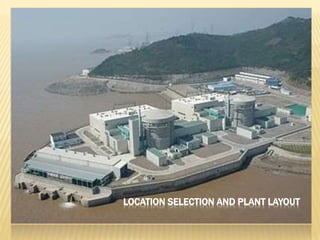
LOCATION SELECTION AND PLANT LAYOUT
1
LOCATION SELECTION
Syllabus:
 Nature of Location Decision, Importance of
Plant Location, Dynamic Nature of Plant
Location,
 Choice of site for selection, State regulations
on location,
 Government policies on decentralization.
 Industrial Estates, Economic survey of Site
selection, SEZ, Comparison of location,
2
IMPORTANCE OF PLANT LOCATION
Reasons for Selection of appropriate
location:
 Reduces the cost of production and distribution
 Increases competitive strength or the profit margin of the
business.
 Location fixes the physical factors of the overall plant design, e.g.
heating and ventilation requirements, storage capacity for raw-
material, taking into consideration their local availability,
transportation need for raw-materials and finished goods, power
needs, costs of labour, taxes, land construction, fuel etc.
 Determines the nature of investment costs to be incurred and
also the level of many operating costs.
 Government Incentives
 Probably no location is so perfect as to guarantee success. But
bad locations can be so bad as to bankrupt a company".
3
WHEN SELECTION OF SUITABLE SITE IS NEEDED ?
When selection of suitable site is needed:
 While starting a new factory/enterprise.
 During the expansion of the existing plant.
 When the existing plant is to be relocated at some other
place to remove its draw backs or to gain the benefits of
still better location.
4
DYNAMIC NATURE OF PLANT LOCATION
 No location can be considered unique and can remain good
forever.
 The business uncertainty and dynamism may convert a good
location of today into an inferior one of tomorrow and vice
versa.
 Location study thus requires constant monitoring.
 Thus the problem of decision to move or to stay at a particular
location is always before the management specially when some
expansion program is undertaken.
 The shift of the location of plant to some other place is known
as relocation.
5
REASONS FOR RELOCATION OF PLANT
 Shift in the structure of the market or movement of markets.
 Changes in the nature and costs of transportation.
 Changes in the costs and availability of raw-materials.
 Change in the pricing policy of the enterprise.
 Undesirable labour situation.
 Non-availability of labour, rise in labour costs, changes in other
factors etc.
 Demolition, compulsory purchase of premises or national
legislation.
 Relocation of various associated industries and plants.
 Scientific discoveries/developments, new field of technology,
increasing competition etc.
6
SITE SELECTION CRITERIA
 The problem of site selection of a factory can be solved in
the following three stages
 Selection of the region.
 Selection of the locality.
 Selection of actual site.
7
SITE SELECTION CRITERIA
Major considerations in selecting the
region
 Availability and proximity of raw-materials
 Vicinity of the market
 Labour supply
 Climatic conditions
 Govt. Policies and Incentives.
8
SITE SELECTION CRITERIA
Selection of the Locality. After selecting, the
region, the specific locality within the region
is considered.
Alternatives open in selecting the locality
 Urban area.
 Rural area.
 Suburban area in the vicinity of the urban area.
9
SITE SELECTION CRITERIA
Factors to be considered while selecting the
location
 Availability of Raw-materials.
 Proximity to markets.
 Availability of labour.
 Transport and communication facilities.
 Availability of power and fuel.
 Climatic conditions.
 Availability of water.
 Ancillary Industries.
 Financial and other aids.
 Business and commercial facilities.
10
SITE SELECTION CRITERIA
Disadvantages of concentration of Industries in few areas
 Unbalanced industrial growth and problems of poverty and unemployment in
industrially backward areas.
 Increasing fixed, operating and living costs due to concentration of industries.
 Problems of pollution : air, water and food pollution.
 Acute housing shortage and growth of slums or zopad patties.
Congestion, bad sanitation, traffic jams etc. in urban areas.
 Social and industrial unrests - strikes, lockouts, murders, morchas and such
other problems.
 Unfavorable from national point of view fear of attack, bombardment by
enemies to destroy industries.
 Inequitable distribution of wealth and income.
11
BACKWARD AREAS AND INDUSTRIAL POLICY
 The Govt. can control the industrial location by adopting
two types of measures
I. Positive measures to encourage establishment of
industries in certain areas (backward areas).
 2. Negative measures to discourage establishment of
Industries in areas having concentration of industries.
 Incentives for establishing industrial units in backward
areas
12
MEASURES TAKEN BY THE GOVERNMENT TO MINIMIZE REGIONAL IMBALANCE
 Establishment of industrial estates in all states and special emphasis on
small scale industries to bring about better regional distribution of
industries.
 Liberal issue of licenses on a preferential basis for starting industries in
less developed regions.
 Central assistance to state for development of their backward areas.
 Rural electrification on a large scale.
 Concessional power, water and finance for backward areas.
 Location of central projects in the backward states.
 Special training facilities in under-developed regions.
 Provision of infrastructure essential for starting industries in
undeveloped areas; tax concessions etc.
13
GOVT. POLICIES FOR DECENTRALISATION
The Central and State Government may take the following effective
measures to achieve decentralization
 Prohibition on starting new industries in industrialized cities or areas and
declaring specific region as industrial areas, somewhat away from the bigger
cities.
 Direct encouragement to private sector units to start their industries or to
shift their existing plants to underdeveloped regions.
 Development of public sector-units in semi-rural and rural areas.
 Establishing Industrial Estates in undeveloped areas, provided with all
facilities for industrialization.
 Development of adequate public utility services in undeveloped regions.
 In producing industrial licensing system under the Industries Act, 1951.
 Development of hydro-electric projects in many states to provide liberal rural
electrification.
14
GOVT. POLICIES FOR DECENTRALISATION
The objectives of Govt. intervention and control can be stated as:
 To attain balanced regional development.
 To narrow down the gap of inequality of income and wealth
through creating and providing employment opportunities to less
developed areas.
 To reduce the concentration of population and congestion of
industries in big cities.
 As strategic defense policy, spread of industries reduces the
chances of heavy losses in war time.
15
INDUSTRIAL ESTATES
 Industrial estate is a piece of vast land sub-divided into
different industrial plots systematically developed, wherein
factory shades are constructed.
 Govt. of India has planned a national policy for the
development of industrial estates to State Government.
 In each state Development Corporations are established.
 Industrial estates have also been developed by private
entrepreneurs and chambers of commerce.
16
INDUSTRIAL ESTATES
 Industrial estate provides all amenities and facilities as well
as public utility services to a number of small business
units.
 Industrial estates has group of small factories, workshop or
business units with suitable sites and facilities to run the
business smoothly.
 The number of units can enjoy common amenities and
benefits of site, sheds, water supply, power supply,
roads, transport, drainage, etc. at reasonable charges
17
ADVANTAGES OF INDUSTRIAL ESTATES
 Industrial development helps in promotion of small and
medium sized industries in the under-developed areas.
 The entrepreneur is not required to carry out survey for
finding suitable location for his plant.
 The member units can enjoy the common facilities like water
supply, power supply, roads, transport, drainage, etc. at
reasonable charges.
 The infrastructure facilities available in industrial estate
reduces the gestation period in the infant stage of business.
18
ADVANTAGES OF INDUSTRIAL ESTATES
 Govt. and other Public authorities offer many tax, incentives
and other concessions in charges and rates as well as other
services at cheaper costs to encourage industrialization in
their areas.
 Each member unit enjoys protection and security from the
promoters of such industrial estates.
 Development of industrial estates offers many advantages
to the community and regions e.g. employment
opportunities, training opportunities, balanced growth,
equitable distribution of, wealth and income, rising living
standard etc.
19
ECONOMIC SURVEY OF SITE SELECTION
 The aim of economic survey is to find out whether or not the
location meets first the primary, and then secondary requirements.
 The relative importance of the necessary factors can be determined on
the basis of their proportionate shares in the unit cost of production and
distribution. After the various factors have been weighed, suitable
regions can be selected.
Computation of investment and cost of Production and Distribution
 The required capital investment and the unit cost of production and
distribution for a given volume of output should be computed for each
prospective location. The ideal location is that which permits the lowest
cost of production and its distribution.
 If the units cost of production in the various locations are some what
comparable, the location that requires the least capital on fixed
investment will be preferred.
20
SPECIAL ECONOMIC ZONE (SEZ)
 A Special Economic Zone (SEZ) is a geographical region that has
economic and other laws that are more free-market-oriented than a
country's typical or national laws. "Nationwide" laws may be
suspended inside a special economic zone.
 The category 'SEZ' covers a broad range of more specific zone types,
including Free Trade Zones (FTZ), Export Processing Zones (EPZ),
Free Zones (FZ), Industrial Estates (IE), Free Ports, Urban Enterprise
Zones and others.
 Usually the goal of a structure is to increase foreign direct investment
by foreign investors, typically an international business or a
multinational corporation (MNC).
 A single SEZ can contain multiple 'specific' zones within its
boundaries.
21
SPECIAL ECONOMIC ZONE (SEZ)
 SEZs are often developed under a public-private
partnership arrangement, in which the public sector
provides some level of support (provision of off-site
infrastructure, equity investment, soft loans, bond issues,
etc.) to enable a private sector developer to obtain a
reasonable rate of return on the project (typically 10-20%
depending on risk levels).
22
ASSIGNMENT - 1
Q1 . Explain the reasons for Selection of appropriate location ?
When it is needed ?
Q 2. Write the factors to be considered while selecting the location.
Q 3. What is dynamic nature of plant location ? What are the reasons
for relocation of the plant ?
Q 4. Write the disadvantages of concentration of Industries in few areas.
Q 5. Compare Rural and Urban area in connection with selection of
site for industry.
Q 6. What are the advantages of sub-urban area in connection with
selection of site for industry.
Q 7. What are industrial Estates ? What are their advantages ?
Q 8. Explain the measures taken by the government to minimize
regional imbalance.
Q 9. What is SEZ ? Explain.
23

1.1 location selection

  • 1.
    LOCATION SELECTION ANDPLANT LAYOUT 1
  • 2.
    LOCATION SELECTION Syllabus:  Natureof Location Decision, Importance of Plant Location, Dynamic Nature of Plant Location,  Choice of site for selection, State regulations on location,  Government policies on decentralization.  Industrial Estates, Economic survey of Site selection, SEZ, Comparison of location, 2
  • 3.
    IMPORTANCE OF PLANTLOCATION Reasons for Selection of appropriate location:  Reduces the cost of production and distribution  Increases competitive strength or the profit margin of the business.  Location fixes the physical factors of the overall plant design, e.g. heating and ventilation requirements, storage capacity for raw- material, taking into consideration their local availability, transportation need for raw-materials and finished goods, power needs, costs of labour, taxes, land construction, fuel etc.  Determines the nature of investment costs to be incurred and also the level of many operating costs.  Government Incentives  Probably no location is so perfect as to guarantee success. But bad locations can be so bad as to bankrupt a company". 3
  • 4.
    WHEN SELECTION OFSUITABLE SITE IS NEEDED ? When selection of suitable site is needed:  While starting a new factory/enterprise.  During the expansion of the existing plant.  When the existing plant is to be relocated at some other place to remove its draw backs or to gain the benefits of still better location. 4
  • 5.
    DYNAMIC NATURE OFPLANT LOCATION  No location can be considered unique and can remain good forever.  The business uncertainty and dynamism may convert a good location of today into an inferior one of tomorrow and vice versa.  Location study thus requires constant monitoring.  Thus the problem of decision to move or to stay at a particular location is always before the management specially when some expansion program is undertaken.  The shift of the location of plant to some other place is known as relocation. 5
  • 6.
    REASONS FOR RELOCATIONOF PLANT  Shift in the structure of the market or movement of markets.  Changes in the nature and costs of transportation.  Changes in the costs and availability of raw-materials.  Change in the pricing policy of the enterprise.  Undesirable labour situation.  Non-availability of labour, rise in labour costs, changes in other factors etc.  Demolition, compulsory purchase of premises or national legislation.  Relocation of various associated industries and plants.  Scientific discoveries/developments, new field of technology, increasing competition etc. 6
  • 7.
    SITE SELECTION CRITERIA The problem of site selection of a factory can be solved in the following three stages  Selection of the region.  Selection of the locality.  Selection of actual site. 7
  • 8.
    SITE SELECTION CRITERIA Majorconsiderations in selecting the region  Availability and proximity of raw-materials  Vicinity of the market  Labour supply  Climatic conditions  Govt. Policies and Incentives. 8
  • 9.
    SITE SELECTION CRITERIA Selectionof the Locality. After selecting, the region, the specific locality within the region is considered. Alternatives open in selecting the locality  Urban area.  Rural area.  Suburban area in the vicinity of the urban area. 9
  • 10.
    SITE SELECTION CRITERIA Factorsto be considered while selecting the location  Availability of Raw-materials.  Proximity to markets.  Availability of labour.  Transport and communication facilities.  Availability of power and fuel.  Climatic conditions.  Availability of water.  Ancillary Industries.  Financial and other aids.  Business and commercial facilities. 10
  • 11.
    SITE SELECTION CRITERIA Disadvantagesof concentration of Industries in few areas  Unbalanced industrial growth and problems of poverty and unemployment in industrially backward areas.  Increasing fixed, operating and living costs due to concentration of industries.  Problems of pollution : air, water and food pollution.  Acute housing shortage and growth of slums or zopad patties. Congestion, bad sanitation, traffic jams etc. in urban areas.  Social and industrial unrests - strikes, lockouts, murders, morchas and such other problems.  Unfavorable from national point of view fear of attack, bombardment by enemies to destroy industries.  Inequitable distribution of wealth and income. 11
  • 12.
    BACKWARD AREAS ANDINDUSTRIAL POLICY  The Govt. can control the industrial location by adopting two types of measures I. Positive measures to encourage establishment of industries in certain areas (backward areas).  2. Negative measures to discourage establishment of Industries in areas having concentration of industries.  Incentives for establishing industrial units in backward areas 12
  • 13.
    MEASURES TAKEN BYTHE GOVERNMENT TO MINIMIZE REGIONAL IMBALANCE  Establishment of industrial estates in all states and special emphasis on small scale industries to bring about better regional distribution of industries.  Liberal issue of licenses on a preferential basis for starting industries in less developed regions.  Central assistance to state for development of their backward areas.  Rural electrification on a large scale.  Concessional power, water and finance for backward areas.  Location of central projects in the backward states.  Special training facilities in under-developed regions.  Provision of infrastructure essential for starting industries in undeveloped areas; tax concessions etc. 13
  • 14.
    GOVT. POLICIES FORDECENTRALISATION The Central and State Government may take the following effective measures to achieve decentralization  Prohibition on starting new industries in industrialized cities or areas and declaring specific region as industrial areas, somewhat away from the bigger cities.  Direct encouragement to private sector units to start their industries or to shift their existing plants to underdeveloped regions.  Development of public sector-units in semi-rural and rural areas.  Establishing Industrial Estates in undeveloped areas, provided with all facilities for industrialization.  Development of adequate public utility services in undeveloped regions.  In producing industrial licensing system under the Industries Act, 1951.  Development of hydro-electric projects in many states to provide liberal rural electrification. 14
  • 15.
    GOVT. POLICIES FORDECENTRALISATION The objectives of Govt. intervention and control can be stated as:  To attain balanced regional development.  To narrow down the gap of inequality of income and wealth through creating and providing employment opportunities to less developed areas.  To reduce the concentration of population and congestion of industries in big cities.  As strategic defense policy, spread of industries reduces the chances of heavy losses in war time. 15
  • 16.
    INDUSTRIAL ESTATES  Industrialestate is a piece of vast land sub-divided into different industrial plots systematically developed, wherein factory shades are constructed.  Govt. of India has planned a national policy for the development of industrial estates to State Government.  In each state Development Corporations are established.  Industrial estates have also been developed by private entrepreneurs and chambers of commerce. 16
  • 17.
    INDUSTRIAL ESTATES  Industrialestate provides all amenities and facilities as well as public utility services to a number of small business units.  Industrial estates has group of small factories, workshop or business units with suitable sites and facilities to run the business smoothly.  The number of units can enjoy common amenities and benefits of site, sheds, water supply, power supply, roads, transport, drainage, etc. at reasonable charges 17
  • 18.
    ADVANTAGES OF INDUSTRIALESTATES  Industrial development helps in promotion of small and medium sized industries in the under-developed areas.  The entrepreneur is not required to carry out survey for finding suitable location for his plant.  The member units can enjoy the common facilities like water supply, power supply, roads, transport, drainage, etc. at reasonable charges.  The infrastructure facilities available in industrial estate reduces the gestation period in the infant stage of business. 18
  • 19.
    ADVANTAGES OF INDUSTRIALESTATES  Govt. and other Public authorities offer many tax, incentives and other concessions in charges and rates as well as other services at cheaper costs to encourage industrialization in their areas.  Each member unit enjoys protection and security from the promoters of such industrial estates.  Development of industrial estates offers many advantages to the community and regions e.g. employment opportunities, training opportunities, balanced growth, equitable distribution of, wealth and income, rising living standard etc. 19
  • 20.
    ECONOMIC SURVEY OFSITE SELECTION  The aim of economic survey is to find out whether or not the location meets first the primary, and then secondary requirements.  The relative importance of the necessary factors can be determined on the basis of their proportionate shares in the unit cost of production and distribution. After the various factors have been weighed, suitable regions can be selected. Computation of investment and cost of Production and Distribution  The required capital investment and the unit cost of production and distribution for a given volume of output should be computed for each prospective location. The ideal location is that which permits the lowest cost of production and its distribution.  If the units cost of production in the various locations are some what comparable, the location that requires the least capital on fixed investment will be preferred. 20
  • 21.
    SPECIAL ECONOMIC ZONE(SEZ)  A Special Economic Zone (SEZ) is a geographical region that has economic and other laws that are more free-market-oriented than a country's typical or national laws. "Nationwide" laws may be suspended inside a special economic zone.  The category 'SEZ' covers a broad range of more specific zone types, including Free Trade Zones (FTZ), Export Processing Zones (EPZ), Free Zones (FZ), Industrial Estates (IE), Free Ports, Urban Enterprise Zones and others.  Usually the goal of a structure is to increase foreign direct investment by foreign investors, typically an international business or a multinational corporation (MNC).  A single SEZ can contain multiple 'specific' zones within its boundaries. 21
  • 22.
    SPECIAL ECONOMIC ZONE(SEZ)  SEZs are often developed under a public-private partnership arrangement, in which the public sector provides some level of support (provision of off-site infrastructure, equity investment, soft loans, bond issues, etc.) to enable a private sector developer to obtain a reasonable rate of return on the project (typically 10-20% depending on risk levels). 22
  • 23.
    ASSIGNMENT - 1 Q1. Explain the reasons for Selection of appropriate location ? When it is needed ? Q 2. Write the factors to be considered while selecting the location. Q 3. What is dynamic nature of plant location ? What are the reasons for relocation of the plant ? Q 4. Write the disadvantages of concentration of Industries in few areas. Q 5. Compare Rural and Urban area in connection with selection of site for industry. Q 6. What are the advantages of sub-urban area in connection with selection of site for industry. Q 7. What are industrial Estates ? What are their advantages ? Q 8. Explain the measures taken by the government to minimize regional imbalance. Q 9. What is SEZ ? Explain. 23