Presenting By:
NASEEL IBNU AZEEZ M.P
Roll No:12
M-Tech MD
AJCE-KANJIRAPALLY
Guided By:
Mr. RICHU THOMAS
Ast. Professor
Mechanical Engineering
AJCE-KANJIRAPALLY
12/2/2015 1
INTRODUCTION
• 3D printing is a modern technology in which
3 dimensional objects are printed from
digital data
• Three dimensional object is created by
laying down successive layers of material
• It is a additive manufacturing technology
HISTORY
1.The technology for printing physical 3D objects from digital data was first
developed by Charles Hull in 1984. He named the technique as Stereo lithography
and obtained a patent for the technique in 1986
2..Fused Deposition Modeling (FDM) and Selective
Laser Sintering (SLS) were introduced.
In 1993
3. In 1996, three major products, "Genisys" from Stratasys, "Actua 2100" from 3D
Systems and "Z402" from Z Corporation, were introduced
4. In 2005, Z Corp. launched a breakthrough product, named Spectrum Z510, which
was the first high definition color 3D Printer in the market.
5.in 2006 with the initiation of an open source project, named Reprap,
which was aimed at developing a selfreplicating 3D printer.
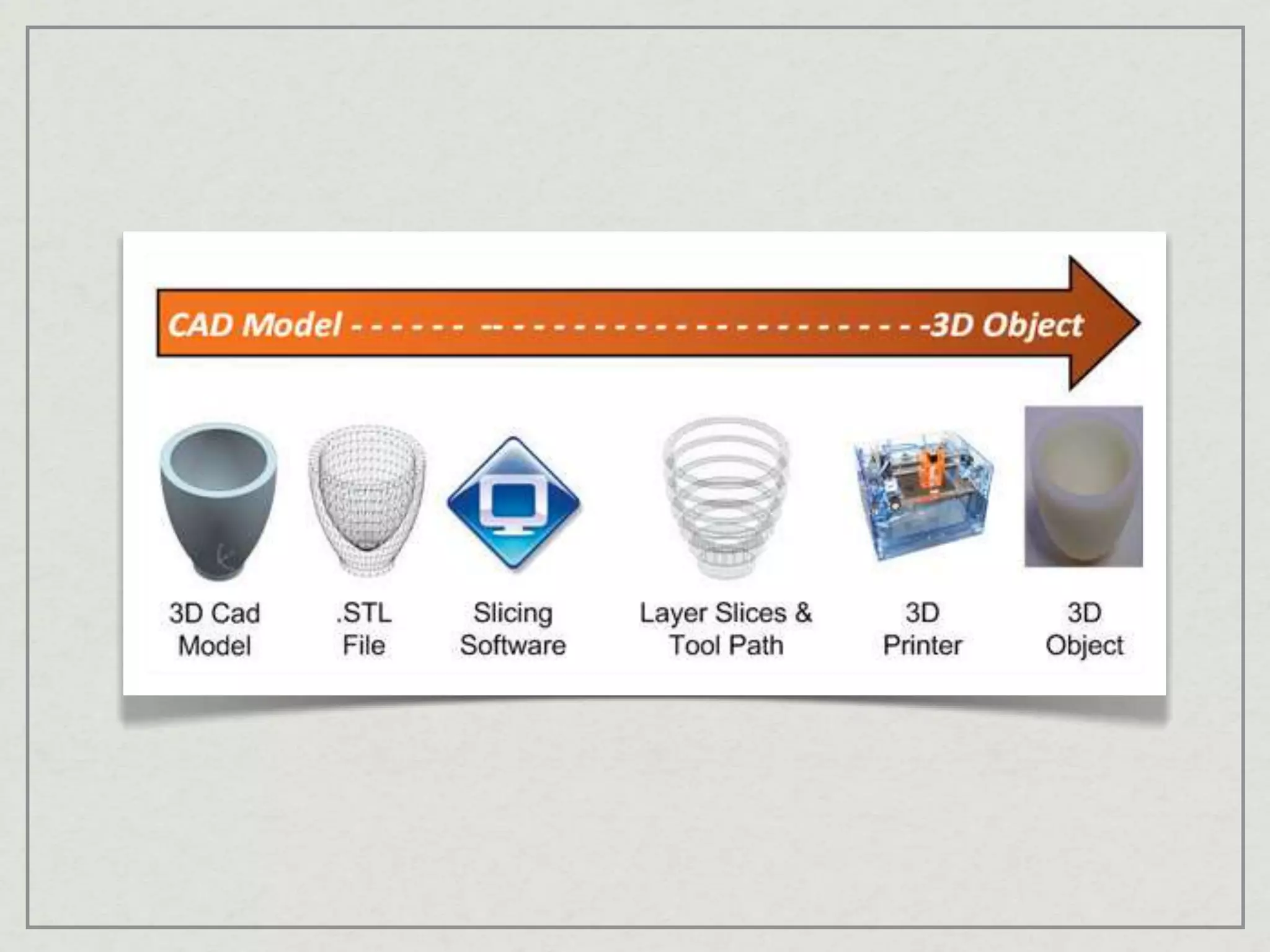
HOW 3D-PRINTING WORKS ?
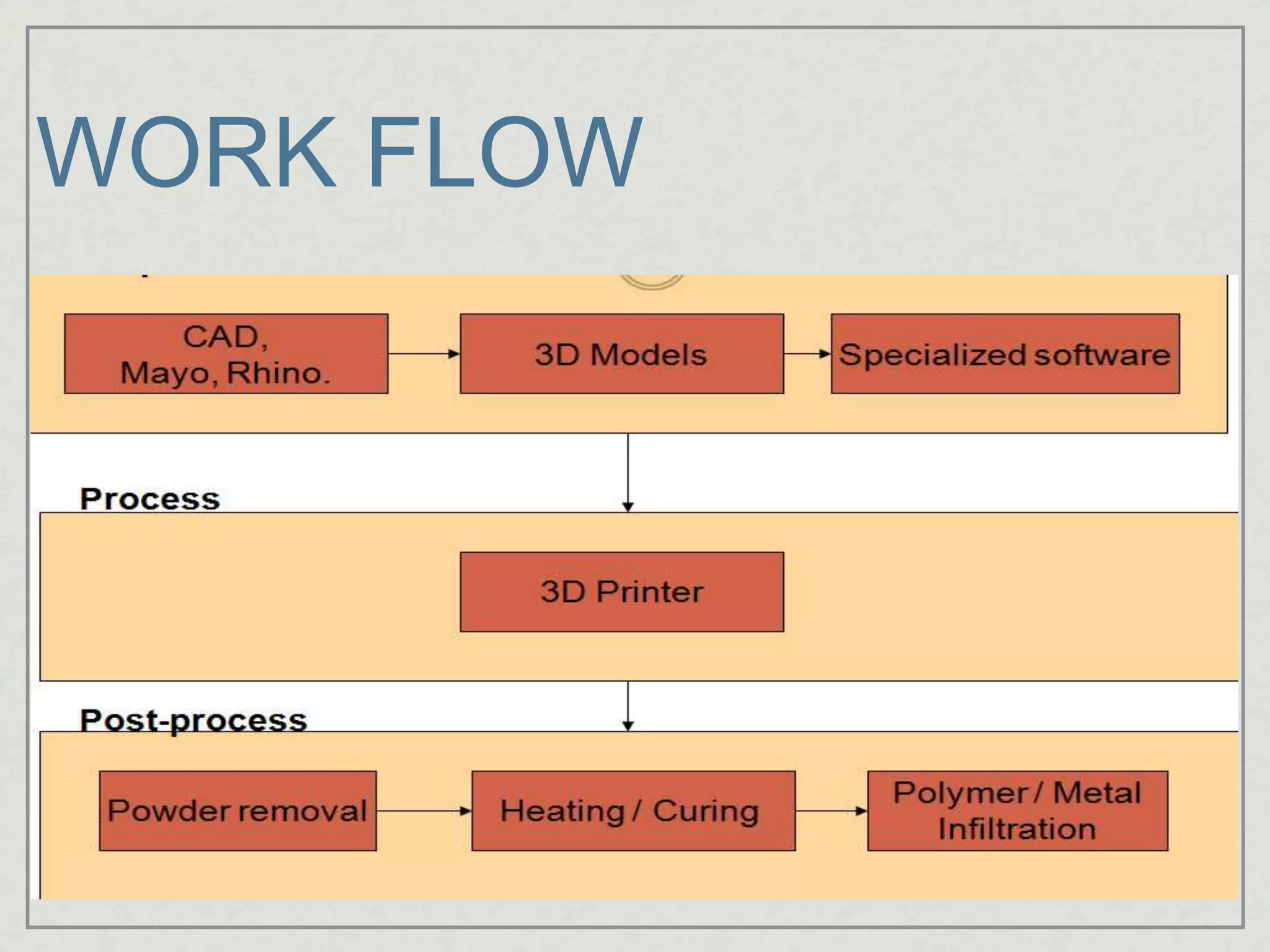
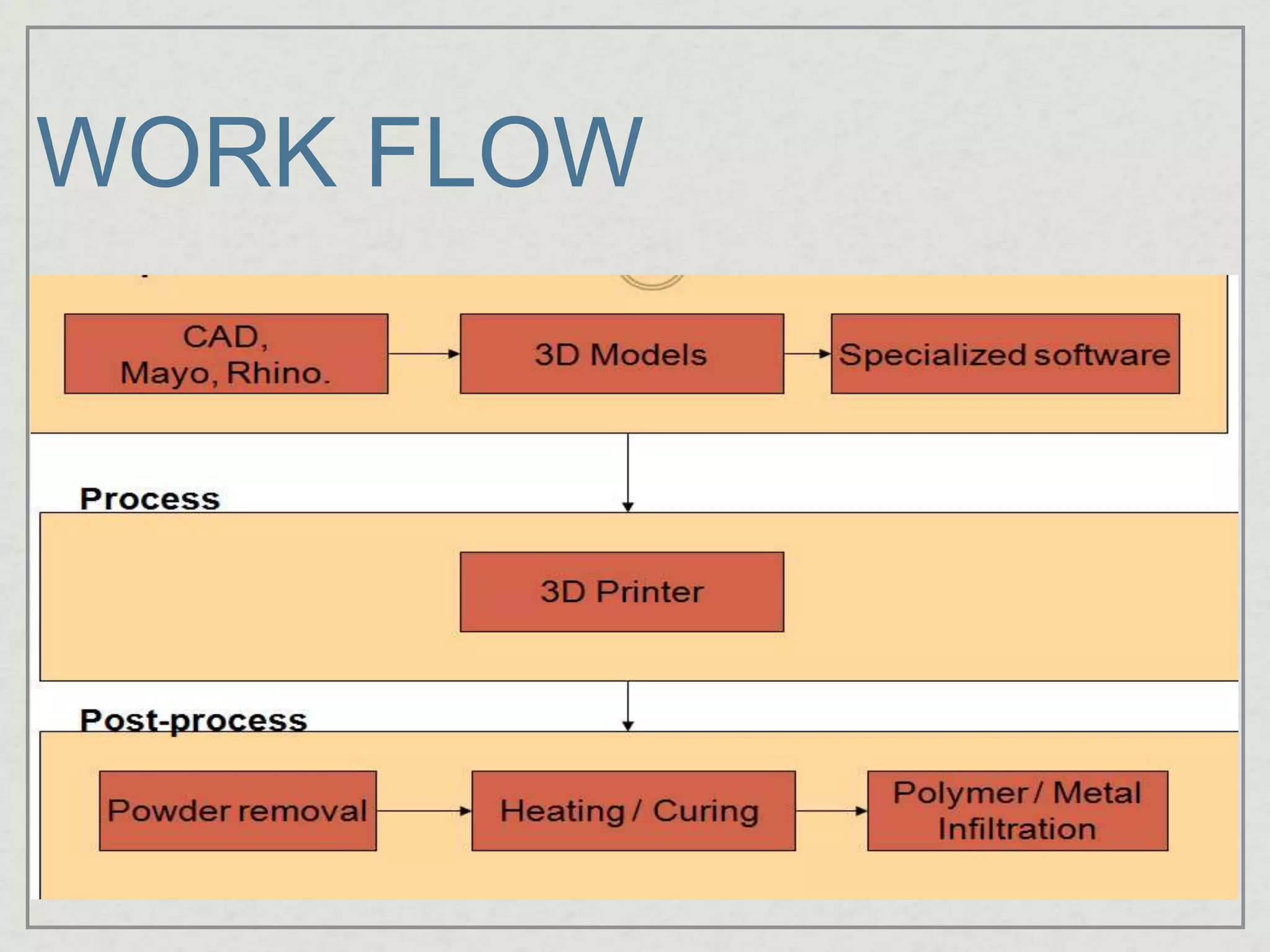
WORK FLOW
DESIGNING/3D SCANING
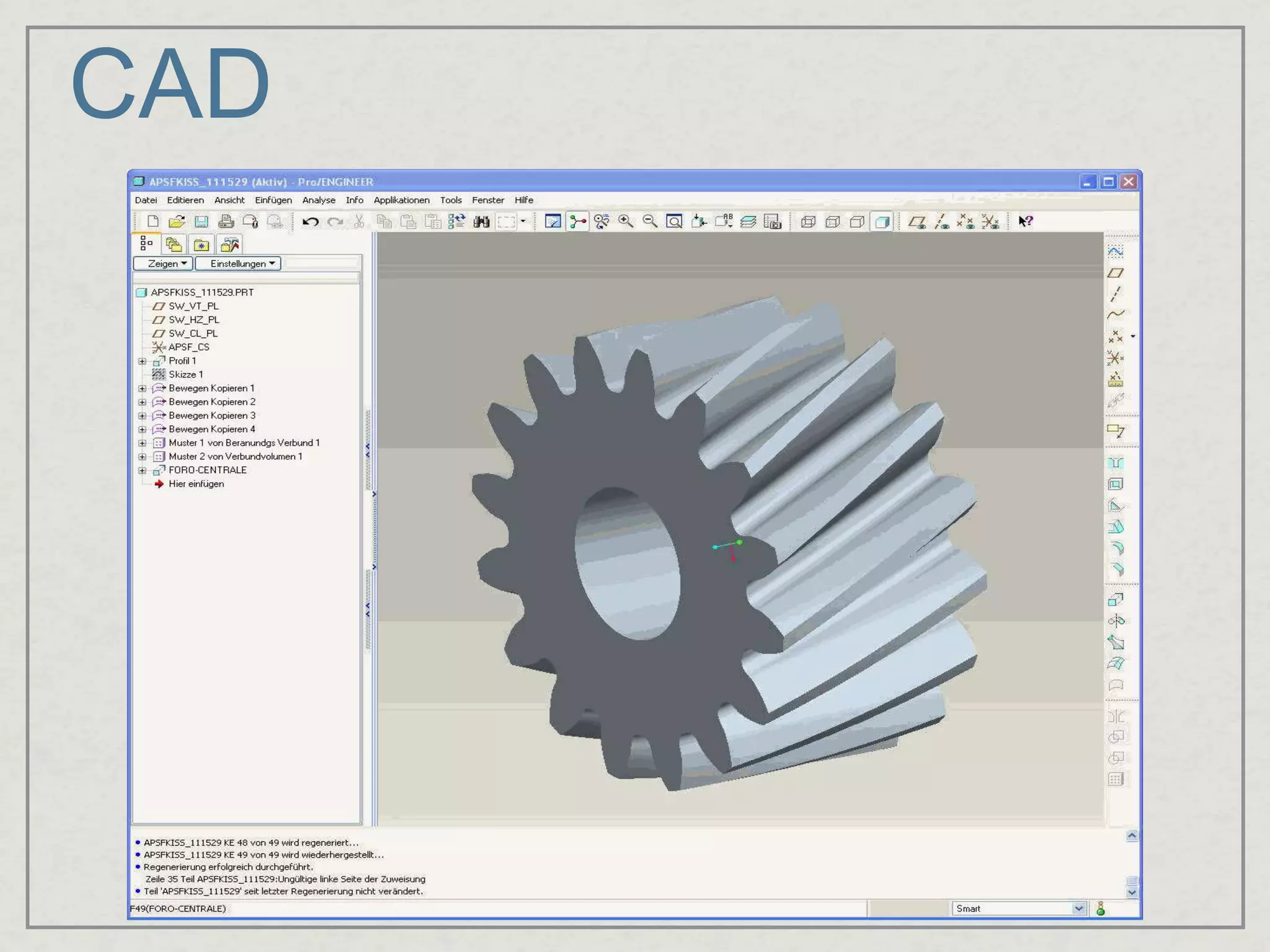
CAD
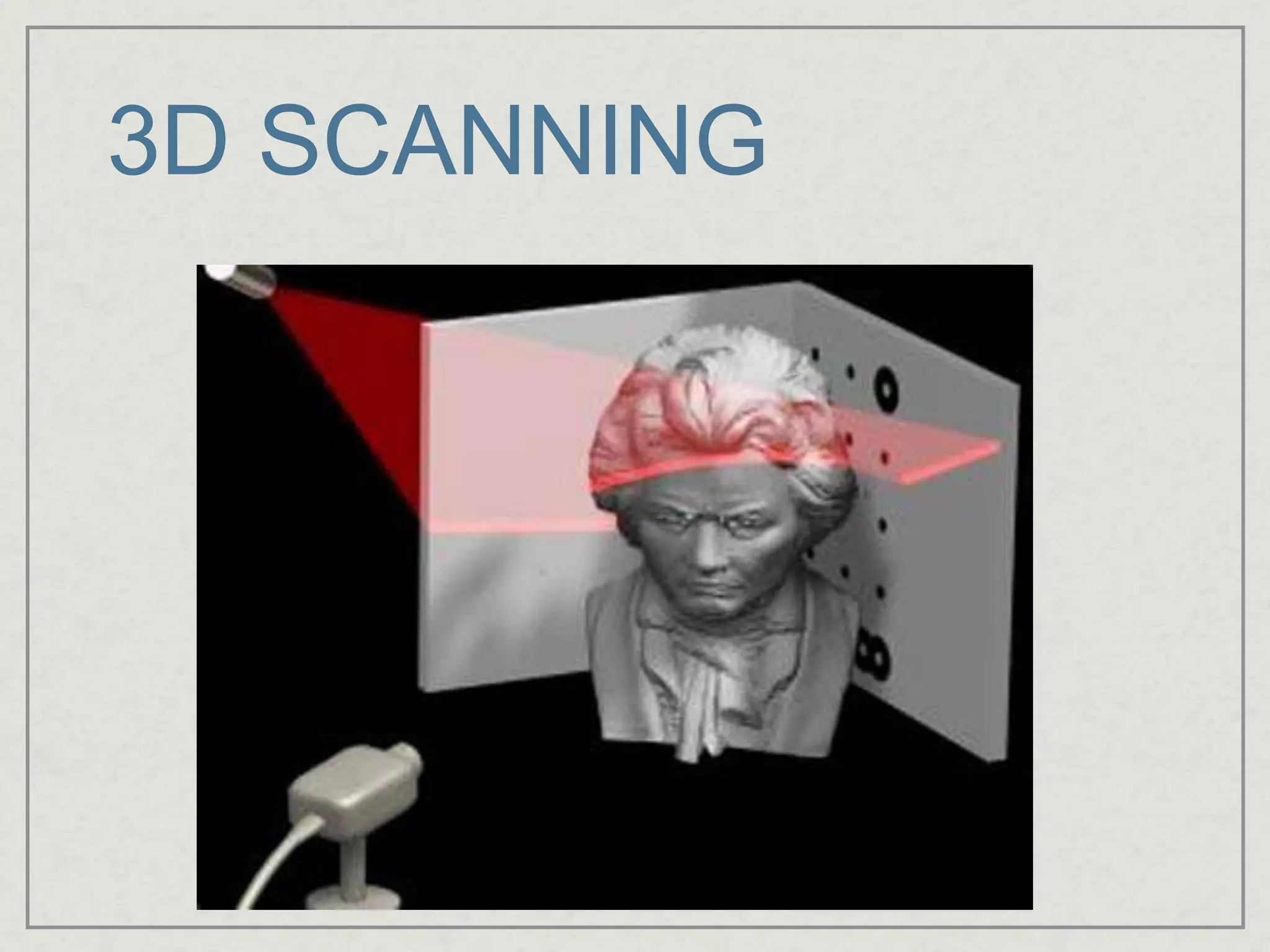
3D SCANNING
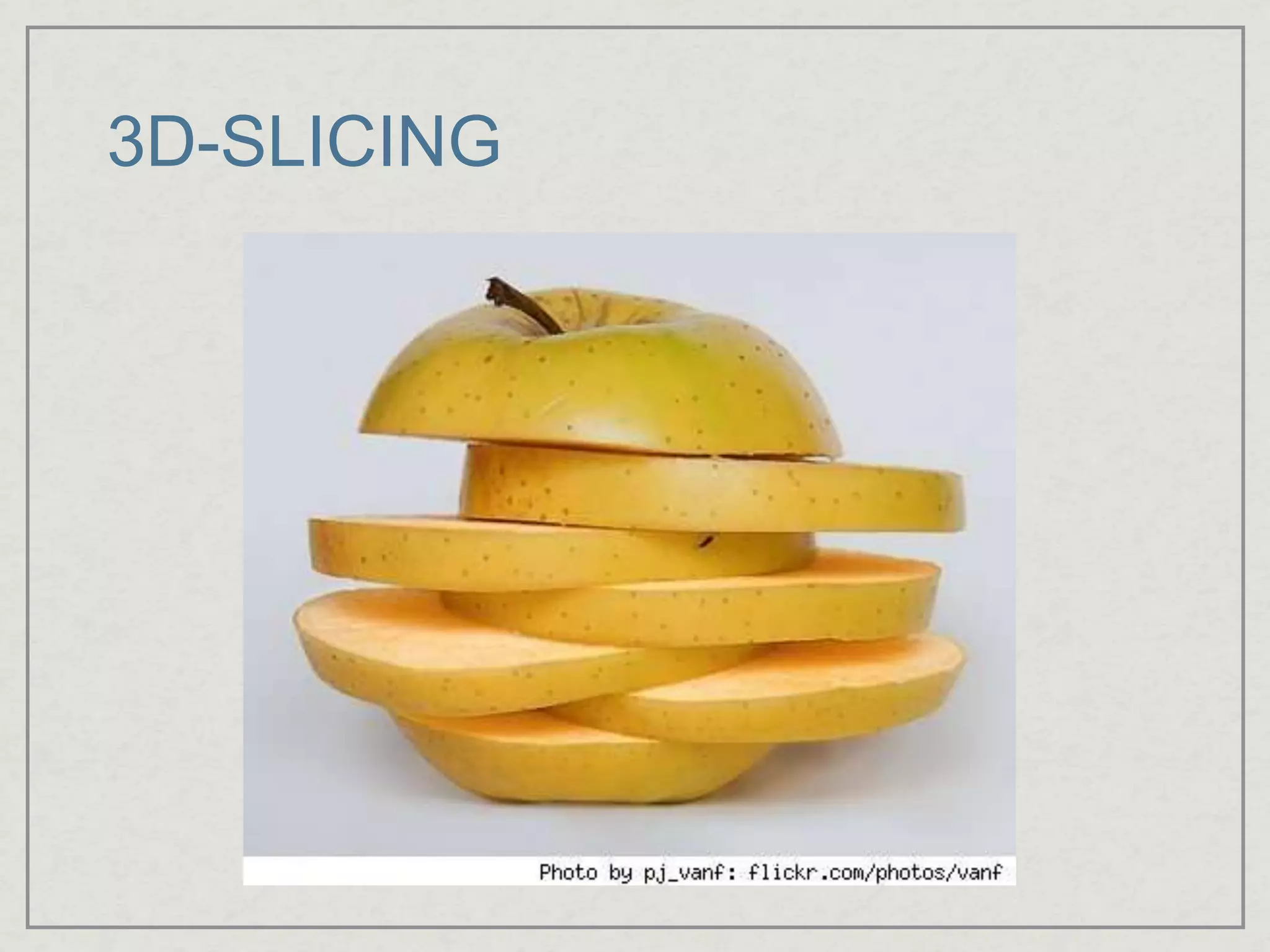
3D-SLICING
PRINTING
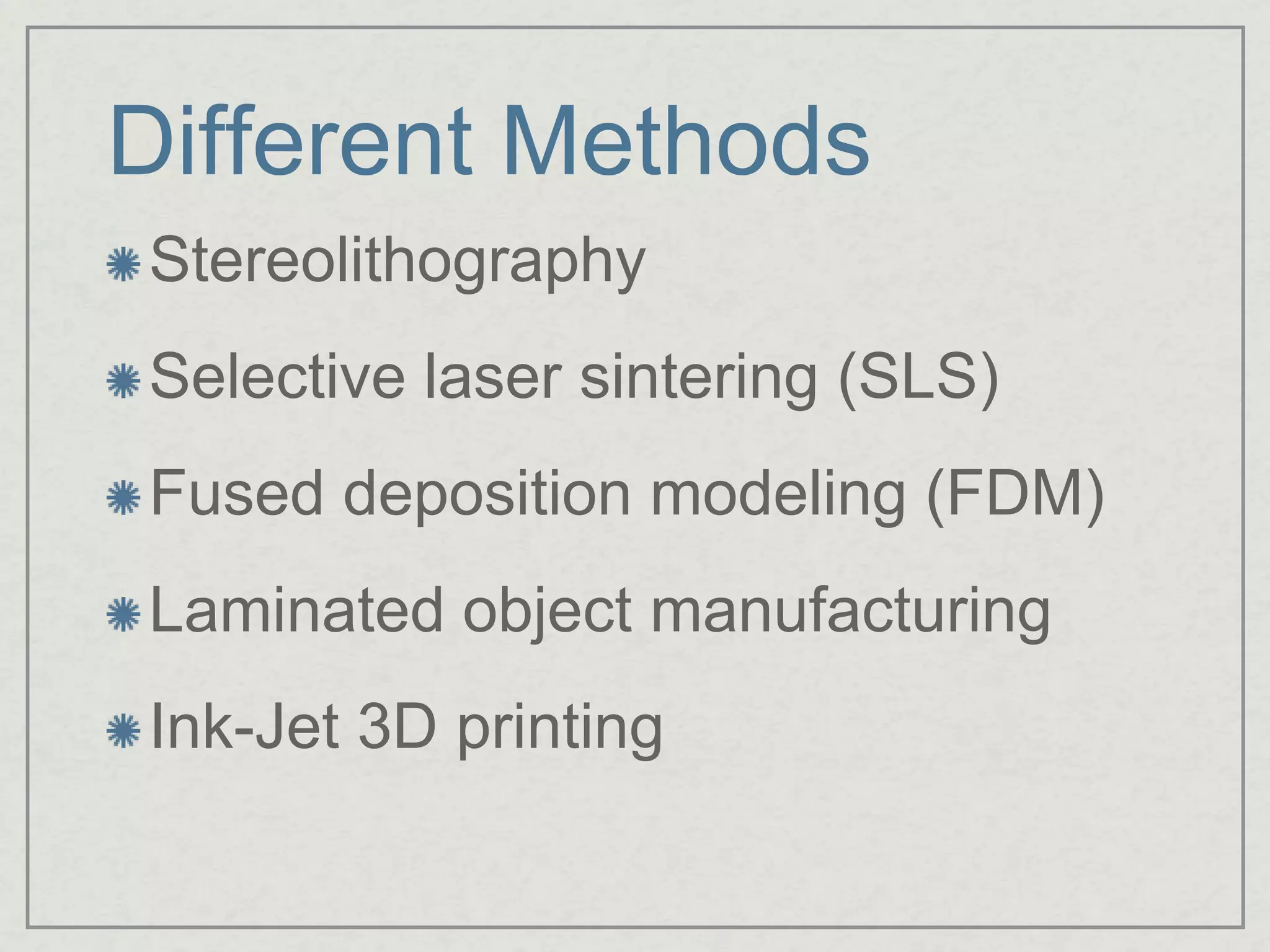
Different Methods
Stereolithography
Selective laser sintering (SLS)
Fused deposition modeling (FDM)
Laminated object manufacturing
Ink-Jet 3D printing
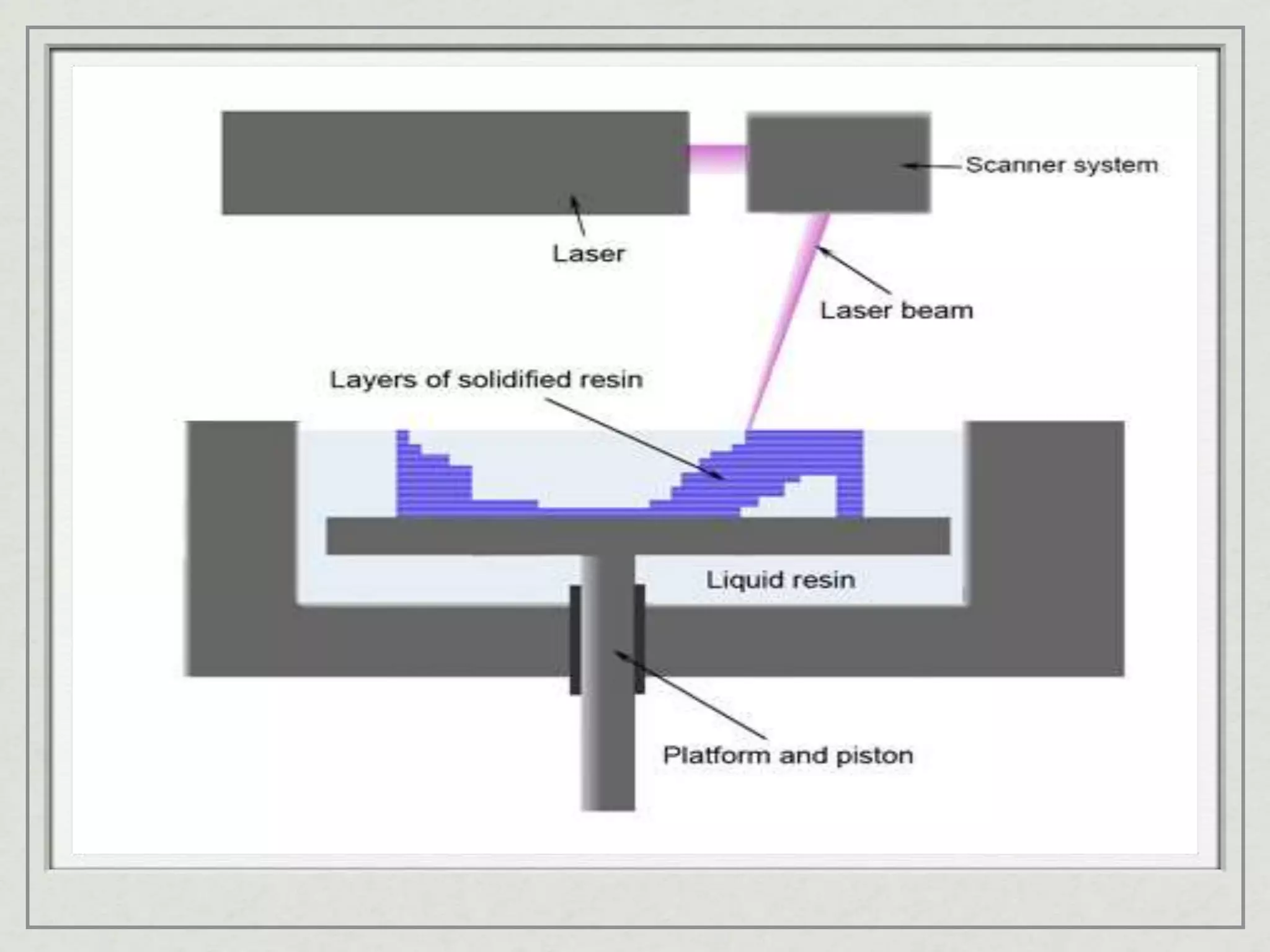
Stereolithography
• Stereolithography is an additive manufacturing process by using
liquid UV-curable photopolymer ”resin” and a UV laser to build
parts a layer at a time.
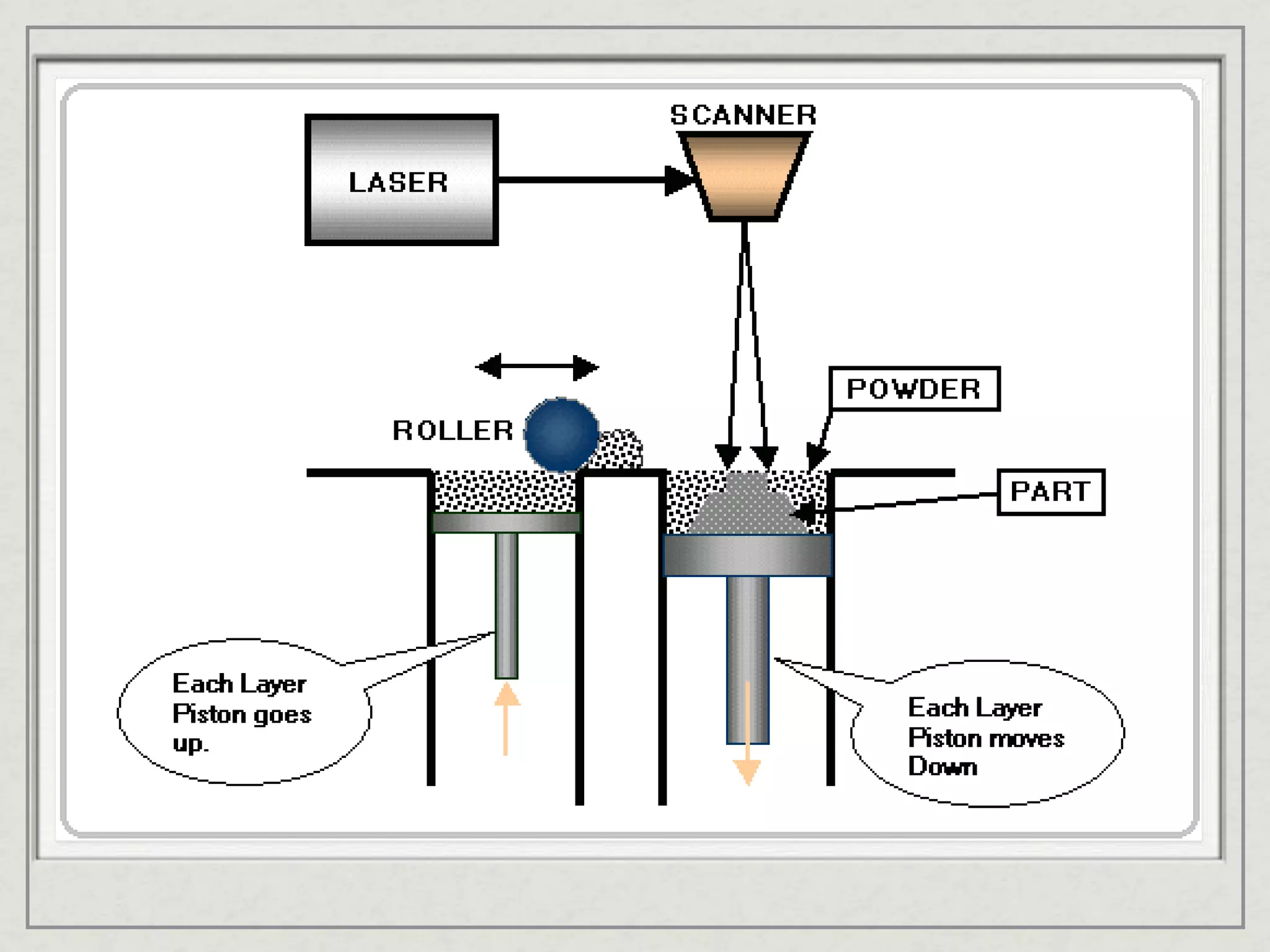
Selective laser sintering (SLS)
• Selective laser sintering (SLS) is an additive
manufacturing technique that uses a high
power laser to fuse small particles of plastic,
metal (direct metal laser sintering),ceramic or
glass powders into a mass that has a desired
3-dimensional shape
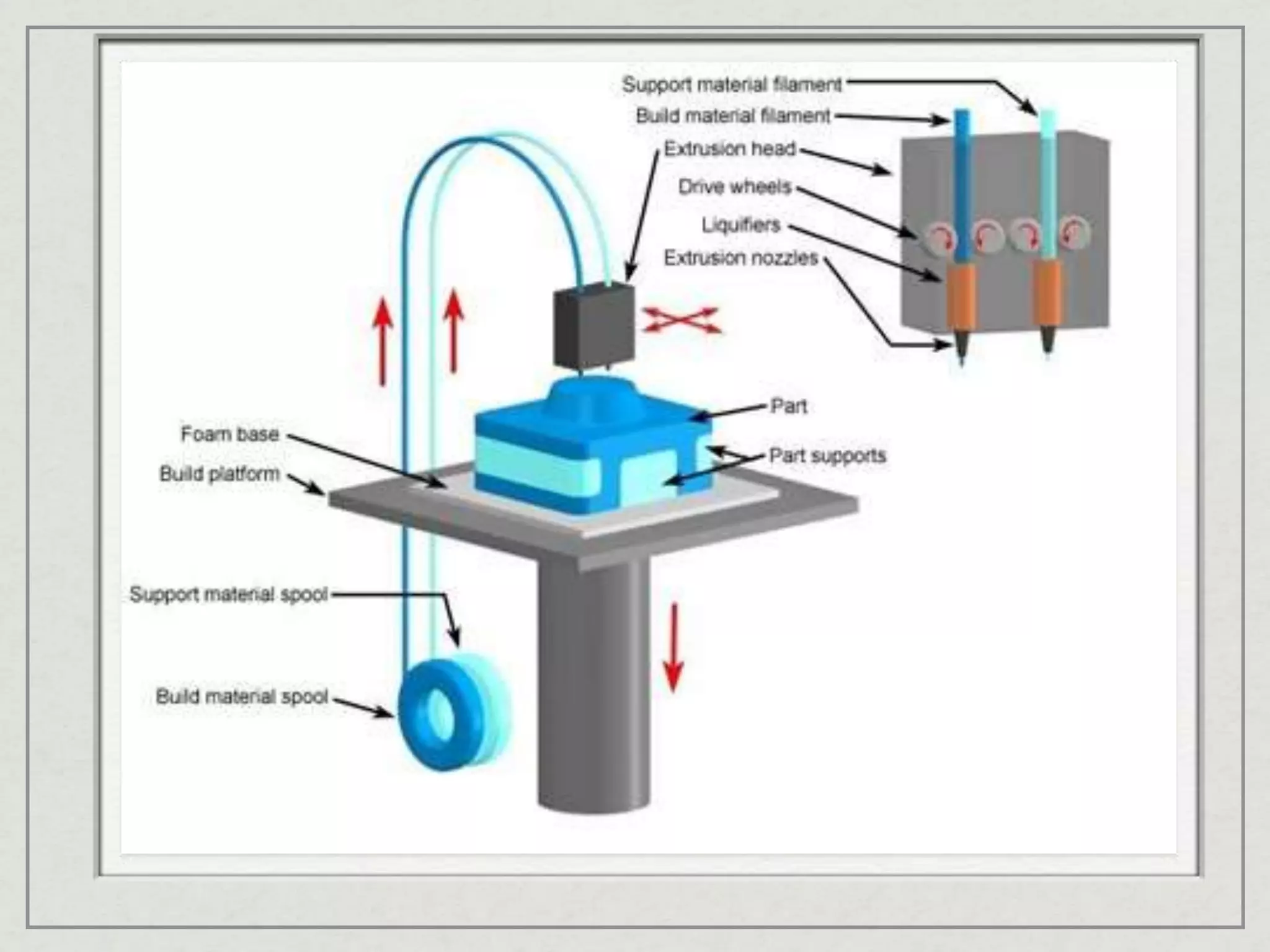
Fused deposition modeling (FDM)
• Commonly used for modeling, prototyping, and
production applications.
• Here a hot thermoplastic is extruded from a
temperature-controlled print head to produce
fairly robust objects to a high degree of accuracy.
Laminated object
manufacturing
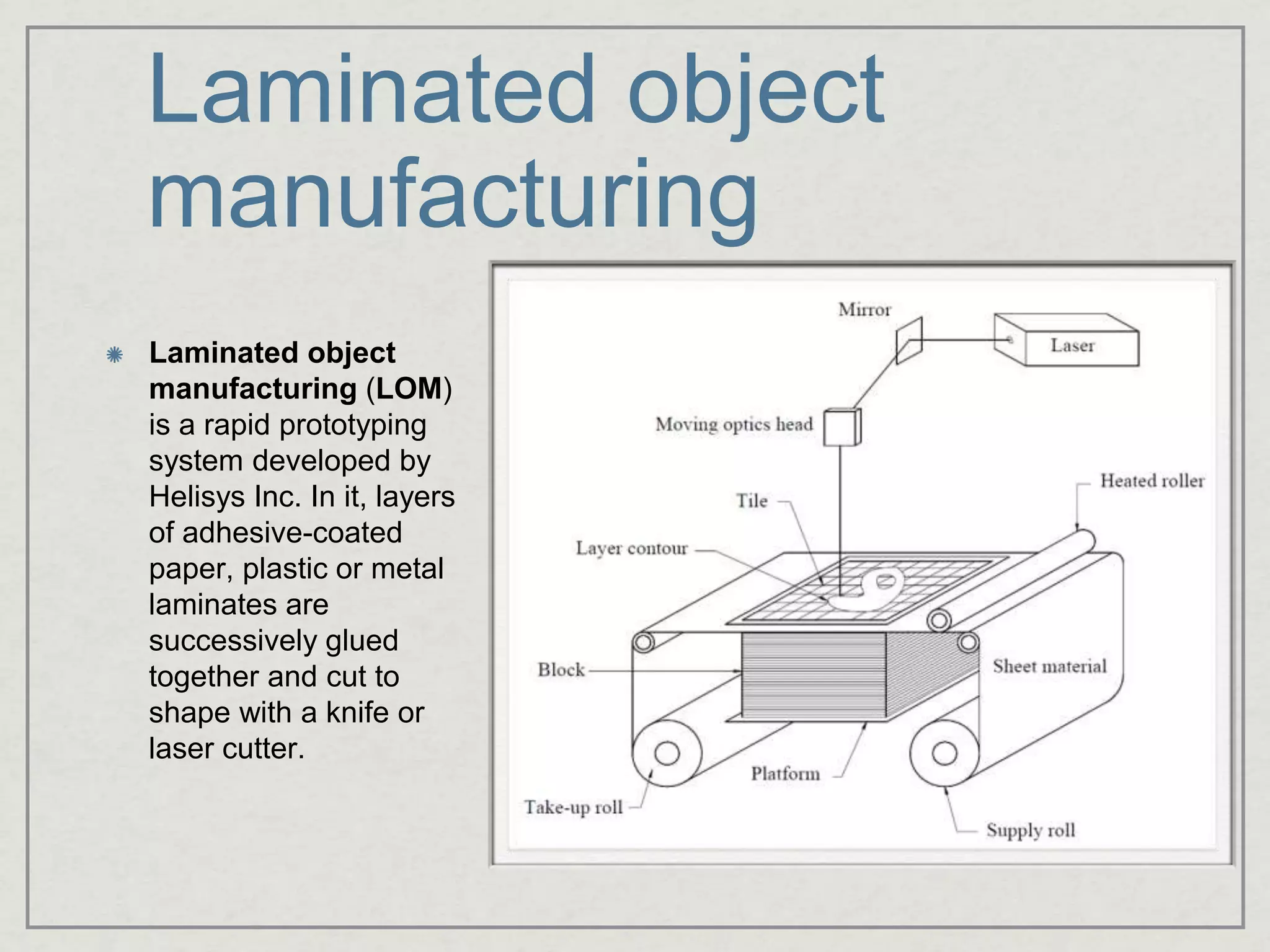
Laminated object
manufacturing (LOM)
is a rapid prototyping
system developed by
Helisys Inc. In it, layers
of adhesive-coated
paper, plastic or metal
laminates are
successively glued
together and cut to
shape with a knife or
laser cutter.
Ink-Jet 3D Printing
It creates the model one layer at a time by
spreading a layer of powder and inkjet printing
binder in the cross-section of the part.
It is the most widely used 3-D Printing technology
these days
PRINTING SYSTEM
 Powder
 Binder
MATERIALS FOR PRINTING
Powder
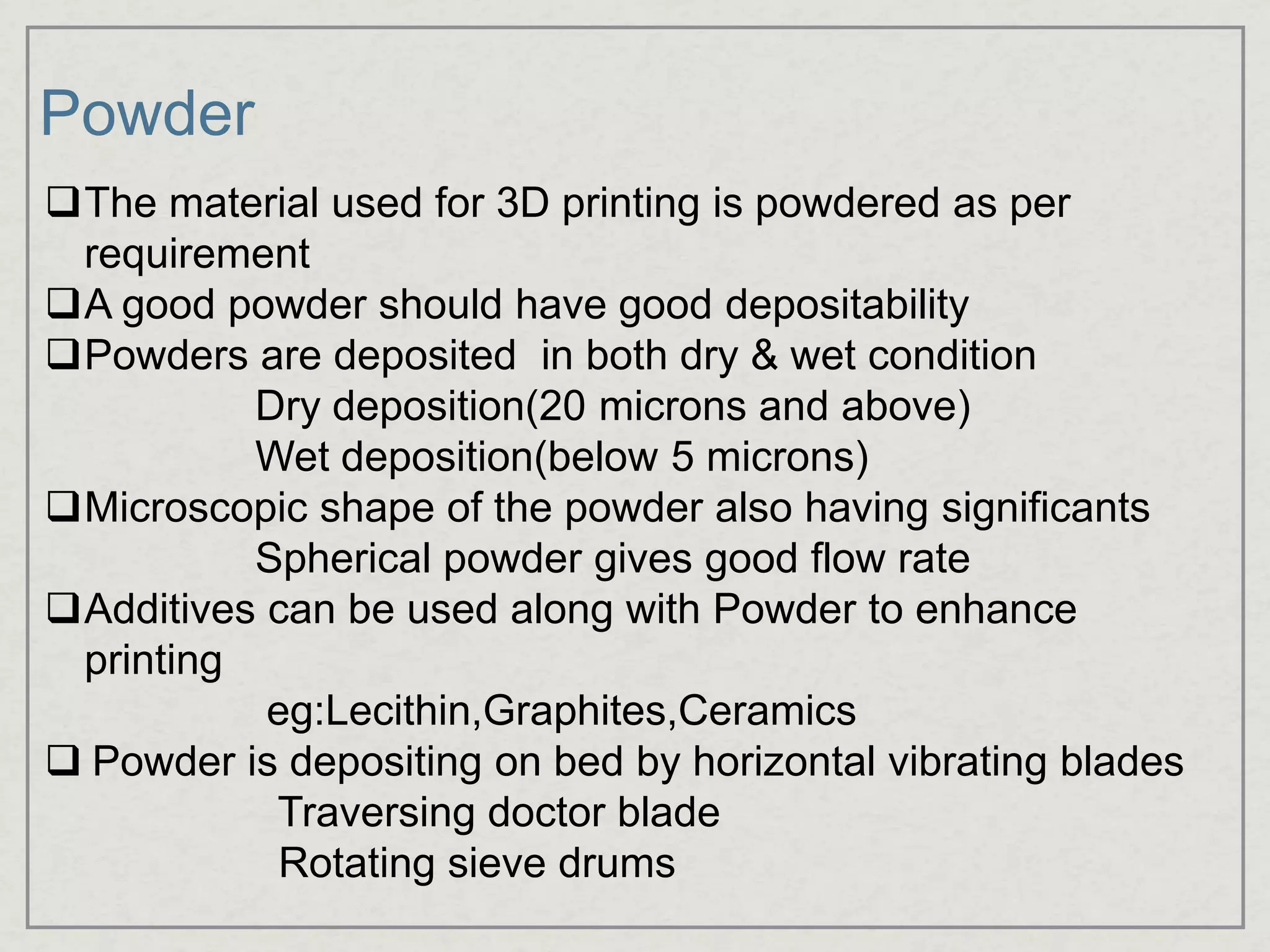
The material used for 3D printing is powdered as per
requirement
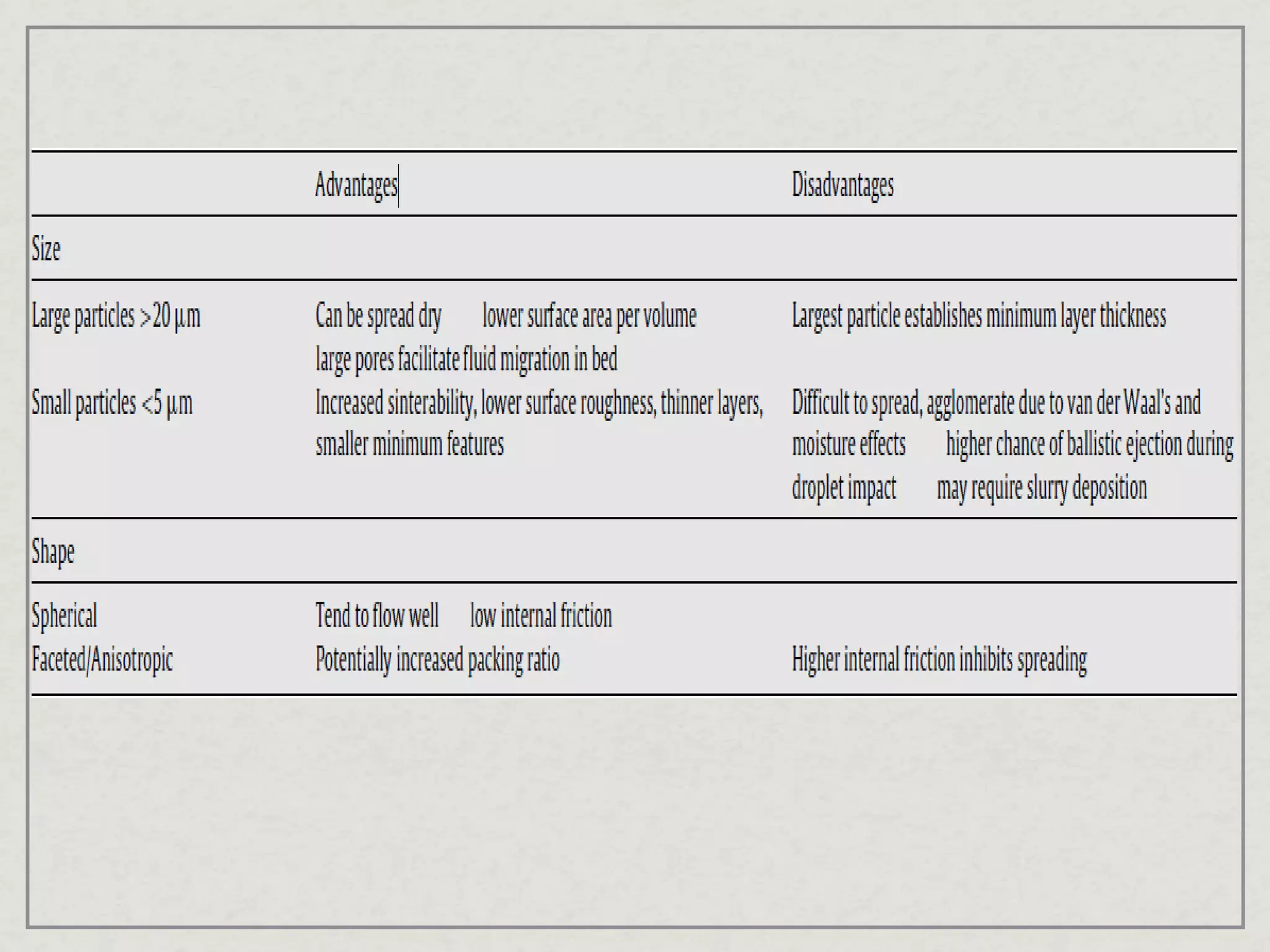
A good powder should have good depositability
Powders are deposited in both dry & wet condition
Dry deposition(20 microns and above)
Wet deposition(below 5 microns)
Microscopic shape of the powder also having significants
Spherical powder gives good flow rate
Additives can be used along with Powder to enhance
printing
eg:Lecithin,Graphites,Ceramics
 Powder is depositing on bed by horizontal vibrating blades
Traversing doctor blade
Rotating sieve drums
Binders
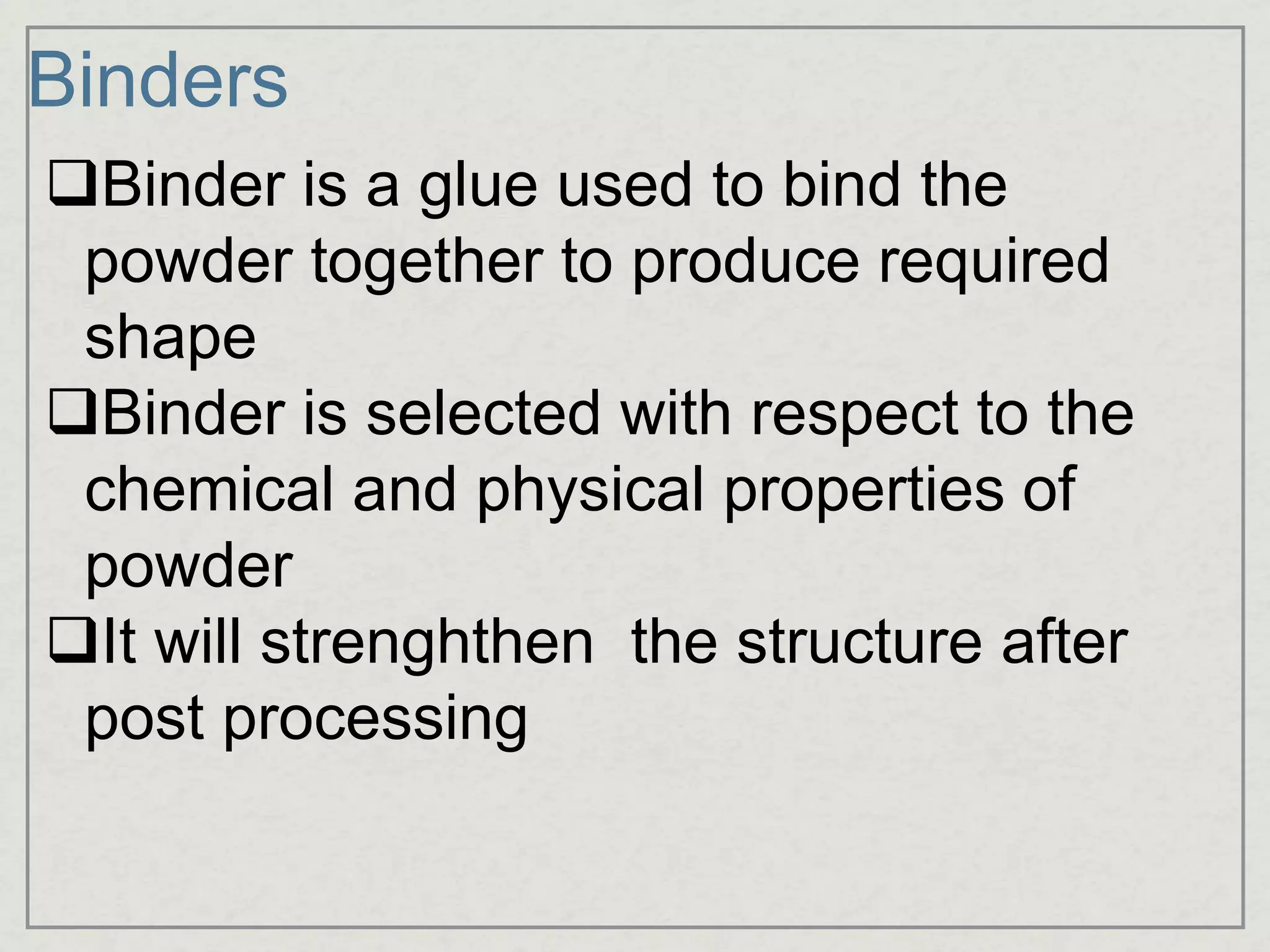
Binder is a glue used to bind the
powder together to produce required
shape
Binder is selected with respect to the
chemical and physical properties of
powder
It will strenghthen the structure after
post processing
Classification Of Binders
The binders are classifies according to their chemical properties and mode
of action
 Organic Binders
They are thermally react with specific gaseous and form binding action
Eg:Butyral resins,Polymeric resins,polyvinyls
 In bed adhesives
They bind the powder after interacting with deposited liquids and
dehydrated on heat treatment
Eg:Maltodextrin & Sucrose
 Hydration System
Binding action can be activated by adding water,they bind together at wet
condition.
Binding behaviors can be controlled by catalysts
Eg:Plasters,Ciment
 Acid-base System
This knid of binders binds most of the materials
Binding is generated through Acid-Base chemical reaction
Eg:Electrolyte coating of polyvinyl pyrrolidone
 Inorganic Binders
They are mainly silica compounds
When treated with CO2 or acids the powder get binded by colloidel gel of
silica and it also gives strength after post processing.
Eg:Colloidal Silica Solution(PH 9-9.5)
 Metal Salts
They are mainly used to bind metal powders
Binding carried our by the recrystallization of metal salts.
Eg: Silver nitrate Salt(reduced to cilver at 4400C )
Copper Sulphate(For steel)
 Solvents
Solvents dissolves particles or nearly all of the particles if it comes in contact
When the solvents evaporates polymers get precipitated and get binds
Eg:Chloroform used to bind polyesters and plastics
 Phase-Changing Materials
This kind of binders melts at high temperature and get solidifies at room
temperature and form bonds between printing powders
Eg: 2-Methyl propane-2-OL
Print Head
Industrial inkjet printing essentially means using inkjet
technology as a printing or deposition process in
manufacturing or on production lines
While all inkjet technologies can fundamentally be described
as the digitally controlled ejection of drops of fluid from a print
head onto a substrate, this is accomplished in a variety of
ways.
There are 2-types of print head for the generation of liquid
drops
Drop-On-Demand (DOD)
Continuous-Jet (CJ)
DOD Print Head
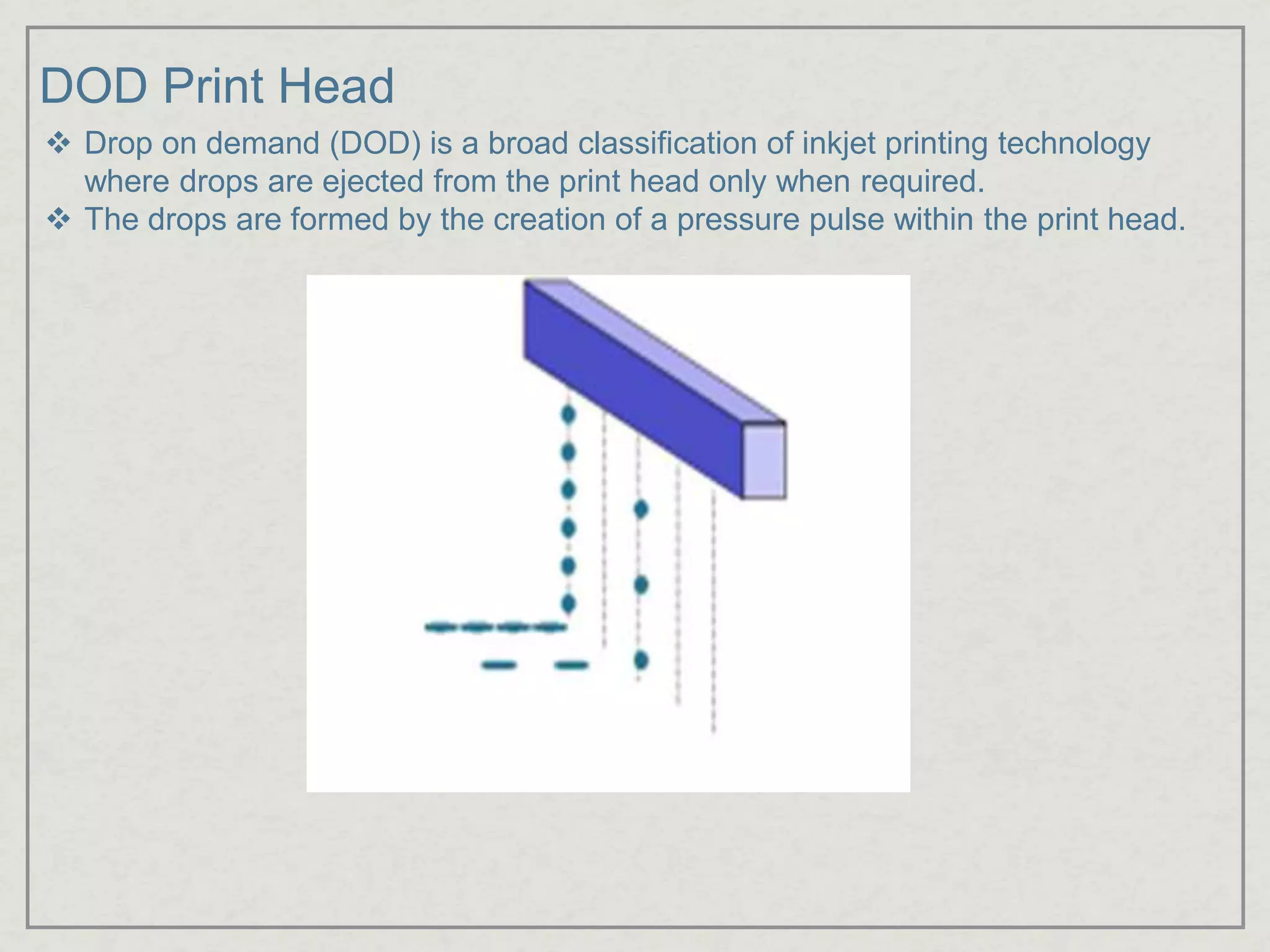
 Drop on demand (DOD) is a broad classification of inkjet printing technology
where drops are ejected from the print head only when required.
 The drops are formed by the creation of a pressure pulse within the print head.
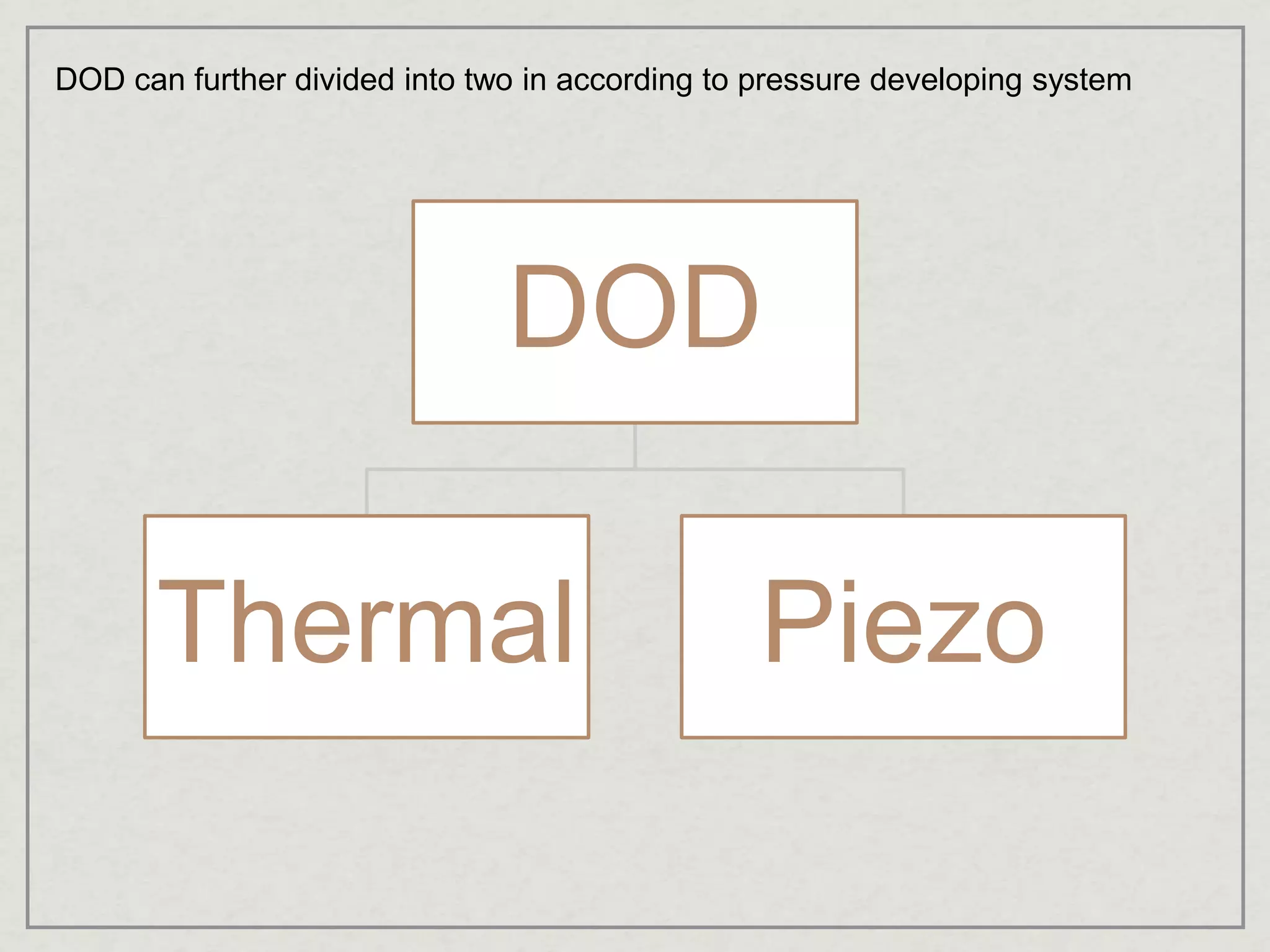
DOD
Thermal Piezo
DOD can further divided into two in according to pressure developing system
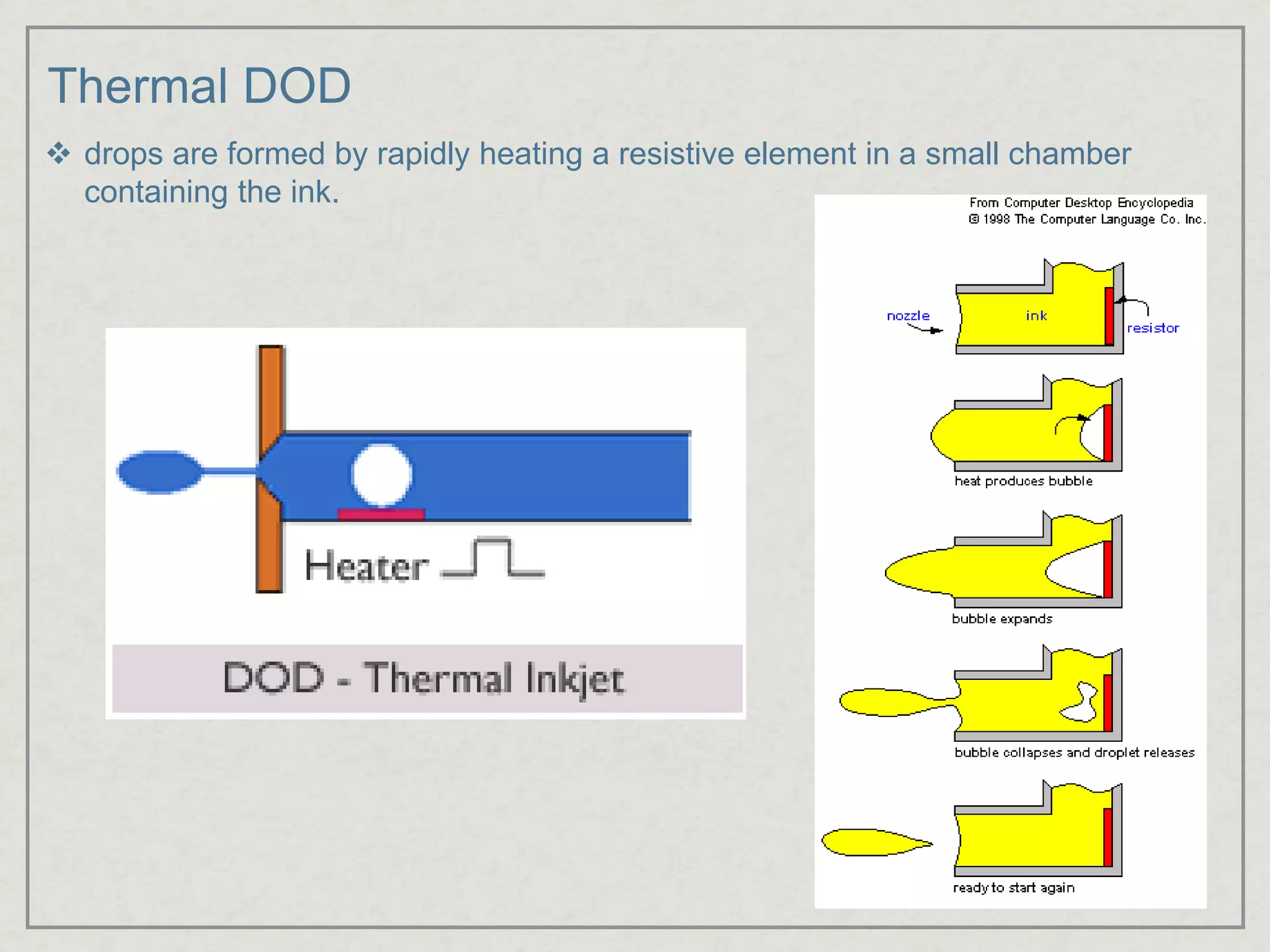
Thermal DOD
 drops are formed by rapidly heating a resistive element in a small chamber
containing the ink.
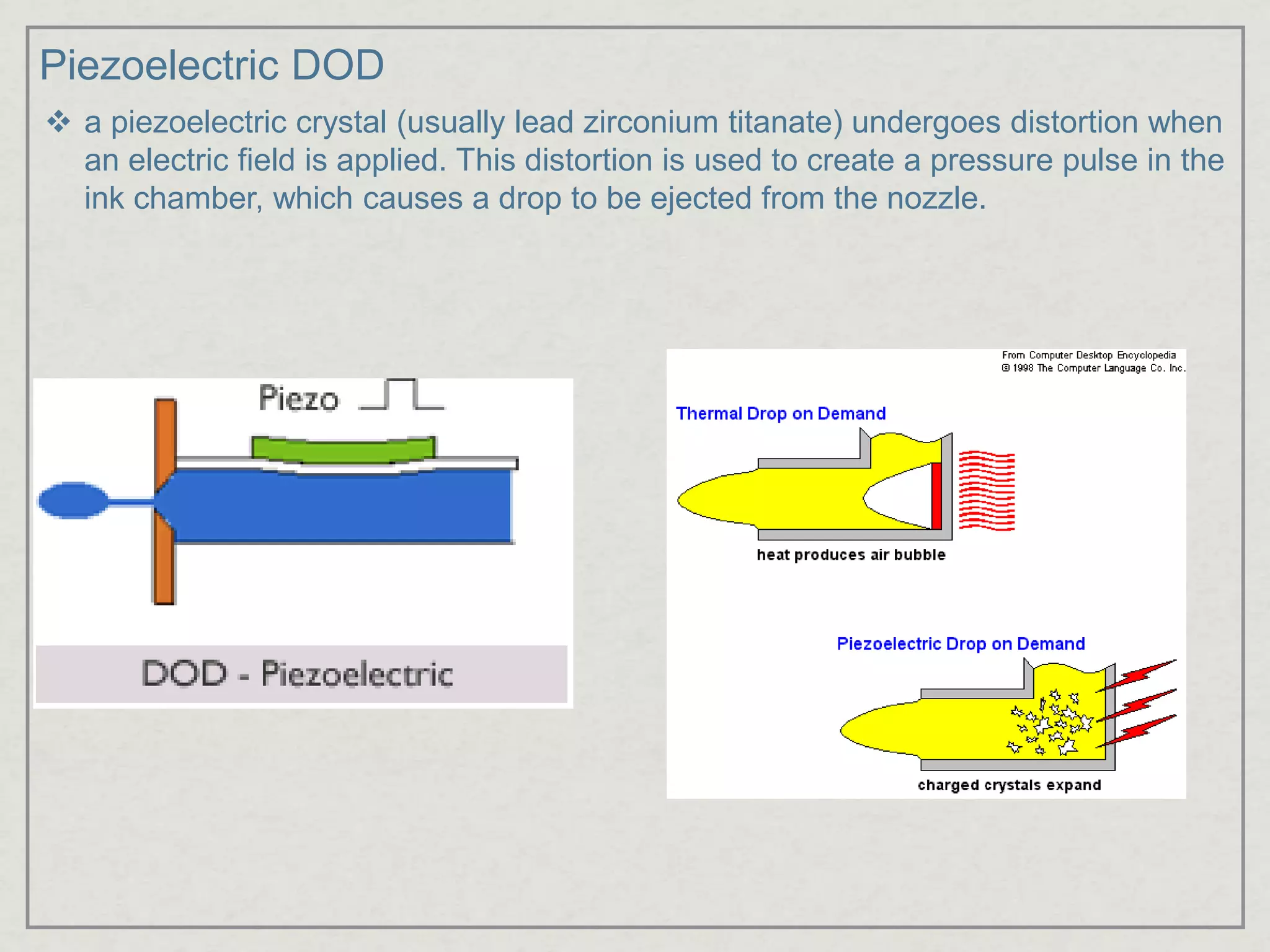
Piezoelectric DOD
 a piezoelectric crystal (usually lead zirconium titanate) undergoes distortion when
an electric field is applied. This distortion is used to create a pressure pulse in the
ink chamber, which causes a drop to be ejected from the nozzle.
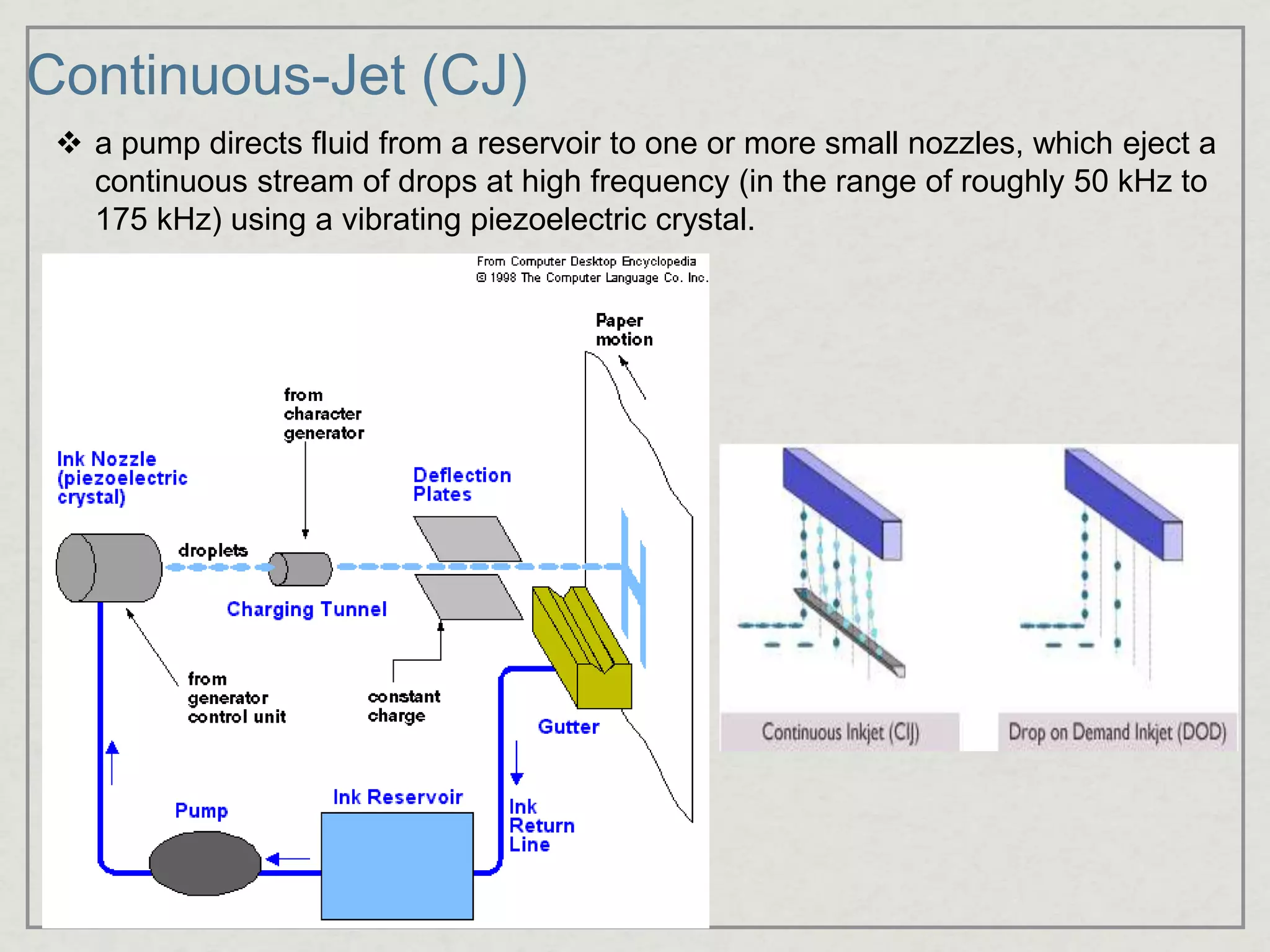
Continuous-Jet (CJ)
 a pump directs fluid from a reservoir to one or more small nozzles, which eject a
continuous stream of drops at high frequency (in the range of roughly 50 kHz to
175 kHz) using a vibrating piezoelectric crystal.
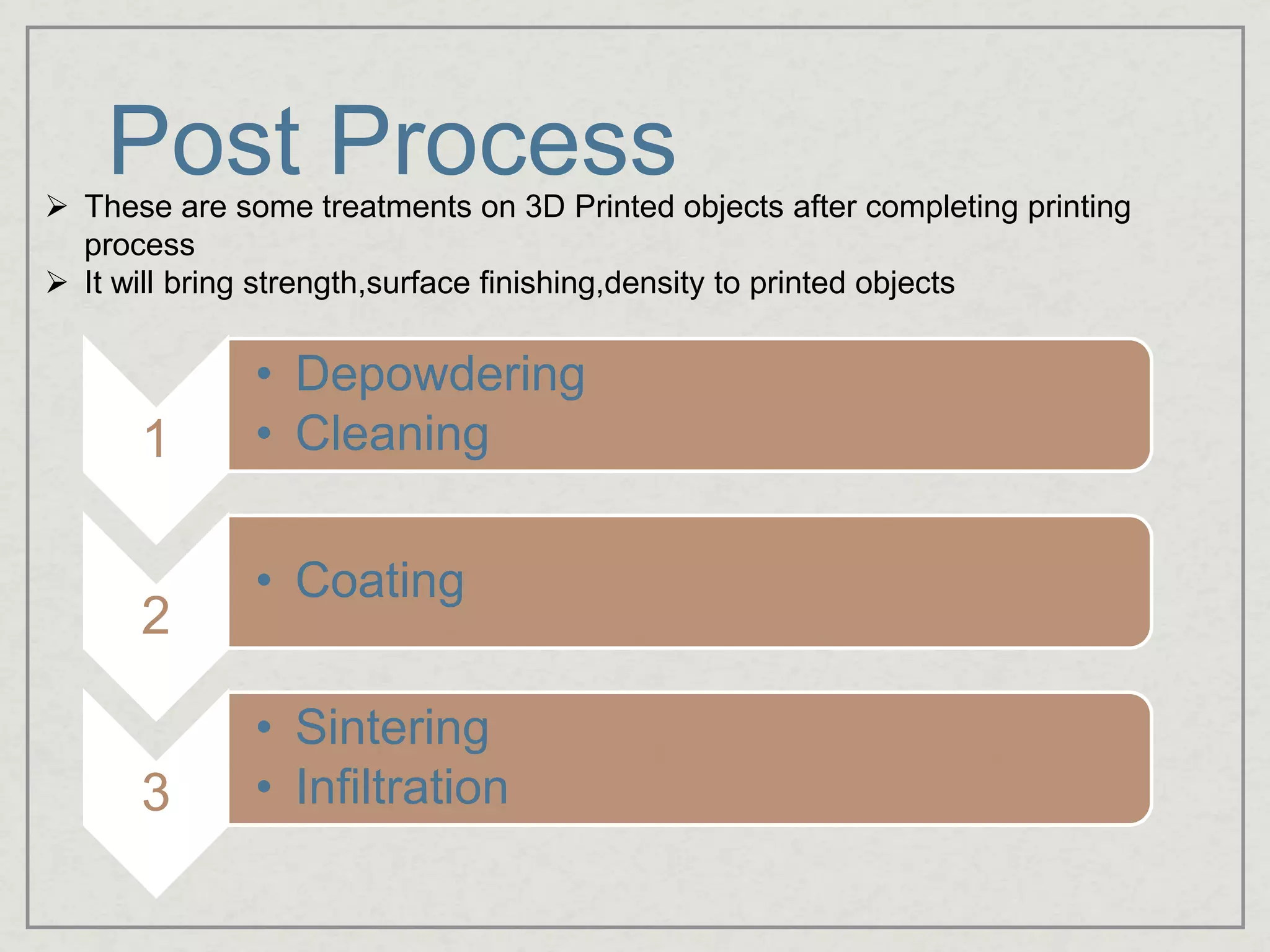
Post Process These are some treatments on 3D Printed objects after completing printing
process
 It will bring strength,surface finishing,density to printed objects
1
• Depowdering
• Cleaning
2
• Coating
3
• Sintering
• Infiltration
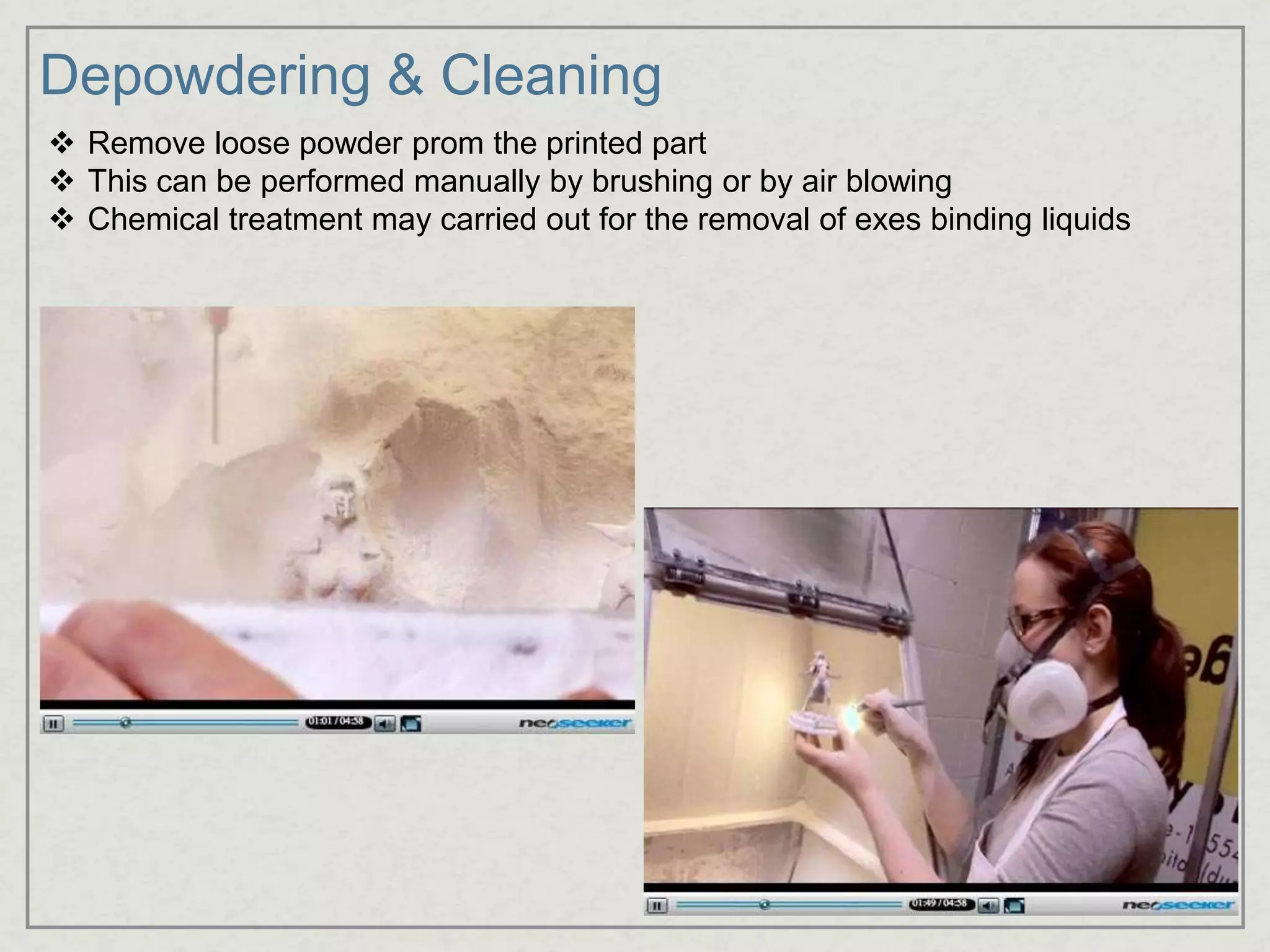
Depowdering & Cleaning
 Remove loose powder prom the printed part
 This can be performed manually by brushing or by air blowing
 Chemical treatment may carried out for the removal of exes binding liquids
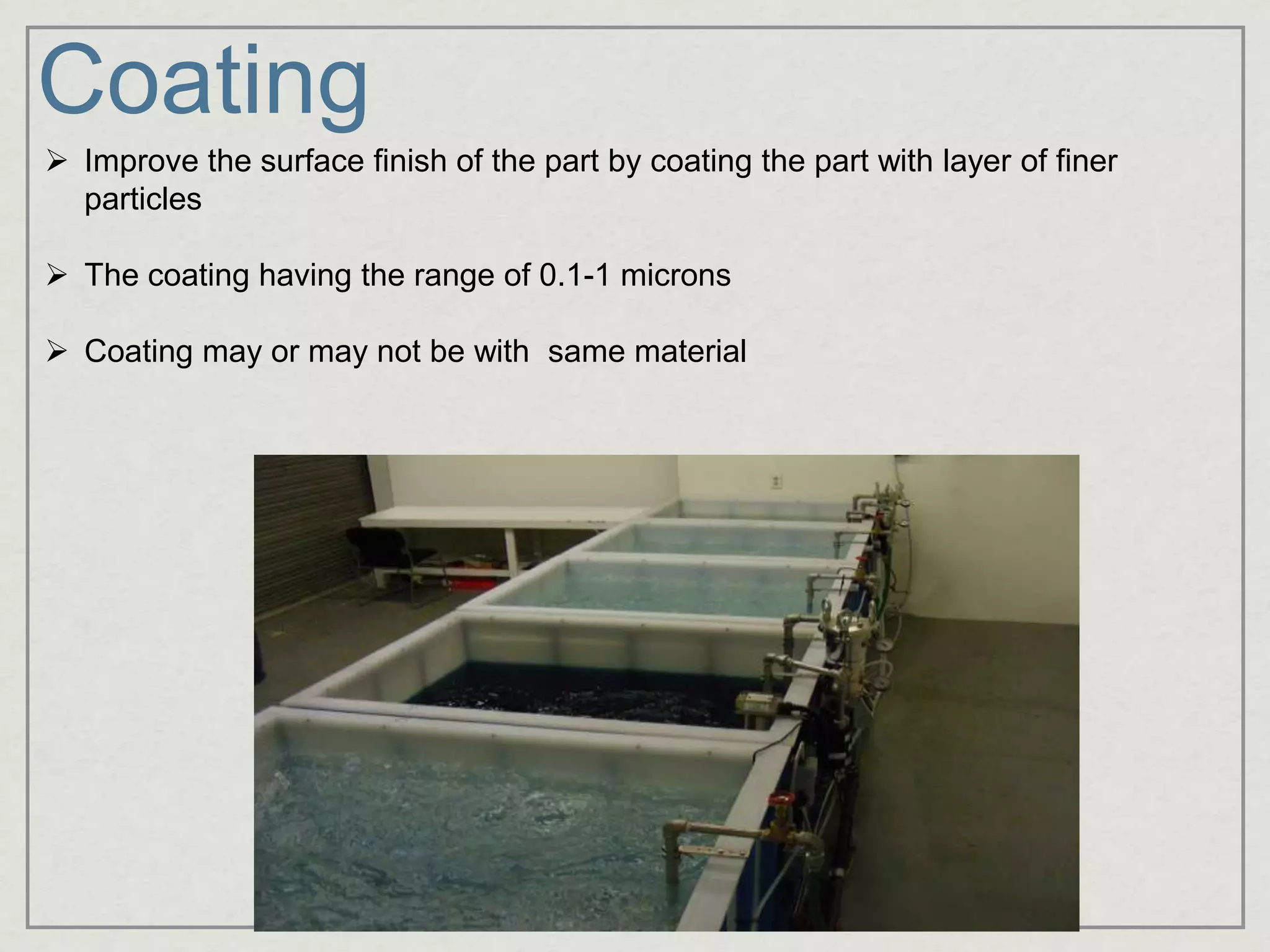
Coating
 Improve the surface finish of the part by coating the part with layer of finer
particles
 The coating having the range of 0.1-1 microns
 Coating may or may not be with same material
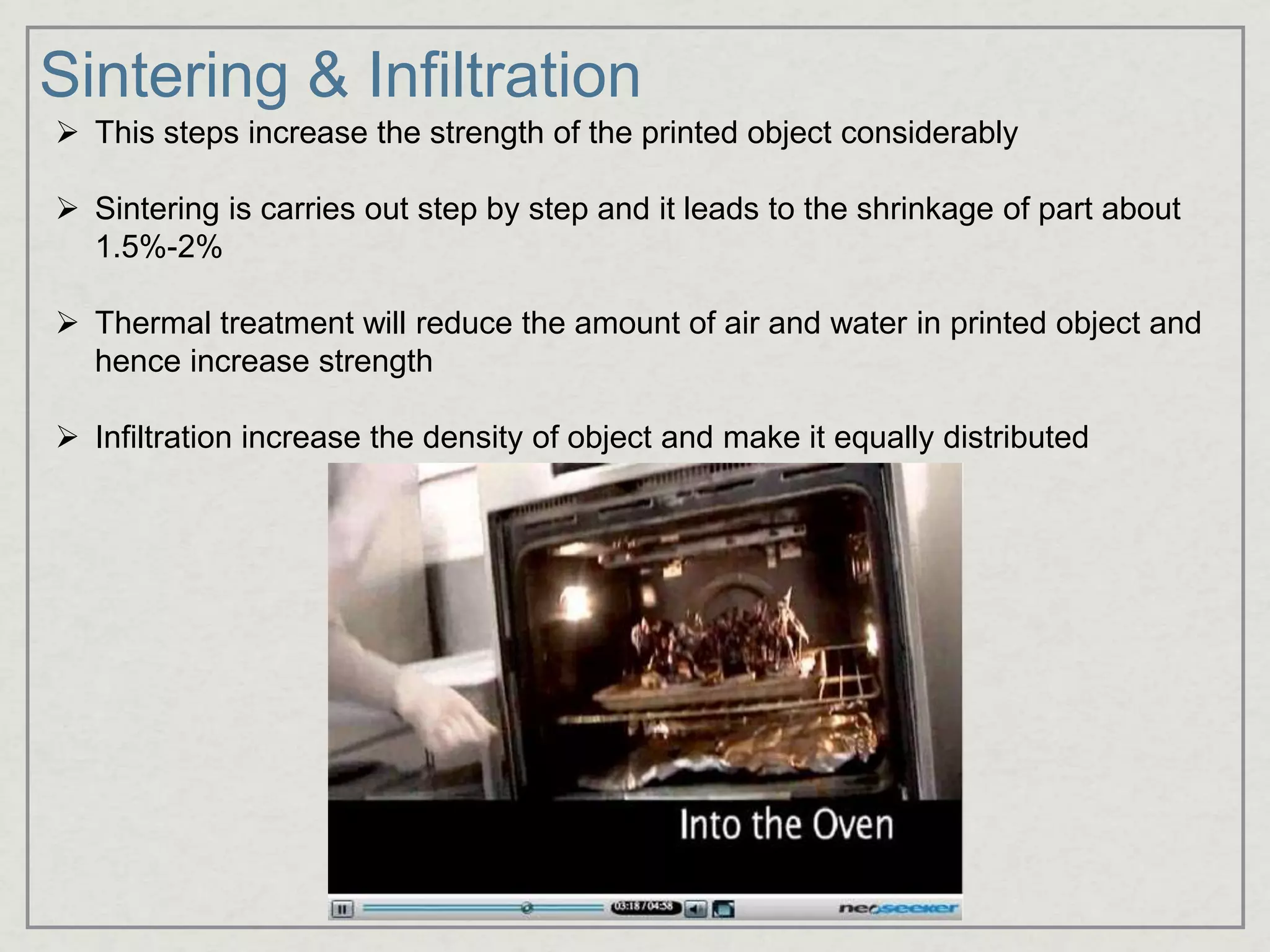
Sintering & Infiltration
 This steps increase the strength of the printed object considerably
 Sintering is carries out step by step and it leads to the shrinkage of part about
1.5%-2%
 Thermal treatment will reduce the amount of air and water in printed object and
hence increase strength
 Infiltration increase the density of object and make it equally distributed
WORK FLOW
Benefits of 3D Printing
The most successful companies have adopted 3D
printing as a critical part of the iterative design
process to:
• Increase Innovation
Print prototypes in hours, obtain feedback, refine
designs and repeat the cycle until designs are
perfect.
• Improve Communication
Hold a full color, realistic 3D model in your hands to
impart infinitely more information than a computer
image.
• Create physical 3D models quickly, easily and
affordably for a wide variety of applications.
• Speed marketing
Compress design cycles by 3D printing multiple
prototypes on demand, right in your office.
• Reduce Development Costs
Cut traditional prototyping and tooling costs.
Identify design errors earlier.
Reduce travel to production facilities.
• Win Business
Bring realistic 3D models to prospective accounts,
sponsors and focus groups
• Reduce part complexity:
An immediately apparent benefit is the ability to
create complex shapes that cannot be produced by
any other means.
• Digital design and manufacturing:
All AM processes create physical parts directly from
a standardized digital file (.STL),
which is a representation of a three-dimensional
solid model.These computer-controlled processes
require a low level of operator expertise and reduce
the amount of human interaction needed to create
an object
• High Speed Production:
In metal casting and injection molding, a new
product requires a new mold in which to cast the
part. In machining, several tool changes are
needed to create the finished product.
However,
3D printing is a “single tool” process no matter
the desired geometry, there is no need to change
even tools.
Could 3D Printing Change the World?
• Adding rather than subtracting—means
everything.
• Assembly lines and supply chains can be reduced
or eliminated for many products. The final product
or large pieces of a final product like a car can be
produced by AM in one process
• Reduce environmental pollution
• It can also be considered as a kind of teleporting
Applications
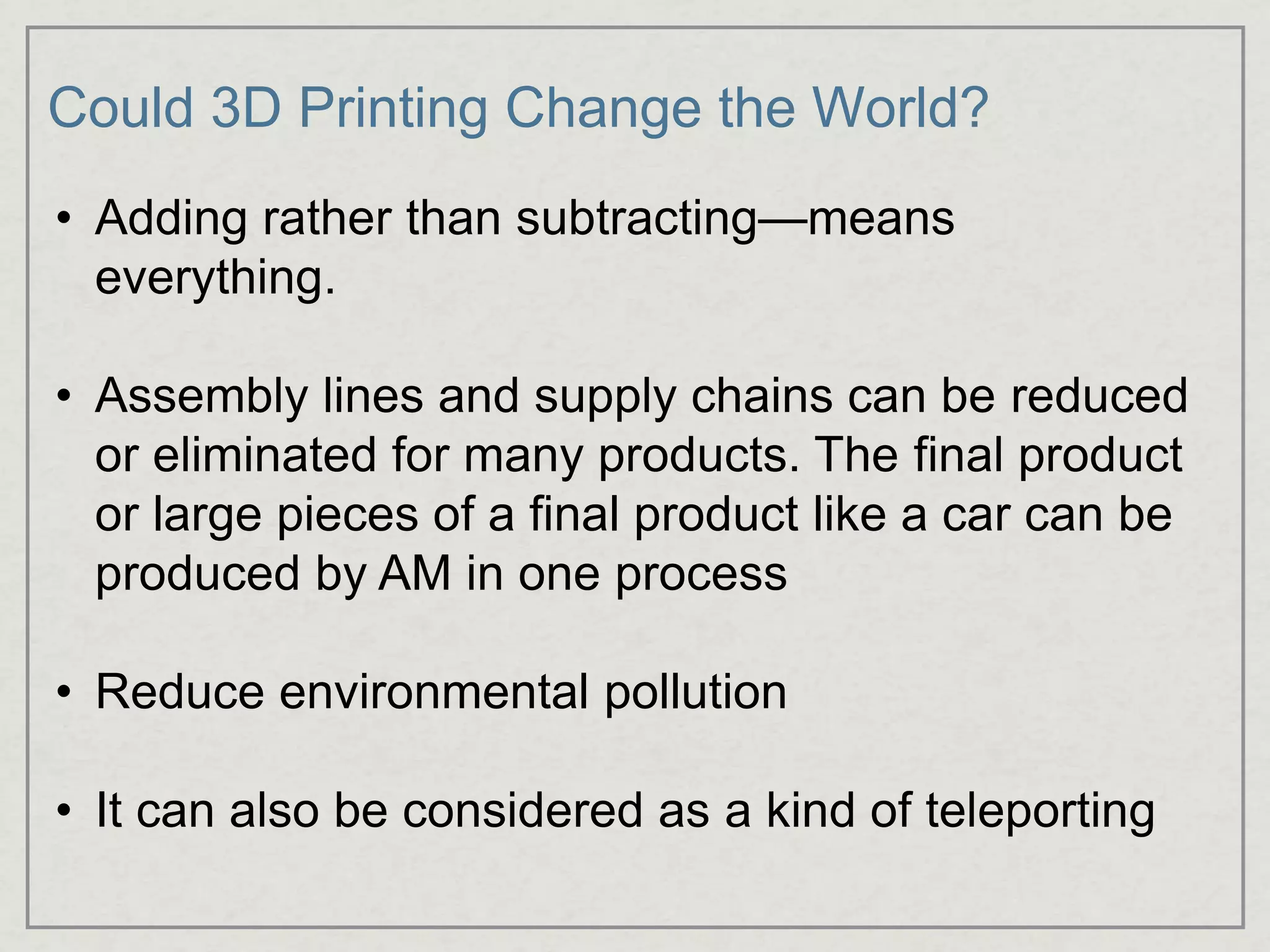
Design Prototypes:
3-Dimensional Printing concept model, functionel prototypes and
presentation models for evaluating and refining design
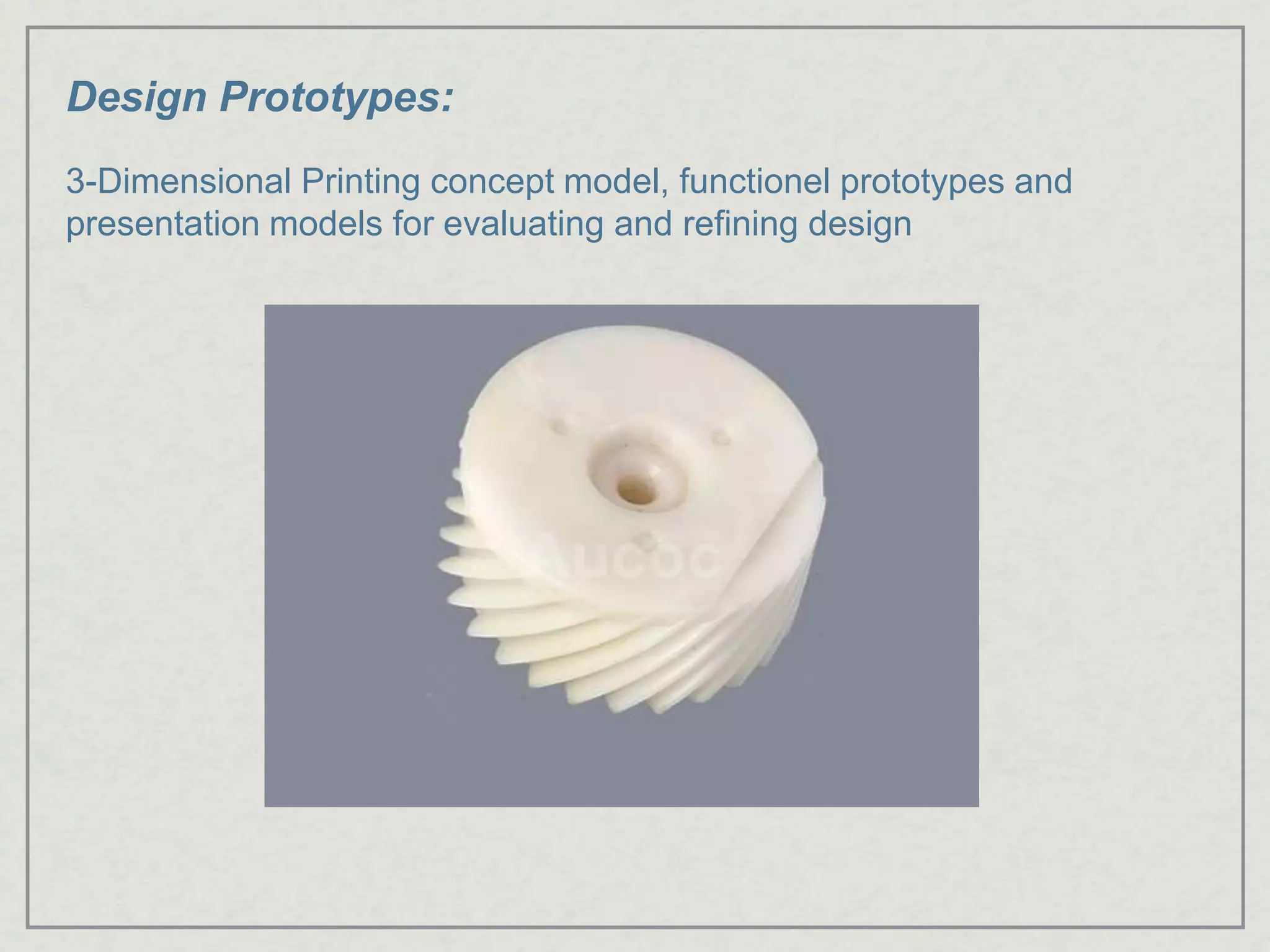
Dummy of a Nokia mobile phone for further study
and demonstration:
• Size: 3.5 x 2 x 0.7 inches
• Printing Time: 0.5 hours
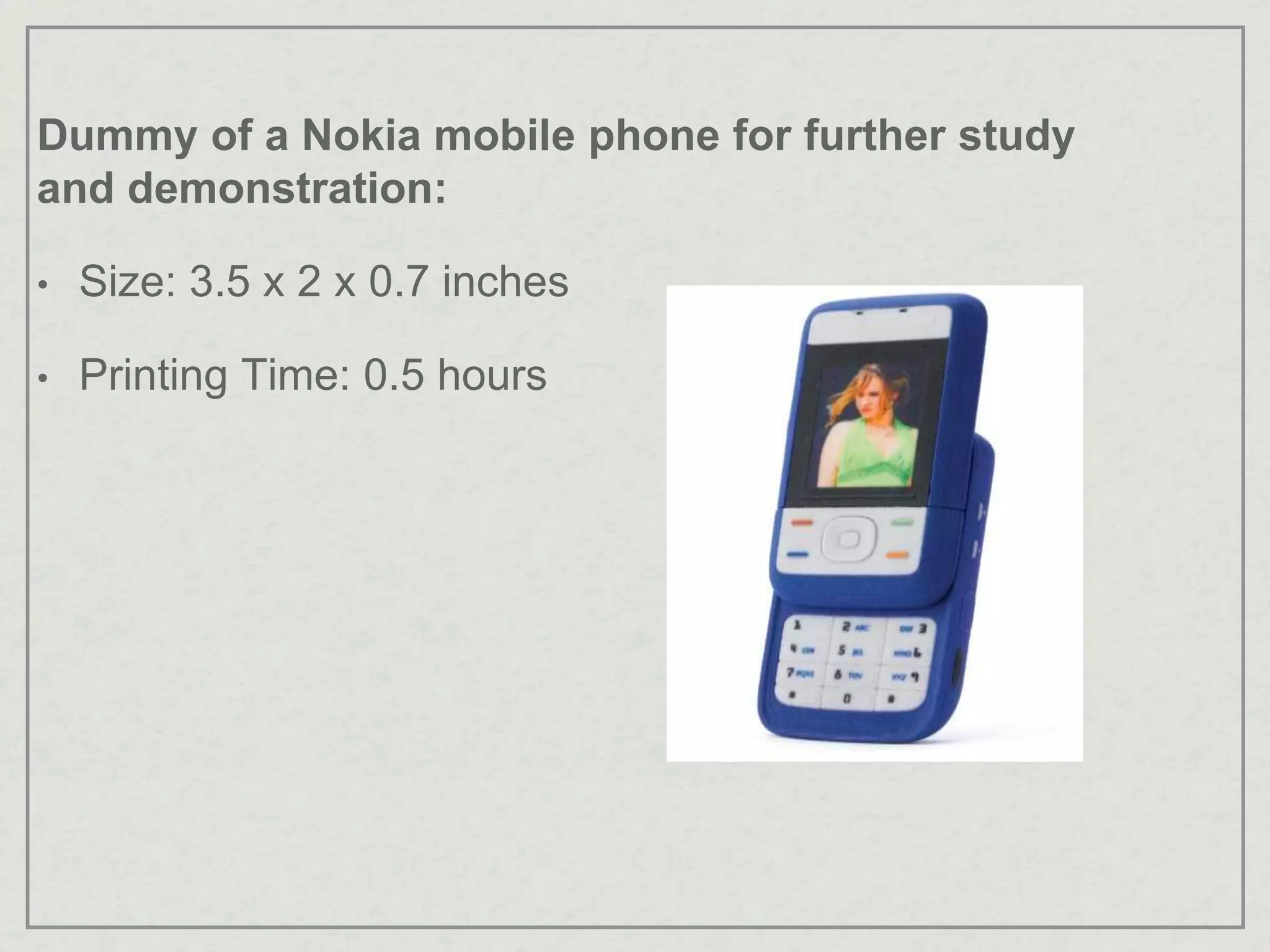
Education:
Helping students by bringing digital concepts into the real
world, turning their ideas into real-life 3D color models that
they can actually hold in their hands.
Printing Time: 3 hours
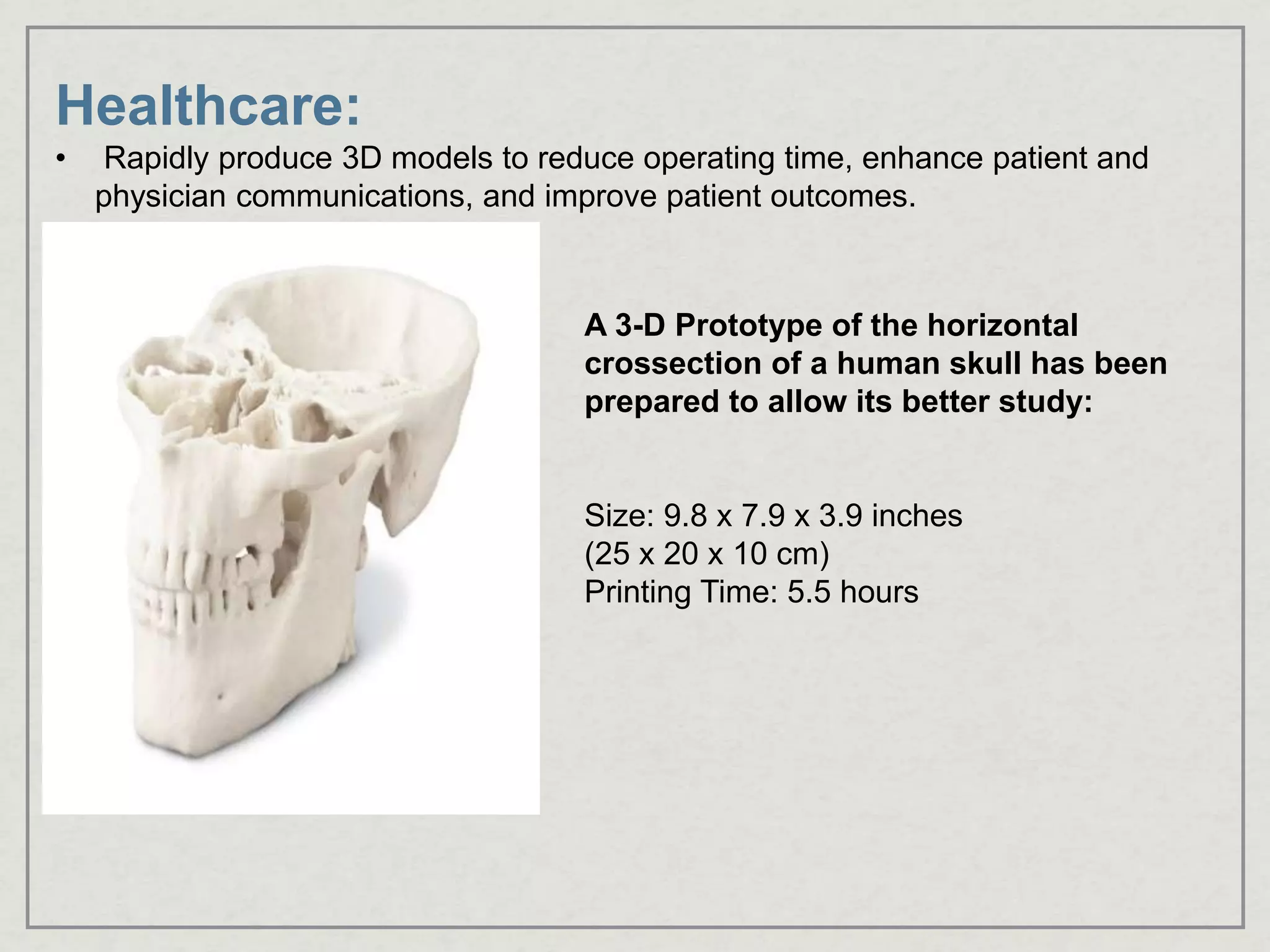
Healthcare:
• Rapidly produce 3D models to reduce operating time, enhance patient and
physician communications, and improve patient outcomes.
A 3-D Prototype of the horizontal
crossection of a human skull has been
prepared to allow its better study:
Size: 9.8 x 7.9 x 3.9 inches
(25 x 20 x 10 cm)
Printing Time: 5.5 hours
SUCCESSstories
Auto parts: for example, parts of "Formula 1" car engines, are
made by direct laser sintering of metal;
Aircraft parts: F-18 (fight aircraft) tube for the control
system environment;
Individual orthodontics: the company Align Technology uses
the 3D Printing to generate accurate individual dental braces for
hundreds of thousands of patients
worldwide by stereolithography from 3D-scans of the
mouth; polymer is used as a material for the production
of staples;
Individual hearing devices: manufactured by
companies Siemens and Phonak, based on 3D-scan of the ear
canal, so that the device is ideally suited to the user;
Conclusion
• Nothing communicates ideas faster than a three-
dimensional part or model. With a 3D printer you can bring
CAD files and design ideas to life right from your desktop
• Test form, fit and function and as many design variations as
we like with functional parts printed by 3D printer
• 3D printing has a bright future, not least in rapid
prototyping,where its impact is already highly significant
• As devices that will provide a solid bridge between
cyberspace and the physical world, and as an important
manifestation of the Second Digital Revolution
REFRENCES
Journals:
1. A review of process development steps for new material systems in three
dimensional printing (3DP)
Ben Utela,Duane Storti,Rhonda Andersonb,Mark Ganter
University of Washington, Seattle, WA, USA
United States Navy, Panama City, FL, USA
2. 3D Microfabrication with inclined/rotated UV Lithography
Sensors and Actuators A: Physical,Volume 111, Issue 1, 1 March 2004,
Pages14-20
Manhee Han, Woonseob Lee, Sung-Keun Lee, Seung S. Lee
3. 3-D printing: The new industrial revolution
Barry Berman Frank G. Zarb School of Business, Hofstra University, 222 Weller
Hall, Hempstead, NY 11549, U.S.A.
4.High aspect ratio- and 3D- printing of freestanding sophisticated
structures
A.Kalin,C.Muller Laboratory for Process Technology, IMTEK, Albert-Ludwigs-
University Freiburg
THANK YOU
•

3D Printing Technology

  • 1.
    Presenting By: NASEEL IBNUAZEEZ M.P Roll No:12 M-Tech MD AJCE-KANJIRAPALLY Guided By: Mr. RICHU THOMAS Ast. Professor Mechanical Engineering AJCE-KANJIRAPALLY 12/2/2015 1
  • 2.
    INTRODUCTION • 3D printingis a modern technology in which 3 dimensional objects are printed from digital data • Three dimensional object is created by laying down successive layers of material • It is a additive manufacturing technology
  • 3.
    HISTORY 1.The technology forprinting physical 3D objects from digital data was first developed by Charles Hull in 1984. He named the technique as Stereo lithography and obtained a patent for the technique in 1986 2..Fused Deposition Modeling (FDM) and Selective Laser Sintering (SLS) were introduced. In 1993 3. In 1996, three major products, "Genisys" from Stratasys, "Actua 2100" from 3D Systems and "Z402" from Z Corporation, were introduced 4. In 2005, Z Corp. launched a breakthrough product, named Spectrum Z510, which was the first high definition color 3D Printer in the market. 5.in 2006 with the initiation of an open source project, named Reprap, which was aimed at developing a selfreplicating 3D printer.
  • 4.
  • 5.
  • 6.
  • 7.
  • 8.
  • 9.
  • 12.
  • 13.
    Different Methods Stereolithography Selective lasersintering (SLS) Fused deposition modeling (FDM) Laminated object manufacturing Ink-Jet 3D printing
  • 14.
    Stereolithography • Stereolithography isan additive manufacturing process by using liquid UV-curable photopolymer ”resin” and a UV laser to build parts a layer at a time.
  • 16.
    Selective laser sintering(SLS) • Selective laser sintering (SLS) is an additive manufacturing technique that uses a high power laser to fuse small particles of plastic, metal (direct metal laser sintering),ceramic or glass powders into a mass that has a desired 3-dimensional shape
  • 18.
    Fused deposition modeling(FDM) • Commonly used for modeling, prototyping, and production applications. • Here a hot thermoplastic is extruded from a temperature-controlled print head to produce fairly robust objects to a high degree of accuracy.
  • 20.
    Laminated object manufacturing Laminated object manufacturing(LOM) is a rapid prototyping system developed by Helisys Inc. In it, layers of adhesive-coated paper, plastic or metal laminates are successively glued together and cut to shape with a knife or laser cutter.
  • 21.
    Ink-Jet 3D Printing Itcreates the model one layer at a time by spreading a layer of powder and inkjet printing binder in the cross-section of the part. It is the most widely used 3-D Printing technology these days
  • 22.
    PRINTING SYSTEM  Powder Binder MATERIALS FOR PRINTING
  • 23.
    Powder The material usedfor 3D printing is powdered as per requirement A good powder should have good depositability Powders are deposited in both dry & wet condition Dry deposition(20 microns and above) Wet deposition(below 5 microns) Microscopic shape of the powder also having significants Spherical powder gives good flow rate Additives can be used along with Powder to enhance printing eg:Lecithin,Graphites,Ceramics  Powder is depositing on bed by horizontal vibrating blades Traversing doctor blade Rotating sieve drums
  • 25.
    Binders Binder is aglue used to bind the powder together to produce required shape Binder is selected with respect to the chemical and physical properties of powder It will strenghthen the structure after post processing
  • 26.
    Classification Of Binders Thebinders are classifies according to their chemical properties and mode of action  Organic Binders They are thermally react with specific gaseous and form binding action Eg:Butyral resins,Polymeric resins,polyvinyls  In bed adhesives They bind the powder after interacting with deposited liquids and dehydrated on heat treatment Eg:Maltodextrin & Sucrose  Hydration System Binding action can be activated by adding water,they bind together at wet condition. Binding behaviors can be controlled by catalysts Eg:Plasters,Ciment
  • 27.
     Acid-base System Thisknid of binders binds most of the materials Binding is generated through Acid-Base chemical reaction Eg:Electrolyte coating of polyvinyl pyrrolidone  Inorganic Binders They are mainly silica compounds When treated with CO2 or acids the powder get binded by colloidel gel of silica and it also gives strength after post processing. Eg:Colloidal Silica Solution(PH 9-9.5)  Metal Salts They are mainly used to bind metal powders Binding carried our by the recrystallization of metal salts. Eg: Silver nitrate Salt(reduced to cilver at 4400C ) Copper Sulphate(For steel)
  • 28.
     Solvents Solvents dissolvesparticles or nearly all of the particles if it comes in contact When the solvents evaporates polymers get precipitated and get binds Eg:Chloroform used to bind polyesters and plastics  Phase-Changing Materials This kind of binders melts at high temperature and get solidifies at room temperature and form bonds between printing powders Eg: 2-Methyl propane-2-OL
  • 29.
    Print Head Industrial inkjetprinting essentially means using inkjet technology as a printing or deposition process in manufacturing or on production lines While all inkjet technologies can fundamentally be described as the digitally controlled ejection of drops of fluid from a print head onto a substrate, this is accomplished in a variety of ways. There are 2-types of print head for the generation of liquid drops Drop-On-Demand (DOD) Continuous-Jet (CJ)
  • 30.
    DOD Print Head Drop on demand (DOD) is a broad classification of inkjet printing technology where drops are ejected from the print head only when required.  The drops are formed by the creation of a pressure pulse within the print head.
  • 31.
    DOD Thermal Piezo DOD canfurther divided into two in according to pressure developing system
  • 32.
    Thermal DOD  dropsare formed by rapidly heating a resistive element in a small chamber containing the ink.
  • 33.
    Piezoelectric DOD  apiezoelectric crystal (usually lead zirconium titanate) undergoes distortion when an electric field is applied. This distortion is used to create a pressure pulse in the ink chamber, which causes a drop to be ejected from the nozzle.
  • 34.
    Continuous-Jet (CJ)  apump directs fluid from a reservoir to one or more small nozzles, which eject a continuous stream of drops at high frequency (in the range of roughly 50 kHz to 175 kHz) using a vibrating piezoelectric crystal.
  • 35.
    Post Process Theseare some treatments on 3D Printed objects after completing printing process  It will bring strength,surface finishing,density to printed objects 1 • Depowdering • Cleaning 2 • Coating 3 • Sintering • Infiltration
  • 36.
    Depowdering & Cleaning Remove loose powder prom the printed part  This can be performed manually by brushing or by air blowing  Chemical treatment may carried out for the removal of exes binding liquids
  • 37.
    Coating  Improve thesurface finish of the part by coating the part with layer of finer particles  The coating having the range of 0.1-1 microns  Coating may or may not be with same material
  • 38.
    Sintering & Infiltration This steps increase the strength of the printed object considerably  Sintering is carries out step by step and it leads to the shrinkage of part about 1.5%-2%  Thermal treatment will reduce the amount of air and water in printed object and hence increase strength  Infiltration increase the density of object and make it equally distributed
  • 39.
  • 41.
  • 42.
    The most successfulcompanies have adopted 3D printing as a critical part of the iterative design process to: • Increase Innovation Print prototypes in hours, obtain feedback, refine designs and repeat the cycle until designs are perfect. • Improve Communication Hold a full color, realistic 3D model in your hands to impart infinitely more information than a computer image. • Create physical 3D models quickly, easily and affordably for a wide variety of applications.
  • 43.
    • Speed marketing Compressdesign cycles by 3D printing multiple prototypes on demand, right in your office. • Reduce Development Costs Cut traditional prototyping and tooling costs. Identify design errors earlier. Reduce travel to production facilities. • Win Business Bring realistic 3D models to prospective accounts, sponsors and focus groups
  • 44.
    • Reduce partcomplexity: An immediately apparent benefit is the ability to create complex shapes that cannot be produced by any other means. • Digital design and manufacturing: All AM processes create physical parts directly from a standardized digital file (.STL), which is a representation of a three-dimensional solid model.These computer-controlled processes require a low level of operator expertise and reduce the amount of human interaction needed to create an object
  • 45.
    • High SpeedProduction: In metal casting and injection molding, a new product requires a new mold in which to cast the part. In machining, several tool changes are needed to create the finished product. However, 3D printing is a “single tool” process no matter the desired geometry, there is no need to change even tools.
  • 46.
    Could 3D PrintingChange the World? • Adding rather than subtracting—means everything. • Assembly lines and supply chains can be reduced or eliminated for many products. The final product or large pieces of a final product like a car can be produced by AM in one process • Reduce environmental pollution • It can also be considered as a kind of teleporting
  • 47.
  • 48.
    Design Prototypes: 3-Dimensional Printingconcept model, functionel prototypes and presentation models for evaluating and refining design
  • 49.
    Dummy of aNokia mobile phone for further study and demonstration: • Size: 3.5 x 2 x 0.7 inches • Printing Time: 0.5 hours
  • 50.
    Education: Helping students bybringing digital concepts into the real world, turning their ideas into real-life 3D color models that they can actually hold in their hands. Printing Time: 3 hours
  • 51.
    Healthcare: • Rapidly produce3D models to reduce operating time, enhance patient and physician communications, and improve patient outcomes. A 3-D Prototype of the horizontal crossection of a human skull has been prepared to allow its better study: Size: 9.8 x 7.9 x 3.9 inches (25 x 20 x 10 cm) Printing Time: 5.5 hours
  • 52.
    SUCCESSstories Auto parts: forexample, parts of "Formula 1" car engines, are made by direct laser sintering of metal; Aircraft parts: F-18 (fight aircraft) tube for the control system environment; Individual orthodontics: the company Align Technology uses the 3D Printing to generate accurate individual dental braces for hundreds of thousands of patients worldwide by stereolithography from 3D-scans of the mouth; polymer is used as a material for the production of staples; Individual hearing devices: manufactured by companies Siemens and Phonak, based on 3D-scan of the ear canal, so that the device is ideally suited to the user;
  • 53.
    Conclusion • Nothing communicatesideas faster than a three- dimensional part or model. With a 3D printer you can bring CAD files and design ideas to life right from your desktop • Test form, fit and function and as many design variations as we like with functional parts printed by 3D printer • 3D printing has a bright future, not least in rapid prototyping,where its impact is already highly significant • As devices that will provide a solid bridge between cyberspace and the physical world, and as an important manifestation of the Second Digital Revolution
  • 54.
    REFRENCES Journals: 1. A reviewof process development steps for new material systems in three dimensional printing (3DP) Ben Utela,Duane Storti,Rhonda Andersonb,Mark Ganter University of Washington, Seattle, WA, USA United States Navy, Panama City, FL, USA 2. 3D Microfabrication with inclined/rotated UV Lithography Sensors and Actuators A: Physical,Volume 111, Issue 1, 1 March 2004, Pages14-20 Manhee Han, Woonseob Lee, Sung-Keun Lee, Seung S. Lee 3. 3-D printing: The new industrial revolution Barry Berman Frank G. Zarb School of Business, Hofstra University, 222 Weller Hall, Hempstead, NY 11549, U.S.A. 4.High aspect ratio- and 3D- printing of freestanding sophisticated structures A.Kalin,C.Muller Laboratory for Process Technology, IMTEK, Albert-Ludwigs- University Freiburg
  • 55.