3D PRINTING
Topics
 What is 3D Printing ?
 Additive Process
 General Principles
 3D Printing Technology
 Applications
 Conclusions
What is 3D Printing?
 The technology used for printing physical 3D objects from digital out is called 3D printing.
 It was first developed by Charls Haul in 1984.
 It is also called RAPID PROTOTYPES.
 In 1993, MIT patented another technology, named "3 Dimensional Printing techniques",
which is similar to the inkjet technology used in 2D Printers.
Additive Manufacturing
The term additive manufacturing refers to technologies that create
objects through a sequential layering process. Objects that are
manufactured additively can be used anywhere throughout the product life
cycle,
General Principles
Modeling:
Additive manufacturing takes virtual blueprints from computer
aided design (CAD) or animation modeling software and "slices" them into
digital cross-sections for the machine to successively use as a guideline
for printing.
General Principles
Printing:
To perform a print, the machine reads the design and lays down successive
layers of liquid, powder, or sheet material to build the model from a series of cross
sections.
These layers, which correspond to the virtual cross sections from the CAD
model, are joined together or automatically fused to create the final shape. The primary
advantage of this technique is its ability to create almost any shape or geometric feature.
General Principles
Finishing :
Though the printer-produced resolution is sufficient for many
applications, printing a slightly oversized version of the desired object in
standard resolution, and then removing material with a higher-resolution
subtractive process can achieve a higher-resolution.
3D Printing Technology
 Stereolithography
Stereolithography is a process for creating threedimensional objects using a
computer-controlled laser to build the required structure, layer by layer. It does this by
using a resin known as liquid photopolymer that hardens when in contact with the air.
3D Printing Technology
 Selective Laser Sintering (SLS)
This builds objects by using a laser to selectively fuse together successive
layers of a cocktail of powdered wax, ceramic, metal, nylon or one of a range of other
materials.
3D Printing Technology
 Multi-Jet Modeling (MJM)
This again builds up objects from successive layers of powder, with an inkjet-
like print head used to spray on a binder solution that glues only the required granules
together. The V-Flash printer, manufactured by Canon, is low-cost 3D printer. It’s known
to build layers with a light curable film. Unlike other printers, the VFlash builds its parts
from the top down.
3D Printing Technology
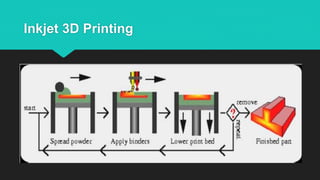
Inkjet 3D printing
 It creates the model one layer at a time by spreading a layer of powder (plaster, or resins) and
inkjet printing binder in the cross-section of the part. It is the most widely used 3-D Printing
technology these days and the reasons beyond that are stated below.
 This technology is the only one that allows for the printing of full color prototypes.
 No toxic chemicals like those used in stereo lithography are required.
 Minimal post printing finish work is needed; one needs only to use the printer itself to blow off
surrounding powder after the printing process.
 Allows overhangs and excess powder can be easily removed with an air blower.
Inkjet 3D Printing
Application of 3D Printing
Design Prototypes:
3-Dimensional Printing concept model, functional prototypes and
presentation models for evaluating and refining design, including Finite Element
Analysis (FEA) results and packaging.
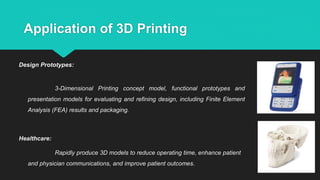
Healthcare:
Rapidly produce 3D models to reduce operating time, enhance patient
and physician communications, and improve patient outcomes.
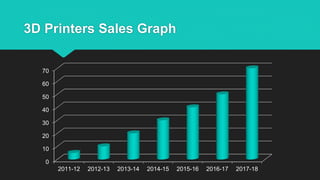
3D Printers Sales Graph
0
10
20
30
40
50
60
70
2011-12 2012-13 2013-14 2014-15 2015-16 2016-17 2017-18
Conclusion
Nothing communicates ideas faster than a three dimensional part or model.
With a 3D printer you can bring CAD files and design ideas to life – right from your
desktop. Test form, fit and function – and as many design variations as you like – with
functional parts.
THANK YOU

3D Printing

  • 1.
  • 2.
    Topics  What is3D Printing ?  Additive Process  General Principles  3D Printing Technology  Applications  Conclusions
  • 3.
    What is 3DPrinting?  The technology used for printing physical 3D objects from digital out is called 3D printing.  It was first developed by Charls Haul in 1984.  It is also called RAPID PROTOTYPES.  In 1993, MIT patented another technology, named "3 Dimensional Printing techniques", which is similar to the inkjet technology used in 2D Printers.
  • 4.
    Additive Manufacturing The termadditive manufacturing refers to technologies that create objects through a sequential layering process. Objects that are manufactured additively can be used anywhere throughout the product life cycle,
  • 5.
    General Principles Modeling: Additive manufacturingtakes virtual blueprints from computer aided design (CAD) or animation modeling software and "slices" them into digital cross-sections for the machine to successively use as a guideline for printing.
  • 6.
    General Principles Printing: To performa print, the machine reads the design and lays down successive layers of liquid, powder, or sheet material to build the model from a series of cross sections. These layers, which correspond to the virtual cross sections from the CAD model, are joined together or automatically fused to create the final shape. The primary advantage of this technique is its ability to create almost any shape or geometric feature.
  • 7.
    General Principles Finishing : Thoughthe printer-produced resolution is sufficient for many applications, printing a slightly oversized version of the desired object in standard resolution, and then removing material with a higher-resolution subtractive process can achieve a higher-resolution.
  • 8.
    3D Printing Technology Stereolithography Stereolithography is a process for creating threedimensional objects using a computer-controlled laser to build the required structure, layer by layer. It does this by using a resin known as liquid photopolymer that hardens when in contact with the air.
  • 9.
    3D Printing Technology Selective Laser Sintering (SLS) This builds objects by using a laser to selectively fuse together successive layers of a cocktail of powdered wax, ceramic, metal, nylon or one of a range of other materials.
  • 10.
    3D Printing Technology Multi-Jet Modeling (MJM) This again builds up objects from successive layers of powder, with an inkjet- like print head used to spray on a binder solution that glues only the required granules together. The V-Flash printer, manufactured by Canon, is low-cost 3D printer. It’s known to build layers with a light curable film. Unlike other printers, the VFlash builds its parts from the top down.
  • 11.
    3D Printing Technology Inkjet3D printing  It creates the model one layer at a time by spreading a layer of powder (plaster, or resins) and inkjet printing binder in the cross-section of the part. It is the most widely used 3-D Printing technology these days and the reasons beyond that are stated below.  This technology is the only one that allows for the printing of full color prototypes.  No toxic chemicals like those used in stereo lithography are required.  Minimal post printing finish work is needed; one needs only to use the printer itself to blow off surrounding powder after the printing process.  Allows overhangs and excess powder can be easily removed with an air blower.
  • 12.
  • 13.
    Application of 3DPrinting Design Prototypes: 3-Dimensional Printing concept model, functional prototypes and presentation models for evaluating and refining design, including Finite Element Analysis (FEA) results and packaging. Healthcare: Rapidly produce 3D models to reduce operating time, enhance patient and physician communications, and improve patient outcomes.
  • 14.
    3D Printers SalesGraph 0 10 20 30 40 50 60 70 2011-12 2012-13 2013-14 2014-15 2015-16 2016-17 2017-18
  • 15.
    Conclusion Nothing communicates ideasfaster than a three dimensional part or model. With a 3D printer you can bring CAD files and design ideas to life – right from your desktop. Test form, fit and function – and as many design variations as you like – with functional parts.
  • 16.