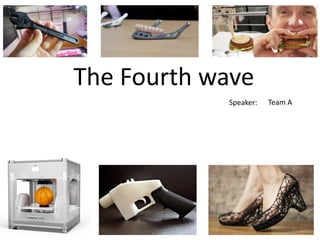
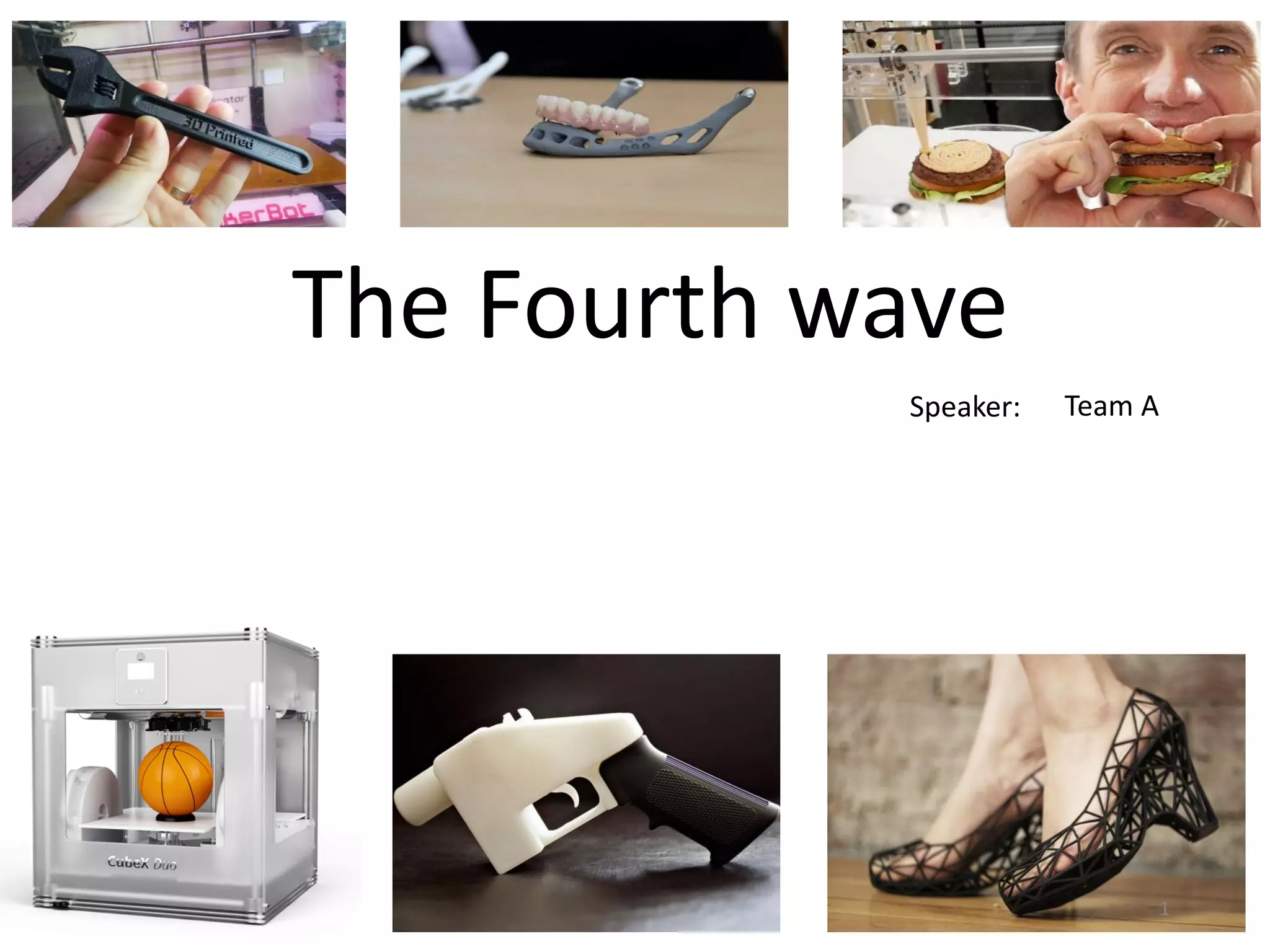
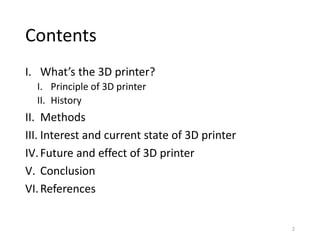
The Fourth wave
Team ASpeaker:
1
Contents
I. What’s the 3D printer?
I. Principle of 3D printer
II. History
II. Methods
III. Interest and current state of 3D printer
IV.Future and effect of 3D printer
V. Conclusion
VI.References
2
3D printer?
Make a three-dimensional structure by additive manufacturing(AM)
AM – a process of joining materials to make objects from three dimensional (3D)
model data, usually layer upon layer, as opposed to subtractive manufacturing
methodologies. [European Commission 2013]
3
History of 3D printer
1980s
1990s
2000s
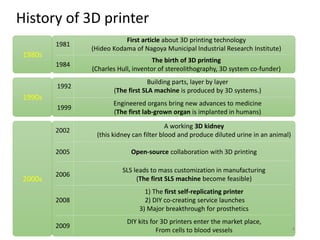
1981
First article about 3D printing technology
(Hideo Kodama of Nagoya Municipal Industrial Research Institute)
1984
The birth of 3D printing
(Charles Hull, inventor of stereolithography, 3D system co-funder)
1992
Building parts, layer by layer
(The first SLA machine is produced by 3D systems.)
1999
Engineered organs bring new advances to medicine
(The first lab-grown organ is implanted in humans)
2002
A working 3D kidney
(this kidney can filter blood and produce diluted urine in an animal)
2005 Open-source collaboration with 3D printing
2006
SLS leads to mass customization in manufacturing
(The first SLS machine become feasible)
2008
1) The first self-replicating printer
2) DIY co-creating service launches
3) Major breakthrough for prosthetics
2009
DIY kits for 3D printers enter the market place,
From cells to blood vessels 4
History of 3D printer
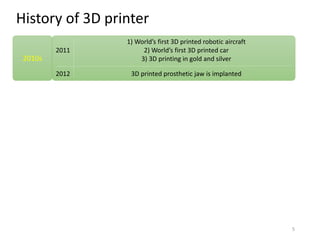
2010s
2011
1) World’s first 3D printed robotic aircraft
2) World’s first 3D printed car
3) 3D printing in gold and silver
2012 3D printed prosthetic jaw is implanted
5
How?
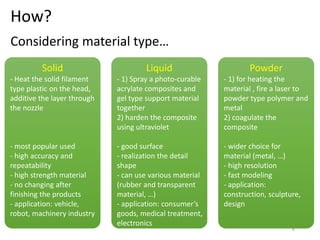
Solid
- Heat the solid filament
type plastic on the head,
additive the layer through
the nozzle
- most popular used
- high accuracy and
repeatability
- high strength material
- no changing after
finishing the products
- application: vehicle,
robot, machinery industry
Liquid
- 1) Spray a photo-curable
acrylate composites and
gel type support material
together
2) harden the composite
using ultraviolet
- good surface
- realization the detail
shape
- can use various material
(rubber and transparent
material, …)
- application: consumer’s
goods, medical treatment,
electronics
Powder
- 1) for heating the
material , fire a laser to
powder type polymer and
metal
2) coagulate the
composite
- wider choice for
material (metal, …)
- high resolution
- fast modeling
- application:
construction, sculpture,
design
Considering material type…
6
How?
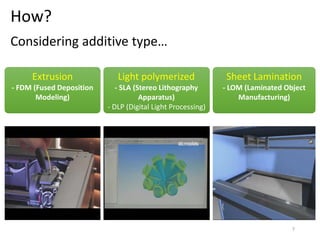
Extrusion
- FDM (Fused Deposition
Modeling)
Light polymerized
- SLA (Stereo Lithography
Apparatus)
- DLP (Digital Light Processing)
Considering additive type…
Sheet Lamination
- LOM (Laminated Object
Manufacturing)
7
How?
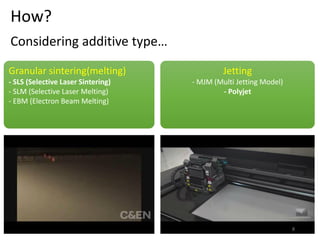
Jetting
- MJM (Multi Jetting Model)
- Polyjet
Granular sintering(melting)
- SLS (Selective Laser Sintering)
- SLM (Selective Laser Melting)
- EBM (Electron Beam Melting)
Considering additive type…
8
Interest and current state for 3D printer
The number of “3D printing” typed on google
Comparison of granted patents and published patents
applications by year
[Source: 3D printing A patent overview]
9
Industry size of 3D printer
Application of 3D printer
[Source: Wohlers report 2013]
Interest and current state for 3D printer
10
0
1
2
3
4
5
6
7
2011 2015 2019
1.7
3.7
6.5
WORLD MARKET
CAGR 18%
(billion dollar)
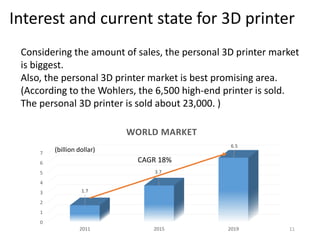
Considering the amount of sales, the personal 3D printer market
is biggest.
Also, the personal 3D printer market is best promising area.
(According to the Wohlers, the 6,500 high-end printer is sold.
The personal 3D printer is sold about 23,000. )
Interest and current state for 3D printer
11
Real story Polaris (concept model/ function test)
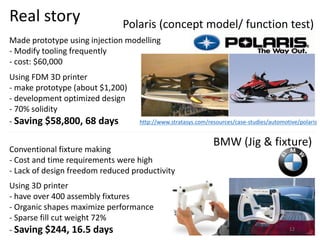
Made prototype using injection modelling
- Modify tooling frequently
- cost: $60,000
Using FDM 3D printer
- make prototype (about $1,200)
- development optimized design
- 70% solidity
- Saving $58,800, 68 days http://www.stratasys.com/resources/case-studies/automotive/polaris
BMW (Jig & fixture)
Conventional fixture making
- Cost and time requirements were high
- Lack of design freedom reduced productivity
Using 3D printer
- have over 400 assembly fixtures
- Organic shapes maximize performance
- Sparse fill cut weight 72%
- Saving $244, 16.5 days 12
Current applications
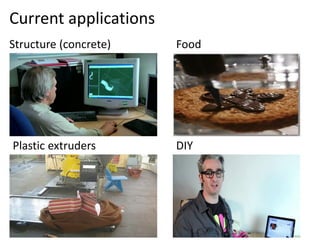
Structure (concrete) Food
Plastic extruders DIY
13
Current state and Interest for 3D printer
Growth promoting factor Obstacle of growth
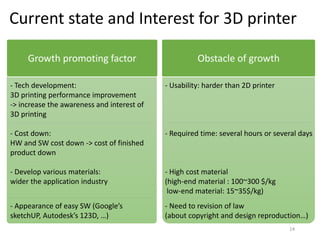
- Tech development:
3D printing performance improvement
-> increase the awareness and interest of
3D printing
- Cost down:
HW and SW cost down -> cost of finished
product down
- Develop various materials:
wider the application industry
- Appearance of easy SW (Google’s
sketchUP, Autodesk’s 123D, …)
- Usability: harder than 2D printer
- Required time: several hours or several days
- High cost material
(high-end material : 100~300 $/kg
low-end material: 15~35$/kg)
- Need to revision of law
(about copyright and design reproduction…)
14
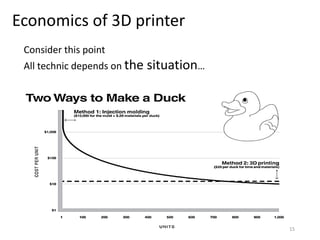
Economics of 3D printer
Consider this point
All technic depends on the situation…
15
Future of 3D printer
• Remove the obstacle points
reduce the required time, lower the price of material, revision the law, …
• Not mass product. Small production and
customized products
small quantity batch production
• Applied on prototype production
• New paradigm for bio-medical area
produce customized organs & cells
• Develop easy SW to use
16
Future of 3D printer’s application
• Nano scale
• Bio-medical
• Architecture
Using MEMS or micro-unit photon…
Make higher resolution products,
smooth surfaces
17
Future of 3D printer’s application
• Nano scale
• Bio-medical
• Architecture
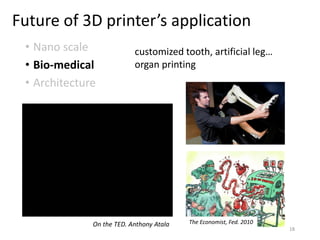
customized tooth, artificial leg…
organ printing
The Economist, Fed. 2010On the TED. Anthony Atala
18
Future of 3D printer’s application
• Nano scale
• Bio-medical
• Architecture
19
Effect of 3D printer
• Revolution of manufacture
customized production
• Easy making proto type
activate the venture company
• Reduce the time and money
example…
• Making kidney
• Need to project intellectual property rights strongly
revision the law
• Disappear job or market: optician, …
• Appear job or increasing market: 3D CAD design
market, 3D scanning, material market, …
20
Conclusion
3D printing will change the manufacture
(Download the 3D design, print and use.)
No more going to the store to buy items
Manufacture right in your own home
21
References
[1] IT Expo Busan, “Applications and development of 3D printer”, 2013
[2] Intellectural Property Office, “3D Printing A patent overview”, 2013
[3]Dave Bourell, “Additive manufacturing History, current applications and where
we are headed”, 2013 (ppt)
[4]Hartmut Stahl, “3D Printing-Risks and Opportunities”, 2013
[5]Stefania Marconi, “3D printing technology”, 2013 (ppt)
[6]Deloltte, “The effect of 3D printing”
[7]Cassidy Silbernagel, “3D printing: Everything you ever wanted to know and
more”, 2012 (ppt)
[8] “Review of global 3D printer industry”, 2013
22

3D printer introduction

  • 1.
  • 2.
    Contents I. What’s the3D printer? I. Principle of 3D printer II. History II. Methods III. Interest and current state of 3D printer IV.Future and effect of 3D printer V. Conclusion VI.References 2
  • 3.
    3D printer? Make athree-dimensional structure by additive manufacturing(AM) AM – a process of joining materials to make objects from three dimensional (3D) model data, usually layer upon layer, as opposed to subtractive manufacturing methodologies. [European Commission 2013] 3
  • 4.
    History of 3Dprinter 1980s 1990s 2000s 1981 First article about 3D printing technology (Hideo Kodama of Nagoya Municipal Industrial Research Institute) 1984 The birth of 3D printing (Charles Hull, inventor of stereolithography, 3D system co-funder) 1992 Building parts, layer by layer (The first SLA machine is produced by 3D systems.) 1999 Engineered organs bring new advances to medicine (The first lab-grown organ is implanted in humans) 2002 A working 3D kidney (this kidney can filter blood and produce diluted urine in an animal) 2005 Open-source collaboration with 3D printing 2006 SLS leads to mass customization in manufacturing (The first SLS machine become feasible) 2008 1) The first self-replicating printer 2) DIY co-creating service launches 3) Major breakthrough for prosthetics 2009 DIY kits for 3D printers enter the market place, From cells to blood vessels 4
  • 5.
    History of 3Dprinter 2010s 2011 1) World’s first 3D printed robotic aircraft 2) World’s first 3D printed car 3) 3D printing in gold and silver 2012 3D printed prosthetic jaw is implanted 5
  • 6.
    How? Solid - Heat thesolid filament type plastic on the head, additive the layer through the nozzle - most popular used - high accuracy and repeatability - high strength material - no changing after finishing the products - application: vehicle, robot, machinery industry Liquid - 1) Spray a photo-curable acrylate composites and gel type support material together 2) harden the composite using ultraviolet - good surface - realization the detail shape - can use various material (rubber and transparent material, …) - application: consumer’s goods, medical treatment, electronics Powder - 1) for heating the material , fire a laser to powder type polymer and metal 2) coagulate the composite - wider choice for material (metal, …) - high resolution - fast modeling - application: construction, sculpture, design Considering material type… 6
  • 7.
    How? Extrusion - FDM (FusedDeposition Modeling) Light polymerized - SLA (Stereo Lithography Apparatus) - DLP (Digital Light Processing) Considering additive type… Sheet Lamination - LOM (Laminated Object Manufacturing) 7
  • 8.
    How? Jetting - MJM (MultiJetting Model) - Polyjet Granular sintering(melting) - SLS (Selective Laser Sintering) - SLM (Selective Laser Melting) - EBM (Electron Beam Melting) Considering additive type… 8
  • 9.
    Interest and currentstate for 3D printer The number of “3D printing” typed on google Comparison of granted patents and published patents applications by year [Source: 3D printing A patent overview] 9
  • 10.
    Industry size of3D printer Application of 3D printer [Source: Wohlers report 2013] Interest and current state for 3D printer 10
  • 11.
    0 1 2 3 4 5 6 7 2011 2015 2019 1.7 3.7 6.5 WORLDMARKET CAGR 18% (billion dollar) Considering the amount of sales, the personal 3D printer market is biggest. Also, the personal 3D printer market is best promising area. (According to the Wohlers, the 6,500 high-end printer is sold. The personal 3D printer is sold about 23,000. ) Interest and current state for 3D printer 11
  • 12.
    Real story Polaris(concept model/ function test) Made prototype using injection modelling - Modify tooling frequently - cost: $60,000 Using FDM 3D printer - make prototype (about $1,200) - development optimized design - 70% solidity - Saving $58,800, 68 days http://www.stratasys.com/resources/case-studies/automotive/polaris BMW (Jig & fixture) Conventional fixture making - Cost and time requirements were high - Lack of design freedom reduced productivity Using 3D printer - have over 400 assembly fixtures - Organic shapes maximize performance - Sparse fill cut weight 72% - Saving $244, 16.5 days 12
  • 13.
    Current applications Structure (concrete)Food Plastic extruders DIY 13
  • 14.
    Current state andInterest for 3D printer Growth promoting factor Obstacle of growth - Tech development: 3D printing performance improvement -> increase the awareness and interest of 3D printing - Cost down: HW and SW cost down -> cost of finished product down - Develop various materials: wider the application industry - Appearance of easy SW (Google’s sketchUP, Autodesk’s 123D, …) - Usability: harder than 2D printer - Required time: several hours or several days - High cost material (high-end material : 100~300 $/kg low-end material: 15~35$/kg) - Need to revision of law (about copyright and design reproduction…) 14
  • 15.
    Economics of 3Dprinter Consider this point All technic depends on the situation… 15
  • 16.
    Future of 3Dprinter • Remove the obstacle points reduce the required time, lower the price of material, revision the law, … • Not mass product. Small production and customized products small quantity batch production • Applied on prototype production • New paradigm for bio-medical area produce customized organs & cells • Develop easy SW to use 16
  • 17.
    Future of 3Dprinter’s application • Nano scale • Bio-medical • Architecture Using MEMS or micro-unit photon… Make higher resolution products, smooth surfaces 17
  • 18.
    Future of 3Dprinter’s application • Nano scale • Bio-medical • Architecture customized tooth, artificial leg… organ printing The Economist, Fed. 2010On the TED. Anthony Atala 18
  • 19.
    Future of 3Dprinter’s application • Nano scale • Bio-medical • Architecture 19
  • 20.
    Effect of 3Dprinter • Revolution of manufacture customized production • Easy making proto type activate the venture company • Reduce the time and money example… • Making kidney • Need to project intellectual property rights strongly revision the law • Disappear job or market: optician, … • Appear job or increasing market: 3D CAD design market, 3D scanning, material market, … 20
  • 21.
    Conclusion 3D printing willchange the manufacture (Download the 3D design, print and use.) No more going to the store to buy items Manufacture right in your own home 21
  • 22.
    References [1] IT ExpoBusan, “Applications and development of 3D printer”, 2013 [2] Intellectural Property Office, “3D Printing A patent overview”, 2013 [3]Dave Bourell, “Additive manufacturing History, current applications and where we are headed”, 2013 (ppt) [4]Hartmut Stahl, “3D Printing-Risks and Opportunities”, 2013 [5]Stefania Marconi, “3D printing technology”, 2013 (ppt) [6]Deloltte, “The effect of 3D printing” [7]Cassidy Silbernagel, “3D printing: Everything you ever wanted to know and more”, 2012 (ppt) [8] “Review of global 3D printer industry”, 2013 22