SEMINAR
ON
3D OPTICAL DATA STORAGE
1
CONTENTS
 Introduction
 History
 Overview
 Processes for writing & reading data
 Media design
 Drive design
 Development issues
 Applications
 Pros and Cons
 Conclusion 2
INTRODUCTION
 3D optical data storage is the term given to any form
of optical data storage in which information can be
recorded and/or read with three dimensional
resolution
 This innovation has the potential to provide byte-level
mass storage on DVD-sized disks.
3
 No commercial product based on 3D optical data
storage has yet arrived on the mass market,
although several companies are actively
developing the technology and claim that it may
become available "soon".
Cont… 4
HISTORY
 Yehuda Hirshberg developed the photochromic
spyropyrans.
 Valeri Barachevskii demonstrated that this
photochromism could be produced by two
photon excitation.
 Peter.T.Rentzepis showed that this could lead to
three dimensional data storage. 5
OVERVIEW
6
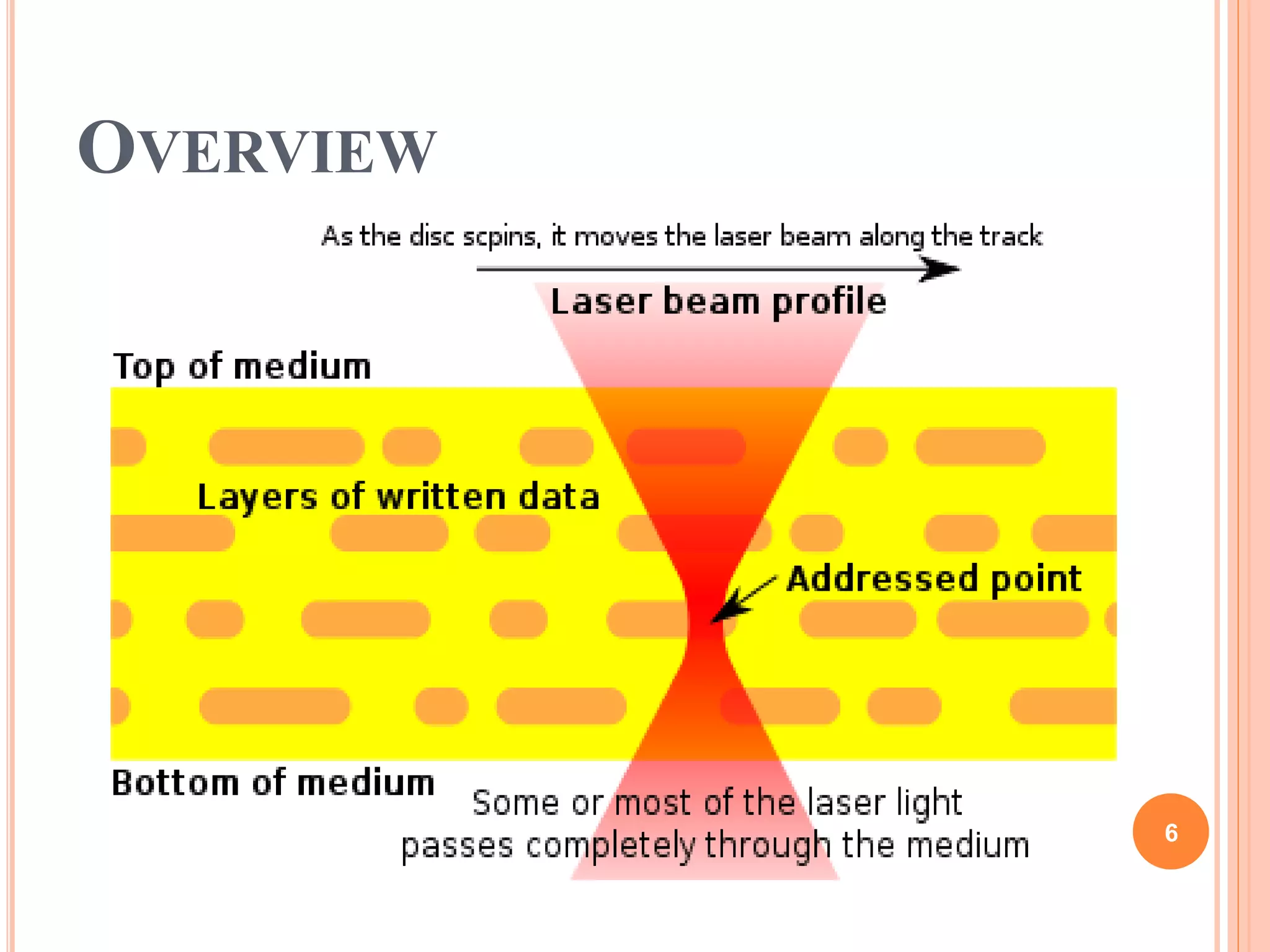
 Current optical data storage media, such as the
CD and DVD store data as a series of reflective
marks on an internal surface of a disc.
 In order to increase storage capacity, it is
possible for discs to hold two or even more of
these data layer.
Cont… 7
PROCESSES FOR CREATING
WRITTEN DATA
 Data recording in a 3D optical storage medium
requires that a change take place in the medium
upon excitation.
 If the photochemical change is reversible, then
rewritable data storage may be achieved.
 multilevel recording, where data is written in
‘grayscale’ rather than as ‘on’ and ‘off’ signals. 8
PROCESSES FOR READING
DATA
 Reading of data from 3D optical memories has
been carried out in many different ways.
 Measurement of small differences in the
refractive index between the two data states.
 Linear excitation of fluorescence - has some
potential problems because the addressing
light interacts with many other data points 9
MEDIA DESIGN
 The active part of 3D optical storage media is
usually an organic polymer either doped or
grafted with the photo chemically active species.
 This photo sensitivity is the main aspect in
reading data in some methods.
10
DRIVE DESIGN
 Care must be taken for the followings during
design
 Laser
 Variable spherical aberration correction
 Detection
 Optical system
11
DEVELOPMENT ISSUES
 Destructive reading
 Thermodynamic stability
 Media sensitivity
12
APPLICATIONS
 Consumer entertainment applications
 Personal computing
 Application software distribution
 Data storage and transport medium world wide
13
ADVANTAGES
 More than 100 layer of information in a single disc
 More data storage in less space
 We can store 100s of movies in a single disc
 Durability
 Transportability
14
DISADVANTAGES
 Reusable- The WORM characteristic of some optical
media makes it excellent for archiving, but it also
prevents you from being able to use that media again.
 Writing time- The server uses software compression
to write compressed data to your optical media.
15
CONCLUSION
 3D optical data storage is the form of optical data
storage which is really a good alternative for the data
storage required in now-a-days life which is having a
lot of data to store. As it can store about 217 DVD’s in
a single disc.
16
17
ANY
QUERIES??
THANK
YOU
18

3D Optical Data Storage

  • 1.
  • 2.
    CONTENTS  Introduction  History Overview  Processes for writing & reading data  Media design  Drive design  Development issues  Applications  Pros and Cons  Conclusion 2
  • 3.
    INTRODUCTION  3D opticaldata storage is the term given to any form of optical data storage in which information can be recorded and/or read with three dimensional resolution  This innovation has the potential to provide byte-level mass storage on DVD-sized disks. 3
  • 4.
     No commercialproduct based on 3D optical data storage has yet arrived on the mass market, although several companies are actively developing the technology and claim that it may become available "soon". Cont… 4
  • 5.
    HISTORY  Yehuda Hirshbergdeveloped the photochromic spyropyrans.  Valeri Barachevskii demonstrated that this photochromism could be produced by two photon excitation.  Peter.T.Rentzepis showed that this could lead to three dimensional data storage. 5
  • 6.
  • 7.
     Current opticaldata storage media, such as the CD and DVD store data as a series of reflective marks on an internal surface of a disc.  In order to increase storage capacity, it is possible for discs to hold two or even more of these data layer. Cont… 7
  • 8.
    PROCESSES FOR CREATING WRITTENDATA  Data recording in a 3D optical storage medium requires that a change take place in the medium upon excitation.  If the photochemical change is reversible, then rewritable data storage may be achieved.  multilevel recording, where data is written in ‘grayscale’ rather than as ‘on’ and ‘off’ signals. 8
  • 9.
    PROCESSES FOR READING DATA Reading of data from 3D optical memories has been carried out in many different ways.  Measurement of small differences in the refractive index between the two data states.  Linear excitation of fluorescence - has some potential problems because the addressing light interacts with many other data points 9
  • 10.
    MEDIA DESIGN  Theactive part of 3D optical storage media is usually an organic polymer either doped or grafted with the photo chemically active species.  This photo sensitivity is the main aspect in reading data in some methods. 10
  • 11.
    DRIVE DESIGN  Caremust be taken for the followings during design  Laser  Variable spherical aberration correction  Detection  Optical system 11
  • 12.
    DEVELOPMENT ISSUES  Destructivereading  Thermodynamic stability  Media sensitivity 12
  • 13.
    APPLICATIONS  Consumer entertainmentapplications  Personal computing  Application software distribution  Data storage and transport medium world wide 13
  • 14.
    ADVANTAGES  More than100 layer of information in a single disc  More data storage in less space  We can store 100s of movies in a single disc  Durability  Transportability 14
  • 15.
    DISADVANTAGES  Reusable- TheWORM characteristic of some optical media makes it excellent for archiving, but it also prevents you from being able to use that media again.  Writing time- The server uses software compression to write compressed data to your optical media. 15
  • 16.
    CONCLUSION  3D opticaldata storage is the form of optical data storage which is really a good alternative for the data storage required in now-a-days life which is having a lot of data to store. As it can store about 217 DVD’s in a single disc. 16
  • 17.
  • 18.