HOLOGRAPHIC
DATA STORAGE
Contents
■ What is data storage?
■ What is Holography?
■ Holography Data Storage
■ Working of HDS
■ Construction and Reconstruction of Holography
■ Reasons for developing HDS
■ Comparison of Storage Discs
■ HolographicVersatile Disc
■ Technology Comparison
■ Data transfer rate
■ Applications of Holographic data Storage
■ Advantages of HDS
■ Drawback of HDS
What is Data Storage?
■ Data storage, is a technology consisting of computer components and recording media
used to retain digital data.
■ A modern digital computer represents data using the binary numeral system. The most
common unit of storage is the byte, equal to 8 bits.
■ For example, the complete works of Shakespeare, about 1250 pages in print, can be
stored in about five megabytes (40 million bits) with one byte per character.
What is Holography?
■ Holography is a technique that enables a light field, which is generally the product of a
light source scattered off objects, to be recorded and later reconstructed when the
original light field is no longer present, due to the absence of the original objects.
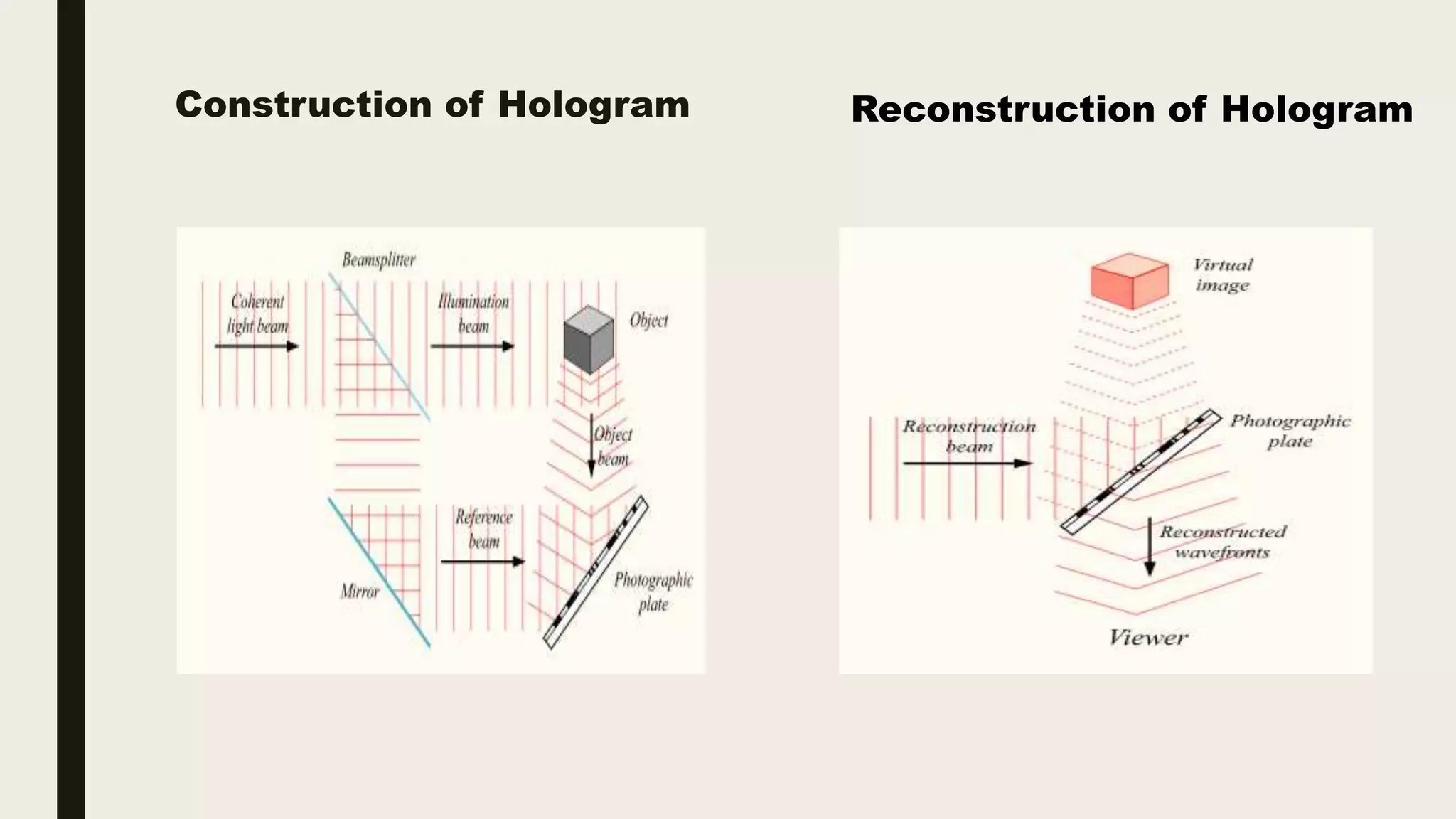
■ The overall process requires :-
– Coherent Light Beam
– BeamSplitter
– Mirror
– Photographic Plate
Holographic Data Storage - HDS
■ Holographic data storage is a high information storage volume technology that empowers
information storage by making holographic pictures of every data instance on a bolstered
medium.
■ It depends on the comparable idea of optical storage gadgets however it empowers the
utilization of a single storage volume to store a lot of information. It is also known
as Three-Dimensional (3-D) Storage.
■ Holographic media is split into write-once (irreversible change), and rewritable media
(change is reversible). Rewritable holographic storage can be accomplished through the
photorefractive impact in crystals.
This memory framework comprises of the accompanying: a blue-green argon laser, beam
splitters, reflectors, an LCD board, lenses, lithium-niobite crystal, and a charge-coupled
device camera.
Holographic Data Storage - HDS
■ Holographic data storage is a potential technology in the area of high-capacity
data storage in the form of multiple images in the same area utilizing light at
different angles recording bits in parallel.
■ Holographic data storage contains information using an optical interference
pattern within a thick, photosensitive optical material
■ The stored data is read through the reproduction of the same reference beam
used to create the hologram.
Working of HDS:
■ The blue-green argon laser would be discharged, and with the assistance of the beam
splitter, the laser shaft would be part into two beams known as the signal beam, which
moves straight ahead, and the reference beam, which is coordinated through the side
of the beam splitter.
■ The signal beam would rebound off of a mirror, and travel through the LCD display to
the lithium-niobite crystal
■ The reference beam would approach the crystal from an alternate way.
At the point when the two beams meet, the information (conveyed by the signal
beam) would be put away in a hologram
Construction of Hologram Reconstruction of Hologram
Working of HDS(contd.):
■ Spatial Light Modulator (SLM): A spatial light
modulator is used for creating binary information out of laser
light. The SLM is a 2D plane, consisting of pixels which can
be turned on and off to create binary 1.s and 0.s.
■ Writing : The light is split in two by the beam splitter. The
signal or object beam will bounce off a mirror and passes
through a SLM.
The reference beam, on the other hand, takes another
course towards the crystal and upon hitting it along with the
object beam, creates an interference pattern that will be used
to store the information relayed by the object beam in a
certain location in the crystal.
Working of HDS(contd.):
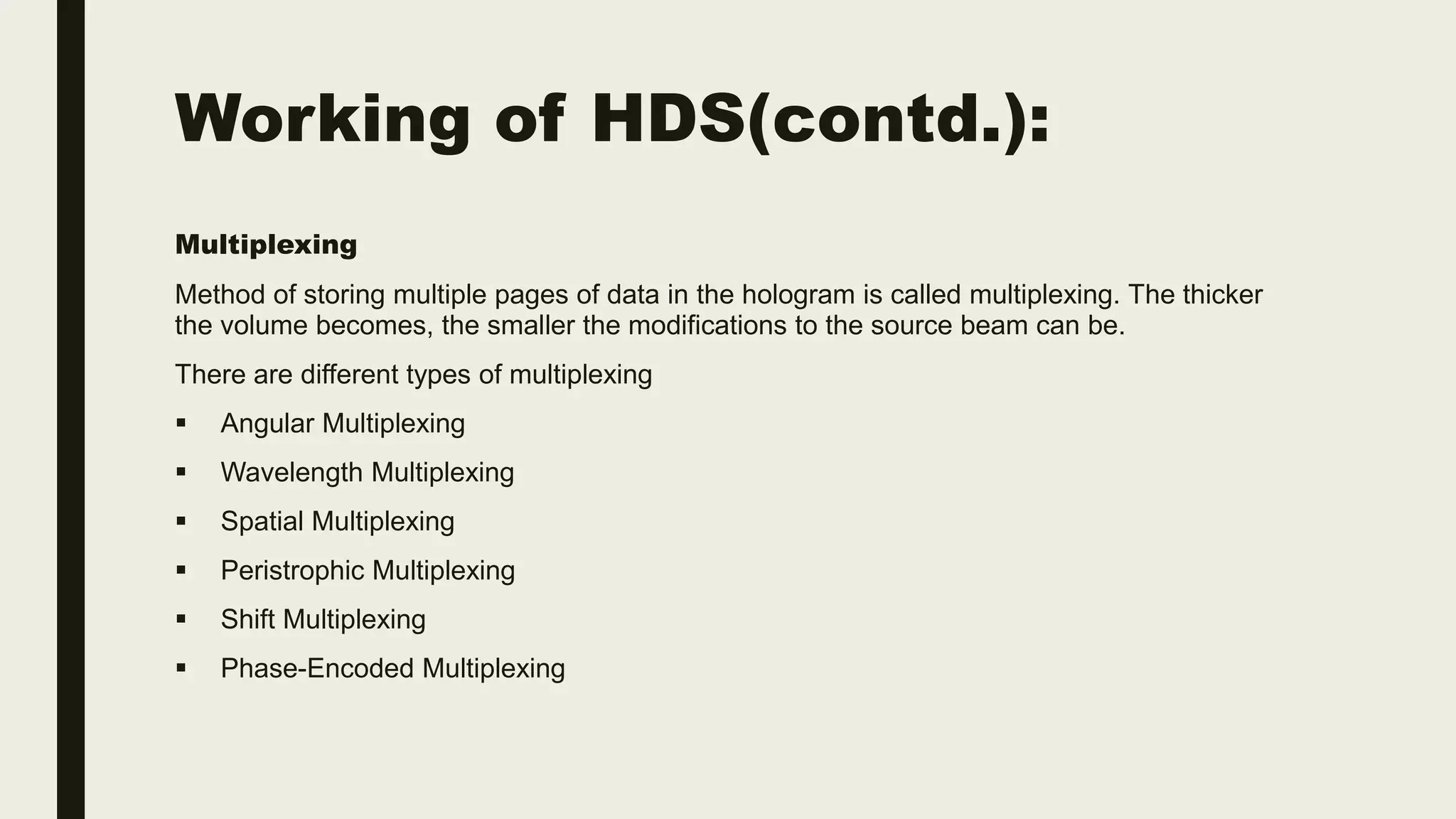
Multiplexing
Method of storing multiple pages of data in the hologram is called multiplexing. The thicker
the volume becomes, the smaller the modifications to the source beam can be.
There are different types of multiplexing
 Angular Multiplexing
 Wavelength Multiplexing
 Spatial Multiplexing
 Peristrophic Multiplexing
 Shift Multiplexing
 Phase-Encoded Multiplexing
Reasons for developing HDS
■ Replacement as a backup media
– Higher data density than tape and current Hard Drives
– Data is stable for an estimated 50 years without regarding
– Faster read and write speeds
 Replacement for DVD
o Higher data density than Blu-Ray
o Faster read and write speeds
o Higher ceiling for max data storage capability
o Increasing resolutions for TVs will require more storage for movies and games
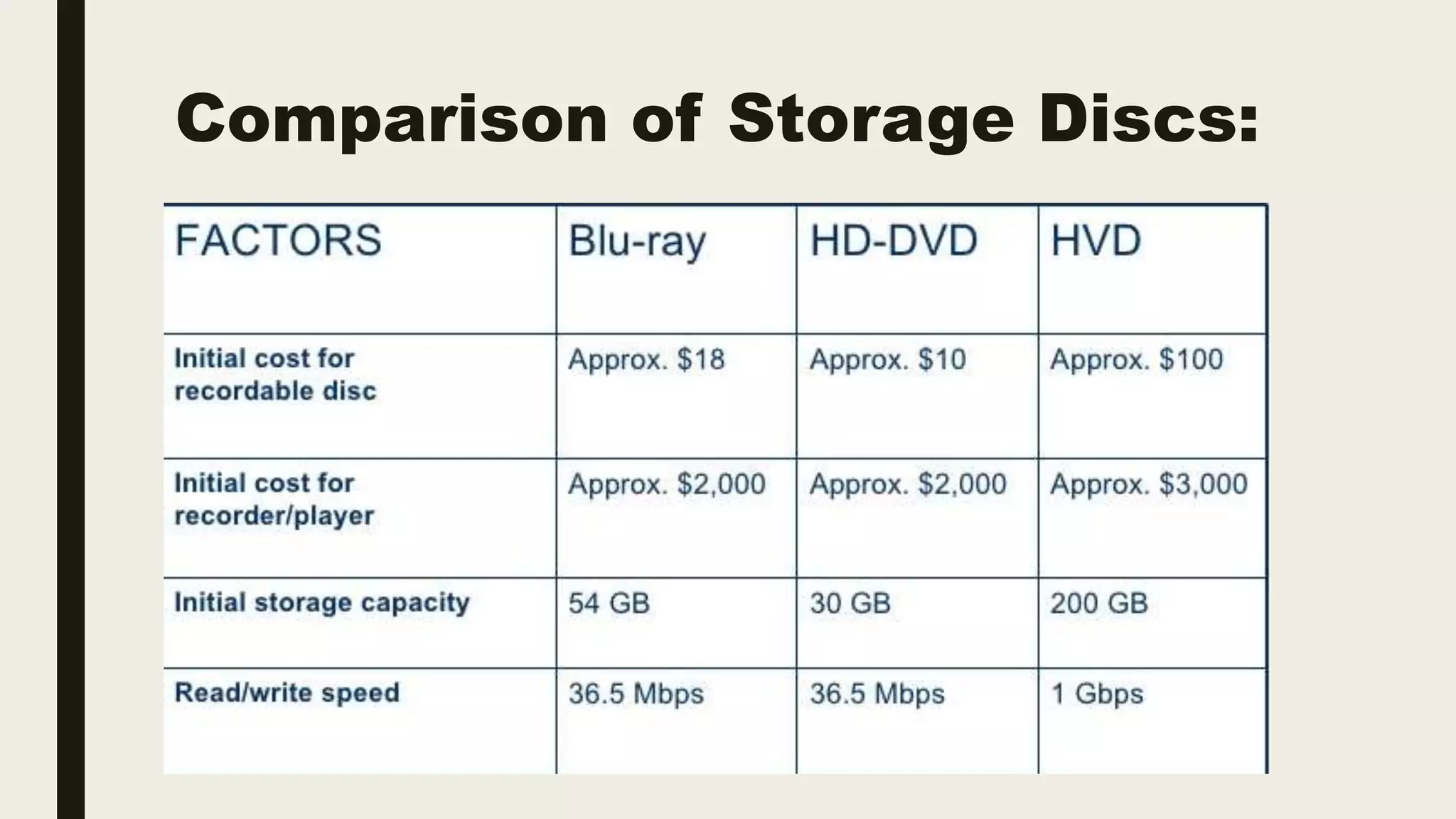
Comparison of Storage Discs:
Holographic Versatile Disc
■ Holographic memory systems have been around for decades.
■ Holographic versatile disc (HVD) is a holographic storage format that looks like a DVD
but is capable of storing far more data. Prototype HVD devices have been created with a
capacity of 3.9 terabytes (TB) and a transfer rate of 1 gigabit per second (1 Gbps). At that
capacity, an HVD could store as much information as 830 DVDs or 160 Blu-Ray discs.
■ An optical disc technology developed between April 2004 and mid-2008 that can store up
to several terabytes of data on an optical disc 10 cm or 12 cm in diameter. The reduced
radius reduces cost and materials used. It employs a technique known as
collinear holography, whereby a green and red laser beam are collimted in a single
beam.
Technology Comparison
Data Transfer Rate
Applications of Holographic
Data Storage: –
1. Data Mining : Data mining is the way toward finding patterns in a lot of information. Data
mining is utilized extraordinarily in enormous databases which hold potential patterns which
can’t be recognized by human eyes because of the huge measure of information. Some
present PC frameworks execute data mining, however, the mass measure of capacity
required is pushing the limits of the current data storage system. The numerous advances in
access times and data storage capacity that holographic memory gives could surpass
conventional storage and accelerate data mining considerably. This would result in
increasingly found patterns in a shorter measure of time.
2. Petaflop Computing : A Petaflop is a thousand trillion gliding operations per second. The
quick access in the exceptionally big amount of information given by holographic memory
frameworks could be used in petaflop architecture. Plainly advances are required in more
than memory systems, however, the hypothetical schematics do exist for such a machine.
Optical capacity, for example, holographic memory gives a feasible answer for the
outrageous measure of information which is required for petaflop computing.
Applications of Holographic Data
Storage (Contd.) : –
3. Holographic memory can be utilized as expanded DRAM with 10ns access time, Hard disk
drives, CD ROMs of huge storage volume and rock mounted of petabytes storage volume.
Advantages of Holographic
Storage:
■ Holographic memory offers a storage volume of around 1 TB. Speed of recovery of
information in tens of microseconds contrasted with a data access time of practically 10ms
offered by the quickest hard disk today. When they are accessible, they can move a whole
movie picture in 30 seconds.
■ Data pursuit is additionally quicker in holographic memory. In holographic capacity whole
pages can be recovered where contents of at least two pages can be contrasted optically
without having to recover the data contained in them. Likewise, HDSS has no moving parts.
So, the constraints of mechanical movement, for example, erosion can be evacuated.
■ Protection from damage – If a few pieces of the medium are damaged, all data can still be
acquired from other parts. All data can be recovered from any piece of the medium.
■ Three dimensional data storage will be able to store more information in a smaller
space and offer faster data transfer times.
■ Unlike other technologies that record one data bit at a time, holography records and
reads more than a million bits of data with a single flash of light.
■ This enables significantly higher transfer rates than current optical storage devices
■ High storage densities and fast transfer rates, combined with durable, reliable, low-
cost medial, mean that holography is poised to become a compelling choice for next-
generation storage.
Drawbacks of HDS
■ Not a guaranteed market leader:
If another technology becomes the industry standard then equipment will be hard to find
■ Expensive development:
■ Existing technology is becoming better and cheaper
■ It is difficult to market a product that is more expensive per GB of storage
References
■ https://electronics.howstuffworks.com/hvd1.htm
■ https://www.techradar.com/news/computing-components/storage/whatever-
happened-to-holographic-storage-1099304
■ https://en.m.wikipedia.org/wiki/Holographic_Versatile_Disc
■ https://searchstorage.techtarget.com/definition/HVD
■ https://www.sciencedirect.com/science/article/pii/S2314717214000245
Thank You

Holographic Data Storage

  • 1.
  • 2.
    Contents ■ What isdata storage? ■ What is Holography? ■ Holography Data Storage ■ Working of HDS ■ Construction and Reconstruction of Holography ■ Reasons for developing HDS ■ Comparison of Storage Discs ■ HolographicVersatile Disc ■ Technology Comparison ■ Data transfer rate ■ Applications of Holographic data Storage ■ Advantages of HDS ■ Drawback of HDS
  • 3.
    What is DataStorage? ■ Data storage, is a technology consisting of computer components and recording media used to retain digital data. ■ A modern digital computer represents data using the binary numeral system. The most common unit of storage is the byte, equal to 8 bits. ■ For example, the complete works of Shakespeare, about 1250 pages in print, can be stored in about five megabytes (40 million bits) with one byte per character.
  • 4.
    What is Holography? ■Holography is a technique that enables a light field, which is generally the product of a light source scattered off objects, to be recorded and later reconstructed when the original light field is no longer present, due to the absence of the original objects. ■ The overall process requires :- – Coherent Light Beam – BeamSplitter – Mirror – Photographic Plate
  • 5.
    Holographic Data Storage- HDS ■ Holographic data storage is a high information storage volume technology that empowers information storage by making holographic pictures of every data instance on a bolstered medium. ■ It depends on the comparable idea of optical storage gadgets however it empowers the utilization of a single storage volume to store a lot of information. It is also known as Three-Dimensional (3-D) Storage. ■ Holographic media is split into write-once (irreversible change), and rewritable media (change is reversible). Rewritable holographic storage can be accomplished through the photorefractive impact in crystals. This memory framework comprises of the accompanying: a blue-green argon laser, beam splitters, reflectors, an LCD board, lenses, lithium-niobite crystal, and a charge-coupled device camera.
  • 6.
    Holographic Data Storage- HDS ■ Holographic data storage is a potential technology in the area of high-capacity data storage in the form of multiple images in the same area utilizing light at different angles recording bits in parallel. ■ Holographic data storage contains information using an optical interference pattern within a thick, photosensitive optical material ■ The stored data is read through the reproduction of the same reference beam used to create the hologram.
  • 7.
    Working of HDS: ■The blue-green argon laser would be discharged, and with the assistance of the beam splitter, the laser shaft would be part into two beams known as the signal beam, which moves straight ahead, and the reference beam, which is coordinated through the side of the beam splitter. ■ The signal beam would rebound off of a mirror, and travel through the LCD display to the lithium-niobite crystal ■ The reference beam would approach the crystal from an alternate way. At the point when the two beams meet, the information (conveyed by the signal beam) would be put away in a hologram
  • 8.
    Construction of HologramReconstruction of Hologram
  • 9.
    Working of HDS(contd.): ■Spatial Light Modulator (SLM): A spatial light modulator is used for creating binary information out of laser light. The SLM is a 2D plane, consisting of pixels which can be turned on and off to create binary 1.s and 0.s. ■ Writing : The light is split in two by the beam splitter. The signal or object beam will bounce off a mirror and passes through a SLM. The reference beam, on the other hand, takes another course towards the crystal and upon hitting it along with the object beam, creates an interference pattern that will be used to store the information relayed by the object beam in a certain location in the crystal.
  • 10.
    Working of HDS(contd.): Multiplexing Methodof storing multiple pages of data in the hologram is called multiplexing. The thicker the volume becomes, the smaller the modifications to the source beam can be. There are different types of multiplexing  Angular Multiplexing  Wavelength Multiplexing  Spatial Multiplexing  Peristrophic Multiplexing  Shift Multiplexing  Phase-Encoded Multiplexing
  • 11.
    Reasons for developingHDS ■ Replacement as a backup media – Higher data density than tape and current Hard Drives – Data is stable for an estimated 50 years without regarding – Faster read and write speeds  Replacement for DVD o Higher data density than Blu-Ray o Faster read and write speeds o Higher ceiling for max data storage capability o Increasing resolutions for TVs will require more storage for movies and games
  • 12.
  • 13.
    Holographic Versatile Disc ■Holographic memory systems have been around for decades. ■ Holographic versatile disc (HVD) is a holographic storage format that looks like a DVD but is capable of storing far more data. Prototype HVD devices have been created with a capacity of 3.9 terabytes (TB) and a transfer rate of 1 gigabit per second (1 Gbps). At that capacity, an HVD could store as much information as 830 DVDs or 160 Blu-Ray discs. ■ An optical disc technology developed between April 2004 and mid-2008 that can store up to several terabytes of data on an optical disc 10 cm or 12 cm in diameter. The reduced radius reduces cost and materials used. It employs a technique known as collinear holography, whereby a green and red laser beam are collimted in a single beam.
  • 14.
  • 15.
  • 16.
    Applications of Holographic DataStorage: – 1. Data Mining : Data mining is the way toward finding patterns in a lot of information. Data mining is utilized extraordinarily in enormous databases which hold potential patterns which can’t be recognized by human eyes because of the huge measure of information. Some present PC frameworks execute data mining, however, the mass measure of capacity required is pushing the limits of the current data storage system. The numerous advances in access times and data storage capacity that holographic memory gives could surpass conventional storage and accelerate data mining considerably. This would result in increasingly found patterns in a shorter measure of time. 2. Petaflop Computing : A Petaflop is a thousand trillion gliding operations per second. The quick access in the exceptionally big amount of information given by holographic memory frameworks could be used in petaflop architecture. Plainly advances are required in more than memory systems, however, the hypothetical schematics do exist for such a machine. Optical capacity, for example, holographic memory gives a feasible answer for the outrageous measure of information which is required for petaflop computing.
  • 17.
    Applications of HolographicData Storage (Contd.) : – 3. Holographic memory can be utilized as expanded DRAM with 10ns access time, Hard disk drives, CD ROMs of huge storage volume and rock mounted of petabytes storage volume.
  • 18.
    Advantages of Holographic Storage: ■Holographic memory offers a storage volume of around 1 TB. Speed of recovery of information in tens of microseconds contrasted with a data access time of practically 10ms offered by the quickest hard disk today. When they are accessible, they can move a whole movie picture in 30 seconds. ■ Data pursuit is additionally quicker in holographic memory. In holographic capacity whole pages can be recovered where contents of at least two pages can be contrasted optically without having to recover the data contained in them. Likewise, HDSS has no moving parts. So, the constraints of mechanical movement, for example, erosion can be evacuated. ■ Protection from damage – If a few pieces of the medium are damaged, all data can still be acquired from other parts. All data can be recovered from any piece of the medium.
  • 19.
    ■ Three dimensionaldata storage will be able to store more information in a smaller space and offer faster data transfer times. ■ Unlike other technologies that record one data bit at a time, holography records and reads more than a million bits of data with a single flash of light. ■ This enables significantly higher transfer rates than current optical storage devices ■ High storage densities and fast transfer rates, combined with durable, reliable, low- cost medial, mean that holography is poised to become a compelling choice for next- generation storage.
  • 20.
    Drawbacks of HDS ■Not a guaranteed market leader: If another technology becomes the industry standard then equipment will be hard to find ■ Expensive development: ■ Existing technology is becoming better and cheaper ■ It is difficult to market a product that is more expensive per GB of storage
  • 21.
    References ■ https://electronics.howstuffworks.com/hvd1.htm ■ https://www.techradar.com/news/computing-components/storage/whatever- happened-to-holographic-storage-1099304 ■https://en.m.wikipedia.org/wiki/Holographic_Versatile_Disc ■ https://searchstorage.techtarget.com/definition/HVD ■ https://www.sciencedirect.com/science/article/pii/S2314717214000245
  • 22.