M. Abhinaya
19841A0582
CSE-4B
 Introduction
 Media and Drive Design
 Basic Components
 Processes for creating written data and for reading data
 Media Form Factor
 3D photonic crystals optical-memory systems
 Commercial Development
 Applications
 Advantages
 Conclusion
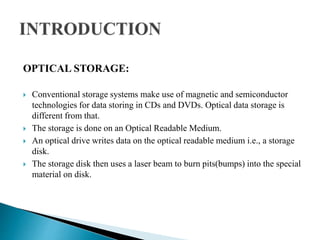
OPTICAL STORAGE:
 Conventional storage systems make use of magnetic and semiconductor
technologies for data storing in CDs and DVDs. Optical data storage is
different from that.
 The storage is done on an Optical Readable Medium.
 An optical drive writes data on the optical readable medium i.e., a storage
disk.
 The storage disk then uses a laser beam to burn pits(bumps) into the special
material on disk.
 This data stream is placed in a Spiral path, in this case the data begins at
the innermost track and works its way towards the edge of the disk.
 An optical drive is a device in a computer that can read CD-ROMs or other
optical disks.
 It is estimated that in the year 2007, optical storage represents 27% of the
world's technological capacity to store information.
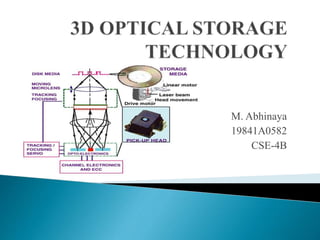
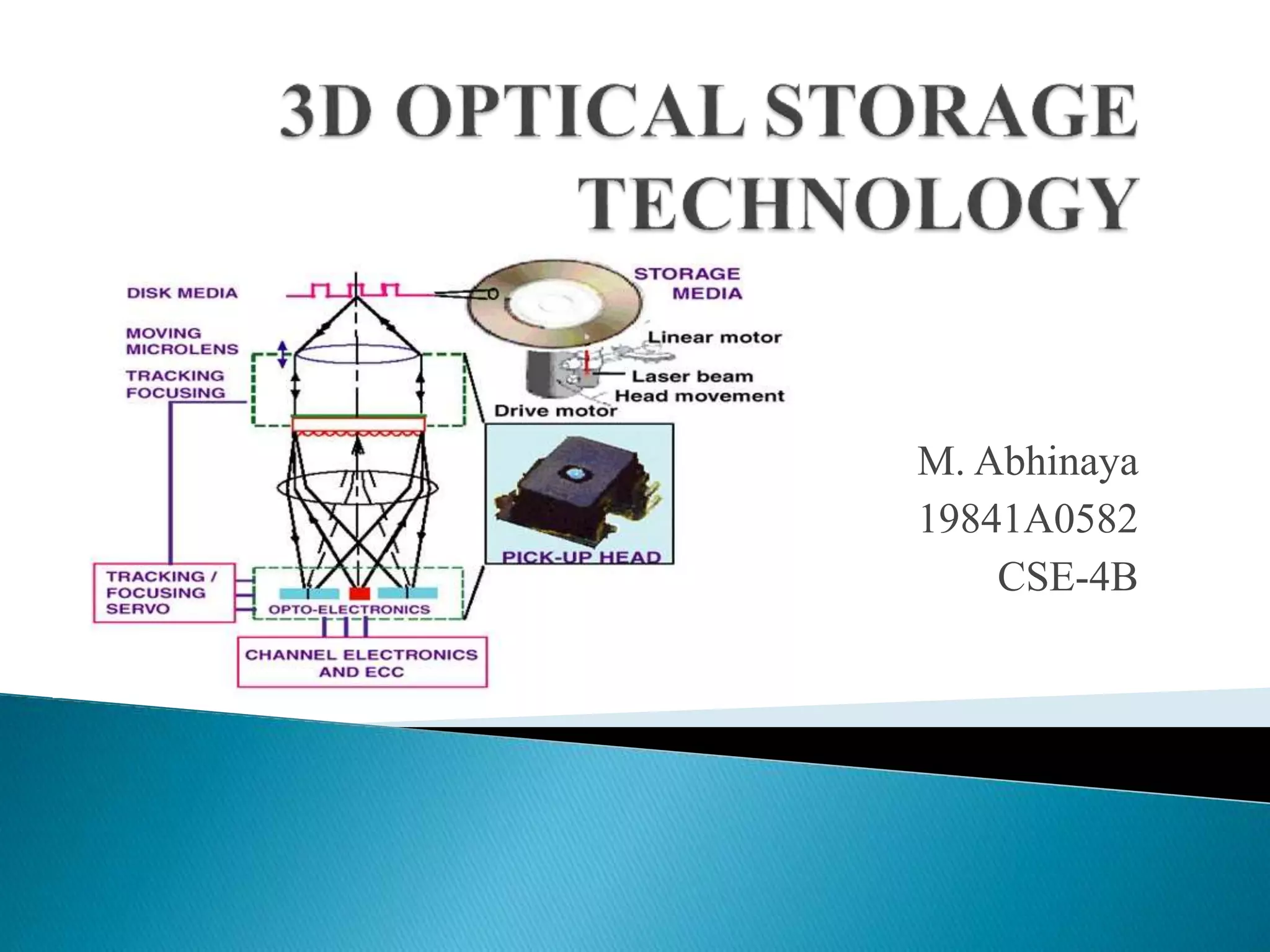
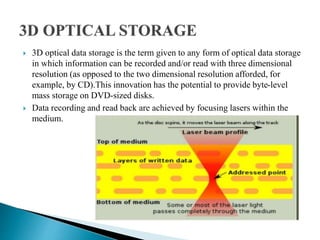
 3D optical data storage is the term given to any form of optical data storage
in which information can be recorded and/or read with three dimensional
resolution (as opposed to the two dimensional resolution afforded, for
example, by CD).This innovation has the potential to provide byte-level
mass storage on DVD-sized disks.
 Data recording and read back are achieved by focusing lasers within the
medium.
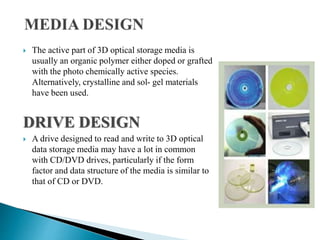
 The active part of 3D optical storage media is
usually an organic polymer either doped or grafted
with the photo chemically active species.
Alternatively, crystalline and sol- gel materials
have been used.
DRIVE DESIGN
 A drive designed to read and write to 3D optical
data storage media may have a lot in common
with CD/DVD drives, particularly if the form
factor and data structure of the media is similar to
that of CD or DVD.
 Optical data storage system requires certain important materials for its data
storage and retrieval processes. The important components required for the
optical data storage are:
 Laser
 Lens and Mirrors
 Spatial Light Modulators (SLM)
 Photosensitive materials
 Charge Coupled Devices (CCD)
 Phase masks for encryption
PROCESSES FOR CREATING WRITTEN DATA
 Data recording in a 3D optical storage medium requires that a change take
place in the medium upon excitation. If the photochemical change is
reversible, then rewritable data storage may be achieved.
PROCESSES FOR READING DATA
 Reading of data from 3D optical memories has been carried out in many
different ways.
- Measurement of small differences in the refractive index between the
two data states.
- Linear excitation of fluorescence - has some potential problems because
the addressing light interacts with many other data points.
 Media for 3D optical data storage have been suggested in several form
factors:
 Disc: A disc media offers a progression from CD/DVD, and allows
reading and writing to be carried out by the familiar spinning disc method.
 Card: A credit card form factor media is attractive from the point of
view of portability and convenience, but would be of a lower capacity than
a disc.
 Crystal, Cube or Sphere: Several science fiction writers have
suggested small solids that store massive amounts of information, and at
least in principle this could be achieved with 3D optical data storage.
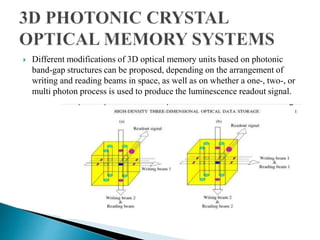
 Different modifications of 3D optical memory units based on photonic
band-gap structures can be proposed, depending on the arrangement of
writing and reading beams in space, as well as on whether a one-, two-, or
multi photon process is used to produce the luminescence readout signal.
 Despite the highly attractive nature of 3D optical data storage, the
development of commercial products has taken a significant length of time.
This results from limited financial backing in the field, as well as technical
issues, including:
 Destructive reading
 Thermodynamic stability
 Media sensitivity
Wide chance of storing data in a less space such as
 DVD
 Servers
 Databases
 Social networking
and so on as we need to save the data…………
 Durability: With proper care, optical media can last a long time,
depending on what kind of optical media you choose.
 Great for archeiving: Several forms of optical media are write-once read-
many, which means that when data is written to them, they cannot be
reused.
 Transportability: Optical media are widely used on other platforms,
including the PC. For example, data written on a DVD-RAM can be read
on a PC or any other system with an optical device and the same file
system.
 Random access: Optical media provide the capability to pinpoint a
particular piece of data stored on it, independent of the other data on the
volume or the order in which that data was stored on the volume
 3D optical data storage is the form of optical data storage which is really a
good alternative for the data storage required in now-a-days life which is
having a lot of data to store, as it can store about 217 DVD’s in a single
disc.
 Its potential applications for storing and archiving of data that was
previously erased for economic reasons holographic disks.
 Ultra HD Sony and other big companies are interested in this technology.
 http://en.wikipedia.org/wiki/3D_optical_data_storage
 http://www.riken.jp/lab-
www/library/publication/review/pdf/No_49/49_052.pdf
 Hunter, S., Kiamilev, F., Esener, S., et al., 1990, Appl. Opt., 29, 2058.
 Parthenopoulos, D.A and Rentzepis, P.M., 1989, Science, 245, 643.
 Dvornikov, A.S., Cokgor, I., McCormick, F.B., et al., 1996, Opt. Commun.,
128, 205.
3D OPTICAL STORAGE TECHNOLOGY technical seminar 4B.pptx

3D OPTICAL STORAGE TECHNOLOGY technical seminar 4B.pptx

  • 1.
  • 2.
     Introduction  Mediaand Drive Design  Basic Components  Processes for creating written data and for reading data  Media Form Factor  3D photonic crystals optical-memory systems  Commercial Development  Applications  Advantages  Conclusion
  • 3.
    OPTICAL STORAGE:  Conventionalstorage systems make use of magnetic and semiconductor technologies for data storing in CDs and DVDs. Optical data storage is different from that.  The storage is done on an Optical Readable Medium.  An optical drive writes data on the optical readable medium i.e., a storage disk.  The storage disk then uses a laser beam to burn pits(bumps) into the special material on disk.
  • 4.
     This datastream is placed in a Spiral path, in this case the data begins at the innermost track and works its way towards the edge of the disk.  An optical drive is a device in a computer that can read CD-ROMs or other optical disks.  It is estimated that in the year 2007, optical storage represents 27% of the world's technological capacity to store information.
  • 5.
     3D opticaldata storage is the term given to any form of optical data storage in which information can be recorded and/or read with three dimensional resolution (as opposed to the two dimensional resolution afforded, for example, by CD).This innovation has the potential to provide byte-level mass storage on DVD-sized disks.  Data recording and read back are achieved by focusing lasers within the medium.
  • 6.
     The activepart of 3D optical storage media is usually an organic polymer either doped or grafted with the photo chemically active species. Alternatively, crystalline and sol- gel materials have been used. DRIVE DESIGN  A drive designed to read and write to 3D optical data storage media may have a lot in common with CD/DVD drives, particularly if the form factor and data structure of the media is similar to that of CD or DVD.
  • 7.
     Optical datastorage system requires certain important materials for its data storage and retrieval processes. The important components required for the optical data storage are:  Laser  Lens and Mirrors  Spatial Light Modulators (SLM)  Photosensitive materials  Charge Coupled Devices (CCD)  Phase masks for encryption
  • 8.
    PROCESSES FOR CREATINGWRITTEN DATA  Data recording in a 3D optical storage medium requires that a change take place in the medium upon excitation. If the photochemical change is reversible, then rewritable data storage may be achieved. PROCESSES FOR READING DATA  Reading of data from 3D optical memories has been carried out in many different ways. - Measurement of small differences in the refractive index between the two data states. - Linear excitation of fluorescence - has some potential problems because the addressing light interacts with many other data points.
  • 9.
     Media for3D optical data storage have been suggested in several form factors:  Disc: A disc media offers a progression from CD/DVD, and allows reading and writing to be carried out by the familiar spinning disc method.  Card: A credit card form factor media is attractive from the point of view of portability and convenience, but would be of a lower capacity than a disc.  Crystal, Cube or Sphere: Several science fiction writers have suggested small solids that store massive amounts of information, and at least in principle this could be achieved with 3D optical data storage.
  • 10.
     Different modificationsof 3D optical memory units based on photonic band-gap structures can be proposed, depending on the arrangement of writing and reading beams in space, as well as on whether a one-, two-, or multi photon process is used to produce the luminescence readout signal.
  • 11.
     Despite thehighly attractive nature of 3D optical data storage, the development of commercial products has taken a significant length of time. This results from limited financial backing in the field, as well as technical issues, including:  Destructive reading  Thermodynamic stability  Media sensitivity
  • 12.
    Wide chance ofstoring data in a less space such as  DVD  Servers  Databases  Social networking and so on as we need to save the data…………
  • 13.
     Durability: Withproper care, optical media can last a long time, depending on what kind of optical media you choose.  Great for archeiving: Several forms of optical media are write-once read- many, which means that when data is written to them, they cannot be reused.  Transportability: Optical media are widely used on other platforms, including the PC. For example, data written on a DVD-RAM can be read on a PC or any other system with an optical device and the same file system.  Random access: Optical media provide the capability to pinpoint a particular piece of data stored on it, independent of the other data on the volume or the order in which that data was stored on the volume
  • 14.
     3D opticaldata storage is the form of optical data storage which is really a good alternative for the data storage required in now-a-days life which is having a lot of data to store, as it can store about 217 DVD’s in a single disc.  Its potential applications for storing and archiving of data that was previously erased for economic reasons holographic disks.  Ultra HD Sony and other big companies are interested in this technology.
  • 15.
     http://en.wikipedia.org/wiki/3D_optical_data_storage  http://www.riken.jp/lab- www/library/publication/review/pdf/No_49/49_052.pdf Hunter, S., Kiamilev, F., Esener, S., et al., 1990, Appl. Opt., 29, 2058.  Parthenopoulos, D.A and Rentzepis, P.M., 1989, Science, 245, 643.  Dvornikov, A.S., Cokgor, I., McCormick, F.B., et al., 1996, Opt. Commun., 128, 205.