 HISTORY
 DEFINATION
 DESIGN
 MERITS
 DEMERITS
 USES
 FUTURE & CHALLENGES
 CONCLUSION
The first recorded historical use of an optical disc was in 1884
when Alexander Graham Bell, Chichester Bell and Charles
Sumner Tainter recorded sound on a glass disc using a beam
of light.
An early optical disc system existed in 1935. An early analog
optical disc used for video recording was invented by David
Paul Gregg in 1958 and patented in the US in 1961 and 1969.
American inventor James T. Russell has been credited with
inventing the first system to record a digital signal on an
optical transparent foil which is lit from behind by a high-
power halogen lamp. Russell's patent application was first
filed in 1966 and he was granted a patent in 1970.
However, the technology didn't appear in the marketplace
until Philips and Sony came out with the compact disc (CD) in
1982. Since then, there has been a constant succession of
optical disc formats, first in CD formats, followed by a
number of DVD formats.
An optical disc is an electronic data storage medium that
can be written to and read using a low-
powered laser beam. Originally developed in the late
1960s, the first optical disc, created by James T. Russell,
stored data as micron-wide dots of light and dark. A laser
read the dots, and the data was converted to an electrical
signal, and finally to audio or visual output.
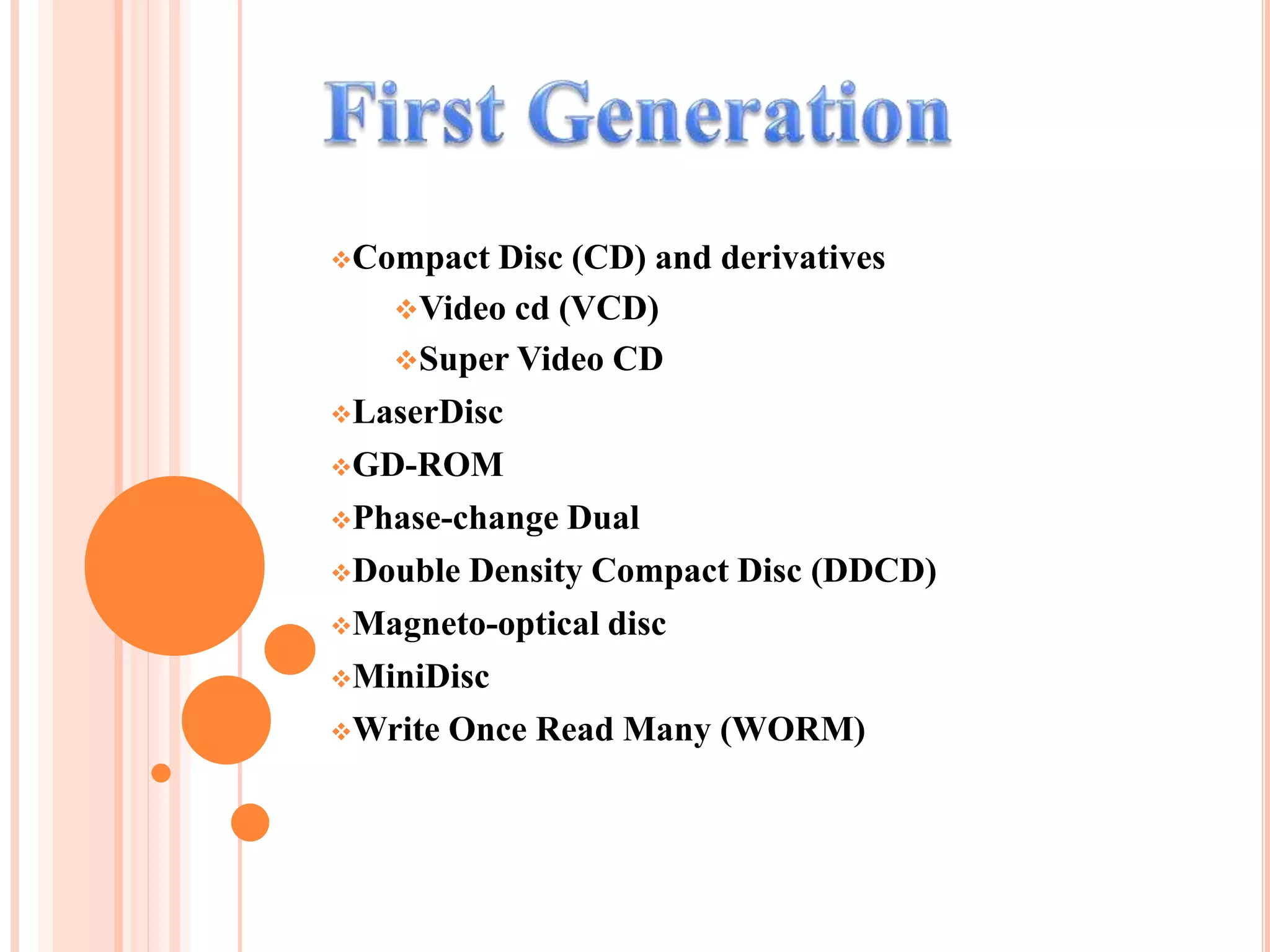
Compact Disc (CD) and derivatives
Video cd (VCD)
Super Video CD
LaserDisc
GD-ROM
Phase-change Dual
Double Density Compact Disc (DDCD)
Magneto-optical disc
MiniDisc
Write Once Read Many (WORM)
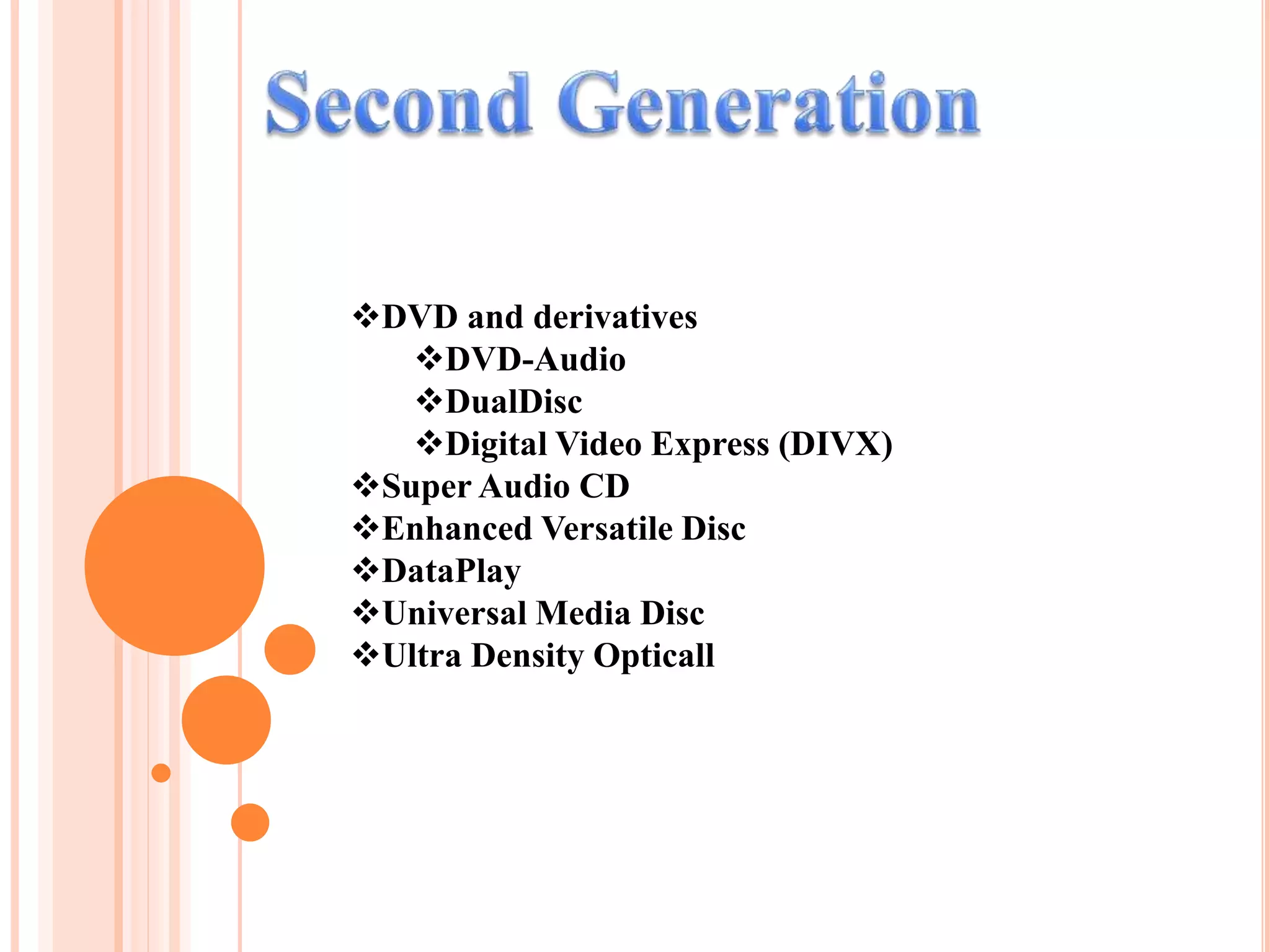
DVD and derivatives
DVD-Audio
DualDisc
Digital Video Express (DIVX)
Super Audio CD
Enhanced Versatile Disc
DataPlay
Universal Media Disc
Ultra Density Opticall
With the increased demands in performance, the optical
disk drive needs to be high speed and more stable. A novel
design of a vibration absorber used in reducing the
vibration caused by the imbalance of an optical disk drive
is proposed. When an optical disk is rotating, the
vibration caused by the imbalance resulting from the non-
homogeneous disk increases as the rotating speed
increases. The proposed vibration absorber with a
circular shape is installed beneath the optical disk. It
rotates with the disk; therefore its natural frequency
varies with the rotating speed due to the change of in-
plane stress caused by the centrifugal force.
The objective is to use shape optimization technique to
make the first radial natural frequency of the absorber
coincide with the rotating speed of the optical disk in a
specific frequency range. Under this circumstance, the
natural frequency of the absorber becomes speed-
dependent and the absorber will keep resonant in this
specific frequency range. It can effectively suppress the
vibration in the radial direction caused by the imbalance
of the optical disk and acts as an auto-balancer. Results
from experiments and numerical simulations using finite
element method both show that the imbalance of the
optical disk can be reduced effectively
They are non- volatile which means that the memory can
be retained even when the power is turned off.
Durability -With proper care, optical media can last a long
time, depending on what kind of optical media you choose.
Transportability -Optical media are widely used on other
platforms, including the PC. For example, data written on a
DVD-RAM can be read on a PC or any other system with an
optical device and the same file system.
Random access -Optical media provide the capability to
pinpoint a particular piece of data stored on it, independent of
the other data on the volume or the order in which that data was
stored on the volume.
WORM discs are permanent
Optical discs require special drives to read/write.
Optical storage does not provide enough data storage in
comparison to other storage technologies
Optical storage is expensive per GB/TB in comparison to
other technologies including disruptive formats that offer
convenience over cost.
Optical storage rewritable formats suffer from compatibility
issues between drives.
Consumer based formats like CD-R and DVD-R, BD-R do
not have a formal method of grading quality of discs. There
are no standards for longevity tests.
Optical discs are most commonly used for storing music (e.g.
for use in a CD player), video (e.g. for use in a Blu-ray
player), or data and programs for personal computers (PC).
The Optical Storage Technology Association (OSTA)
promotes standardized optical storage formats.
Recently technology demonstrated, according to optical
storage technology expert, a new commercial optical
storage technology using UV light would probably have
to be in the 200 nm range and would provide storage
capacities of over 100 GB in a single layer. However
there are lots of commercial issues with a UV optical disc
besides creating inexpensive devices to generate this
wavelength of light.
One of the biggest issues with working with UV is that
UV is generally destructive of most plastics, so making
stable long term storage could be an issue.
So why are people working on creating such a large
capacity optical disc technology?
The answer is distribution of higher definition content.
Optical disc

Optical disc

  • 2.
     HISTORY  DEFINATION DESIGN  MERITS  DEMERITS  USES  FUTURE & CHALLENGES  CONCLUSION
  • 3.
    The first recordedhistorical use of an optical disc was in 1884 when Alexander Graham Bell, Chichester Bell and Charles Sumner Tainter recorded sound on a glass disc using a beam of light. An early optical disc system existed in 1935. An early analog optical disc used for video recording was invented by David Paul Gregg in 1958 and patented in the US in 1961 and 1969. American inventor James T. Russell has been credited with inventing the first system to record a digital signal on an optical transparent foil which is lit from behind by a high- power halogen lamp. Russell's patent application was first filed in 1966 and he was granted a patent in 1970. However, the technology didn't appear in the marketplace until Philips and Sony came out with the compact disc (CD) in 1982. Since then, there has been a constant succession of optical disc formats, first in CD formats, followed by a number of DVD formats.
  • 4.
    An optical discis an electronic data storage medium that can be written to and read using a low- powered laser beam. Originally developed in the late 1960s, the first optical disc, created by James T. Russell, stored data as micron-wide dots of light and dark. A laser read the dots, and the data was converted to an electrical signal, and finally to audio or visual output.
  • 5.
    Compact Disc (CD)and derivatives Video cd (VCD) Super Video CD LaserDisc GD-ROM Phase-change Dual Double Density Compact Disc (DDCD) Magneto-optical disc MiniDisc Write Once Read Many (WORM)
  • 6.
    DVD and derivatives DVD-Audio DualDisc DigitalVideo Express (DIVX) Super Audio CD Enhanced Versatile Disc DataPlay Universal Media Disc Ultra Density Opticall
  • 7.
    With the increaseddemands in performance, the optical disk drive needs to be high speed and more stable. A novel design of a vibration absorber used in reducing the vibration caused by the imbalance of an optical disk drive is proposed. When an optical disk is rotating, the vibration caused by the imbalance resulting from the non- homogeneous disk increases as the rotating speed increases. The proposed vibration absorber with a circular shape is installed beneath the optical disk. It rotates with the disk; therefore its natural frequency varies with the rotating speed due to the change of in- plane stress caused by the centrifugal force.
  • 8.
    The objective isto use shape optimization technique to make the first radial natural frequency of the absorber coincide with the rotating speed of the optical disk in a specific frequency range. Under this circumstance, the natural frequency of the absorber becomes speed- dependent and the absorber will keep resonant in this specific frequency range. It can effectively suppress the vibration in the radial direction caused by the imbalance of the optical disk and acts as an auto-balancer. Results from experiments and numerical simulations using finite element method both show that the imbalance of the optical disk can be reduced effectively
  • 9.
    They are non-volatile which means that the memory can be retained even when the power is turned off. Durability -With proper care, optical media can last a long time, depending on what kind of optical media you choose. Transportability -Optical media are widely used on other platforms, including the PC. For example, data written on a DVD-RAM can be read on a PC or any other system with an optical device and the same file system. Random access -Optical media provide the capability to pinpoint a particular piece of data stored on it, independent of the other data on the volume or the order in which that data was stored on the volume.
  • 10.
    WORM discs arepermanent Optical discs require special drives to read/write. Optical storage does not provide enough data storage in comparison to other storage technologies Optical storage is expensive per GB/TB in comparison to other technologies including disruptive formats that offer convenience over cost. Optical storage rewritable formats suffer from compatibility issues between drives. Consumer based formats like CD-R and DVD-R, BD-R do not have a formal method of grading quality of discs. There are no standards for longevity tests.
  • 11.
    Optical discs aremost commonly used for storing music (e.g. for use in a CD player), video (e.g. for use in a Blu-ray player), or data and programs for personal computers (PC). The Optical Storage Technology Association (OSTA) promotes standardized optical storage formats.
  • 12.
    Recently technology demonstrated,according to optical storage technology expert, a new commercial optical storage technology using UV light would probably have to be in the 200 nm range and would provide storage capacities of over 100 GB in a single layer. However there are lots of commercial issues with a UV optical disc besides creating inexpensive devices to generate this wavelength of light. One of the biggest issues with working with UV is that UV is generally destructive of most plastics, so making stable long term storage could be an issue. So why are people working on creating such a large capacity optical disc technology? The answer is distribution of higher definition content.