CONTENTS
› Introduction
› Overview
›Media design
› Media form factor
› Media manufacturing
› Commercial development
› Basic components
› Processes for written & reading data
› Advantages AND disadvantages
› Conclusion
› References
3.
INTRODUCTION
› 3D opticaldata storage is the term given to any form of optical
data storage in which information can be recorded and/or read
with three dimensional resolution (as opposed to the two
dimensional resolution afforded, for example, by CD).
› This innovation has the potential to provide byte-level mass
storage on DVD-sized disks. Data recording and read back are
achieved by focusing lasers within the medium.
› No commercial product based on 3D optical data storage has yet
arrived on the mass market, although several companies are
actively developing the technology and claim that it may become
available "soon".
4.
OVERVIEW
• Current opticaldata
storage media, such as
the CD and DVD store
data as a series of
reflective marks on an
internal surface of a disc.
• In order to increase
storage capacity, it is
possible for discs to hold
two or even more of these
data layers, but their
number is severely limited
since the addressing laser
interacts with every layer
that it passes through on
the way to and from the
addressed layer.
5.
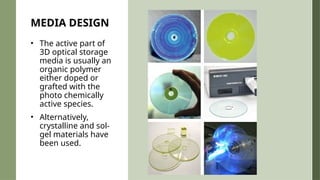
MEDIA DESIGN
• Theactive part of
3D optical storage
media is usually an
organic polymer
either doped or
grafted with the
photo chemically
active species.
• Alternatively,
crystalline and sol-
gel materials have
been used.
6.
MEDIA FORM FACTOR
Mediafor 3D optical data storage have been suggested in several form
factors:
› Disc: A disc media offers a progression from CD/DVD, and allows
reading and writing to be carried out by the familiar spinning disc
method.
› Card: A credit card form factor media is attractive from the point of
view of portability and convenience, but would be of a lower capacity
than a disc.
› Crystal, Cube or Sphere: Several science fiction writers have
suggested small solids that store massive amounts of information,
and at least in principle this could be achieved with 3D optical data
storage.
7.
MEDIA MANUFACTURING
› Thesimplest method of manufacturing - the molding of a disk in one
piece is a possibility for some systems.
› A more complex method of media manufacturing is for the media to be
constructed layer by layer.
› This is required if the data is to be physically created during
manufacture. However, layer-by-layer construction need not mean the
sandwiching of many layers together.
8.
DRIVE DESIGN
A drivedesigned to read and write to 3D optical data storage media
may have a lot in common with CD/DVD drives, particularly if the form
factor and data structure of the media is similar to that of CD or DVD.
However, there are a number of notable differences that must be
taken into account when designing such a drive, including:
Laser
Variable spherical aberration correction
Optical system
Detection
Data tracking
9.
COMMERCIAL DEVLOPMENT
› Inaddition to the academic research, several companies
have been set up to commercialize 3D optical data storage
and some large corporations have also shown an interest in
the technology.
› However, it is not yet clear whether the technology will
succeed in the market in the presence of competition from
other quarters such as hard drives, flash storage, and
holographic storage.
10.
BASIC COMPONENTS
Optical datastorage system requires certain important materials
for its data storage and retrieval processes. The important
components required for the optical data storage are:
› Laser
› Lens and Mirrors
› Spatial Light Modulators (SLM)
› Photosensitive materials
› Charge Coupled Devices (CCD)
11.
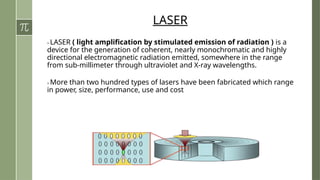
LASER
> LASER (light amplification by stimulated emission of radiation ) is a
device for the generation of coherent, nearly monochromatic and highly
directional electromagnetic radiation emitted, somewhere in the range
from sub-millimeter through ultraviolet and X-ray wavelengths.
> More than two hundred types of lasers have been fabricated which range
in power, size, performance, use and cost.
12.
LENS AND MIRROR
›Mirrors are used to reflect laser beams to the desired direction.
Lenses are usually used to converge the laser to a point.
> A special type of lens is used in the case of optical recording
called the Fourier lens.
> The lens has the property of obtaining the Fourier transform and
the inverse transform system is described below:
lens as a Fourier transform system
13.
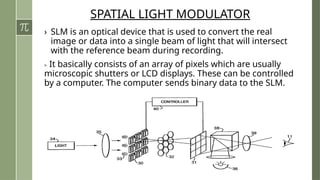
SPATIAL LIGHT MODULATOR
›SLM is an optical device that is used to convert the real
image or data into a single beam of light that will intersect
with the reference beam during recording.
> It basically consists of an array of pixels which are usually
microscopic shutters or LCD displays. These can be controlled
by a computer. The computer sends binary data to the SLM.
PHOTO REFRACTIVE CRYSTAL
›The two main classes of materials used for the
holographic storage medium are photo refractive crystals
and photo polymers.
› The recording medium usually used is a photo refractive
crystal such as Lithium niobate (LiNbO3) or Barium
Titanate (BaTiO3) that has certain optical characteristics.
› These characteristics include high efficiency, high
resolution, permanent and fast storage.
› Photo refractive crystals are suitable for random access
memory with periodic refreshing of data, and can be
erased and written to many times.
16.
PHOTO POLYMER
> Photopolymer are also used as holographic data
storage medium in this technique
>Typically the thickness of the photopolymers is much
less than the thickness of photo refractive crystals
because the photopolymers are limited by mechanical
stability and optical quality.
> photopolymers are suited for read only memory (ROM).
17.
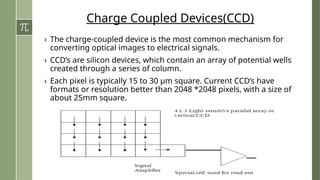
Charge Coupled Devices(CCD)
›The charge-coupled device is the most common mechanism for
converting optical images to electrical signals.
› CCD’s are silicon devices, which contain an array of potential wells
created through a series of column.
› Each pixel is typically 15 to 30 μm square. Current CCD’s have
formats or resolution better than 2048 *2048 pixels, with a size of
about 25mm square.
18.
PROCESSES FOR CREATINGWRITTEN DATA &
READING DATA
› Data recording in a 3D optical storage medium
requires that a change take place in the medium
upon excitation.
› Generally a photochemical reaction.
› If the photochemical change is reversible, then
rewritable data storage may be achieved, at least
in principle
› Instead of causing a photochemical change in
the media the laser causes fluorescence.
› This is achieved e.g. by using a lower laser power
or a different laser wavelength.
› The intensity or wavelength of the fluorescence
is different depending on whether the media has
been written at that point, and so by measuring
the emitted light the data is read
19.
ADVANTAGES
› Durability. Withproper care, optical media can last a long time,
depending on what kind of optical media you choose.
› Great for archiving. Several forms of optical media are write-once
read-many, which means that when data is written to them, they
cannot be reused. This is excellent for archiving because data is
preserved permanently with no possibility of being overwritten.
› Transportability. Optical media are widely used on other platforms,
including the PC. For example, data written on a DVD-RAM can be
read on a PC or any other system with an optical device and the same
file system.
› Random access. Optical media provide the capability to pinpoint a
particular piece of data stored on it, independent of the other data on
the volume or the order in which that data was stored on the volume
20.
DISADVANTAGES
› Reusable. Thewrite-once read-many (WORM)
characteristic of some optical media makes it excellent for
archiving, but it also prevents you from being able to use
that media again.
› Writing time. The server uses software compression to
write compressed data to your optical media. This process
takes considerable processing unit resources and may
increase the time needed to write and restore that data.
21.
CONCLUSION
. 3D opticaldata storage or holographic data storage are
now in state of prototyping and research.
Ultra HD sony and other big companies are interested in
this technology.
This analysis shows that a light field in such a structure
can be localized in a sub wavelength-size area,
suggesting a new way of arranging three-dimensional
optical-memory devices.