SEMINAR
ON
CLUSTER COMPUTING
Presented By:
B. Shobha Rani
IV Sem ,MCA.
1
Contents
 Introduction
 Definition
 How does it works?
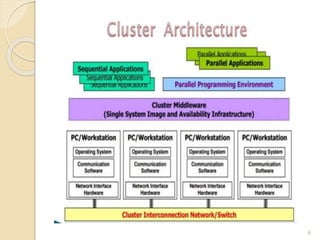
 Cluster Architecture
 Types of Clusters
 Cluster Components
 Pros and Cons
 Limitations
 Conclusion
2
Introduction
 Cluster is a widely used term meaning
independent computers combined into a
unified system through software and
networking
 A cluster computing is a single logical
unit consisting of multiple computers that
are linked through a LAN. The networked
computers essentially act as a single,
much more powerful machine.
3
Definition
A computer cluster is a set of loosely or
tightly connected computers that work
together so that, in many aspects, they can
be viewed as a single system. Unlike grid
computers, computer clusters have each
node set to perform the same task,
controlled and scheduled by software.
4
HOW DOES IT WORKS?
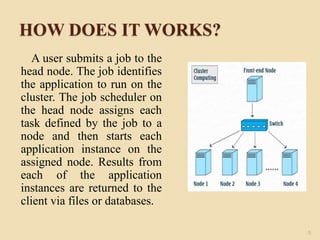
A user submits a job to the
head node. The job identifies
the application to run on the
cluster. The job scheduler on
the head node assigns each
task defined by the job to a
node and then starts each
application instance on the
assigned node. Results from
each of the application
instances are returned to the
client via files or databases.
5
6
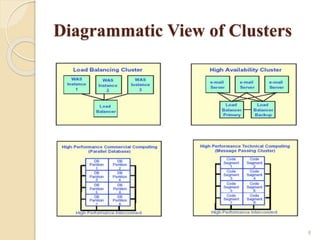
Types of Cluster Computing
 Load-balancing clusters
 High availability (HA) clusters
 High performance (HP) clusters
i) Parallel model
ii) Technical model
7
Diagrammatic View of Clusters
8
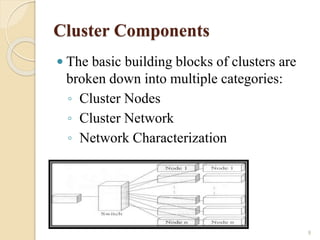
Cluster Components
 The basic building blocks of clusters are
broken down into multiple categories:
◦ Cluster Nodes
◦ Cluster Network
◦ Network Characterization
9
Advantages
 Reduced cost
 Processing power/Performance
 Improved Network Technology
 Scalability
 Availability
10
Disadvantages
 Good knowledge of parallel programming
is required
 Hardware needs to be adjusted to the
specific application (network topology)
 More complex administration
11
Limitations
 Typically latency is very high and
bandwidth relatively low.
 Currently there is very little software
support for treating a cluster as a single
system.
 Problems exist in the interactions between
mixed application workloads on a single
time-shared computer
12
Conclusion
Cluster Computing has become a major
part of many research programs because the
price to performance ratio of commodity
clusters is very good. Also, because the
nodes in a cluster are clones, there is no
single point of failure, which enhances the
reliability to the cluster.
13
Thank you
14
Any Queries?
15

Cluster Computing

  • 1.
  • 2.
    Contents  Introduction  Definition How does it works?  Cluster Architecture  Types of Clusters  Cluster Components  Pros and Cons  Limitations  Conclusion 2
  • 3.
    Introduction  Cluster isa widely used term meaning independent computers combined into a unified system through software and networking  A cluster computing is a single logical unit consisting of multiple computers that are linked through a LAN. The networked computers essentially act as a single, much more powerful machine. 3
  • 4.
    Definition A computer clusteris a set of loosely or tightly connected computers that work together so that, in many aspects, they can be viewed as a single system. Unlike grid computers, computer clusters have each node set to perform the same task, controlled and scheduled by software. 4
  • 5.
    HOW DOES ITWORKS? A user submits a job to the head node. The job identifies the application to run on the cluster. The job scheduler on the head node assigns each task defined by the job to a node and then starts each application instance on the assigned node. Results from each of the application instances are returned to the client via files or databases. 5
  • 6.
  • 7.
    Types of ClusterComputing  Load-balancing clusters  High availability (HA) clusters  High performance (HP) clusters i) Parallel model ii) Technical model 7
  • 8.
  • 9.
    Cluster Components  Thebasic building blocks of clusters are broken down into multiple categories: ◦ Cluster Nodes ◦ Cluster Network ◦ Network Characterization 9
  • 10.
    Advantages  Reduced cost Processing power/Performance  Improved Network Technology  Scalability  Availability 10
  • 11.
    Disadvantages  Good knowledgeof parallel programming is required  Hardware needs to be adjusted to the specific application (network topology)  More complex administration 11
  • 12.
    Limitations  Typically latencyis very high and bandwidth relatively low.  Currently there is very little software support for treating a cluster as a single system.  Problems exist in the interactions between mixed application workloads on a single time-shared computer 12
  • 13.
    Conclusion Cluster Computing hasbecome a major part of many research programs because the price to performance ratio of commodity clusters is very good. Also, because the nodes in a cluster are clones, there is no single point of failure, which enhances the reliability to the cluster. 13
  • 14.
  • 15.