Gold History
Gold is a chemical element with the symbol Au (from Latin: aurum)
and the atomic number 79. In its purest form, it is a bright, slightly
reddish yellow, dense, soft, malleable and ductile metal. Chemically,
gold is a transition metal and a group 11 element. It is one of the
least reactive chemical elements, and is solid under standard
conditions
The metal therefore occurs often in free elemental (native)
form, as nuggets or grains, in rocks, in veins and in alluvial
deposits. It occurs in a solid solution series with the native
element silver (as electrum) and also naturally alloyed with
copper and palladium. Less commonly, it occurs in minerals as
gold compounds, often with tellurium (gold tellurides).
Because gold is dispersed widely throughout the
geologic world, its discovery occurred to many different
groups in many different locales. And nearly everyone
who found it was impressed with it, and so was the
developing culture in which they lived.
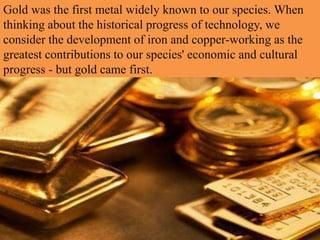
Gold was the first metal widely known to our species. When
thinking about the historical progress of technology, we
consider the development of iron and copper-working as the
greatest contributions to our species' economic and cultural
progress - but gold came first.
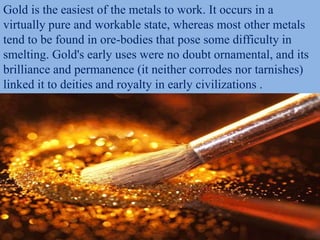
Gold is the easiest of the metals to work. It occurs in a
virtually pure and workable state, whereas most other metals
tend to be found in ore-bodies that pose some difficulty in
smelting. Gold's early uses were no doubt ornamental, and its
brilliance and permanence (it neither corrodes nor tarnishes)
linked it to deities and royalty in early civilizations .
Thank You For More
Creatdit By Vinod Chouhan

Gold history

  • 1.
  • 2.
    Gold is achemical element with the symbol Au (from Latin: aurum) and the atomic number 79. In its purest form, it is a bright, slightly reddish yellow, dense, soft, malleable and ductile metal. Chemically, gold is a transition metal and a group 11 element. It is one of the least reactive chemical elements, and is solid under standard conditions
  • 3.
    The metal thereforeoccurs often in free elemental (native) form, as nuggets or grains, in rocks, in veins and in alluvial deposits. It occurs in a solid solution series with the native element silver (as electrum) and also naturally alloyed with copper and palladium. Less commonly, it occurs in minerals as gold compounds, often with tellurium (gold tellurides).
  • 4.
    Because gold isdispersed widely throughout the geologic world, its discovery occurred to many different groups in many different locales. And nearly everyone who found it was impressed with it, and so was the developing culture in which they lived.
  • 5.
    Gold was thefirst metal widely known to our species. When thinking about the historical progress of technology, we consider the development of iron and copper-working as the greatest contributions to our species' economic and cultural progress - but gold came first.
  • 6.
    Gold is theeasiest of the metals to work. It occurs in a virtually pure and workable state, whereas most other metals tend to be found in ore-bodies that pose some difficulty in smelting. Gold's early uses were no doubt ornamental, and its brilliance and permanence (it neither corrodes nor tarnishes) linked it to deities and royalty in early civilizations .
  • 7.
    Thank You ForMore Creatdit By Vinod Chouhan