2
COMMON ROCK-FORMING
MINERALS
for EARTH and LIFE SCIENCE/Grade 11
Quarter 1/ Week 2
2
FOREWORD
This SELF-LEARNING KIT in SCIENCE is made to help you
continue your learning about the different rock-forming
minerals and how to identify them based on their physical
and chemical properties.
It is our sincere aim to provide you with relevant
activities, exercises, and assessment that we believe would
be necessary in order for you to acquire the appropriate
knowledge in identifying the different rock-forming minerals
found on Earth amid the academic challenges we are
currently facing.
The activities in this Self-Learning Kit are carefully made
for you to easily understand the concepts. Your enthusiasm,
eagerness, and active involvement in accomplishing these
activities will surely make a difference.
3
LEARNING COMPETENCY:
Identify common rock-forming minerals using their physical and
chemical properties. (S11/12ES-Ia-e-9)
OBJECTIVES:
At the end of the lesson, the learners will be able to:
K: Identify several common rock-forming minerals;
S: Describe the different properties of minerals; and
A: Recognize the importance of minerals in our daily
lives.
4
I. WHAT HAPPENED
PRE-ACTIVITIES/PRE-TEST:
Brainstorming!
1. Do you consider water as a mineral? Defend your answer.
2. How about snowflake? An ice? Are these minerals? Explain.
II. WHAT I NEED TO KNOW
What is a mineral?
How is a mineral different from a rock?
➢ Minerals are the building blocks of rocks. These minerals that
are common and abundant on Earth’s crust are known as rock-
forming minerals.
➢ There are five important characteristics which define a mineral:
❖ Naturally-occurring (NOT man-made or machine
generated)
❖ Inorganic (not a byproduct of living things)
❖ Solid (should exhibit stability at room temperature)
❖ Crystalline structure (looks like crystals since the
arrangement of their atoms is ordered and repetitive)
Can be represented by a chemical formula (most minerals are
chemical compounds and can be represented using a fixed or
variable chemical formula. For example: quartz (SiO2) which
indicates that the mineral quartz contains one silicon atom and two
oxygen atoms).
MINERAL POPERTIES
5
Minerals can be identified based on physical and chemical
properties.
A. PHYSICAL PROPERTIES:
We are going to use halite (table salt) to demonstrate the different
mineral properties.
Mineral Name Halite (table salt)
Chemical composition NaCl
Luster Non-metallic – vitreous; transparent to
translucent
Hardness Soft (2-2.5)
Color White
Streak White
Crystal Form/Habit Cubic
Cleavage Perfect cubic
Specific Gravity Light (2.2)
Other Properties Salty taste; very soluble; produces reddish spark
in flame
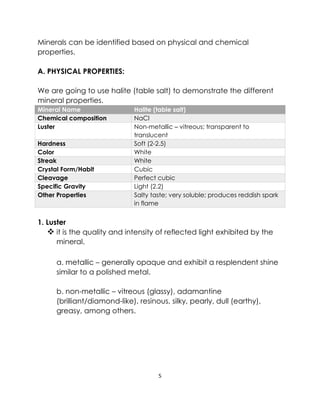
1. Luster
❖ it is the quality and intensity of reflected light exhibited by the
mineral.
a. metallic – generally opaque and exhibit a resplendent shine
similar to a polished metal.
b. non-metallic – vitreous (glassy), adamantine
(brilliant/diamond-like), resinous, silky, pearly, dull (earthy),
greasy, among others.
6
(https://www.teacherspayteachers.com/Product/Properties-of-
Minerals-Luster-5E-Activity-3959187)
2. Hardness
❖ it is a measure of the resistance of a mineral (not specifically
surface) to abrasion.
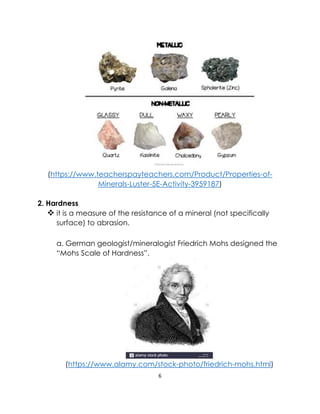
a. German geologist/mineralogist Friedrich Mohs designed the
“Mohs Scale of Hardness”.
(https://www.alamy.com/stock-photo/friedrich-mohs.html)
7
b. The “Mohs Scale of Hardness” measures the scratch
resistance of various minerals from a scale of 1 to 10, based on
the ability of a harder material/mineral to scratch a softer one.
c. Advantages of Mohs scale:
i. The test is easy.
ii. The test can be done anywhere, anytime, as long as
there is sufficient light to see scratches.
iii. The test is convenient for field geologists with scratch
kits who want to make a rough identification of minerals outside
the lab.
d. Disadvantages of Mohs scale:
i. The scale is qualitative, not quantitative.
ii. The test cannot be used to accurately test the hardness
of industrial materials.
8
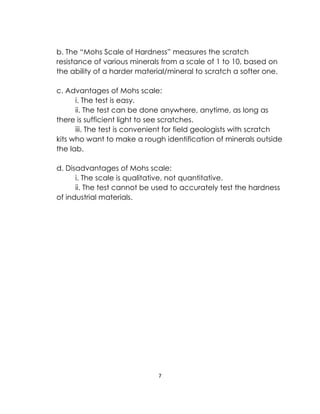
(https://www.nps.gov/articles/mohs-hardness-scale.htm)
Big Idea:
• If you will be able to scratch a mineral using your finger
nail, then its hardness is around 1 – 2.5.
• If you will be able to scratch a mineral using a coin, then
its hardness is around 2.5 – 3.5.
• If you will be able to scratch a mineral using a knife or
glass plate, then its hardness is around 3.5 – 5.5.
• If you will be able to scratch a mineral using a steel nail,
then its hardness is around 5.5 -6.5.
• If you will be able to scratch a mineral using a masonry
drill, then its hardness is around 6.5 to 8.5.
• If you will not be able to scratch a mineral using all the
materials mentioned above, then its hardness is around
8.5 – 10.
9
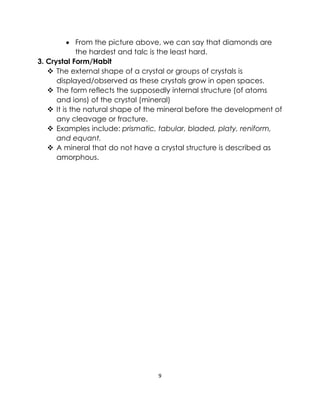
• From the picture above, we can say that diamonds are
the hardest and talc is the least hard.
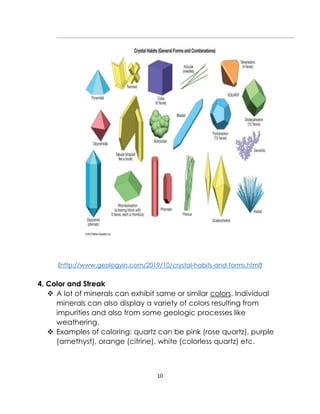
3. Crystal Form/Habit
❖ The external shape of a crystal or groups of crystals is
displayed/observed as these crystals grow in open spaces.
❖ The form reflects the supposedly internal structure (of atoms
and ions) of the crystal (mineral)
❖ It is the natural shape of the mineral before the development of
any cleavage or fracture.
❖ Examples include: prismatic, tabular, bladed, platy, reniform,
and equant.
❖ A mineral that do not have a crystal structure is described as
amorphous.
10
(http://www.geologyin.com/2019/10/crystal-habits-and-forms.html)
4. Color and Streak
❖ A lot of minerals can exhibit same or similar colors. Individual
minerals can also display a variety of colors resulting from
impurities and also from some geologic processes like
weathering.
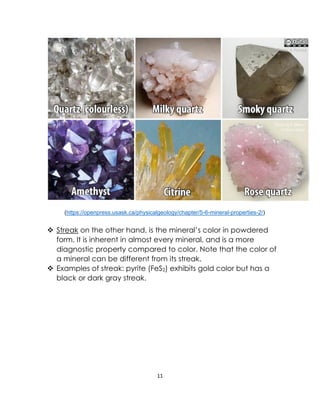
❖ Examples of coloring: quartz can be pink (rose quartz), purple
(amethyst), orange (citrine), white (colorless quartz) etc.
11
(https://openpress.usask.ca/physicalgeology/chapter/5-6-mineral-properties-2/)
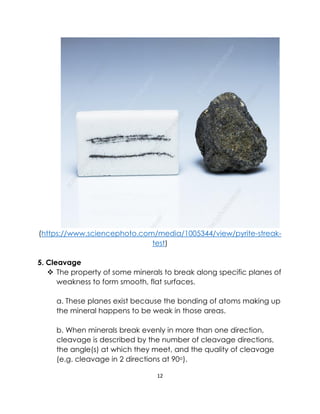
❖ Streak on the other hand, is the mineral’s color in powdered
form. It is inherent in almost every mineral, and is a more
diagnostic property compared to color. Note that the color of
a mineral can be different from its streak.
❖ Examples of streak: pyrite (FeS2) exhibits gold color but has a
black or dark gray streak.
12
(https://www.sciencephoto.com/media/1005344/view/pyrite-streak-
test)
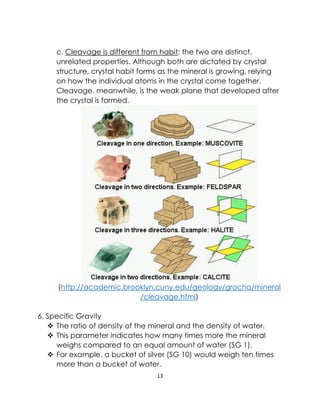
5. Cleavage
❖ The property of some minerals to break along specific planes of
weakness to form smooth, flat surfaces.
a. These planes exist because the bonding of atoms making up
the mineral happens to be weak in those areas.
b. When minerals break evenly in more than one direction,
cleavage is described by the number of cleavage directions,
the angle(s) at which they meet, and the quality of cleavage
(e.g. cleavage in 2 directions at 90o).
13
c. Cleavage is different from habit; the two are distinct,
unrelated properties. Although both are dictated by crystal
structure, crystal habit forms as the mineral is growing, relying
on how the individual atoms in the crystal come together.
Cleavage, meanwhile, is the weak plane that developed after
the crystal is formed.
(http://academic.brooklyn.cuny.edu/geology/grocha/mineral
/cleavage.html)
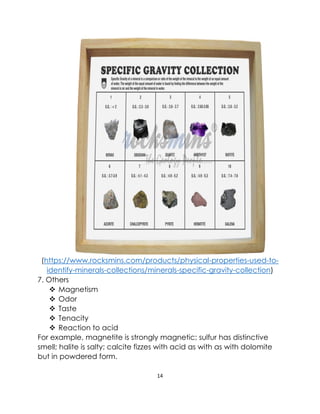
6. Specific Gravity
❖ The ratio of density of the mineral and the density of water.
❖ This parameter indicates how many times more the mineral
weighs compared to an equal amount of water (SG 1).
❖ For example, a bucket of silver (SG 10) would weigh ten times
more than a bucket of water.
14
(https://www.rocksmins.com/products/physical-properties-used-to-
identify-minerals-collections/minerals-specific-gravity-collection)
7. Others
❖ Magnetism
❖ Odor
❖ Taste
❖ Tenacity
❖ Reaction to acid
For example, magnetite is strongly magnetic; sulfur has distinctive
smell; halite is salty; calcite fizzes with acid as with as with dolomite
but in powdered form.
15
Although physical properties are useful for mineral identification,
some minerals may exhibit a wide range of properties. Minerals, like
many other things, can also be categorized based on their chemical
compositions: Silicates, Oxides, Sulfates, Sulfides, Carbonates, Native
elements, and Halides.
B. CHEMICAL PROPERTIES:
1. Silicates
❖ Minerals containing the two most abundant elements in the
Earth’s crust, namely, silicon and oxygen.
❖ When linked together, these two elements form the silicon
oxygen tetrahedron – the fundamental building block of
silicate minerals.
❖ Over 90% of rock-forming minerals belong to this group.
2. Oxides
❖ Minerals composed of oxygen anion (O2
-) combined with one
or more metal ions.
3. Sulfates
❖ Minerals containing sulfur and oxygen in the form of the (SO4)-
anion.
4. Sulfides
❖ Minerals containing sulfur and a metal; some sulfides are
sources of economically important metals such as copper,
lead, and zinc.
5. Carbonates
❖ Minerals containing the carbonate (CO3)2
- anion combined
with other elements.
16
6. Native elements
❖ Minerals that formed as individual elements.
a. metals and intermetals – minerals with high thermal and
electrical conductivity, typically with metallic luster, low
hardness (gold, lead)
b. semi-metals – minerals that are more fragile than metals and
have lower conductivity (arsenic, bismuth).
c. nonmetals – nonconductive (sulfur, diamond)
7. Halides
❖ Minerals containing halogen elements combined with one or
more metals.
The table below shows the summary of mineral group categorization
based on their chemical compositions.
Element Element
+ SiO
Element +
O
Element +
SO
Element
+ S
Element +
CO
Element
+
Halogens
Native Silicate Oxide Sulfate Sulfide Carbonate Halide
Gold Quartz Hematite Gypsum Pyrite Calcite Chlorine
Bismuth Olivine Magnetite Barite Galena Dolomite Fluorine
Diamond Talc Chromite Anhydrite Bornite Malachite Halite
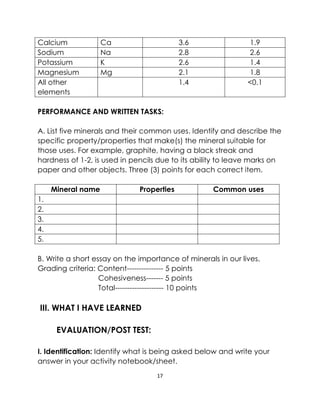
The elements listed below comprise almost 99% of the minerals
making up the Earth’s crust.
Element Symbol % by weight of
Earth’s crust
% atoms
Oxygen O 46.6 62.6
Silicon Si 27.7 21.2
Aluminum Al 8.1 6.5
Iron Fe 5.0 1.9
3
17
Calcium Ca 3.6 1.9
Sodium Na 2.8 2.6
Potassium K 2.6 1.4
Magnesium Mg 2.1 1.8
All other
elements
1.4 <0.1
PERFORMANCE AND WRITTEN TASKS:
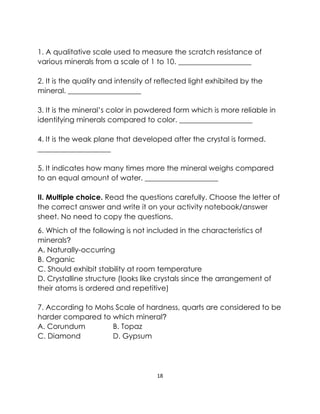
A. List five minerals and their common uses. Identify and describe the
specific property/properties that make(s) the mineral suitable for
those uses. For example, graphite, having a black streak and
hardness of 1-2, is used in pencils due to its ability to leave marks on
paper and other objects. Three (3) points for each correct item.
Mineral name Properties Common uses
1.
2.
3.
4.
5.
B. Write a short essay on the importance of minerals in our lives.
Grading criteria: Content--------------- 5 points
Cohesiveness------- 5 points
Total-------------------- 10 points
III. WHAT I HAVE LEARNED
EVALUATION/POST TEST:
I. Identification: Identify what is being asked below and write your
answer in your activity notebook/sheet.
18
1. A qualitative scale used to measure the scratch resistance of
various minerals from a scale of 1 to 10. ____________________
2. It is the quality and intensity of reflected light exhibited by the
mineral. ____________________
3. It is the mineral’s color in powdered form which is more reliable in
identifying minerals compared to color. ____________________
4. It is the weak plane that developed after the crystal is formed.
____________________
5. It indicates how many times more the mineral weighs compared
to an equal amount of water. ____________________
II. Multiple choice. Read the questions carefully. Choose the letter of
the correct answer and write it on your activity notebook/answer
sheet. No need to copy the questions.
6. Which of the following is not included in the characteristics of
minerals?
A. Naturally-occurring
B. Organic
C. Should exhibit stability at room temperature
D. Crystalline structure (looks like crystals since the arrangement of
their atoms is ordered and repetitive)
7. According to Mohs Scale of hardness, quarts are considered to be
harder compared to which mineral?
A. Corundum B. Topaz
C. Diamond D. Gypsum
19
8. If you will be able to scratch a mineral using a coin, then its
hardness is believed to be around what range?
A. 1-2.5 B. 2.5-3.5 C. 3.5-5.5 D. 5.5-6.5
9. What do you call a mineral that does not have a crystal structure?
A. amorphous B. analogous
C. anamorphous D. none of the choices
10. What is the mineral’s color in powdered form which is inherent in
almost every mineral and is a more diagnostic property compared
to color?
A. Specific gravity B. Habit
C. Streak D. Cleavage
11. What is the correct pairing of elements for the mineral group that
belongs to silicates?
A. silicon & carbon B. silicon & nitrogen
C. silicon & oxygen D. silicon & hydrogen
12. What do you call to a mineral group wherein it is a combination
of a sulfur element and a metal?
A. Sulfates B. Sulfides
C. Carbonates D. Halides
13. Which mineral group does dolomite belong?
A. Carbonates B. Oxides
C. Halides D. Sulfates
14. Diamond is a mineral that is formed as an individual element. It is
non-conductive. What is the other characteristic of a diamond?
A. metal B. semi-metal
C. non-metal D. none of the choices
15. Which of the following is true about streak?
A. Streak is reliable than color.
B. Streak is the color of a mineral in powdered form.
C. It is inherent to most minerals.
D. none of the above
20
References:
Cortez, Leah Amor S. and Sia, Shila Rose D. (2016). Science in
Today’s World Earth and Life Science. Sibs Publishing House,
Inc., 9-30
Licuanan, Patricia B. (2016). Earth and Life Science Teacher’s
Guide. Commission on Higher Education. 24-40, 46-55
21
DEPARTMENT OF EDUCATION
SCHOOLS DIVISION OF NEGROS ORIENTAL
SENEN PRISCILLO P. PAULIN, CESO V
Schools Division Superintendent
FAY C. LUAREZ, TM, Ed.D., Ph.D.
OIC - Assistant Schools Division Superintendent
Acting CID Chief
ADOLF P. AGUILAR
OIC - Assistant Schools Division Superintendent
NILITA L. RAGAY, Ed.D.
OIC - Assistant Schools Division Superintendent
ROSELA R. ABIERA
Education Program Supervisor – (LRMS)
ARNOLD R. JUNGCO
Education Program Supervisor – (SCIENCE & MATH)
MARICEL S. RASID
Librarian II (LRMDS)
ELMAR L. CABRERA
PDO II (LRMDS)
FRUSSELL V. ELTANAL
Writer/ILLUSTRATOR
FRUSSELL V. ELTANAL
RAFAEL REX B. FELISILDA
LAY-OUT ARTISTS
BETA QA TEAM
ZENAIDA A. ACADEMIA
DORIN FAYE D. CADAYDAY
MERCY G. DAGOY
RANJEL D. ESTIMAR
MARIA SALOME B. GOMEZ
JUSTIN PAUL ARSENIO C. KINAMOT
ARJIE T. PALUMPA
ALPHA QA TEAM
LIEZEL A. AGOR
EUFRATES G. ANSOK, Jr.
JOAN Y. BUBULI
MA. OFELIA I. BUSCATO
DEXTER D. PAIRA
LIELIN A. DE LA ZERNA
22
SYNOPSIS AND ABOUT THE AUTHOR
This lesson tackles on identifying rock-forming
minerals. A mineral is a naturally-occurring,
inorganic solid that exhibits a crystalline
structure and can be represented by a
chemical formula. The different properties of a
mineral, such as luster, color, streak, hardness, and
specific gravity, are used in identifying specific
types of minerals. Rock-forming minerals are the
minerals that are commonly found in all rock types.
Frussell V. Eltanal is a Registered Nurse who graduated in Silliman
University. He took a Crash Program in Education at LCC-Bais
campus. A Licensed Professional Teacher who is currently teaching
at Gregorio Elmaga Memorial High School - Senior High School
Department – in Nasig-id, Zamboanguita, Negros Oriental,
Philippines. He is currently taking up Master of Arts in Science
Teaching at Negros Oriental State University.
Answer key:
I. Pre-test
1. No. It is not solid and
crystalline.
2. Snowflake possesses all the
properties of mineral. Ice is
not mineral since it is not
naturally-occurring.
II. Performance and written
tasks: Answers may vary
III. Post-test
Identification
1. Mohs scale of Hardness
2. Luster
3. Streak
4. Cleavage
5. Specific gravity
Multiple choice
6. B 11. C
7. D 12. B
8. B 13. A
9. A 14. A
10. C 15. D

Earth-and-Life-Science-Q1-Week-2.pdf

  • 1.
    2 COMMON ROCK-FORMING MINERALS for EARTHand LIFE SCIENCE/Grade 11 Quarter 1/ Week 2
  • 2.
    2 FOREWORD This SELF-LEARNING KITin SCIENCE is made to help you continue your learning about the different rock-forming minerals and how to identify them based on their physical and chemical properties. It is our sincere aim to provide you with relevant activities, exercises, and assessment that we believe would be necessary in order for you to acquire the appropriate knowledge in identifying the different rock-forming minerals found on Earth amid the academic challenges we are currently facing. The activities in this Self-Learning Kit are carefully made for you to easily understand the concepts. Your enthusiasm, eagerness, and active involvement in accomplishing these activities will surely make a difference.
  • 3.
    3 LEARNING COMPETENCY: Identify commonrock-forming minerals using their physical and chemical properties. (S11/12ES-Ia-e-9) OBJECTIVES: At the end of the lesson, the learners will be able to: K: Identify several common rock-forming minerals; S: Describe the different properties of minerals; and A: Recognize the importance of minerals in our daily lives.
  • 4.
    4 I. WHAT HAPPENED PRE-ACTIVITIES/PRE-TEST: Brainstorming! 1.Do you consider water as a mineral? Defend your answer. 2. How about snowflake? An ice? Are these minerals? Explain. II. WHAT I NEED TO KNOW What is a mineral? How is a mineral different from a rock? ➢ Minerals are the building blocks of rocks. These minerals that are common and abundant on Earth’s crust are known as rock- forming minerals. ➢ There are five important characteristics which define a mineral: ❖ Naturally-occurring (NOT man-made or machine generated) ❖ Inorganic (not a byproduct of living things) ❖ Solid (should exhibit stability at room temperature) ❖ Crystalline structure (looks like crystals since the arrangement of their atoms is ordered and repetitive) Can be represented by a chemical formula (most minerals are chemical compounds and can be represented using a fixed or variable chemical formula. For example: quartz (SiO2) which indicates that the mineral quartz contains one silicon atom and two oxygen atoms). MINERAL POPERTIES
  • 5.
    5 Minerals can beidentified based on physical and chemical properties. A. PHYSICAL PROPERTIES: We are going to use halite (table salt) to demonstrate the different mineral properties. Mineral Name Halite (table salt) Chemical composition NaCl Luster Non-metallic – vitreous; transparent to translucent Hardness Soft (2-2.5) Color White Streak White Crystal Form/Habit Cubic Cleavage Perfect cubic Specific Gravity Light (2.2) Other Properties Salty taste; very soluble; produces reddish spark in flame 1. Luster ❖ it is the quality and intensity of reflected light exhibited by the mineral. a. metallic – generally opaque and exhibit a resplendent shine similar to a polished metal. b. non-metallic – vitreous (glassy), adamantine (brilliant/diamond-like), resinous, silky, pearly, dull (earthy), greasy, among others.
  • 6.
    6 (https://www.teacherspayteachers.com/Product/Properties-of- Minerals-Luster-5E-Activity-3959187) 2. Hardness ❖ itis a measure of the resistance of a mineral (not specifically surface) to abrasion. a. German geologist/mineralogist Friedrich Mohs designed the “Mohs Scale of Hardness”. (https://www.alamy.com/stock-photo/friedrich-mohs.html)
  • 7.
    7 b. The “MohsScale of Hardness” measures the scratch resistance of various minerals from a scale of 1 to 10, based on the ability of a harder material/mineral to scratch a softer one. c. Advantages of Mohs scale: i. The test is easy. ii. The test can be done anywhere, anytime, as long as there is sufficient light to see scratches. iii. The test is convenient for field geologists with scratch kits who want to make a rough identification of minerals outside the lab. d. Disadvantages of Mohs scale: i. The scale is qualitative, not quantitative. ii. The test cannot be used to accurately test the hardness of industrial materials.
  • 8.
    8 (https://www.nps.gov/articles/mohs-hardness-scale.htm) Big Idea: • Ifyou will be able to scratch a mineral using your finger nail, then its hardness is around 1 – 2.5. • If you will be able to scratch a mineral using a coin, then its hardness is around 2.5 – 3.5. • If you will be able to scratch a mineral using a knife or glass plate, then its hardness is around 3.5 – 5.5. • If you will be able to scratch a mineral using a steel nail, then its hardness is around 5.5 -6.5. • If you will be able to scratch a mineral using a masonry drill, then its hardness is around 6.5 to 8.5. • If you will not be able to scratch a mineral using all the materials mentioned above, then its hardness is around 8.5 – 10.
  • 9.
    9 • From thepicture above, we can say that diamonds are the hardest and talc is the least hard. 3. Crystal Form/Habit ❖ The external shape of a crystal or groups of crystals is displayed/observed as these crystals grow in open spaces. ❖ The form reflects the supposedly internal structure (of atoms and ions) of the crystal (mineral) ❖ It is the natural shape of the mineral before the development of any cleavage or fracture. ❖ Examples include: prismatic, tabular, bladed, platy, reniform, and equant. ❖ A mineral that do not have a crystal structure is described as amorphous.
  • 10.
    10 (http://www.geologyin.com/2019/10/crystal-habits-and-forms.html) 4. Color andStreak ❖ A lot of minerals can exhibit same or similar colors. Individual minerals can also display a variety of colors resulting from impurities and also from some geologic processes like weathering. ❖ Examples of coloring: quartz can be pink (rose quartz), purple (amethyst), orange (citrine), white (colorless quartz) etc.
  • 11.
    11 (https://openpress.usask.ca/physicalgeology/chapter/5-6-mineral-properties-2/) ❖ Streak onthe other hand, is the mineral’s color in powdered form. It is inherent in almost every mineral, and is a more diagnostic property compared to color. Note that the color of a mineral can be different from its streak. ❖ Examples of streak: pyrite (FeS2) exhibits gold color but has a black or dark gray streak.
  • 12.
    12 (https://www.sciencephoto.com/media/1005344/view/pyrite-streak- test) 5. Cleavage ❖ Theproperty of some minerals to break along specific planes of weakness to form smooth, flat surfaces. a. These planes exist because the bonding of atoms making up the mineral happens to be weak in those areas. b. When minerals break evenly in more than one direction, cleavage is described by the number of cleavage directions, the angle(s) at which they meet, and the quality of cleavage (e.g. cleavage in 2 directions at 90o).
  • 13.
    13 c. Cleavage isdifferent from habit; the two are distinct, unrelated properties. Although both are dictated by crystal structure, crystal habit forms as the mineral is growing, relying on how the individual atoms in the crystal come together. Cleavage, meanwhile, is the weak plane that developed after the crystal is formed. (http://academic.brooklyn.cuny.edu/geology/grocha/mineral /cleavage.html) 6. Specific Gravity ❖ The ratio of density of the mineral and the density of water. ❖ This parameter indicates how many times more the mineral weighs compared to an equal amount of water (SG 1). ❖ For example, a bucket of silver (SG 10) would weigh ten times more than a bucket of water.
  • 14.
    14 (https://www.rocksmins.com/products/physical-properties-used-to- identify-minerals-collections/minerals-specific-gravity-collection) 7. Others ❖ Magnetism ❖Odor ❖ Taste ❖ Tenacity ❖ Reaction to acid For example, magnetite is strongly magnetic; sulfur has distinctive smell; halite is salty; calcite fizzes with acid as with as with dolomite but in powdered form.
  • 15.
    15 Although physical propertiesare useful for mineral identification, some minerals may exhibit a wide range of properties. Minerals, like many other things, can also be categorized based on their chemical compositions: Silicates, Oxides, Sulfates, Sulfides, Carbonates, Native elements, and Halides. B. CHEMICAL PROPERTIES: 1. Silicates ❖ Minerals containing the two most abundant elements in the Earth’s crust, namely, silicon and oxygen. ❖ When linked together, these two elements form the silicon oxygen tetrahedron – the fundamental building block of silicate minerals. ❖ Over 90% of rock-forming minerals belong to this group. 2. Oxides ❖ Minerals composed of oxygen anion (O2 -) combined with one or more metal ions. 3. Sulfates ❖ Minerals containing sulfur and oxygen in the form of the (SO4)- anion. 4. Sulfides ❖ Minerals containing sulfur and a metal; some sulfides are sources of economically important metals such as copper, lead, and zinc. 5. Carbonates ❖ Minerals containing the carbonate (CO3)2 - anion combined with other elements.
  • 16.
    16 6. Native elements ❖Minerals that formed as individual elements. a. metals and intermetals – minerals with high thermal and electrical conductivity, typically with metallic luster, low hardness (gold, lead) b. semi-metals – minerals that are more fragile than metals and have lower conductivity (arsenic, bismuth). c. nonmetals – nonconductive (sulfur, diamond) 7. Halides ❖ Minerals containing halogen elements combined with one or more metals. The table below shows the summary of mineral group categorization based on their chemical compositions. Element Element + SiO Element + O Element + SO Element + S Element + CO Element + Halogens Native Silicate Oxide Sulfate Sulfide Carbonate Halide Gold Quartz Hematite Gypsum Pyrite Calcite Chlorine Bismuth Olivine Magnetite Barite Galena Dolomite Fluorine Diamond Talc Chromite Anhydrite Bornite Malachite Halite The elements listed below comprise almost 99% of the minerals making up the Earth’s crust. Element Symbol % by weight of Earth’s crust % atoms Oxygen O 46.6 62.6 Silicon Si 27.7 21.2 Aluminum Al 8.1 6.5 Iron Fe 5.0 1.9 3
  • 17.
    17 Calcium Ca 3.61.9 Sodium Na 2.8 2.6 Potassium K 2.6 1.4 Magnesium Mg 2.1 1.8 All other elements 1.4 <0.1 PERFORMANCE AND WRITTEN TASKS: A. List five minerals and their common uses. Identify and describe the specific property/properties that make(s) the mineral suitable for those uses. For example, graphite, having a black streak and hardness of 1-2, is used in pencils due to its ability to leave marks on paper and other objects. Three (3) points for each correct item. Mineral name Properties Common uses 1. 2. 3. 4. 5. B. Write a short essay on the importance of minerals in our lives. Grading criteria: Content--------------- 5 points Cohesiveness------- 5 points Total-------------------- 10 points III. WHAT I HAVE LEARNED EVALUATION/POST TEST: I. Identification: Identify what is being asked below and write your answer in your activity notebook/sheet.
  • 18.
    18 1. A qualitativescale used to measure the scratch resistance of various minerals from a scale of 1 to 10. ____________________ 2. It is the quality and intensity of reflected light exhibited by the mineral. ____________________ 3. It is the mineral’s color in powdered form which is more reliable in identifying minerals compared to color. ____________________ 4. It is the weak plane that developed after the crystal is formed. ____________________ 5. It indicates how many times more the mineral weighs compared to an equal amount of water. ____________________ II. Multiple choice. Read the questions carefully. Choose the letter of the correct answer and write it on your activity notebook/answer sheet. No need to copy the questions. 6. Which of the following is not included in the characteristics of minerals? A. Naturally-occurring B. Organic C. Should exhibit stability at room temperature D. Crystalline structure (looks like crystals since the arrangement of their atoms is ordered and repetitive) 7. According to Mohs Scale of hardness, quarts are considered to be harder compared to which mineral? A. Corundum B. Topaz C. Diamond D. Gypsum
  • 19.
    19 8. If youwill be able to scratch a mineral using a coin, then its hardness is believed to be around what range? A. 1-2.5 B. 2.5-3.5 C. 3.5-5.5 D. 5.5-6.5 9. What do you call a mineral that does not have a crystal structure? A. amorphous B. analogous C. anamorphous D. none of the choices 10. What is the mineral’s color in powdered form which is inherent in almost every mineral and is a more diagnostic property compared to color? A. Specific gravity B. Habit C. Streak D. Cleavage 11. What is the correct pairing of elements for the mineral group that belongs to silicates? A. silicon & carbon B. silicon & nitrogen C. silicon & oxygen D. silicon & hydrogen 12. What do you call to a mineral group wherein it is a combination of a sulfur element and a metal? A. Sulfates B. Sulfides C. Carbonates D. Halides 13. Which mineral group does dolomite belong? A. Carbonates B. Oxides C. Halides D. Sulfates 14. Diamond is a mineral that is formed as an individual element. It is non-conductive. What is the other characteristic of a diamond? A. metal B. semi-metal C. non-metal D. none of the choices 15. Which of the following is true about streak? A. Streak is reliable than color. B. Streak is the color of a mineral in powdered form. C. It is inherent to most minerals. D. none of the above
  • 20.
    20 References: Cortez, Leah AmorS. and Sia, Shila Rose D. (2016). Science in Today’s World Earth and Life Science. Sibs Publishing House, Inc., 9-30 Licuanan, Patricia B. (2016). Earth and Life Science Teacher’s Guide. Commission on Higher Education. 24-40, 46-55
  • 21.
    21 DEPARTMENT OF EDUCATION SCHOOLSDIVISION OF NEGROS ORIENTAL SENEN PRISCILLO P. PAULIN, CESO V Schools Division Superintendent FAY C. LUAREZ, TM, Ed.D., Ph.D. OIC - Assistant Schools Division Superintendent Acting CID Chief ADOLF P. AGUILAR OIC - Assistant Schools Division Superintendent NILITA L. RAGAY, Ed.D. OIC - Assistant Schools Division Superintendent ROSELA R. ABIERA Education Program Supervisor – (LRMS) ARNOLD R. JUNGCO Education Program Supervisor – (SCIENCE & MATH) MARICEL S. RASID Librarian II (LRMDS) ELMAR L. CABRERA PDO II (LRMDS) FRUSSELL V. ELTANAL Writer/ILLUSTRATOR FRUSSELL V. ELTANAL RAFAEL REX B. FELISILDA LAY-OUT ARTISTS BETA QA TEAM ZENAIDA A. ACADEMIA DORIN FAYE D. CADAYDAY MERCY G. DAGOY RANJEL D. ESTIMAR MARIA SALOME B. GOMEZ JUSTIN PAUL ARSENIO C. KINAMOT ARJIE T. PALUMPA ALPHA QA TEAM LIEZEL A. AGOR EUFRATES G. ANSOK, Jr. JOAN Y. BUBULI MA. OFELIA I. BUSCATO DEXTER D. PAIRA LIELIN A. DE LA ZERNA
  • 22.
    22 SYNOPSIS AND ABOUTTHE AUTHOR This lesson tackles on identifying rock-forming minerals. A mineral is a naturally-occurring, inorganic solid that exhibits a crystalline structure and can be represented by a chemical formula. The different properties of a mineral, such as luster, color, streak, hardness, and specific gravity, are used in identifying specific types of minerals. Rock-forming minerals are the minerals that are commonly found in all rock types. Frussell V. Eltanal is a Registered Nurse who graduated in Silliman University. He took a Crash Program in Education at LCC-Bais campus. A Licensed Professional Teacher who is currently teaching at Gregorio Elmaga Memorial High School - Senior High School Department – in Nasig-id, Zamboanguita, Negros Oriental, Philippines. He is currently taking up Master of Arts in Science Teaching at Negros Oriental State University. Answer key: I. Pre-test 1. No. It is not solid and crystalline. 2. Snowflake possesses all the properties of mineral. Ice is not mineral since it is not naturally-occurring. II. Performance and written tasks: Answers may vary III. Post-test Identification 1. Mohs scale of Hardness 2. Luster 3. Streak 4. Cleavage 5. Specific gravity Multiple choice 6. B 11. C 7. D 12. B 8. B 13. A 9. A 14. A 10. C 15. D