Rhizosphere
Roots must compete with the invading root
systems of neighboring plant species for
space, water and mineral nutrients, and
with soil-borne microorganisms, including
bacteria, fungi, and insects feeding on an
abundant source of organic material
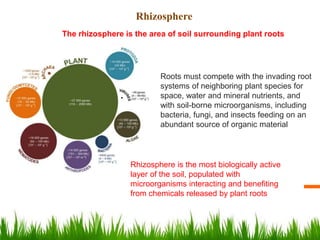
The rhizosphere is the area of soil surrounding plant roots
Rhizosphere is the most biologically active
layer of the soil, populated with
microorganisms interacting and benefiting
from chemicals released by plant roots
Rhizosphere
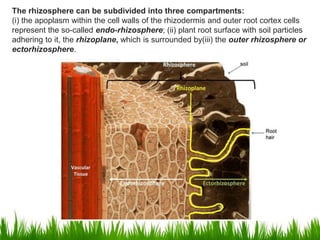
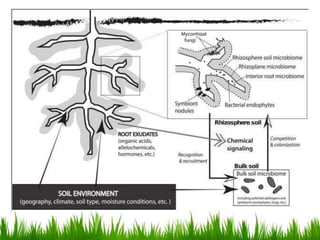
The rhizosphere can be subdivided into three compartments:
(i) the apoplasm within the cell walls of the rhizodermis and outer root cortex cells
represent the so-called endo-rhizosphere; (ii) plant root surface with soil particles
adhering to it, the rhizoplane, which is surrounded by(iii) the outer rhizosphere or
ectorhizosphere.
Hiltner, in 1904, originally used Rhizosphaire to describe the zone of soil
under the influence of legume roots
Expansion of the rhizosphere concept to other plants soon followed; however,
the term was still used to describe a niche within soil.
With the base word, rhizosphere, referring to a soil niche, the addition of endo
would make the word literally refer to an interior zone of the same soil niche.
Endorhizosphere describes soil, rather than a niche within the host plant.
Correct terms to describe the interior of roots would be endoroot, endorhiza,
hypoepidermis, or hyporhizoplane.
Plant roots release organic compounds into their surrounding soils.
Compounds are rhizodeposits
Process is rhizodeposition
Plants – release organic compounds and lose carbon to the surrounding soil
Soil – benefits from the plants lost carbon
The release of organic compounds supports the soil microbial life.
The amount and composition of rhizodeposits from plant roots vary depending
on the type of plant, the climate, the nutrient deficiency, and the physical,
chemical and biological properties of soil surrounding the root.
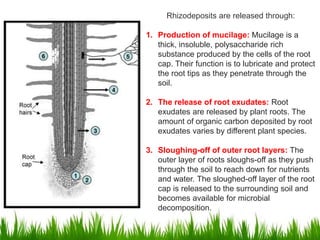
Rhizodeposits are released through:
1. Production of mucilage: Mucilage is a
thick, insoluble, polysaccharide rich
substance produced by the cells of the root
cap. Their function is to lubricate and protect
the root tips as they penetrate through the
soil.
2. The release of root exudates: Root
exudates are released by plant roots. The
amount of organic carbon deposited by root
exudates varies by different plant species.
3. Sloughing-off of outer root layers: The
outer layer of roots sloughs-off as they push
through the soil to reach down for nutrients
and water. The sloughed-off layer of the root
cap is released to the surrounding soil and
becomes available for microbial
decomposition.
Plant roots can modify the rhizosphere chemistry by number of ways:
• release and uptake of organic compounds,
• gas exchange (CO2/O2) related with respiration of roots
• rhizosphere microorganisms
• root uptake as well as release of water and nutrients, which may be
associated
• with uptake or extrusion of protons and modifications of the redox
potential
Roots also modify the physical properties of the rhizosphere soil:
• aggregate stability
• hydrophobicity
• numbers and size of micropores by their growth through the soil as well as
presence of polymeric substances
The radial gradients of nutrients in the rhizosphere are determined by their
solubility and mobility, and the uptake capacity of the roots. Depending on
the mobility of these nutrients, gradients can extend over less than 1 mm
up to several cm distance from the root surface (Hinsinger et al., 2009).
The amount of rhizosphere soil will depend on root morphology
(particularly root hairs) and physiology (release of binding agents such as
mucilage) as well as on soil properties (texture, water content, organic
matter content).
Depending on the rhizosphere processes considered (exudation of
reactive compounds, respiration, uptake of more or less mobile nutrients
and water), the radial extent of the rhizosphere can range from scales of
less than 1 μm to several centimetres.
the soil microbial community in their
immediate vicinity
cope with herbivores
encourage beneficial symbioses
change the chemical and physical properties
of the soil
inhibit the growth of competing plant species
Roots
exudate
may
regulate
The chemicals secreted into the soil by roots are broadly referred to as root exudates.
The concentration of organic compounds released from plant roots declines with
increasing distance from the roots.
The distance of diffusion largely depends on soil properties and adsorption
characteristics of the respective compounds.
Whereas polar compounds such as uncharged low-molecular- weight sugars or
simple amino acids can diffuse several millimetres from the root surface, di- and
tri-carboxylates, such as malate, citrate or oxalate may be adsorbed to positively
charged sorption sites of the soil matrix and are only detectable close to the
rhizoplane. This holds true also for root-secretory proteins, polygalacturonic acids
and phenolic compounds .
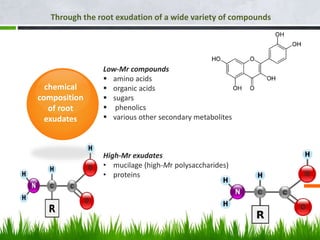
chemical
composition
of root
exudates
Low-Mr compounds
 amino acids
 organic acids
 sugars
 phenolics
 various other secondary metabolites
High-Mr exudates
• mucilage (high-Mr polysaccharides)
• proteins
Through the root exudation of a wide variety of compounds
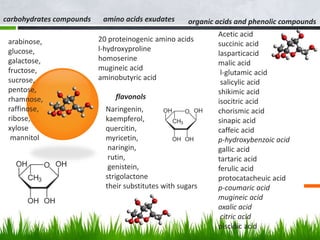
carbohydrates compounds
arabinose,
glucose,
galactose,
fructose,
sucrose,
pentose,
rhamnose,
raffinose,
ribose,
xylose
mannitol
amino acids exudates
20 proteinogenic amino acids
l-hydroxyproline
homoserine
mugineic acid
aminobutyric acid
organic acids and phenolic compounds
Acetic acid
succinic acid
lasparticacid
malic acid
l-glutamic acid
salicylic acid
shikimic acid
isocitric acid
chorismic acid
sinapic acid
caffeic acid
p-hydroxybenzoic acid
gallic acid
tartaric acid
ferulic acid
protocatacheuic acid
p-coumaric acid
mugineic acid
oxalic acid
citric acid
piscidic acid
flavonols
Naringenin,
kaempferol,
quercitin,
myricetin,
naringin,
rutin,
genistein,
strigolactone
their substitutes with sugars
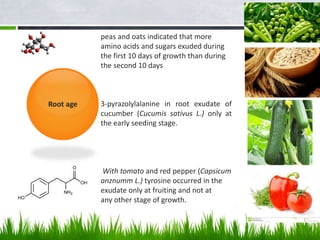
Root age
peas and oats indicated that more
amino acids and sugars exuded during
the first 10 days of growth than during
the second 10 days
3-pyrazolylalanine in root exudate of
cucumber (Cucumis sativus L.) only at
the early seeding stage.
With tomato and red pepper (Capsicum
anznumm L.) tyrosine occurred in the
exudate only at fruiting and not at
any other stage of growth.
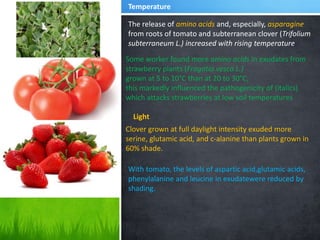
Temperature
The release of amino acids and, especially, asparagine
from roots of tomato and subterranean clover (Trifolium
subterraneum L.) increased with rising temperature
Some worker found more amino acids in exudates from
strawberry plants (Fragatia vesca L.)
grown at 5 to 10°C than at 20 to 30°C;
this markedly influenced the pathogenicity of (italics)
which attacks strawberries at low soil temperatures
Light
Clover grown at full daylight intensity exuded more
serine, glutamic acid, and c-alanine than plants grown in
60% shade.
With tomato, the levels of aspartic acid,glutamic acids,
phenylalanine and leucine in exudatewere reduced by
shading.
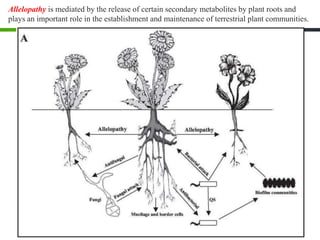
Allelopathy is mediated by the release of certain secondary metabolites by plant roots and
plays an important role in the establishment and maintenance of terrestrial plant communities.
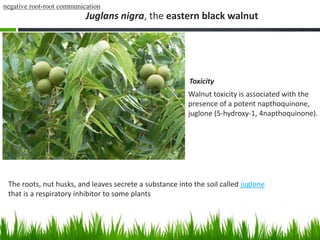
Toxicity
Walnut toxicity is associated with the
presence of a potent napthoquinone,
juglone (5-hydroxy-1, 4napthoquinone).
Juglans nigra, the eastern black walnut
The roots, nut husks, and leaves secrete a substance into the soil called juglone
that is a respiratory inhibitor to some plants
negative root-root communication
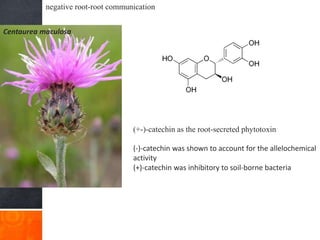
Centaurea maculosa
(+-)-catechin as the root-secreted phytotoxin
(-)-catechin was shown to account for the allelochemical
activity
(+)-catechin was inhibitory to soil-borne bacteria
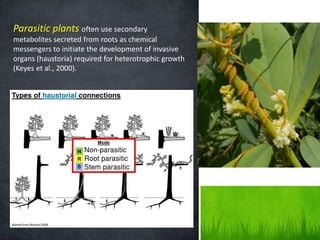
Parasitic plants often use secondary
metabolites secreted from roots as chemical
messengers to initiate the development of invasive
organs (haustoria) required for heterotrophic growth
(Keyes et al., 2000).
Root-
Microbe
Communication
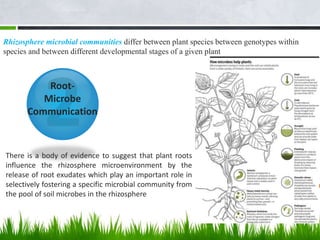
Rhizosphere microbial communities differ between plant species between genotypes within
species and between different developmental stages of a given plant
There is a body of evidence to suggest that plant roots
influence the rhizosphere microenvironment by the
release of root exudates which play an important role in
selectively fostering a specific microbial community from
the pool of soil microbes in the rhizosphere
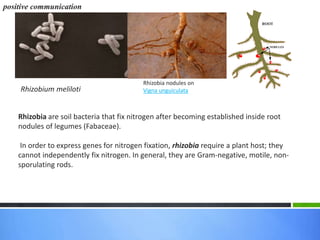
Rhizobium meliloti
Rhizobia nodules on
Vigna unguiculata
Rhizobia are soil bacteria that fix nitrogen after becoming established inside root
nodules of legumes (Fabaceae).
In order to express genes for nitrogen fixation, rhizobia require a plant host; they
cannot independently fix nitrogen. In general, they are Gram-negative, motile, non-
sporulating rods.
positive communication
antimicrobial activity
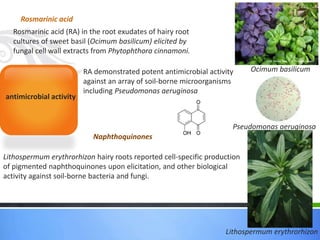
Rosmarinic acid
Rosmarinic acid (RA) in the root exudates of hairy root
cultures of sweet basil (Ocimum basilicum) elicited by
fungal cell wall extracts from Phytophthora cinnamoni.
RA demonstrated potent antimicrobial activity
against an array of soil-borne microorganisms
including Pseudomonas aeruginosa
Naphthoquinones
Lithospermum erythrorhizon hairy roots reported cell-specific production
of pigmented naphthoquinones upon elicitation, and other biological
activity against soil-borne bacteria and fungi.
Pseudomonas aeruginosa
Ocimum basilicum
Lithospermum erythrorhizon
Thanks for your attention!

Rhizopher.pptx

  • 1.
  • 2.
    Roots must competewith the invading root systems of neighboring plant species for space, water and mineral nutrients, and with soil-borne microorganisms, including bacteria, fungi, and insects feeding on an abundant source of organic material The rhizosphere is the area of soil surrounding plant roots Rhizosphere is the most biologically active layer of the soil, populated with microorganisms interacting and benefiting from chemicals released by plant roots Rhizosphere
  • 3.
    The rhizosphere canbe subdivided into three compartments: (i) the apoplasm within the cell walls of the rhizodermis and outer root cortex cells represent the so-called endo-rhizosphere; (ii) plant root surface with soil particles adhering to it, the rhizoplane, which is surrounded by(iii) the outer rhizosphere or ectorhizosphere.
  • 4.
    Hiltner, in 1904,originally used Rhizosphaire to describe the zone of soil under the influence of legume roots Expansion of the rhizosphere concept to other plants soon followed; however, the term was still used to describe a niche within soil. With the base word, rhizosphere, referring to a soil niche, the addition of endo would make the word literally refer to an interior zone of the same soil niche. Endorhizosphere describes soil, rather than a niche within the host plant. Correct terms to describe the interior of roots would be endoroot, endorhiza, hypoepidermis, or hyporhizoplane.
  • 5.
    Plant roots releaseorganic compounds into their surrounding soils. Compounds are rhizodeposits Process is rhizodeposition Plants – release organic compounds and lose carbon to the surrounding soil Soil – benefits from the plants lost carbon The release of organic compounds supports the soil microbial life. The amount and composition of rhizodeposits from plant roots vary depending on the type of plant, the climate, the nutrient deficiency, and the physical, chemical and biological properties of soil surrounding the root.
  • 6.
    Rhizodeposits are releasedthrough: 1. Production of mucilage: Mucilage is a thick, insoluble, polysaccharide rich substance produced by the cells of the root cap. Their function is to lubricate and protect the root tips as they penetrate through the soil. 2. The release of root exudates: Root exudates are released by plant roots. The amount of organic carbon deposited by root exudates varies by different plant species. 3. Sloughing-off of outer root layers: The outer layer of roots sloughs-off as they push through the soil to reach down for nutrients and water. The sloughed-off layer of the root cap is released to the surrounding soil and becomes available for microbial decomposition.
  • 8.
    Plant roots canmodify the rhizosphere chemistry by number of ways: • release and uptake of organic compounds, • gas exchange (CO2/O2) related with respiration of roots • rhizosphere microorganisms • root uptake as well as release of water and nutrients, which may be associated • with uptake or extrusion of protons and modifications of the redox potential Roots also modify the physical properties of the rhizosphere soil: • aggregate stability • hydrophobicity • numbers and size of micropores by their growth through the soil as well as presence of polymeric substances
  • 9.
    The radial gradientsof nutrients in the rhizosphere are determined by their solubility and mobility, and the uptake capacity of the roots. Depending on the mobility of these nutrients, gradients can extend over less than 1 mm up to several cm distance from the root surface (Hinsinger et al., 2009). The amount of rhizosphere soil will depend on root morphology (particularly root hairs) and physiology (release of binding agents such as mucilage) as well as on soil properties (texture, water content, organic matter content). Depending on the rhizosphere processes considered (exudation of reactive compounds, respiration, uptake of more or less mobile nutrients and water), the radial extent of the rhizosphere can range from scales of less than 1 μm to several centimetres.
  • 10.
    the soil microbialcommunity in their immediate vicinity cope with herbivores encourage beneficial symbioses change the chemical and physical properties of the soil inhibit the growth of competing plant species Roots exudate may regulate The chemicals secreted into the soil by roots are broadly referred to as root exudates.
  • 11.
    The concentration oforganic compounds released from plant roots declines with increasing distance from the roots. The distance of diffusion largely depends on soil properties and adsorption characteristics of the respective compounds. Whereas polar compounds such as uncharged low-molecular- weight sugars or simple amino acids can diffuse several millimetres from the root surface, di- and tri-carboxylates, such as malate, citrate or oxalate may be adsorbed to positively charged sorption sites of the soil matrix and are only detectable close to the rhizoplane. This holds true also for root-secretory proteins, polygalacturonic acids and phenolic compounds .
  • 12.
    chemical composition of root exudates Low-Mr compounds amino acids  organic acids  sugars  phenolics  various other secondary metabolites High-Mr exudates • mucilage (high-Mr polysaccharides) • proteins Through the root exudation of a wide variety of compounds
  • 13.
    carbohydrates compounds arabinose, glucose, galactose, fructose, sucrose, pentose, rhamnose, raffinose, ribose, xylose mannitol amino acidsexudates 20 proteinogenic amino acids l-hydroxyproline homoserine mugineic acid aminobutyric acid organic acids and phenolic compounds Acetic acid succinic acid lasparticacid malic acid l-glutamic acid salicylic acid shikimic acid isocitric acid chorismic acid sinapic acid caffeic acid p-hydroxybenzoic acid gallic acid tartaric acid ferulic acid protocatacheuic acid p-coumaric acid mugineic acid oxalic acid citric acid piscidic acid flavonols Naringenin, kaempferol, quercitin, myricetin, naringin, rutin, genistein, strigolactone their substitutes with sugars
  • 14.
    Root age peas andoats indicated that more amino acids and sugars exuded during the first 10 days of growth than during the second 10 days 3-pyrazolylalanine in root exudate of cucumber (Cucumis sativus L.) only at the early seeding stage. With tomato and red pepper (Capsicum anznumm L.) tyrosine occurred in the exudate only at fruiting and not at any other stage of growth.
  • 15.
    Temperature The release ofamino acids and, especially, asparagine from roots of tomato and subterranean clover (Trifolium subterraneum L.) increased with rising temperature Some worker found more amino acids in exudates from strawberry plants (Fragatia vesca L.) grown at 5 to 10°C than at 20 to 30°C; this markedly influenced the pathogenicity of (italics) which attacks strawberries at low soil temperatures Light Clover grown at full daylight intensity exuded more serine, glutamic acid, and c-alanine than plants grown in 60% shade. With tomato, the levels of aspartic acid,glutamic acids, phenylalanine and leucine in exudatewere reduced by shading.
  • 16.
    Allelopathy is mediatedby the release of certain secondary metabolites by plant roots and plays an important role in the establishment and maintenance of terrestrial plant communities.
  • 17.
    Toxicity Walnut toxicity isassociated with the presence of a potent napthoquinone, juglone (5-hydroxy-1, 4napthoquinone). Juglans nigra, the eastern black walnut The roots, nut husks, and leaves secrete a substance into the soil called juglone that is a respiratory inhibitor to some plants negative root-root communication
  • 18.
    negative root-root communication Centaureamaculosa (+-)-catechin as the root-secreted phytotoxin (-)-catechin was shown to account for the allelochemical activity (+)-catechin was inhibitory to soil-borne bacteria
  • 19.
    Parasitic plants oftenuse secondary metabolites secreted from roots as chemical messengers to initiate the development of invasive organs (haustoria) required for heterotrophic growth (Keyes et al., 2000).
  • 20.
    Root- Microbe Communication Rhizosphere microbial communitiesdiffer between plant species between genotypes within species and between different developmental stages of a given plant There is a body of evidence to suggest that plant roots influence the rhizosphere microenvironment by the release of root exudates which play an important role in selectively fostering a specific microbial community from the pool of soil microbes in the rhizosphere
  • 21.
    Rhizobium meliloti Rhizobia noduleson Vigna unguiculata Rhizobia are soil bacteria that fix nitrogen after becoming established inside root nodules of legumes (Fabaceae). In order to express genes for nitrogen fixation, rhizobia require a plant host; they cannot independently fix nitrogen. In general, they are Gram-negative, motile, non- sporulating rods. positive communication
  • 22.
    antimicrobial activity Rosmarinic acid Rosmarinicacid (RA) in the root exudates of hairy root cultures of sweet basil (Ocimum basilicum) elicited by fungal cell wall extracts from Phytophthora cinnamoni. RA demonstrated potent antimicrobial activity against an array of soil-borne microorganisms including Pseudomonas aeruginosa Naphthoquinones Lithospermum erythrorhizon hairy roots reported cell-specific production of pigmented naphthoquinones upon elicitation, and other biological activity against soil-borne bacteria and fungi. Pseudomonas aeruginosa Ocimum basilicum Lithospermum erythrorhizon
  • 23.
    Thanks for yourattention!