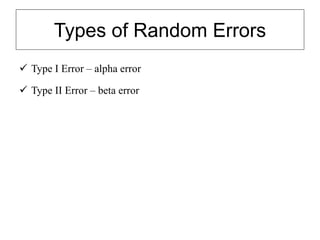
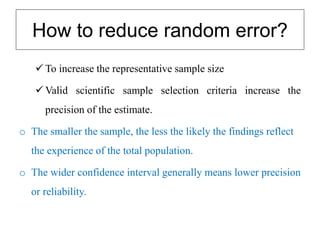
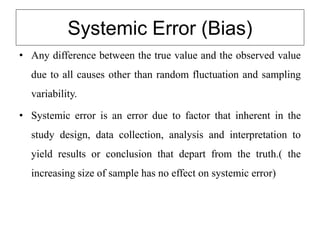
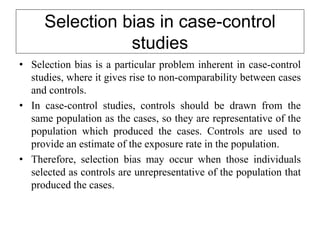
This document discusses sources of bias and error in epidemiological studies. It defines random and systematic errors, and describes the main types of each. Random errors are due to chance and include sampling variability. Systematic or bias errors are due to flaws in study design, implementation or analysis. The key types of bias discussed are selection bias, information bias, and confounding. Selection bias results from non-representative samples. Information bias stems from errors in measuring or recording exposures and outcomes. Confounding occurs when a third variable influences the exposure-outcome relationship. The document also provides examples and ways to reduce biases, such as increasing sample size and using statistical controls.