RANDOMIZED CONTROLLED TRIAL
DR. SNEHA
Post graduate
Department of Community Medicine
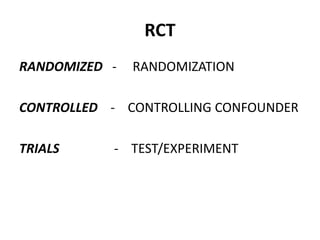
RCT
RANDOMIZED - RANDOMIZATION
CONTROLLED - CONTROLLING CONFOUNDER
TRIALS - TEST/EXPERIMENT
DEFINITION
โ€ข RCT is a planned epidemiological experiment
where individuals are randomly assigned to
one or more experiment and control groups to
assess the effect of a preventive or
therapeutic measure.
โ€ข GOLD STANDARD of epidemiological studies.
โ€ข Provides the strongest possible causation that
epidemiological studies can deliver.
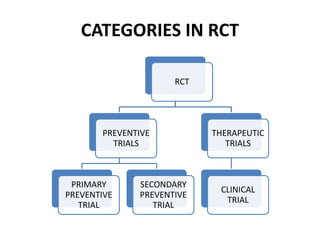
CATEGORIES IN RCT
RCT
PREVENTIVE
TRIALS
PRIMARY
PREVENTIVE
TRIAL
SECONDARY
PREVENTIVE
TRIAL
THERAPEUTIC
TRIALS
CLINICAL
TRIAL
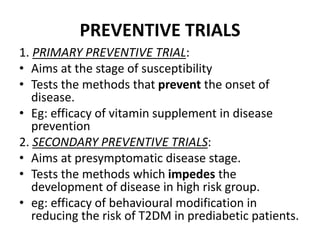
PREVENTIVE TRIALS
1. PRIMARY PREVENTIVE TRIAL:
โ€ข Aims at the stage of susceptibility
โ€ข Tests the methods that prevent the onset of
disease.
โ€ข Eg: efficacy of vitamin supplement in disease
prevention
2. SECONDARY PREVENTIVE TRIALS:
โ€ข Aims at presymptomatic disease stage.
โ€ข Tests the methods which impedes the
development of disease in high risk group.
โ€ข eg: efficacy of behavioural modification in
reducing the risk of T2DM in prediabetic patients.
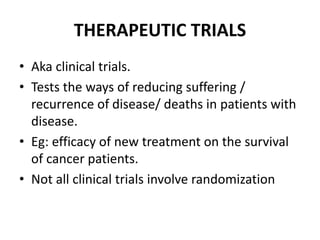
THERAPEUTIC TRIALS
โ€ข Aka clinical trials.
โ€ข Tests the ways of reducing suffering /
recurrence of disease/ deaths in patients with
disease.
โ€ข Eg: efficacy of new treatment on the survival
of cancer patients.
โ€ข Not all clinical trials involve randomization
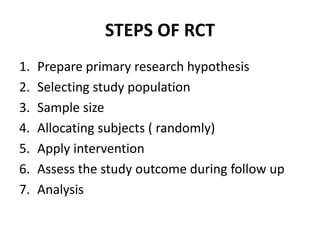
STEPS OF RCT
1. Prepare primary research hypothesis
2. Selecting study population
3. Sample size
4. Allocating subjects ( randomly)
5. Apply intervention
6. Assess the study outcome during follow up
7. Analysis
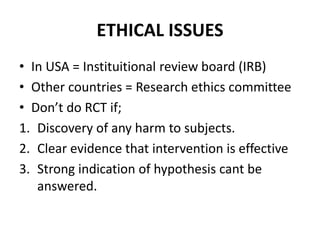
ETHICAL ISSUES
โ€ข In USA = Instituitional review board (IRB)
โ€ข Other countries = Research ethics committee
โ€ข Donโ€™t do RCT if;
1. Discovery of any harm to subjects.
2. Clear evidence that intervention is effective
3. Strong indication of hypothesis cant be
answered.
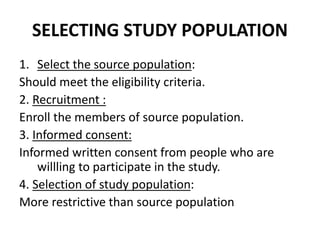
SELECTING STUDY POPULATION
1. Select the source population:
Should meet the eligibility criteria.
2. Recruitment :
Enroll the members of source population.
3. Informed consent:
Informed written consent from people who are
willling to participate in the study.
4. Selection of study population:
More restrictive than source population
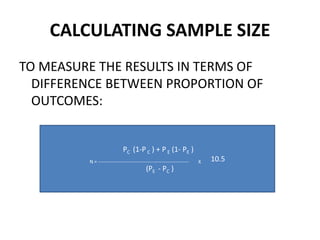
CALCULATING SAMPLE SIZE
TO MEASURE THE RESULTS IN TERMS OF
DIFFERENCE BETWEEN PROPORTION OF
OUTCOMES:
PC (1-P C ) + P E (1- PE )
N = -------------------------------------------------------- X 10.5
(PE - PC )
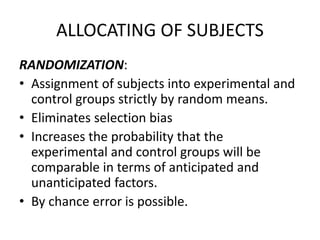
ALLOCATING OF SUBJECTS
RANDOMIZATION:
โ€ข Assignment of subjects into experimental and
control groups strictly by random means.
โ€ข Eliminates selection bias
โ€ข Increases the probability that the
experimental and control groups will be
comparable in terms of anticipated and
unanticipated factors.
โ€ข By chance error is possible.
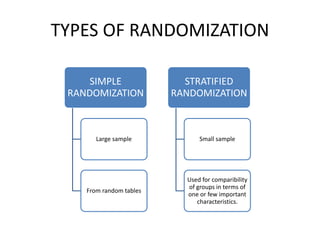
TYPES OF RANDOMIZATION
SIMPLE
RANDOMIZATION
Large sample
From random tables
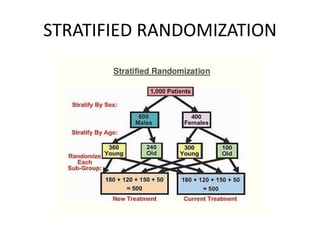
STRATIFIED
RANDOMIZATION
Small sample
Used for comparibility
of groups in terms of
one or few important
characteristics.
STRATIFIED RANDOMIZATION
BLOCK RANDOMIZATION
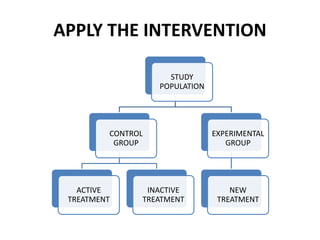
APPLY THE INTERVENTION
STUDY
POPULATION
CONTROL
GROUP
ACTIVE
TREATMENT
INACTIVE
TREATMENT
EXPERIMENTAL
GROUP
NEW
TREATMENT
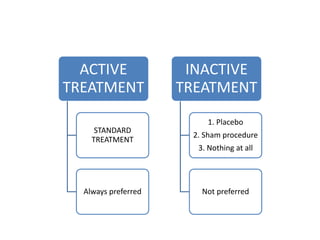
ACTIVE
TREATMENT
STANDARD
TREATMENT
Always preferred
INACTIVE
TREATMENT
1. Placebo
2. Sham procedure
3. Nothing at all
Not preferred
REPORTING THE OUTCOMES
โ€ข Biased if it is subjective: pain relief
โ€ข Usually biased if the study participants know
the assignment.
โ€ข Exp : tendency to report positive benefits
โ€ข Control: non compliance
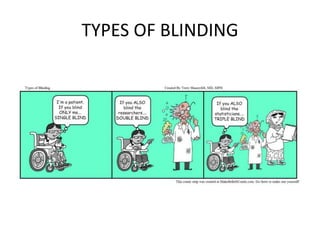
โ€ข Prevention: BLINDING/MASKING
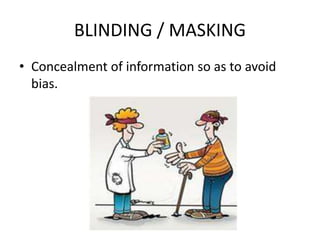
BLINDING / MASKING
โ€ข Concealment of information so as to avoid
bias.
TYPES OF BLINDING
ANALYSIS
1. INTENTION TO TREAT ANALYSIS
2. PER PROTOCOL ANALYSIS
3. EFFICACY OF INTERVENTION
4. RELATIVE RISK
5. SURVIVAL CURVES
TYPES OF RCT
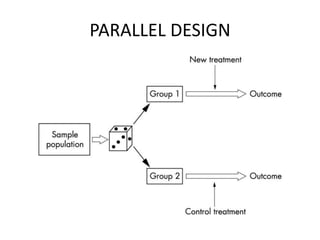
1. m/c: parallel design or non cross over design
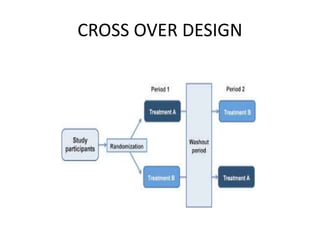
2. Cross over design
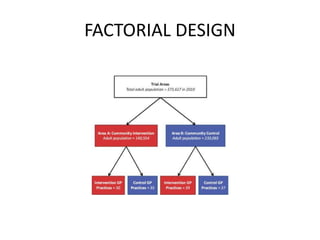
3. Factorial design
4. Fixed sample size design
PARALLEL DESIGN
CROSS OVER DESIGN
FACTORIAL DESIGN
USES 0F RCT
TO STUDY THE EFFICACY OF :
1. New drug
2. New surgery
3. Preventive measure
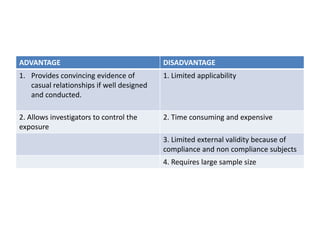
ADVANTAGE DISADVANTAGE
1. Provides convincing evidence of
casual relationships if well designed
and conducted.
1. Limited applicability
2. Allows investigators to control the
exposure
2. Time consuming and expensive
3. Limited external validity because of
compliance and non compliance subjects
4. Requires large sample size
THANK YOU !!!!!!!

Introduction to Randomized control trial