HAZMAHAZMA
TT
CLASSECLASSE
SS
LEARNING OBJECTIVELEARNING OBJECTIVE
 List the major hazard classesList the major hazard classes
and the most common materialand the most common material
associated with each class.associated with each class.
 Describe the general hazardsDescribe the general hazards
associated with each class.associated with each class.
 Introduction
 Able to identify the different &
classification types of Hazmat classes
 Understand the hazards posed by
each hazmat classes substances
 Conclusion
SCOPESCOPE
Substances that have the potential to harmSubstances that have the potential to harm
living tissues, damage property and pollute theliving tissues, damage property and pollute the
environmentenvironment
 What isWhat is HAZMATHAZMAT??
HAZHAZ – hazardous MATMAT – materials
INTRODUCTION
UN CLASSIFICATION OF HAZMATUN CLASSIFICATION OF HAZMAT
UN No.
Multi-load
HAZCHEM CODE
2WE
IN EMERGENCY DIAL
999 POLICE or
995 FIRE SERVICE
SPECIALIST ADVICE
ABC Pte Ltd
Tel No. 1234567
DANGEROUS
GOODS
Emergency Information
Panel
Appropriate DG class label
& Sub-risk label if any
Technical Name of Subst
Identification No.
Emergency Action
Code
Tel no. & name of Emergency Service Tel no. & name of coy or org
(manufacturer/local
agent/consignor)
domiciled in S’pore where
specialised
advice can be obtained at all
times
Emergency Information
Panel
 Uniformity in recognizing hazmat in
international transport
 Assists responder in identification and
establishing initial protective actions
 Four digit number assigned to each hazmat
 May appear on placards, EIP, labels
8
1017
UN Identification Number
 Class 1 : ExplosivesClass 1 : Explosives
 Class 2 : GasesClass 2 : Gases
 Class 3 : Flammable LiquidsClass 3 : Flammable Liquids
 Class 4 : Flammable SolidsClass 4 : Flammable Solids
 Class 5 : Oxidizing AgentsClass 5 : Oxidizing Agents
 Class 6 : Toxic & InfectiousClass 6 : Toxic & Infectious
SubstancesSubstances
 Class 7 : Radioactive SubstancesClass 7 : Radioactive Substances
 Class 8 : Corrosive SubstancesClass 8 : Corrosive Substances
 Class 9 : MiscellaneousClass 9 : Miscellaneous
THE 9 HAZARD CLASSES
GeneralGeneral
 A chemical substance that in itself canA chemical substance that in itself can react to produce a gas at areact to produce a gas at a
relatively high temperature and pressurerelatively high temperature and pressure and at such a speed as toand at such a speed as to
damage the surroundings.damage the surroundings.
Class 1 is sub-divided into 6 classes:Class 1 is sub-divided into 6 classes:
CLASS 1 EXPLOSIVES
1.1 — Explosives with a
mass explosion hazard.
1.2 — Explosives with a
blast/projection
hazard.
1.3 — Explosives with a
minor blast hazard.
(rocket propellant,
1.4 — Explosives with a
major fire hazard.
(consumer fireworks,
ammunition
1.5 — Blasting agents.
1.6 — Extremely insensitive
explosives.
HazardsHazards
 Most explosives pose a big fireMost explosives pose a big fire
hazard due to the very nature ofhazard due to the very nature of
explosives.explosives.
 Danger of injuries via projectilesDanger of injuries via projectiles
(E.g. shrapnel, debris etc.).(E.g. shrapnel, debris etc.).
 Some explosives can cause massSome explosives can cause mass
explosion hazard. (E.g. Blackexplosion hazard. (E.g. Black
powder, Dynamite, TNT etc.).powder, Dynamite, TNT etc.).
 Ear rupture is caused by the soundEar rupture is caused by the sound
waves.waves.
CLASS 1 EXPLOSIVES
Pressure frontPressure front
Heat frontHeat front
ProjectilesProjectiles
Sound waveSound wave
Blast Effects
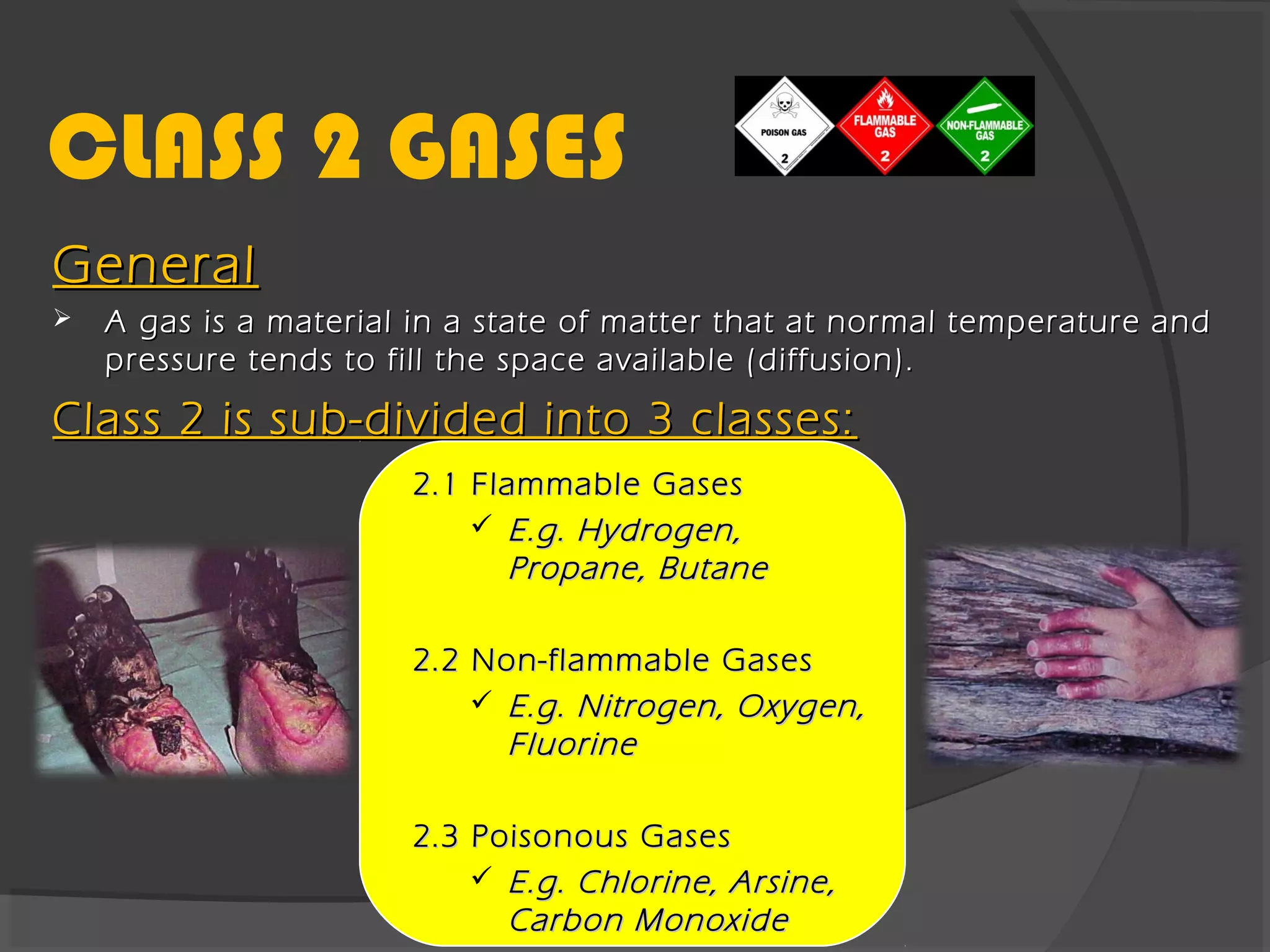
CLASS 2 GASES
GeneralGeneral
 A gas is a material in a state of matter that at normal temperature andA gas is a material in a state of matter that at normal temperature and
pressure tends to fill the space available (diffusion).pressure tends to fill the space available (diffusion).
Class 2 is sub-divided into 3 classes:Class 2 is sub-divided into 3 classes:
2.1 Flammable Gases2.1 Flammable Gases
 E.g. Hydrogen,E.g. Hydrogen,
Propane, ButanePropane, Butane
2.2 Non-flammable Gases2.2 Non-flammable Gases
 E.g. Nitrogen, Oxygen,E.g. Nitrogen, Oxygen,
FluorineFluorine
2.3 Poisonous Gases2.3 Poisonous Gases
 E.g. Chlorine, Arsine,E.g. Chlorine, Arsine,
Carbon MonoxideCarbon Monoxide
HazardsHazards
 Physical storagePhysical storage
 Gasses are difficult to store and the methods of storing theseGasses are difficult to store and the methods of storing these
gases pose a great hazard if not handled properly or not storedgases pose a great hazard if not handled properly or not stored
properlyproperly..
CompressedCompressed
General
Pressurised
Gas phase
Eg. air, acetylene
Hazards
Projectile
General
Pressurised
Gas/liquid phase
Eg. Liquid
Petroleum Gas (LPG)
Hazards
Prone to ignition
Projectile
General
Very low temperatures
Liquid phase
Eg. ammonia,
nitrogen, oxygen
Hazards
Frost bite
High expansion ratio
CLASS 2 GASES
CLASS 3 LIQUIDS
GeneralGeneral
 Physical propertiesPhysical properties
 Vapour pressure and density affects behavior of gas when theVapour pressure and density affects behavior of gas when the
liquid evaporates.liquid evaporates.
 Wider flammability rangeWider flammability range  greater danger.greater danger.
HazardsHazards
 Flammable/explosive situationFlammable/explosive situation
 Due to its tendency to generate flammable vapourDue to its tendency to generate flammable vapour
when released, an explosive situation will always arisewhen released, an explosive situation will always arise
in the event of a leakin the event of a leak  ProjectilesProjectiles
 Flowing fireFlowing fire
 Due to the physical nature of liquid to flow, anyDue to the physical nature of liquid to flow, any
release will affect a large area causing fire to spreadrelease will affect a large area causing fire to spread
along drains, low-lying areas, etc.along drains, low-lying areas, etc.
 Toxic, corrosive, carcinogenicToxic, corrosive, carcinogenic
 Some liquids can be toxic if consumed, corrosive to theSome liquids can be toxic if consumed, corrosive to the
skin and even cancer-causing.skin and even cancer-causing.
CLASS 4 SOLIDS
GeneralGeneral
4.1 Solids that easily4.1 Solids that easily
ignited and difficult toignited and difficult to
extinguish eg.extinguish eg.
MagnesiumMagnesium
4.2 Air-reactive4.2 Air-reactive
substancessubstances
(Spontaneously(Spontaneously
combusts in air) eg.combusts in air) eg.
White phosphorusWhite phosphorus
4.3 Water-reactive4.3 Water-reactive
substances
HazardsHazards
 Explosive or toxic situationExplosive or toxic situation
 Generation of flammable or toxic gas/vapourGeneration of flammable or toxic gas/vapour
 Difficult to extinguishDifficult to extinguish
 Once a fire has been initiated, it is difficult to extinguishOnce a fire has been initiated, it is difficult to extinguish
metal fires due to the high temperatures involved. Somemetal fires due to the high temperatures involved. Some
metals can be so hot that application of water can resultmetals can be so hot that application of water can result
in a steam explosion due to the rapid expansion of water.in a steam explosion due to the rapid expansion of water.
 Metal dustMetal dust
 Can cause serious complications to health if inhaled.Can cause serious complications to health if inhaled.
CLASS 4 SOLIDS
GeneralGeneral
 Substances that releases oxygenSubstances that releases oxygen
 Generally, oxidizers areGenerally, oxidizers are
compounds which release oxygencompounds which release oxygen
when they react with otherwhen they react with other
substances intensifying the fire.substances intensifying the fire.
 Examples of oxidizers areExamples of oxidizers are
aluminium nitrate, fluorine,aluminium nitrate, fluorine,
hydrogen peroxides, etc.hydrogen peroxides, etc.
CLASS 5 OXIDIZER
HazardsHazards
Oxidizers are very reactiveOxidizers are very reactive
compounds & Spontaneouslycompounds & Spontaneously
combustible that will burn fiercelycombustible that will burn fiercely
when combining with combustiblewhen combining with combustible
materials or intimate with ordinarymaterials or intimate with ordinary
combustible .combustible .
CLASS 5 OXIDIZER
CLASS 6 POISONS
GeneralGeneral
 Substances that causeSubstances that cause
death or serious healthdeath or serious health
effects upon exposureeffects upon exposure
through:through:
InhalationInhalation
IngestionIngestion
AbsorptionAbsorption
HazardsHazards
 Interferes with bodily functionsInterferes with bodily functions
Carbon Monoxide – binds toCarbon Monoxide – binds to
red blood cells, deprives bodyred blood cells, deprives body
of oxygenof oxygen
Hydrogen Fluoride - binds toHydrogen Fluoride - binds to
calcium in bonescalcium in bones
Cyanides – interferes withCyanides – interferes with
respirationrespiration
CLASS 6 POISONS
Effects of Arsenic
CLASS 7 RADIOACTIVES
GeneralGeneral
 Radioactive substances emitsRadioactive substances emits
radiationradiation
Non-ionizing radiation - radioNon-ionizing radiation - radio
waves, UV, infraredwaves, UV, infrared
Ionizing radiationIonizing radiation
 E.g.E.g. Alpha particlesAlpha particles
Beta particlesBeta particles
Gamma raysGamma rays
HazardsHazards
 Radiation sicknessRadiation sickness
NauseaNausea
VomitingVomiting
DiarrheaDiarrhea
ExhaustionExhaustion
HaemorrhageHaemorrhage
 Radiation injuryRadiation injury
BurnsBurns
 Radiation poisoningRadiation poisoning
CancerCancer
CLASS 7 RADIOACTIVES
CLASS 8 CORRISIVES
GeneralGeneral
 Substances that can causeSubstances that can cause
visible destruction to tissuevisible destruction to tissue
AcidsAcids
BasesBases
 Most widely used in industryMost widely used in industry
E.g. Sulfuric acid ,E.g. Sulfuric acid ,
Hydrochloric acid, SodiumHydrochloric acid, Sodium
HydroxideHydroxide
HazardsHazards
 Skin and tissue destructionSkin and tissue destruction
 Reacts with metals - liberateReacts with metals - liberate
hydrogenhydrogen
 May be absorbed into skinMay be absorbed into skin
 React with chemicals - liberateReact with chemicals - liberate
heatheat
CLASS 8 CORRISIVES
Chemical burns
CLASS 9 MISCELLANEOUS
 Class 9 encompasses allClass 9 encompasses all
hazardous materials thathazardous materials that
do not fit into one of thedo not fit into one of the
definitions listed in Class 1definitions listed in Class 1
through Class 8.through Class 8.
 Example – Dry ice,Example – Dry ice,
pollutantspollutants
 Different classes of HazMat haveDifferent classes of HazMat have
different properties and posedifferent properties and pose
different threats.different threats.
 Knowledge of properties andKnowledge of properties and
hazards for different HazMat classeshazards for different HazMat classes
allows us to take the appropriateallows us to take the appropriate
protective measures during anprotective measures during an
encounter, enabling us to protectencounter, enabling us to protect
CONCLUSION

3.1.2 hazmat classes

  • 1.
  • 2.
    LEARNING OBJECTIVELEARNING OBJECTIVE List the major hazard classesList the major hazard classes and the most common materialand the most common material associated with each class.associated with each class.  Describe the general hazardsDescribe the general hazards associated with each class.associated with each class.
  • 3.
     Introduction  Ableto identify the different & classification types of Hazmat classes  Understand the hazards posed by each hazmat classes substances  Conclusion SCOPESCOPE
  • 4.
    Substances that havethe potential to harmSubstances that have the potential to harm living tissues, damage property and pollute theliving tissues, damage property and pollute the environmentenvironment  What isWhat is HAZMATHAZMAT?? HAZHAZ – hazardous MATMAT – materials INTRODUCTION
  • 5.
    UN CLASSIFICATION OFHAZMATUN CLASSIFICATION OF HAZMAT
  • 6.
    UN No. Multi-load HAZCHEM CODE 2WE INEMERGENCY DIAL 999 POLICE or 995 FIRE SERVICE SPECIALIST ADVICE ABC Pte Ltd Tel No. 1234567 DANGEROUS GOODS Emergency Information Panel
  • 7.
    Appropriate DG classlabel & Sub-risk label if any Technical Name of Subst Identification No. Emergency Action Code Tel no. & name of Emergency Service Tel no. & name of coy or org (manufacturer/local agent/consignor) domiciled in S’pore where specialised advice can be obtained at all times Emergency Information Panel
  • 8.
     Uniformity inrecognizing hazmat in international transport  Assists responder in identification and establishing initial protective actions  Four digit number assigned to each hazmat  May appear on placards, EIP, labels 8 1017 UN Identification Number
  • 9.
     Class 1: ExplosivesClass 1 : Explosives  Class 2 : GasesClass 2 : Gases  Class 3 : Flammable LiquidsClass 3 : Flammable Liquids  Class 4 : Flammable SolidsClass 4 : Flammable Solids  Class 5 : Oxidizing AgentsClass 5 : Oxidizing Agents  Class 6 : Toxic & InfectiousClass 6 : Toxic & Infectious SubstancesSubstances  Class 7 : Radioactive SubstancesClass 7 : Radioactive Substances  Class 8 : Corrosive SubstancesClass 8 : Corrosive Substances  Class 9 : MiscellaneousClass 9 : Miscellaneous THE 9 HAZARD CLASSES
  • 10.
    GeneralGeneral  A chemicalsubstance that in itself canA chemical substance that in itself can react to produce a gas at areact to produce a gas at a relatively high temperature and pressurerelatively high temperature and pressure and at such a speed as toand at such a speed as to damage the surroundings.damage the surroundings. Class 1 is sub-divided into 6 classes:Class 1 is sub-divided into 6 classes: CLASS 1 EXPLOSIVES 1.1 — Explosives with a mass explosion hazard. 1.2 — Explosives with a blast/projection hazard. 1.3 — Explosives with a minor blast hazard. (rocket propellant, 1.4 — Explosives with a major fire hazard. (consumer fireworks, ammunition 1.5 — Blasting agents. 1.6 — Extremely insensitive explosives.
  • 11.
    HazardsHazards  Most explosivespose a big fireMost explosives pose a big fire hazard due to the very nature ofhazard due to the very nature of explosives.explosives.  Danger of injuries via projectilesDanger of injuries via projectiles (E.g. shrapnel, debris etc.).(E.g. shrapnel, debris etc.).  Some explosives can cause massSome explosives can cause mass explosion hazard. (E.g. Blackexplosion hazard. (E.g. Black powder, Dynamite, TNT etc.).powder, Dynamite, TNT etc.).  Ear rupture is caused by the soundEar rupture is caused by the sound waves.waves. CLASS 1 EXPLOSIVES Pressure frontPressure front Heat frontHeat front ProjectilesProjectiles Sound waveSound wave Blast Effects
  • 12.
    CLASS 2 GASES GeneralGeneral A gas is a material in a state of matter that at normal temperature andA gas is a material in a state of matter that at normal temperature and pressure tends to fill the space available (diffusion).pressure tends to fill the space available (diffusion). Class 2 is sub-divided into 3 classes:Class 2 is sub-divided into 3 classes: 2.1 Flammable Gases2.1 Flammable Gases  E.g. Hydrogen,E.g. Hydrogen, Propane, ButanePropane, Butane 2.2 Non-flammable Gases2.2 Non-flammable Gases  E.g. Nitrogen, Oxygen,E.g. Nitrogen, Oxygen, FluorineFluorine 2.3 Poisonous Gases2.3 Poisonous Gases  E.g. Chlorine, Arsine,E.g. Chlorine, Arsine, Carbon MonoxideCarbon Monoxide
  • 13.
    HazardsHazards  Physical storagePhysicalstorage  Gasses are difficult to store and the methods of storing theseGasses are difficult to store and the methods of storing these gases pose a great hazard if not handled properly or not storedgases pose a great hazard if not handled properly or not stored properlyproperly.. CompressedCompressed General Pressurised Gas phase Eg. air, acetylene Hazards Projectile General Pressurised Gas/liquid phase Eg. Liquid Petroleum Gas (LPG) Hazards Prone to ignition Projectile General Very low temperatures Liquid phase Eg. ammonia, nitrogen, oxygen Hazards Frost bite High expansion ratio CLASS 2 GASES
  • 14.
    CLASS 3 LIQUIDS GeneralGeneral Physical propertiesPhysical properties  Vapour pressure and density affects behavior of gas when theVapour pressure and density affects behavior of gas when the liquid evaporates.liquid evaporates.  Wider flammability rangeWider flammability range  greater danger.greater danger. HazardsHazards  Flammable/explosive situationFlammable/explosive situation  Due to its tendency to generate flammable vapourDue to its tendency to generate flammable vapour when released, an explosive situation will always arisewhen released, an explosive situation will always arise in the event of a leakin the event of a leak  ProjectilesProjectiles  Flowing fireFlowing fire  Due to the physical nature of liquid to flow, anyDue to the physical nature of liquid to flow, any release will affect a large area causing fire to spreadrelease will affect a large area causing fire to spread along drains, low-lying areas, etc.along drains, low-lying areas, etc.  Toxic, corrosive, carcinogenicToxic, corrosive, carcinogenic  Some liquids can be toxic if consumed, corrosive to theSome liquids can be toxic if consumed, corrosive to the skin and even cancer-causing.skin and even cancer-causing.
  • 15.
    CLASS 4 SOLIDS GeneralGeneral 4.1Solids that easily4.1 Solids that easily ignited and difficult toignited and difficult to extinguish eg.extinguish eg. MagnesiumMagnesium 4.2 Air-reactive4.2 Air-reactive substancessubstances (Spontaneously(Spontaneously combusts in air) eg.combusts in air) eg. White phosphorusWhite phosphorus 4.3 Water-reactive4.3 Water-reactive substances
  • 16.
    HazardsHazards  Explosive ortoxic situationExplosive or toxic situation  Generation of flammable or toxic gas/vapourGeneration of flammable or toxic gas/vapour  Difficult to extinguishDifficult to extinguish  Once a fire has been initiated, it is difficult to extinguishOnce a fire has been initiated, it is difficult to extinguish metal fires due to the high temperatures involved. Somemetal fires due to the high temperatures involved. Some metals can be so hot that application of water can resultmetals can be so hot that application of water can result in a steam explosion due to the rapid expansion of water.in a steam explosion due to the rapid expansion of water.  Metal dustMetal dust  Can cause serious complications to health if inhaled.Can cause serious complications to health if inhaled. CLASS 4 SOLIDS
  • 17.
    GeneralGeneral  Substances thatreleases oxygenSubstances that releases oxygen  Generally, oxidizers areGenerally, oxidizers are compounds which release oxygencompounds which release oxygen when they react with otherwhen they react with other substances intensifying the fire.substances intensifying the fire.  Examples of oxidizers areExamples of oxidizers are aluminium nitrate, fluorine,aluminium nitrate, fluorine, hydrogen peroxides, etc.hydrogen peroxides, etc. CLASS 5 OXIDIZER
  • 18.
    HazardsHazards Oxidizers are veryreactiveOxidizers are very reactive compounds & Spontaneouslycompounds & Spontaneously combustible that will burn fiercelycombustible that will burn fiercely when combining with combustiblewhen combining with combustible materials or intimate with ordinarymaterials or intimate with ordinary combustible .combustible . CLASS 5 OXIDIZER
  • 19.
    CLASS 6 POISONS GeneralGeneral Substances that causeSubstances that cause death or serious healthdeath or serious health effects upon exposureeffects upon exposure through:through: InhalationInhalation IngestionIngestion AbsorptionAbsorption
  • 20.
    HazardsHazards  Interferes withbodily functionsInterferes with bodily functions Carbon Monoxide – binds toCarbon Monoxide – binds to red blood cells, deprives bodyred blood cells, deprives body of oxygenof oxygen Hydrogen Fluoride - binds toHydrogen Fluoride - binds to calcium in bonescalcium in bones Cyanides – interferes withCyanides – interferes with respirationrespiration CLASS 6 POISONS Effects of Arsenic
  • 21.
    CLASS 7 RADIOACTIVES GeneralGeneral Radioactive substances emitsRadioactive substances emits radiationradiation Non-ionizing radiation - radioNon-ionizing radiation - radio waves, UV, infraredwaves, UV, infrared Ionizing radiationIonizing radiation  E.g.E.g. Alpha particlesAlpha particles Beta particlesBeta particles Gamma raysGamma rays
  • 22.
    HazardsHazards  Radiation sicknessRadiationsickness NauseaNausea VomitingVomiting DiarrheaDiarrhea ExhaustionExhaustion HaemorrhageHaemorrhage  Radiation injuryRadiation injury BurnsBurns  Radiation poisoningRadiation poisoning CancerCancer CLASS 7 RADIOACTIVES
  • 23.
    CLASS 8 CORRISIVES GeneralGeneral Substances that can causeSubstances that can cause visible destruction to tissuevisible destruction to tissue AcidsAcids BasesBases  Most widely used in industryMost widely used in industry E.g. Sulfuric acid ,E.g. Sulfuric acid , Hydrochloric acid, SodiumHydrochloric acid, Sodium HydroxideHydroxide
  • 24.
    HazardsHazards  Skin andtissue destructionSkin and tissue destruction  Reacts with metals - liberateReacts with metals - liberate hydrogenhydrogen  May be absorbed into skinMay be absorbed into skin  React with chemicals - liberateReact with chemicals - liberate heatheat CLASS 8 CORRISIVES Chemical burns
  • 25.
    CLASS 9 MISCELLANEOUS Class 9 encompasses allClass 9 encompasses all hazardous materials thathazardous materials that do not fit into one of thedo not fit into one of the definitions listed in Class 1definitions listed in Class 1 through Class 8.through Class 8.  Example – Dry ice,Example – Dry ice, pollutantspollutants
  • 26.
     Different classesof HazMat haveDifferent classes of HazMat have different properties and posedifferent properties and pose different threats.different threats.  Knowledge of properties andKnowledge of properties and hazards for different HazMat classeshazards for different HazMat classes allows us to take the appropriateallows us to take the appropriate protective measures during anprotective measures during an encounter, enabling us to protectencounter, enabling us to protect CONCLUSION

Editor's Notes

  • #7 The information requirement for transportation of multiple load within a single vehicle.
  • #9 The UN has developed a system of numbers and reference materials used internationally in transportation of hazmat. By using the UN numbers and reference materials, the first responder can determine information on general hazard class and establish initial protective actions. This is a four digit number assigned to each material and may appear on placards, labels, emergency information panel, and transportation container. The identification number assists the responder in identifying materials and in correctly referencing the material in emergency response guidebooks.
  • #11 A layman’s definition of an explosive is as follows: A chemical substance that in itself can react to produce a gas at a relatively high temperature and pressure and at such a speed as to damage the surroundings. Heat or friction or pressure can initiate the explosive reaction and the severity of the reaction depends on the particular material and the conditions present.
  • #14 Hazards presented by gases are divided into two types: the properties of the gas itself and the manner in which the gas is stored. Physical Storage The gaseous materials used and stored in the workplace are found in three basic forms: compressed, liquefied, and cryogenic. Each of these can present a variety of hazards and problems for those who use, work with, or respond to emergencies involving gases. Compressed gas Compressed gases are stored in cylinders under relatively high pressure. The concept is that a gaseous material such as oxygen or helium has been forced into the cylinder by applying lots of pressure. High pressure cylinders are dangerous in the event they are compromised. All compressed cylinders may project its broken pieces in the event of a failure. Liquefied gas Liquefaction is achieved by subjecting the gas to a certain amount of pressure while lowering the temperature inside the storage vessel. Liquefied gases are stored in cylinders in the liquid/gas phase. The primary advantage to liquefying gases is that the container can hold significantly more potential volume when stored in the liquid state. Expansion ratios of 270 to 1 can be obtained. As the container is pressurized, the problem of projectiles is also present in this mode of storage. In addition to that, liquefied flammable gas are subject to a phenomenon known as BLEVE (Boiling Liquid Expanding Vapor Explosion). Cryogenics These are gases which exist below -90oC and can only be maintained by ensuring a low temperature. The benefit of using cryogens is that at these temperatures, it is possible to get an even larger amount of gas into the cylinder. Expansion ratios of up to 1445 to 1 are possible. Examples of cryogens are nitrogen, hydrogen. Due to the coldness, cryogens can cause severe damage to anything which comes in contact with it.
  • #17 Hazards Metal in fine particulate form can cause health problems when inhaled. Some dusts like sodium metal react with the moisture in the lungs to form a caustic solution that causes burning of sensitive tissues. All attempts should be made to avoid exposure with skin, eyes, and mucus membranes. Once a fire has been initiated, it is difficult to extinguish metal fires due to the high temperatures involved. Metals such as magnesium will breakdown water molecule to get to the oxygen releasing the flammable hydrogen which intensifies the fire. Some metal fires are so hot that the application of water will result in steam explosion due to the sudden expansion of superheated steam. Most water reactive substance will liberate flammable or toxic gases when they come in contact with water. Example calcium carbide releases acetylene gas while sodium releases hydrogen when contacted by water. An explosive atmosphere may be created due to the presence of the flammable gases.
  • #19 Hazards Oxidizers are subject to spontaneous combustion and may even form explosive mixtures with normal combustibles given the right conditions. Most are skin irritants and should not be allowed to contact the skin. Very reactive Oxidizers are very reactive compounds and will burn fiercely when combining with combustible materials. Spontaneously combustible Under certain conditions they may also be explosive when in intimate contact with ordinary combustibles. Examples of such reactions are hydrogen peroxide and wood shavings
  • #21 Poisons act by interfering with normal bodily functions. such as the nervous system, circulatory system, respiratory system, and critical organs in the body. Carbon monoxide is a common poison which binds itself to the haemogoblin, the oxygen carrier in the red blood cells thus depriving the cells of oxygen required for cell activity. OP pesticides interfere with the nervous system transmissions. This causes the body systems to suffer unyielding stimulation and victims will display signs including salivation, urination, defecation, and gastric disturbance. The victims heart may also result in seizures. Hydrogen fluoride, known as the bone seeker, ionizes when absorbed into the body. The fluorine tends to bond with calcium which is found in the bones and this interaction is quite painful and may cause substantial damage. Some poisons take a long time to act. One such poison is arsenic which can impair health when small doses are received over a long period of time.
  • #23 Ionizing radiation may knock out an electron from the atoms in the body cells. Your body generally deals with this kind of damage and life goes on unchanged. In the event the body responds negatively to the newly created ion, or does not respond at all, biological changes occur. Radiation sickness is caused by exposure to large amounts of radiation. The initial symptoms of radiation sickness include nausea, vomiting, and malaise. Radiation injuries generally occur from high amounts of the less-penetrating types of radiation like beta particles. These injuries are most commonly in the form of burns. Radiation injury is usually confined to the hands, because such large amounts of exposure generally occur during improper handling of radiation sources. Radiation poisoning is caused by dangerous amounts of internal radiation. The internal radiation can cause medical problems such as anemia or cancer. Internal exposure from alpha particles is the most common cause of radiation poisoning.
  • #25 Hazards Corrosives cause skin damage and the corrosive action depends on the strength of the chemical and the duration of exposure. Some substances have a slower corrosive action from 3 to 60 minutes. Some cause damage in less than 3 minutes exposure. Some can be absorbed into the skin causing systemic damage or poisoning. Many corrosives also react with other chemicals giving off heat as a by-product which can result in fire.
  • #27 Different classes of HazMat have different properties and pose different threats. Knowing the hazard allows one to appropriately protect themselves and take initial protective actions. However, attempts must be made to gather more specific information so that the incident can be managed effectively.