Powerpoint Templates
Page 1
Powerpoint Templates
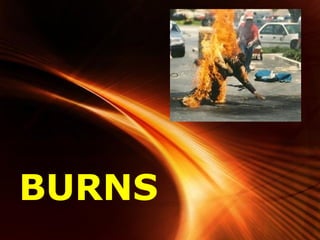
BURNS
Powerpoint Templates
Page 2
By the end of the lesson, cadets
should be able to:
1. List and describe the three types of
burns
2. Assess the severity of burn injuries
3. Administer first aid treatment to the
victim
Powerpoint Templates
Page 3
• Introduction
• Types of Burns
• Severity of
Burns
• Treatment of
Burns
• Conclusion
Scope
Powerpoint Templates
Page 4
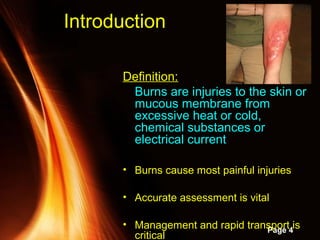
Definition:
Burns are injuries to the skin or
mucous membrane from
excessive heat or cold,
chemical substances or
electrical current
• Burns cause most painful injuries
• Accurate assessment is vital
• Management and rapid transport is
critical
Introduction
Powerpoint Templates
Page 5
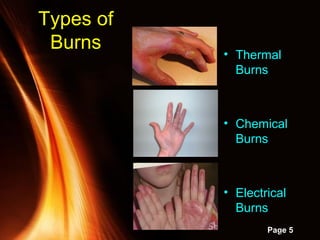
• Thermal
Burns
• Chemical
Burns
• Electrical
Burns
Types of
Burns
Powerpoint Templates
Page 6
The following slide contain
pictures of shocking nature
Warning!
Powerpoint Templates
Page 7
• Thermal Burns:
– Destroy tissues through heat
– Burning in the tissues
continues for about 10
minutes following the critical
burn injury
– Smoke inhalation and carbon
monoxide poisoning
Types of Burns
Powerpoint Templates
Page 8
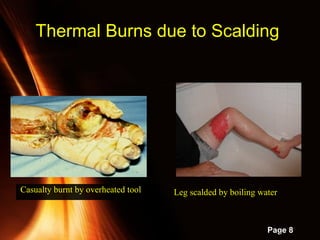
Thermal Burns due to ScaldingThermal Burns due to Scalding
Leg scalded by boiling waterLeg scalded by boiling waterCasualty burnt by overheated tool
Powerpoint Templates
Page 9
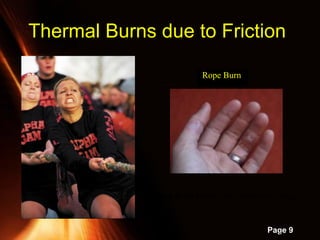
Thermal Burns due to FrictionThermal Burns due to Friction
Rope Burn blisters on nearly every finger
Rope Burn
Powerpoint Templates
Page 10
• Chemical Burns
– chemical contact
– destroy tissues through protein
coagulation
– extent of tissue destruction depends on
duration of contact, concentration &
amount of tissue exposed
Types of Burns
Powerpoint Templates
Page 11
The following slide contain
pictures of shocking nature
Warning!
Powerpoint Templates
Page 12
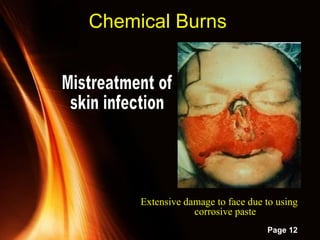
Chemical Burns
Extensive damage to face due to usingExtensive damage to face due to using
corrosive pastecorrosive paste
Powerpoint Templates
Page 13
• Electrical Burns:
– Occurs when some body parts complete
the electrical circuit
– Electrical current passes through the body
and destroys internal tissue (muscles,
nerves, etc)
– Can be extremely deceiving (not obvious)
as there may be no significant signs of
surface burns
– A small surface wound may uncover
widespread underlying tissue damage
– May induce cardiac arrest (heart failure)
Types of Burns
Powerpoint Templates
Page 14
The following slide contain
pictures of shocking nature
Warning!
Powerpoint Templates
Page 15
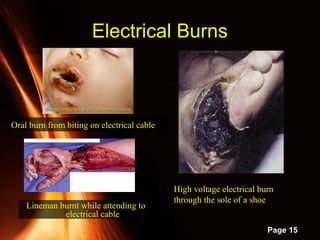
Electrical BurnsElectrical Burns
Oral burn from biting on electrical cable
High voltage electrical burn
through the sole of a shoe
Lineman burnt while attending to
electrical cable
Powerpoint Templates
Page 16
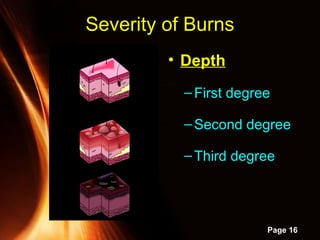
• Depth
–First degree
–Second degree
–Third degree
Severity of Burns
Powerpoint Templates
Page 17
The following slide contain
pictures of shocking nature
Warning!
Powerpoint Templates
Page 18
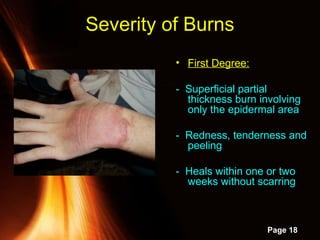
Severity of Burns
• First Degree:
- Superficial partial
thickness burn involving
only the epidermal area
- Redness, tenderness and
peeling
- Heals within one or two
weeks without scarring
Powerpoint Templates
Page 19
Severity of Burns
• Second Degree:
- Deep, partial thickness
burn involving the dermis
and epidermis
- Characterised by red or
mottled (spots) skin, often
with blisters
Powerpoint Templates
Page 20
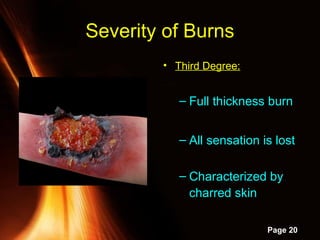
• Third Degree:
– Full thickness burn
– All sensation is lost
– Characterized by
charred skin
Severity of BurnsSeverity of Burns
Powerpoint Templates
Page 21
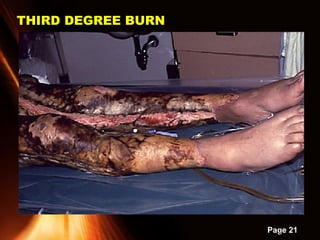
THIRD DEGREE BURNTHIRD DEGREE BURN
Powerpoint Templates
Page 22
• Reduce the spread of heat, pain and swelling by placing the burnt
area under cold running water or immersing it in cold water for at
least 10 minutes
• Gently remove any rings, watches, belts or constricting
clothing from the injured area before it starts to swell
• Cover the injured area with clean, preferably sterile, non-
fluffy material
• A burnt face may be covered with a gauze mask, with holes cut
into it to assist the victim in breathing.
Treating Burns and Scalds
First AidFirst Aid
Powerpoint Templates
Page 23
• Do not break blisters or remove anything that is
sticking to a burn.
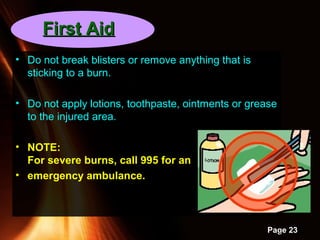
• Do not apply lotions, toothpaste, ointments or grease
to the injured area.
• NOTE:
For severe burns, call 995 for an
• emergency ambulance.
First AidFirst Aid
Powerpoint Templates
Page 24
Time to test your knowledge!
Powerpoint Templates
Page 25
What is the definition of burns?
Question 1
Burns are injuries to the
skin or mucous membrane
from excessive heat or
cold, chemical substances
and electrical current
Powerpoint Templates
Page 26
Name the three types of burns.
Question 2
Thermal Burns
Chemical Burns
Electrical Burns
Powerpoint Templates
Page 27
What are the features of
second-degree burns?
Question 3
Deep, partial thickness burn
involving the dermis and
epidermis
Characterised by red or mottled
(spots) skin, often with blisters
Powerpoint Templates
Page 28
While some burns may be treated
with first aid, most burns are
severe injuries that require
immediate medical attention.
In general, if you are unsure of the
severity of any burn, seek medical
attention promptly.
Conclusion

1.3.3 burns

  • 1.
  • 2.
    Powerpoint Templates Page 2 Bythe end of the lesson, cadets should be able to: 1. List and describe the three types of burns 2. Assess the severity of burn injuries 3. Administer first aid treatment to the victim
  • 3.
    Powerpoint Templates Page 3 •Introduction • Types of Burns • Severity of Burns • Treatment of Burns • Conclusion Scope
  • 4.
    Powerpoint Templates Page 4 Definition: Burnsare injuries to the skin or mucous membrane from excessive heat or cold, chemical substances or electrical current • Burns cause most painful injuries • Accurate assessment is vital • Management and rapid transport is critical Introduction
  • 5.
    Powerpoint Templates Page 5 •Thermal Burns • Chemical Burns • Electrical Burns Types of Burns
  • 6.
    Powerpoint Templates Page 6 Thefollowing slide contain pictures of shocking nature Warning!
  • 7.
    Powerpoint Templates Page 7 •Thermal Burns: – Destroy tissues through heat – Burning in the tissues continues for about 10 minutes following the critical burn injury – Smoke inhalation and carbon monoxide poisoning Types of Burns
  • 8.
    Powerpoint Templates Page 8 ThermalBurns due to ScaldingThermal Burns due to Scalding Leg scalded by boiling waterLeg scalded by boiling waterCasualty burnt by overheated tool
  • 9.
    Powerpoint Templates Page 9 ThermalBurns due to FrictionThermal Burns due to Friction Rope Burn blisters on nearly every finger Rope Burn
  • 10.
    Powerpoint Templates Page 10 •Chemical Burns – chemical contact – destroy tissues through protein coagulation – extent of tissue destruction depends on duration of contact, concentration & amount of tissue exposed Types of Burns
  • 11.
    Powerpoint Templates Page 11 Thefollowing slide contain pictures of shocking nature Warning!
  • 12.
    Powerpoint Templates Page 12 ChemicalBurns Extensive damage to face due to usingExtensive damage to face due to using corrosive pastecorrosive paste
  • 13.
    Powerpoint Templates Page 13 •Electrical Burns: – Occurs when some body parts complete the electrical circuit – Electrical current passes through the body and destroys internal tissue (muscles, nerves, etc) – Can be extremely deceiving (not obvious) as there may be no significant signs of surface burns – A small surface wound may uncover widespread underlying tissue damage – May induce cardiac arrest (heart failure) Types of Burns
  • 14.
    Powerpoint Templates Page 14 Thefollowing slide contain pictures of shocking nature Warning!
  • 15.
    Powerpoint Templates Page 15 ElectricalBurnsElectrical Burns Oral burn from biting on electrical cable High voltage electrical burn through the sole of a shoe Lineman burnt while attending to electrical cable
  • 16.
    Powerpoint Templates Page 16 •Depth –First degree –Second degree –Third degree Severity of Burns
  • 17.
    Powerpoint Templates Page 17 Thefollowing slide contain pictures of shocking nature Warning!
  • 18.
    Powerpoint Templates Page 18 Severityof Burns • First Degree: - Superficial partial thickness burn involving only the epidermal area - Redness, tenderness and peeling - Heals within one or two weeks without scarring
  • 19.
    Powerpoint Templates Page 19 Severityof Burns • Second Degree: - Deep, partial thickness burn involving the dermis and epidermis - Characterised by red or mottled (spots) skin, often with blisters
  • 20.
    Powerpoint Templates Page 20 •Third Degree: – Full thickness burn – All sensation is lost – Characterized by charred skin Severity of BurnsSeverity of Burns
  • 21.
    Powerpoint Templates Page 21 THIRDDEGREE BURNTHIRD DEGREE BURN
  • 22.
    Powerpoint Templates Page 22 •Reduce the spread of heat, pain and swelling by placing the burnt area under cold running water or immersing it in cold water for at least 10 minutes • Gently remove any rings, watches, belts or constricting clothing from the injured area before it starts to swell • Cover the injured area with clean, preferably sterile, non- fluffy material • A burnt face may be covered with a gauze mask, with holes cut into it to assist the victim in breathing. Treating Burns and Scalds First AidFirst Aid
  • 23.
    Powerpoint Templates Page 23 •Do not break blisters or remove anything that is sticking to a burn. • Do not apply lotions, toothpaste, ointments or grease to the injured area. • NOTE: For severe burns, call 995 for an • emergency ambulance. First AidFirst Aid
  • 24.
    Powerpoint Templates Page 24 Timeto test your knowledge!
  • 25.
    Powerpoint Templates Page 25 Whatis the definition of burns? Question 1 Burns are injuries to the skin or mucous membrane from excessive heat or cold, chemical substances and electrical current
  • 26.
    Powerpoint Templates Page 26 Namethe three types of burns. Question 2 Thermal Burns Chemical Burns Electrical Burns
  • 27.
    Powerpoint Templates Page 27 Whatare the features of second-degree burns? Question 3 Deep, partial thickness burn involving the dermis and epidermis Characterised by red or mottled (spots) skin, often with blisters
  • 28.
    Powerpoint Templates Page 28 Whilesome burns may be treated with first aid, most burns are severe injuries that require immediate medical attention. In general, if you are unsure of the severity of any burn, seek medical attention promptly. Conclusion

Editor's Notes

  • #3 NOTES Inform the trainees that at the end of this lesson, they are expected to achieve the three learning objectives set out as follows:- - List and describe the three types of burns. - Assess the severity, depth and extent of injury. - Assess and administrate management treatment steps to the victim.
  • #4 Briefly inform the cadets of the scope of the lesson
  • #5 NOTES Explain the definition of burns Explain to the trainees that burns cause some of the most painful and catastrophic injuries you will encounter in the field. Your accurate assessment, management and rapid transport of burn victims- particularly those with inhalation injuries - is often critical to their survival.
  • #6 NOTES State that there are three types of burns:
  • #8 NOTES State that thermal burn destroys tissue through heat. Burning in the tissues continues for about 10 minutes following the critical burn injury. Thermal burns are often accompanied by serious complications like smoke inhalation and carbon monoxide poisoning.
  • #11 NOTES State that a chemical burn results when a chemical comes in contact with the skin. Chemicals usually destroy tissue through protein coagulation rather than heat. The extent of tissue destruction in chemical burns depends primarily on three factors: - duration of contact - concentration or strength of chemical - amount of tissue exposed to the chemical
  • #14 NOTES State that an electrical burn occurs some parts of the body complete the circuit between two conductors. Electrical burns can be extremely deceiving. A small surface wound may cover widespread underlying tissue damage. As the current passes through the body, destruction of muscle, nerve, and blood vessels can occur. Tetanic muscle contractions can be strong enough to fracture long bones and the vertebrae. Further disruption of cardiac contraction or damage to myocardium can induce cardiac arrest. Frequently, the electrical current interferes with the body’s own electrical activity, resulting in cardiac and neurogenic complications. Arrhythmia, respiratory arrest, muscle spasm and seizures are all common conditions. In cases of cardiac arrest, defibrillation and CPR have proven to be effective. CPR must be continued until the patient is provided with ACLS.
  • #17 NOTES State that the depth of a thermal burn can range from a very superficial to very deep. The classifications of the depth are first, second and third degree. First Degree: Involves only the outermost layer of skin. Superficial burns are characterised by redness, swelling, and tenderness Second Degree: Affects the epidermis, and the skin becomes red and raw. Blisters form over the skin due to fluid released from the damaged tissues Third Degree: All the layers of the skin are affected; there may be some damage to nerves, fat tissue, muscles, and blood vessels
  • #19 NOTES Explain that a first degree burn is a superficial partial thickness burn involving only the epidermal area. Signs and symptoms includes redness, tenderness and peeling. First degree burns heal within one or two weeks without scarring.
  • #20 NOTES State that second degree burn is a deep, partial thickness burn involving the dermis and epidermis. The epidermal cells, which line the hair follicles and sweat glands, are usually preserved. A second degree burn is characterised by red or mottled skin, pain, blisters or open weeping areas and swelling. This burn heals within two or three weeks without scarring.
  • #21 NOTES State that third degree burn is a full thickness burn which destroys the epidermis, dermis, sub-cutaneous layer, and deeper layers. All sensation is lost because the sensory organs are destroyed. The third degree burn is characterized by white or charred skin, a loss of skin, and an absence of pain except around the burn margins. Healing is paralyzed with scar tissue formation.
  • #23 NOTES The instructor explains the treatment and management of a burn victim should follow the patient assessment method Removal of casualty from danger area: The medic must remove the casualty from any immediate danger. Primary survey: - Ensure an open airway and adequate breathing. If unconscious, airway obstruction must be removed by head-tilt- chin-lift method. Give artificial ventilation if necessary. - Ensure adequate circulation. In case of severe haemorrhage, arrest it immediately. Check carotid pulse and note shock signs. - Fluid resuscitation in a burn casualty. Intravenous infusion is important. Lost fluids should be replenished immediately to prevent further dehydration.
  • #29 NOTES The instructor will revise the main sections of the topic: - Definition - Types of burns - Assessment of burns - Management of burns The instructor will clarify any questions from the trainees.