STRETCHER DRILLS
Transportation of Casualties with Stretcher
LEARNING OBJECTIVES
By the end of this lesson, cadets should be able to:
 understand the purpose of the various types of
stretchers
 load / unload casualties onto stretchers
 transport casualties with stretchers
SCOPE
 Rescue Preliminaries
 Types of Stretchers
 Principle of evacuating casualties with stretchers
 Loading / unloading of casualty onto the stretcher
 Transporting of casualty with the stretcher
 Execution of stretcher drill
 Questions and Answers
 Conclusion
RESCUE PRELIMINARIES
Rescue helmet and gloves to be worn at all
times
Smart 4 rolled down to Long 4
Ensure all surrounding hazards are cleared
before approaching for victim for rescue
RESCUE PRELIMINARIES
Make sure hands are tucked into the belt and
legs are crossed
TYPES OF STRETCHERS
1. Collapsible Stretcher
2. Sked Stretcher
3. Basket Stretcher
4. Perforated Stretcher
5. Roller Stretcher
6. Scoop Stretcher
PRINCIPLES OF EVACUATING
CASUALTIES BY STRETCHERS
Stretcher is to be kept as level as possible
Constant watch casualty’s head to determine
and prevent of aspiration/ respiratory failure
Look for any recurrence of haemorrhage
LOADING/UNLOADING OF
CASUALTY ONTO THE STRETCHER
Opening of collapsible stretcher
1.
2.
LOADING/UNLOADING OF
CASUALTY ONTO THE STRETCHER
Opening of collapsible stretcher
3. 4.
LOADING/UNLOADING OF
CASUALTY ONTO THE STRETCHER
Getting ready to lift casualty
(For normal/light weight casualty)
6.5.
LOADING/UNLOADING OF
CASUALTY ONTO THE STRETCHER
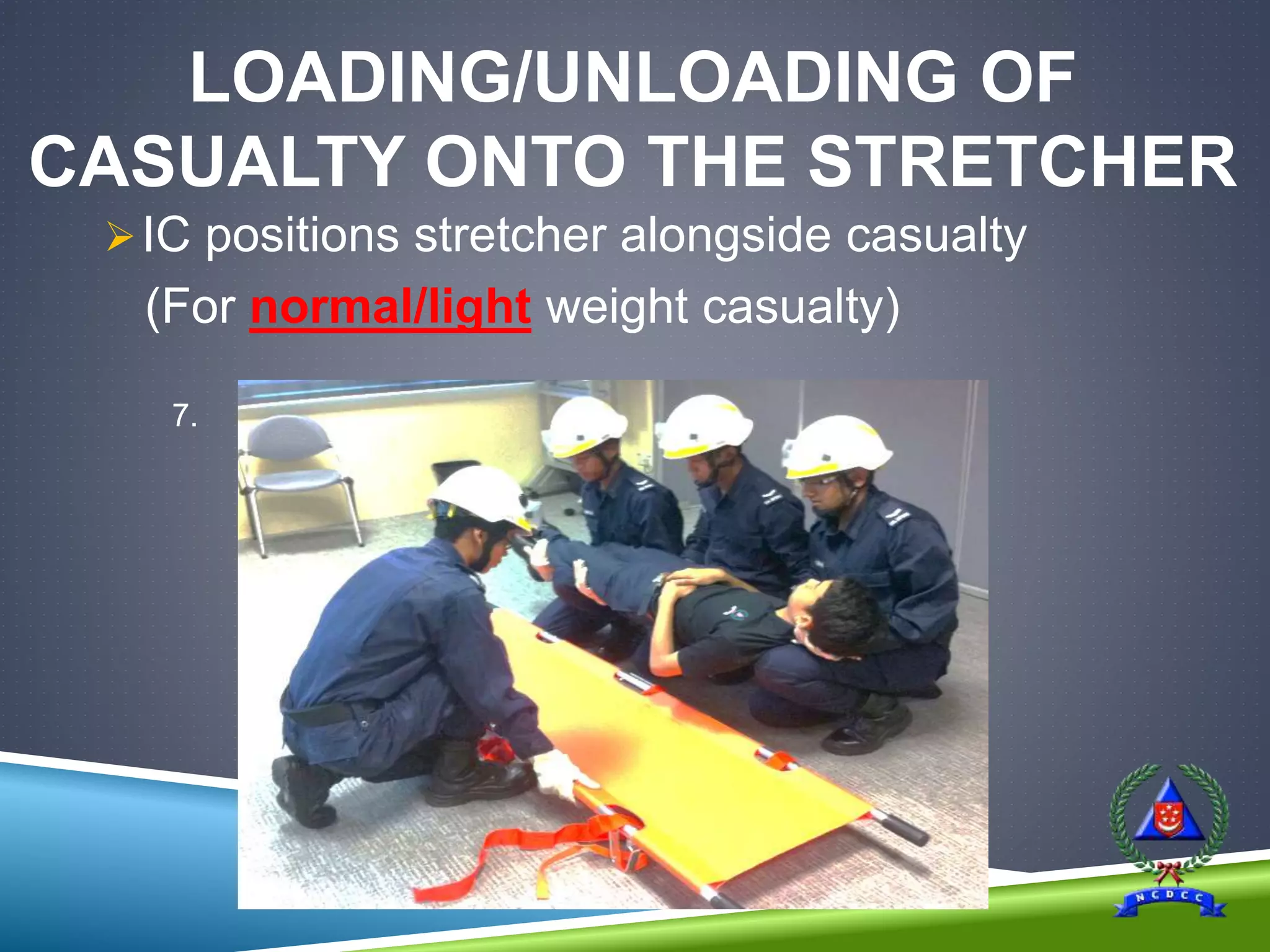
IC positions stretcher alongside casualty
(For normal/light weight casualty)
7.
LOADING/UNLOADING OF
CASUALTY ONTO THE STRETCHER
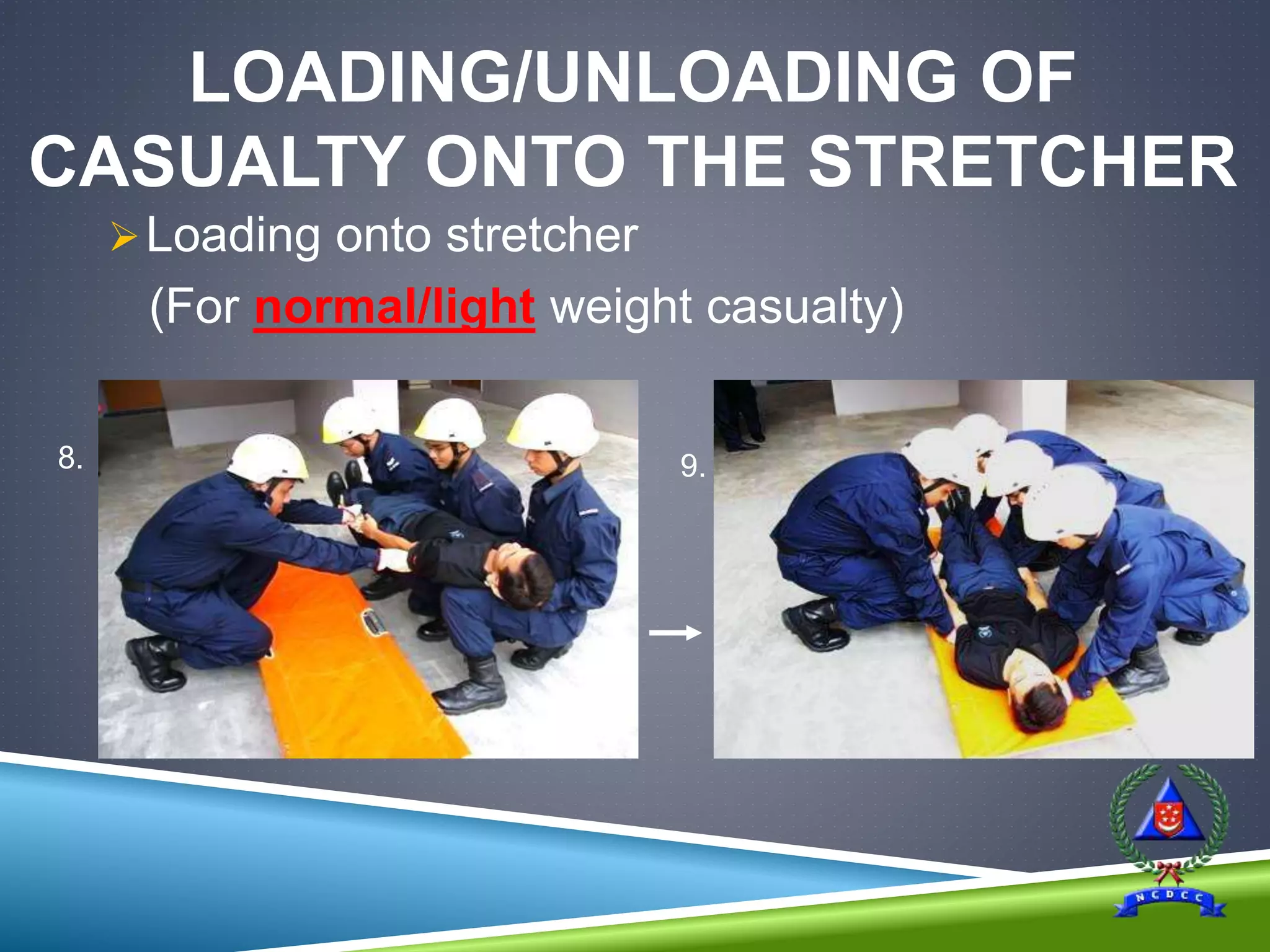
Loading onto stretcher
(For normal/light weight casualty)
8. 9.
LOADING/UNLOADING OF
CASUALTY ONTO THE STRETCHER
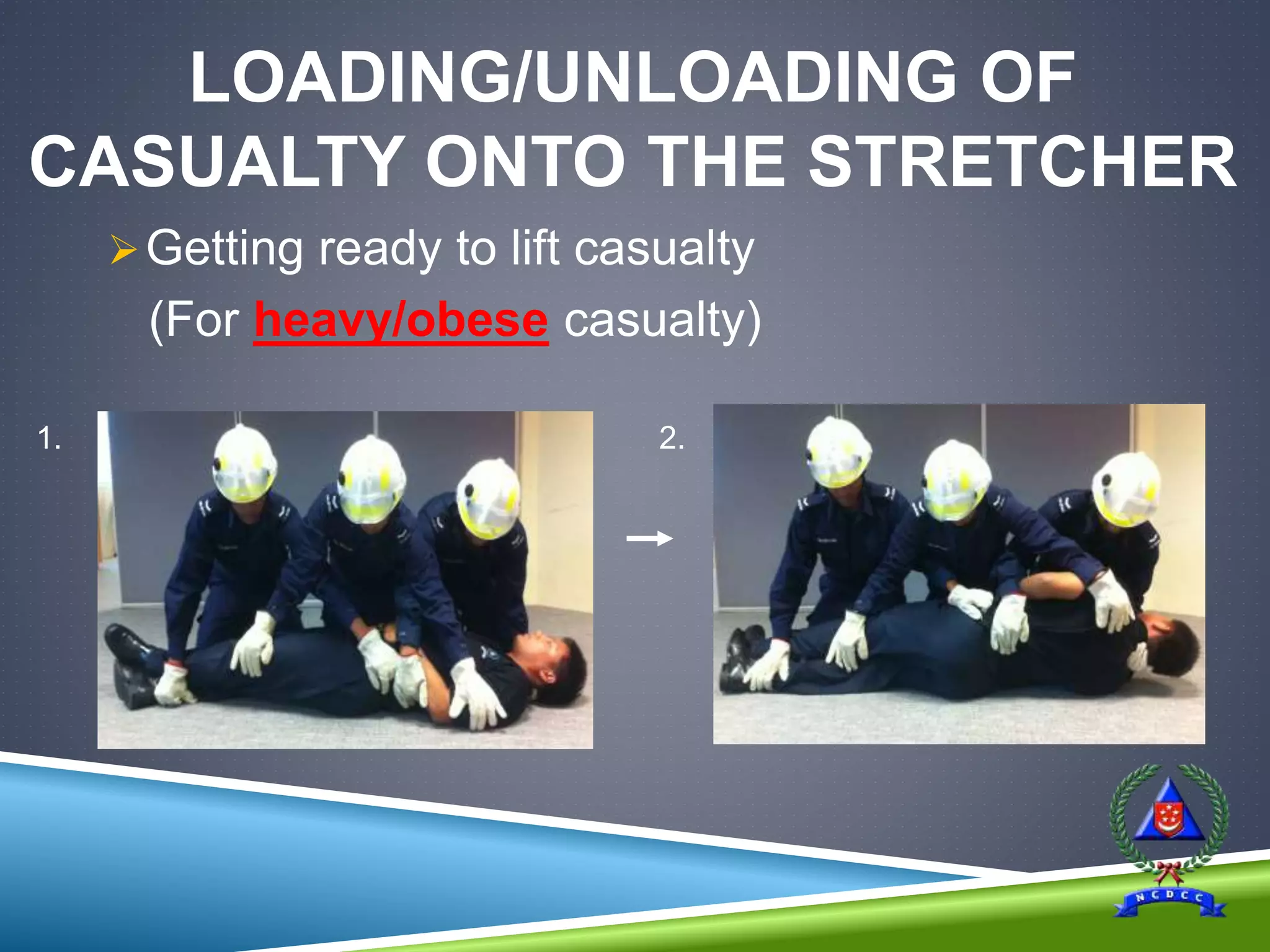
Getting ready to lift casualty
(For heavy/obese casualty)
1. 2.
LOADING/UNLOADING OF
CASUALTY ONTO THE STRETCHER
Loading onto stretcher
(For heavy/obese casualty)
3.
TRANSPORTING OF CASUALTY
WITH THE STRETCHER
 From ground level to waist level, 1..2..3.. up
(IC’s position is either side of the casualty’s head )
1.
TRANSPORTING OF CASUALTY
WITH THE STRETCHER
Ready, 1..2..3.. move.
(Move off with casualty’s legs first)
2.
TRANSPORTING OF CASUALTY
WITH THE STRETCHER
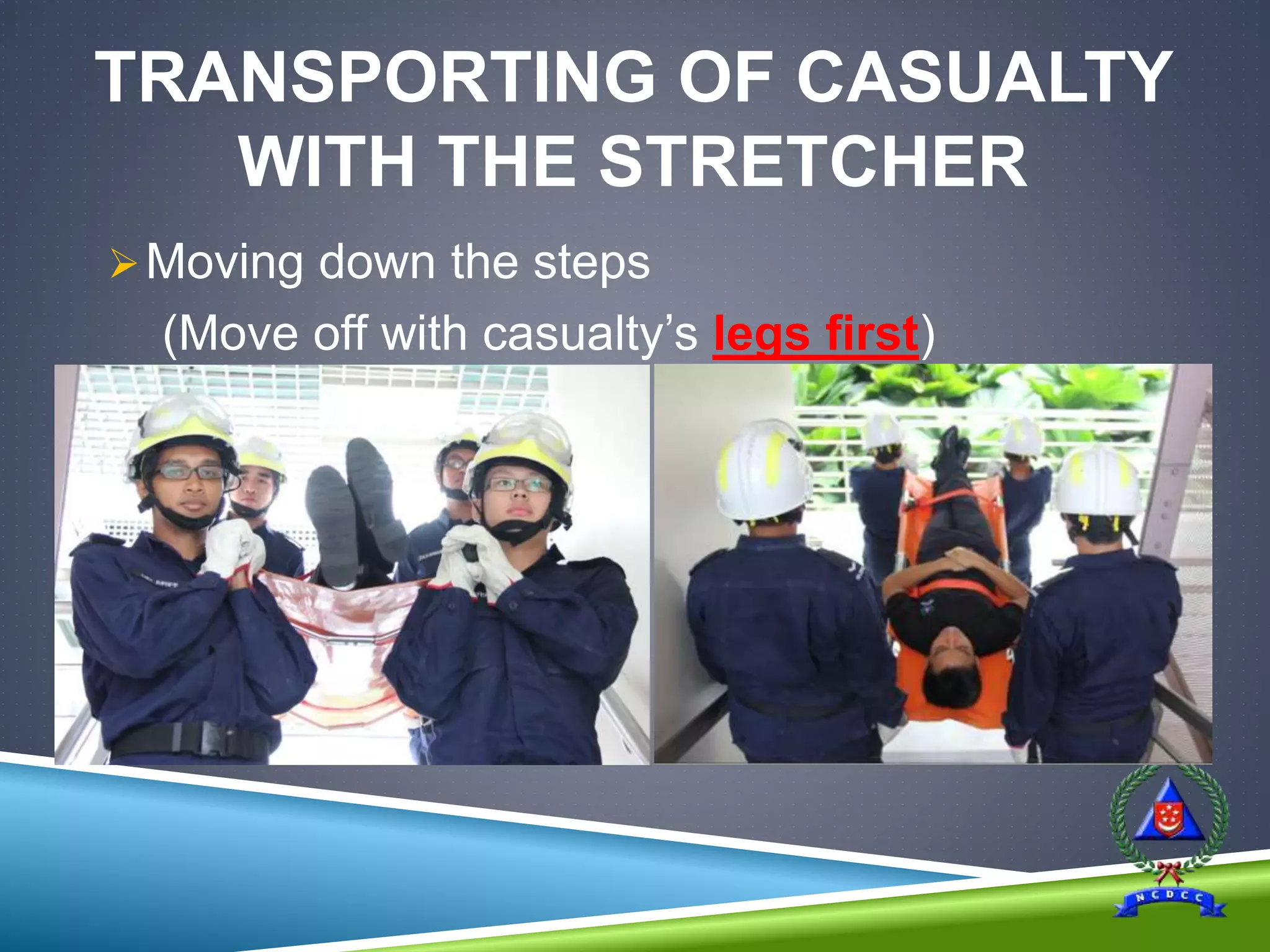
Moving down the steps
(Move off with casualty’s legs first)
2.
TRANSPORTING OF CASUALTY
WITH THE STRETCHER
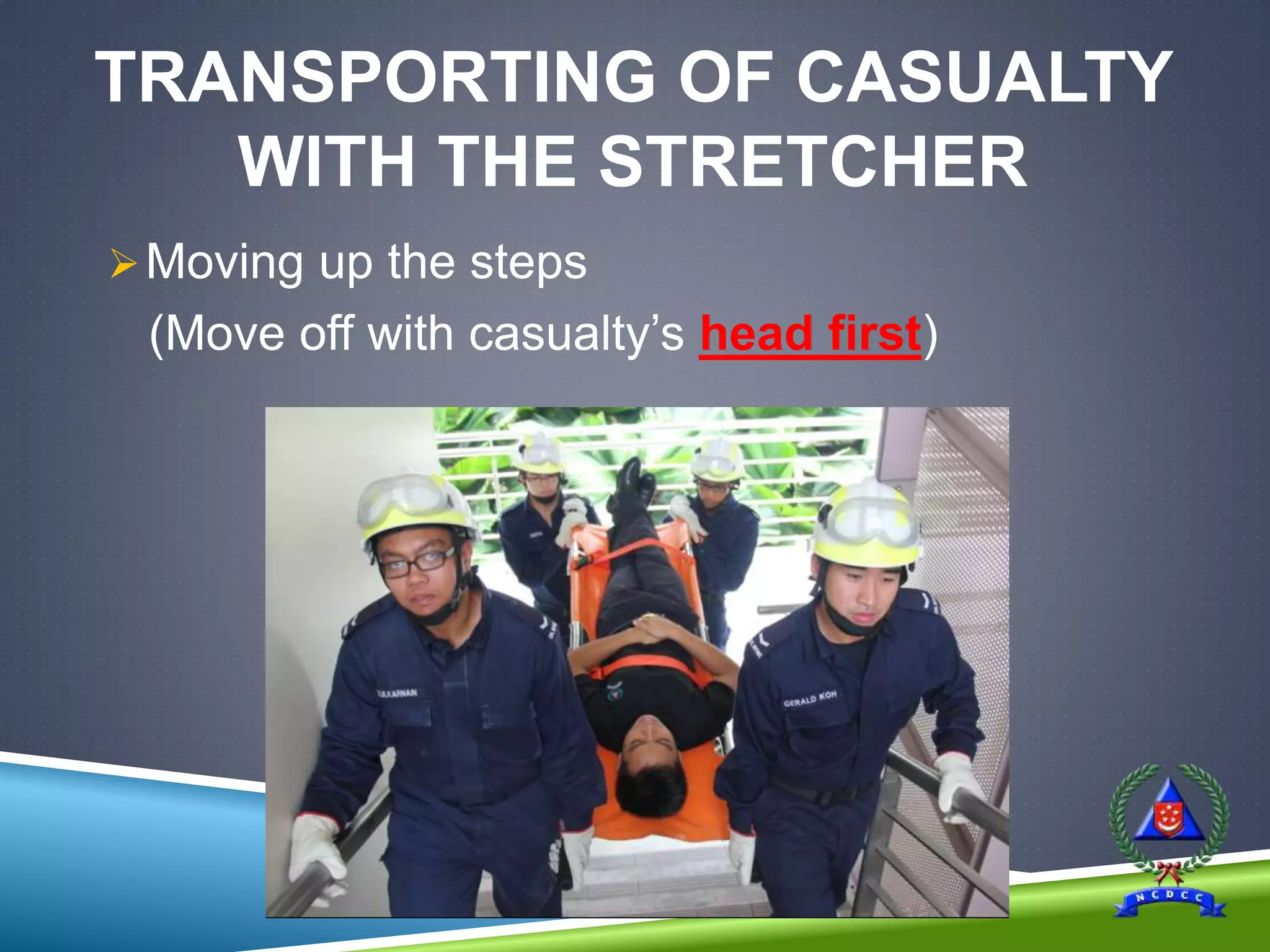
Moving up the steps
(Move off with casualty’s head first)
PRACTICE ON
STRETCHER DRILL
QUESTIONS?
CONCLUSION
 Adhere to safety precautions when
transporting casualty.
 Stretcher must always be kept level
whenever possible
 Movement must be coordinated to
maximize safety

2.3.1 stretcher drill

Editor's Notes

  • #7 Collapsible Stretcher - Mainly used during sports events. Can be folded twice Sked Stretcher – Used for aerial evacuation, confined space rescue, hauling casualty over rough outdoor surfaces Basket Stretcher - To secure injured casualty with spinal injuries. To hoist from height or depth. Perforated Stretcher - For decontaminating casualties (Hazmat purpose) Roller Stretcher - A stretcher on a variable-height wheeled frame. To facilitate moving the patient onto a fixed bed or table on arrival at the emergency room. Scoop Stretcher - Suitable for casualty with spinal injuries.
  • #13 Add textbox on hand position (interlace)
  • #14 Add textbox on hand position (interlace)
  • #16 Change photo (elbow must be tucked in)
  • #18 Note: If casualty were to slip from the stretcher, he would land leg first. (Moving off with legs first)
  • #19 Note: If casualty were to slip from the stretcher, he would land leg first. (Moving off with heads first)