Genetic Engineering, Crop
Improvement and Biotechnology
Chris Leaver
chris.leaver@plants.ox.ac.uk
Map of the world showing the major centres of origin
of crops, which are distributed mainly in tropical
regions
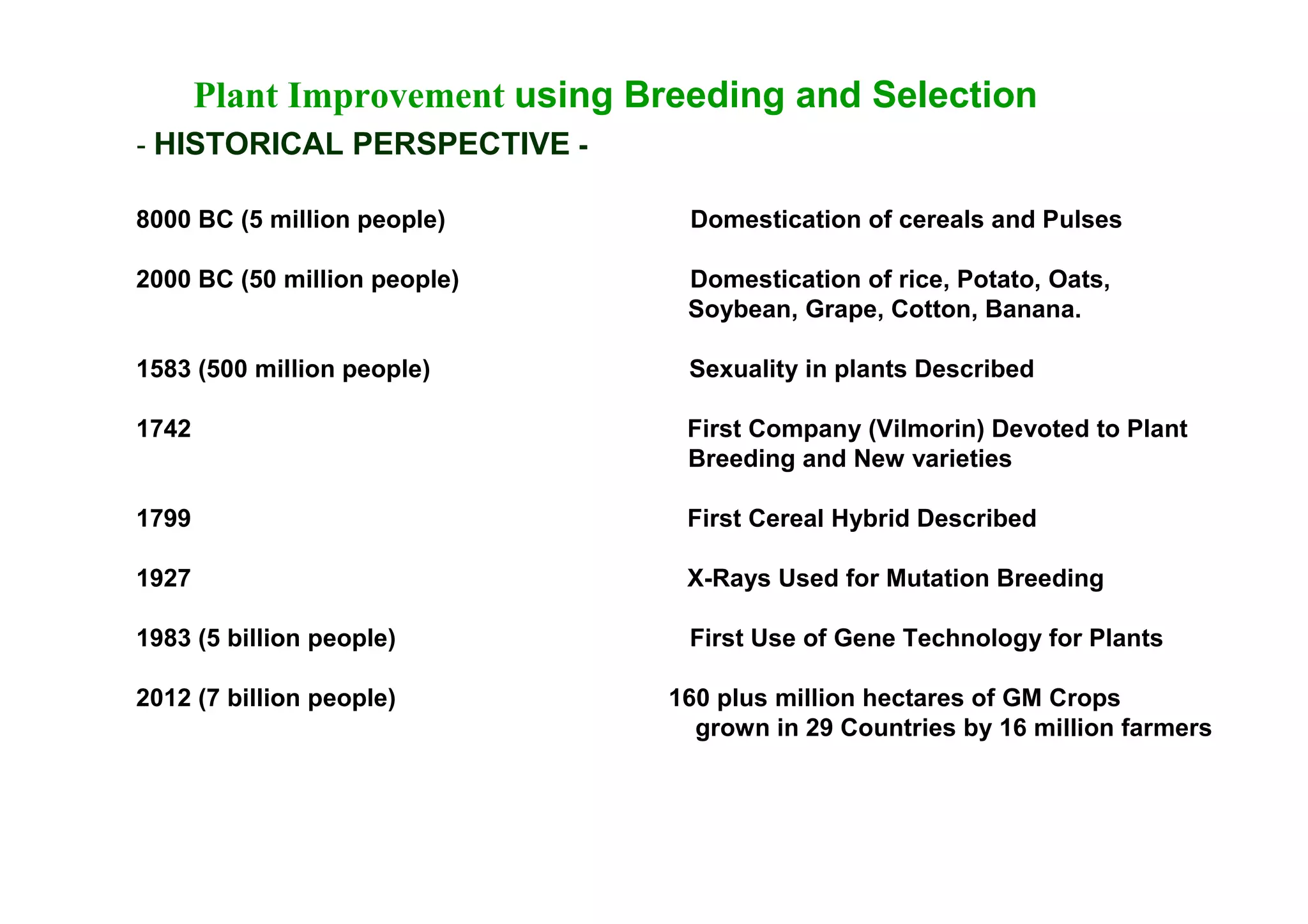
Plant Improvement using Breeding and Selection
- HISTORICAL PERSPECTIVE 8000 BC (5 million people)

Domestication of cereals and Pulses

2000 BC (50 million people)

Domestication of rice, Potato, Oats,
Soybean, Grape, Cotton, Banana.

1583 (500 million people)

Sexuality in plants Described

1742

First Company (Vilmorin) Devoted to Plant
Breeding and New varieties

1799

First Cereal Hybrid Described

1927

X-Rays Used for Mutation Breeding

1983 (5 billion people)

First Use of Gene Technology for Plants

2012 (7 billion people)

160 plus million hectares of GM Crops
grown in 29 Countries by 16 million farmers
The evolution of maize (corn)
Domestication

The adaptation
to Europe

Extension of corn
crop
areas

years

The wild
ancestor

Teosinte

First corns

America

Mexico

Populations
South of Europe
Introduction

Hybrids
First creation of
hybrids in France

SOURCE: GNIS (Groupement National Interprofessionnel des Semences)
Genetic modification arose as a consequence
of cultivation and selection of the best plants
Planting seeds from
“good” plants increased
their representation in
subsequent generations

Natural
variation
within
population

Image courtesy of University of California Museum of Paleontology, Understanding Evolution - www.evolution.berkeley.edu
F1 Hybrid Seed Production in
self-pollinating crop species –
a basis for crop improvement and
the development of heterosis or
hybrid vigour
F1 hybrid seed production in a range of major crops
including Maize, Rice, Sorghum, Sunflower, Sugar Beet,
Carrot, Onions, Brassica’s etc
F1 Hybrid Seed Production in Maize

Pollen - male parent
Female parent
Tassel removed

F1 Hybrid

X

Ear

Inbred Parental Corn
Lines

Hybrid Vigour
F1 Hybrid Maize Production Field
Detasseled Maize
Hybrids
Selection and Plant Breeding was Applied to a
Range of Important Crops we Grow Today

Teosinte

Rice

Corn

Tomato
The Creation of Corn
The corn that Columbus received was
created by the Native Americans some
8,000 years ago by domestication of a
wild plant called teosinte. They used
‘genetic engineering’ in a quite remarkable
way to produce a more productive variety.
PRODUCTS OF MODERN BREEDING

Tomatoes

Peppers

Potato
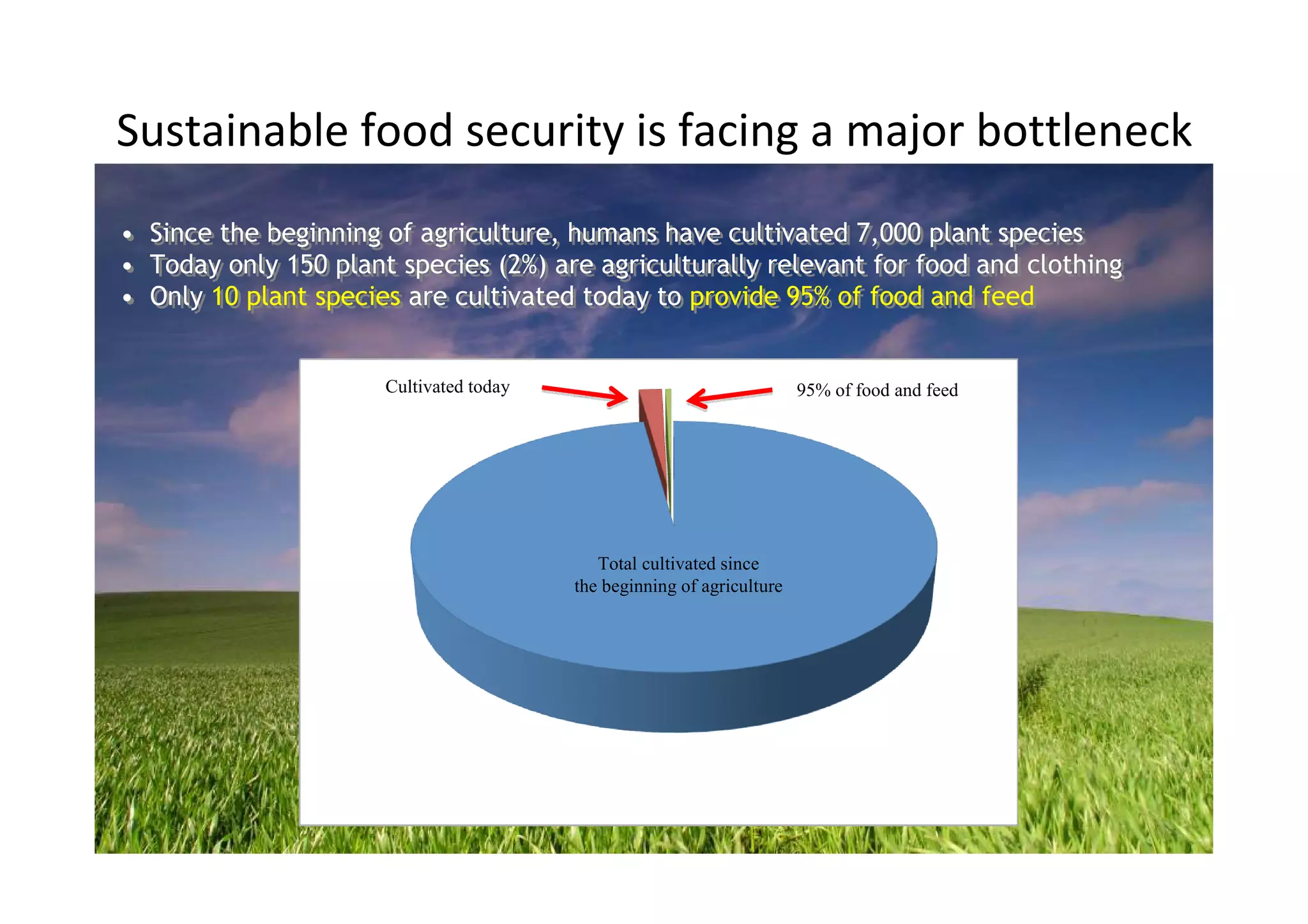
Sustainable food security is facing a major bottleneck
•
•
•
•
•
•

Since the beginning of agriculture, humans have cultivated 7,000 plant species
Today only 150 plant species (2%) are agriculturally relevant for food and clothing
Only 10 plant species are cultivated today to provide 95% of food and feed
Cultivated today

95% of food and feed

Total cultivated since
the beginning of agriculture
Mankind depends on a few crop species for our food
The top four – Global yield
(UN-FAO Statistics)
Soybean

Wheat

2nd
4th

Maize

Rice

1st
3rd
The myth of natural food
The food we eat comes from
plants already extensively
modified from their original
form. Even heritage varieties are
extensively genetically modified.

Credit: Nicolle Rager Fuller, National Science Foundation
What traits/characteristics are
selected by plant breeders?
•
•
•
•
•
•
•
•
•
•
•

Improved Nutrition
Improved Yield
Improved Rate of growth
Self-pollinating
Reduced pod shatter
Able to harvest & store the fruit
Palatability
Better Taste
Reduced toxins
Reduced / negligible dormancy requirement
Disease resistance

THESE TRAITS ARE ENCODED BY GENE(S)
DNA: the language of life
Cell
Chromosome

Nucleus

Gene

DNA
There are 25-40,000 genes found in the nucleus
of each plant cell depending on the species
DNA APPEARS BLUE

CSIRO.
Introduction to
A gene is a code for a protein
Ca.25000 GENES

CSIRO. A
plant Gene
The set of genes is the master plan which
contains all the information to make a plant

What is a gene?
Control
Switch

Code for
Protein

Downstream
control region

DNA
Start

RNA

Protein
Enzymes

Stop
Genes provide the foundation of new
plants/products for farmers

Genes

Protein

Yield?
Tolerance to
drought?
Flowering time?

Trait

Nutrition
Taste?
Tolerance to Pests
and Diseases

Product
Maize
Genome/DNA sequence data (the masterplan) are
available for many important crop plants
Advanced Genomics Will Accelerate
Discovery of Genes of Use to Farmers
Gene
sequence

Genome Gene
DNA
map
t

c

g

c

g

t

g

a

t

g

t

c

t

g

t

c

a

t

a

t

g

g

g

t

g

a

a

t

a

t

t

a

c

c

t

g

g

c

g

t

GENE

g

g
a

c

g

c

t

Gene
expression

g

SEQUENCE FUNCTION

Plant
traits
Yield
Drought
Disease
Stress
Stress
Oil quality
Disease
Yield
Maturity
Herbicide
tolerance

TRAIT
Finding the needle in a haystackplant gene discovery
If selective breeding and genetic
modification are based on genes,
how does one go about finding
the genes of interest?
The Challenge: Finding the genes that provide the foundation of new
traits and crop improvements for farmers
A Central Role for Omics, BioInformatics and Systems Biology

Technology
Platforms
Bioinformatics

Modelling physiology

0
Transcriptomics

Metabolomics

Proteomics

leaf 2

s te
m

leaf 3

f1

Process

Grain filling
lea

Genome Sequencing

Molecular profiling

Time post anthesis

PhenomicsTRAIT ANALYSIS
Building Increased Productivity and
Sustainability into the Seed by
Plant Breeding and Biotechnology
The scientific basis of all crop improvement is
identification of the genes that encode and
regulate specific phenotypic characteristics or
traits of use to the farmer:
Genetic modification by marker assisted
breeding (MAB) and GM technology where
appropriate:
NEW TOOLS FOR CROP
IMPROVEMENT
Elite
Germplasm

Gene
Sequencing

r
ula g
c
ole edin
M re
B

Marker Assisted
BREEDING

Seeds

Better
Varieties,
Faster

Seed
Production

GENOMICS
Functional
Genomics

Finding the
Genes

Ge
ne
s

Trait
Development

PLANT
BIOTECH
Plant
Transformation

Traits

New Traits
of
Use to the
Farmer
Using molecular-gene markers
Healthy wheat Infected wheat

Isolate DNA from young plants

RRRR rr rr RR rr RR rr RR rr rr

Selected plants
What is Genetic Modification?
Genetic modification is the addition, alteration or removal of
genetic material, usually single genes, in order to alter an
organism’s characteristics.
Living organisms contain 5,000-30,000 genes arranged in linear
order in chromosomes which are long strands of DNA.
Genes are heritable segments of DNA that contain the code
for an individual protein molecule.
Nucleus
ca.25,000
Genes
Chloroplasts
ca.80 Genes

Mitochondria
ca.60 Genes
Genetic Information in a Plant Cell
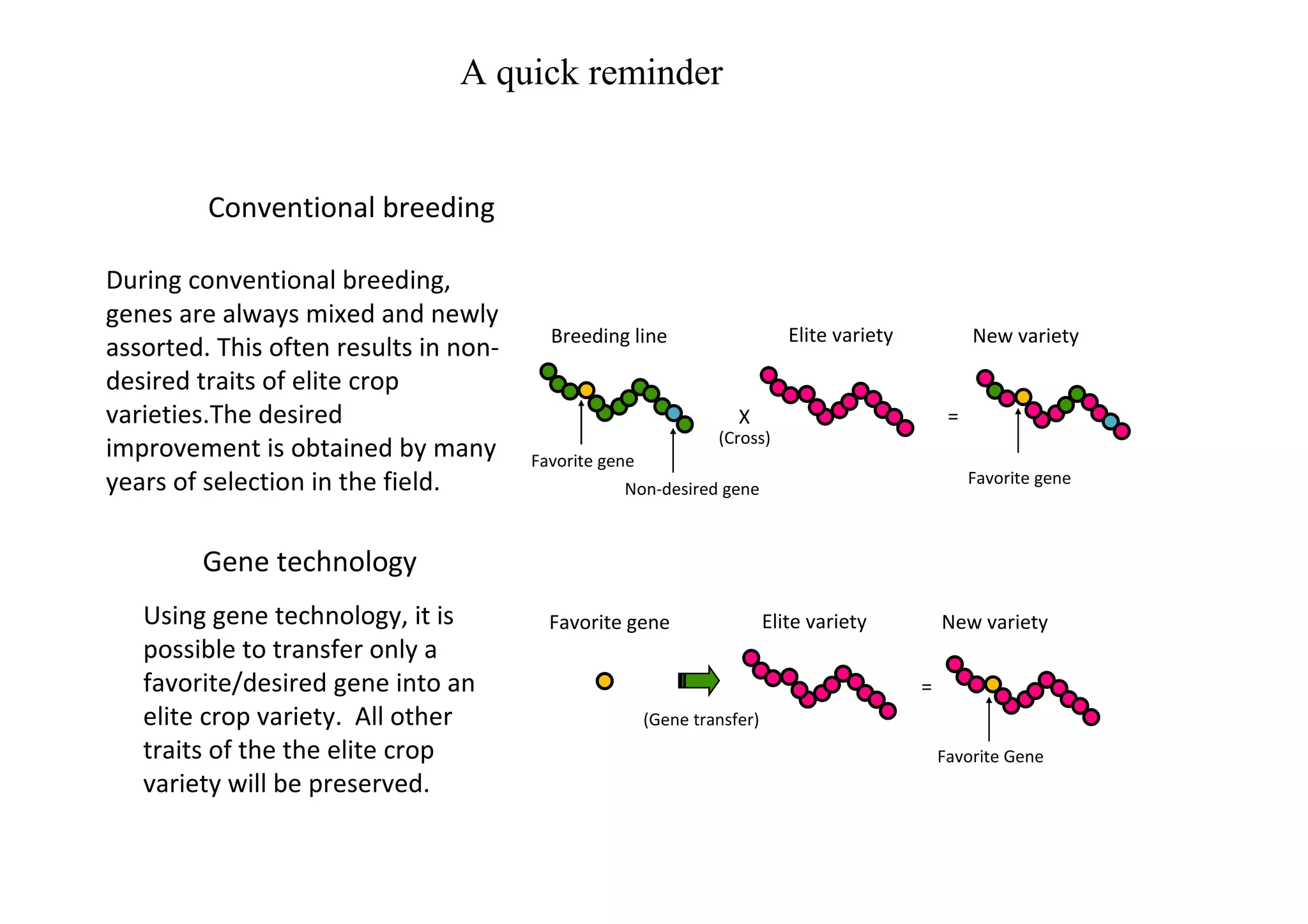
A quick reminder

Conventional breeding
During conventional breeding,
genes are always mixed and newly
assorted. This often results in nondesired traits of elite crop
varieties.The desired
improvement is obtained by many
years of selection in the field.

Elite variety

Breeding line

New variety

=

X
(Cross)
Favorite gene

Favorite gene

Non-desired gene

Gene technology
Using gene technology, it is
possible to transfer only a
favorite/desired gene into an
elite crop variety. All other
traits of the the elite crop
variety will be preserved.

Favorite gene

Elite variety

New variety
=

(Gene transfer)
Favorite Gene
Gene Transfer by Classical Plant Breeding

25,000 genes

25,000 genes

Selection
S = gene for susceptibility to pest
R = gene for resistance to pest
R=gene for resistance
The backcrossing programme
(BC) can take 8 to 10 years
Single gene
S = gene for susceptibility to
pest

25,000 genes

R=gene for resistance
Single gene

25,000 genes

R = gene for resistance to pest
Repeated
Backcrossing
and selection for
desired traits
Genetic modification is the addition, alteration or removal of genetic
material usually single genes, in order to alter an organism’s
characteristics. The genes can be from any donor organisms
Microorganisms
Plants
DNA
Animals

Man
Approximately
30% of animal,
plant and fungus
genes are similar

A large percent of our
genes are the same as
those of simple organisms
such as bacteria and
viruses
REASONS FOR UNDERTAKING ANY
GENETIC MODIFICATION
1 To improve the efficiency of a specific metabolic pathway so as
to improve the “efficiency” of the plant as a whole in terms
of its yield, nutritional quality or agronomic
characteristics(eg height, seed size)
2 To bypass some limiting such as intolerance to heat or
cold,drought,flooding, or to improve resistance to pests and
diseases
3 To change the nature of the harvested product – as a human
foodstuff; to provide a product of therapeutic value; to provide
industrial feed-stocks (e.g. the production of biodegradable
polymers) and biofuels.
Conventional Plant Breeding has been very successful but yield gains
are now slowing. The new molecular technologies allow more precise
and rapid crop improvement by marker assisted selection breeding
and GM approaches. This requires the identification of the gene(s)
that underlie the traits and then combination with native traits using
molecular markers and/or GM to improve the crop– these include:
•Avoidance of losses from pests-insects,bacteria,fungi,viruses
•More effective water use-drought tolerance
•Increased tolerance towards temperature stress
•Increased yield
•Time to maturity – shortened growing season
•Growth on marginal soils-salinity, pH, metal toxicity
•More effective fertiliser use-nutrient(NPK) use efficiency
•Increased flooding tolerance
•Competing with weeds
•Improved nutritional quality-biofortification (eg.Vitamins,Iron)
•Sustainable production with a low carbon footprint
Specificity of Genetic Modification
Identification and isolation of specific genes with
defined function
Insertion of specific genes into a crop species to
promote desirable characters
GM progeny can be selected for the product or
activity of specific genes with a defined function
There are no “surprises” from unknown genes
transferred along with the planned cross
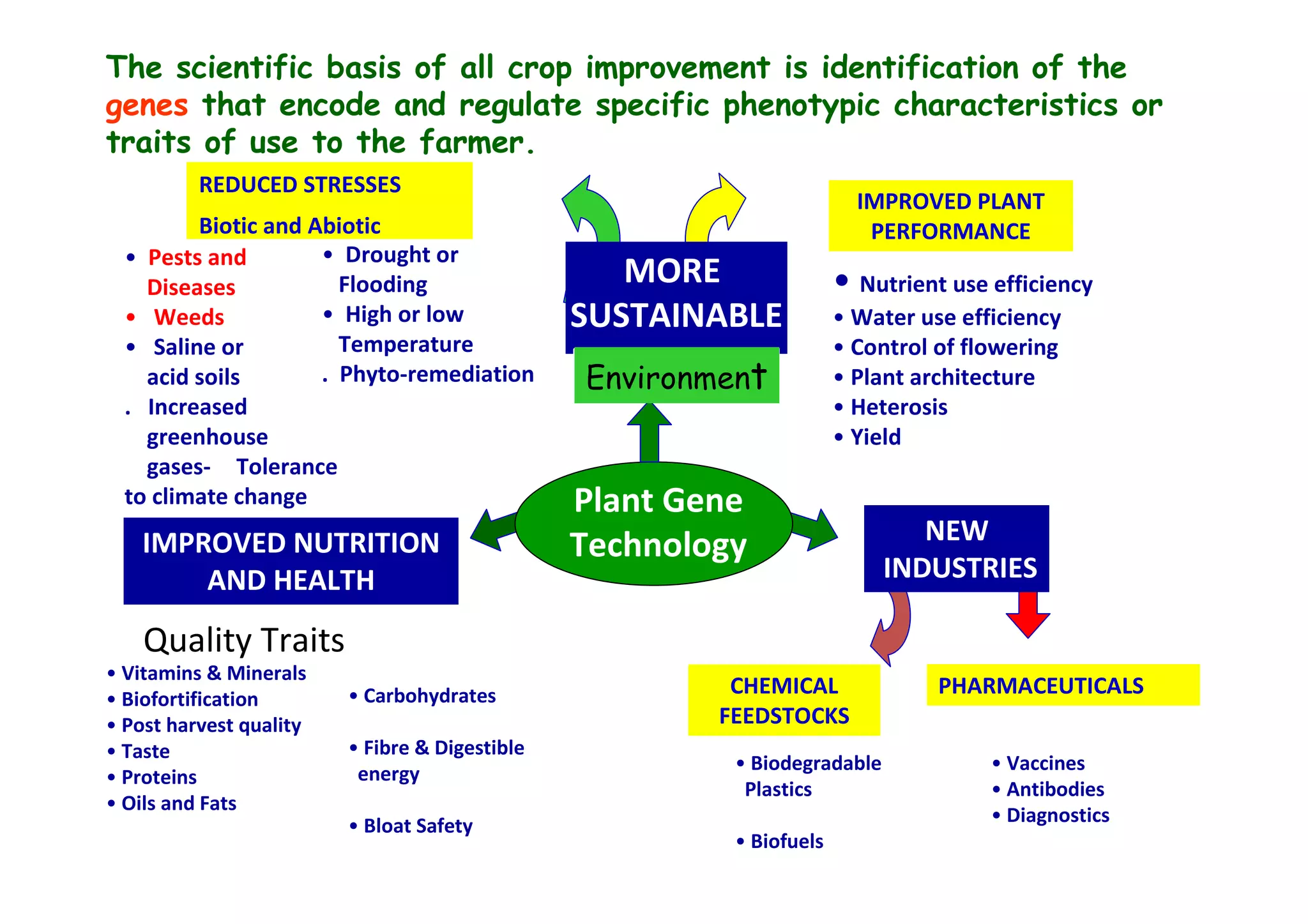
The scientific basis of all crop improvement is identification of the
genes that encode and regulate specific phenotypic characteristics or
traits of use to the farmer.
REDUCED STRESSES
Biotic and Abiotic
• Drought or
• Pests and
Flooding
Diseases
• High or low
• Weeds
Temperature
• Saline or
. Phyto-remediation
acid soils
. Increased
greenhouse
gases- Tolerance
to climate change

IMPROVED NUTRITION
AND HEALTH

IMPROVED PLANT
PERFORMANCE

MORE
SUSTAINABLE
PRODUCTION
Environment

• Nutrient use efficiency
• Water use efficiency
• Control of flowering
• Plant architecture
• Heterosis
• Yield

Plant Gene
Technology

NEW
INDUSTRIES

Quality Traits
• Vitamins & Minerals
• Biofortification
• Post harvest quality
• Taste
• Proteins
• Oils and Fats

• Carbohydrates
• Fibre & Digestible
energy
• Bloat Safety

CHEMICAL
FEEDSTOCKS
• Biodegradable
Plastics
• Biofuels

PHARMACEUTICALS
• Vaccines
• Antibodies
• Diagnostics
Genetic transformation
of plants
The steps involved in genetic modification
Identify the gene
an interesting gene
from a donor organism

Isolate
the interesting gene

Insert
the gene in a
genetic construction

Multiply
the genetic
construction

(bacteria,
plant ...)

Transfer the gene

Evaluate

Plant
regeneration

gene
expression

Add to other
varieties
by crosses

Selection of transformed cells
SOURCE: GNIS (Groupement National Interprofessionnel des Semences)
Gene Isolation by
standard techniques
of molecular biology
The first step is to isolate DNA
like you did yesterday.Then cut
the DNA into gene size pieces
with
special enzymes and identify the
genes and what they do. The trait
or characteristic which they
contain the information for.
Getting genes into plants
Tissue Fragment
of target
plant

THE GENE
TRANSFERRED DNA

CELL DIVISION
CELLS REGENERATE
INTO PLANTLETS

Selection of
Transgenic Cell

Transfer
to Soil

PLANTS WITH
NEW TRAIT
Schematic
representation of the
two main ways to
create transgenic plants

Agrobacterium Method

Particle Gun Method
Agrobacterium Method

Agrobacterium tumefaciens-a common soil bacterium
Nature’s original genetic engineer
Gall
formation
Agrobacterium

Crown Gall

The soil bacterium Agrobacterium is able to infect plants
and make them produce the food it needs to live on. The
bacterium does this by inserting a small piece of its own
DNA into the genome (DNA) of the plant. Scientist have
modified this naturally occur process to make genetically
modified plants.
Agrobacterium-mediated plant transformation

Agrobacteria
containing
recombinant Ti plasmid are
multiplied in liquid culture
Cocultivation:
Agrobacterium
culture is added to callus culture
(e.g. rice) in Petri dish. Agrobacteria
infect the callus cells. T-DNA
excises from the Ti plasmid and
integrates into chromosomal DNA
in the nucleus of the callus cell.

In planta transformation: Flowering Arabidopsis is
inverted so that flowers dip into the Agrobacterium
culture in a bell-jar. Application of vacuum helps
bacterial infiltration. Plants are removed and grown.
Flowers are allowed to self and seeds are germinated in
selection agent so that only transformed seedlings
(about 10% of the total) develop.

Selection: transformed cells
(white) are resistant to
selection agent (herbicide or
antibiotic. Non-transformed
cells (color) eventually die.
DNA delivery to plant cells:
Agrobacterium

Agrobacterium

chromosome

Genes for
transfer

T-DNA

Regeneration

Agrobacterium
cell
Plant Cell
Totipotency:
Regeneration of a New Plant from a
Single Cell
More recently techniques have been developed in whereby Agrobacterium is vacuum
infiltrated into developing floral buds of a number of different plant species
DNA delivery to plant cells: biolistics
DNA coating
of
microscopic
metal
particles

DNA code for RR
Metal particles
DNA

DNA insertion
Plant cell

Particles
are shot
into plant
cells

Transferred
DNA

Transformed
plant cell

Cell division
Broad Leaved
Crops

Cereal
Transformation
Crop Transformation
• High efficiency transformation protocol
• Output > 25,000 transformed plants per year
Automated Plant Evaluation System
REGULATORY COSTS
From laboratory to commercialisation
specific gene transfer in the lab. followed by subsequent
testing in the field
this is the only plant breeding technology which requires
regulatory approval (and, in some countries, labelling of all the
food products derived from modified plants):
• testing for food toxicity, nutritional value, composition and allergenicity – includes animal feeding
trials
• characterisation of the transferred gene as well
as its effects on the host genome
•an environmental audit as well
A quick reminder

Conventional breeding
During conventional breeding,
genes are always mixed and newly
assorted. This often results in nondesired traits of elite crop
varieties.The desired
improvement is obtained by many
years of selection in the field.

Elite variety

Breeding line

New variety

=

X
(Cross)
Favorite gene

Favorite gene

Non-desired gene

Gene technology
Using gene technology, it is
possible to transfer only a
favorite/desired gene into an
elite crop variety. All other
traits of the the elite crop
variety will be preserved.

Favorite gene

Elite variety

New variety
=

(Gene transfer)
Favorite Gene
Why are GM methods used sometimes
and molecular breeding others?
Molecular breeding

1. Desired trait must be
present in population

2. Genetic resources must
be available

3. Plant should be
propagated sexually

GM

1. Gene can come from any
source

2. Genetic resources not
required

3. Plant can be propagated
vegetatively
Photo credits: Gramene.org ETH Life International
How have we fared thus far?

Rice genome
Sequenced
Plant
Transformation

1983
1865
Mendel’s Discovery
of Genes

1905
Genetics

1953
Structure of DNA

1001
Arabidopsis
genomes
sequenced

2002 2011
1995 2000

Crop Circles
‘Synteny’

2010

First Plant NGS
Genome
Sequence
The science behind gene technology
• A gene is a code for a protein
• We can purify and reconstruct genes
• We can transfer genes to plants to introduce a
useful characteristic, eg insect protection or weed
control
• The resulting plants are thoroughly tested
Genes are part of our diet

Copyright CSIRO
Can Genetic Improvement of Crops
Help Feed the world?
• No single solution will solve this problem but
the new genetic technologies of plant breeding
developed during the last few years can helpthey are but one tool in the toolbox.
• They can can increase agricultural efficiencies
and save people from hunger in a sustainable
manner, particularly in African nations where
the need is greatest. Genomics, markerassisted screening, phenotype analysis,
computer modeling, and genetic modification
(GM) when required, have greatly accelerated
the breeding process.

B4FA 2012 Tanzania: Plant breeding and GM technology - Chris Leaver

  • 1.
    Genetic Engineering, Crop Improvementand Biotechnology Chris Leaver chris.leaver@plants.ox.ac.uk
  • 2.
    Map of theworld showing the major centres of origin of crops, which are distributed mainly in tropical regions
  • 3.
    Plant Improvement usingBreeding and Selection - HISTORICAL PERSPECTIVE 8000 BC (5 million people) Domestication of cereals and Pulses 2000 BC (50 million people) Domestication of rice, Potato, Oats, Soybean, Grape, Cotton, Banana. 1583 (500 million people) Sexuality in plants Described 1742 First Company (Vilmorin) Devoted to Plant Breeding and New varieties 1799 First Cereal Hybrid Described 1927 X-Rays Used for Mutation Breeding 1983 (5 billion people) First Use of Gene Technology for Plants 2012 (7 billion people) 160 plus million hectares of GM Crops grown in 29 Countries by 16 million farmers
  • 4.
    The evolution ofmaize (corn) Domestication The adaptation to Europe Extension of corn crop areas years The wild ancestor Teosinte First corns America Mexico Populations South of Europe Introduction Hybrids First creation of hybrids in France SOURCE: GNIS (Groupement National Interprofessionnel des Semences)
  • 5.
    Genetic modification aroseas a consequence of cultivation and selection of the best plants Planting seeds from “good” plants increased their representation in subsequent generations Natural variation within population Image courtesy of University of California Museum of Paleontology, Understanding Evolution - www.evolution.berkeley.edu
  • 6.
    F1 Hybrid SeedProduction in self-pollinating crop species – a basis for crop improvement and the development of heterosis or hybrid vigour F1 hybrid seed production in a range of major crops including Maize, Rice, Sorghum, Sunflower, Sugar Beet, Carrot, Onions, Brassica’s etc
  • 7.
    F1 Hybrid SeedProduction in Maize Pollen - male parent Female parent Tassel removed F1 Hybrid X Ear Inbred Parental Corn Lines Hybrid Vigour
  • 8.
    F1 Hybrid MaizeProduction Field Detasseled Maize
  • 9.
  • 10.
    Selection and PlantBreeding was Applied to a Range of Important Crops we Grow Today Teosinte Rice Corn Tomato The Creation of Corn The corn that Columbus received was created by the Native Americans some 8,000 years ago by domestication of a wild plant called teosinte. They used ‘genetic engineering’ in a quite remarkable way to produce a more productive variety.
  • 11.
    PRODUCTS OF MODERNBREEDING Tomatoes Peppers Potato
  • 12.
    Sustainable food securityis facing a major bottleneck • • • • • • Since the beginning of agriculture, humans have cultivated 7,000 plant species Since the beginning of agriculture, humans have cultivated 7,000 plant species Today only 150 plant species (2%) are agriculturally relevant for food and clothing Today only 150 plant species (2%) are agriculturally relevant for food and clothing Only 10 plant species are cultivated today to provide 95% of food and feed Only 10 plant species are cultivated today to provide 95% of food and feed Cultivated today 95% of food and feed Total cultivated since the beginning of agriculture
  • 13.
    Mankind depends ona few crop species for our food
  • 14.
    The top four– Global yield (UN-FAO Statistics) Soybean Wheat 2nd 4th Maize Rice 1st 3rd
  • 15.
    The myth ofnatural food The food we eat comes from plants already extensively modified from their original form. Even heritage varieties are extensively genetically modified. Credit: Nicolle Rager Fuller, National Science Foundation
  • 16.
    What traits/characteristics are selectedby plant breeders? • • • • • • • • • • • Improved Nutrition Improved Yield Improved Rate of growth Self-pollinating Reduced pod shatter Able to harvest & store the fruit Palatability Better Taste Reduced toxins Reduced / negligible dormancy requirement Disease resistance THESE TRAITS ARE ENCODED BY GENE(S)
  • 17.
    DNA: the languageof life Cell Chromosome Nucleus Gene DNA
  • 18.
    There are 25-40,000genes found in the nucleus of each plant cell depending on the species DNA APPEARS BLUE CSIRO. Introduction to
  • 19.
    A gene isa code for a protein Ca.25000 GENES CSIRO. A plant Gene
  • 20.
    The set ofgenes is the master plan which contains all the information to make a plant What is a gene? Control Switch Code for Protein Downstream control region DNA Start RNA Protein Enzymes Stop
  • 21.
    Genes provide thefoundation of new plants/products for farmers Genes Protein Yield? Tolerance to drought? Flowering time? Trait Nutrition Taste? Tolerance to Pests and Diseases Product
  • 22.
    Maize Genome/DNA sequence data(the masterplan) are available for many important crop plants
  • 23.
    Advanced Genomics WillAccelerate Discovery of Genes of Use to Farmers Gene sequence Genome Gene DNA map t c g c g t g a t g t c t g t c a t a t g g g t g a a t a t t a c c t g g c g t GENE g g a c g c t Gene expression g SEQUENCE FUNCTION Plant traits Yield Drought Disease Stress Stress Oil quality Disease Yield Maturity Herbicide tolerance TRAIT
  • 24.
    Finding the needlein a haystackplant gene discovery If selective breeding and genetic modification are based on genes, how does one go about finding the genes of interest?
  • 25.
    The Challenge: Findingthe genes that provide the foundation of new traits and crop improvements for farmers A Central Role for Omics, BioInformatics and Systems Biology Technology Platforms Bioinformatics Modelling physiology 0 Transcriptomics Metabolomics Proteomics leaf 2 s te m leaf 3 f1 Process Grain filling lea Genome Sequencing Molecular profiling Time post anthesis PhenomicsTRAIT ANALYSIS
  • 26.
    Building Increased Productivityand Sustainability into the Seed by Plant Breeding and Biotechnology The scientific basis of all crop improvement is identification of the genes that encode and regulate specific phenotypic characteristics or traits of use to the farmer: Genetic modification by marker assisted breeding (MAB) and GM technology where appropriate:
  • 27.
    NEW TOOLS FORCROP IMPROVEMENT Elite Germplasm Gene Sequencing r ula g c ole edin M re B Marker Assisted BREEDING Seeds Better Varieties, Faster Seed Production GENOMICS Functional Genomics Finding the Genes Ge ne s Trait Development PLANT BIOTECH Plant Transformation Traits New Traits of Use to the Farmer
  • 28.
    Using molecular-gene markers Healthywheat Infected wheat Isolate DNA from young plants RRRR rr rr RR rr RR rr RR rr rr Selected plants
  • 29.
    What is GeneticModification? Genetic modification is the addition, alteration or removal of genetic material, usually single genes, in order to alter an organism’s characteristics. Living organisms contain 5,000-30,000 genes arranged in linear order in chromosomes which are long strands of DNA. Genes are heritable segments of DNA that contain the code for an individual protein molecule. Nucleus ca.25,000 Genes Chloroplasts ca.80 Genes Mitochondria ca.60 Genes Genetic Information in a Plant Cell
  • 30.
    A quick reminder Conventionalbreeding During conventional breeding, genes are always mixed and newly assorted. This often results in nondesired traits of elite crop varieties.The desired improvement is obtained by many years of selection in the field. Elite variety Breeding line New variety = X (Cross) Favorite gene Favorite gene Non-desired gene Gene technology Using gene technology, it is possible to transfer only a favorite/desired gene into an elite crop variety. All other traits of the the elite crop variety will be preserved. Favorite gene Elite variety New variety = (Gene transfer) Favorite Gene
  • 31.
    Gene Transfer byClassical Plant Breeding 25,000 genes 25,000 genes Selection S = gene for susceptibility to pest R = gene for resistance to pest R=gene for resistance The backcrossing programme (BC) can take 8 to 10 years Single gene
  • 32.
    S = genefor susceptibility to pest 25,000 genes R=gene for resistance Single gene 25,000 genes R = gene for resistance to pest Repeated Backcrossing and selection for desired traits
  • 33.
    Genetic modification isthe addition, alteration or removal of genetic material usually single genes, in order to alter an organism’s characteristics. The genes can be from any donor organisms Microorganisms Plants DNA Animals Man Approximately 30% of animal, plant and fungus genes are similar A large percent of our genes are the same as those of simple organisms such as bacteria and viruses
  • 34.
    REASONS FOR UNDERTAKINGANY GENETIC MODIFICATION 1 To improve the efficiency of a specific metabolic pathway so as to improve the “efficiency” of the plant as a whole in terms of its yield, nutritional quality or agronomic characteristics(eg height, seed size) 2 To bypass some limiting such as intolerance to heat or cold,drought,flooding, or to improve resistance to pests and diseases 3 To change the nature of the harvested product – as a human foodstuff; to provide a product of therapeutic value; to provide industrial feed-stocks (e.g. the production of biodegradable polymers) and biofuels.
  • 35.
    Conventional Plant Breedinghas been very successful but yield gains are now slowing. The new molecular technologies allow more precise and rapid crop improvement by marker assisted selection breeding and GM approaches. This requires the identification of the gene(s) that underlie the traits and then combination with native traits using molecular markers and/or GM to improve the crop– these include: •Avoidance of losses from pests-insects,bacteria,fungi,viruses •More effective water use-drought tolerance •Increased tolerance towards temperature stress •Increased yield •Time to maturity – shortened growing season •Growth on marginal soils-salinity, pH, metal toxicity •More effective fertiliser use-nutrient(NPK) use efficiency •Increased flooding tolerance •Competing with weeds •Improved nutritional quality-biofortification (eg.Vitamins,Iron) •Sustainable production with a low carbon footprint
  • 36.
    Specificity of GeneticModification Identification and isolation of specific genes with defined function Insertion of specific genes into a crop species to promote desirable characters GM progeny can be selected for the product or activity of specific genes with a defined function There are no “surprises” from unknown genes transferred along with the planned cross
  • 37.
    The scientific basisof all crop improvement is identification of the genes that encode and regulate specific phenotypic characteristics or traits of use to the farmer. REDUCED STRESSES Biotic and Abiotic • Drought or • Pests and Flooding Diseases • High or low • Weeds Temperature • Saline or . Phyto-remediation acid soils . Increased greenhouse gases- Tolerance to climate change IMPROVED NUTRITION AND HEALTH IMPROVED PLANT PERFORMANCE MORE SUSTAINABLE PRODUCTION Environment • Nutrient use efficiency • Water use efficiency • Control of flowering • Plant architecture • Heterosis • Yield Plant Gene Technology NEW INDUSTRIES Quality Traits • Vitamins & Minerals • Biofortification • Post harvest quality • Taste • Proteins • Oils and Fats • Carbohydrates • Fibre & Digestible energy • Bloat Safety CHEMICAL FEEDSTOCKS • Biodegradable Plastics • Biofuels PHARMACEUTICALS • Vaccines • Antibodies • Diagnostics
  • 38.
  • 39.
    The steps involvedin genetic modification Identify the gene an interesting gene from a donor organism Isolate the interesting gene Insert the gene in a genetic construction Multiply the genetic construction (bacteria, plant ...) Transfer the gene Evaluate Plant regeneration gene expression Add to other varieties by crosses Selection of transformed cells SOURCE: GNIS (Groupement National Interprofessionnel des Semences)
  • 40.
    Gene Isolation by standardtechniques of molecular biology The first step is to isolate DNA like you did yesterday.Then cut the DNA into gene size pieces with special enzymes and identify the genes and what they do. The trait or characteristic which they contain the information for.
  • 41.
    Getting genes intoplants Tissue Fragment of target plant THE GENE TRANSFERRED DNA CELL DIVISION CELLS REGENERATE INTO PLANTLETS Selection of Transgenic Cell Transfer to Soil PLANTS WITH NEW TRAIT
  • 42.
    Schematic representation of the twomain ways to create transgenic plants Agrobacterium Method Particle Gun Method
  • 43.
  • 44.
    Nature’s original geneticengineer Gall formation Agrobacterium Crown Gall The soil bacterium Agrobacterium is able to infect plants and make them produce the food it needs to live on. The bacterium does this by inserting a small piece of its own DNA into the genome (DNA) of the plant. Scientist have modified this naturally occur process to make genetically modified plants.
  • 45.
    Agrobacterium-mediated plant transformation Agrobacteria containing recombinantTi plasmid are multiplied in liquid culture Cocultivation: Agrobacterium culture is added to callus culture (e.g. rice) in Petri dish. Agrobacteria infect the callus cells. T-DNA excises from the Ti plasmid and integrates into chromosomal DNA in the nucleus of the callus cell. In planta transformation: Flowering Arabidopsis is inverted so that flowers dip into the Agrobacterium culture in a bell-jar. Application of vacuum helps bacterial infiltration. Plants are removed and grown. Flowers are allowed to self and seeds are germinated in selection agent so that only transformed seedlings (about 10% of the total) develop. Selection: transformed cells (white) are resistant to selection agent (herbicide or antibiotic. Non-transformed cells (color) eventually die.
  • 46.
    DNA delivery toplant cells: Agrobacterium Agrobacterium chromosome Genes for transfer T-DNA Regeneration Agrobacterium cell Plant Cell
  • 47.
    Totipotency: Regeneration of aNew Plant from a Single Cell
  • 48.
    More recently techniqueshave been developed in whereby Agrobacterium is vacuum infiltrated into developing floral buds of a number of different plant species
  • 49.
    DNA delivery toplant cells: biolistics DNA coating of microscopic metal particles DNA code for RR Metal particles DNA DNA insertion Plant cell Particles are shot into plant cells Transferred DNA Transformed plant cell Cell division
  • 53.
  • 54.
    Crop Transformation • Highefficiency transformation protocol • Output > 25,000 transformed plants per year
  • 55.
  • 57.
  • 58.
    From laboratory tocommercialisation specific gene transfer in the lab. followed by subsequent testing in the field this is the only plant breeding technology which requires regulatory approval (and, in some countries, labelling of all the food products derived from modified plants): • testing for food toxicity, nutritional value, composition and allergenicity – includes animal feeding trials • characterisation of the transferred gene as well as its effects on the host genome •an environmental audit as well
  • 59.
    A quick reminder Conventionalbreeding During conventional breeding, genes are always mixed and newly assorted. This often results in nondesired traits of elite crop varieties.The desired improvement is obtained by many years of selection in the field. Elite variety Breeding line New variety = X (Cross) Favorite gene Favorite gene Non-desired gene Gene technology Using gene technology, it is possible to transfer only a favorite/desired gene into an elite crop variety. All other traits of the the elite crop variety will be preserved. Favorite gene Elite variety New variety = (Gene transfer) Favorite Gene
  • 60.
    Why are GMmethods used sometimes and molecular breeding others? Molecular breeding 1. Desired trait must be present in population 2. Genetic resources must be available 3. Plant should be propagated sexually GM 1. Gene can come from any source 2. Genetic resources not required 3. Plant can be propagated vegetatively Photo credits: Gramene.org ETH Life International
  • 61.
    How have wefared thus far? Rice genome Sequenced Plant Transformation 1983 1865 Mendel’s Discovery of Genes 1905 Genetics 1953 Structure of DNA 1001 Arabidopsis genomes sequenced 2002 2011 1995 2000 Crop Circles ‘Synteny’ 2010 First Plant NGS Genome Sequence
  • 62.
    The science behindgene technology • A gene is a code for a protein • We can purify and reconstruct genes • We can transfer genes to plants to introduce a useful characteristic, eg insect protection or weed control • The resulting plants are thoroughly tested
  • 63.
    Genes are partof our diet Copyright CSIRO
  • 64.
    Can Genetic Improvementof Crops Help Feed the world? • No single solution will solve this problem but the new genetic technologies of plant breeding developed during the last few years can helpthey are but one tool in the toolbox. • They can can increase agricultural efficiencies and save people from hunger in a sustainable manner, particularly in African nations where the need is greatest. Genomics, markerassisted screening, phenotype analysis, computer modeling, and genetic modification (GM) when required, have greatly accelerated the breeding process.