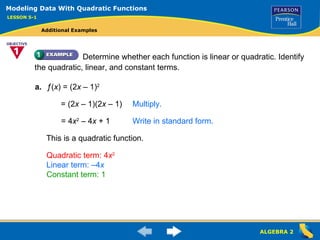
Determine whether each function is linear or quadratic. Identify the quadratic, linear, and constant terms. a. ƒ ( x ) = (2 x  – 1) 2 This is a quadratic function. Quadratic term: 4 x 2 Linear term: –4 x Constant term: 1 Modeling Data With Quadratic Functions LESSON 5-1 Additional Examples = (2 x  – 1)(2 x  – 1) Multiply. = 4 x 2  – 4 x  + 1 Write in standard form.
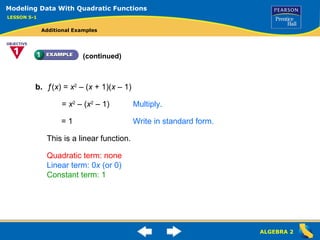
(continued) b. ƒ ( x ) =  x 2  – ( x  + 1)( x  – 1) This is a linear function. Quadratic term: none Linear term: 0 x  (or 0) Constant term: 1 Modeling Data With Quadratic Functions LESSON 5-1 Additional Examples =  x 2  – ( x 2  – 1) Multiply. = 1 Write in standard form.
Below is the graph of  y  =  x 2  – 6 x  + 11. Identify the vertex and the axis of symmetry. Identify points corresponding to  P  and  Q . Modeling Data With Quadratic Functions LESSON 5-1 Additional Examples The vertex is (3, 2). The axis of symmetry is  x  = 3. P (1, 6) is two units to the left of the axis of symmetry. Corresponding point  P  (5, 6) is two units to the right of the axis of symmetry. Q (4, 3) is one unit to the right of the axis of symmetry. Corresponding point  Q  (2, 3) is one unit to the left of the axis of symmetry.
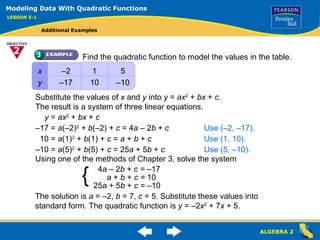
Find the quadratic function to model the values in the table. The solution is  a  = –2,  b  = 7,  c  = 5. Substitute these values into standard form. The quadratic function is  y  = –2 x 2  + 7 x  + 5. Using one of the methods of Chapter 3, solve the system Modeling Data With Quadratic Functions LESSON 5-1 Additional Examples x y – 2 – 17 1 10 5 – 10 Substitute the values of  x  and  y  into  y  =  ax 2  +  bx  +  c . The result is a system of three linear equations. y  =  ax 2  +  bx  +  c 4 a  – 2 b  +  c =  –17 a  +  b  +  c =  10 25 a  + 5 b  +  c =  –10 { – 17 =  a (–2) 2  +  b (–2) +  c  = 4 a  – 2 b  +  c Use (–2, –17). 10 =  a (1) 2  +  b (1) +  c  =  a  +  b  +  c Use (1, 10). – 10 =  a (5) 2  +  b (5) +  c  = 25 a  + 5 b  +  c Use (5, –10).
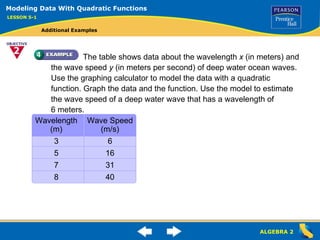
The table shows data about the wavelength  x  (in meters) and the wave speed  y  (in meters per second) of deep water ocean waves. Use the graphing calculator to model the data with a quadratic function. Graph the data and the function. Use the model to estimate the wave speed of a deep water wave that has a wavelength of  6 meters. Wavelength (m) 3 5 7 8 Wave Speed (m/s) 6 16 31 40 Modeling Data With Quadratic Functions LESSON 5-1 Additional Examples
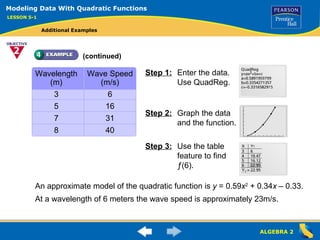
(continued) An approximate model of the quadratic function is  y  = 0.59 x 2  + 0.34 x  – 0.33. At a wavelength of 6 meters the wave speed is approximately 23m/s. Modeling Data With Quadratic Functions LESSON 5-1 Additional Examples Wavelength (m) 3 5 7 8 Wave Speed (m/s) 6 16 31 40 Step 1: Enter the data. Use QuadReg. Step 2: Graph the data and the function. Step 3: Use the table feature to find  ƒ (6).

Modeling quadratic fxns

  • 1.
    Determine whether eachfunction is linear or quadratic. Identify the quadratic, linear, and constant terms. a. ƒ ( x ) = (2 x – 1) 2 This is a quadratic function. Quadratic term: 4 x 2 Linear term: –4 x Constant term: 1 Modeling Data With Quadratic Functions LESSON 5-1 Additional Examples = (2 x – 1)(2 x – 1) Multiply. = 4 x 2 – 4 x + 1 Write in standard form.
  • 2.
    (continued) b. ƒ( x ) = x 2 – ( x + 1)( x – 1) This is a linear function. Quadratic term: none Linear term: 0 x (or 0) Constant term: 1 Modeling Data With Quadratic Functions LESSON 5-1 Additional Examples = x 2 – ( x 2 – 1) Multiply. = 1 Write in standard form.
  • 3.
    Below is thegraph of y = x 2 – 6 x + 11. Identify the vertex and the axis of symmetry. Identify points corresponding to P and Q . Modeling Data With Quadratic Functions LESSON 5-1 Additional Examples The vertex is (3, 2). The axis of symmetry is x = 3. P (1, 6) is two units to the left of the axis of symmetry. Corresponding point P (5, 6) is two units to the right of the axis of symmetry. Q (4, 3) is one unit to the right of the axis of symmetry. Corresponding point Q (2, 3) is one unit to the left of the axis of symmetry.
  • 4.
    Find the quadraticfunction to model the values in the table. The solution is a = –2, b = 7, c = 5. Substitute these values into standard form. The quadratic function is y = –2 x 2 + 7 x + 5. Using one of the methods of Chapter 3, solve the system Modeling Data With Quadratic Functions LESSON 5-1 Additional Examples x y – 2 – 17 1 10 5 – 10 Substitute the values of x and y into y = ax 2 + bx + c . The result is a system of three linear equations. y = ax 2 + bx + c 4 a – 2 b + c = –17 a + b + c = 10 25 a + 5 b + c = –10 { – 17 = a (–2) 2 + b (–2) + c = 4 a – 2 b + c Use (–2, –17). 10 = a (1) 2 + b (1) + c = a + b + c Use (1, 10). – 10 = a (5) 2 + b (5) + c = 25 a + 5 b + c Use (5, –10).
  • 5.
    The table showsdata about the wavelength x (in meters) and the wave speed y (in meters per second) of deep water ocean waves. Use the graphing calculator to model the data with a quadratic function. Graph the data and the function. Use the model to estimate the wave speed of a deep water wave that has a wavelength of 6 meters. Wavelength (m) 3 5 7 8 Wave Speed (m/s) 6 16 31 40 Modeling Data With Quadratic Functions LESSON 5-1 Additional Examples
  • 6.
    (continued) An approximatemodel of the quadratic function is y = 0.59 x 2 + 0.34 x – 0.33. At a wavelength of 6 meters the wave speed is approximately 23m/s. Modeling Data With Quadratic Functions LESSON 5-1 Additional Examples Wavelength (m) 3 5 7 8 Wave Speed (m/s) 6 16 31 40 Step 1: Enter the data. Use QuadReg. Step 2: Graph the data and the function. Step 3: Use the table feature to find ƒ (6).