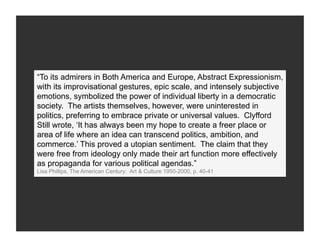
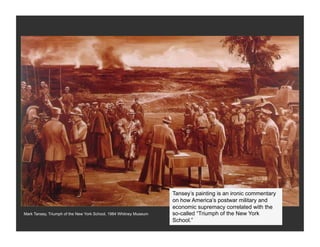
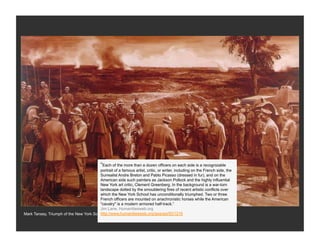
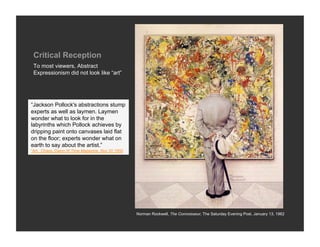
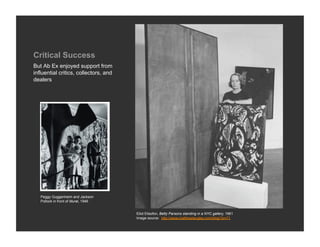
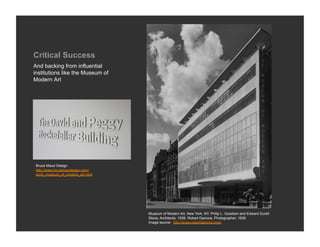
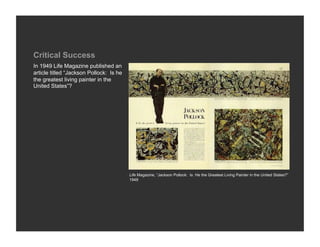
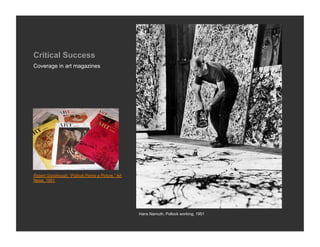
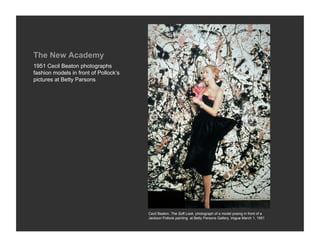
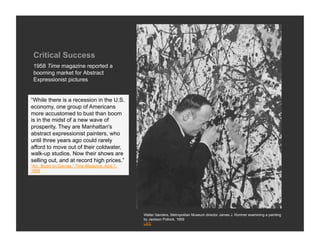
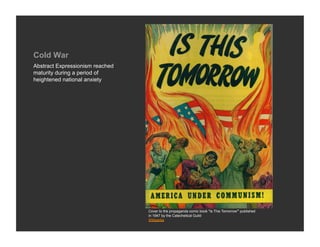
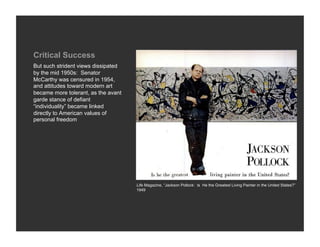
The document discusses the critical reception of Abstract Expressionism from its emergence in the late 1940s through the 1950s and beyond. Initially, most viewers did not consider it "art" but influential critics, collectors, and institutions like MoMA provided support. As the Cold War intensified, the avant-garde nature of Abstract Expressionism became linked to American values of freedom and individualism, and the US government promoted it abroad as a symbol of American ideals in contrast to Soviet restrictions on artists. However, the artists themselves claimed to be free from political ideology.

![“[T]he public grew more tolerant of modern art and came to believe
that the flourishing of avant-garde art and culture was the mark of a
liberal democratic society. Indeed, at decade’s end, the same art
once lambasted by conservative forces as anti-American were being
held up as a symbol of capitalist liberty, freedom, and the American
way of life. By the late 1950s and early 1960s, Abstract
Expressionism was celebrated as a quintessentially American form,
the embodiment of the kind of personal freedom of expression denied
artists behind the Iron curtain. For the first time, modernism and
America were linked, the one nurtured by the free society of the
other.”
Lisa Phillips, The American Century: Art & Culture 1950-2000, p. 37](https://image.slidesharecdn.com/3-1abexcoldwar-120531054218-phpapp01/85/3-1-abex-cold-war-15-320.jpg)

![Abstract
Expressionism and the
Cold War
“[A]bstract expressionism was for many
people an expression of freedom: freedom
to create controversial works, freedom
symbolized by action and gesture, by the
expression of the artist apparently freed
from all restraints . . . [and] proof of the
inherent liberty of the American system, as
opposed to the restrictions imposed on
artists in the Soviet system.”
Serge Guilbaut, “The New Adventures of the Avant Garde in
America,” October 15 (Winter 1980); rpt in Ellen Landau,
ed., Reading Abstract Expressionism: Context and Critique,
Yale University Press, 2005, p. 383-395](https://image.slidesharecdn.com/3-1abexcoldwar-120531054218-phpapp01/85/3-1-abex-cold-war-20-320.jpg)