West	
  Coast	
  Pop	
  Art	


Art	
  109A:	
  	
  Art	
  since	
  1945	
  
Westchester	
  Community	
  College	
  
Fall	
  2012	
  
Dr.	
  Melissa	
  Hall	
  
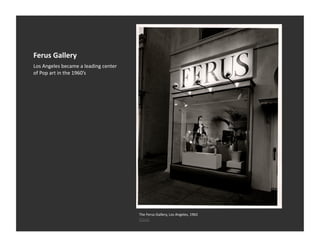
Ferus	
  Gallery	
  
Los	
  Angeles	
  became	
  a	
  leading	
  center	
  
of	
  Pop	
  art	
  in	
  the	
  1960’s	


                                                         The	
  Ferus	
  Gallery,	
  Los	
  Angeles,	
  1962	
  
                                                         Artnet	
  
Ferus	
  Gallery	
  
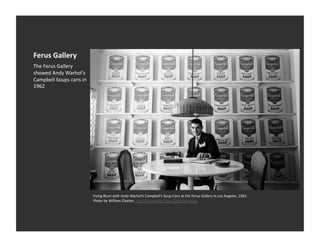
The	
  Ferus	
  Gallery	
  
showed	
  Andy	
  Warhol's	
  
Campbell	
  Soups	
  cans	
  in	
  
1962	


                                      Irving	
  Blum	
  with	
  Andy	
  Warhol’s	
  Campbell’s	
  Soup	
  Cans	
  at	
  the	
  Ferus	
  Gallery	
  in	
  Los	
  Angeles,	
  1962.	
  
                                      Photo	
  by	
  William	
  Claxton.	
  	
  Pacific	
  Standard	
  Time,	
  GeSy	
  Museum	
  
Ferus	
  Gallery	
  
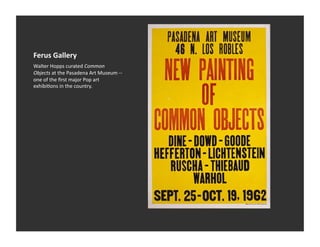
Walter	
  Hopps	
  curated	
  Common	
  
Objects	
  at	
  the	
  Pasadena	
  Art	
  Museum	
  -­‐-­‐	
  
one	
  of	
  the	
  first	
  major	
  Pop	
  art	
  
exhibiVons	
  in	
  the	
  country.	
  
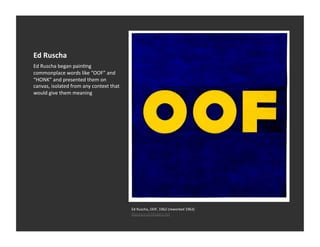
Ed	
  Ruscha	
  
Ed	
  Ruscha	
  began	
  painVng	
  
commonplace	
  words	
  like	
  “OOF”	
  and	
  
“HONK”	
  and	
  presented	
  them	
  on	
  
canvas,	
  isolated	
  from	
  any	
  context	
  that	
  
would	
  give	
  them	
  meaning	


                                                            Ed	
  Ruscha,	
  OOF,	
  1962	
  (reworked	
  1963)	
  
                                                            Museum	
  of	
  Modern	
  Art	
  
Ed	
  Ruscha	
  
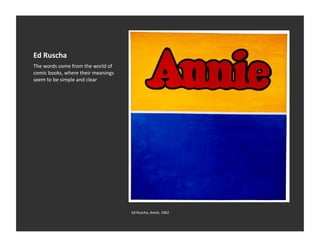
The	
  words	
  come	
  from	
  the	
  world	
  of	
  
comic	
  books,	
  where	
  their	
  meanings	
  
seem	
  to	
  be	
  simple	
  and	
  clear	


                                                         Ed	
  Ruscha,	
  Annie,	
  1962	
  
Ed	
  Ruscha	
  
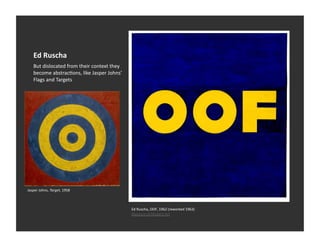
     But	
  dislocated	
  from	
  their	
  context	
  they	
  
     become	
  abstracVons,	
  like	
  Jasper	
  Johns’	
  
     Flags	
  and	
  Targets	


Jasper	
  Johns,	
  Target,	
  1958	


                                                                 Ed	
  Ruscha,	
  OOF,	
  1962	
  (reworked	
  1963)	
  
                                                                 Museum	
  of	
  Modern	
  Art	
  
Ed	
  Ruscha	
  
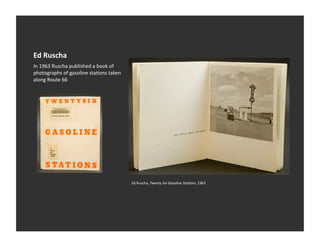
In	
  1963	
  Ruscha	
  published	
  a	
  book	
  of	
  
photographs	
  of	
  gasoline	
  staVons	
  taken	
  
along	
  Route	
  66	


                                                           Ed	
  Ruscha,	
  Twenty	
  Six	
  Gasoline	
  Sta:ons,	
  1963	
  
Ed	
  Ruscha	
  
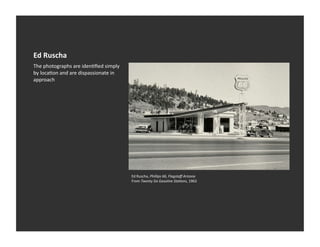
The	
  photographs	
  are	
  idenVfied	
  simply	
  
by	
  locaVon	
  and	
  are	
  dispassionate	
  in	
  
approach	


                                                         Ed	
  Ruscha,	
  Phillips	
  66,	
  Flagstaff	
  Arizona	
  
                                                         From	
  Twenty	
  Six	
  Gasoline	
  Sta:ons,	
  1963	
  
Ed	
  Ruscha	
  
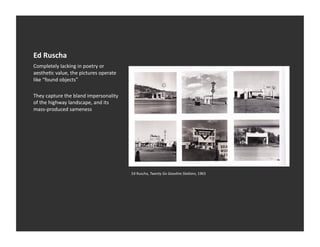
Completely	
  lacking	
  in	
  poetry	
  or	
  
aestheVc	
  value,	
  the	
  pictures	
  operate	
  
like	
  “found	
  objects”	


They	
  capture	
  the	
  bland	
  impersonality	
  
of	
  the	
  highway	
  landscape,	
  and	
  its	
  
mass-­‐produced	
  sameness	


                                                       Ed	
  Ruscha,	
  Twenty	
  Six	
  Gasoline	
  Sta:ons,	
  1963	
  
Ed	
  Ruscha	
  
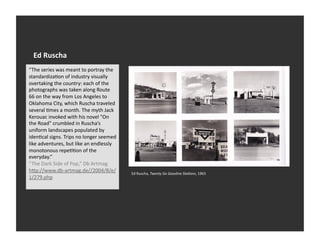
“The	
  series	
  was	
  meant	
  to	
  portray	
  the	
  
standardizaVon	
  of	
  industry	
  visually	
  
overtaking	
  the	
  country:	
  each	
  of	
  the	
  
photographs	
  was	
  taken	
  along	
  Route	
  
66	
  on	
  the	
  way	
  from	
  Los	
  Angeles	
  to	
  
Oklahoma	
  City,	
  which	
  Ruscha	
  traveled	
  
several	
  Vmes	
  a	
  month.	
  The	
  myth	
  Jack	
  
Kerouac	
  invoked	
  with	
  his	
  novel	
  "On	
  
the	
  Road"	
  crumbled	
  in	
  Ruscha’s	
  
uniform	
  landscapes	
  populated	
  by	
  
idenVcal	
  signs.	
  Trips	
  no	
  longer	
  seemed	
  
like	
  adventures,	
  but	
  like	
  an	
  endlessly	
  
monotonous	
  repeVVon	
  of	
  the	
  
everyday.”	
  
“The	
  Dark	
  Side	
  of	
  Pop,”	
  Db	
  Artmag	
  	
  
hSp://www.db-­‐artmag.de//2004/8/e/                           Ed	
  Ruscha,	
  Twenty	
  Six	
  Gasoline	
  Sta:ons,	
  1963	
  
1/279.php	
  
Ed	
  Ruscha	
  
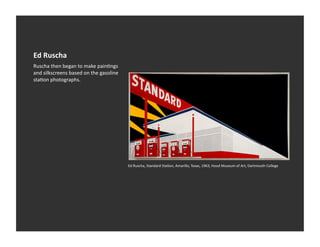
Ruscha	
  then	
  began	
  to	
  make	
  painVngs	
  
and	
  silkscreens	
  based	
  on	
  the	
  gasoline	
  
staVon	
  photographs.	


                                                           Ed	
  Ruscha,	
  Standard	
  StaVon,	
  Amarillo,	
  Texas,	
  1963,	
  Hood	
  Museum	
  of	
  Art,	
  Dartmouth	
  College	
  
Ed	
  Ruscha	
  
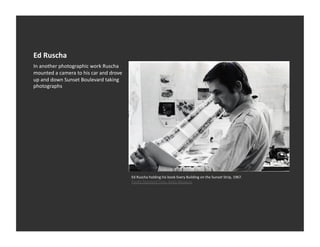
In	
  another	
  photographic	
  work	
  Ruscha	
  
mounted	
  a	
  camera	
  to	
  his	
  car	
  and	
  drove	
  
up	
  and	
  down	
  Sunset	
  Boulevard	
  taking	
  
photographs	


                                                                 Ed	
  Ruscha	
  holding	
  his	
  book	
  Every	
  Building	
  on	
  the	
  Sunset	
  Strip,	
  1967.	


                                                                 Pacific	
  Standard	
  Time,	
  GeSy	
  Museum	
  
Ed	
  Ruscha	
  
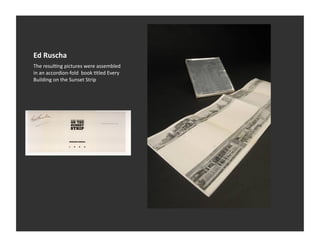
The	
  resulVng	
  pictures	
  were	
  assembled	
  
in	
  an	
  accordion-­‐fold	
  	
  book	
  Vtled	
  Every	
  
Building	
  on	
  the	
  Sunset	
  Strip	
  
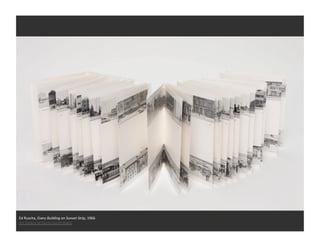
Ed	
  Ruscha,	
  Every	
  Building	
  on	
  Sunset	
  Strip,	
  1966	
  
Art	
  Gallery	
  of	
  North	
  South	
  Wales	
  
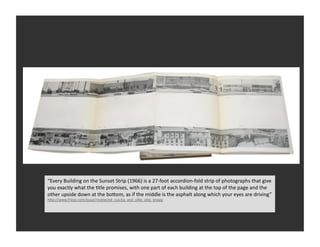
“Every	
  Building	
  on	
  the	
  Sunset	
  Strip	
  (1966)	
  is	
  a	
  27-­‐foot	
  accordion-­‐fold	
  strip	
  of	
  photographs	
  that	
  give	
  
you	
  exactly	
  what	
  the	
  Vtle	
  promises,	
  with	
  one	
  part	
  of	
  each	
  building	
  at	
  the	
  top	
  of	
  the	
  page	
  and	
  the	
  
other	
  upside	
  down	
  at	
  the	
  boSom,	
  as	
  if	
  the	
  middle	
  is	
  the	
  asphalt	
  along	
  which	
  your	
  eyes	
  are	
  driving”	
  
hSp://www.frieze.com/issue/review/ed_ruscha_and_silke_oSo_knapp                 	
  
Ed	
  Ruscha	
  
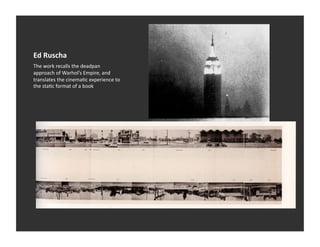
The	
  work	
  recalls	
  the	
  deadpan	
  
approach	
  of	
  Warhol’s	
  Empire,	
  and	
  
translates	
  the	
  cinemaVc	
  experience	
  to	
  
the	
  staVc	
  format	
  of	
  a	
  book	
  

5.2 west coast_pop

  • 1.
    West  Coast  Pop  Art   Art  109A:    Art  since  1945   Westchester  Community  College   Fall  2012   Dr.  Melissa  Hall  
  • 2.
    Ferus  Gallery   Los  Angeles  became  a  leading  center   of  Pop  art  in  the  1960’s   The  Ferus  Gallery,  Los  Angeles,  1962   Artnet  
  • 3.
    Ferus  Gallery   The  Ferus  Gallery   showed  Andy  Warhol's   Campbell  Soups  cans  in   1962   Irving  Blum  with  Andy  Warhol’s  Campbell’s  Soup  Cans  at  the  Ferus  Gallery  in  Los  Angeles,  1962.   Photo  by  William  Claxton.    Pacific  Standard  Time,  GeSy  Museum  
  • 4.
    Ferus  Gallery   Walter  Hopps  curated  Common   Objects  at  the  Pasadena  Art  Museum  -­‐-­‐   one  of  the  first  major  Pop  art   exhibiVons  in  the  country.  
  • 5.
    Ed  Ruscha   Ed  Ruscha  began  painVng   commonplace  words  like  “OOF”  and   “HONK”  and  presented  them  on   canvas,  isolated  from  any  context  that   would  give  them  meaning   Ed  Ruscha,  OOF,  1962  (reworked  1963)   Museum  of  Modern  Art  
  • 6.
    Ed  Ruscha   The  words  come  from  the  world  of   comic  books,  where  their  meanings   seem  to  be  simple  and  clear   Ed  Ruscha,  Annie,  1962  
  • 7.
    Ed  Ruscha   But  dislocated  from  their  context  they   become  abstracVons,  like  Jasper  Johns’   Flags  and  Targets   Jasper  Johns,  Target,  1958   Ed  Ruscha,  OOF,  1962  (reworked  1963)   Museum  of  Modern  Art  
  • 8.
    Ed  Ruscha   In  1963  Ruscha  published  a  book  of   photographs  of  gasoline  staVons  taken   along  Route  66   Ed  Ruscha,  Twenty  Six  Gasoline  Sta:ons,  1963  
  • 9.
    Ed  Ruscha   The  photographs  are  idenVfied  simply   by  locaVon  and  are  dispassionate  in   approach   Ed  Ruscha,  Phillips  66,  Flagstaff  Arizona   From  Twenty  Six  Gasoline  Sta:ons,  1963  
  • 10.
    Ed  Ruscha   Completely  lacking  in  poetry  or   aestheVc  value,  the  pictures  operate   like  “found  objects”     They  capture  the  bland  impersonality   of  the  highway  landscape,  and  its   mass-­‐produced  sameness   Ed  Ruscha,  Twenty  Six  Gasoline  Sta:ons,  1963  
  • 11.
    Ed  Ruscha   “The  series  was  meant  to  portray  the   standardizaVon  of  industry  visually   overtaking  the  country:  each  of  the   photographs  was  taken  along  Route   66  on  the  way  from  Los  Angeles  to   Oklahoma  City,  which  Ruscha  traveled   several  Vmes  a  month.  The  myth  Jack   Kerouac  invoked  with  his  novel  "On   the  Road"  crumbled  in  Ruscha’s   uniform  landscapes  populated  by   idenVcal  signs.  Trips  no  longer  seemed   like  adventures,  but  like  an  endlessly   monotonous  repeVVon  of  the   everyday.”   “The  Dark  Side  of  Pop,”  Db  Artmag     hSp://www.db-­‐artmag.de//2004/8/e/ Ed  Ruscha,  Twenty  Six  Gasoline  Sta:ons,  1963   1/279.php  
  • 12.
    Ed  Ruscha   Ruscha  then  began  to  make  painVngs   and  silkscreens  based  on  the  gasoline   staVon  photographs.   Ed  Ruscha,  Standard  StaVon,  Amarillo,  Texas,  1963,  Hood  Museum  of  Art,  Dartmouth  College  
  • 13.
    Ed  Ruscha   In  another  photographic  work  Ruscha   mounted  a  camera  to  his  car  and  drove   up  and  down  Sunset  Boulevard  taking   photographs   Ed  Ruscha  holding  his  book  Every  Building  on  the  Sunset  Strip,  1967.         Pacific  Standard  Time,  GeSy  Museum  
  • 14.
    Ed  Ruscha   The  resulVng  pictures  were  assembled   in  an  accordion-­‐fold    book  Vtled  Every   Building  on  the  Sunset  Strip  
  • 15.
    Ed  Ruscha,  Every  Building  on  Sunset  Strip,  1966   Art  Gallery  of  North  South  Wales  
  • 16.
    “Every  Building  on  the  Sunset  Strip  (1966)  is  a  27-­‐foot  accordion-­‐fold  strip  of  photographs  that  give   you  exactly  what  the  Vtle  promises,  with  one  part  of  each  building  at  the  top  of  the  page  and  the   other  upside  down  at  the  boSom,  as  if  the  middle  is  the  asphalt  along  which  your  eyes  are  driving”   hSp://www.frieze.com/issue/review/ed_ruscha_and_silke_oSo_knapp  
  • 17.
    Ed  Ruscha   The  work  recalls  the  deadpan   approach  of  Warhol’s  Empire,  and   translates  the  cinemaVc  experience  to   the  staVc  format  of  a  book