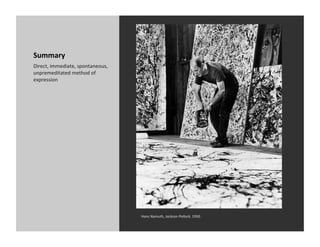
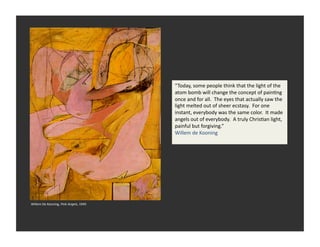
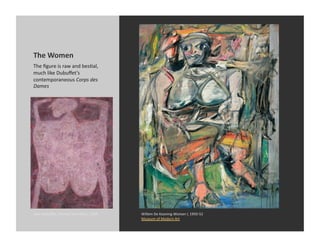
This document provides an overview of Abstract Expressionism, a style of painting that emerged in New York City after World War II. It discusses the major artists of the movement, including Pollock, de Kooning, Rothko, and Newman. Abstract Expressionist paintings were abstract in style but the artists felt the subject and content were still important. The paintings aimed to express the psychological trauma of events like the Depression, World Wars, and Holocaust. Artists turned inward and explored the unconscious through archetypes and Jungian symbolism during the formative 1940s period. By the late 1940s, Abstract Expressionism had developed into gestural, action-based paintings and color field works that expressed the feelings of a post-war world in


![Forma<ve
Years
(1940s)
“If
we
profess
kinship
to
the
art
of
primiDve
man,
it
is
because
the
feelings
they
[sic]
expressed
have
a
parDcular
perDnence
today.
In
Dmes
of
violence,
personal
predilecDons
for
the
niceDes
of
color
and
form
seem
irrelevant.
All
primiDve
expression
reveals
the
constant
awareness
of
powerful
forces,
the
immediate
presence
of
terror
and
fear,
recogniDon
of
the
brutality
of
the
natural
world
as
well
as
the
eternal
insecuriDes
of
life.
That
these
feelings
are
being
experienced
by
many
people
throughout
the
world
today
is
an
unfortunate
fact
and
to
us
an
art
that
glosses
over
and
evades
these
feelings
is
superficial
and
meaningless.
That
is
why
we
insist
on
subject
maVer,
a
subject
maVer
that
embraces
these
feelings
and
permits
them
to
be
expressed.”
Adolph
GoVlieb
and
Mark
Rothko
Adolph
GoVlieb,
Pictograph,
1942
Art
Ins>tute
of
Chicago](https://image.slidesharecdn.com/2-2abexnew1-120525164432-phpapp02/85/2-2-abex-new1-11-320.jpg)

![FormaDve
Years
(1940s)
Jungian
theory
proposes
that
the
individual
psyche
is
a
reservoir
for
the
collecDve
unconscious
“The
present
painter
is
concerned
not
with
his
own
feelings
or
with
the
mystery
of
his
own
personality
but
with
the
penetraDon
into
the
world
mystery.
His
imaginaDon
is
therefore
aVempDng
to
dig
into
metaphysical
secrets.”
BarneV
Newman,
“ The
Plasmic
Image”
“[In
their
work]
the
personal
and
social
converge”
Irving
Sandler](https://image.slidesharecdn.com/2-2abexnew1-120525164432-phpapp02/85/2-2-abex-new1-13-320.jpg)




![Student
Responses
“[It
seems
to]
represent
disharmony.
I
had
the
feeling
there
was
discontent
in
his
life,
or
in
the
world
at
that
Dme”
“The
forms
are
furious,
organic
and
inorganic,
curved
and
ruler
straight.
It
is
an
angry
piece”
“The
movement
seems
to
express
frustraDon.
The
use
of
bland
colors
such
as
brown
and
white
gives
it
the
feeling
of
frustrated
energy”
Jackson Pollock, Autumn Rhythm, 1950
Metropolitan Museum](https://image.slidesharecdn.com/2-2abexnew1-120525164432-phpapp02/85/2-2-abex-new1-52-320.jpg)