World War II

Art 109A: Art Since 1945
Westchester Community College
Fall 2012
Dr. Melissa Hall
World War II
(1939-1945)
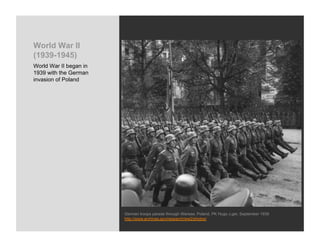
World War II began in
1939 with the German
invasion of Poland


                        German troops parade through Warsaw, Poland. PK Hugo J.ger, September 1939
                        http://www.archives.gov/research/ww2/photos/
World War II
(1939-1945)
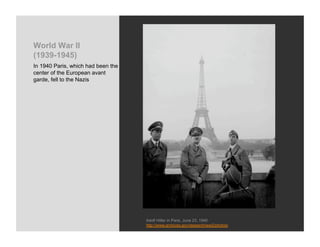
In 1940 Paris, which had been the
center of the European avant
garde, fell to the Nazis


                                    Adolf Hitler in Paris, June 23, 1940
                                    http://www.archives.gov/research/ww2/photos/
World War II
(1939-1945)
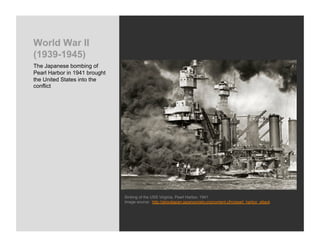
The Japanese bombing of
Pearl Harbor in 1941 brought
the United States into the
conflict


                               Sinking of the USS Virginia, Pearl Harbor, 1941
                               Image source: http://aboutjapan.japansociety.org/content.cfm/pearl_harbor_attack
World War II
(1939-1945)
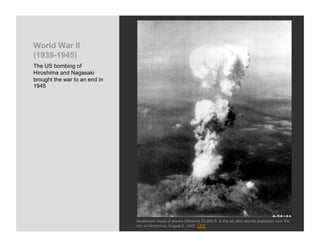
The US bombing of
Hiroshima and Nagasaki
brought the war to an end in
1945


                               Mushroom cloud of smoke billowing 20,000 ft. in the air after atomic explosion over the
                               city of Hiroshima, August 6, 1945 LIFE
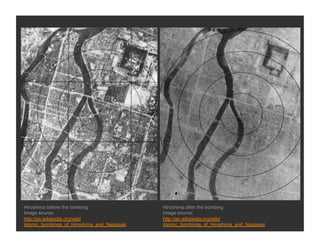
Hiroshima before the bombing                Hiroshima after the bombing
Image source:                               Image source:
http://en.wikipedia.org/wiki/               http://en.wikipedia.org/wiki/
Atomic_bombings_of_Hiroshima_and_Nagasaki   Atomic_bombings_of_Hiroshima_and_Nagasaki
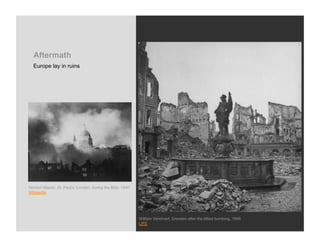
Aftermath
  Europe lay in ruins


Herbert Mason, St. Paul’s, London, during the Blitz, 1940
Wikipedia


                                                            William Vandivert, Dresden after the Allied bombing, 1946
                                                            LIFE
Aftermath
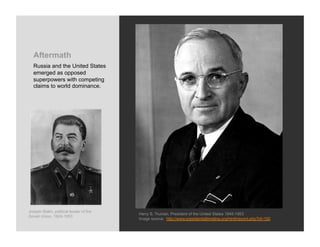
  Russia and the United States
  emerged as opposed
  superpowers with competing
  claims to world dominance.


Joseph Stalin, political leader of the
                                         Harry S. Truman, President of the United States 1945-1953
Soviet Union, 1924-1953
                                         Image source: http://www.presidentialtimeline.org/html/record.php?id=100
Aftermath
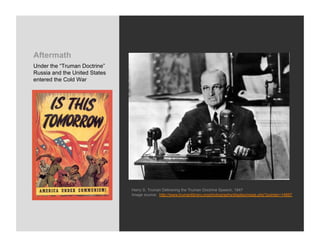
Under the “Truman Doctrine”
Russia and the United States
entered the Cold War


                               Harry S. Truman Delivering the Truman Doctrine Speech, 1947
                               Image source: http://www.trumanlibrary.org/photographs/displayimage.php?pointer=14687
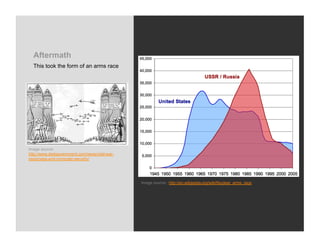
Aftermath
  This took the form of an arms race


Image source:
http://www.darkgovernment.com/news/cold-war-
espionage-and-computer-security/


                                               Image source: http://en.wikipedia.org/wiki/Nuclear_arms_race
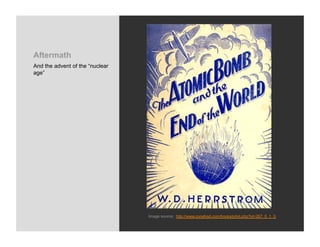
Aftermath
And the advent of the “nuclear
age”


                                 Image source: http://www.conelrad.com/books/print.php?id=267_0_1_0
Aftermath
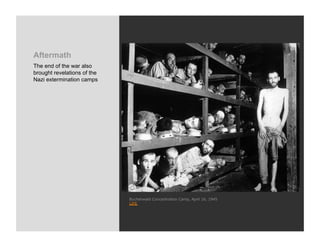
The end of the war also
brought revelations of the
Nazi extermination camps


                             Buchenwald Concentration Camp, April 16, 1945
                             LIFE
Aftermath
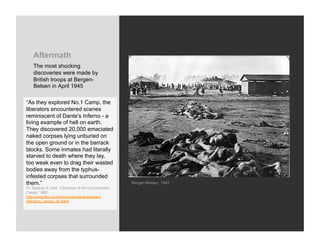
    The most shocking
    discoveries were made by
    British troops at Bergen-
    Belsen in April 1945

“As they explored No.1 Camp, the
liberators encountered scenes
reminiscent of Dante's Inferno - a
living example of hell on earth.
They discovered 20,000 emaciated
naked corpses lying unburied on
the open ground or in the barrack
blocks. Some inmates had literally
starved to death where they lay,
too weak even to drag their wasted
bodies away from the typhus-
infested corpses that surrounded
them.”                                                  Bergen-Belsen, 1945
Dr. Stephen A. Hart, “Liberation of the Concentration
Camps,” BBC
http://www.bbc.co.uk/history/worldwars/wwtwo/
liberation_camps_04.shtml
Aftermath
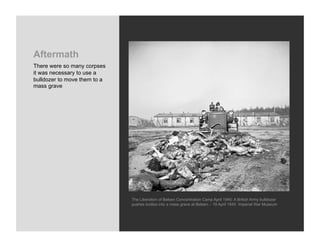
There were so many corpses
it was necessary to use a
bulldozer to move them to a
mass grave


                              The Liberation of Belsen Concentration Camp April 1945: A British Army bulldozer
                              pushes bodies into a mass grave at Belsen. - 19 April 1945 Imperial War Museum
Aftermath
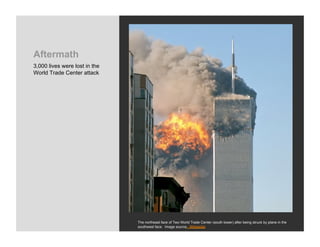
3,000 lives were lost in the
World Trade Center attack


                               The northeast face of Two World Trade Center (south tower) after being struck by plane in the
                               southwest face. Image source: Wikipedia
Aftermath
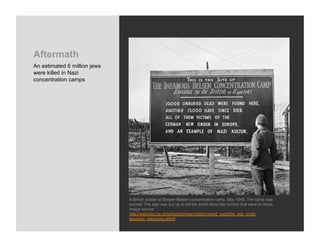
An estimated 6 million jews
were killed in Nazi
concentration camps


                              A British soldier at Bergen-Belsen concentration camp, May 1945. The camp was
                              burned. The sign was put up to tell the world about the horrors that went on there.
                              Image source:
                              http://www.bbc.co.uk/schools/primaryhistory/world_war2/the_war_ends/
                              teachers_resources.shtml
Aftermath
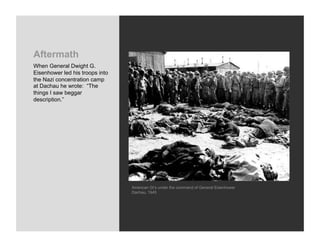
When General Dwight G.
Eisenhower led his troops into
the Nazi concentration camp
at Dachau he wrote: “The
things I saw beggar
description.”


                                 American GI’s under the command of General Eisenhower
                                 Dachau, 1945
Aftermath
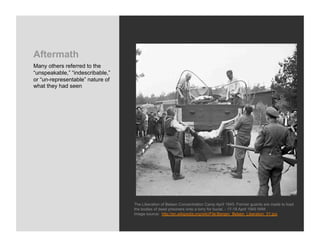
Many others referred to the
“unspeakable,” “indescribable,”
or “un-representable” nature of
what they had seen


                                  The Liberation of Belsen Concentration Camp April 1945: Former guards are made to load
                                  the bodies of dead prisoners onto a lorry for burial. - 17-18 April 1945 IWM
                                  Image source: http://en.wikipedia.org/wiki/File:Bergen_Belsen_Liberation_01.jpg
Bearing Witness
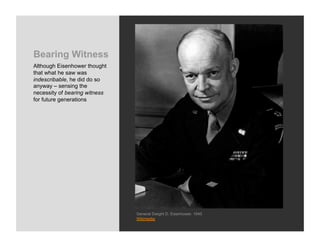
Although Eisenhower thought
that what he saw was
indescribable, he did do so
anyway – sensing the
necessity of bearing witness
for future generations


                               General Dwight D. Eisenhower, 1945
                               Wikimedia
Bearing Witness
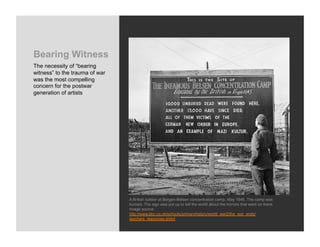
The necessity of “bearing
witness” to the trauma of war
was the most compelling
concern for the postwar
generation of artists


                                A British soldier at Bergen-Belsen concentration camp, May 1945. The camp was
                                burned. The sign was put up to tell the world about the horrors that went on there.
                                Image source:
                                http://www.bbc.co.uk/schools/primaryhistory/world_war2/the_war_ends/
                                teachers_resources.shtml
Bearing Witness
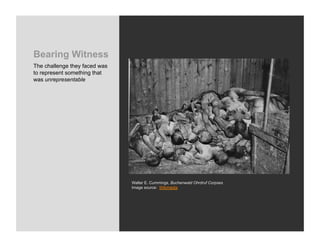
The challenge they faced was
to represent something that
was unrepresentable


                               Walter E. Cummings, Buchenwald Ohrdruf Corpses
                               Image source: Wikimedia
Bearing Witness
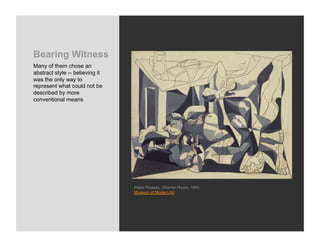
Many of them chose an
abstract style -- believing it
was the only way to
represent what could not be
described by more
conventional means


                                 Pablo Picasso, Charnel House, 1945
                                 Museum of Modern Art
Postwar
Abstraction
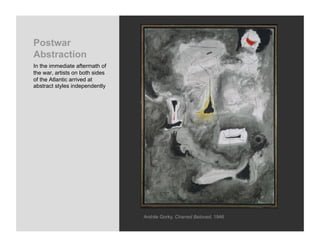
In the immediate aftermath of
the war, artists on both sides
of the Atlantic arrived at
abstract styles independently


                                 Arshile Gorky, Charred Beloved, 1946
Postwar
Abstraction
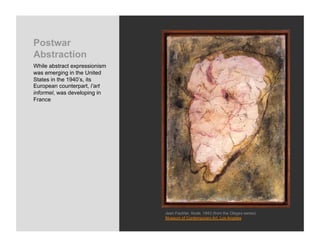
While abstract expressionism
was emerging in the United
States in the 1940’s, its
European counterpart, l’art
informel, was developing in
France


                               Jean Fautrier, Nude, 1943 (from the Otages series)
                               Museum of Contemporary Art, Los Angeles
Postwar
Abstraction
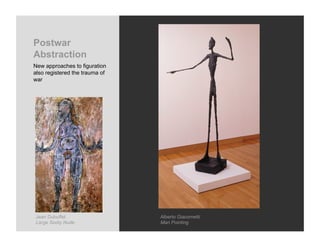
New approaches to figuration
also registered the trauma of
war


Jean Dubuffet                   Alberto Giacometti
Large Sooty Nude                Man Pointing
Postwar
Abstraction
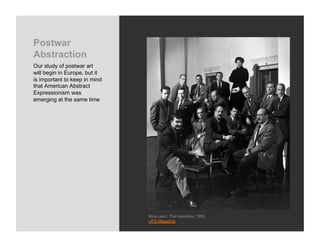
Our study of postwar art
will begin in Europe, but it
is important to keep in mind
that American Abstract
Expressionism was
emerging at the same time


                               Nina Leen, The Irascibles, 1950
                               LIFE Magazine
Web Resources

Audio Slideshow of the Liberation of Belsen, with the original BBC radio broadcast
http://news.bbc.co.uk/2/hi/in_depth/4445811.stm

Liberation of the Concentration Camps –BBC
http://www.bbc.co.uk/history/worldwars/wwtwo/liberation_camps_01.shtml

Video on The Holocaust (YouTube)
http://www.youtube.com/watch?v=bHAF0sgzKOs

Documentary on Hiroshima (YouTube)
http://www.youtube.com/watch?v=x9lwvImJqT0

John Cage In the Name of the Holocaust
http://www.youtube.com/watch?v=s8CSLliG2oo

1.3 wwii

  • 1.
    World War II Art109A: Art Since 1945 Westchester Community College Fall 2012 Dr. Melissa Hall
  • 2.
    World War II (1939-1945) WorldWar II began in 1939 with the German invasion of Poland German troops parade through Warsaw, Poland. PK Hugo J.ger, September 1939 http://www.archives.gov/research/ww2/photos/
  • 3.
    World War II (1939-1945) In1940 Paris, which had been the center of the European avant garde, fell to the Nazis Adolf Hitler in Paris, June 23, 1940 http://www.archives.gov/research/ww2/photos/
  • 4.
    World War II (1939-1945) TheJapanese bombing of Pearl Harbor in 1941 brought the United States into the conflict Sinking of the USS Virginia, Pearl Harbor, 1941 Image source: http://aboutjapan.japansociety.org/content.cfm/pearl_harbor_attack
  • 5.
    World War II (1939-1945) TheUS bombing of Hiroshima and Nagasaki brought the war to an end in 1945 Mushroom cloud of smoke billowing 20,000 ft. in the air after atomic explosion over the city of Hiroshima, August 6, 1945 LIFE
  • 6.
    Hiroshima before thebombing Hiroshima after the bombing Image source: Image source: http://en.wikipedia.org/wiki/ http://en.wikipedia.org/wiki/ Atomic_bombings_of_Hiroshima_and_Nagasaki Atomic_bombings_of_Hiroshima_and_Nagasaki
  • 7.
    Aftermath Europelay in ruins Herbert Mason, St. Paul’s, London, during the Blitz, 1940 Wikipedia William Vandivert, Dresden after the Allied bombing, 1946 LIFE
  • 8.
    Aftermath Russiaand the United States emerged as opposed superpowers with competing claims to world dominance. Joseph Stalin, political leader of the Harry S. Truman, President of the United States 1945-1953 Soviet Union, 1924-1953 Image source: http://www.presidentialtimeline.org/html/record.php?id=100
  • 9.
    Aftermath Under the “TrumanDoctrine” Russia and the United States entered the Cold War Harry S. Truman Delivering the Truman Doctrine Speech, 1947 Image source: http://www.trumanlibrary.org/photographs/displayimage.php?pointer=14687
  • 10.
    Aftermath Thistook the form of an arms race Image source: http://www.darkgovernment.com/news/cold-war- espionage-and-computer-security/ Image source: http://en.wikipedia.org/wiki/Nuclear_arms_race
  • 11.
    Aftermath And the adventof the “nuclear age” Image source: http://www.conelrad.com/books/print.php?id=267_0_1_0
  • 12.
    Aftermath The end ofthe war also brought revelations of the Nazi extermination camps Buchenwald Concentration Camp, April 16, 1945 LIFE
  • 13.
    Aftermath The most shocking discoveries were made by British troops at Bergen- Belsen in April 1945 “As they explored No.1 Camp, the liberators encountered scenes reminiscent of Dante's Inferno - a living example of hell on earth. They discovered 20,000 emaciated naked corpses lying unburied on the open ground or in the barrack blocks. Some inmates had literally starved to death where they lay, too weak even to drag their wasted bodies away from the typhus- infested corpses that surrounded them.” Bergen-Belsen, 1945 Dr. Stephen A. Hart, “Liberation of the Concentration Camps,” BBC http://www.bbc.co.uk/history/worldwars/wwtwo/ liberation_camps_04.shtml
  • 14.
    Aftermath There were somany corpses it was necessary to use a bulldozer to move them to a mass grave The Liberation of Belsen Concentration Camp April 1945: A British Army bulldozer pushes bodies into a mass grave at Belsen. - 19 April 1945 Imperial War Museum
  • 15.
    Aftermath 3,000 lives werelost in the World Trade Center attack The northeast face of Two World Trade Center (south tower) after being struck by plane in the southwest face. Image source: Wikipedia
  • 16.
    Aftermath An estimated 6million jews were killed in Nazi concentration camps A British soldier at Bergen-Belsen concentration camp, May 1945. The camp was burned. The sign was put up to tell the world about the horrors that went on there. Image source: http://www.bbc.co.uk/schools/primaryhistory/world_war2/the_war_ends/ teachers_resources.shtml
  • 17.
    Aftermath When General DwightG. Eisenhower led his troops into the Nazi concentration camp at Dachau he wrote: “The things I saw beggar description.” American GI’s under the command of General Eisenhower Dachau, 1945
  • 18.
    Aftermath Many others referredto the “unspeakable,” “indescribable,” or “un-representable” nature of what they had seen The Liberation of Belsen Concentration Camp April 1945: Former guards are made to load the bodies of dead prisoners onto a lorry for burial. - 17-18 April 1945 IWM Image source: http://en.wikipedia.org/wiki/File:Bergen_Belsen_Liberation_01.jpg
  • 19.
    Bearing Witness Although Eisenhowerthought that what he saw was indescribable, he did do so anyway – sensing the necessity of bearing witness for future generations General Dwight D. Eisenhower, 1945 Wikimedia
  • 20.
    Bearing Witness The necessityof “bearing witness” to the trauma of war was the most compelling concern for the postwar generation of artists A British soldier at Bergen-Belsen concentration camp, May 1945. The camp was burned. The sign was put up to tell the world about the horrors that went on there. Image source: http://www.bbc.co.uk/schools/primaryhistory/world_war2/the_war_ends/ teachers_resources.shtml
  • 21.
    Bearing Witness The challengethey faced was to represent something that was unrepresentable Walter E. Cummings, Buchenwald Ohrdruf Corpses Image source: Wikimedia
  • 22.
    Bearing Witness Many ofthem chose an abstract style -- believing it was the only way to represent what could not be described by more conventional means Pablo Picasso, Charnel House, 1945 Museum of Modern Art
  • 23.
    Postwar Abstraction In the immediateaftermath of the war, artists on both sides of the Atlantic arrived at abstract styles independently Arshile Gorky, Charred Beloved, 1946
  • 24.
    Postwar Abstraction While abstract expressionism wasemerging in the United States in the 1940’s, its European counterpart, l’art informel, was developing in France Jean Fautrier, Nude, 1943 (from the Otages series) Museum of Contemporary Art, Los Angeles
  • 25.
    Postwar Abstraction New approaches tofiguration also registered the trauma of war Jean Dubuffet Alberto Giacometti Large Sooty Nude Man Pointing
  • 26.
    Postwar Abstraction Our study ofpostwar art will begin in Europe, but it is important to keep in mind that American Abstract Expressionism was emerging at the same time Nina Leen, The Irascibles, 1950 LIFE Magazine
  • 27.
    Web Resources Audio Slideshowof the Liberation of Belsen, with the original BBC radio broadcast http://news.bbc.co.uk/2/hi/in_depth/4445811.stm Liberation of the Concentration Camps –BBC http://www.bbc.co.uk/history/worldwars/wwtwo/liberation_camps_01.shtml Video on The Holocaust (YouTube) http://www.youtube.com/watch?v=bHAF0sgzKOs Documentary on Hiroshima (YouTube) http://www.youtube.com/watch?v=x9lwvImJqT0 John Cage In the Name of the Holocaust http://www.youtube.com/watch?v=s8CSLliG2oo