Applications of Factoring
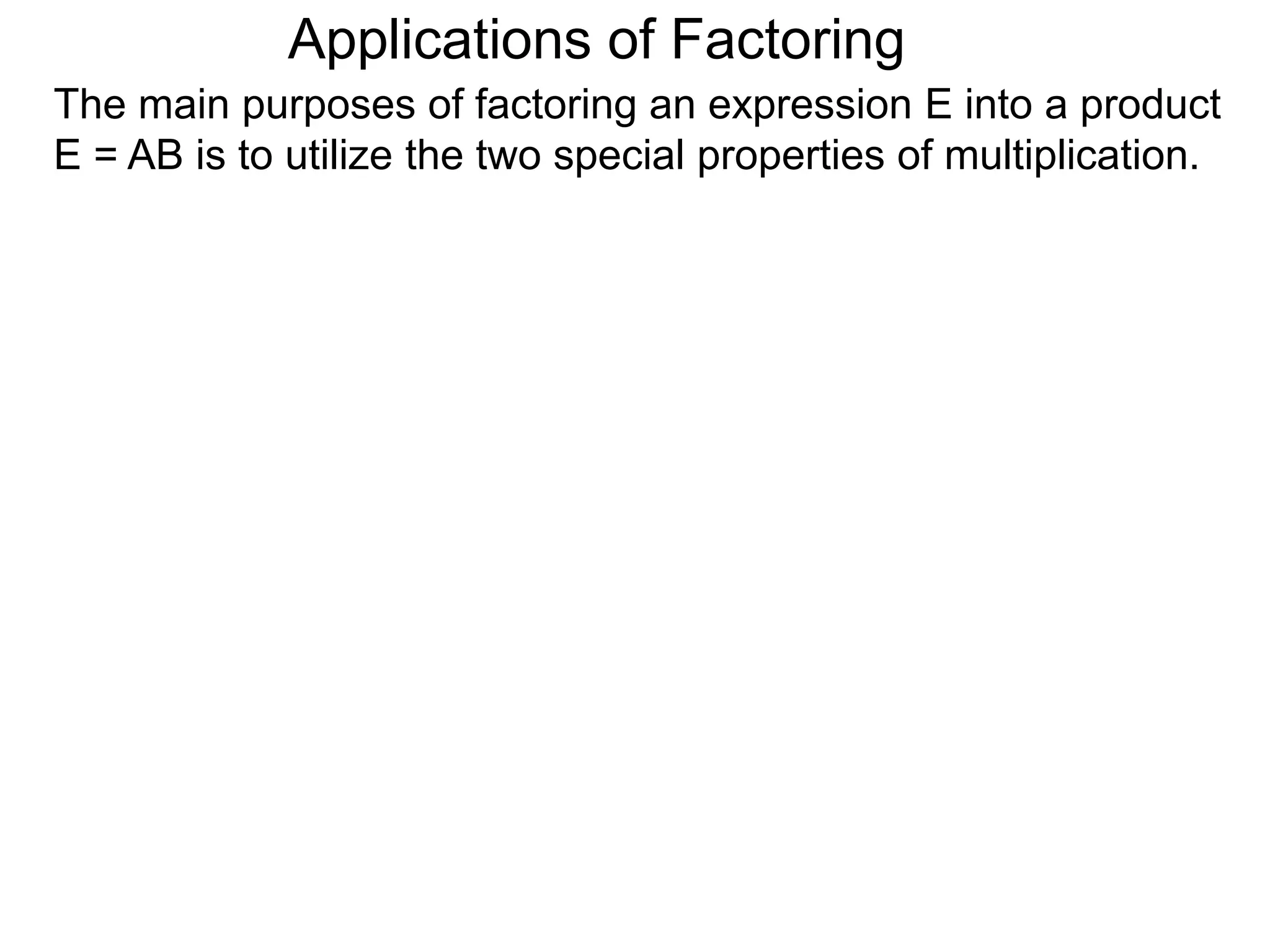
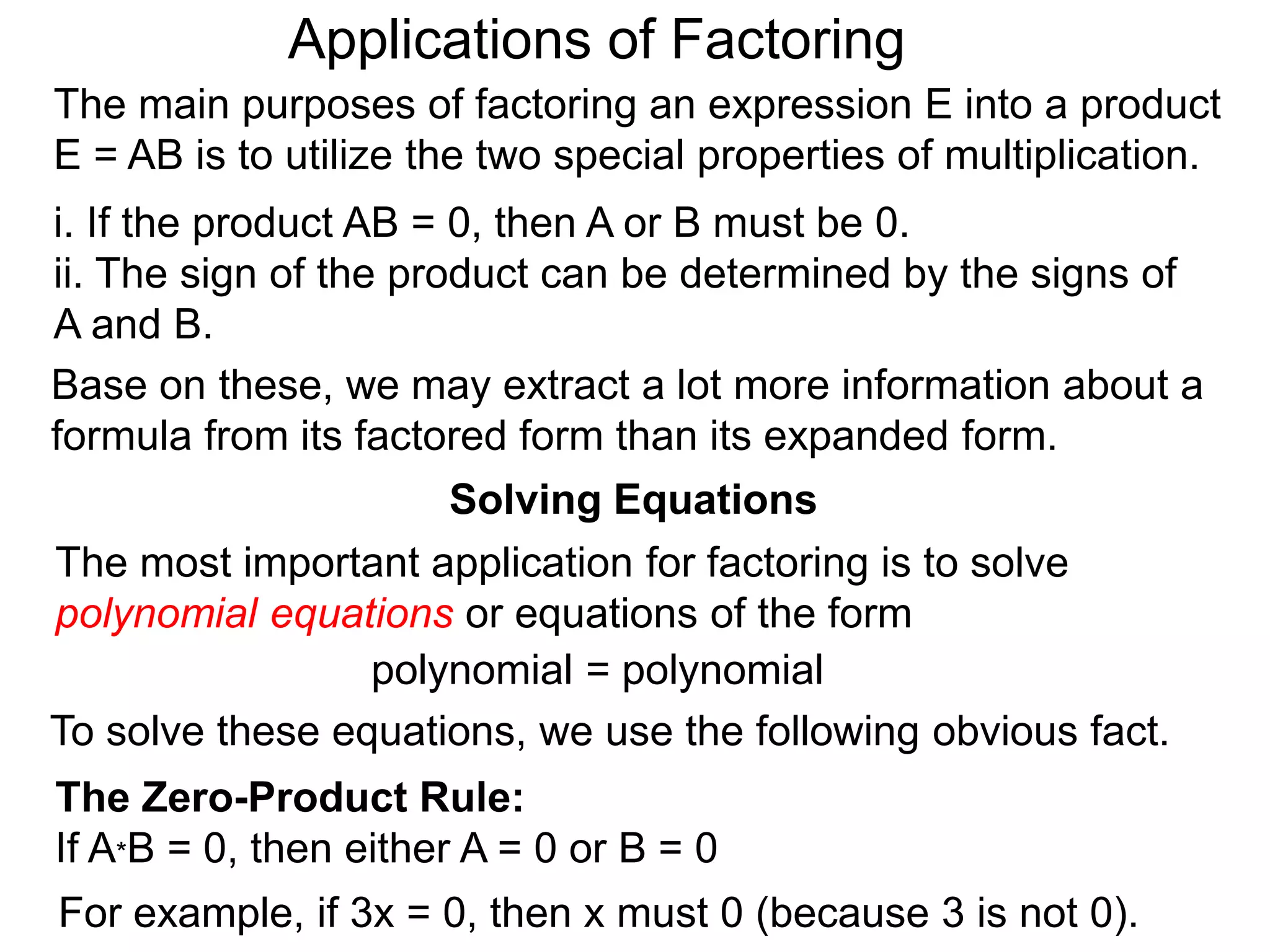
The main purposes of factoring an expression E into a product
E = AB is to utilize the two special properties of multiplication.
Applications of Factoring
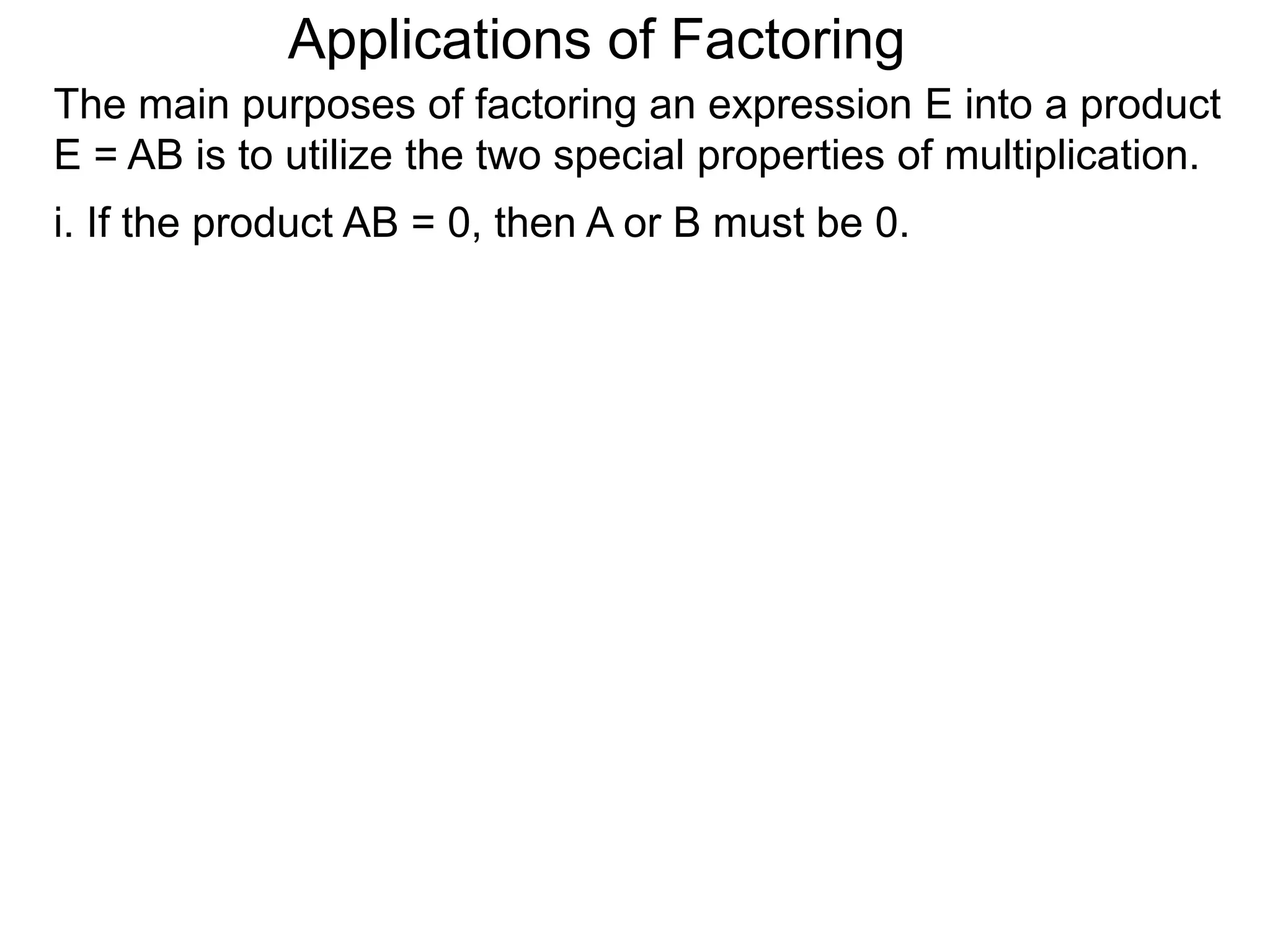
The main purposes of factoring an expression E into a product
E = AB is to utilize the two special properties of multiplication.
i. If the product AB = 0, then A or B must be 0.
Applications of Factoring
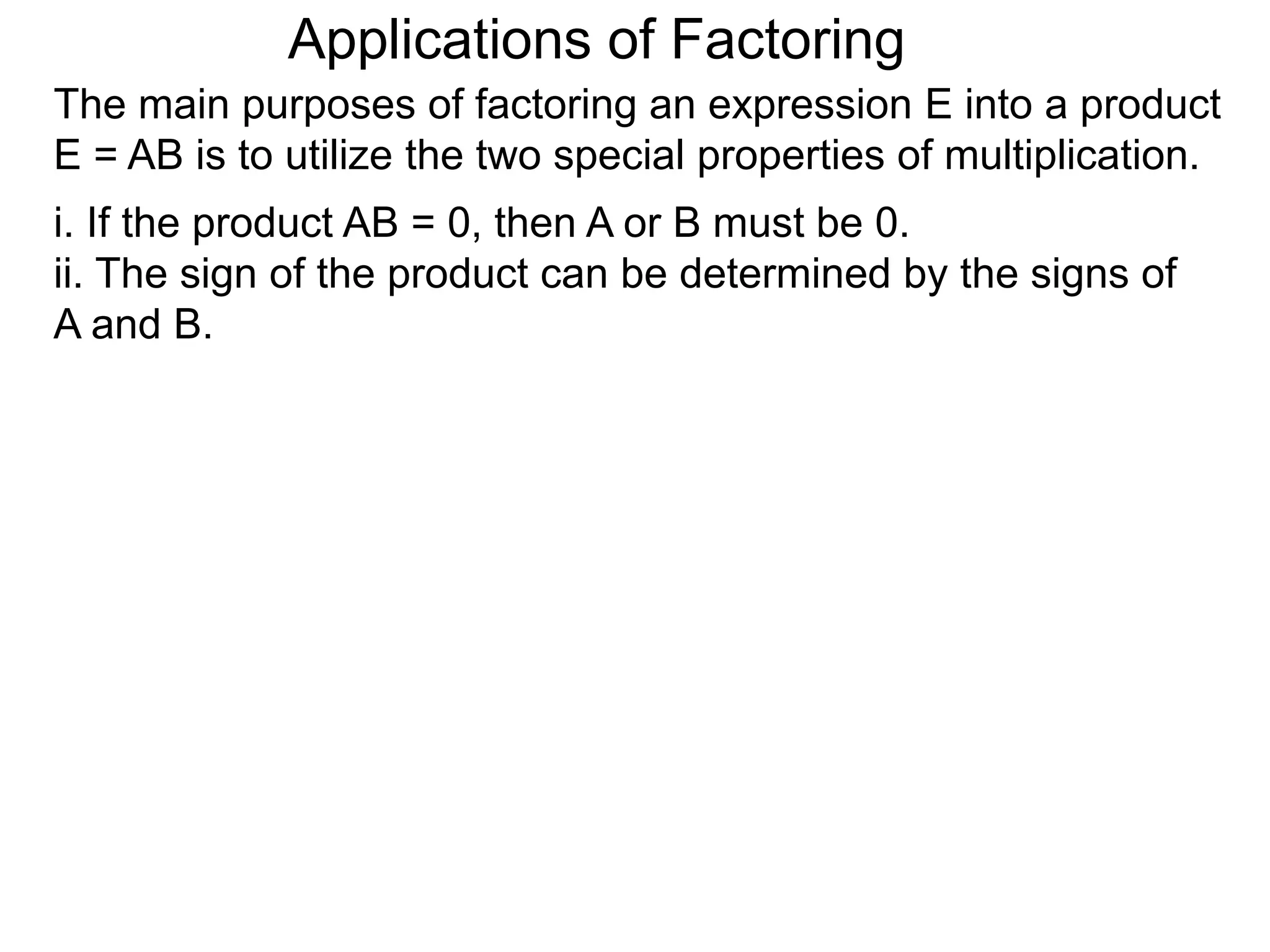
The main purposes of factoring an expression E into a product
E = AB is to utilize the two special properties of multiplication.
i. If the product AB = 0, then A or B must be 0.
ii. The sign of the product can be determined by the signs of
A and B.
Applications of Factoring
The main purposes of factoring an expression E into a product
E = AB is to utilize the two special properties of multiplication.
i. If the product AB = 0, then A or B must be 0.
ii. The sign of the product can be determined by the signs of
A and B.
Base on these, we may extract a lot more information about a
formula from its factored form than its expanded form.
Applications of Factoring
Solving Equations
The main purposes of factoring an expression E into a product
E = AB is to utilize the two special properties of multiplication.
i. If the product AB = 0, then A or B must be 0.
ii. The sign of the product can be determined by the signs of
A and B.
Base on these, we may extract a lot more information about a
formula from its factored form than its expanded form.
Applications of Factoring
Solving Equations
The most important application for factoring is to solve
polynomial equations or equations of the form
polynomial = polynomial
The main purposes of factoring an expression E into a product
E = AB is to utilize the two special properties of multiplication.
i. If the product AB = 0, then A or B must be 0.
ii. The sign of the product can be determined by the signs of
A and B.
Base on these, we may extract a lot more information about a
formula from its factored form than its expanded form.
Applications of Factoring
Solving Equations
The most important application for factoring is to solve
polynomial equations or equations of the form
polynomial = polynomial
To solve these equations, we use the following obvious fact.
The main purposes of factoring an expression E into a product
E = AB is to utilize the two special properties of multiplication.
i. If the product AB = 0, then A or B must be 0.
ii. The sign of the product can be determined by the signs of
A and B.
Base on these, we may extract a lot more information about a
formula from its factored form than its expanded form.
Applications of Factoring
Solving Equations
The most important application for factoring is to solve
polynomial equations or equations of the form
polynomial = polynomial
To solve these equations, we use the following obvious fact.
The Zero-Product Rule:
If A*B = 0, then either A = 0 or B = 0
The main purposes of factoring an expression E into a product
E = AB is to utilize the two special properties of multiplication.
i. If the product AB = 0, then A or B must be 0.
ii. The sign of the product can be determined by the signs of
A and B.
Base on these, we may extract a lot more information about a
formula from its factored form than its expanded form.
Applications of Factoring
Solving Equations
The most important application for factoring is to solve
polynomial equations or equations of the form
polynomial = polynomial
To solve these equations, we use the following obvious fact.
The Zero-Product Rule:
If A*B = 0, then either A = 0 or B = 0
For example, if 3x = 0, then x must 0 (because 3 is not 0).
The main purposes of factoring an expression E into a product
E = AB is to utilize the two special properties of multiplication.
i. If the product AB = 0, then A or B must be 0.
ii. The sign of the product can be determined by the signs of
A and B.
Base on these, we may extract a lot more information about a
formula from its factored form than its expanded form.
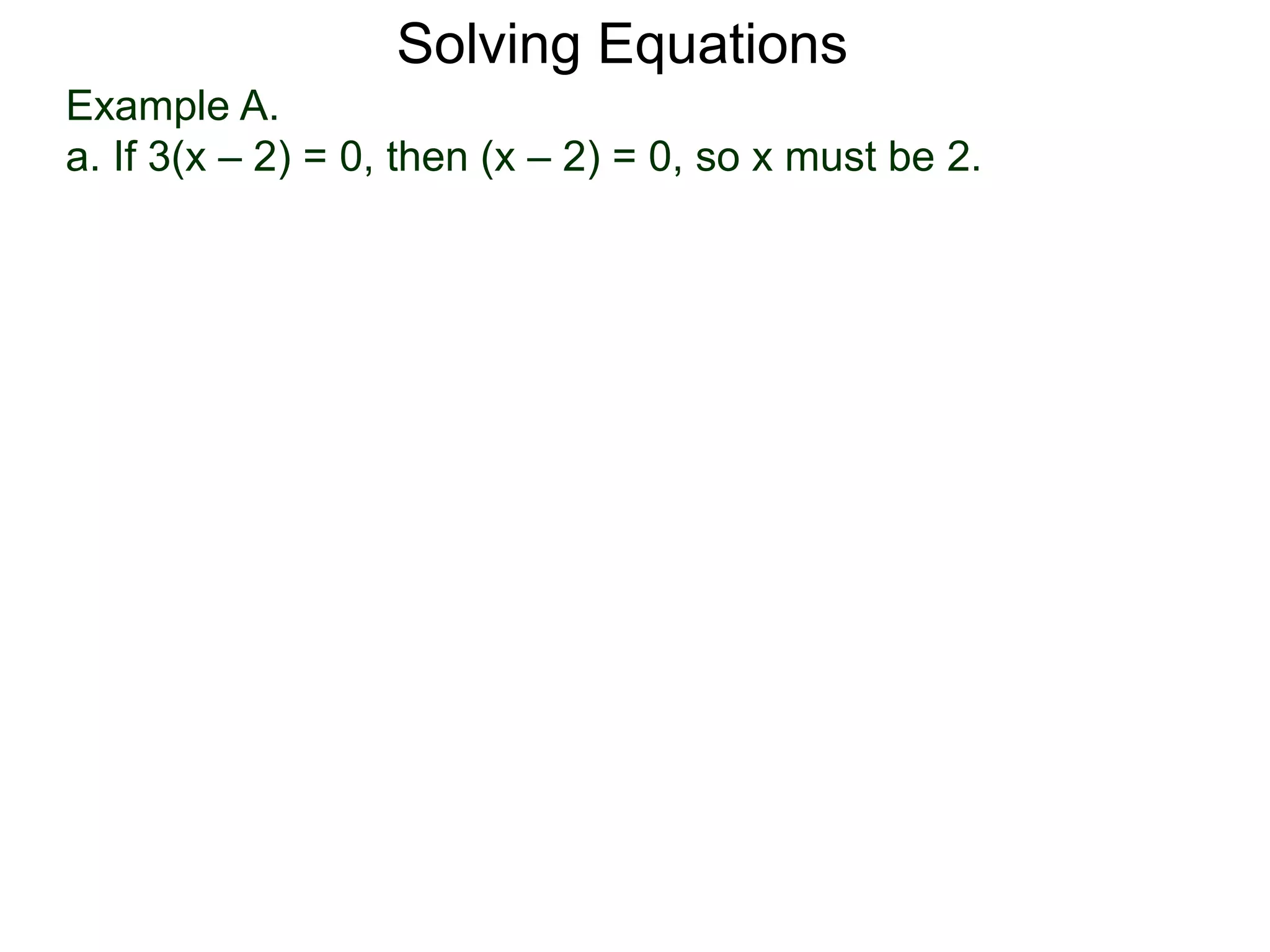
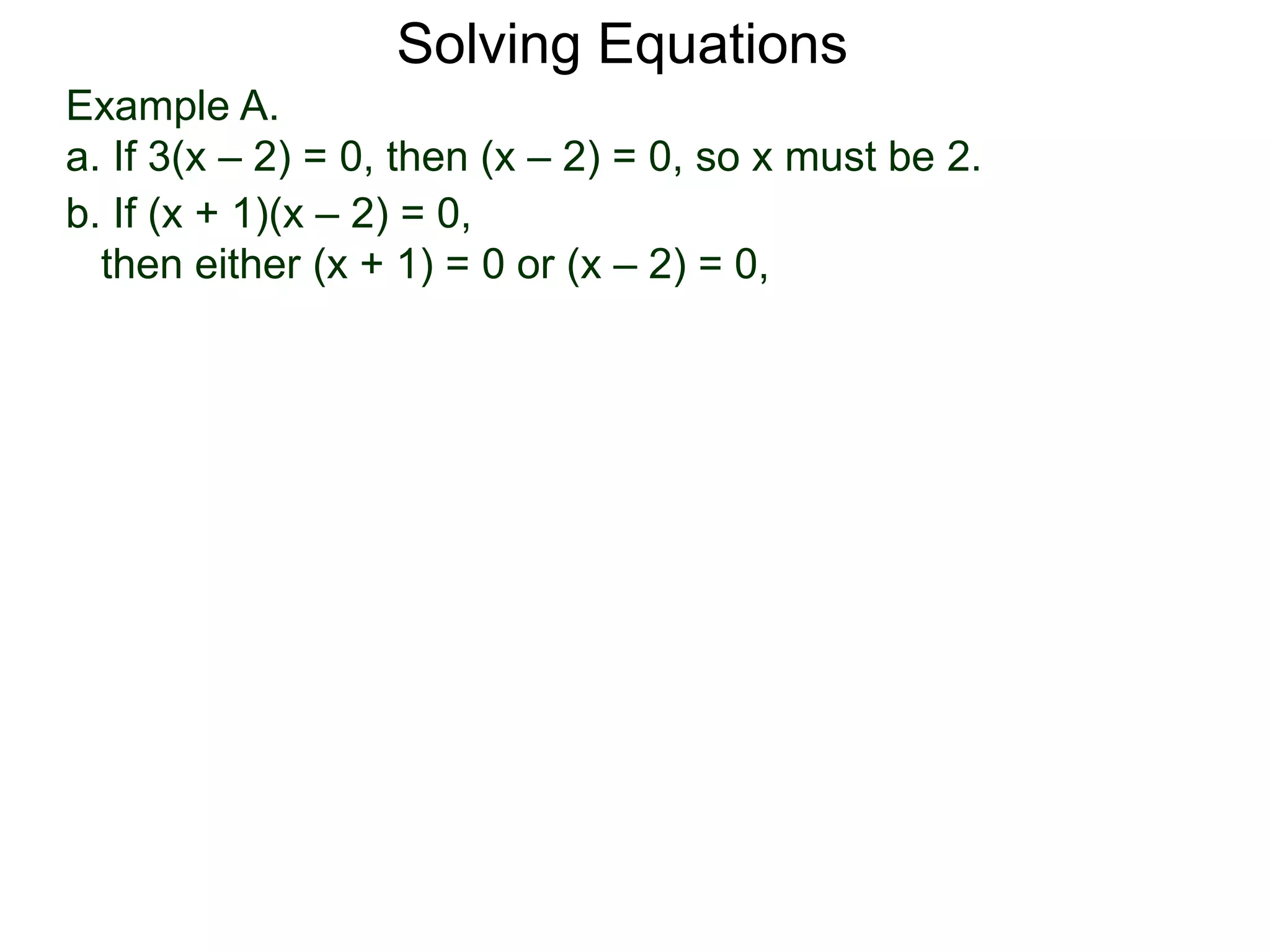
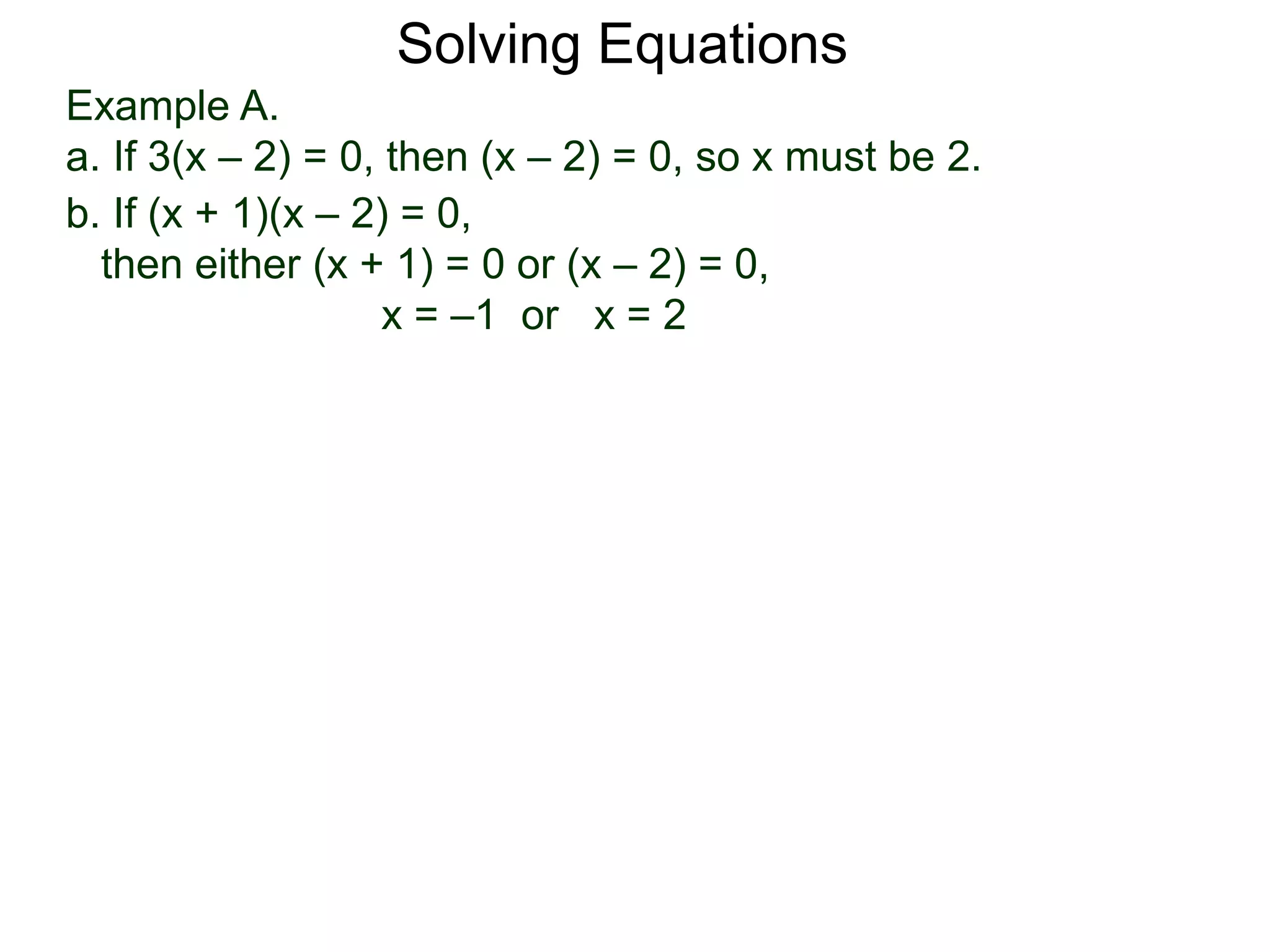
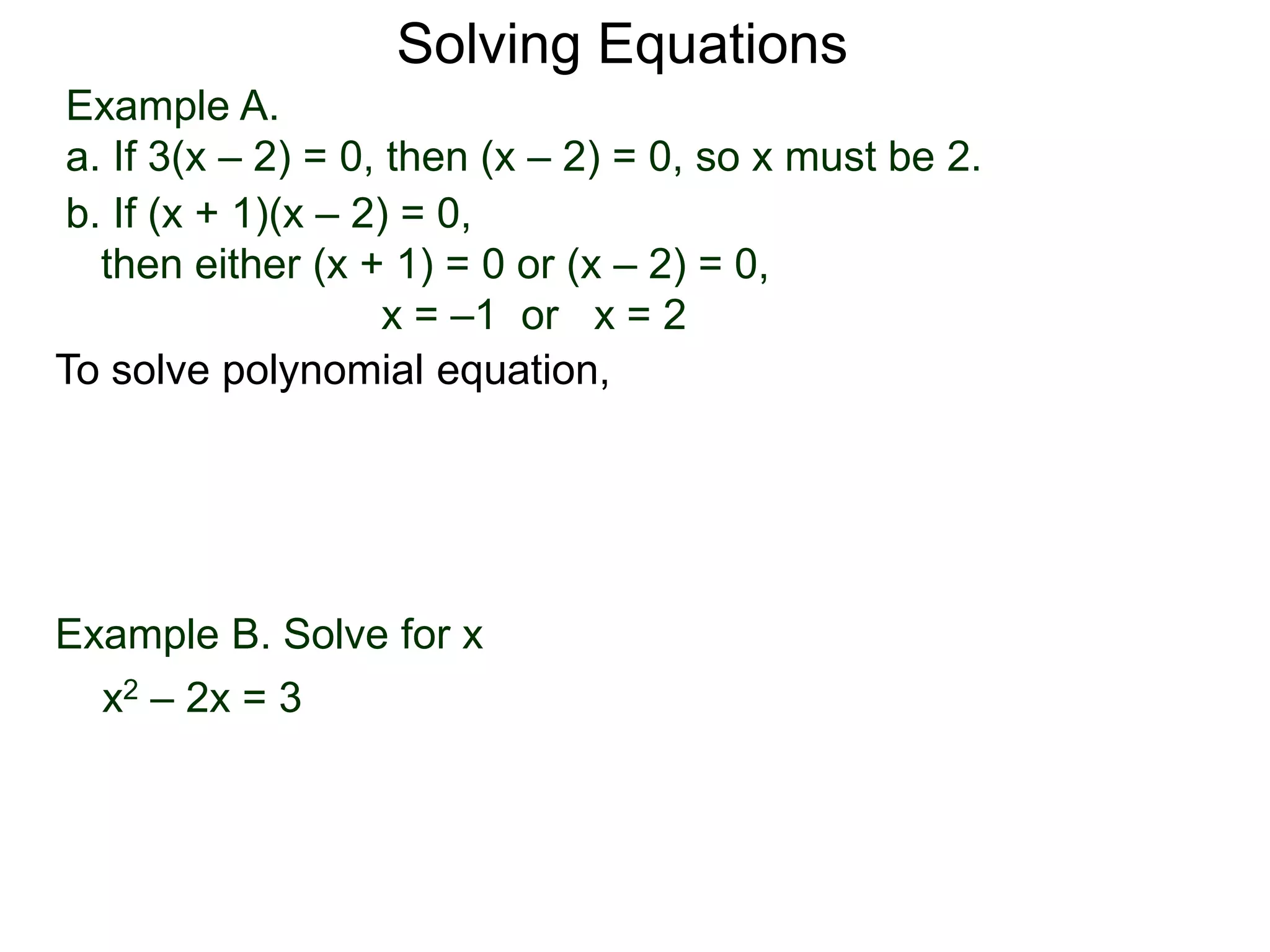
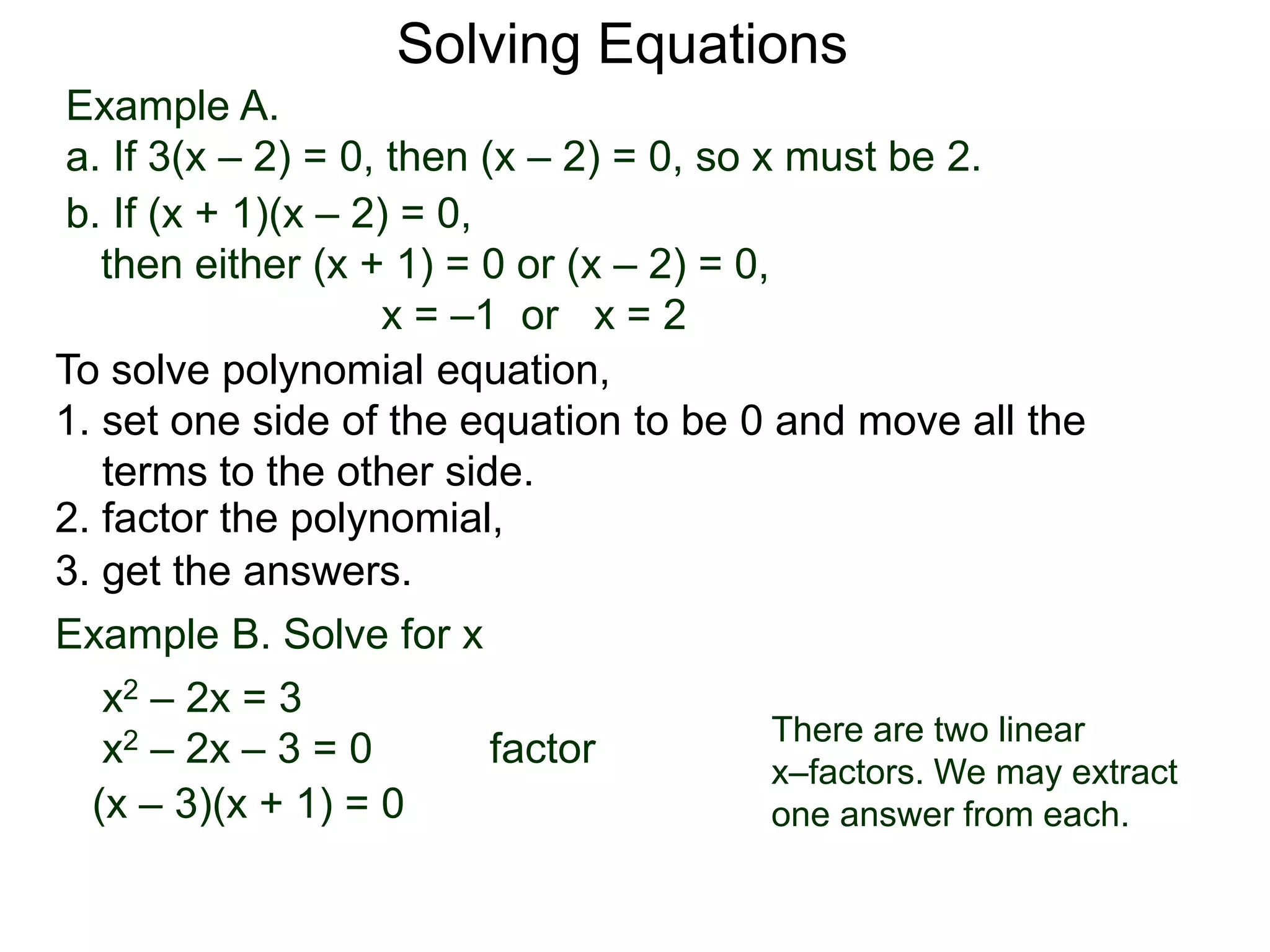
Example A.
a. If 3(x – 2) = 0, then (x – 2) = 0, so x must be 2.
Solving Equations
Example A.
a. If 3(x – 2) = 0, then (x – 2) = 0, so x must be 2.
Solving Equations
b. If (x + 1)(x – 2) = 0,
then either (x + 1) = 0 or (x – 2) = 0,
Example A.
a. If 3(x – 2) = 0, then (x – 2) = 0, so x must be 2.
Solving Equations
b. If (x + 1)(x – 2) = 0,
then either (x + 1) = 0 or (x – 2) = 0,
x = –1 or x = 2
Example A.
a. If 3(x – 2) = 0, then (x – 2) = 0, so x must be 2.
Solving Equations
To solve polynomial equation,
b. If (x + 1)(x – 2) = 0,
then either (x + 1) = 0 or (x – 2) = 0,
x = –1 or x = 2
Example B. Solve for x
a. x2 – 2x = 3
Example A.
a. If 3(x – 2) = 0, then (x – 2) = 0, so x must be 2.
Solving Equations
To solve polynomial equation,
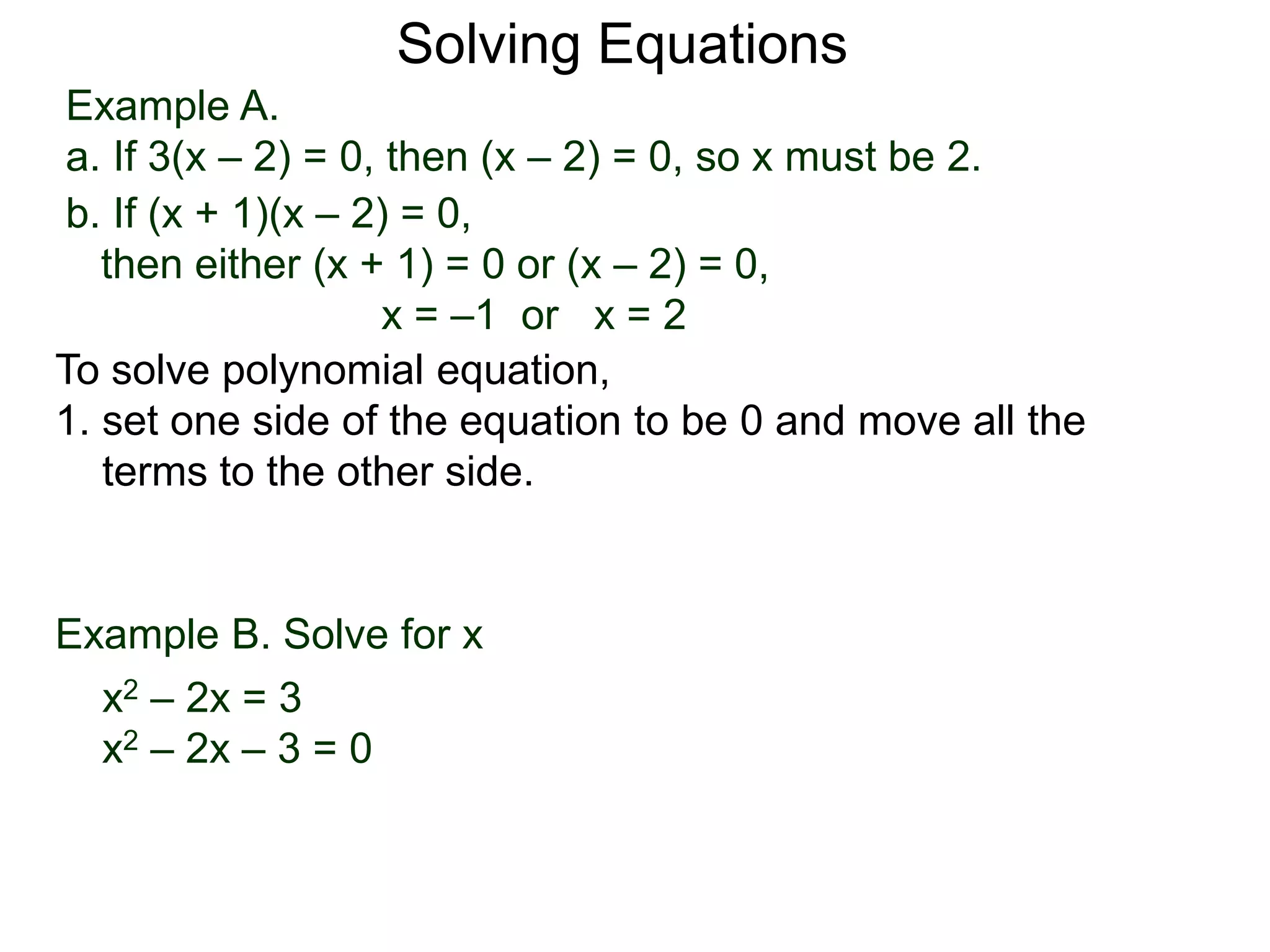
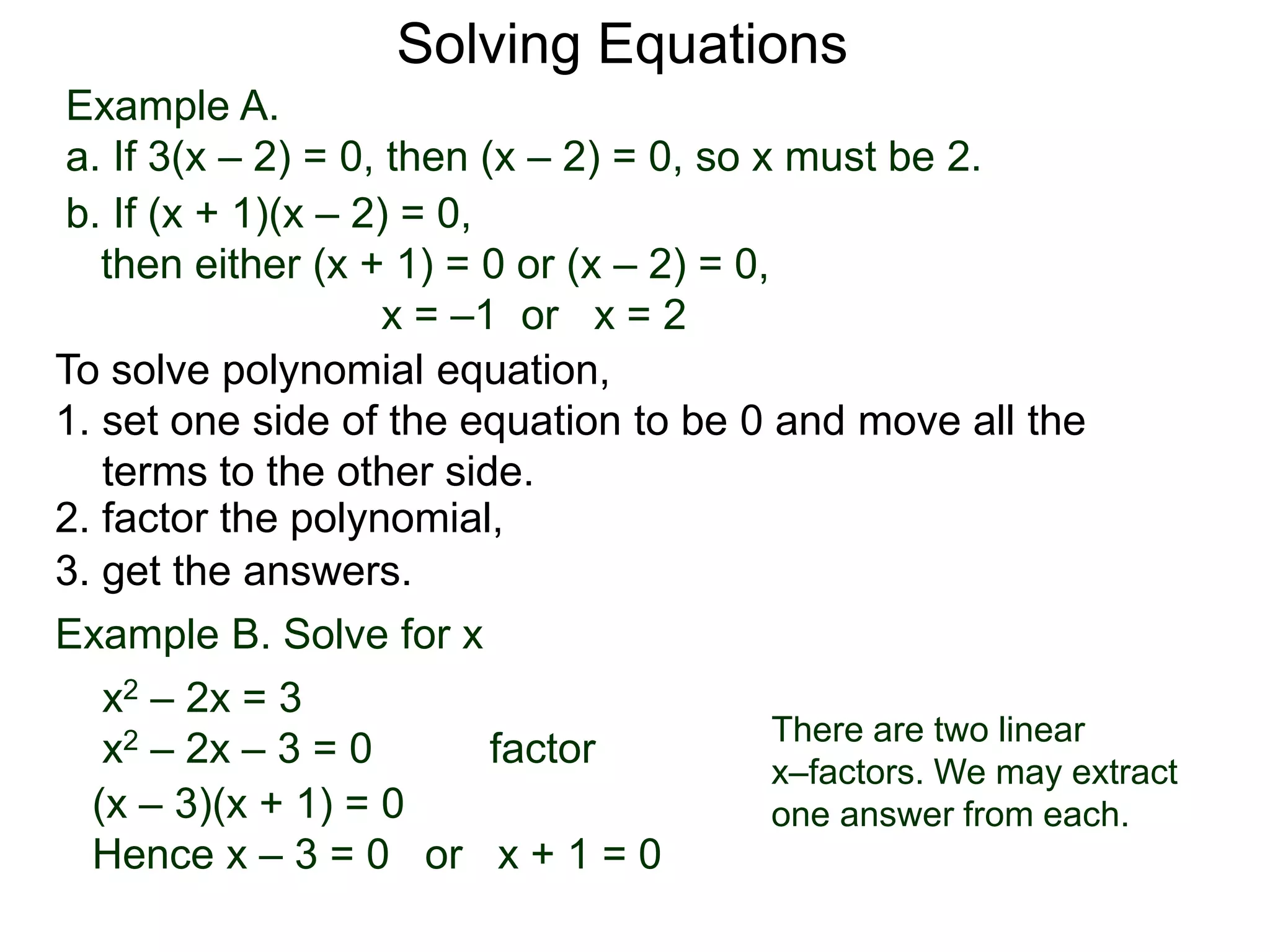
1. set one side of the equation to be 0 and move all the
terms to the other side.
b. If (x + 1)(x – 2) = 0,
then either (x + 1) = 0 or (x – 2) = 0,
x = –1 or x = 2
Example B. Solve for x
a. x2 – 2x = 3
x2 – 2x – 3 = 0
Example A.
a. If 3(x – 2) = 0, then (x – 2) = 0, so x must be 2.
Solving Equations
To solve polynomial equation,
1. set one side of the equation to be 0 and move all the
terms to the other side.
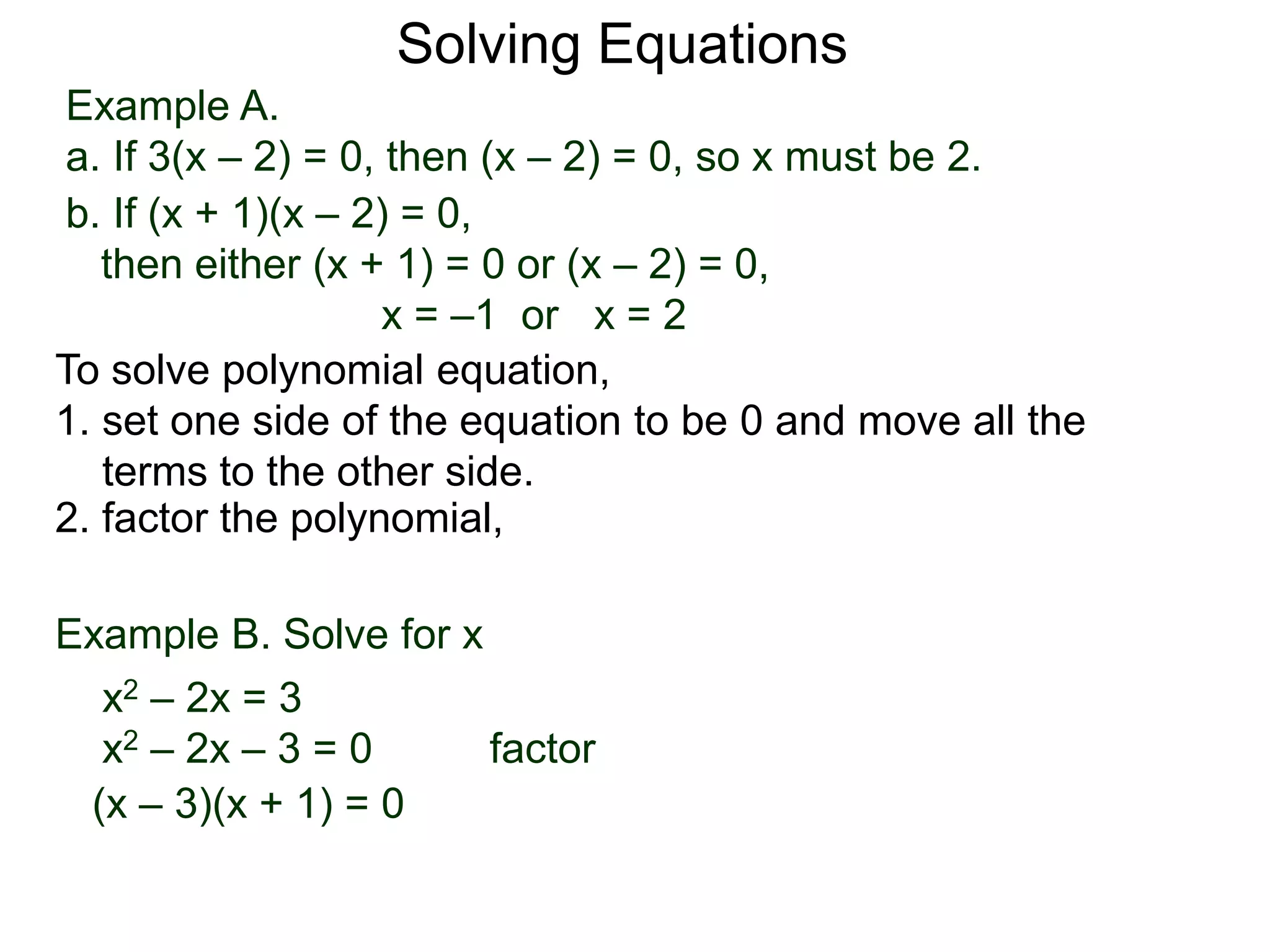
2. factor the polynomial,
b. If (x + 1)(x – 2) = 0,
then either (x + 1) = 0 or (x – 2) = 0,
x = –1 or x = 2
Example B. Solve for x
a. x2 – 2x = 3
x2 – 2x – 3 = 0 factor
(x – 3)(x + 1) = 0
Example A.
a. If 3(x – 2) = 0, then (x – 2) = 0, so x must be 2.
Solving Equations
To solve polynomial equation,
1. set one side of the equation to be 0 and move all the
terms to the other side.
2. factor the polynomial,
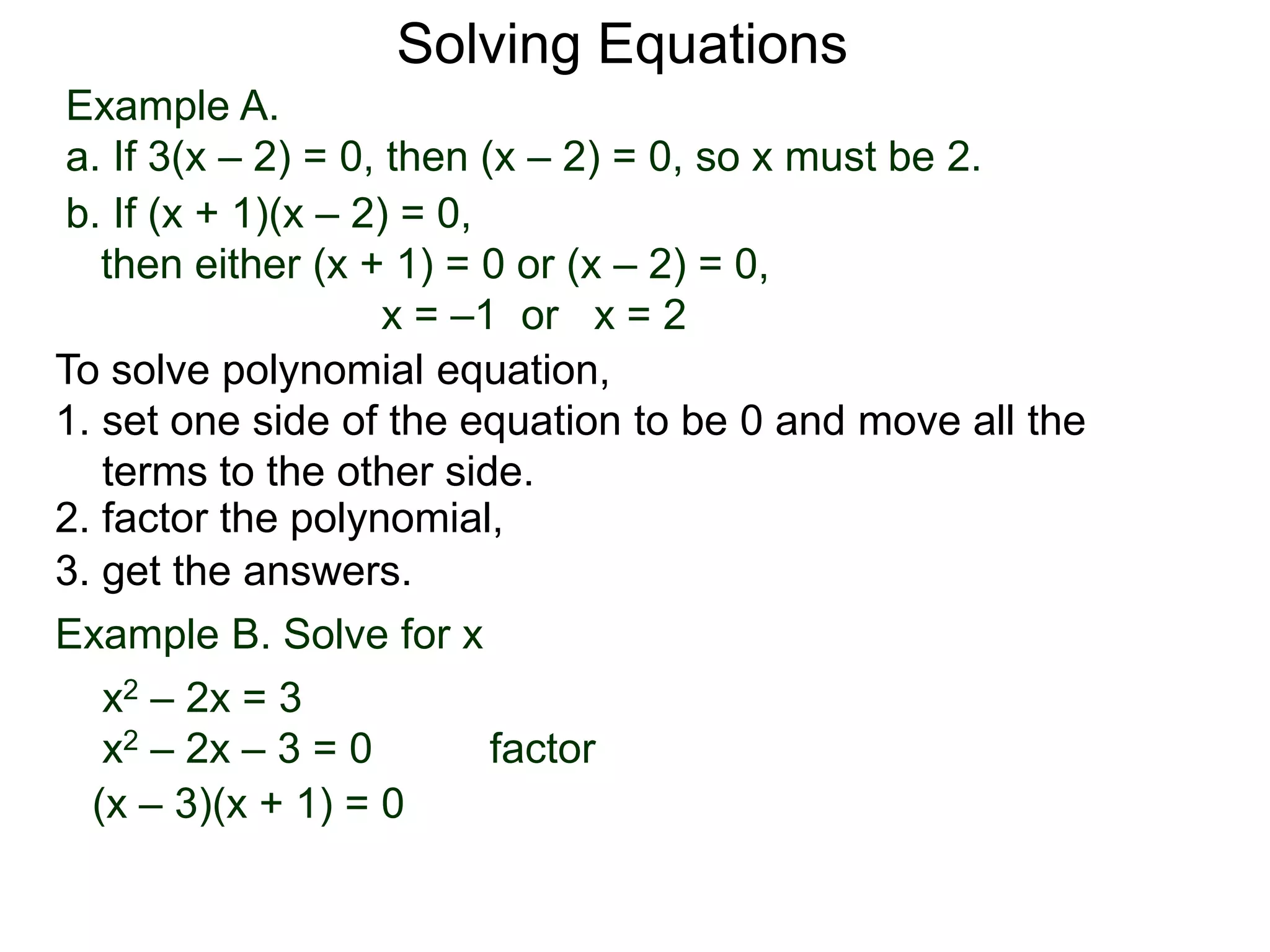
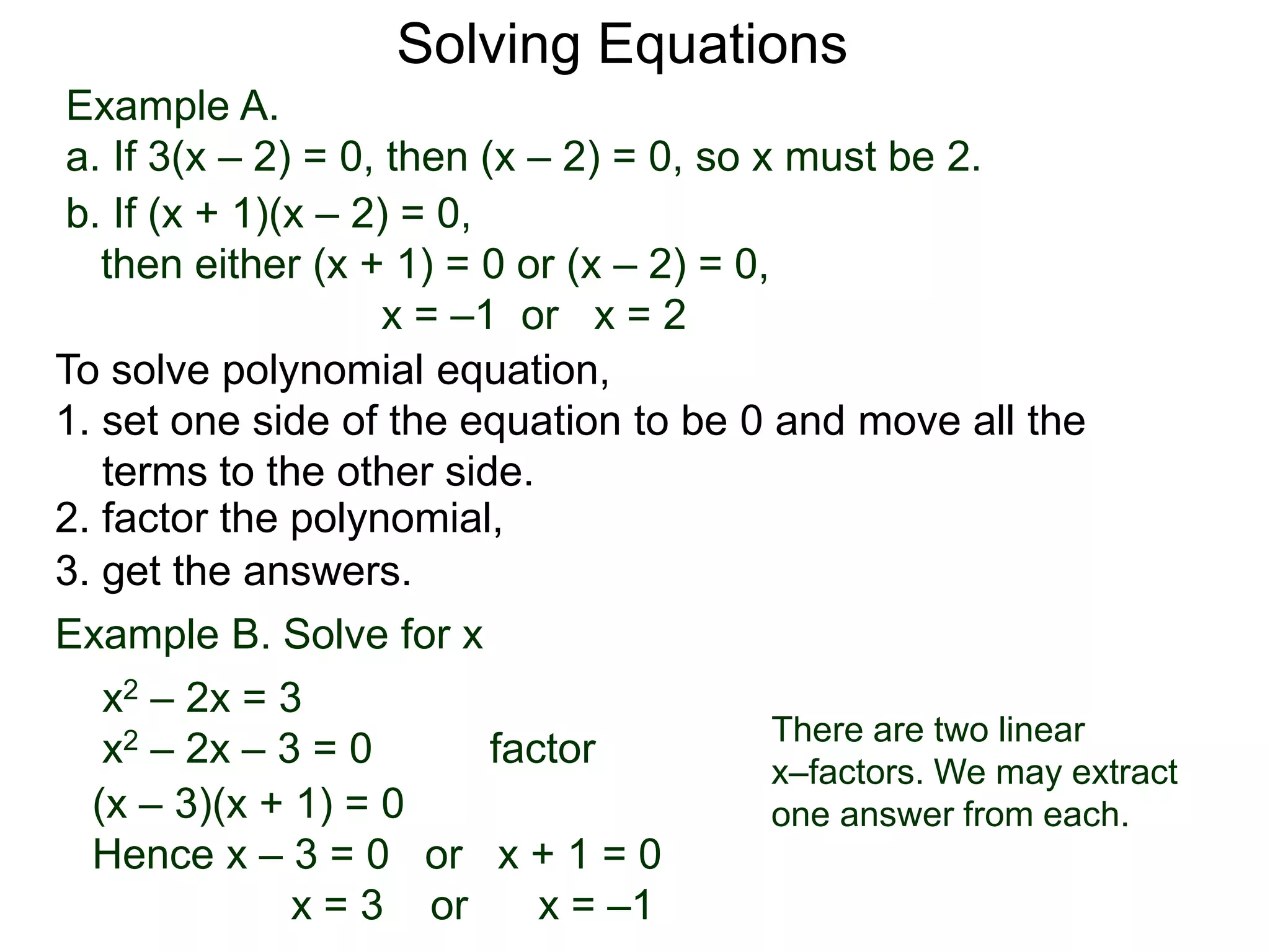
3. get the answers.
b. If (x + 1)(x – 2) = 0,
then either (x + 1) = 0 or (x – 2) = 0,
x = –1 or x = 2
Example B. Solve for x
a. x2 – 2x = 3
x2 – 2x – 3 = 0 factor
(x – 3)(x + 1) = 0
Example A.
a. If 3(x – 2) = 0, then (x – 2) = 0, so x must be 2.
Solving Equations
To solve polynomial equation,
1. set one side of the equation to be 0 and move all the
terms to the other side.
2. factor the polynomial,
3. get the answers.
b. If (x + 1)(x – 2) = 0,
then either (x + 1) = 0 or (x – 2) = 0,
x = –1 or x = 2
Example B. Solve for x
a. x2 – 2x = 3
x2 – 2x – 3 = 0 factor
(x – 3)(x + 1) = 0
There are two linear
x–factors. We may extract
one answer from each.
Example A.
a. If 3(x – 2) = 0, then (x – 2) = 0, so x must be 2.
Solving Equations
To solve polynomial equation,
1. set one side of the equation to be 0 and move all the
terms to the other side.
2. factor the polynomial,
3. get the answers.
b. If (x + 1)(x – 2) = 0,
then either (x + 1) = 0 or (x – 2) = 0,
x = –1 or x = 2
Example B. Solve for x
a. x2 – 2x = 3
x2 – 2x – 3 = 0 factor
(x – 3)(x + 1) = 0
Hence x – 3 = 0 or x + 1 = 0
There are two linear
x–factors. We may extract
one answer from each.
Example A.
a. If 3(x – 2) = 0, then (x – 2) = 0, so x must be 2.
Solving Equations
To solve polynomial equation,
1. set one side of the equation to be 0 and move all the
terms to the other side.
2. factor the polynomial,
3. get the answers.
b. If (x + 1)(x – 2) = 0,
then either (x + 1) = 0 or (x – 2) = 0,
x = –1 or x = 2
Example B. Solve for x
a. x2 – 2x = 3
x2 – 2x – 3 = 0 factor
(x – 3)(x + 1) = 0
Hence x – 3 = 0 or x + 1 = 0
x = 3 or x = –1
There are two linear
x–factors. We may extract
one answer from each.
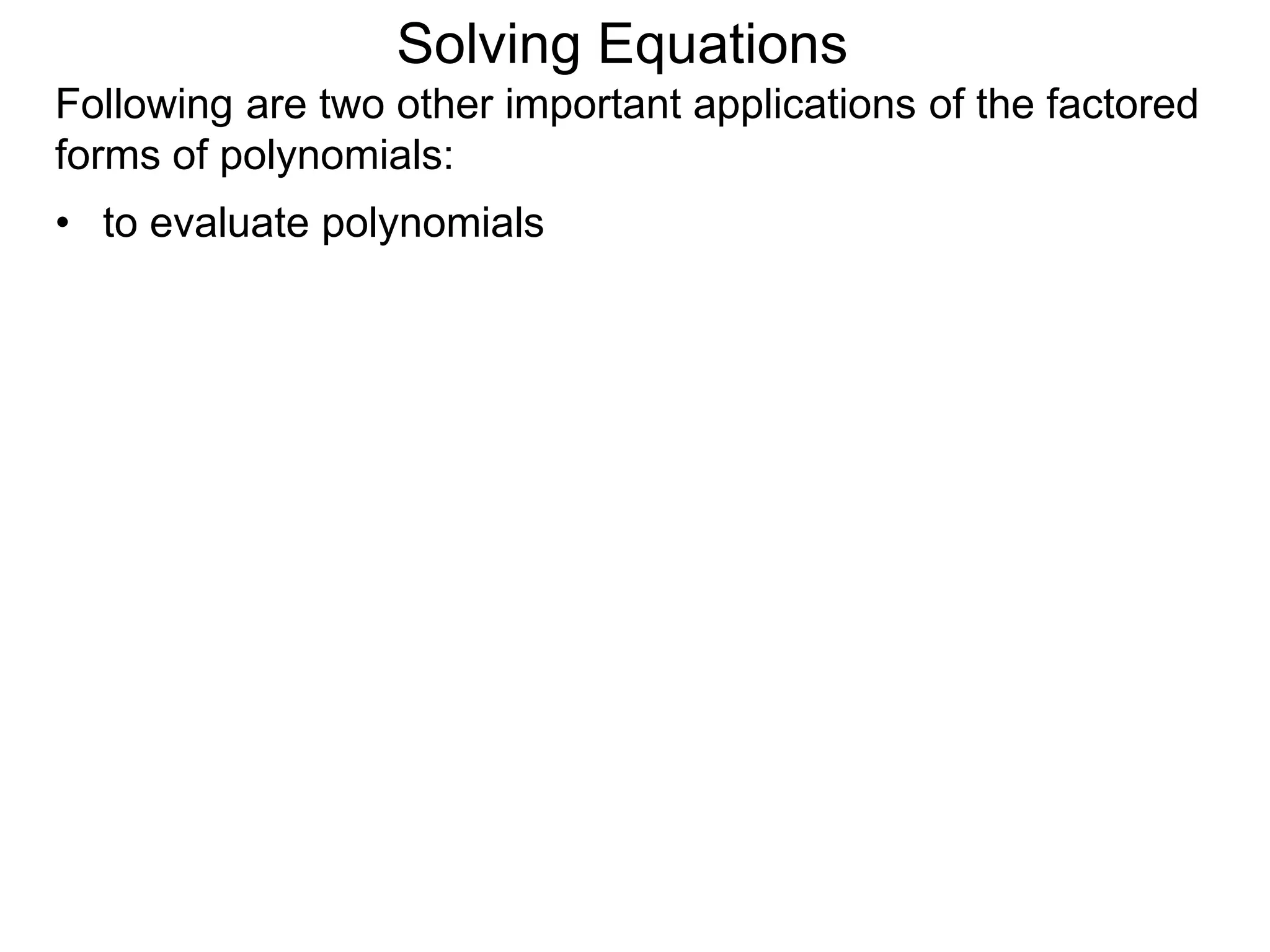
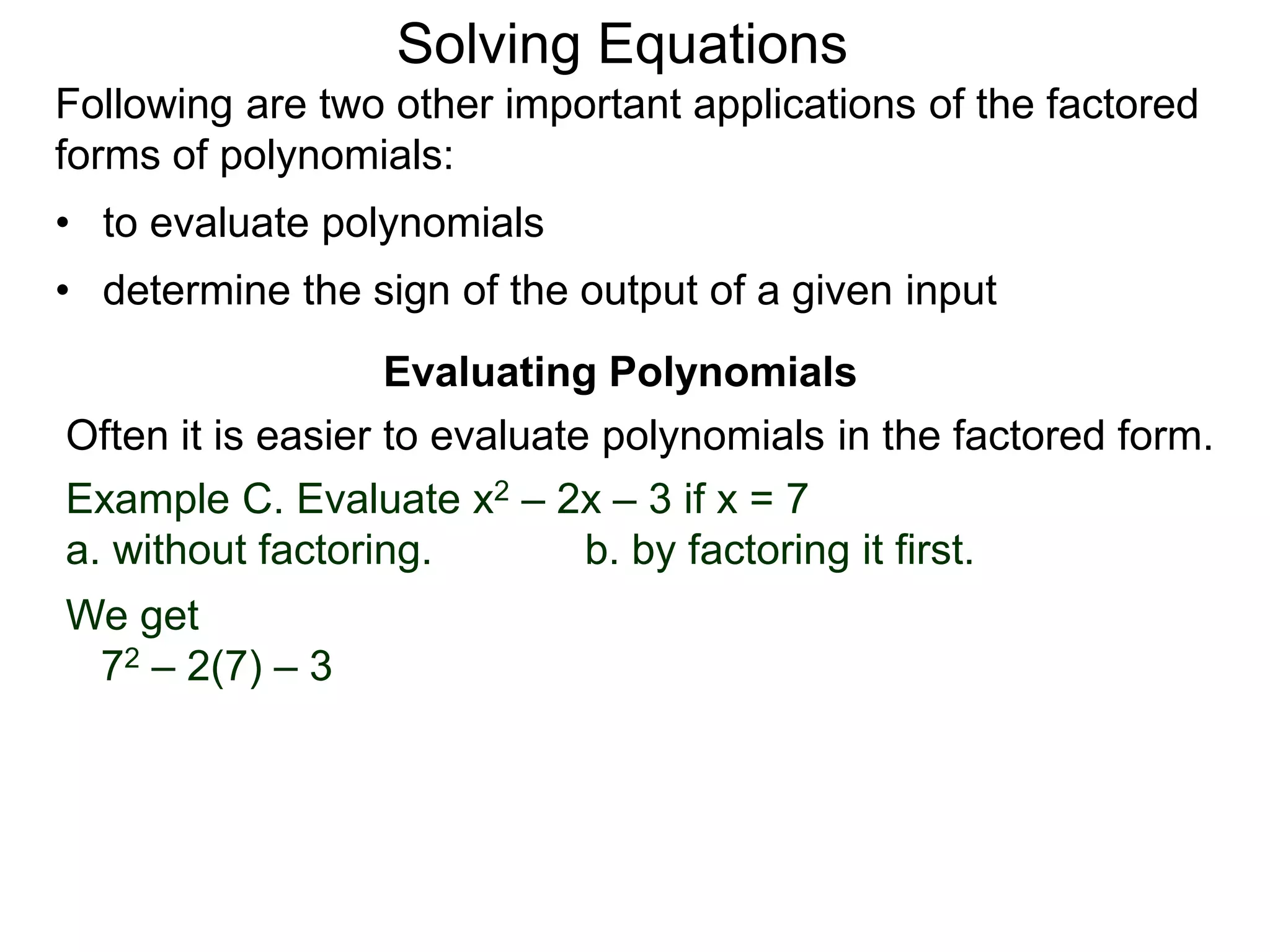
Following are two other important applications of the factored
forms of polynomials:
• to evaluate polynomials
Solving Equations
Following are two other important applications of the factored
forms of polynomials:
• to evaluate polynomials
• determine the sign of the output of a given input
Solving Equations
Evaluating Polynomials
Often it is easier to evaluate polynomials in the factored form.
Following are two other important applications of the factored
forms of polynomials:
• to evaluate polynomials
• determine the sign of the output of a given input
Solving Equations
Evaluating Polynomials
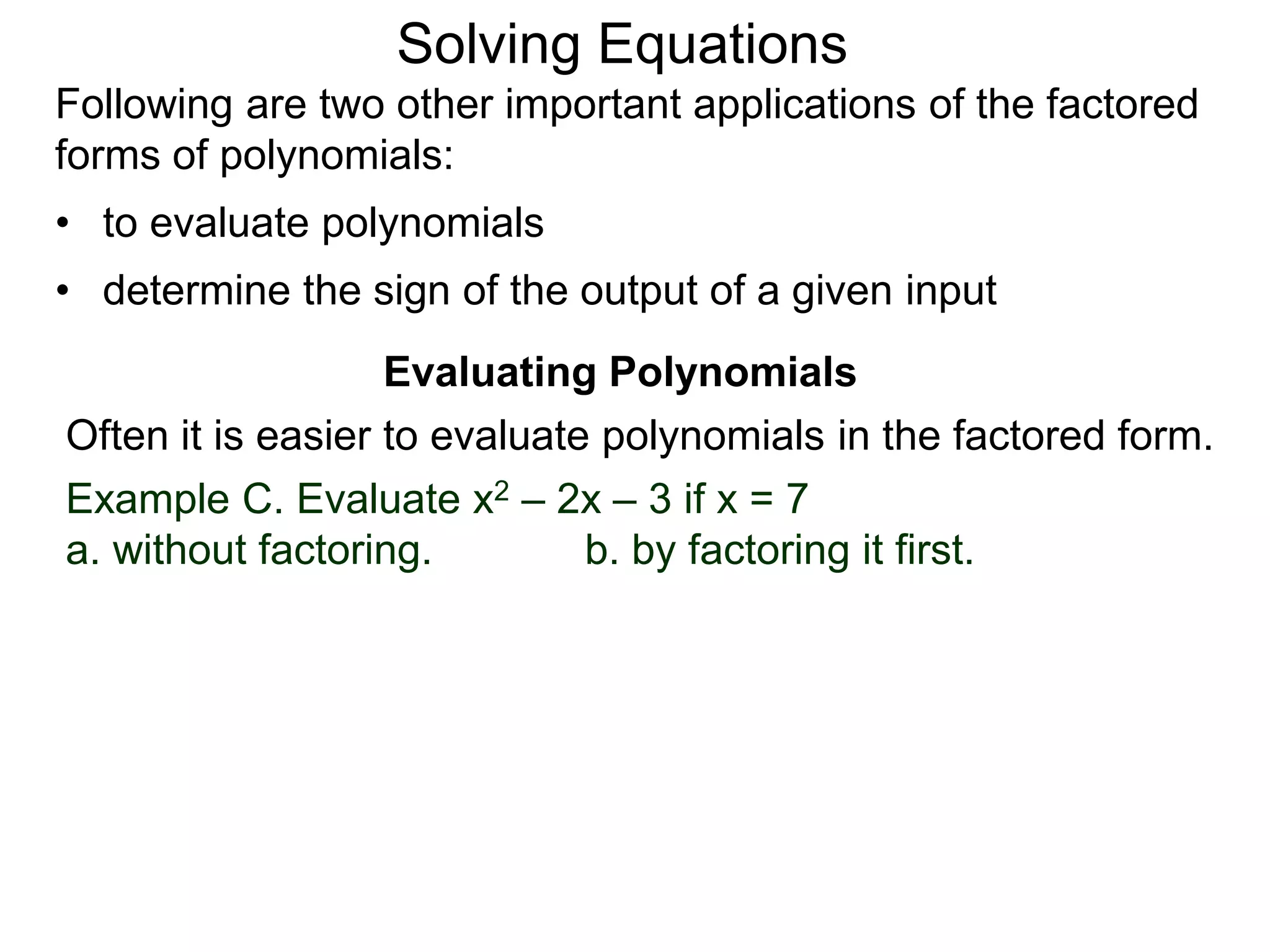
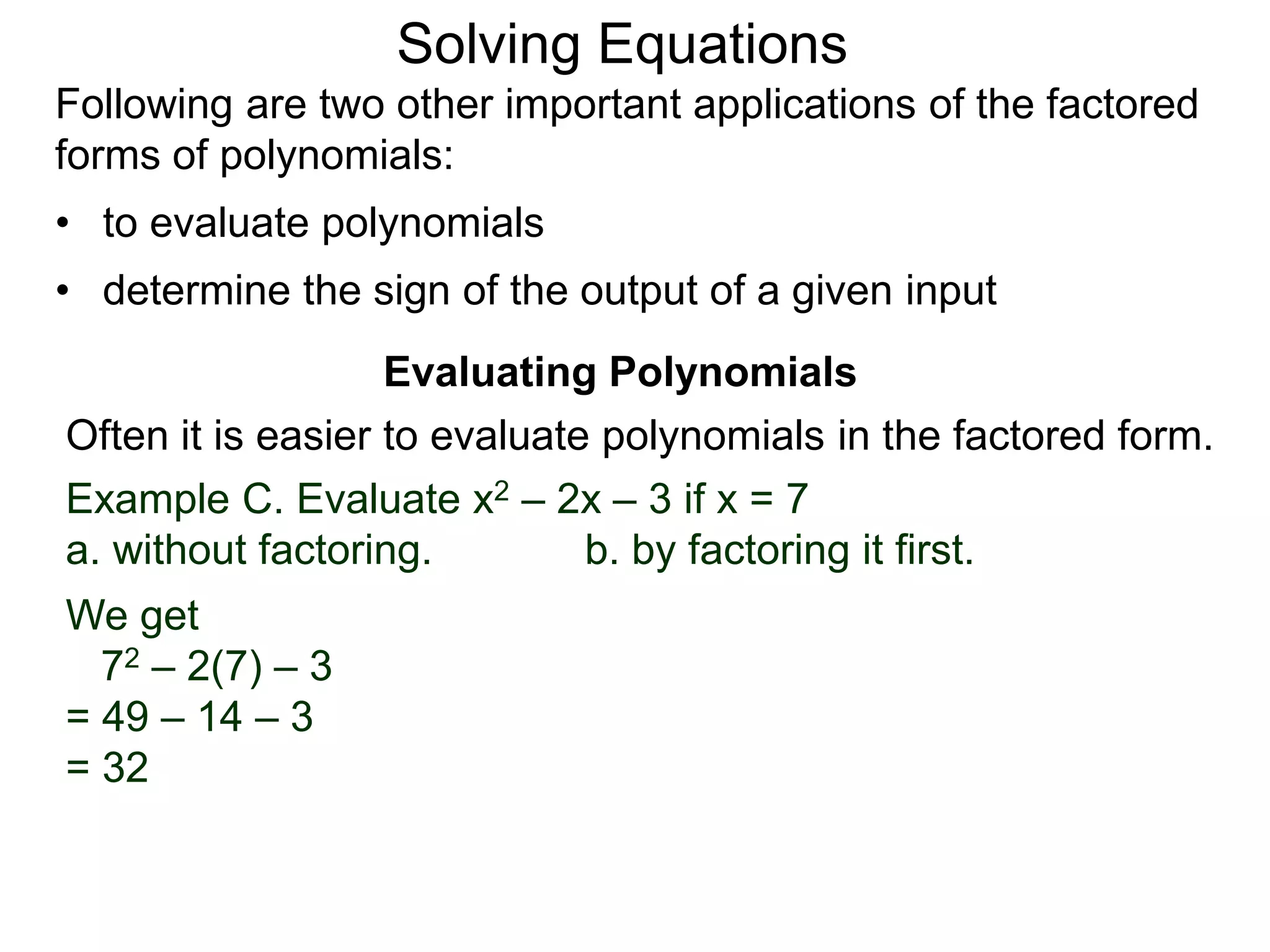
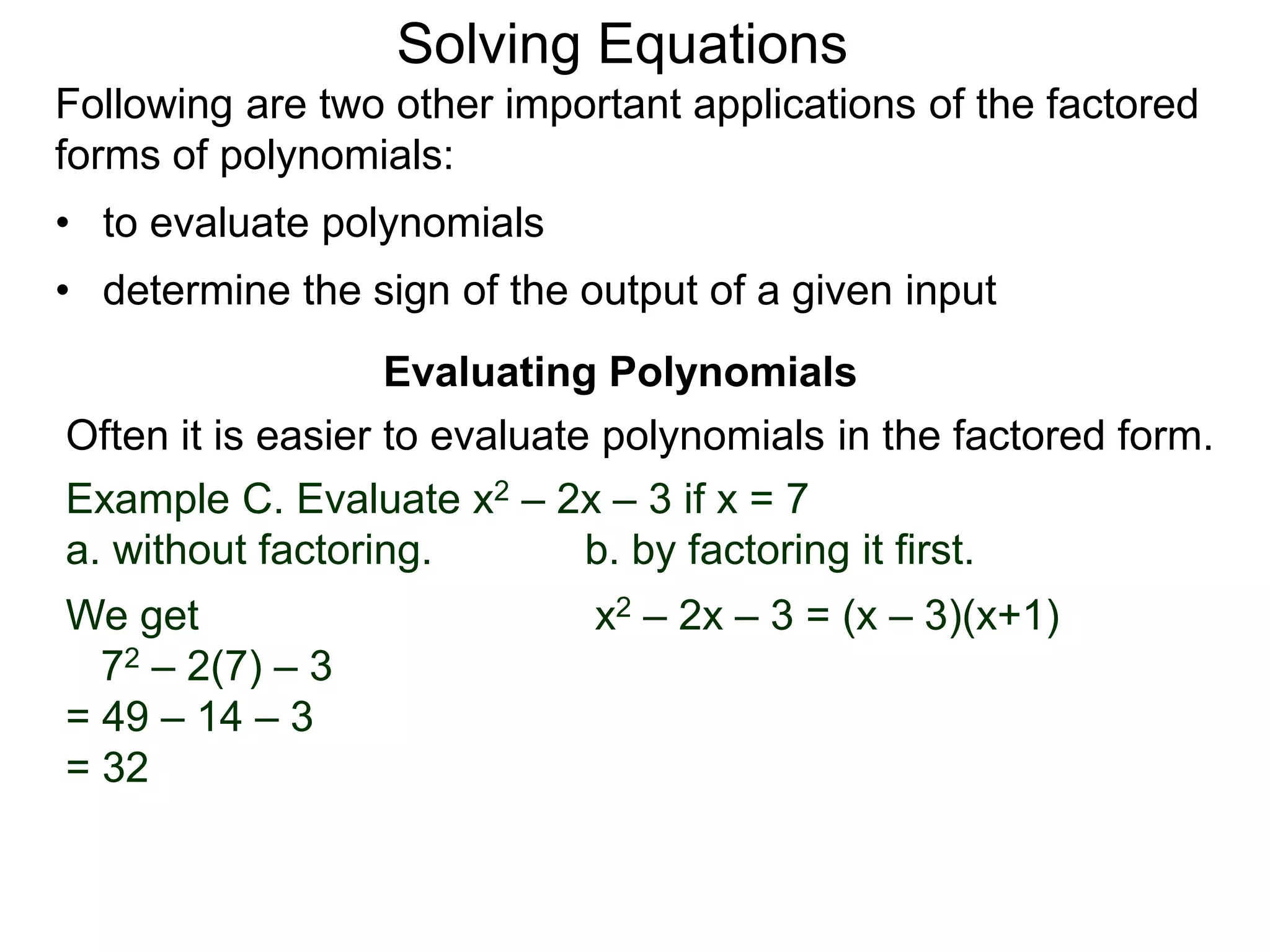
Example C. Evaluate x2 – 2x – 3 if x = 7
a. without factoring. b. by factoring it first.
Often it is easier to evaluate polynomials in the factored form.
Following are two other important applications of the factored
forms of polynomials:
• to evaluate polynomials
• determine the sign of the output of a given input
Solving Equations
Evaluating Polynomials
Example C. Evaluate x2 – 2x – 3 if x = 7
a. without factoring. b. by factoring it first.
We get
72 – 2(7) – 3
Often it is easier to evaluate polynomials in the factored form.
Following are two other important applications of the factored
forms of polynomials:
• to evaluate polynomials
• determine the sign of the output of a given input
Solving Equations
Evaluating Polynomials
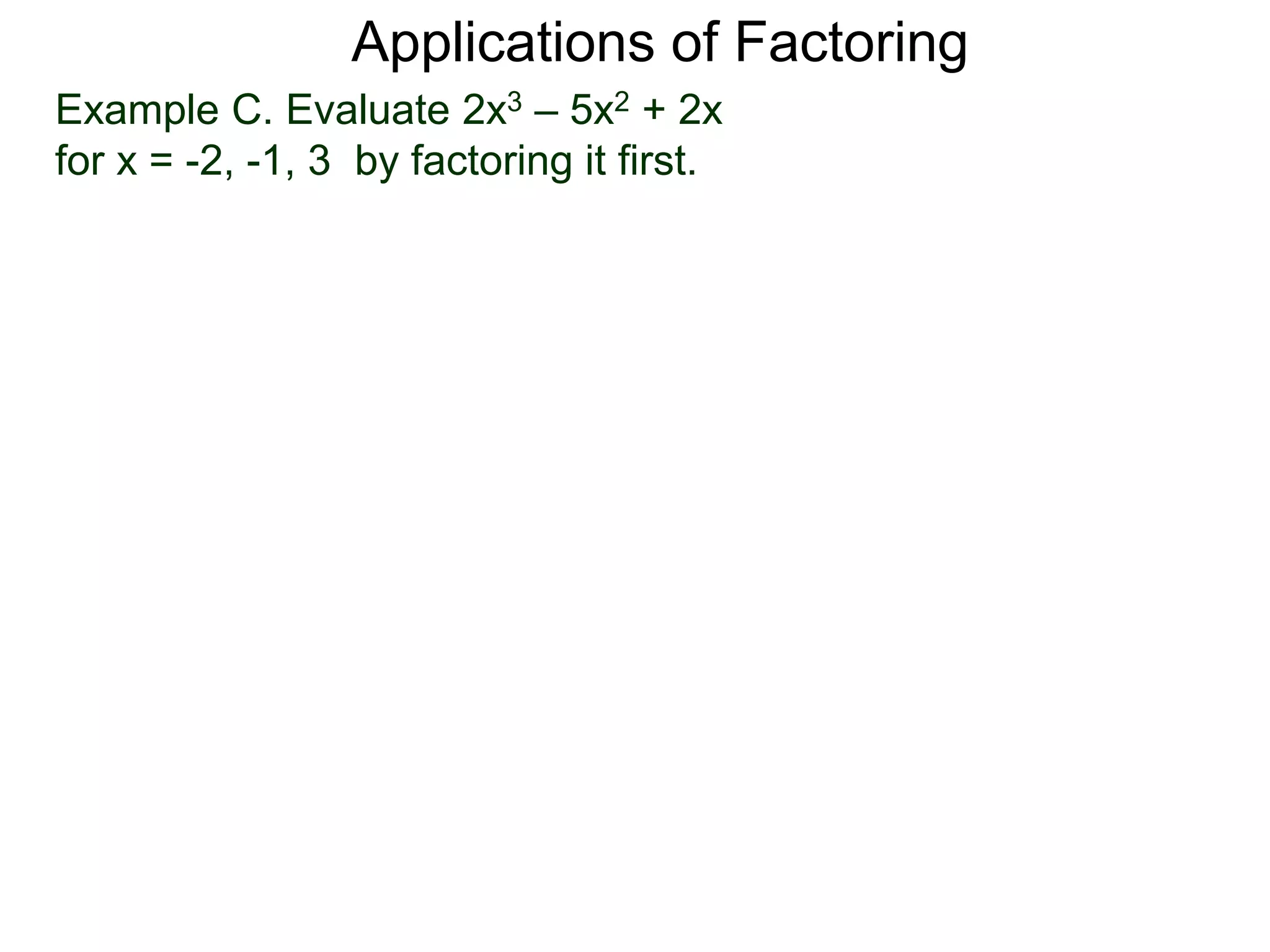
Example C. Evaluate x2 – 2x – 3 if x = 7
a. without factoring. b. by factoring it first.
We get
72 – 2(7) – 3
= 49 – 14 – 3
= 32
Often it is easier to evaluate polynomials in the factored form.
Following are two other important applications of the factored
forms of polynomials:
• to evaluate polynomials
• determine the sign of the output of a given input
Solving Equations
Evaluating Polynomials
Example C. Evaluate x2 – 2x – 3 if x = 7
a. without factoring. b. by factoring it first.
We get
72 – 2(7) – 3
= 49 – 14 – 3
= 32
x2 – 2x – 3 = (x – 3)(x+1)
Often it is easier to evaluate polynomials in the factored form.
Following are two other important applications of the factored
forms of polynomials:
• to evaluate polynomials
• determine the sign of the output of a given input
Solving Equations
Evaluating Polynomials
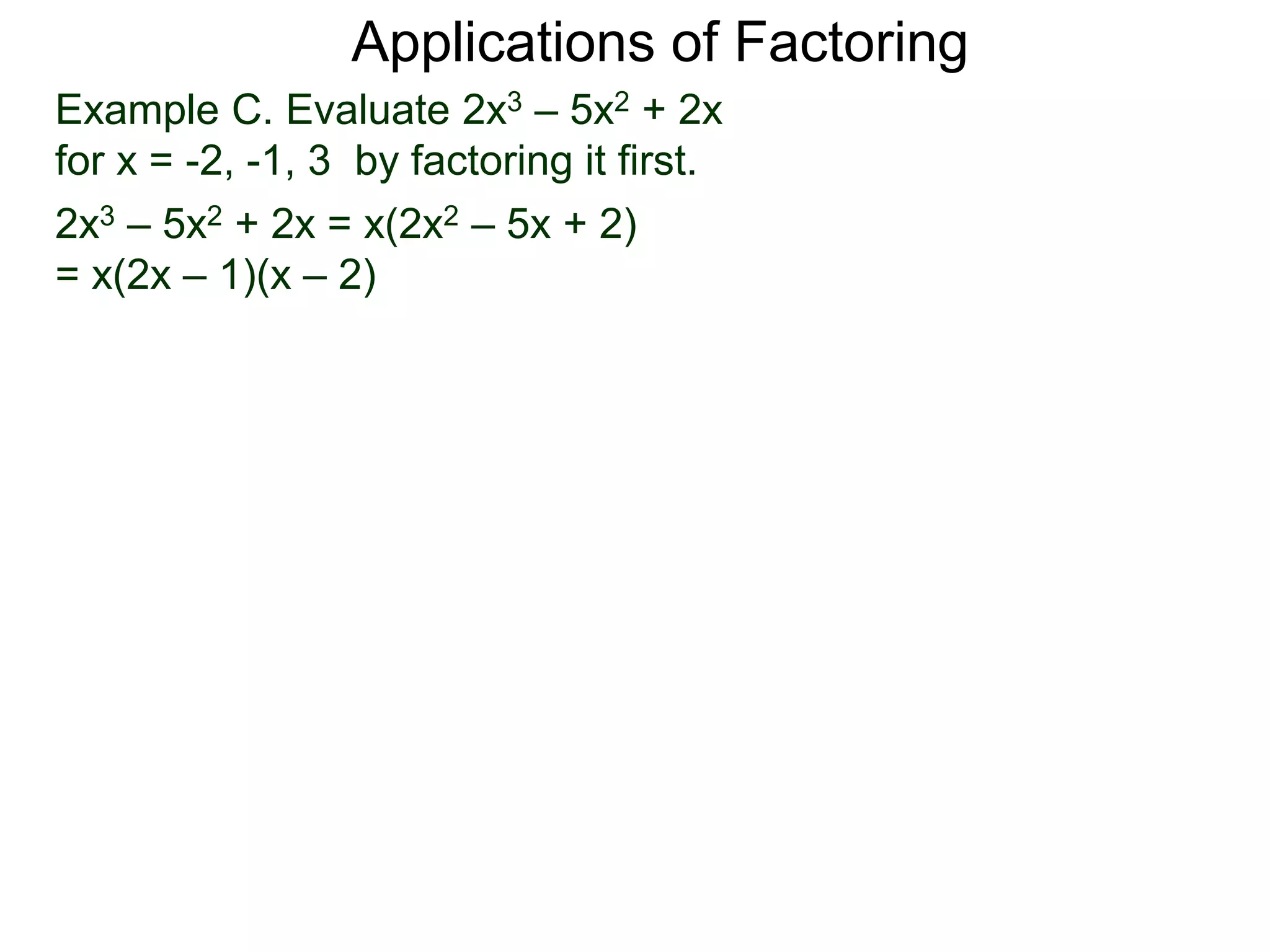
Example C. Evaluate x2 – 2x – 3 if x = 7
a. without factoring. b. by factoring it first.
We get
72 – 2(7) – 3
= 49 – 14 – 3
= 32
x2 – 2x – 3 = (x – 3)(x+1)
We have that
(7 – 3)(7 + 1)
= 4(8)
= 32
Often it is easier to evaluate polynomials in the factored form.
Following are two other important applications of the factored
forms of polynomials:
• to evaluate polynomials
• determine the sign of the output of a given input
Solving Equations
Example C. Evaluate 2x3 – 5x2 + 2x
for x = -2, -1, 3 by factoring it first.
Applications of Factoring
Example C. Evaluate 2x3 – 5x2 + 2x
for x = -2, -1, 3 by factoring it first.
2x3 – 5x2 + 2x = x(2x2 – 5x + 2)
= x(2x – 1)(x – 2)
Applications of Factoring
Example C. Evaluate 2x3 – 5x2 + 2x
for x = -2, -1, 3 by factoring it first.
2x3 – 5x2 + 2x = x(2x2 – 5x + 2)
= x(2x – 1)(x – 2)
For x = -2:
(-2)[2(-2) – 1] [(-2) – 2] =
Applications of Factoring
Example C. Evaluate 2x3 – 5x2 + 2x
for x = -2, -1, 3 by factoring it first.
2x3 – 5x2 + 2x = x(2x2 – 5x + 2)
= x(2x – 1)(x – 2)
For x = -2:
(-2)[2(-2) – 1] [(-2) – 2] = -2 [-5] [-4] = -40
Applications of Factoring
Example C. Evaluate 2x3 – 5x2 + 2x
for x = -2, -1, 3 by factoring it first.
2x3 – 5x2 + 2x = x(2x2 – 5x + 2)
= x(2x – 1)(x – 2)
For x = -2:
(-2)[2(-2) – 1] [(-2) – 2] = -2 [-5] [-4] = -40
For x = -1:
(-1)[2(-1) – 1] [(-1) – 2] =
Applications of Factoring
Example C. Evaluate 2x3 – 5x2 + 2x
for x = -2, -1, 3 by factoring it first.
2x3 – 5x2 + 2x = x(2x2 – 5x + 2)
= x(2x – 1)(x – 2)
For x = -2:
(-2)[2(-2) – 1] [(-2) – 2] = -2 [-5] [-4] = -40
For x = -1:
(-1)[2(-1) – 1] [(-1) – 2] = -1 [-3] [-3] = -9
For x = 3:
3 [2(3) – 1] [(3) – 2] =
Applications of Factoring
Example C. Evaluate 2x3 – 5x2 + 2x
for x = -2, -1, 3 by factoring it first.
2x3 – 5x2 + 2x = x(2x2 – 5x + 2)
= x(2x – 1)(x – 2)
For x = -2:
(-2)[2(-2) – 1] [(-2) – 2] = -2 [-5] [-4] = -40
For x = -1:
(-1)[2(-1) – 1] [(-1) – 2] = -1 [-3] [-3] = -9
For x = 3:
3 [2(3) – 1] [(3) – 2] = 3 [5] [1] = 15
Applications of Factoring
Your turn: Double check these answers via the expanded form.
Example C. Evaluate 2x3 – 5x2 + 2x
for x = -2, -1, 3 by factoring it first.
2x3 – 5x2 + 2x = x(2x2 – 5x + 2)
= x(2x – 1)(x – 2)
For x = -2:
(-2)[2(-2) – 1] [(-2) – 2] = -2 [-5] [-4] = -40
For x = -1:
(-1)[2(-1) – 1] [(-1) – 2] = -1 [-3] [-3] = -9
For x = 3:
3 [2(3) – 1] [(3) – 2] = 3 [5] [1] = 15
Applications of Factoring
Determine the signs of the outputs
Your turn: Double check these answers via the expanded form.
Example C. Evaluate 2x3 – 5x2 + 2x
for x = -2, -1, 3 by factoring it first.
2x3 – 5x2 + 2x = x(2x2 – 5x + 2)
= x(2x – 1)(x – 2)
For x = -2:
(-2)[2(-2) – 1] [(-2) – 2] = -2 [-5] [-4] = -40
For x = -1:
(-1)[2(-1) – 1] [(-1) – 2] = -1 [-3] [-3] = -9
For x = 3:
3 [2(3) – 1] [(3) – 2] = 3 [5] [1] = 15
Applications of Factoring
Determine the signs of the outputs
Often we only want to know the sign of the output,
i.e. whether the output is positive or negative.
It is easy to do this using the factored form.
Your turn: Double check these answers via the expanded form.
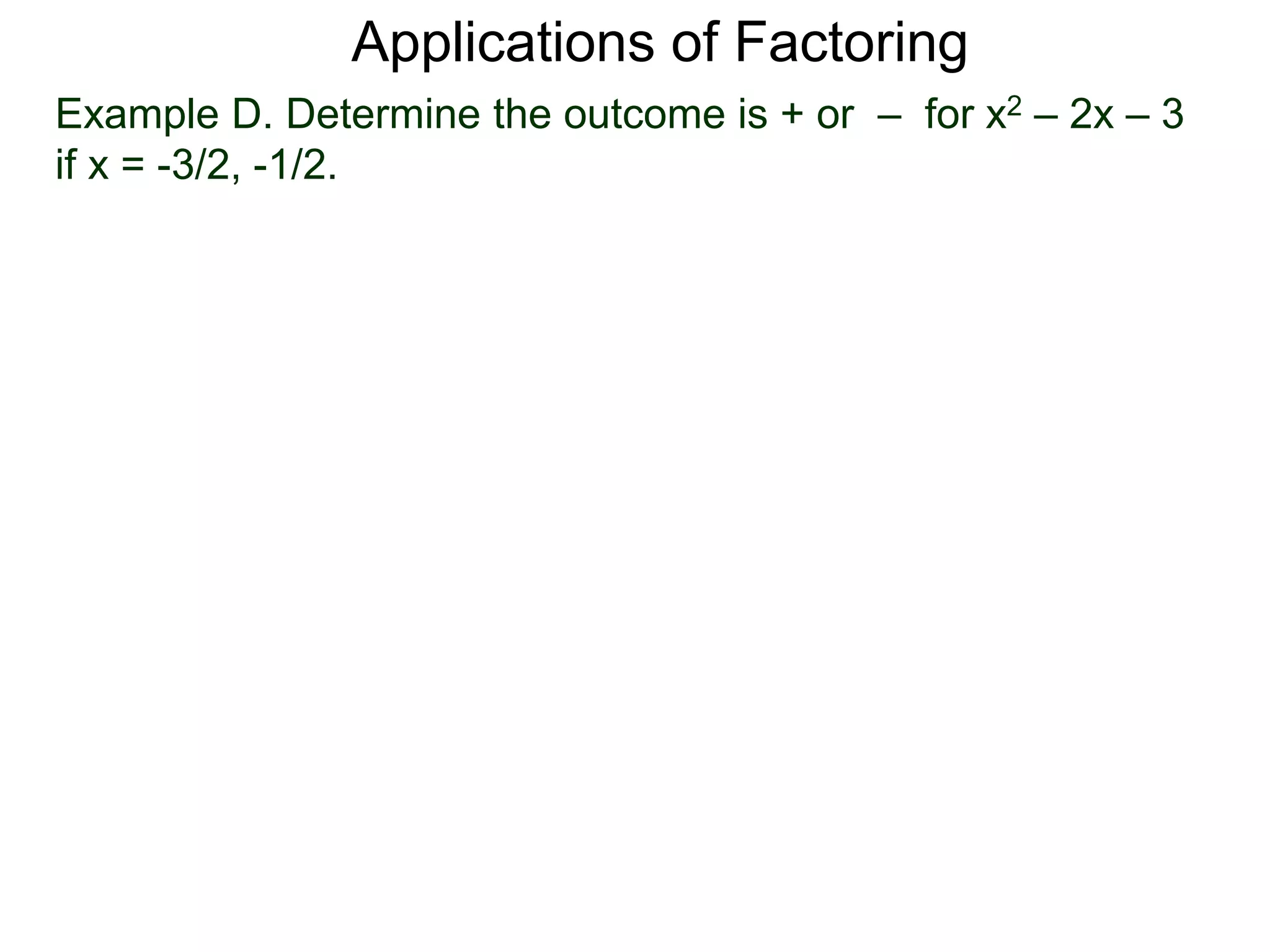
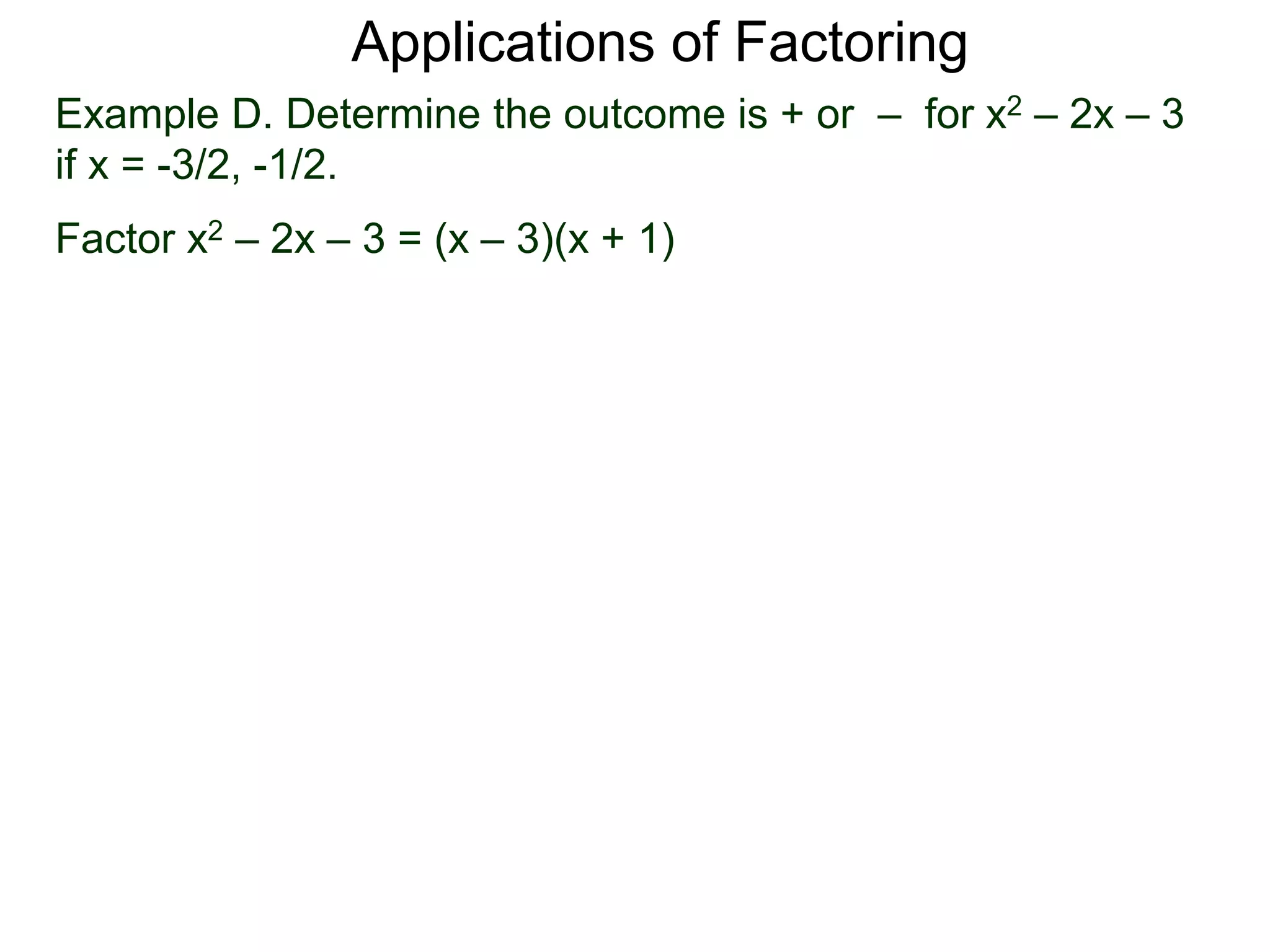
Example D. Determine the outcome is + or – for x2 – 2x – 3
if x = -3/2, -1/2.
Applications of Factoring
Example D. Determine the outcome is + or – for x2 – 2x – 3
if x = -3/2, -1/2.
Factor x2 – 2x – 3 = (x – 3)(x + 1)
Applications of Factoring
Example D. Determine the outcome is + or – for x2 – 2x – 3
if x = -3/2, -1/2.
Factor x2 – 2x – 3 = (x – 3)(x + 1)
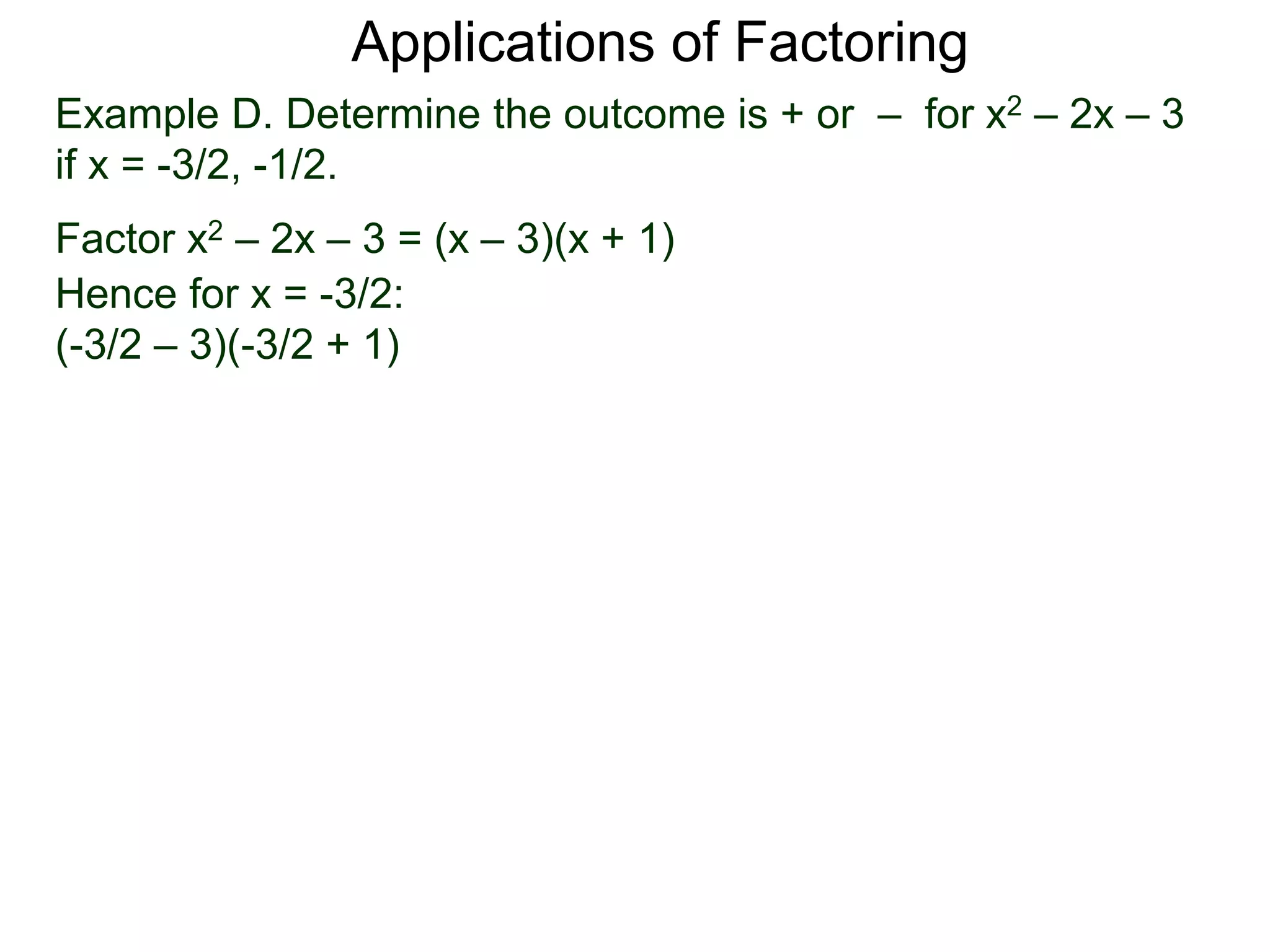
Hence for x = -3/2:
(-3/2 – 3)(-3/2 + 1)
Applications of Factoring
Example D. Determine the outcome is + or – for x2 – 2x – 3
if x = -3/2, -1/2.
Factor x2 – 2x – 3 = (x – 3)(x + 1)
Hence for x = -3/2:
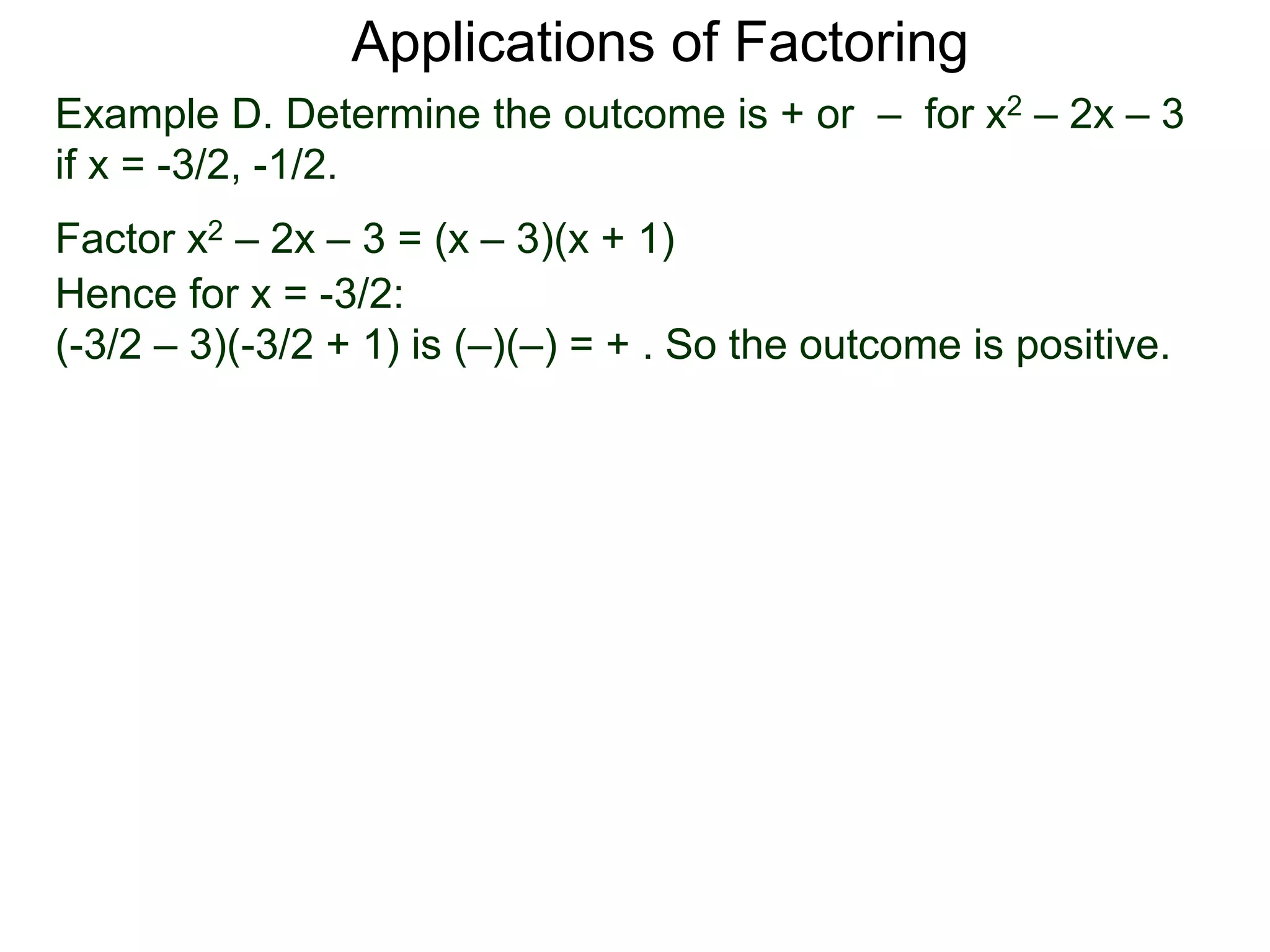
(-3/2 – 3)(-3/2 + 1) is (–)(–) = + . So the outcome is positive.
Applications of Factoring
Example D. Determine the outcome is + or – for x2 – 2x – 3
if x = -3/2, -1/2.
Factor x2 – 2x – 3 = (x – 3)(x + 1)
Hence for x = -3/2:
(-3/2 – 3)(-3/2 + 1) is (–)(–) = + . So the outcome is positive.
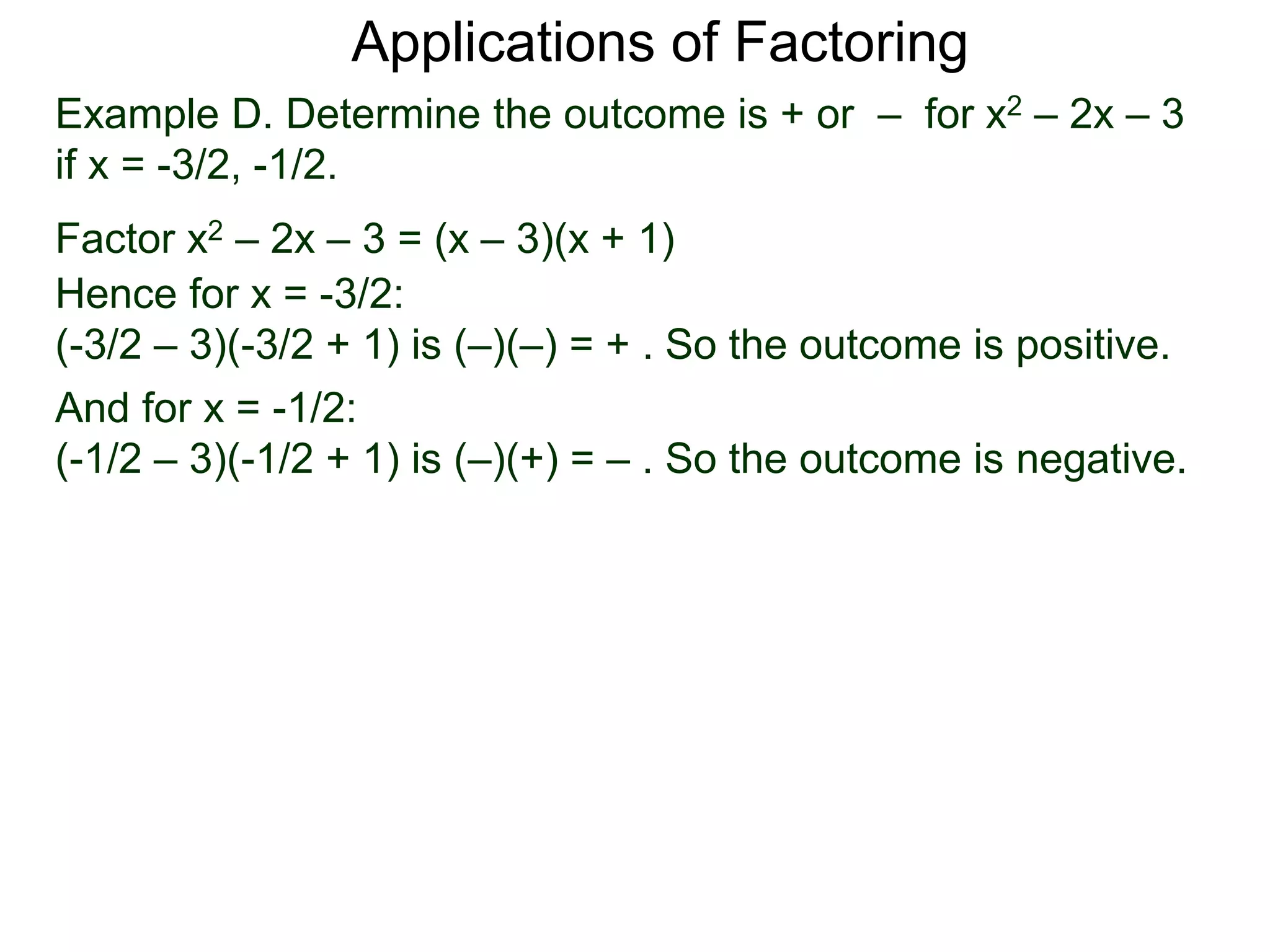
And for x = -1/2:
(-1/2 – 3)(-1/2 + 1) is (–)(+) = – . So the outcome is negative.
Applications of Factoring
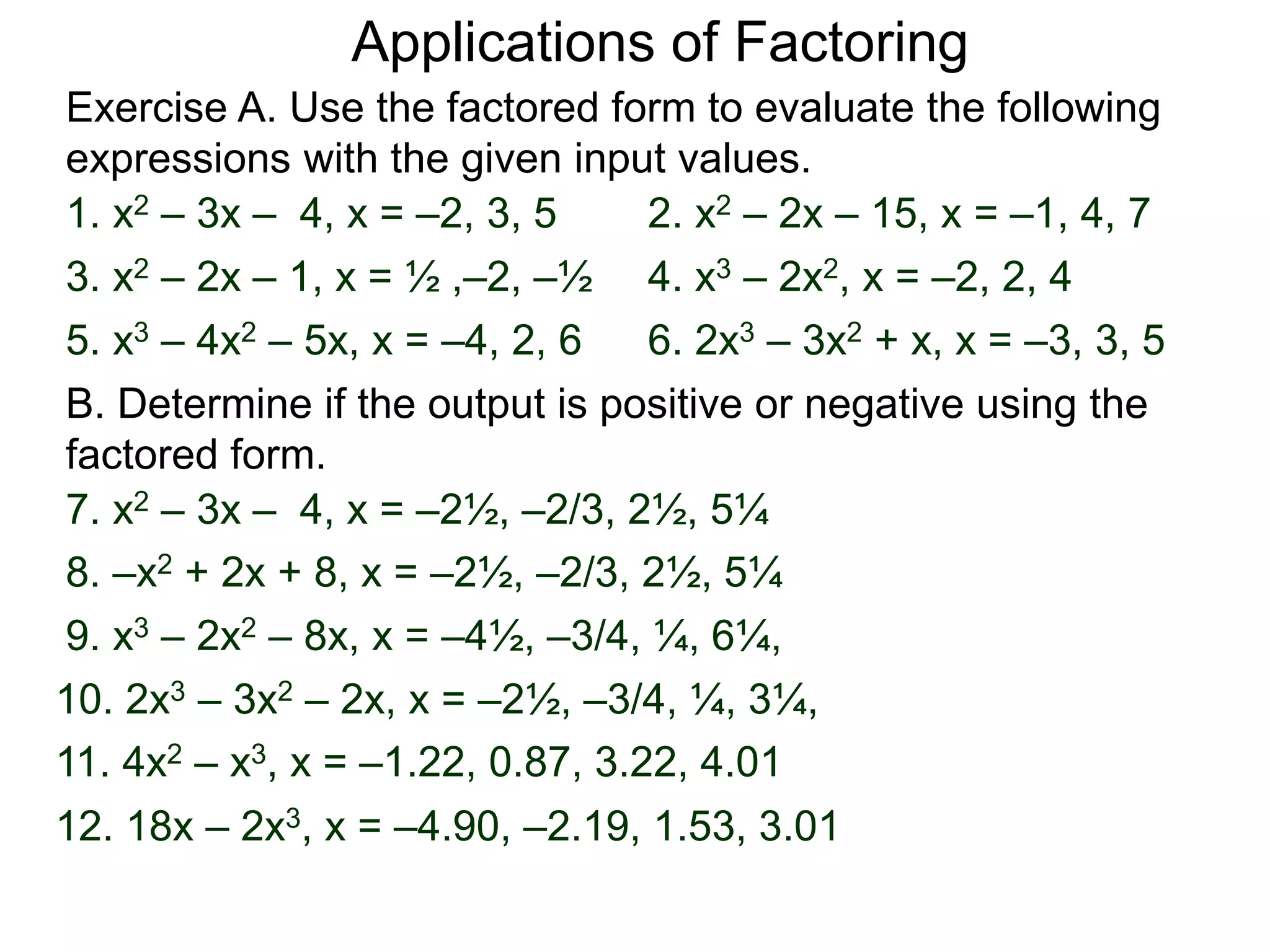
Exercise A. Use the factored form to evaluate the following
expressions with the given input values.
Applications of Factoring
1. x2 – 3x – 4, x = –2, 3, 5 2. x2 – 2x – 15, x = –1, 4, 7
3. x2 – 2x – 1, x = ½ ,–2, –½ 4. x3 – 2x2, x = –2, 2, 4
5. x3 – 4x2 – 5x, x = –4, 2, 6 6. 2x3 – 3x2 + x, x = –3, 3, 5
B. Determine if the output is positive or negative using the
factored form.
7. x2 – 3x – 4, x = –2½, –2/3, 2½, 5¼
8. –x2 + 2x + 8, x = –2½, –2/3, 2½, 5¼
9. x3 – 2x2 – 8x, x = –4½, –3/4, ¼, 6¼,
11. 4x2 – x3, x = –1.22, 0.87, 3.22, 4.01
12. 18x – 2x3, x = –4.90, –2.19, 1.53, 3.01
10. 2x3 – 3x2 – 2x, x = –2½, –3/4, ¼, 3¼,
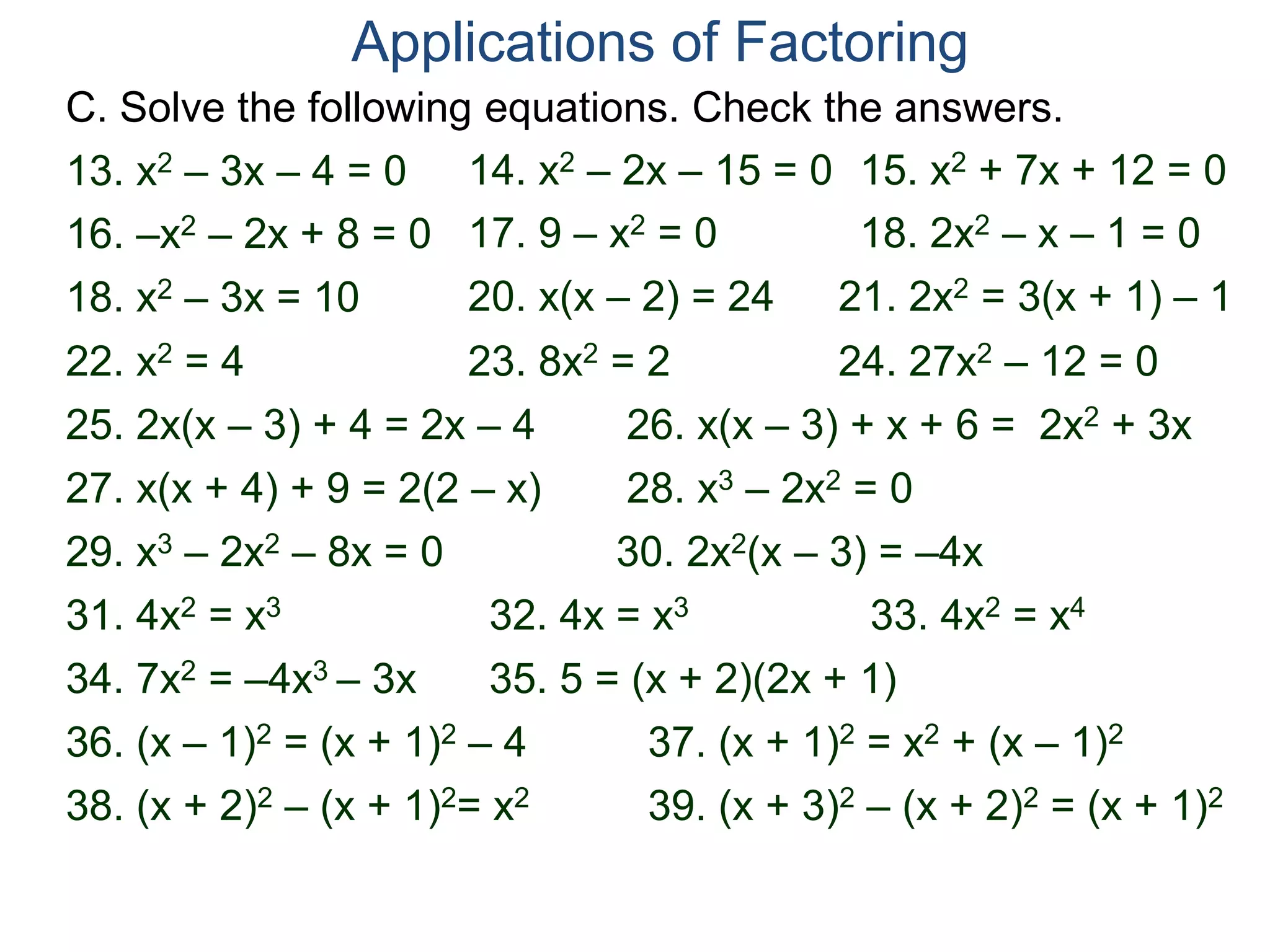
C. Solve the following equations. Check the answers.
Applications of Factoring
18. x2 – 3x = 10 20. x(x – 2) = 24 21. 2x2 = 3(x + 1) – 1
28. x3 – 2x2 = 0
22. x2 = 4
25. 2x(x – 3) + 4 = 2x – 4
29. x3 – 2x2 – 8x = 0
31. 4x2 = x3
30. 2x2(x – 3) = –4x
26. x(x – 3) + x + 6 = 2x2 + 3x
13. x2 – 3x – 4 = 0 14. x2 – 2x – 15 = 0 15. x2 + 7x + 12 = 0
16. –x2 – 2x + 8 = 0 17. 9 – x2 = 0 18. 2x2 – x – 1 = 0
27. x(x + 4) + 9 = 2(2 – x)
23. 8x2 = 2 24. 27x2 – 12 = 0
32. 4x = x3 33. 4x2 = x4
34. 7x2 = –4x3 – 3x 35. 5 = (x + 2)(2x + 1)
36. (x – 1)2 = (x + 1)2 – 4 37. (x + 1)2 = x2 + (x – 1)2
38. (x + 2)2 – (x + 1)2= x2 39. (x + 3)2 – (x + 2)2 = (x + 1)2

3 solving 2nd degree equations by factoring xc

  • 1.
  • 2.
    Applications of Factoring Themain purposes of factoring an expression E into a product E = AB is to utilize the two special properties of multiplication.
  • 3.
    Applications of Factoring Themain purposes of factoring an expression E into a product E = AB is to utilize the two special properties of multiplication. i. If the product AB = 0, then A or B must be 0.
  • 4.
    Applications of Factoring Themain purposes of factoring an expression E into a product E = AB is to utilize the two special properties of multiplication. i. If the product AB = 0, then A or B must be 0. ii. The sign of the product can be determined by the signs of A and B.
  • 5.
    Applications of Factoring Themain purposes of factoring an expression E into a product E = AB is to utilize the two special properties of multiplication. i. If the product AB = 0, then A or B must be 0. ii. The sign of the product can be determined by the signs of A and B. Base on these, we may extract a lot more information about a formula from its factored form than its expanded form.
  • 6.
    Applications of Factoring SolvingEquations The main purposes of factoring an expression E into a product E = AB is to utilize the two special properties of multiplication. i. If the product AB = 0, then A or B must be 0. ii. The sign of the product can be determined by the signs of A and B. Base on these, we may extract a lot more information about a formula from its factored form than its expanded form.
  • 7.
    Applications of Factoring SolvingEquations The most important application for factoring is to solve polynomial equations or equations of the form polynomial = polynomial The main purposes of factoring an expression E into a product E = AB is to utilize the two special properties of multiplication. i. If the product AB = 0, then A or B must be 0. ii. The sign of the product can be determined by the signs of A and B. Base on these, we may extract a lot more information about a formula from its factored form than its expanded form.
  • 8.
    Applications of Factoring SolvingEquations The most important application for factoring is to solve polynomial equations or equations of the form polynomial = polynomial To solve these equations, we use the following obvious fact. The main purposes of factoring an expression E into a product E = AB is to utilize the two special properties of multiplication. i. If the product AB = 0, then A or B must be 0. ii. The sign of the product can be determined by the signs of A and B. Base on these, we may extract a lot more information about a formula from its factored form than its expanded form.
  • 9.
    Applications of Factoring SolvingEquations The most important application for factoring is to solve polynomial equations or equations of the form polynomial = polynomial To solve these equations, we use the following obvious fact. The Zero-Product Rule: If A*B = 0, then either A = 0 or B = 0 The main purposes of factoring an expression E into a product E = AB is to utilize the two special properties of multiplication. i. If the product AB = 0, then A or B must be 0. ii. The sign of the product can be determined by the signs of A and B. Base on these, we may extract a lot more information about a formula from its factored form than its expanded form.
  • 10.
    Applications of Factoring SolvingEquations The most important application for factoring is to solve polynomial equations or equations of the form polynomial = polynomial To solve these equations, we use the following obvious fact. The Zero-Product Rule: If A*B = 0, then either A = 0 or B = 0 For example, if 3x = 0, then x must 0 (because 3 is not 0). The main purposes of factoring an expression E into a product E = AB is to utilize the two special properties of multiplication. i. If the product AB = 0, then A or B must be 0. ii. The sign of the product can be determined by the signs of A and B. Base on these, we may extract a lot more information about a formula from its factored form than its expanded form.
  • 11.
    Example A. a. If3(x – 2) = 0, then (x – 2) = 0, so x must be 2. Solving Equations
  • 12.
    Example A. a. If3(x – 2) = 0, then (x – 2) = 0, so x must be 2. Solving Equations b. If (x + 1)(x – 2) = 0, then either (x + 1) = 0 or (x – 2) = 0,
  • 13.
    Example A. a. If3(x – 2) = 0, then (x – 2) = 0, so x must be 2. Solving Equations b. If (x + 1)(x – 2) = 0, then either (x + 1) = 0 or (x – 2) = 0, x = –1 or x = 2
  • 14.
    Example A. a. If3(x – 2) = 0, then (x – 2) = 0, so x must be 2. Solving Equations To solve polynomial equation, b. If (x + 1)(x – 2) = 0, then either (x + 1) = 0 or (x – 2) = 0, x = –1 or x = 2 Example B. Solve for x a. x2 – 2x = 3
  • 15.
    Example A. a. If3(x – 2) = 0, then (x – 2) = 0, so x must be 2. Solving Equations To solve polynomial equation, 1. set one side of the equation to be 0 and move all the terms to the other side. b. If (x + 1)(x – 2) = 0, then either (x + 1) = 0 or (x – 2) = 0, x = –1 or x = 2 Example B. Solve for x a. x2 – 2x = 3 x2 – 2x – 3 = 0
  • 16.
    Example A. a. If3(x – 2) = 0, then (x – 2) = 0, so x must be 2. Solving Equations To solve polynomial equation, 1. set one side of the equation to be 0 and move all the terms to the other side. 2. factor the polynomial, b. If (x + 1)(x – 2) = 0, then either (x + 1) = 0 or (x – 2) = 0, x = –1 or x = 2 Example B. Solve for x a. x2 – 2x = 3 x2 – 2x – 3 = 0 factor (x – 3)(x + 1) = 0
  • 17.
    Example A. a. If3(x – 2) = 0, then (x – 2) = 0, so x must be 2. Solving Equations To solve polynomial equation, 1. set one side of the equation to be 0 and move all the terms to the other side. 2. factor the polynomial, 3. get the answers. b. If (x + 1)(x – 2) = 0, then either (x + 1) = 0 or (x – 2) = 0, x = –1 or x = 2 Example B. Solve for x a. x2 – 2x = 3 x2 – 2x – 3 = 0 factor (x – 3)(x + 1) = 0
  • 18.
    Example A. a. If3(x – 2) = 0, then (x – 2) = 0, so x must be 2. Solving Equations To solve polynomial equation, 1. set one side of the equation to be 0 and move all the terms to the other side. 2. factor the polynomial, 3. get the answers. b. If (x + 1)(x – 2) = 0, then either (x + 1) = 0 or (x – 2) = 0, x = –1 or x = 2 Example B. Solve for x a. x2 – 2x = 3 x2 – 2x – 3 = 0 factor (x – 3)(x + 1) = 0 There are two linear x–factors. We may extract one answer from each.
  • 19.
    Example A. a. If3(x – 2) = 0, then (x – 2) = 0, so x must be 2. Solving Equations To solve polynomial equation, 1. set one side of the equation to be 0 and move all the terms to the other side. 2. factor the polynomial, 3. get the answers. b. If (x + 1)(x – 2) = 0, then either (x + 1) = 0 or (x – 2) = 0, x = –1 or x = 2 Example B. Solve for x a. x2 – 2x = 3 x2 – 2x – 3 = 0 factor (x – 3)(x + 1) = 0 Hence x – 3 = 0 or x + 1 = 0 There are two linear x–factors. We may extract one answer from each.
  • 20.
    Example A. a. If3(x – 2) = 0, then (x – 2) = 0, so x must be 2. Solving Equations To solve polynomial equation, 1. set one side of the equation to be 0 and move all the terms to the other side. 2. factor the polynomial, 3. get the answers. b. If (x + 1)(x – 2) = 0, then either (x + 1) = 0 or (x – 2) = 0, x = –1 or x = 2 Example B. Solve for x a. x2 – 2x = 3 x2 – 2x – 3 = 0 factor (x – 3)(x + 1) = 0 Hence x – 3 = 0 or x + 1 = 0 x = 3 or x = –1 There are two linear x–factors. We may extract one answer from each.
  • 21.
    Following are twoother important applications of the factored forms of polynomials: • to evaluate polynomials Solving Equations
  • 22.
    Following are twoother important applications of the factored forms of polynomials: • to evaluate polynomials • determine the sign of the output of a given input Solving Equations
  • 23.
    Evaluating Polynomials Often itis easier to evaluate polynomials in the factored form. Following are two other important applications of the factored forms of polynomials: • to evaluate polynomials • determine the sign of the output of a given input Solving Equations
  • 24.
    Evaluating Polynomials Example C.Evaluate x2 – 2x – 3 if x = 7 a. without factoring. b. by factoring it first. Often it is easier to evaluate polynomials in the factored form. Following are two other important applications of the factored forms of polynomials: • to evaluate polynomials • determine the sign of the output of a given input Solving Equations
  • 25.
    Evaluating Polynomials Example C.Evaluate x2 – 2x – 3 if x = 7 a. without factoring. b. by factoring it first. We get 72 – 2(7) – 3 Often it is easier to evaluate polynomials in the factored form. Following are two other important applications of the factored forms of polynomials: • to evaluate polynomials • determine the sign of the output of a given input Solving Equations
  • 26.
    Evaluating Polynomials Example C.Evaluate x2 – 2x – 3 if x = 7 a. without factoring. b. by factoring it first. We get 72 – 2(7) – 3 = 49 – 14 – 3 = 32 Often it is easier to evaluate polynomials in the factored form. Following are two other important applications of the factored forms of polynomials: • to evaluate polynomials • determine the sign of the output of a given input Solving Equations
  • 27.
    Evaluating Polynomials Example C.Evaluate x2 – 2x – 3 if x = 7 a. without factoring. b. by factoring it first. We get 72 – 2(7) – 3 = 49 – 14 – 3 = 32 x2 – 2x – 3 = (x – 3)(x+1) Often it is easier to evaluate polynomials in the factored form. Following are two other important applications of the factored forms of polynomials: • to evaluate polynomials • determine the sign of the output of a given input Solving Equations
  • 28.
    Evaluating Polynomials Example C.Evaluate x2 – 2x – 3 if x = 7 a. without factoring. b. by factoring it first. We get 72 – 2(7) – 3 = 49 – 14 – 3 = 32 x2 – 2x – 3 = (x – 3)(x+1) We have that (7 – 3)(7 + 1) = 4(8) = 32 Often it is easier to evaluate polynomials in the factored form. Following are two other important applications of the factored forms of polynomials: • to evaluate polynomials • determine the sign of the output of a given input Solving Equations
  • 29.
    Example C. Evaluate2x3 – 5x2 + 2x for x = -2, -1, 3 by factoring it first. Applications of Factoring
  • 30.
    Example C. Evaluate2x3 – 5x2 + 2x for x = -2, -1, 3 by factoring it first. 2x3 – 5x2 + 2x = x(2x2 – 5x + 2) = x(2x – 1)(x – 2) Applications of Factoring
  • 31.
    Example C. Evaluate2x3 – 5x2 + 2x for x = -2, -1, 3 by factoring it first. 2x3 – 5x2 + 2x = x(2x2 – 5x + 2) = x(2x – 1)(x – 2) For x = -2: (-2)[2(-2) – 1] [(-2) – 2] = Applications of Factoring
  • 32.
    Example C. Evaluate2x3 – 5x2 + 2x for x = -2, -1, 3 by factoring it first. 2x3 – 5x2 + 2x = x(2x2 – 5x + 2) = x(2x – 1)(x – 2) For x = -2: (-2)[2(-2) – 1] [(-2) – 2] = -2 [-5] [-4] = -40 Applications of Factoring
  • 33.
    Example C. Evaluate2x3 – 5x2 + 2x for x = -2, -1, 3 by factoring it first. 2x3 – 5x2 + 2x = x(2x2 – 5x + 2) = x(2x – 1)(x – 2) For x = -2: (-2)[2(-2) – 1] [(-2) – 2] = -2 [-5] [-4] = -40 For x = -1: (-1)[2(-1) – 1] [(-1) – 2] = Applications of Factoring
  • 34.
    Example C. Evaluate2x3 – 5x2 + 2x for x = -2, -1, 3 by factoring it first. 2x3 – 5x2 + 2x = x(2x2 – 5x + 2) = x(2x – 1)(x – 2) For x = -2: (-2)[2(-2) – 1] [(-2) – 2] = -2 [-5] [-4] = -40 For x = -1: (-1)[2(-1) – 1] [(-1) – 2] = -1 [-3] [-3] = -9 For x = 3: 3 [2(3) – 1] [(3) – 2] = Applications of Factoring
  • 35.
    Example C. Evaluate2x3 – 5x2 + 2x for x = -2, -1, 3 by factoring it first. 2x3 – 5x2 + 2x = x(2x2 – 5x + 2) = x(2x – 1)(x – 2) For x = -2: (-2)[2(-2) – 1] [(-2) – 2] = -2 [-5] [-4] = -40 For x = -1: (-1)[2(-1) – 1] [(-1) – 2] = -1 [-3] [-3] = -9 For x = 3: 3 [2(3) – 1] [(3) – 2] = 3 [5] [1] = 15 Applications of Factoring Your turn: Double check these answers via the expanded form.
  • 36.
    Example C. Evaluate2x3 – 5x2 + 2x for x = -2, -1, 3 by factoring it first. 2x3 – 5x2 + 2x = x(2x2 – 5x + 2) = x(2x – 1)(x – 2) For x = -2: (-2)[2(-2) – 1] [(-2) – 2] = -2 [-5] [-4] = -40 For x = -1: (-1)[2(-1) – 1] [(-1) – 2] = -1 [-3] [-3] = -9 For x = 3: 3 [2(3) – 1] [(3) – 2] = 3 [5] [1] = 15 Applications of Factoring Determine the signs of the outputs Your turn: Double check these answers via the expanded form.
  • 37.
    Example C. Evaluate2x3 – 5x2 + 2x for x = -2, -1, 3 by factoring it first. 2x3 – 5x2 + 2x = x(2x2 – 5x + 2) = x(2x – 1)(x – 2) For x = -2: (-2)[2(-2) – 1] [(-2) – 2] = -2 [-5] [-4] = -40 For x = -1: (-1)[2(-1) – 1] [(-1) – 2] = -1 [-3] [-3] = -9 For x = 3: 3 [2(3) – 1] [(3) – 2] = 3 [5] [1] = 15 Applications of Factoring Determine the signs of the outputs Often we only want to know the sign of the output, i.e. whether the output is positive or negative. It is easy to do this using the factored form. Your turn: Double check these answers via the expanded form.
  • 38.
    Example D. Determinethe outcome is + or – for x2 – 2x – 3 if x = -3/2, -1/2. Applications of Factoring
  • 39.
    Example D. Determinethe outcome is + or – for x2 – 2x – 3 if x = -3/2, -1/2. Factor x2 – 2x – 3 = (x – 3)(x + 1) Applications of Factoring
  • 40.
    Example D. Determinethe outcome is + or – for x2 – 2x – 3 if x = -3/2, -1/2. Factor x2 – 2x – 3 = (x – 3)(x + 1) Hence for x = -3/2: (-3/2 – 3)(-3/2 + 1) Applications of Factoring
  • 41.
    Example D. Determinethe outcome is + or – for x2 – 2x – 3 if x = -3/2, -1/2. Factor x2 – 2x – 3 = (x – 3)(x + 1) Hence for x = -3/2: (-3/2 – 3)(-3/2 + 1) is (–)(–) = + . So the outcome is positive. Applications of Factoring
  • 42.
    Example D. Determinethe outcome is + or – for x2 – 2x – 3 if x = -3/2, -1/2. Factor x2 – 2x – 3 = (x – 3)(x + 1) Hence for x = -3/2: (-3/2 – 3)(-3/2 + 1) is (–)(–) = + . So the outcome is positive. And for x = -1/2: (-1/2 – 3)(-1/2 + 1) is (–)(+) = – . So the outcome is negative. Applications of Factoring
  • 43.
    Exercise A. Usethe factored form to evaluate the following expressions with the given input values. Applications of Factoring 1. x2 – 3x – 4, x = –2, 3, 5 2. x2 – 2x – 15, x = –1, 4, 7 3. x2 – 2x – 1, x = ½ ,–2, –½ 4. x3 – 2x2, x = –2, 2, 4 5. x3 – 4x2 – 5x, x = –4, 2, 6 6. 2x3 – 3x2 + x, x = –3, 3, 5 B. Determine if the output is positive or negative using the factored form. 7. x2 – 3x – 4, x = –2½, –2/3, 2½, 5¼ 8. –x2 + 2x + 8, x = –2½, –2/3, 2½, 5¼ 9. x3 – 2x2 – 8x, x = –4½, –3/4, ¼, 6¼, 11. 4x2 – x3, x = –1.22, 0.87, 3.22, 4.01 12. 18x – 2x3, x = –4.90, –2.19, 1.53, 3.01 10. 2x3 – 3x2 – 2x, x = –2½, –3/4, ¼, 3¼,
  • 44.
    C. Solve thefollowing equations. Check the answers. Applications of Factoring 18. x2 – 3x = 10 20. x(x – 2) = 24 21. 2x2 = 3(x + 1) – 1 28. x3 – 2x2 = 0 22. x2 = 4 25. 2x(x – 3) + 4 = 2x – 4 29. x3 – 2x2 – 8x = 0 31. 4x2 = x3 30. 2x2(x – 3) = –4x 26. x(x – 3) + x + 6 = 2x2 + 3x 13. x2 – 3x – 4 = 0 14. x2 – 2x – 15 = 0 15. x2 + 7x + 12 = 0 16. –x2 – 2x + 8 = 0 17. 9 – x2 = 0 18. 2x2 – x – 1 = 0 27. x(x + 4) + 9 = 2(2 – x) 23. 8x2 = 2 24. 27x2 – 12 = 0 32. 4x = x3 33. 4x2 = x4 34. 7x2 = –4x3 – 3x 35. 5 = (x + 2)(2x + 1) 36. (x – 1)2 = (x + 1)2 – 4 37. (x + 1)2 = x2 + (x – 1)2 38. (x + 2)2 – (x + 1)2= x2 39. (x + 3)2 – (x + 2)2 = (x + 1)2