Solution:
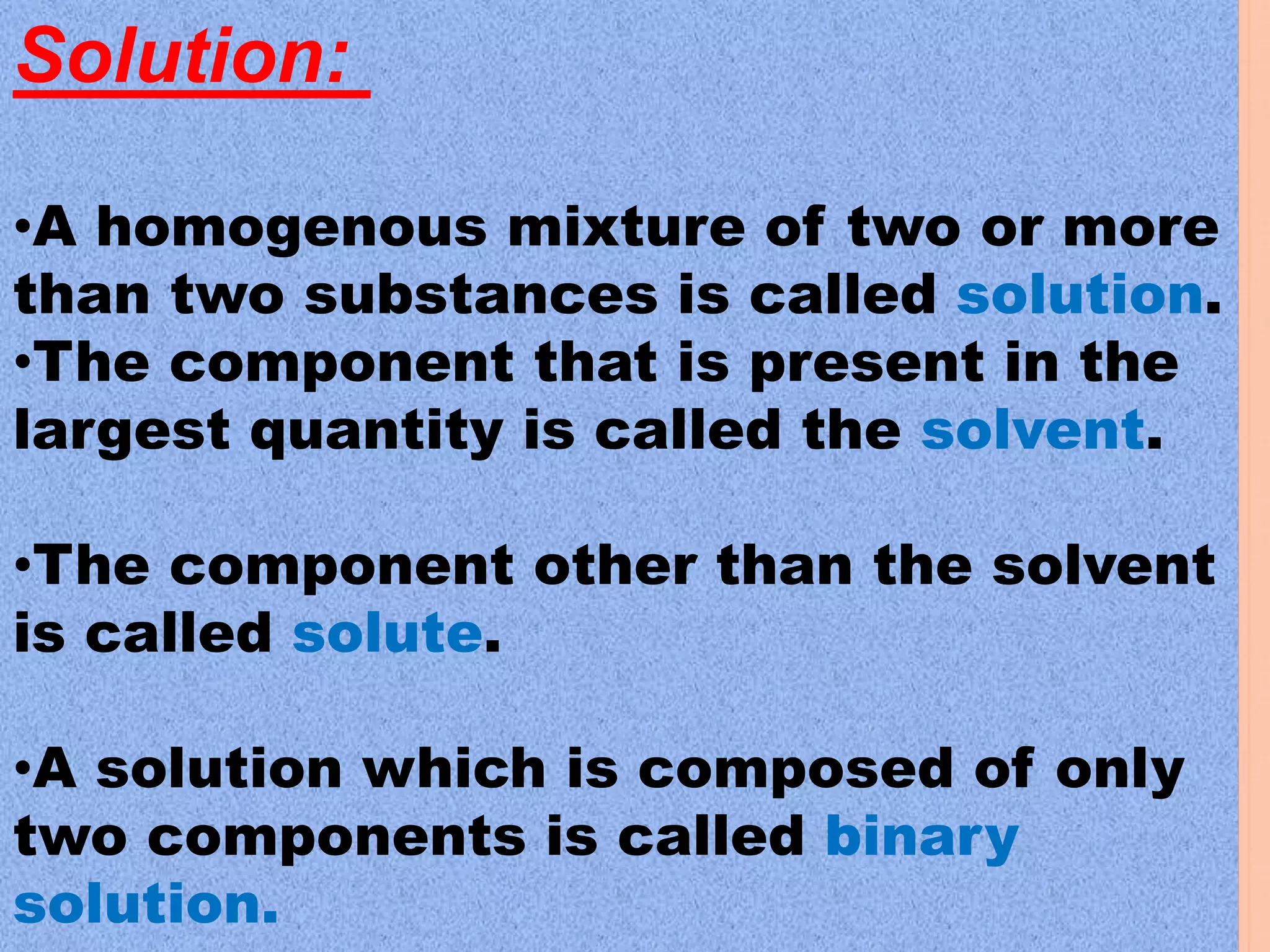
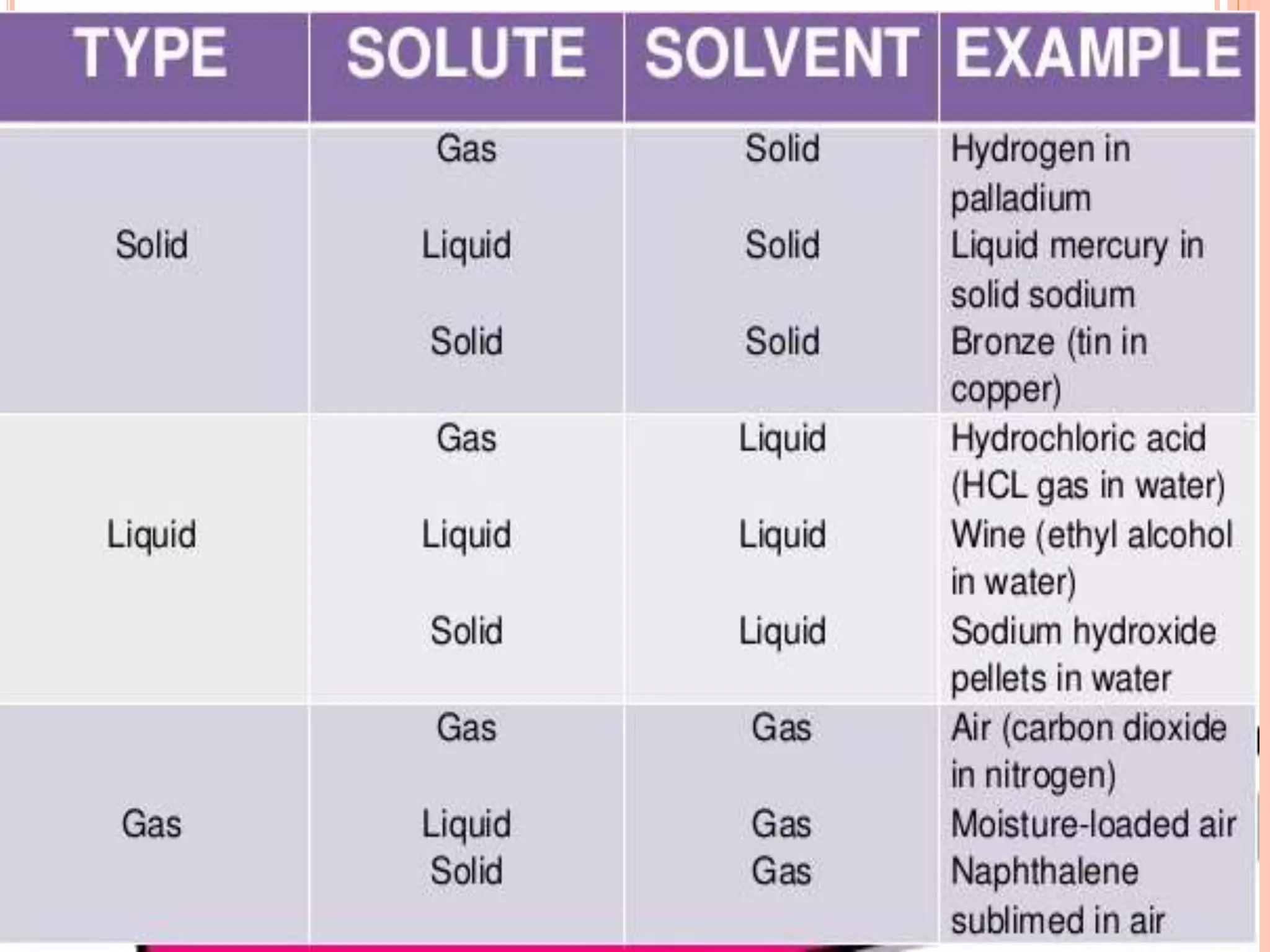
•A homogenous mixture of two or more
than two substances is called solution.
•The component that is present in the
largest quantity is called the solvent.
•The component other than the solvent
is called solute.
•A solution which is composed of only
two components is called binary
solution.
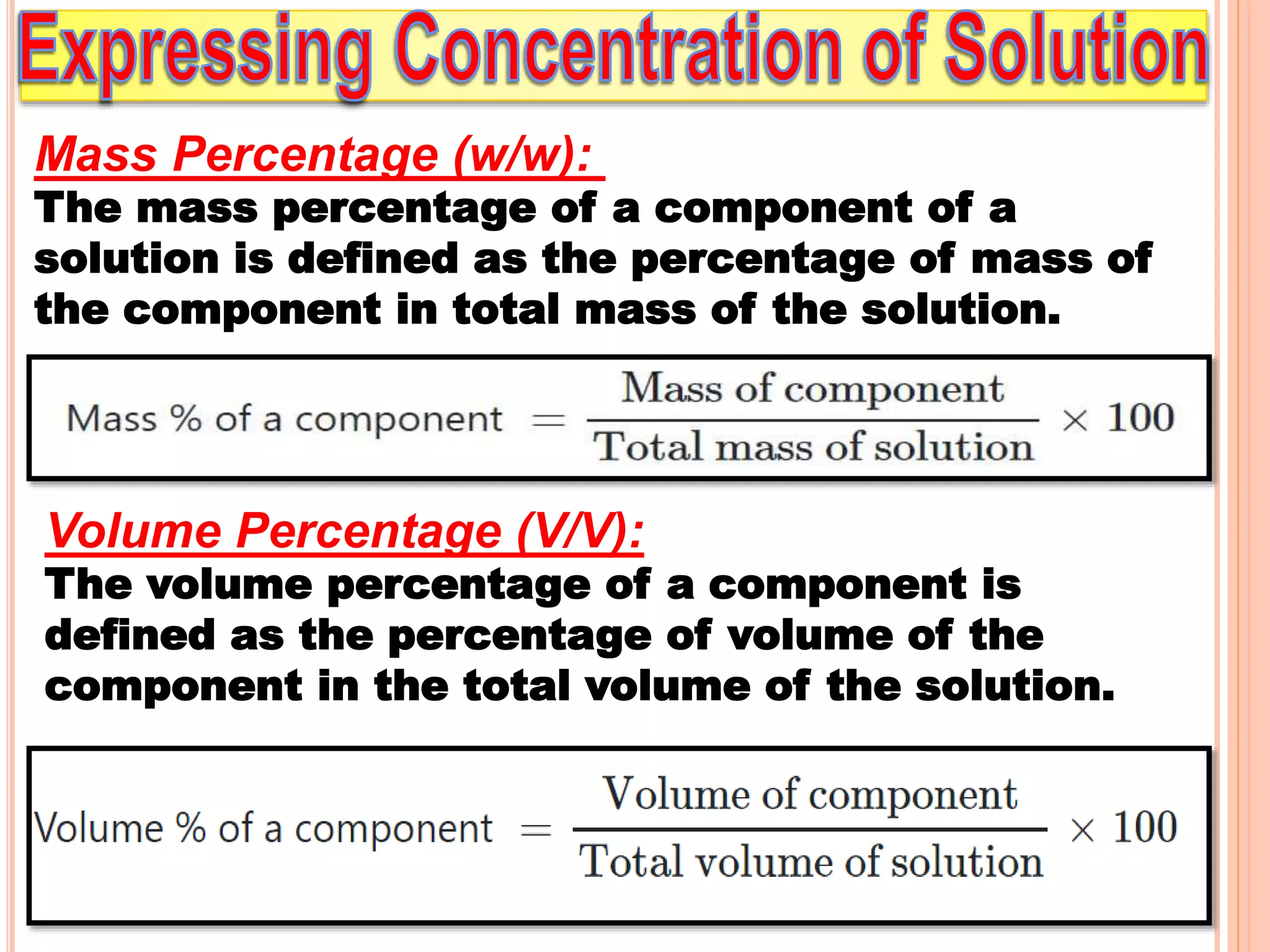
Mass Percentage (w/w):
The mass percentage of a component of a
solution is defined as the percentage of mass of
the component in total mass of the solution.
Volume Percentage (V/V):
The volume percentage of a component is
defined as the percentage of volume of the
component in the total volume of the solution.
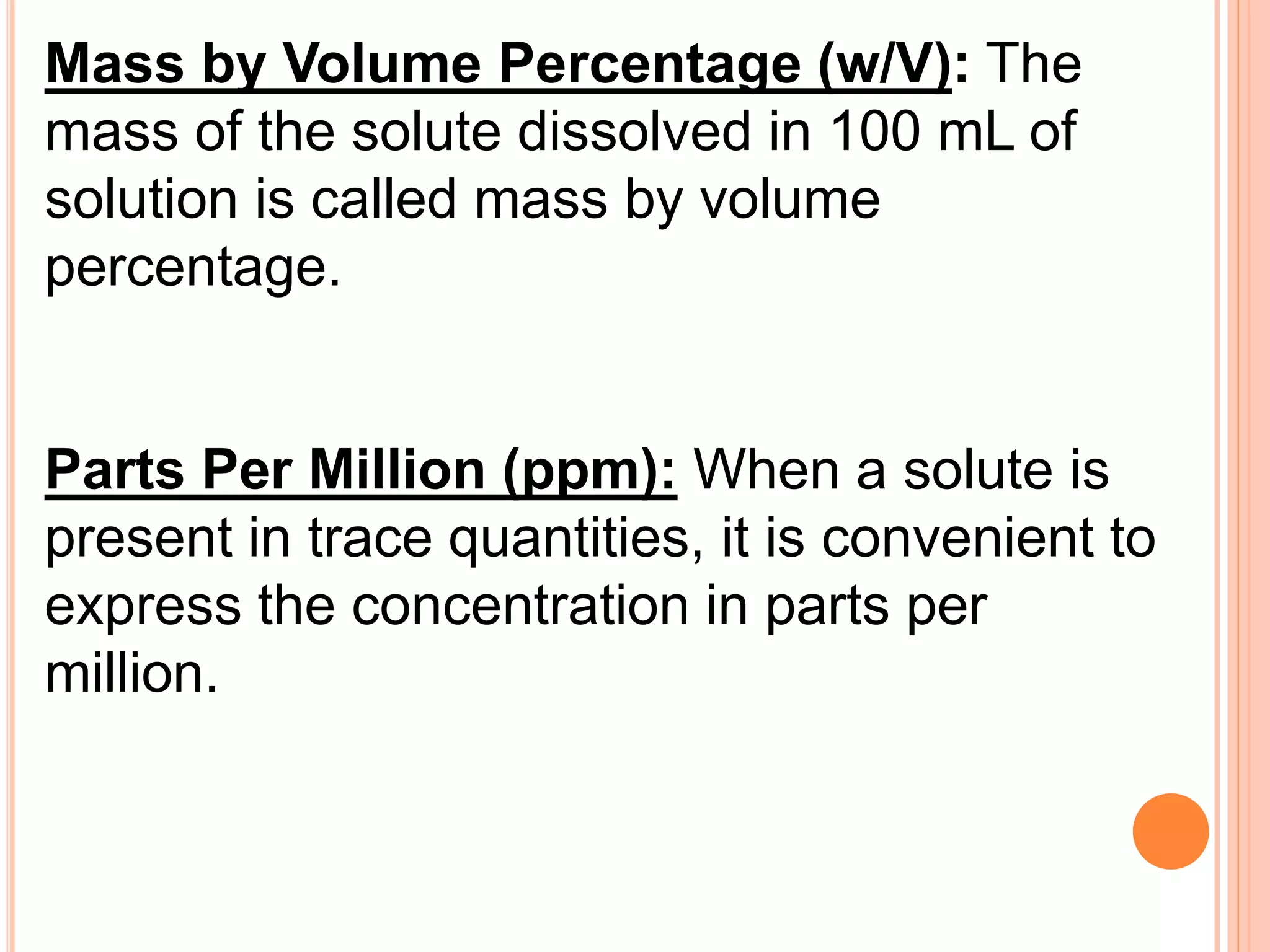
Mass by Volume Percentage (w/V): The
mass of the solute dissolved in 100 mL of
solution is called mass by volume
percentage.
Parts Per Million (ppm): When a solute is
present in trace quantities, it is convenient to
express the concentration in parts per
million.
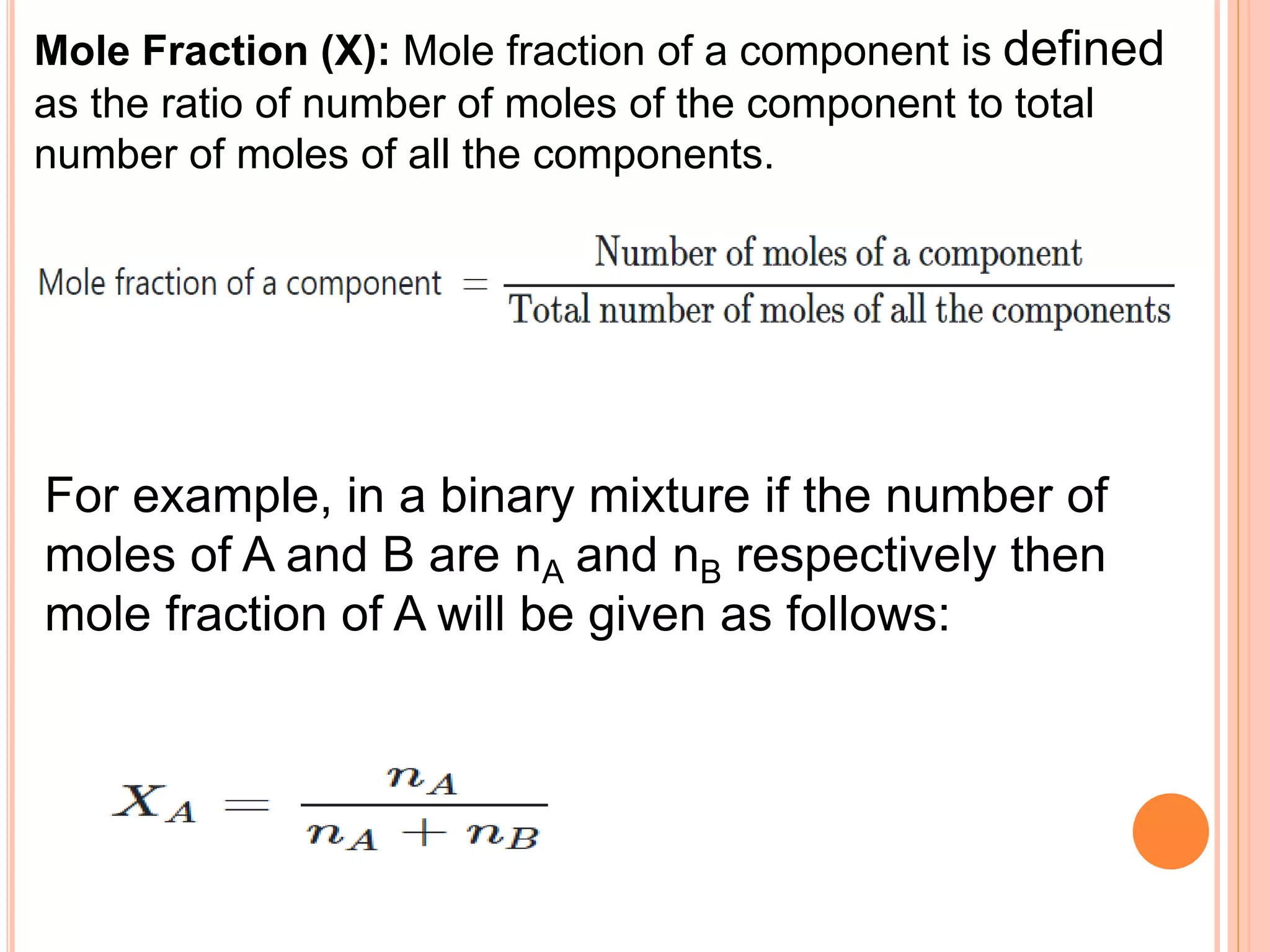
Mole Fraction (X): Mole fraction of a component is defined
as the ratio of number of moles of the component to total
number of moles of all the components.
For example, in a binary mixture if the number of
moles of A and B are nA and nB respectively then
mole fraction of A will be given as follows:
The solubility of solute is its amount
per unit volume of saturated solution At
a specific temperature.
The solubility of a solute is its
maximum concentration and expressed
in the Concentration units mol L-1
i) Nature of solute and solvent:
Generally the compounds with the
similar chemical character are more
readily soluble in each other.
“like dissolves like”
ii)Effect of temperature on
Solubility:
a) endothermic :- solubility increases
with increasing temperature
b) exothermic :- solubility decreases
with increasing temperature
iii)Effect of pressure on solubility:-
pressure has no effect on solubility of
solid and liquid as they are
incompressible.
However, solubility of gas increases
with increasing pressure.
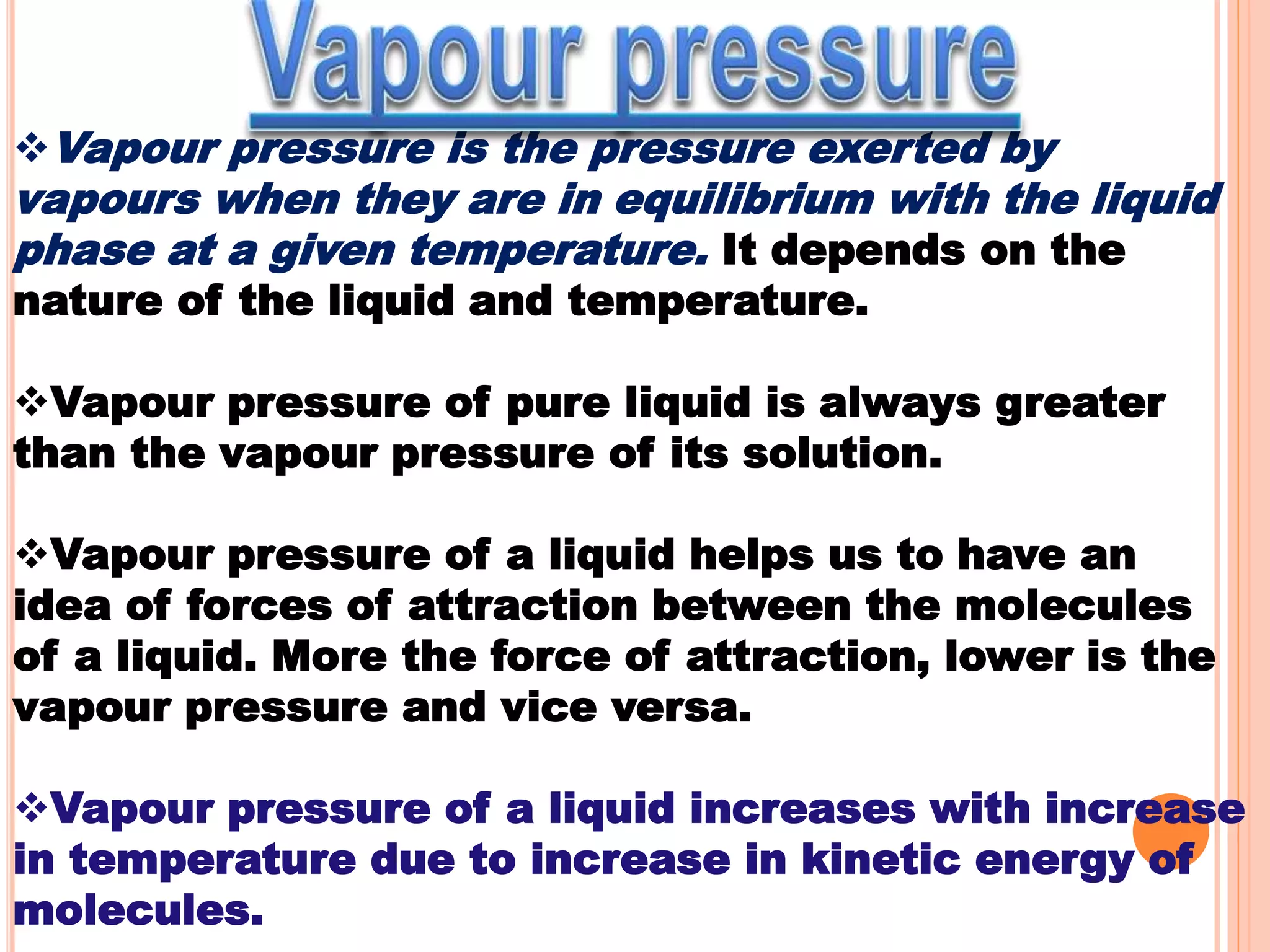
Vapour pressure is the pressure exerted by
vapours when they are in equilibrium with the liquid
phase at a given temperature. It depends on the
nature of the liquid and temperature.
Vapour pressure of pure liquid is always greater
than the vapour pressure of its solution.
Vapour pressure of a liquid helps us to have an
idea of forces of attraction between the molecules
of a liquid. More the force of attraction, lower is the
vapour pressure and vice versa.
Vapour pressure of a liquid increases with increase
in temperature due to increase in kinetic energy of
molecules.
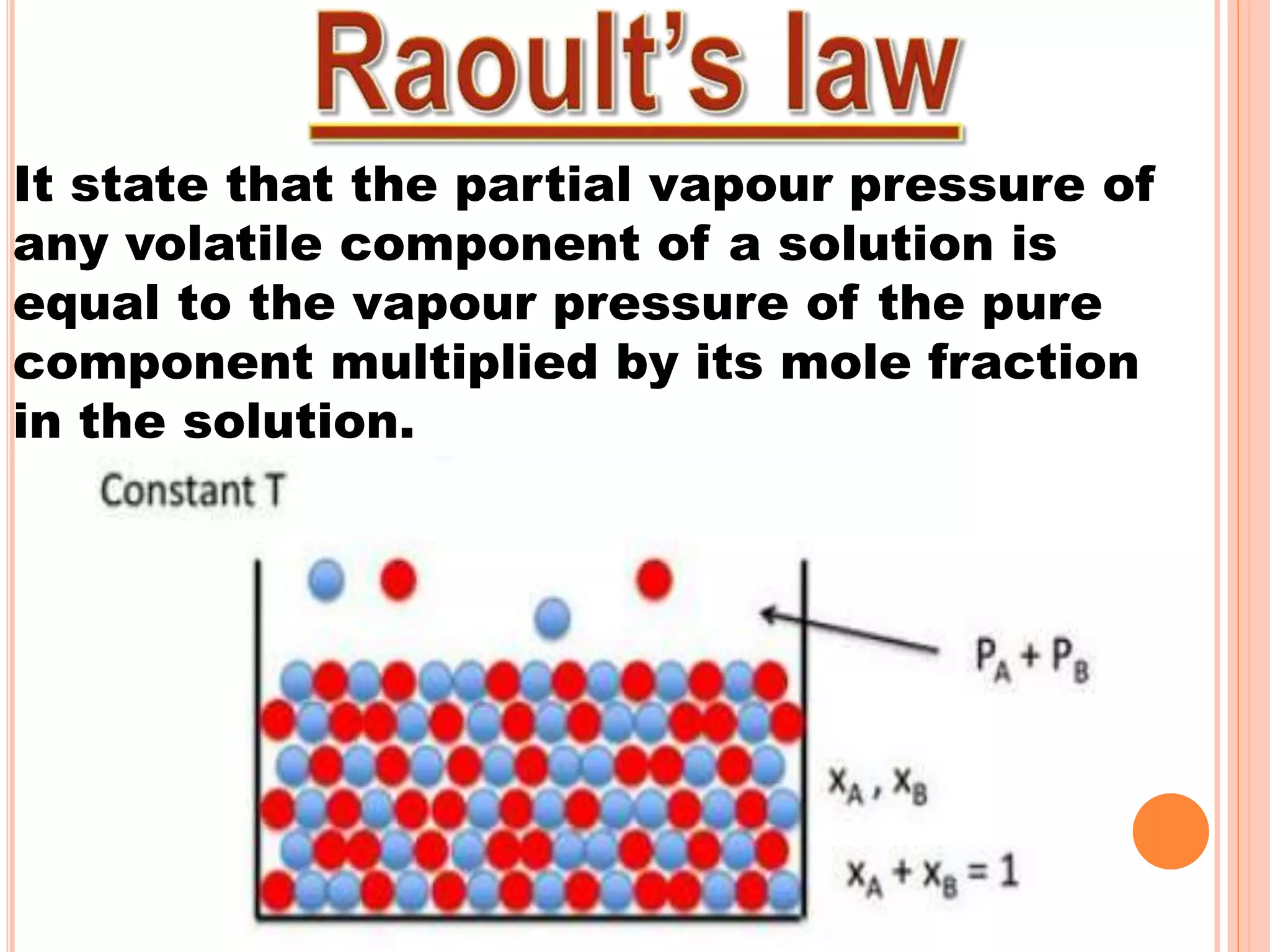
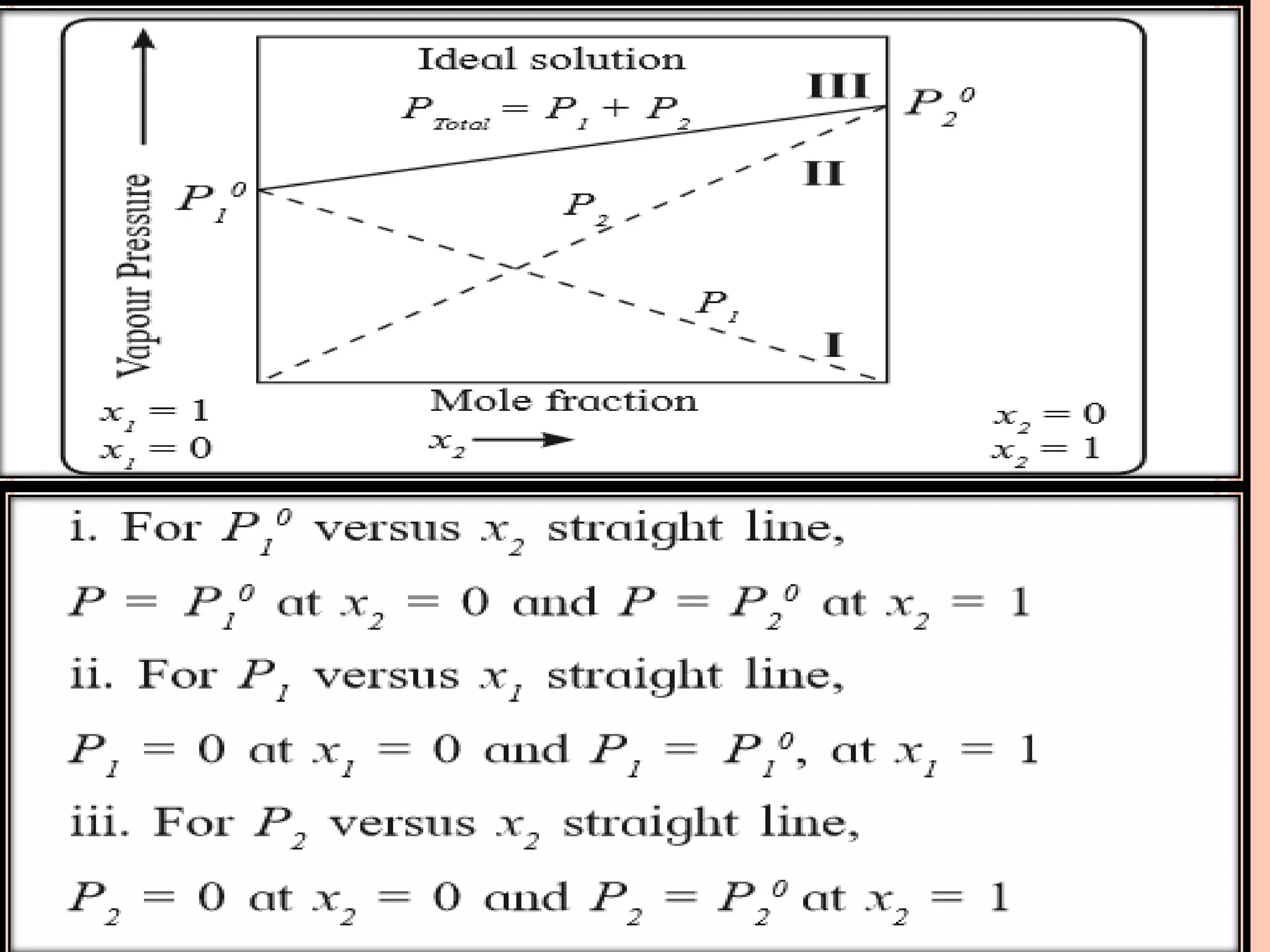
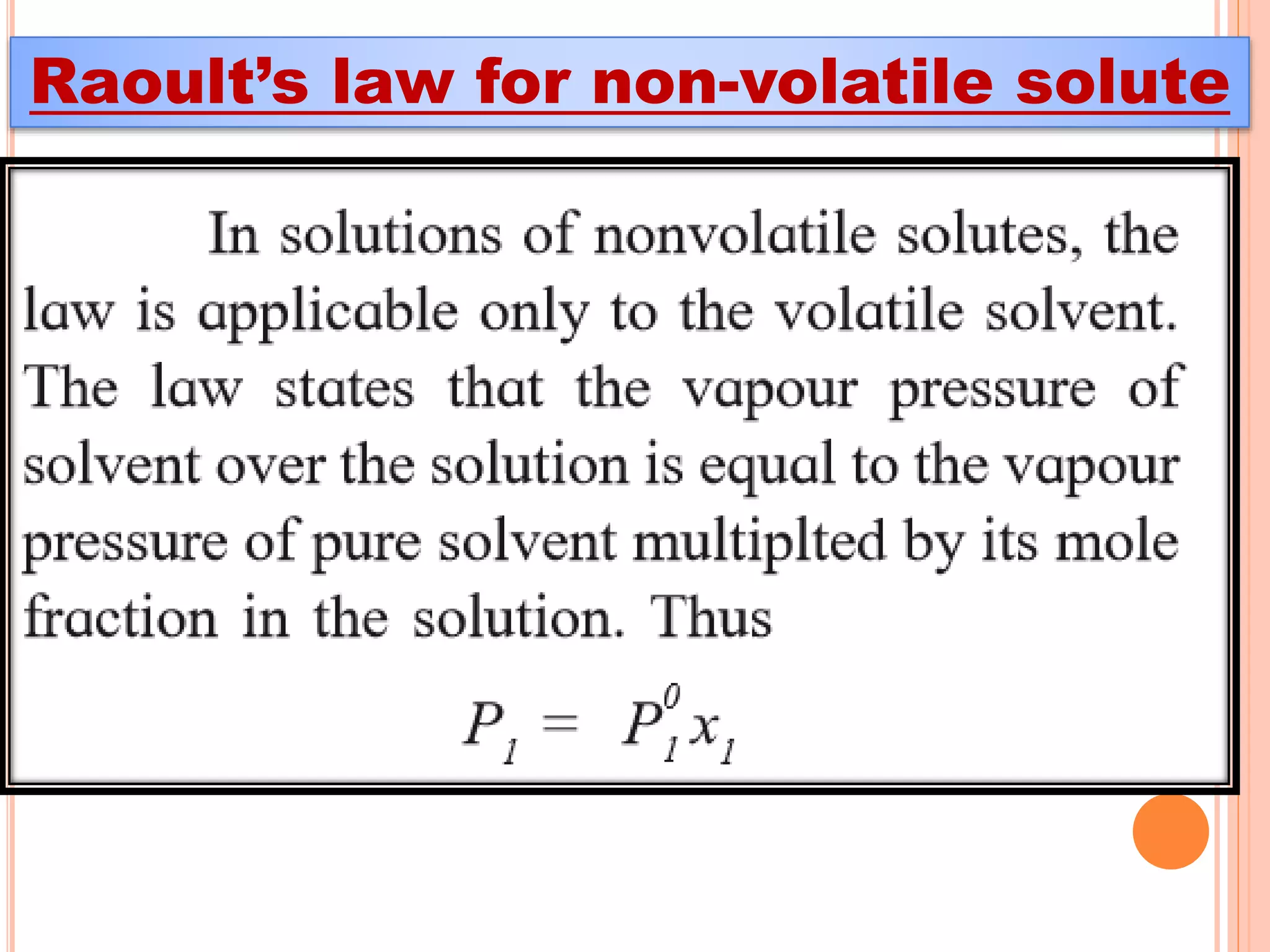
It state that the partial vapour pressure of
any volatile component of a solution is
equal to the vapour pressure of the pure
component multiplied by its mole fraction
in the solution.
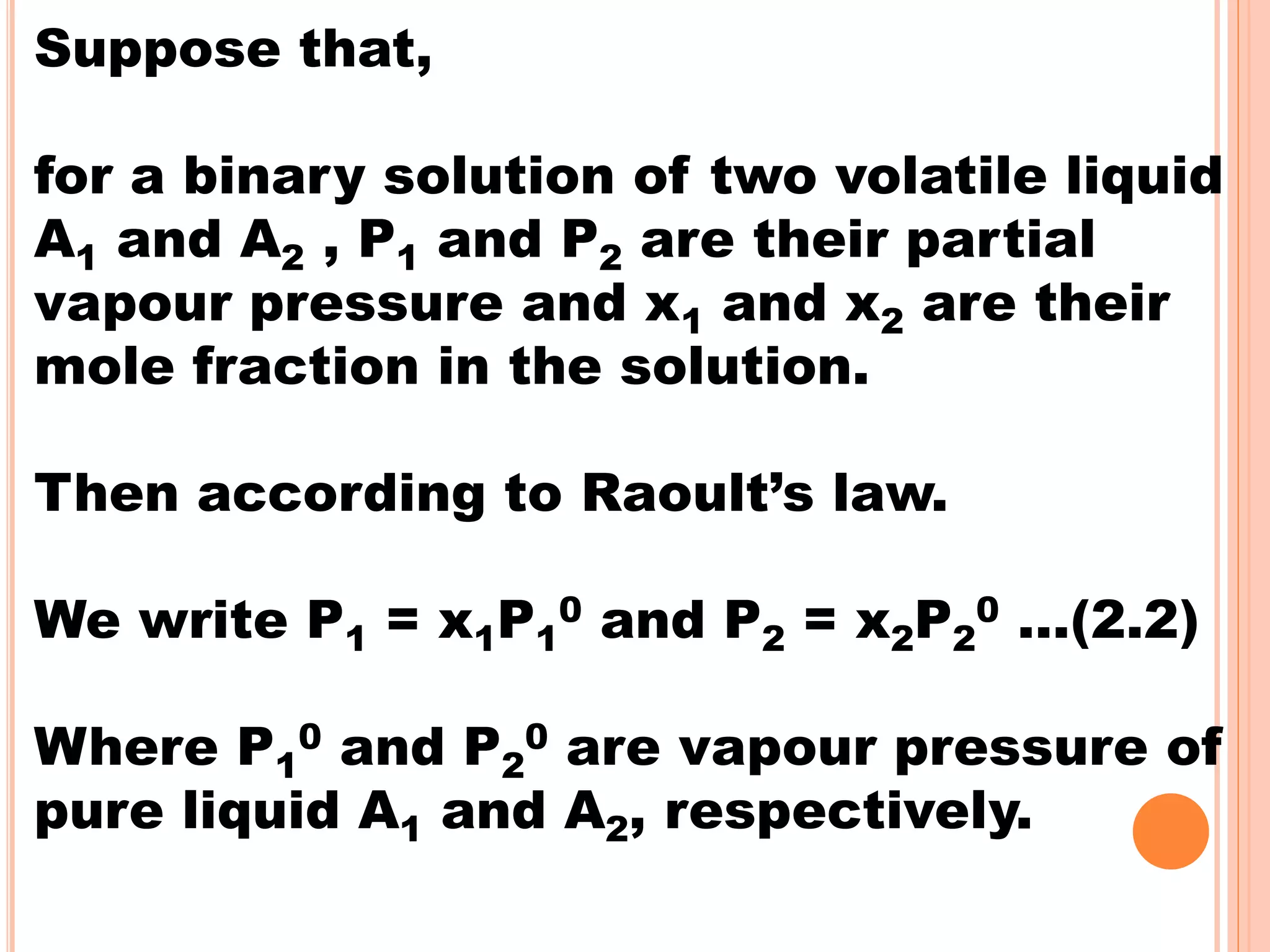
Suppose that,
for a binary solution of two volatile liquid
A1 and A2 , P1 and P2 are their partial
vapour pressure and x1 and x2 are their
mole fraction in the solution.
Then according to Raoult’s law.
We write P1 = x1P1
0 and P2 = x2P2
0 …(2.2)
Where P1
0 and P2
0 are vapour pressure of
pure liquid A1 and A2, respectively.
1. Ideal solution obey Raoult,s law over entire range
of concentration.
2. No heat is evolved or absorbed when two
components forming an ideal solution are mixed.
Thus, the enthalpy of the mixing is zero.
3. There is no volume change when two
components forming an ideal solution are mixed.
Thus volume of an ideal solution is equal to the
sum of volumes of two components taken for
mixing.
4. In ideal solution , solvent-solute, solute-solute
and solvent-solvent molecule interactions are
comparable.
5. The vapour pressure of ideal solution always lies
vapour pressures of pure components.
1. Nonideal solution do not obey Raoult,s law
over entire range of concentration.
2.The vapour pressure of these solution can
be higher or lower than those of pure
component.
3.These solution shows two types of
deviation from Raoult’s law.
A) Positive deviation from Raoult’s law.
The solution in which solvent-solute
intermolecular attraction are weaker than
those between solvent-solvent molecules
and solute-solute molecules attraction.
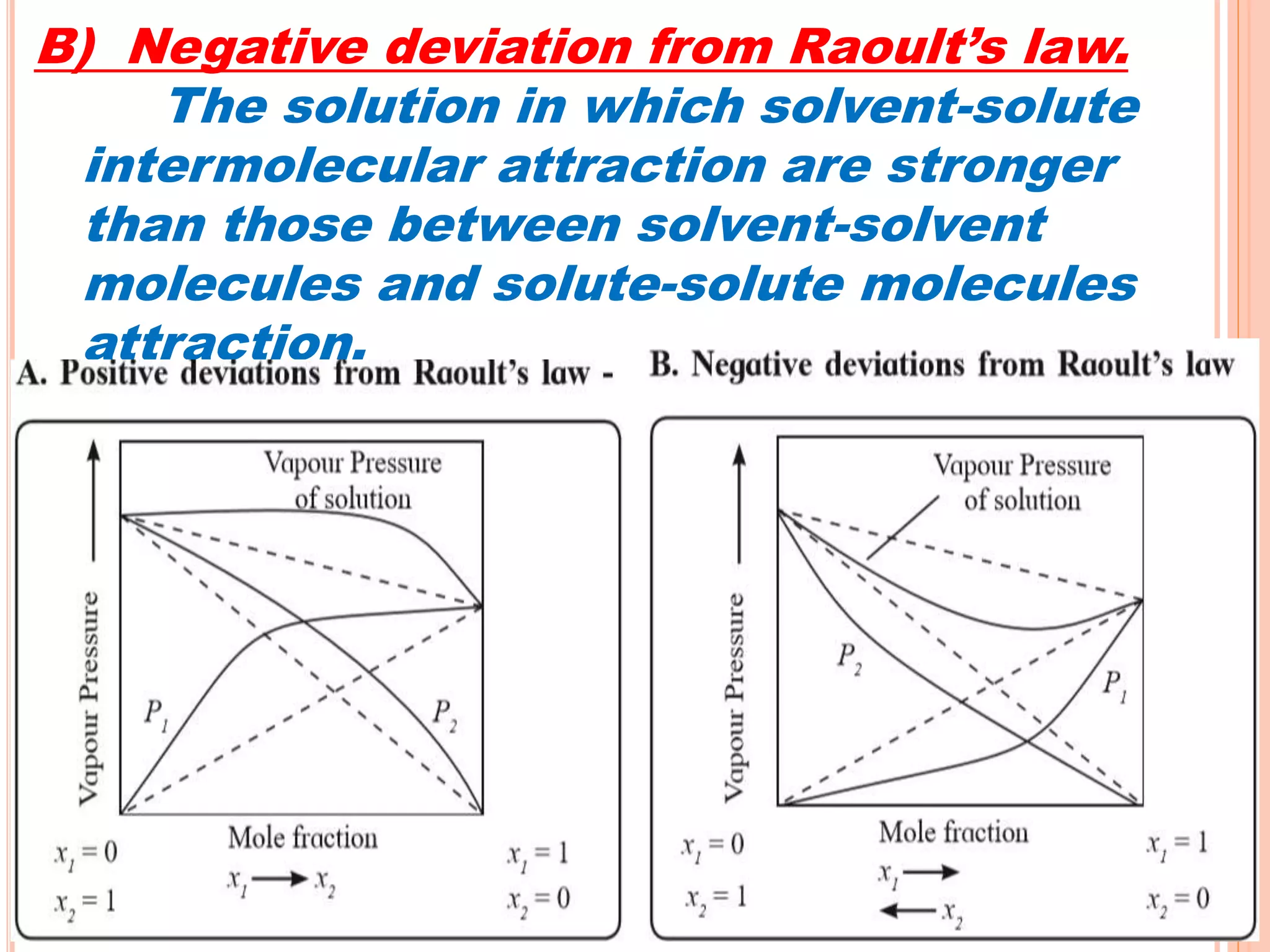
B) Negative deviation from Raoult’s law.
The solution in which solvent-solute
intermolecular attraction are stronger
than those between solvent-solvent
molecules and solute-solute molecules
attraction.
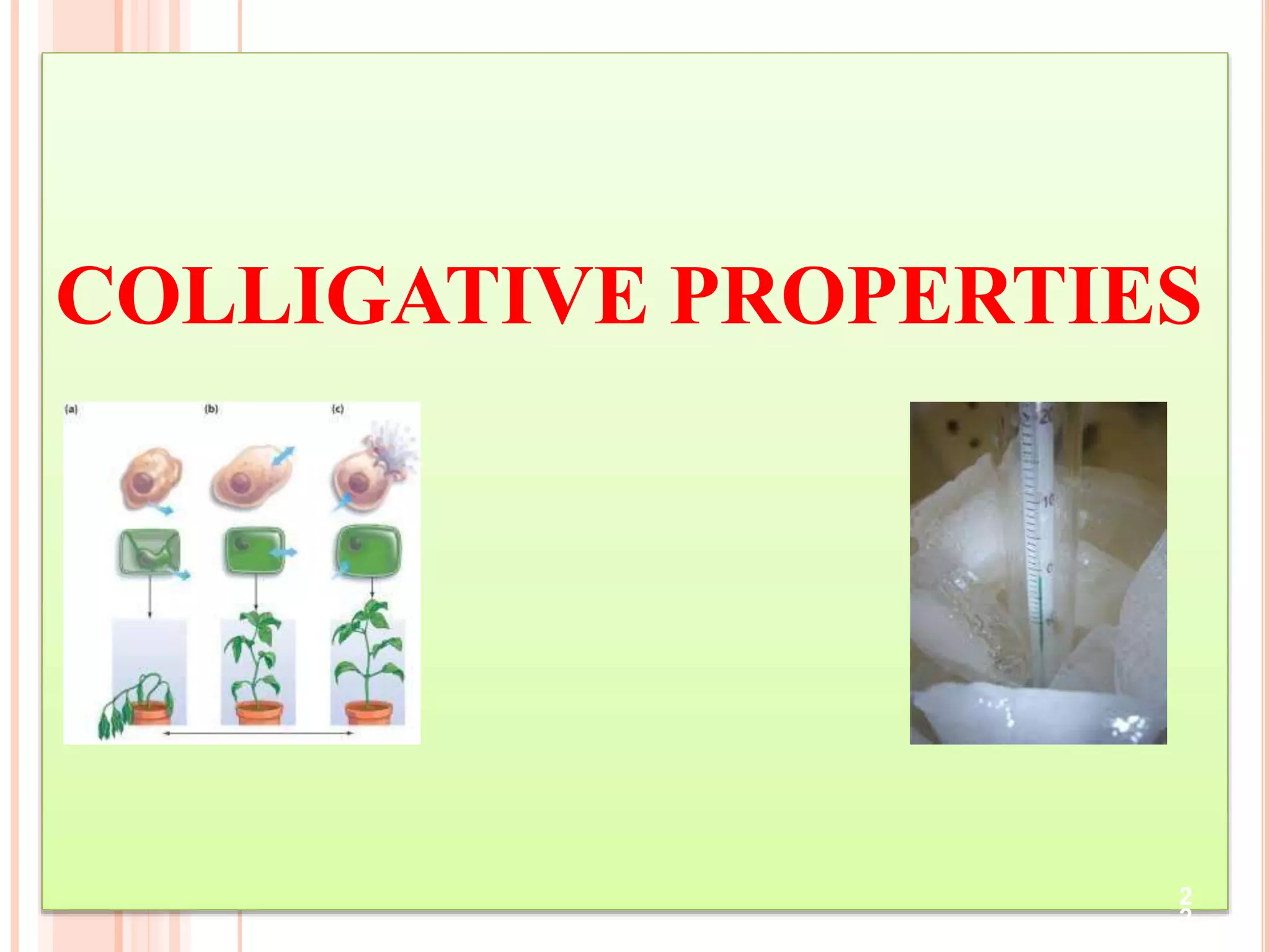
COLLIGATIVE PROPERTIES
2
2
COLLIGATIVE PROPERTIES
2
3
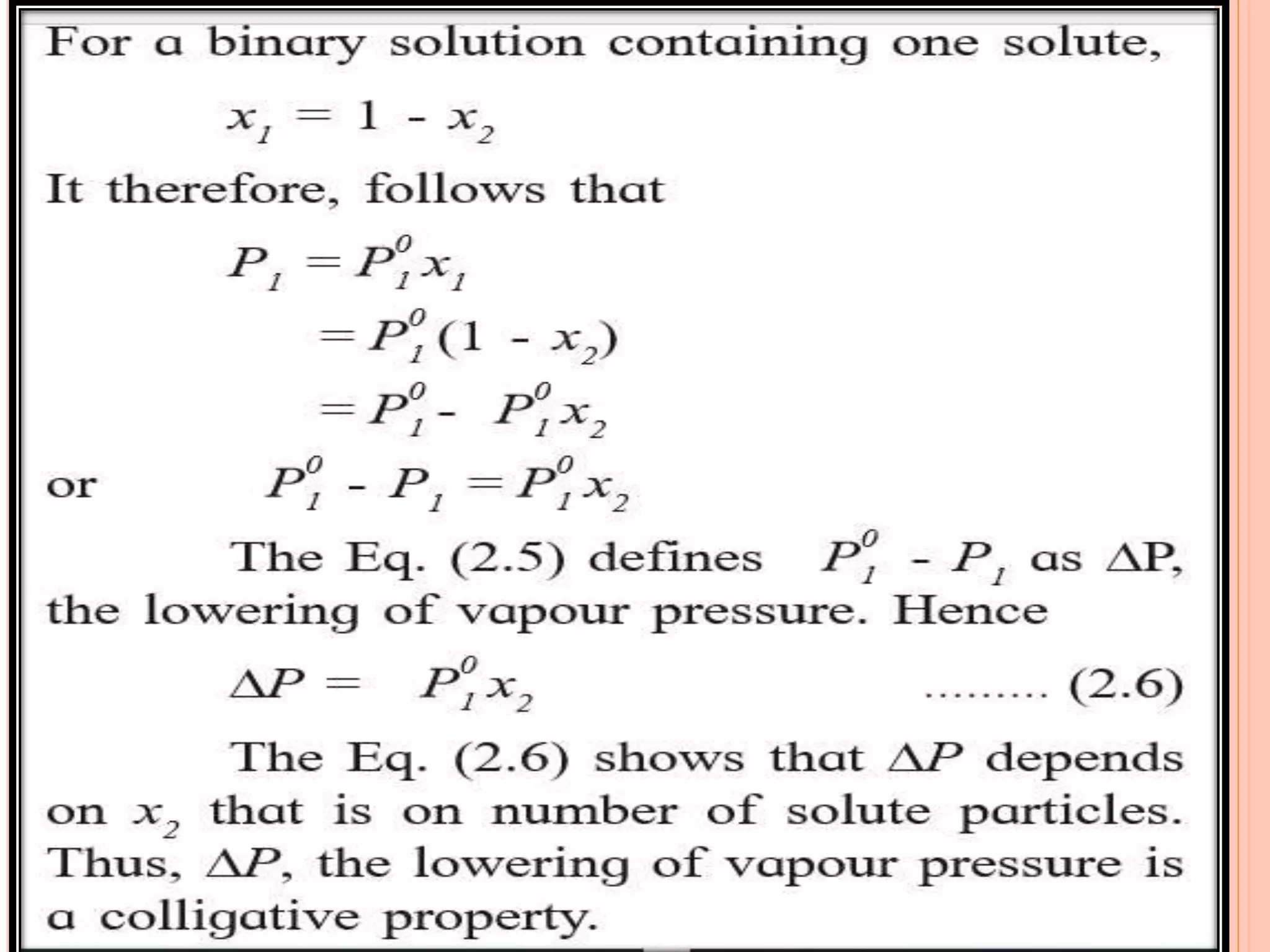
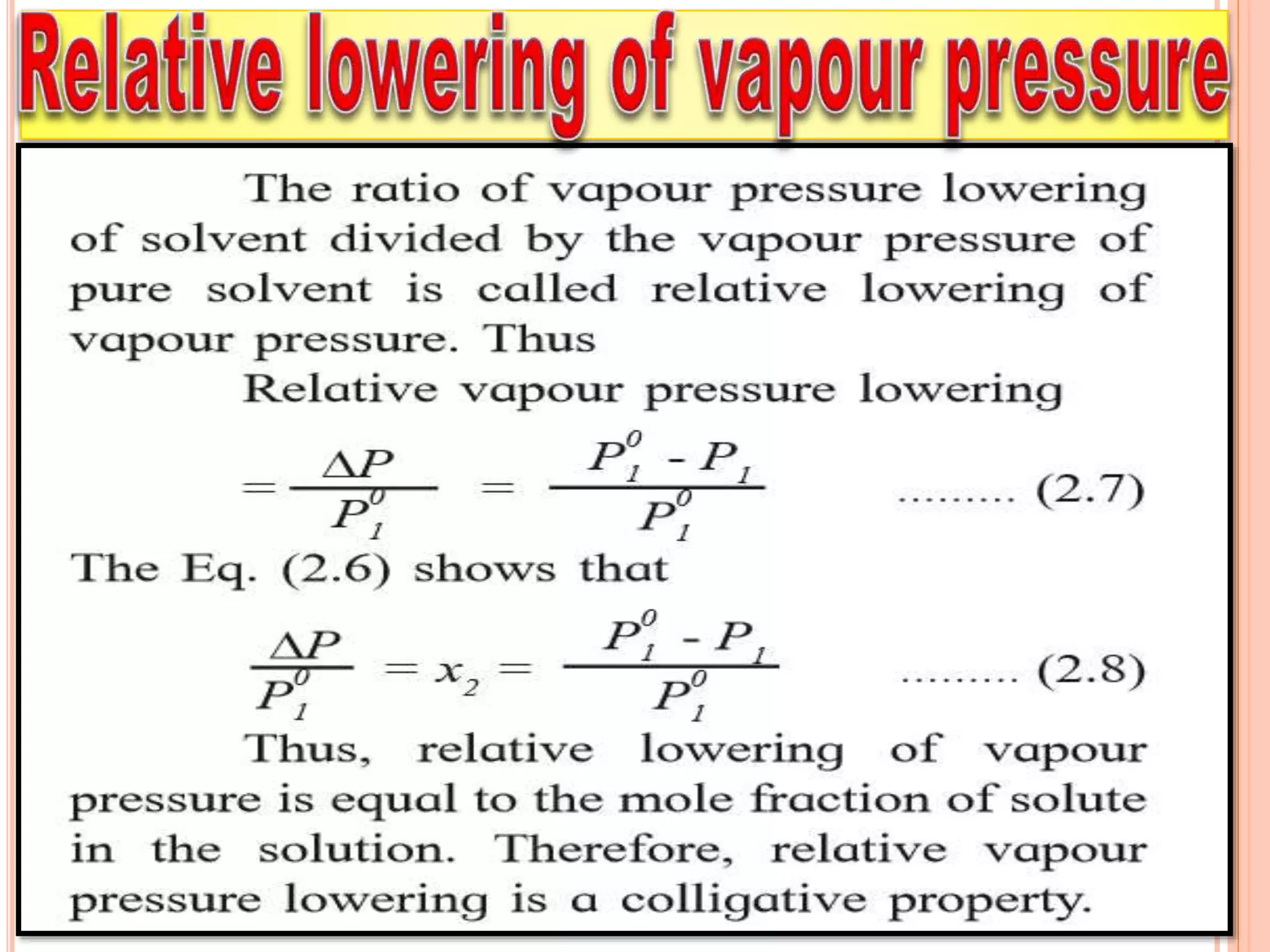
Colligative properties depend only
on the number of solute particles
present, not on the nature of the
solute particles.
Among colligative properties are
Vapor pressure lowering
Boiling point elevation
depression of freezing
point
Osmotic pressure
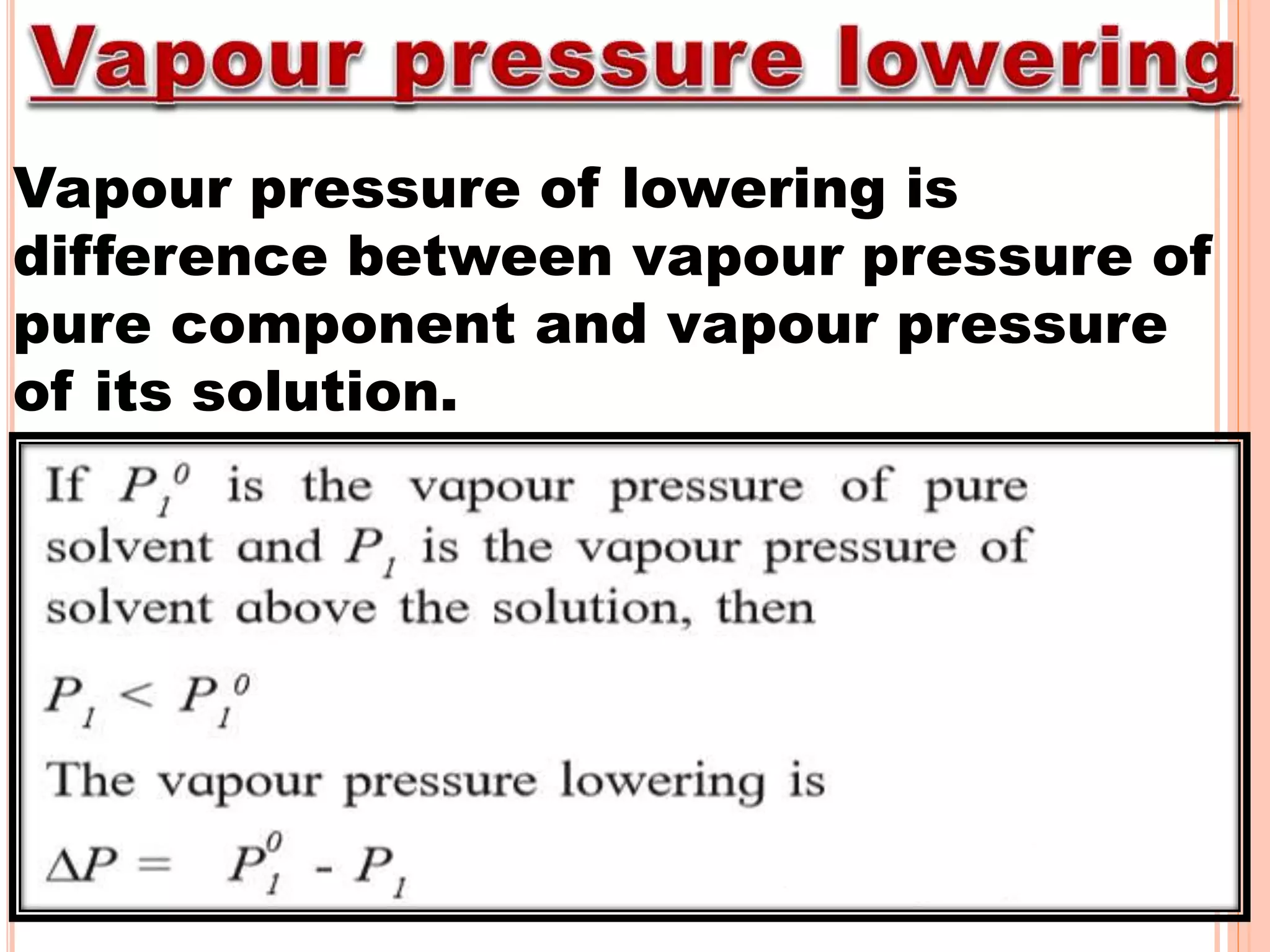
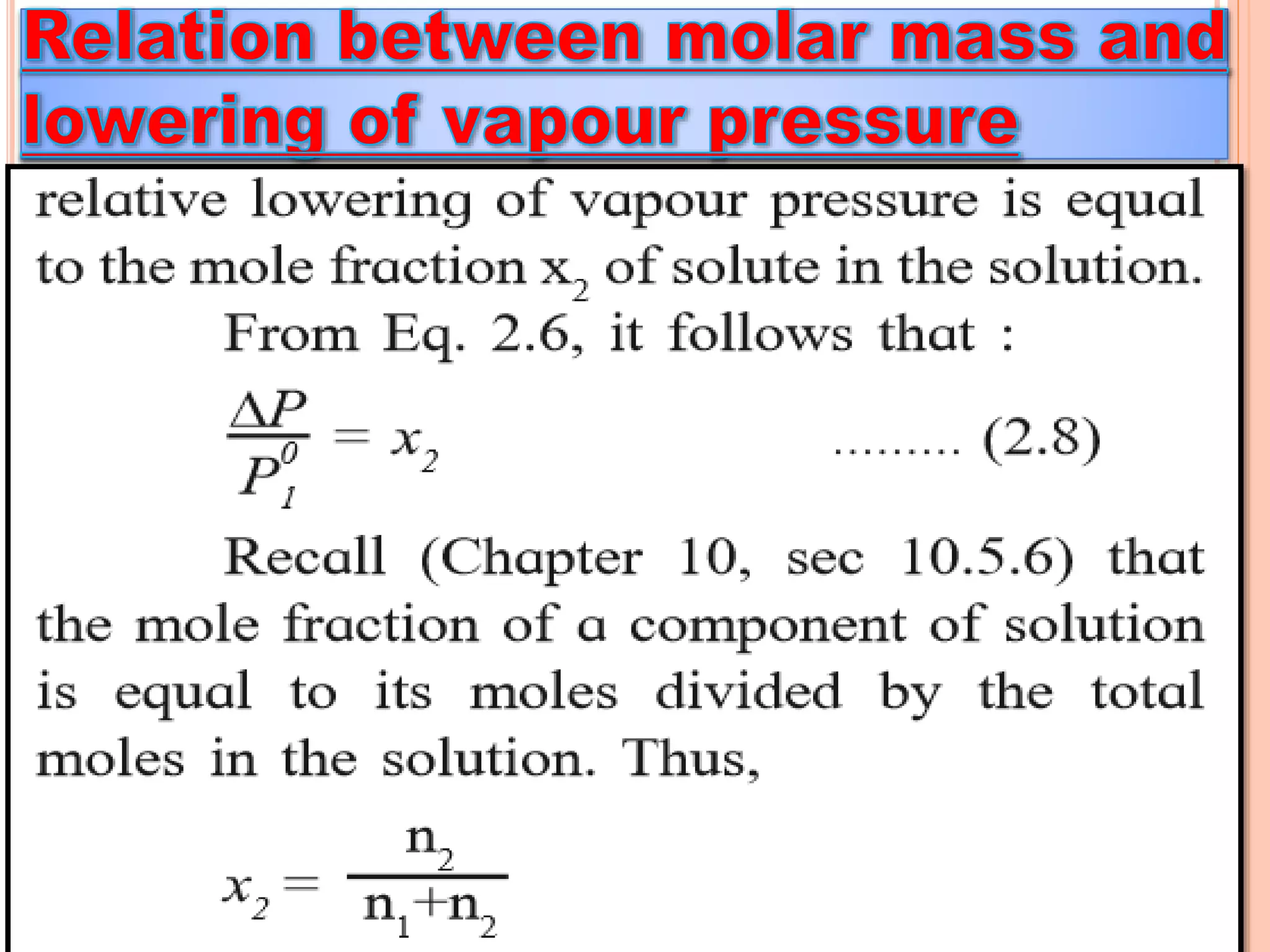
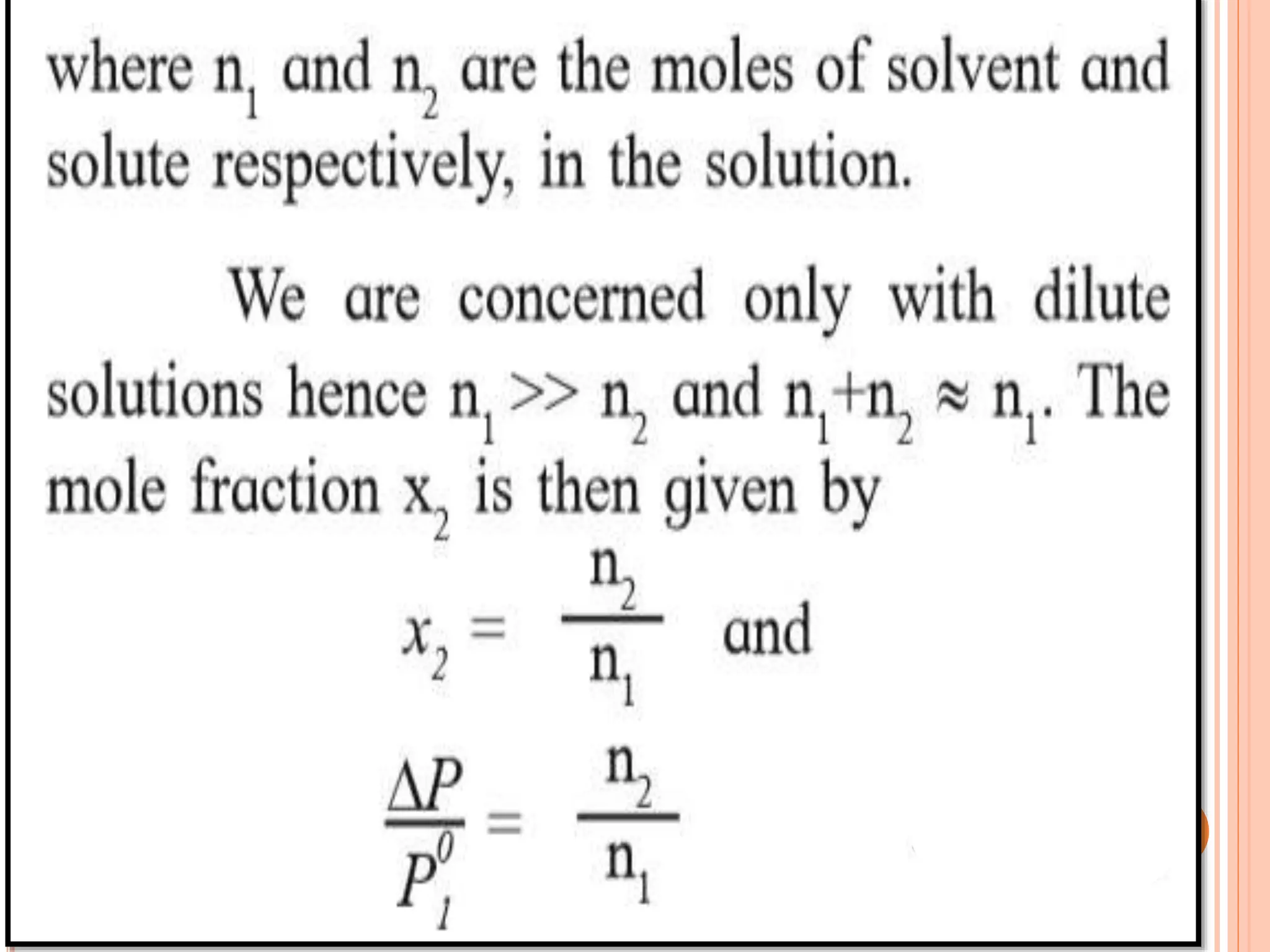
Vapour pressure of lowering is
difference between vapour pressure of
pure component and vapour pressure
of its solution.
Raoult’s law for non-volatile solute
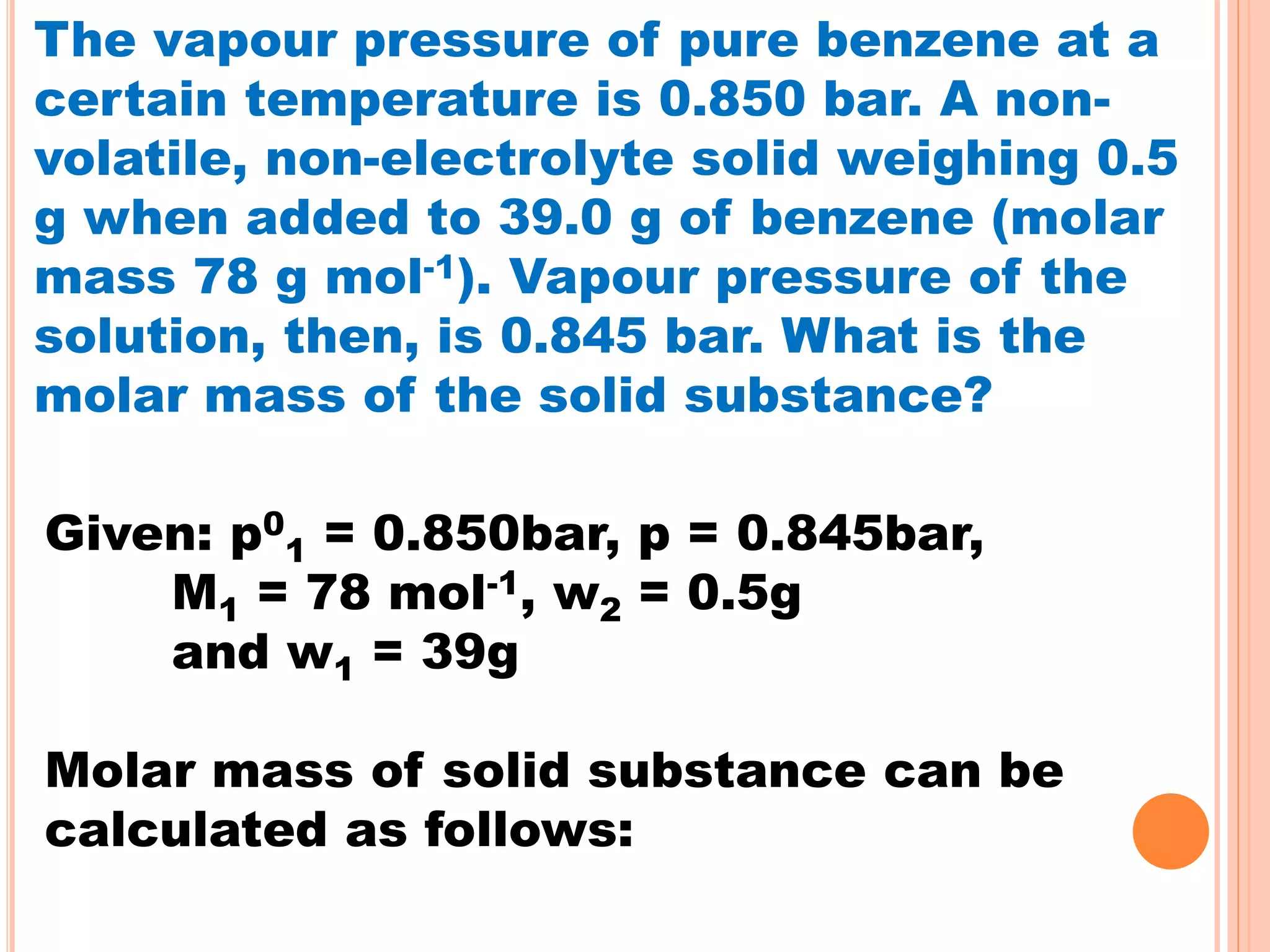
The vapour pressure of pure benzene at a
certain temperature is 0.850 bar. A non-
volatile, non-electrolyte solid weighing 0.5
g when added to 39.0 g of benzene (molar
mass 78 g mol-1). Vapour pressure of the
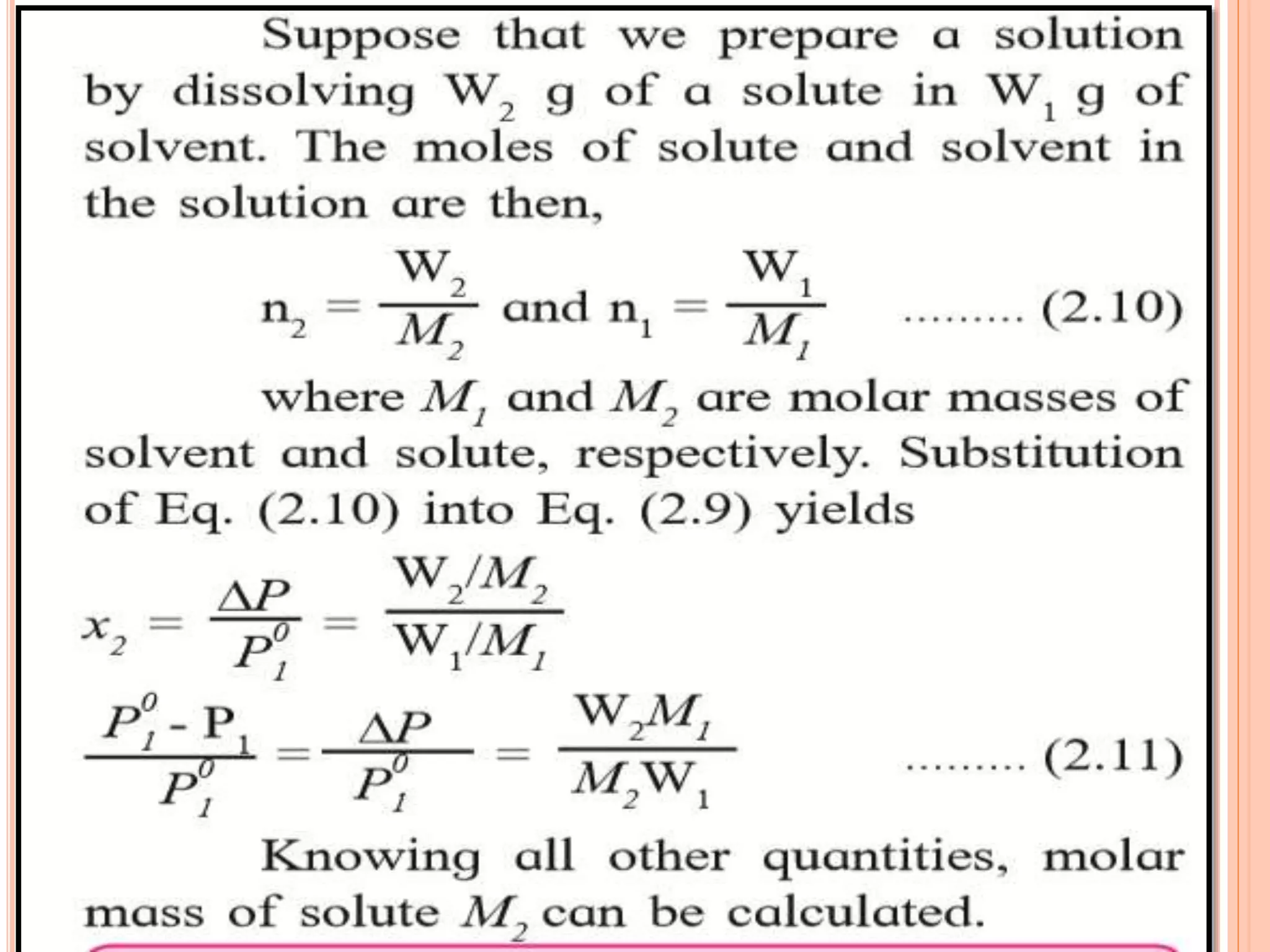
solution, then, is 0.845 bar. What is the
molar mass of the solid substance?
Given: p0
1 = 0.850bar, p = 0.845bar,
M1 = 78 mol-1, w2 = 0.5g
and w1 = 39g
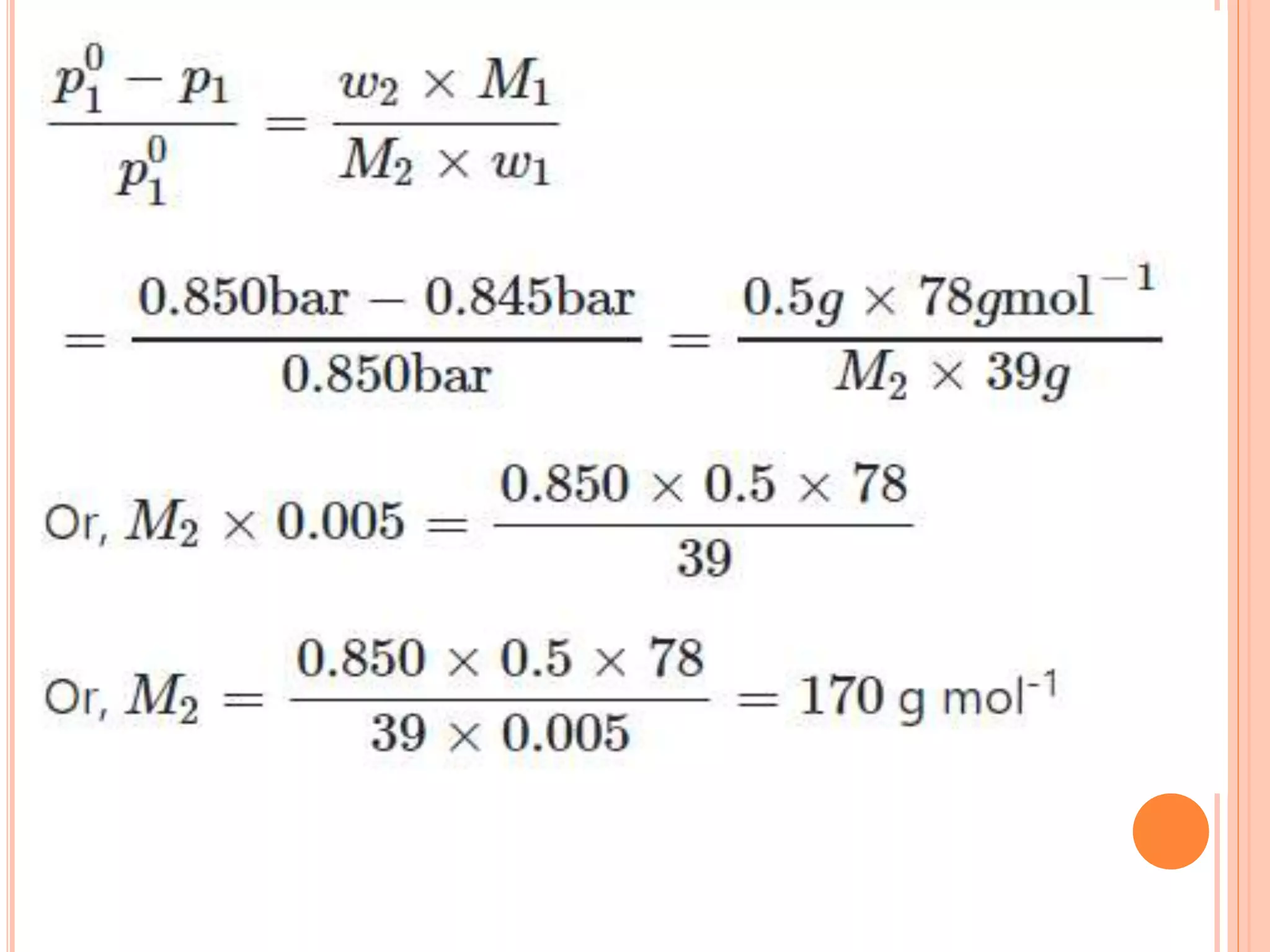
Molar mass of solid substance can be
calculated as follows:
BOILING POINT ELEVATION
3
3
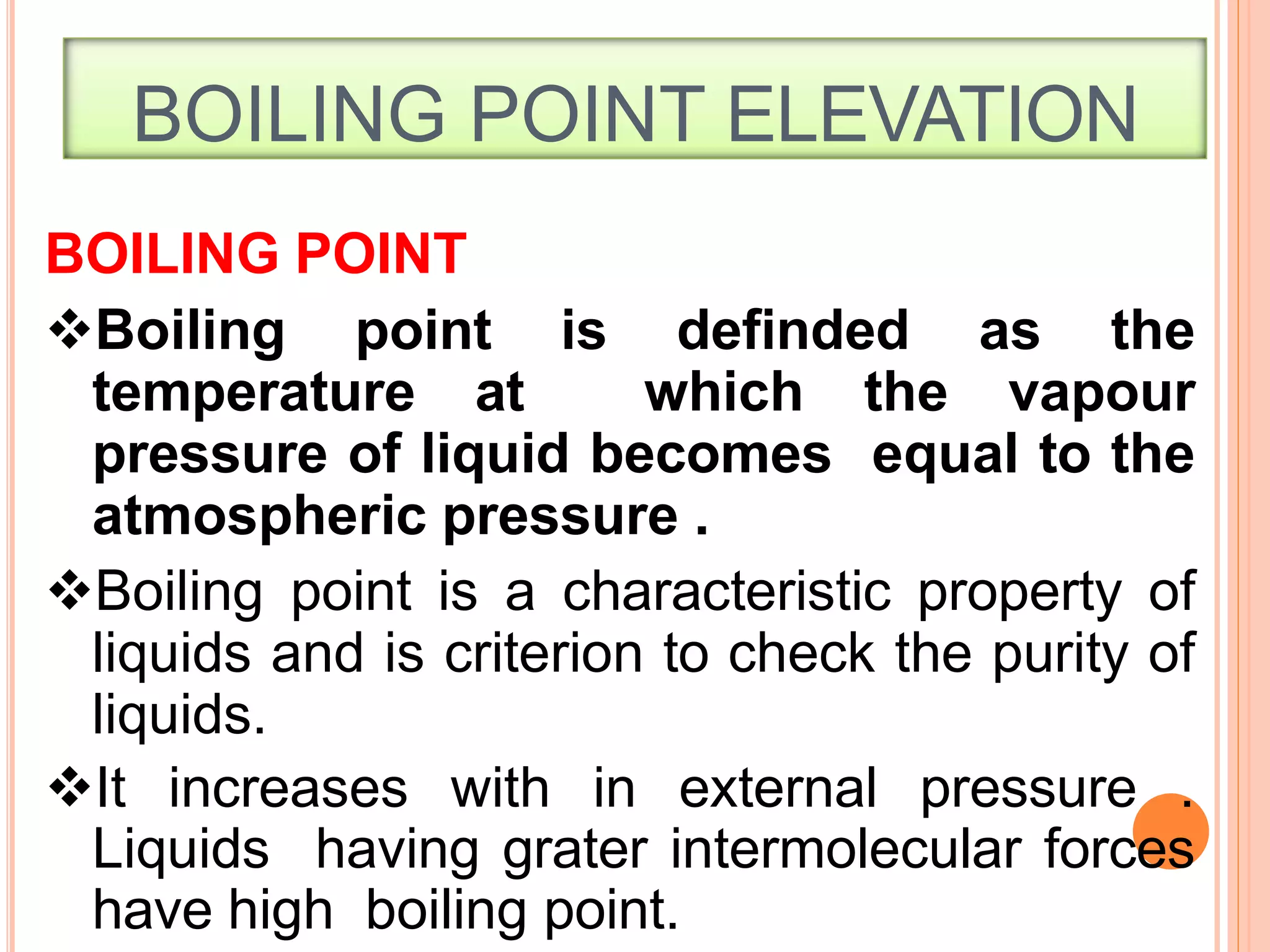
BOILING POINT
Boiling point is definded as the
temperature at which the vapour
pressure of liquid becomes equal to the
atmospheric pressure .
Boiling point is a characteristic property of
liquids and is criterion to check the purity of
liquids.
It increases with in external pressure .
Liquids having grater intermolecular forces
have high boiling point.
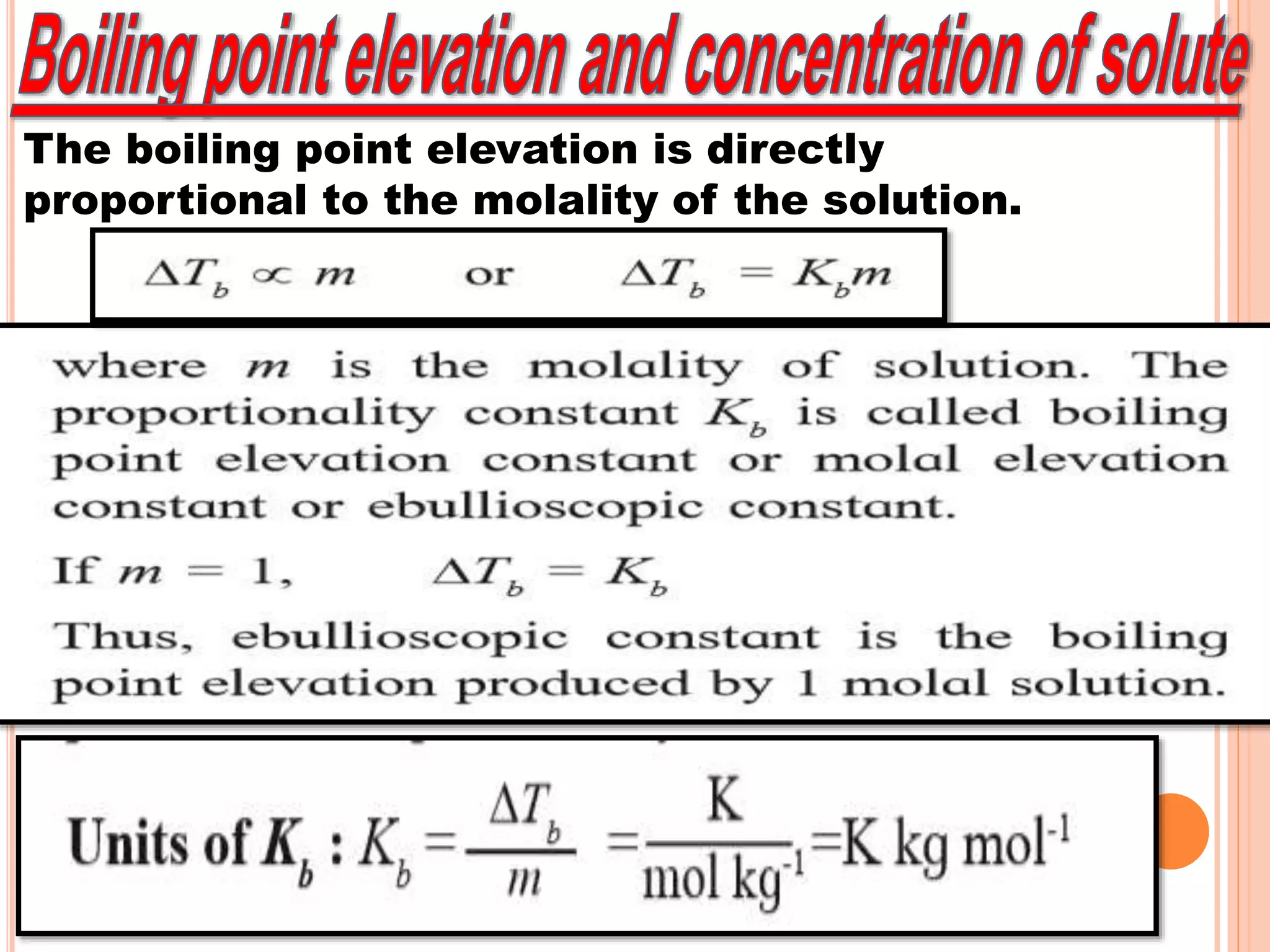
The boiling point elevation is directly
proportional to the molality of the solution.
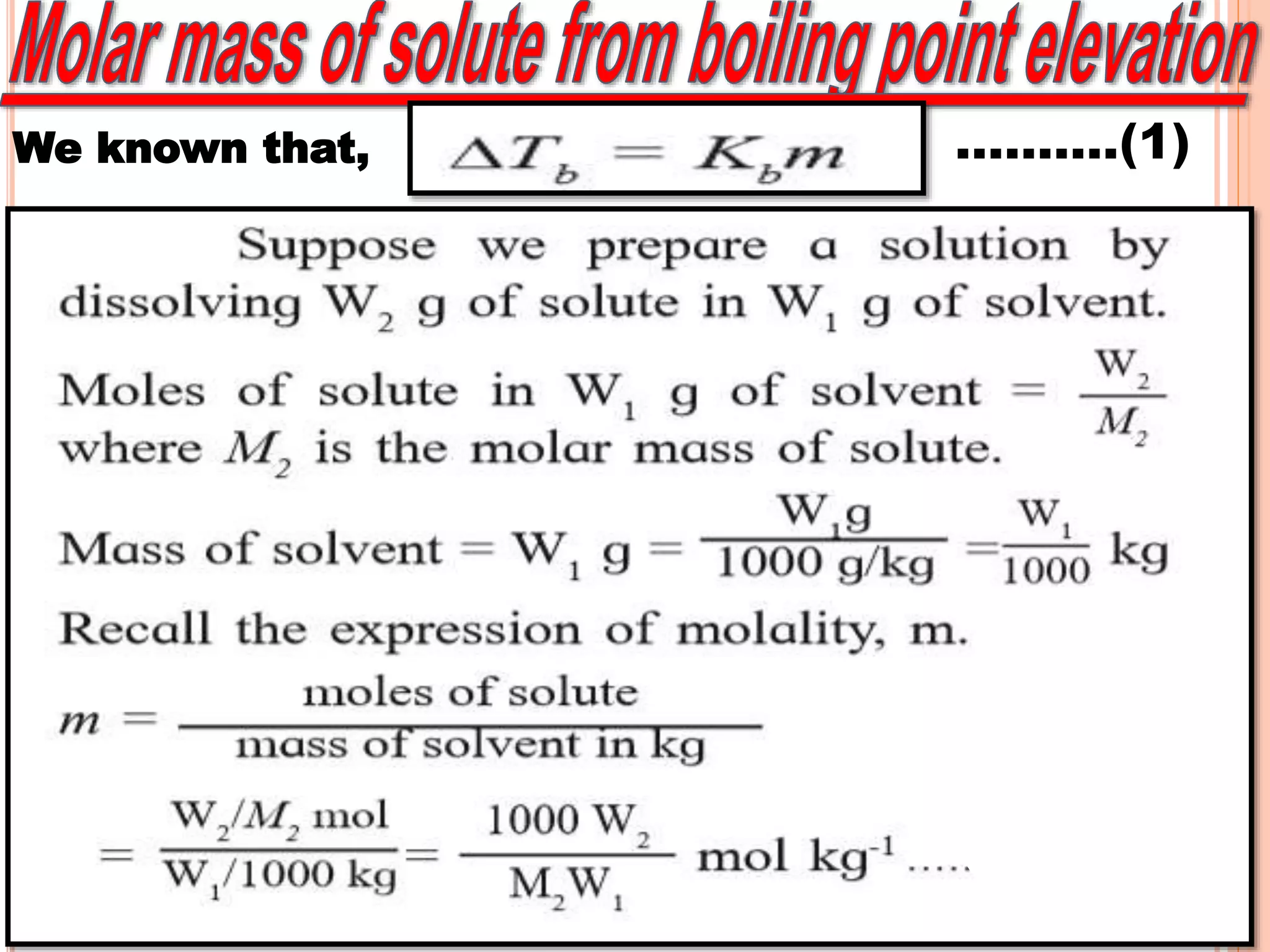
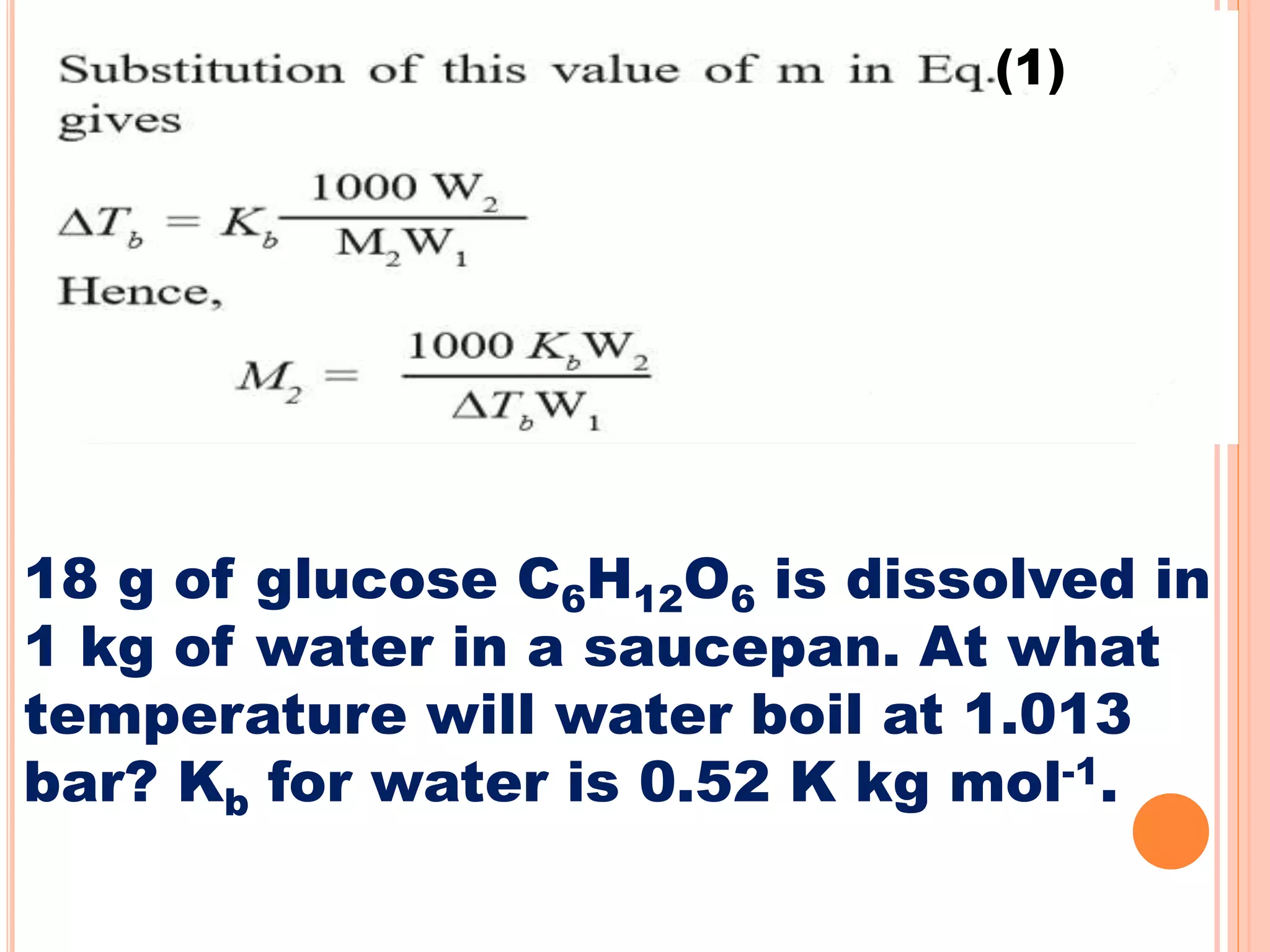
We known that, ……….(1)
(1)
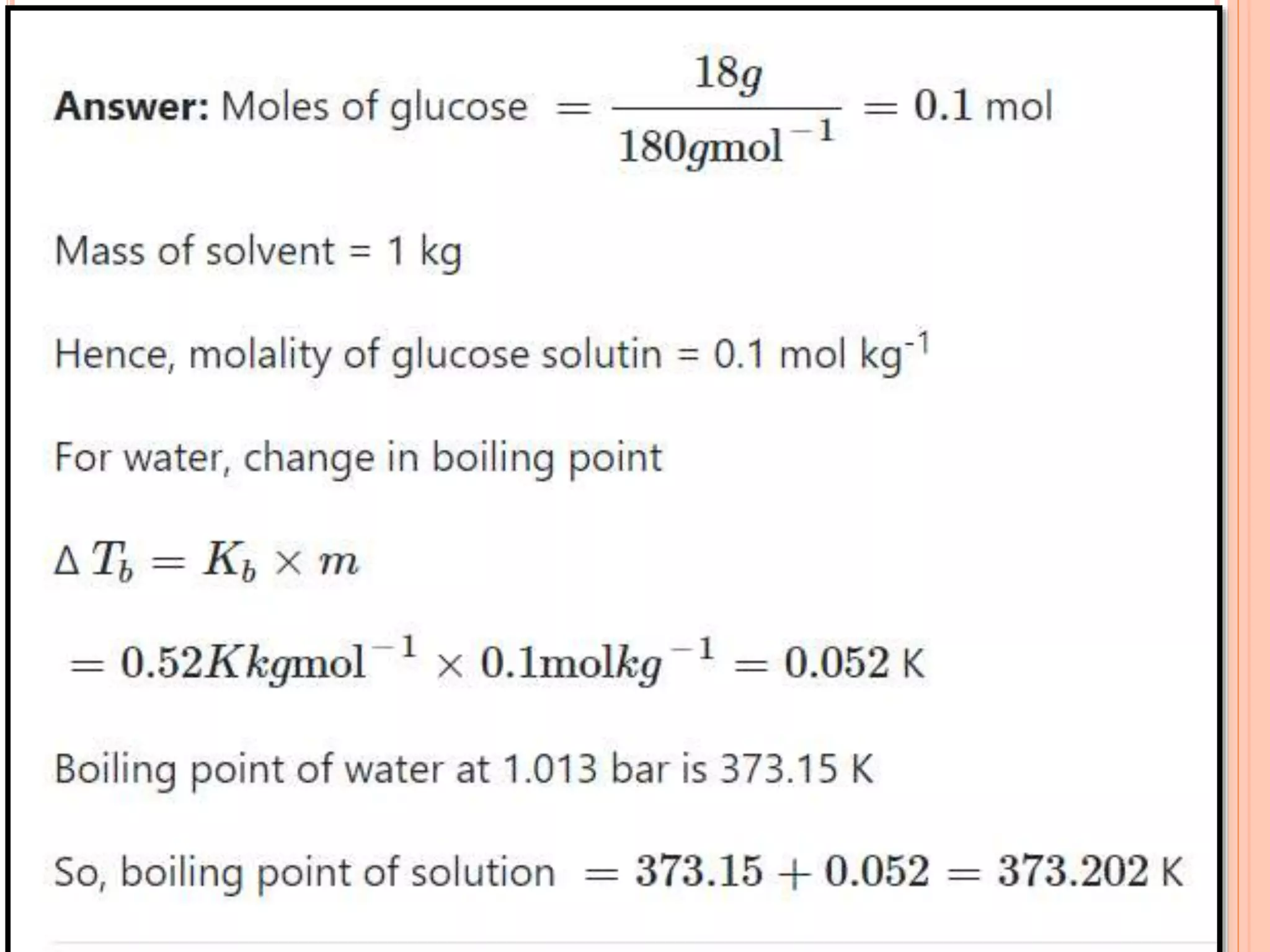
18 g of glucose C6H12O6 is dissolved in
1 kg of water in a saucepan. At what
temperature will water boil at 1.013
bar? Kb for water is 0.52 K kg mol-1.
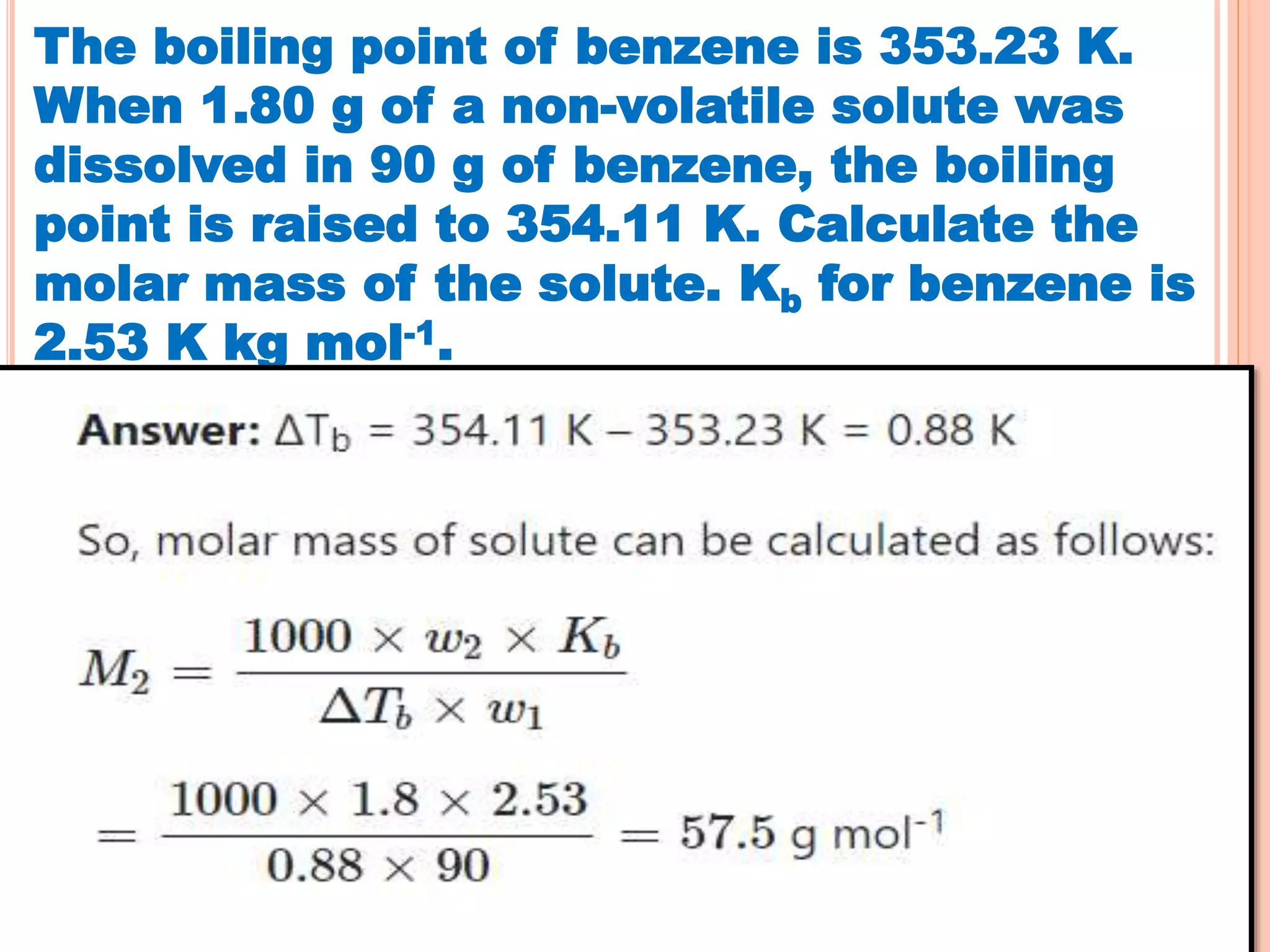
The boiling point of benzene is 353.23 K.
When 1.80 g of a non-volatile solute was
dissolved in 90 g of benzene, the boiling
point is raised to 354.11 K. Calculate the
molar mass of the solute. Kb for benzene is
2.53 K kg mol-1.
FREEZING POINT DEPRESSION
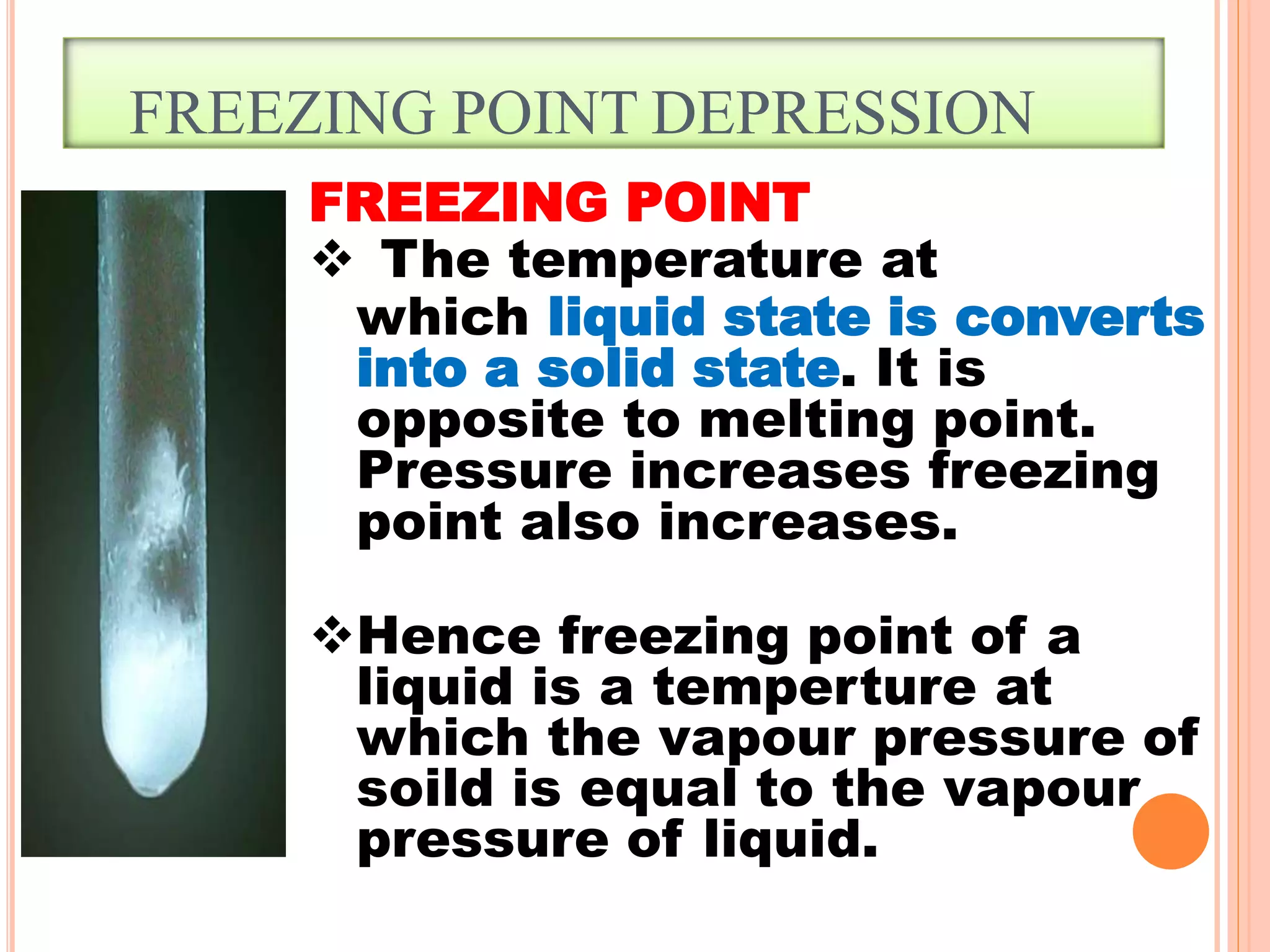
FREEZING POINT
 The temperature at
which liquid state is converts
into a solid state. It is
opposite to melting point.
Pressure increases freezing
point also increases.
Hence freezing point of a
liquid is a temperture at
which the vapour pressure of
soild is equal to the vapour
pressure of liquid.
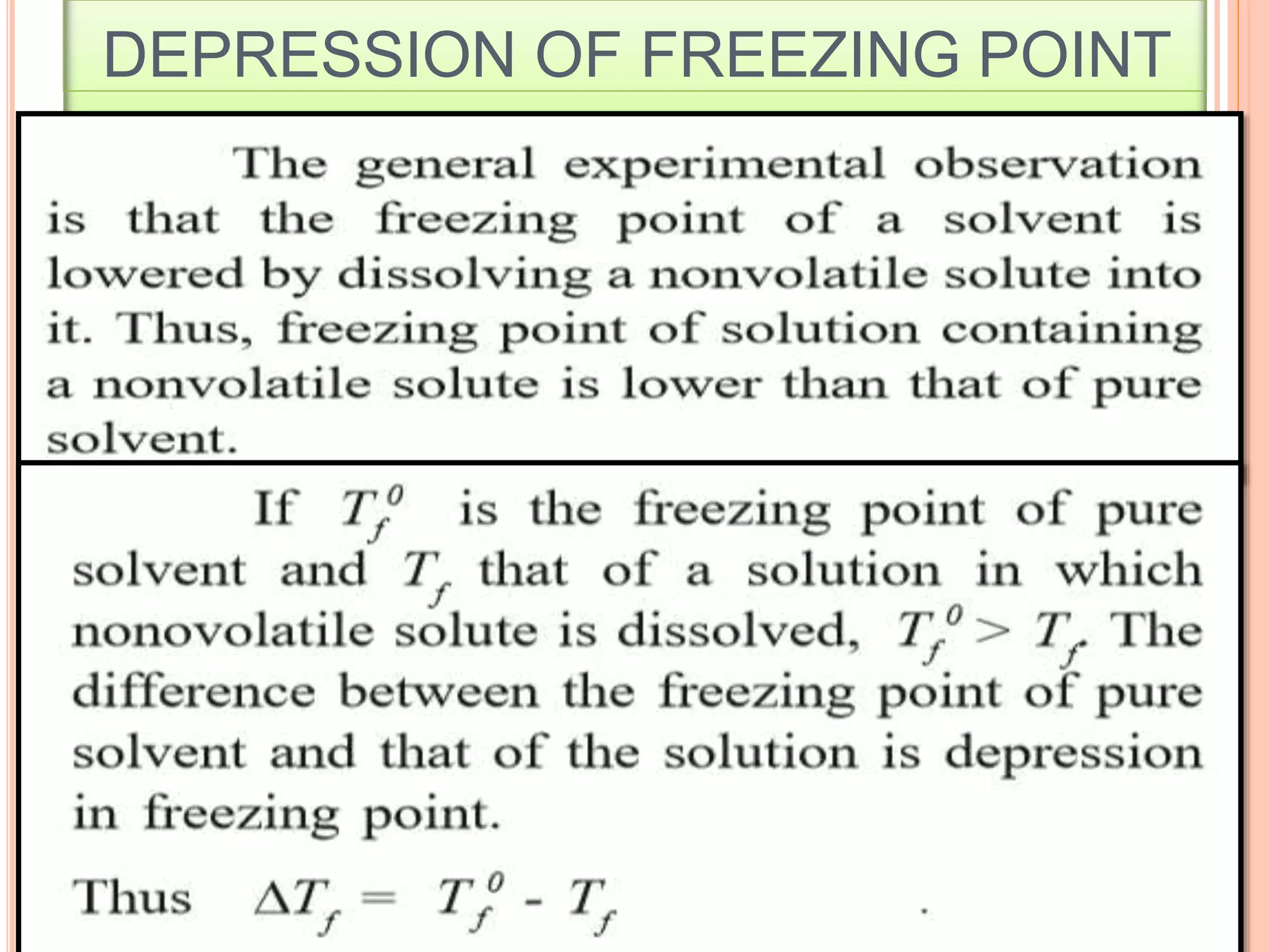
DEPRESSION OF FREEZING POINT
4
1
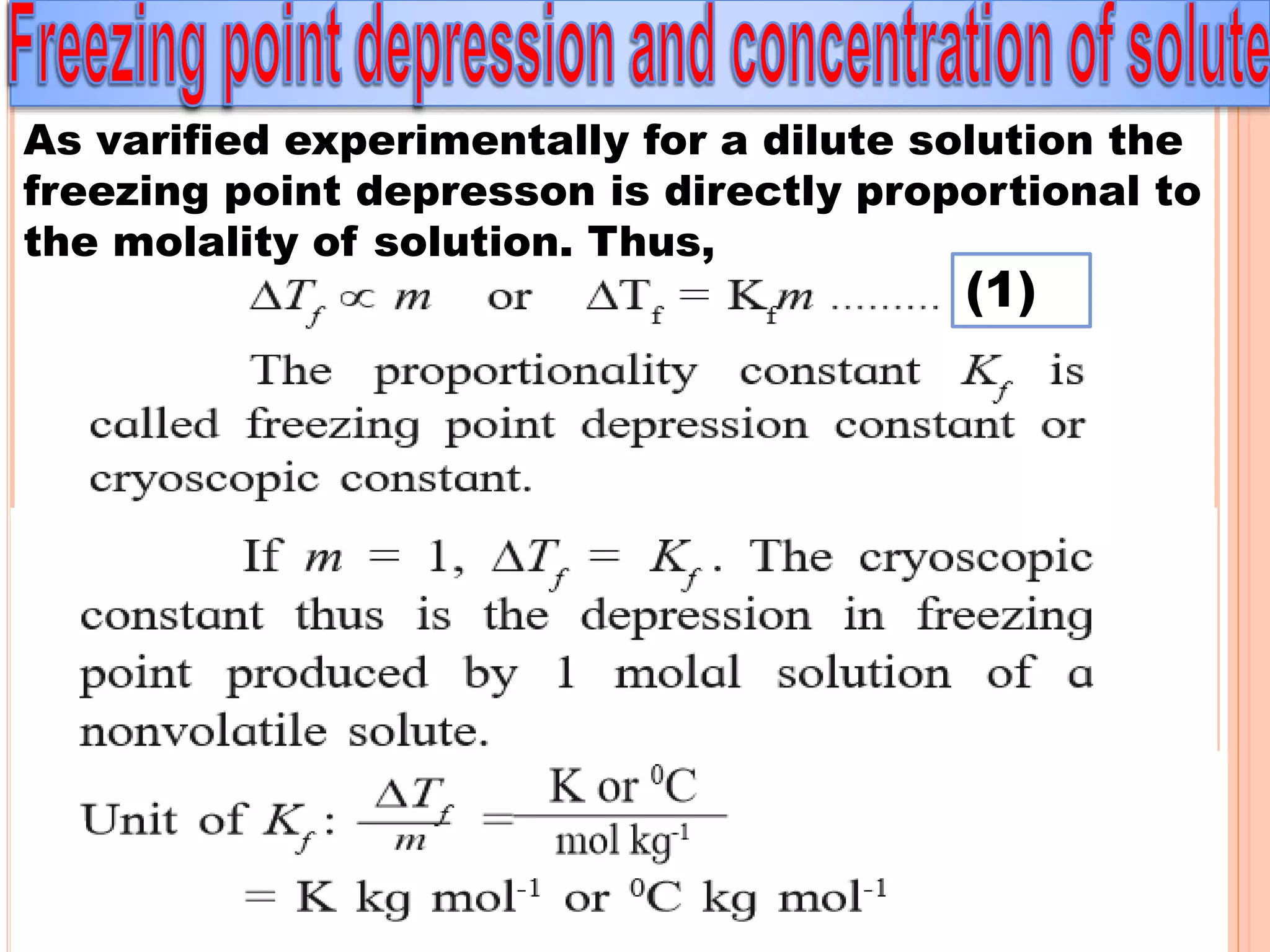
As varified experimentally for a dilute solution the
freezing point depresson is directly proportional to
the molality of solution. Thus,
(1)
(1)
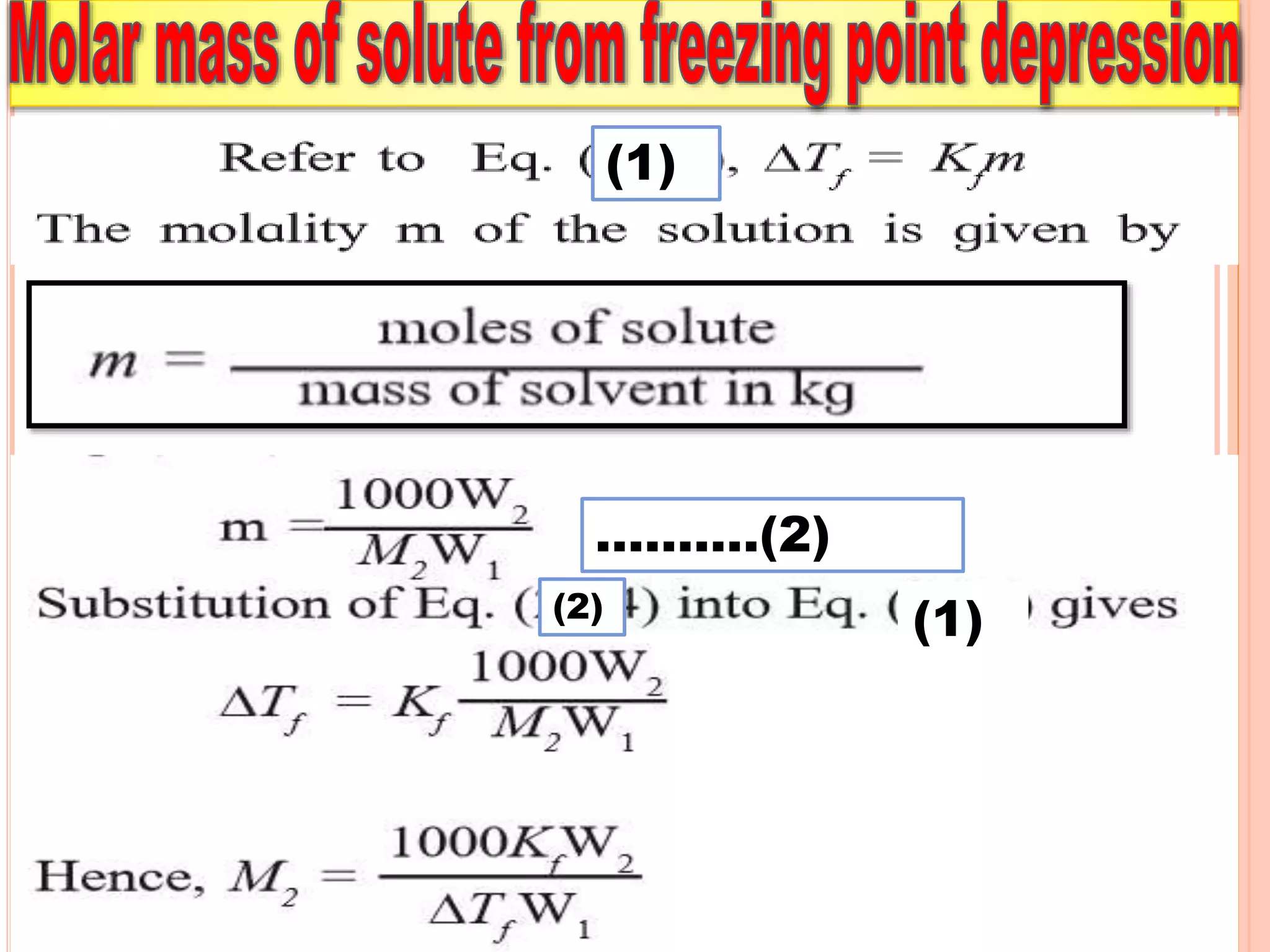
……….(2)
(2) (1)
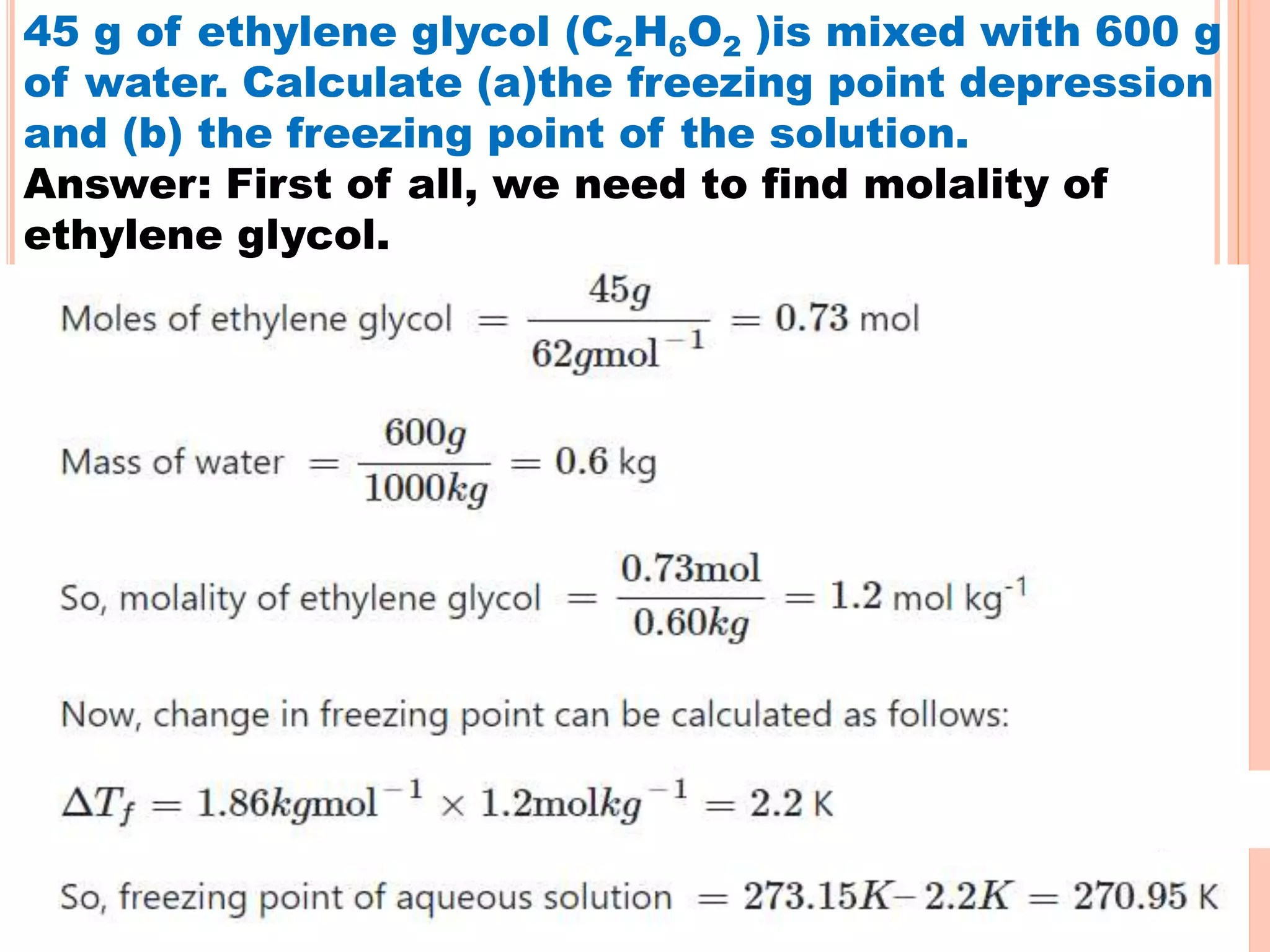
45 g of ethylene glycol (C2H6O2 )is mixed with 600 g
of water. Calculate (a)the freezing point depression
and (b) the freezing point of the solution.
Answer: First of all, we need to find molality of
ethylene glycol.
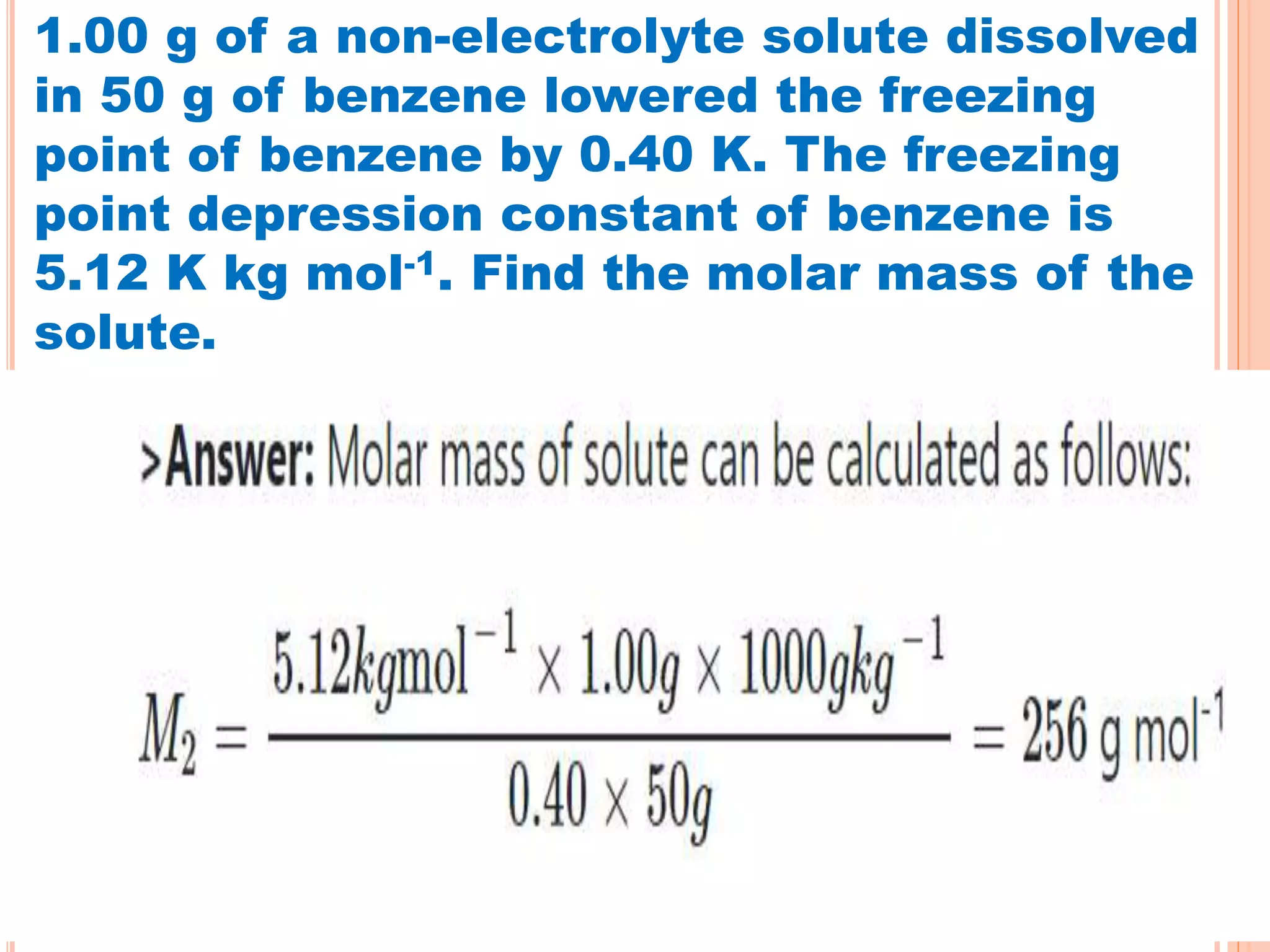
1.00 g of a non-electrolyte solute dissolved
in 50 g of benzene lowered the freezing
point of benzene by 0.40 K. The freezing
point depression constant of benzene is
5.12 K kg mol-1. Find the molar mass of the
solute.
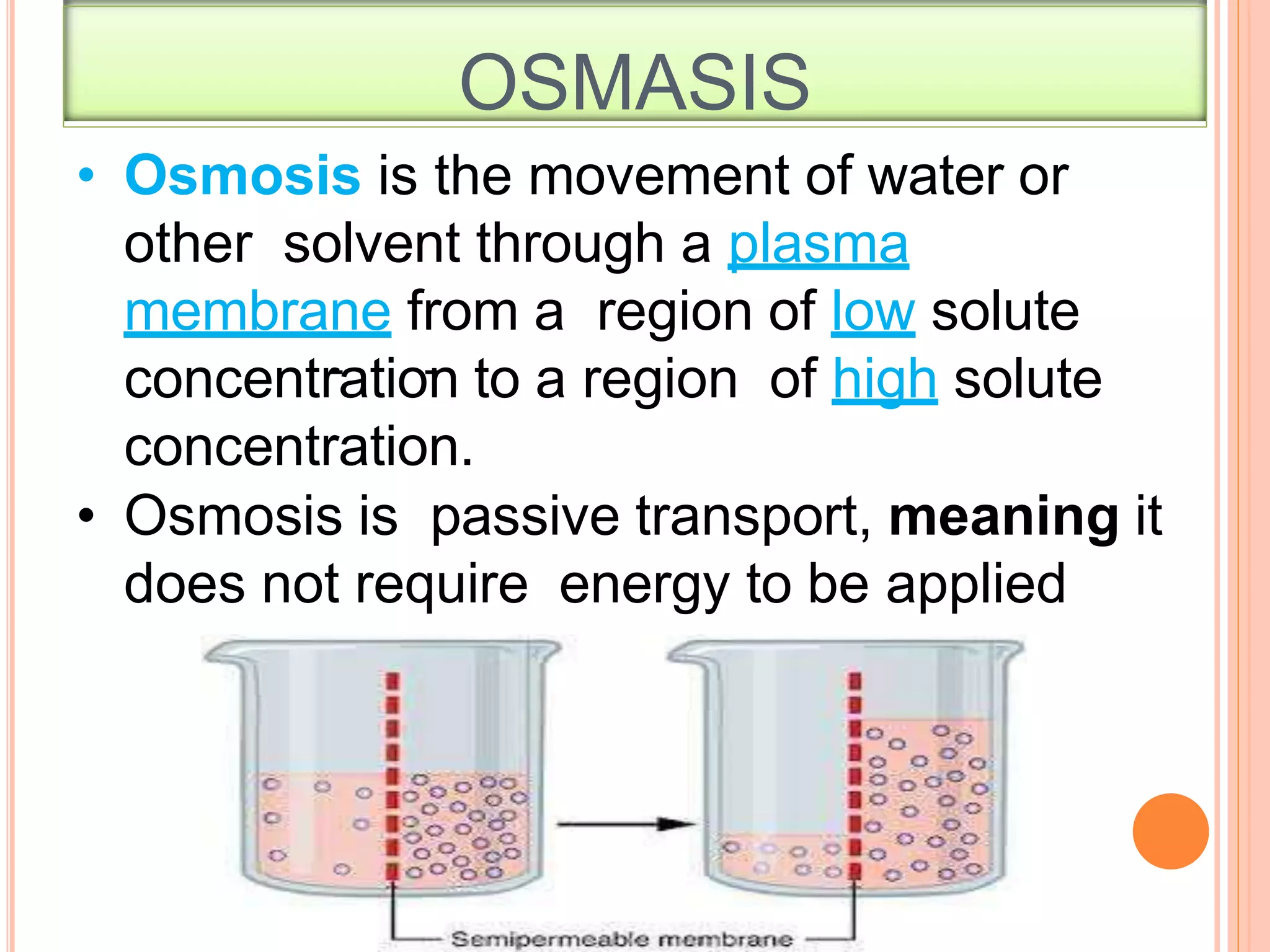
OSMASIS
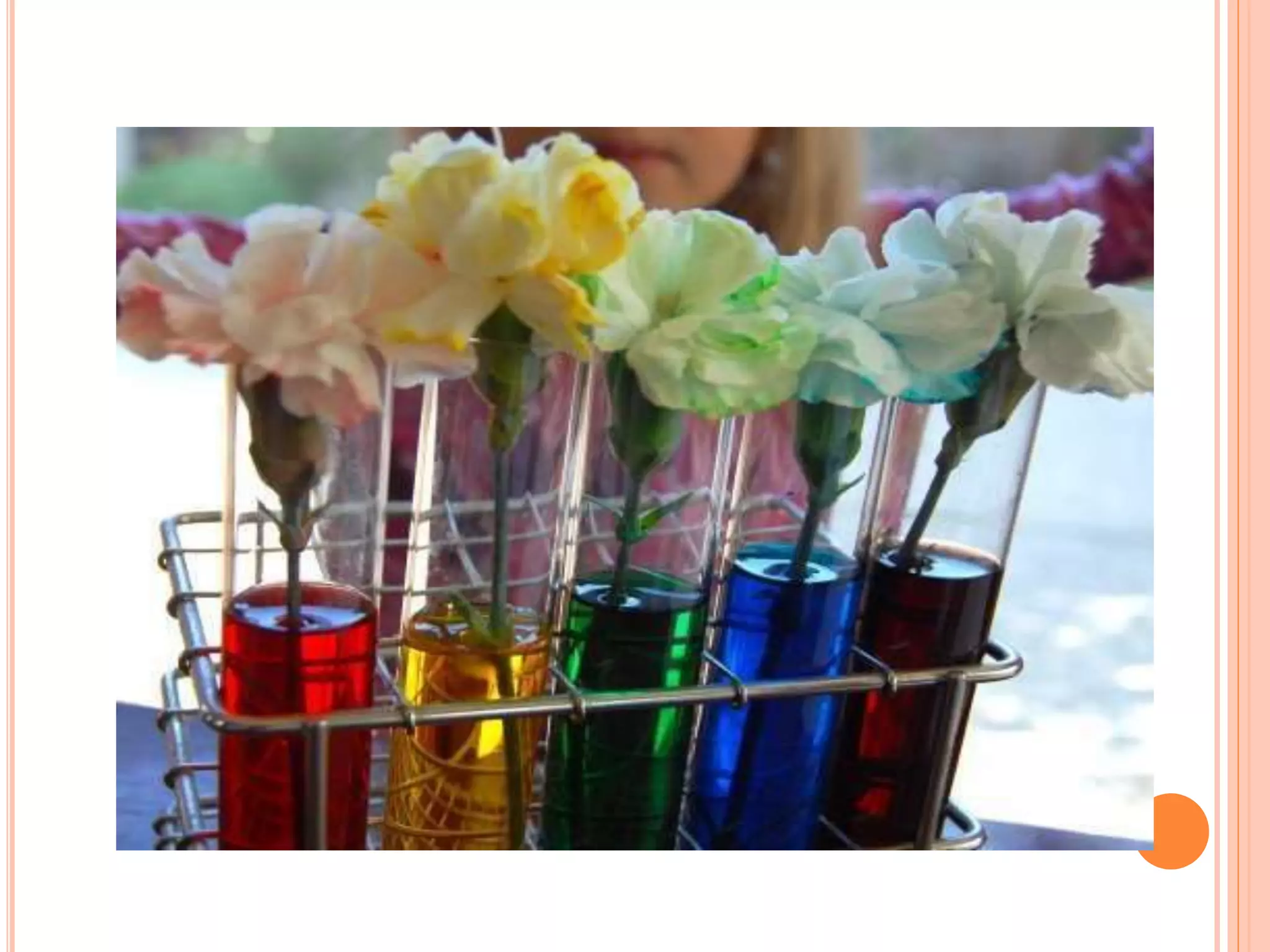
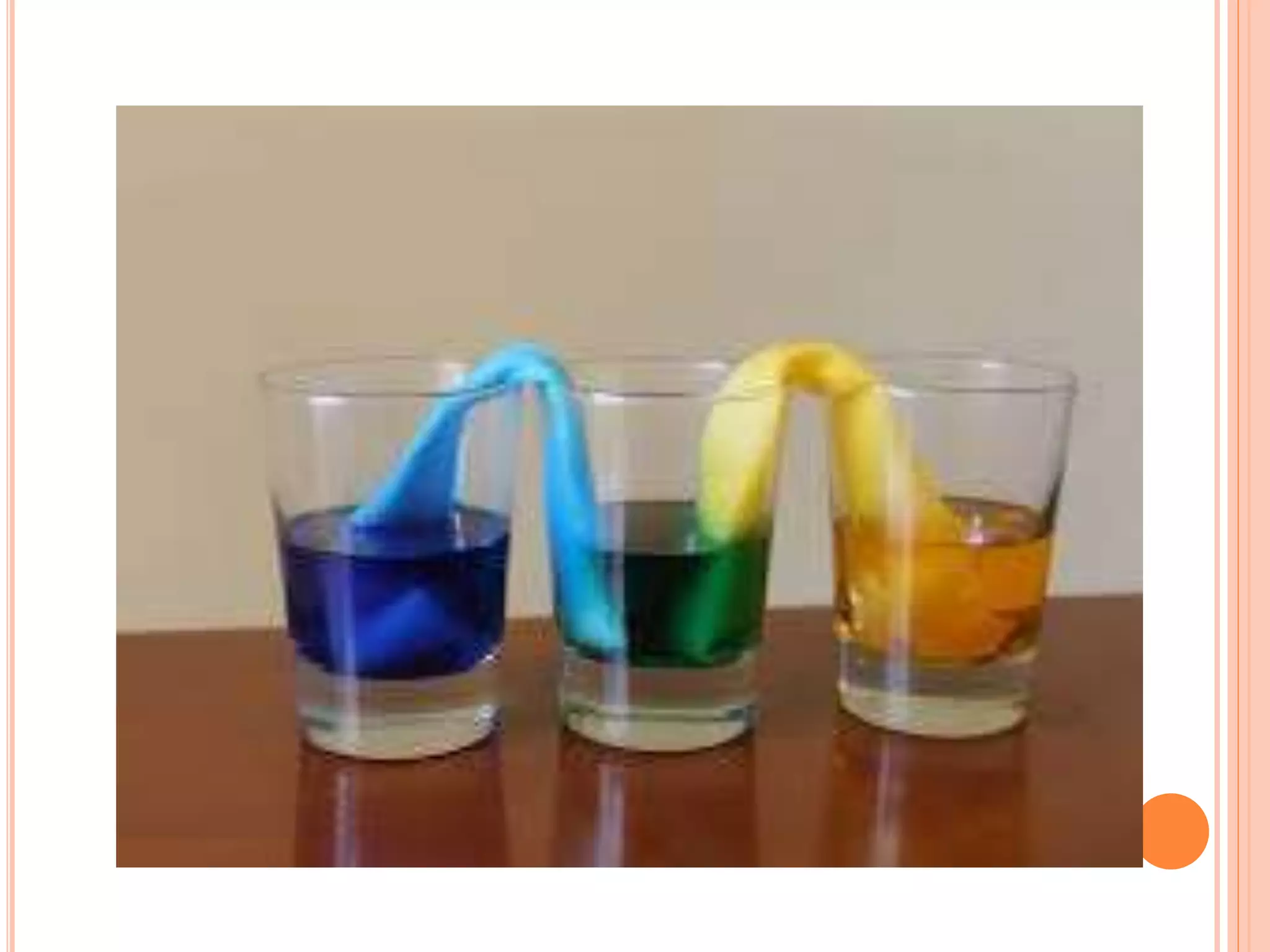
• Osmosis is the movement of water or
other solvent through a plasma
membrane from a region of low solute
concentration to a region of high solute
concentration.
• Osmosis is passive transport, meaning it
does not require energy to be applied
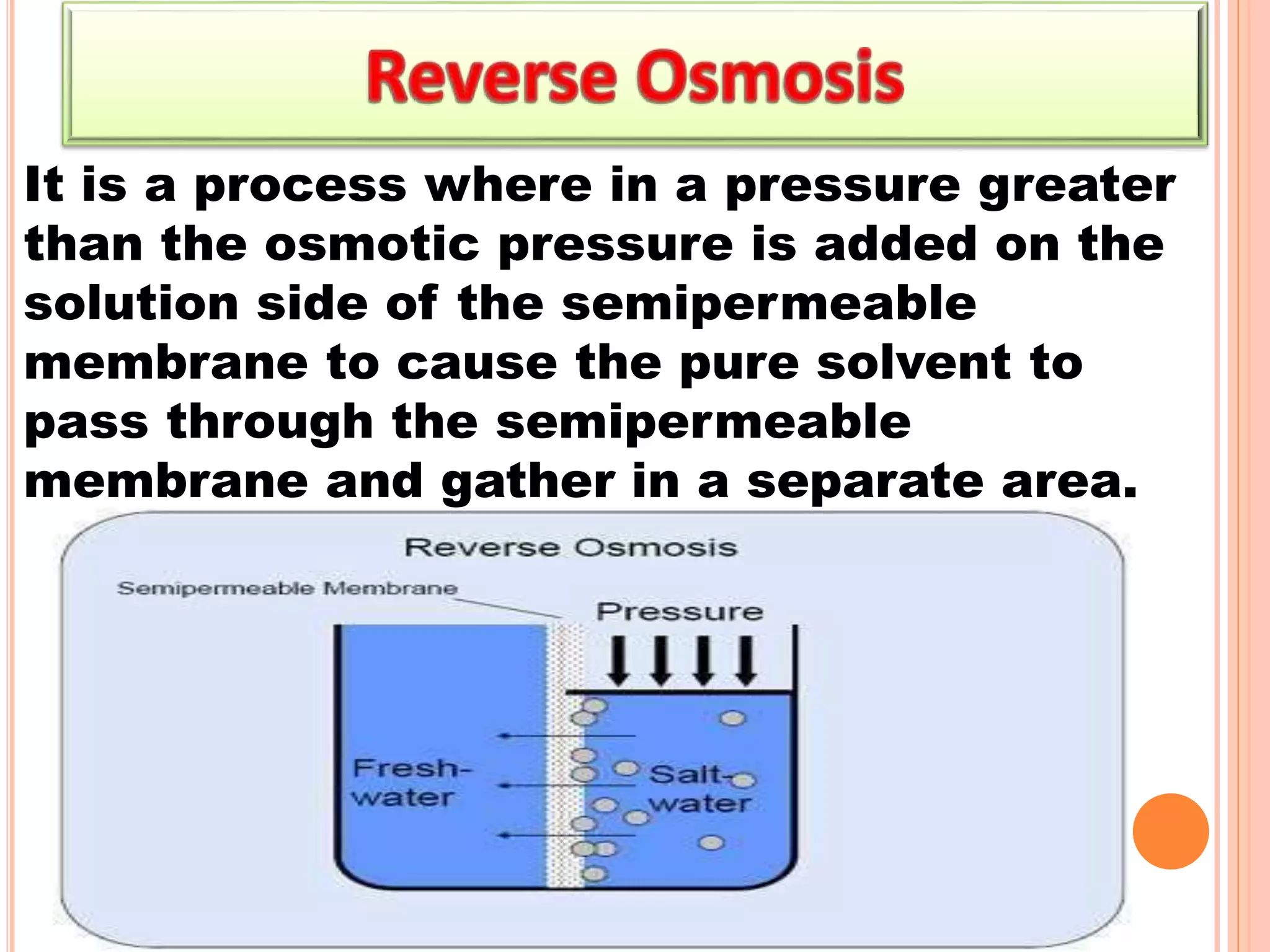
It is a process where in a pressure greater
than the osmotic pressure is added on the
solution side of the semipermeable
membrane to cause the pure solvent to
pass through the semipermeable
membrane and gather in a separate area.
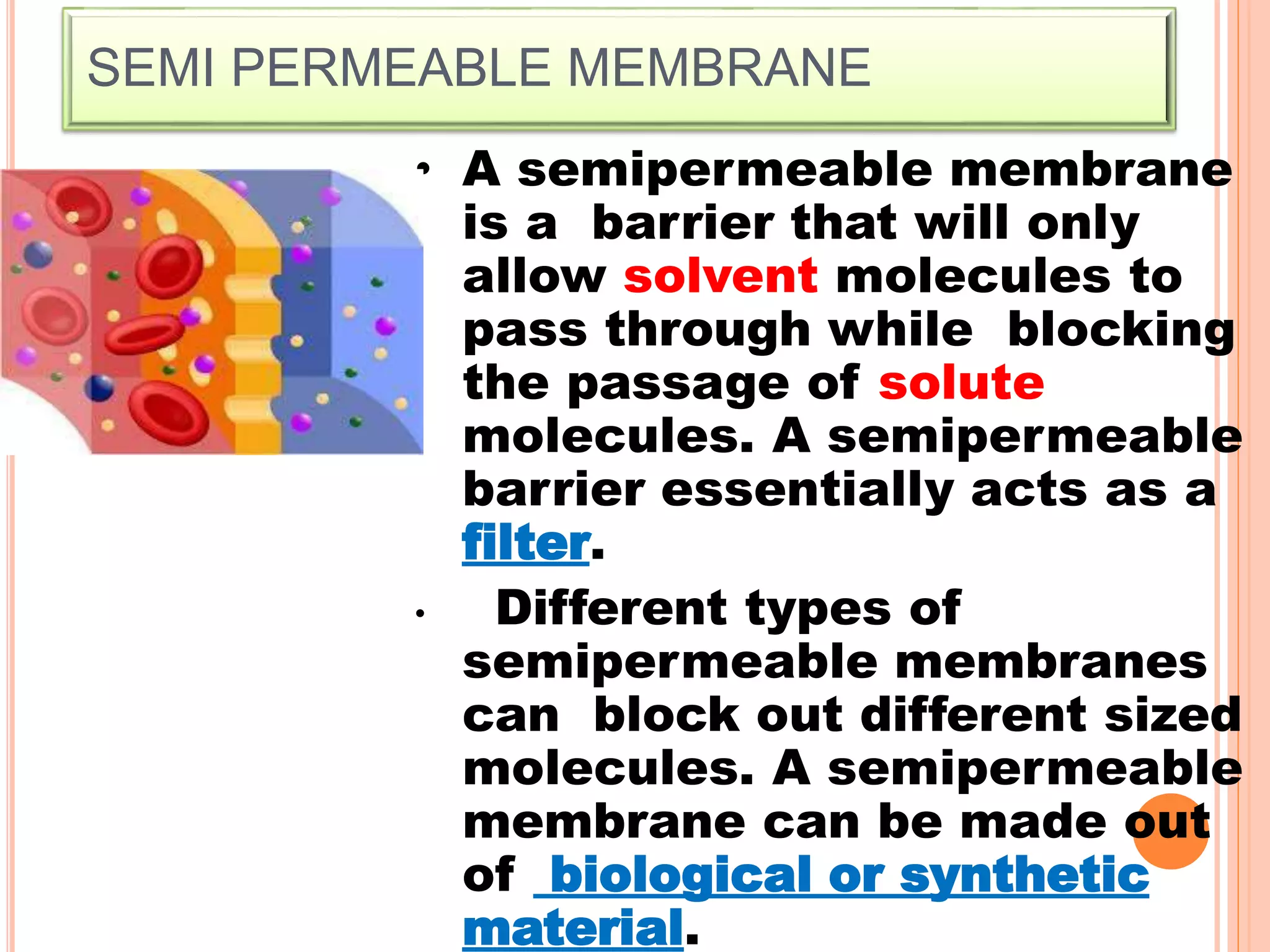
SEMI PERMEABLE MEMBRANE
• A semipermeable membrane
is a barrier that will only
allow solvent molecules to
pass through while blocking
the passage of solute
molecules. A semipermeable
barrier essentially acts as a
filter.
• Different types of
semipermeable membranes
can block out different sized
molecules. A semipermeable
membrane can be made out
of biological or synthetic
material.
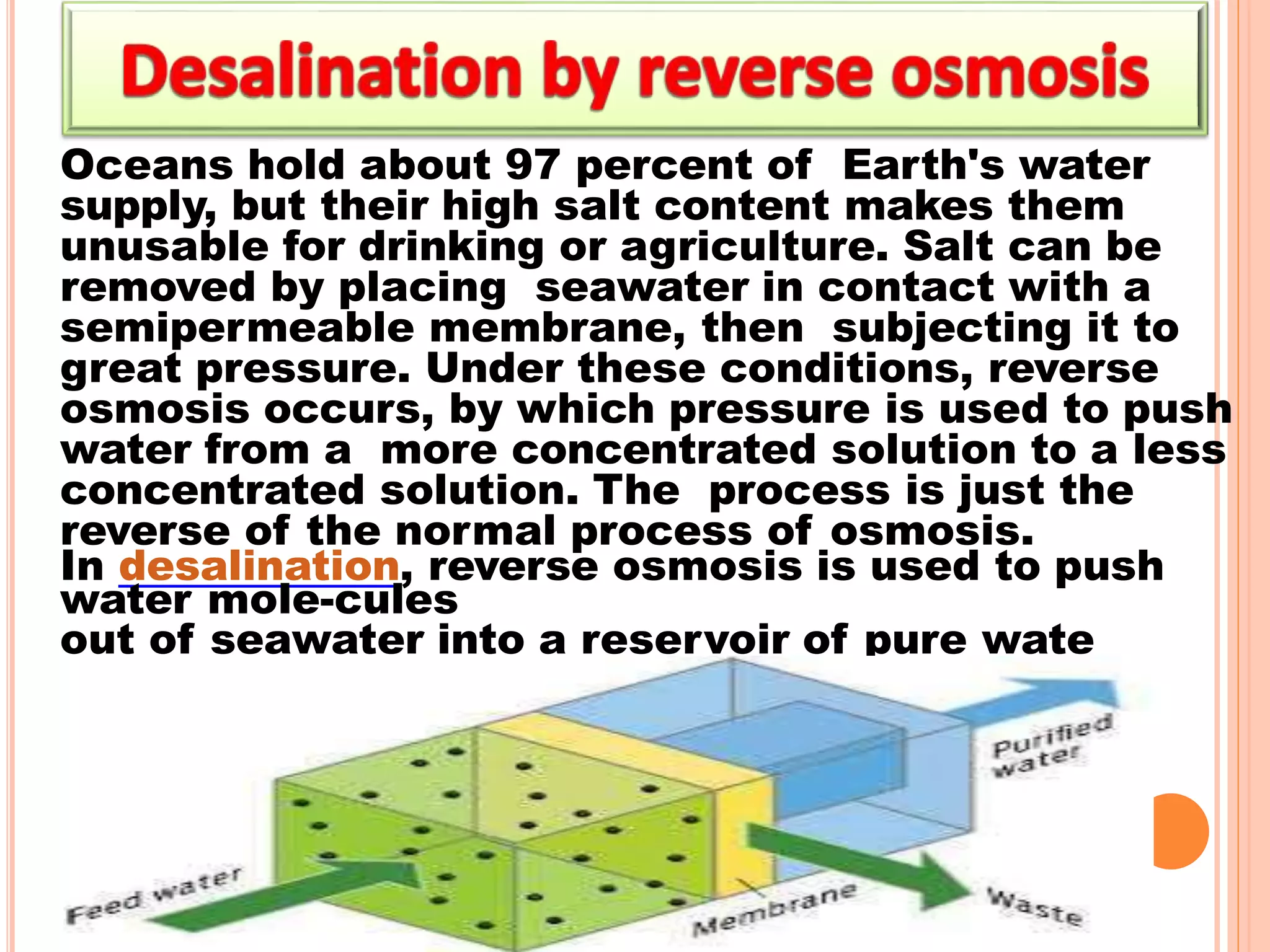
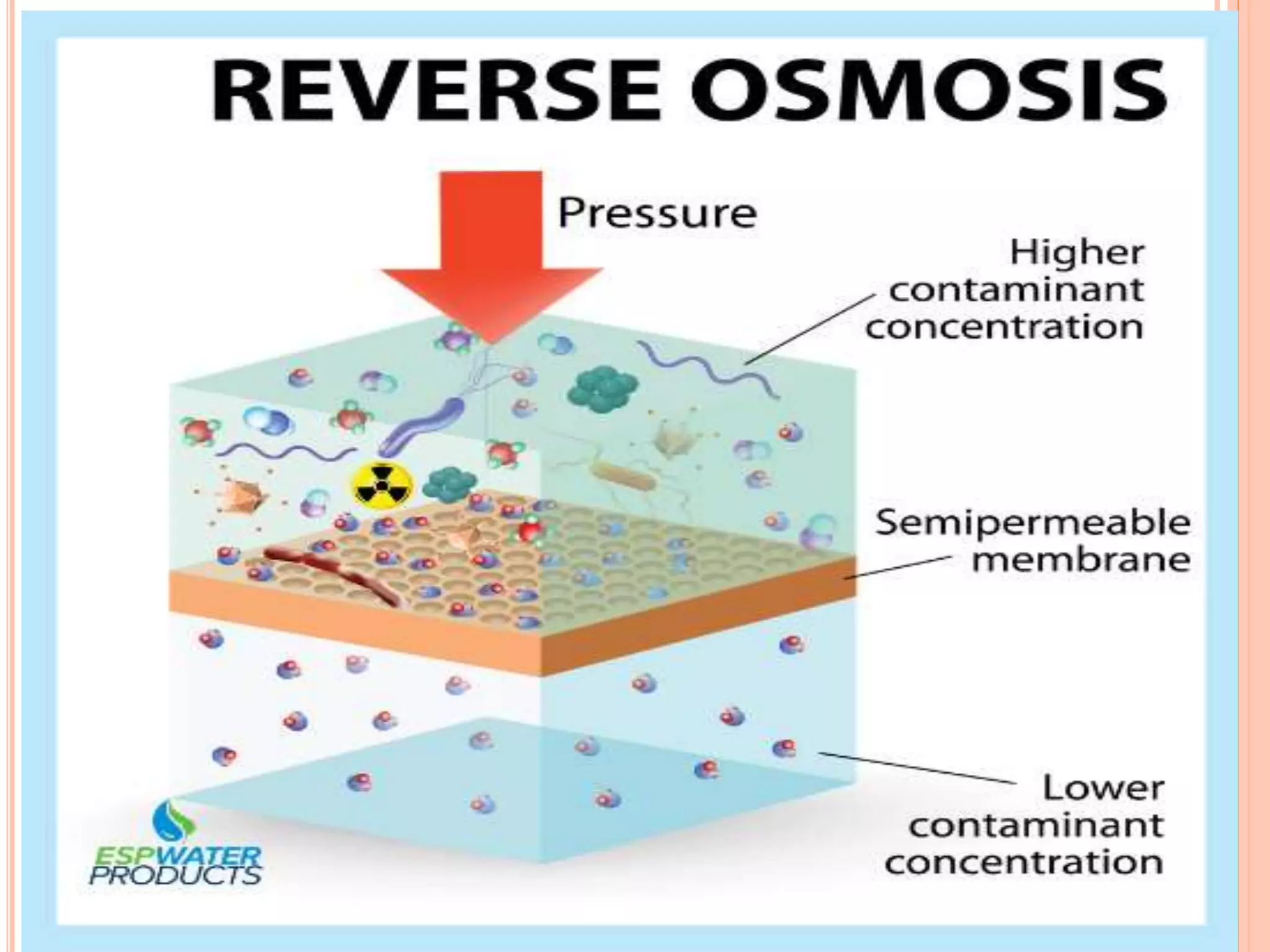
Oceans hold about 97 percent of Earth's water
supply, but their high salt content makes them
unusable for drinking or agriculture. Salt can be
removed by placing seawater in contact with a
semipermeable membrane, then subjecting it to
great pressure. Under these conditions, reverse
osmosis occurs, by which pressure is used to push
water from a more concentrated solution to a less
concentrated solution. The process is just the
reverse of the normal process of osmosis.
In desalination, reverse osmosis is used to push
water mole-cules
out of seawater into a reservoir of pure wate
4
9
5
0
3
2
3
3
5
3
The excess of pressure on the side of solution that
stop the net flow of solvent into the solution
through semi-permeable membrane is called
osmotic pressure.
The flow of solvent from solvent side to solution
side (across a semi-permeable membrane) can be
stopped by applying some extra pressure. The
pressure which is just enough to stop osmosis is
called osmotic pressure of the solution.
LAW OF OSMOTIC PRESSURE
Boyle-van’t Hoff Law
Vant Hoff Charles Law
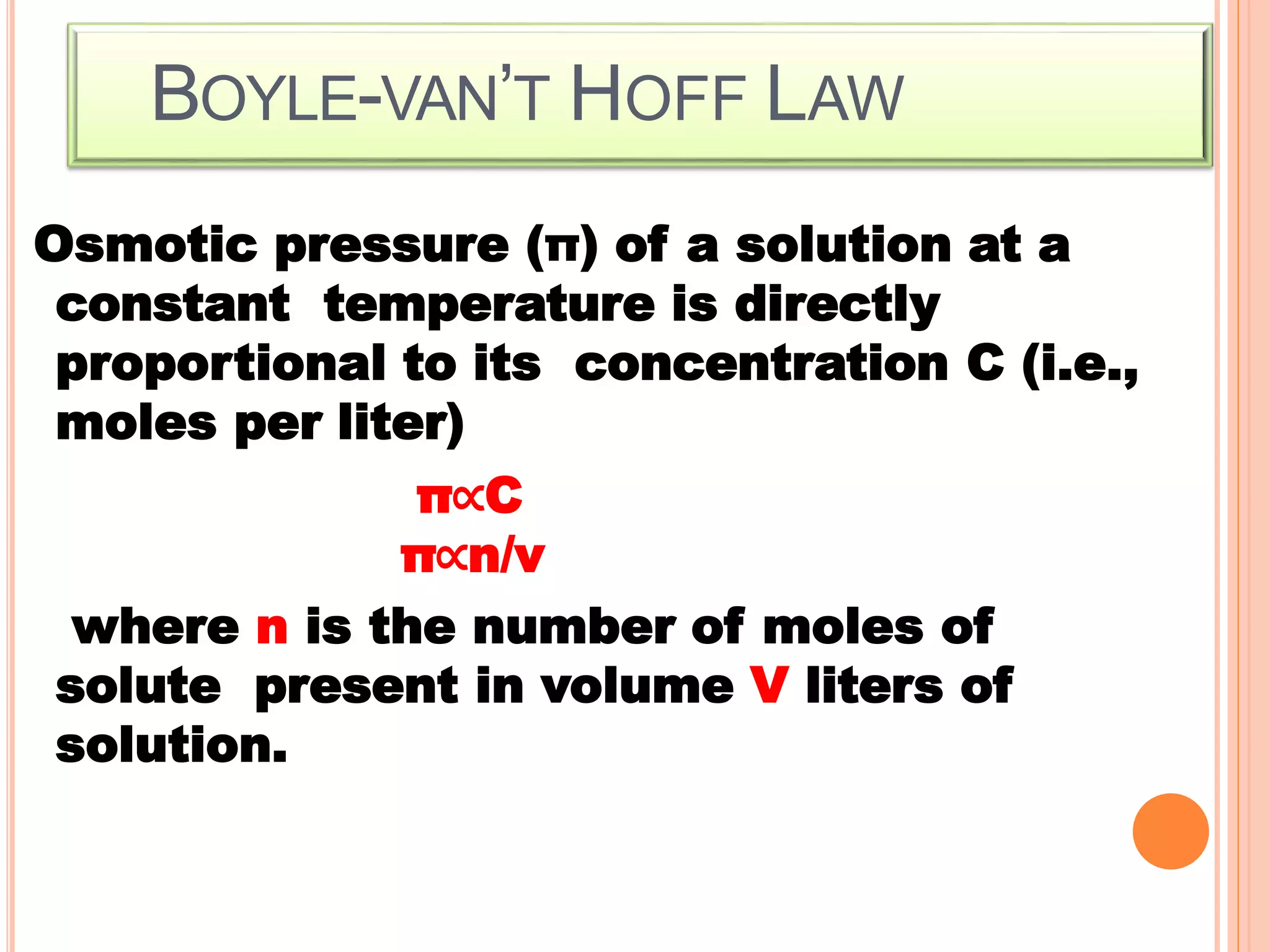
BOYLE-VAN’T HOFF LAW
Osmotic pressure (π) of a solution at a
constant temperature is directly
proportional to its concentration C (i.e.,
moles per liter)
π∝C
π∝n/v
where n is the number of moles of
solute present in volume V liters of
solution.
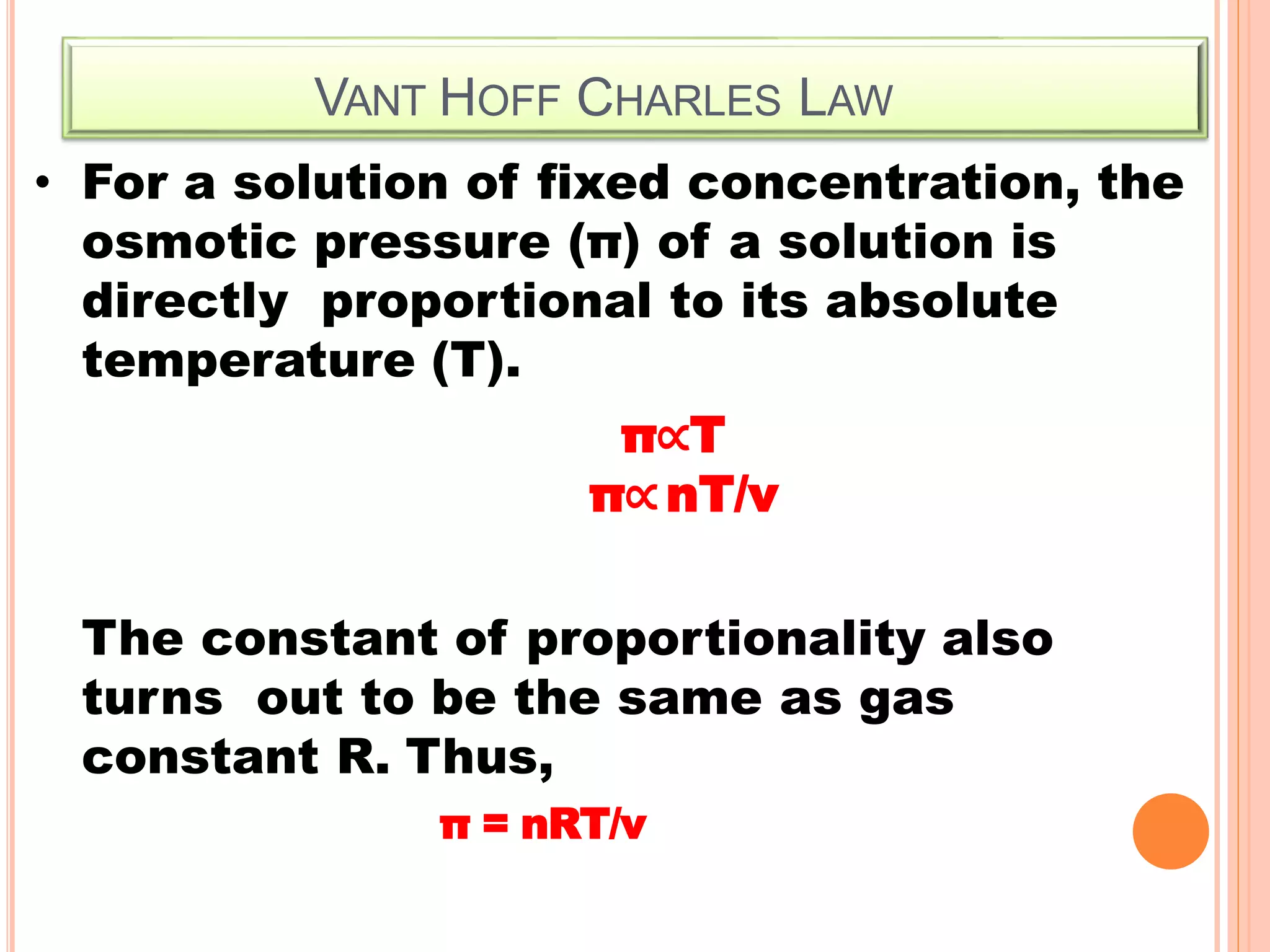
VANT HOFF CHARLES LAW
• For a solution of fixed concentration, the
osmotic pressure (π) of a solution is
directly proportional to its absolute
temperature (T).
π∝T
π∝nT/v
The constant of proportionality also
turns out to be the same as gas
constant R. Thus,
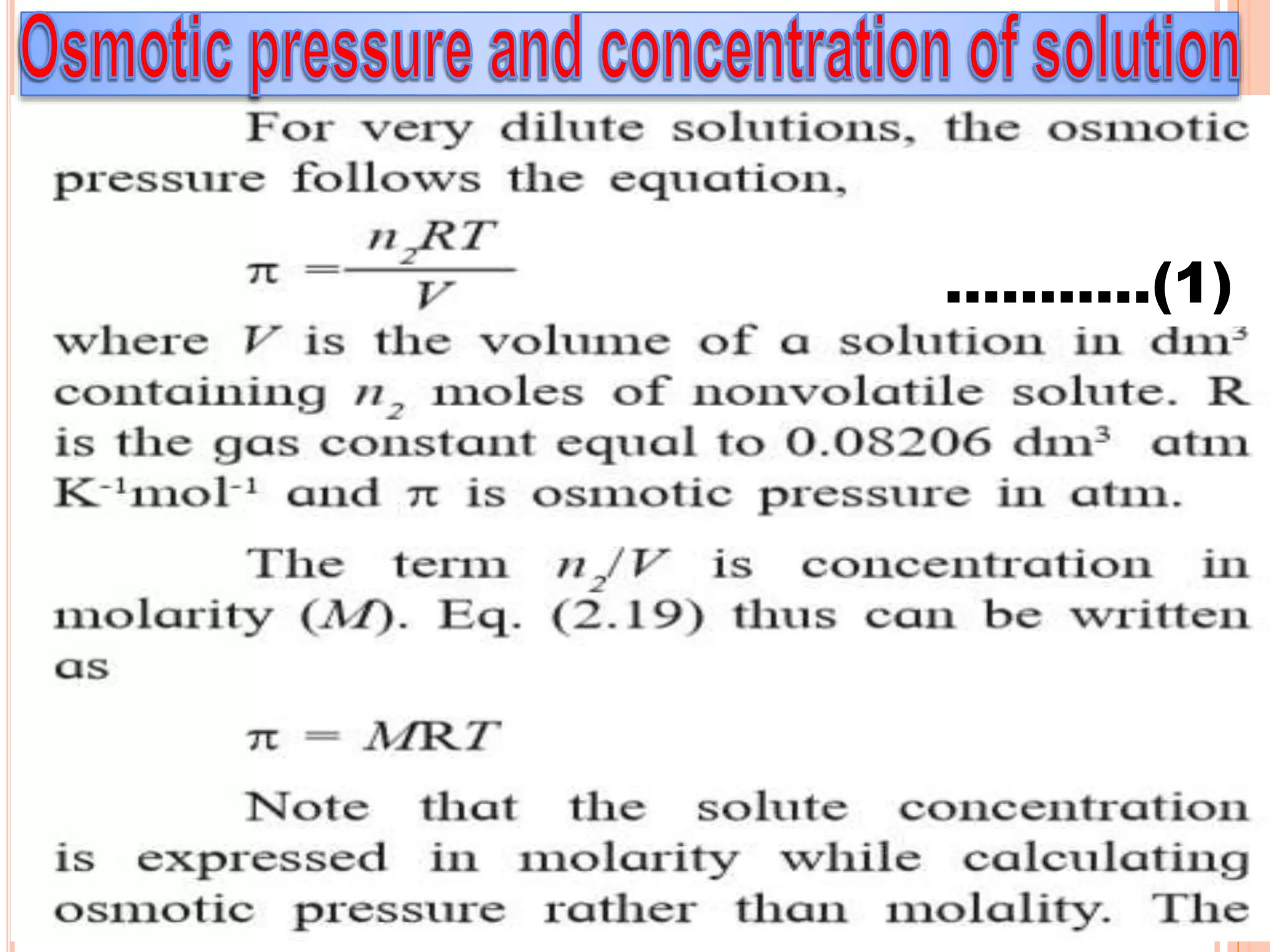
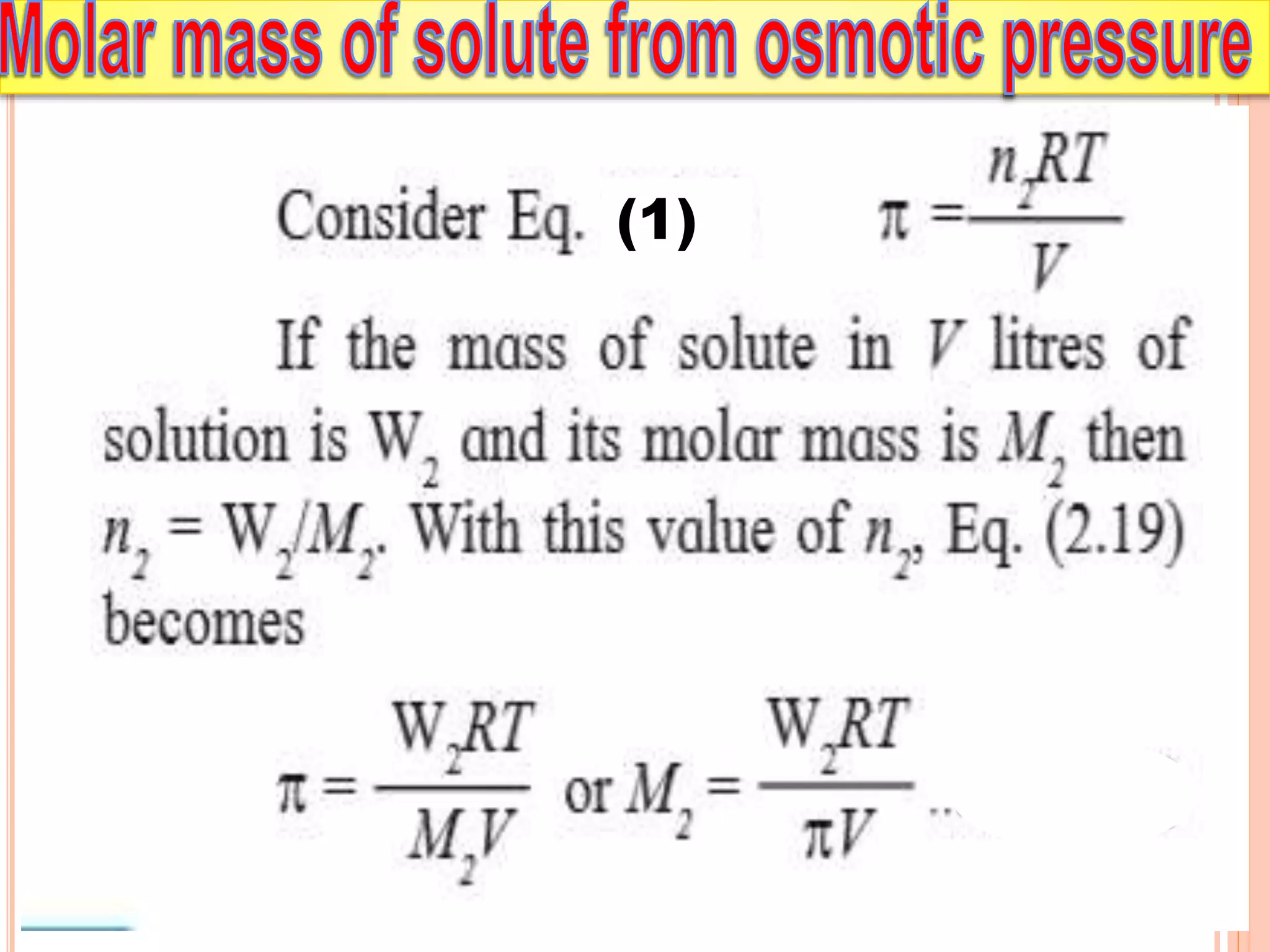
π = nRT/v
………..(1)
(1)
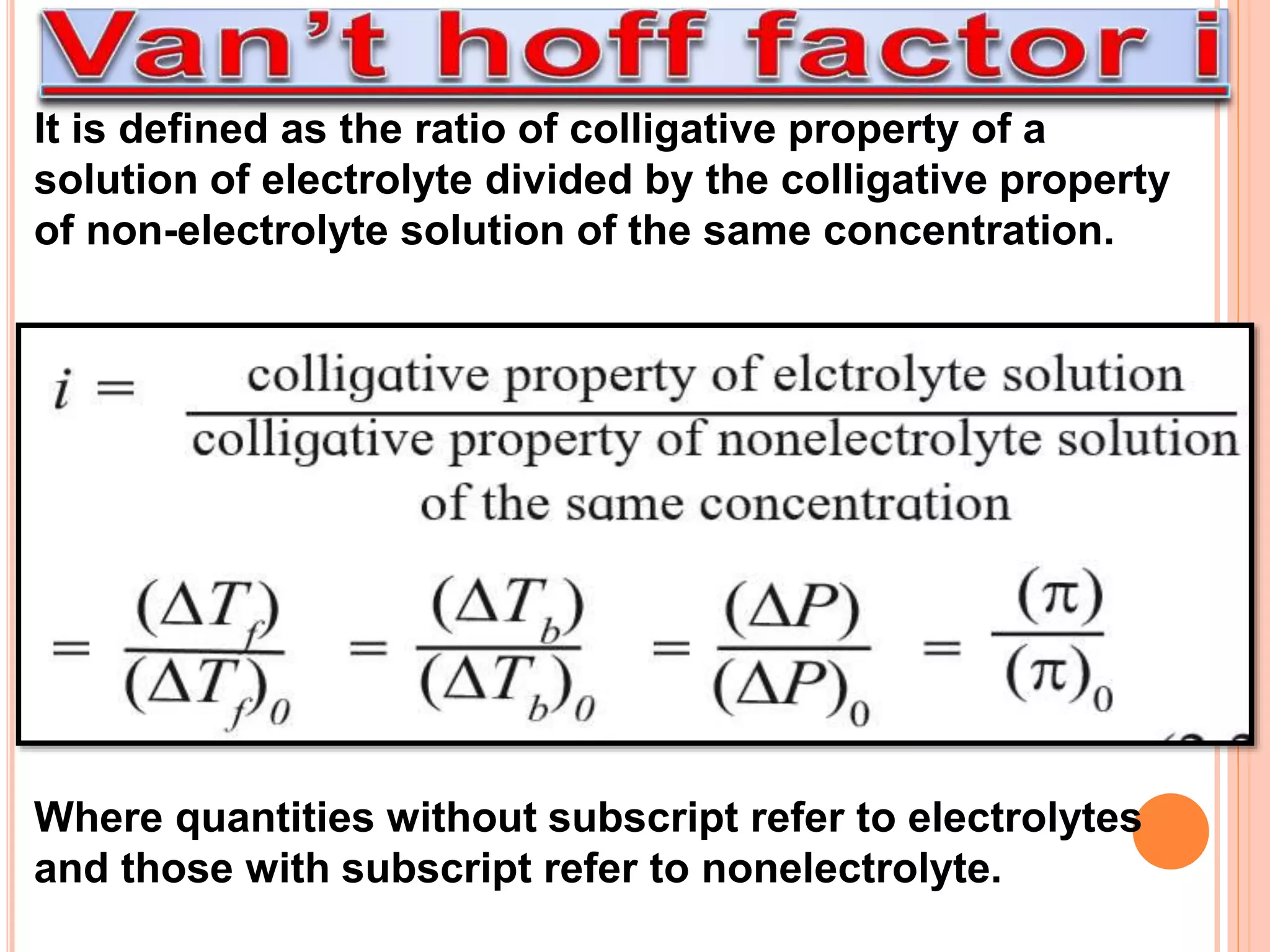
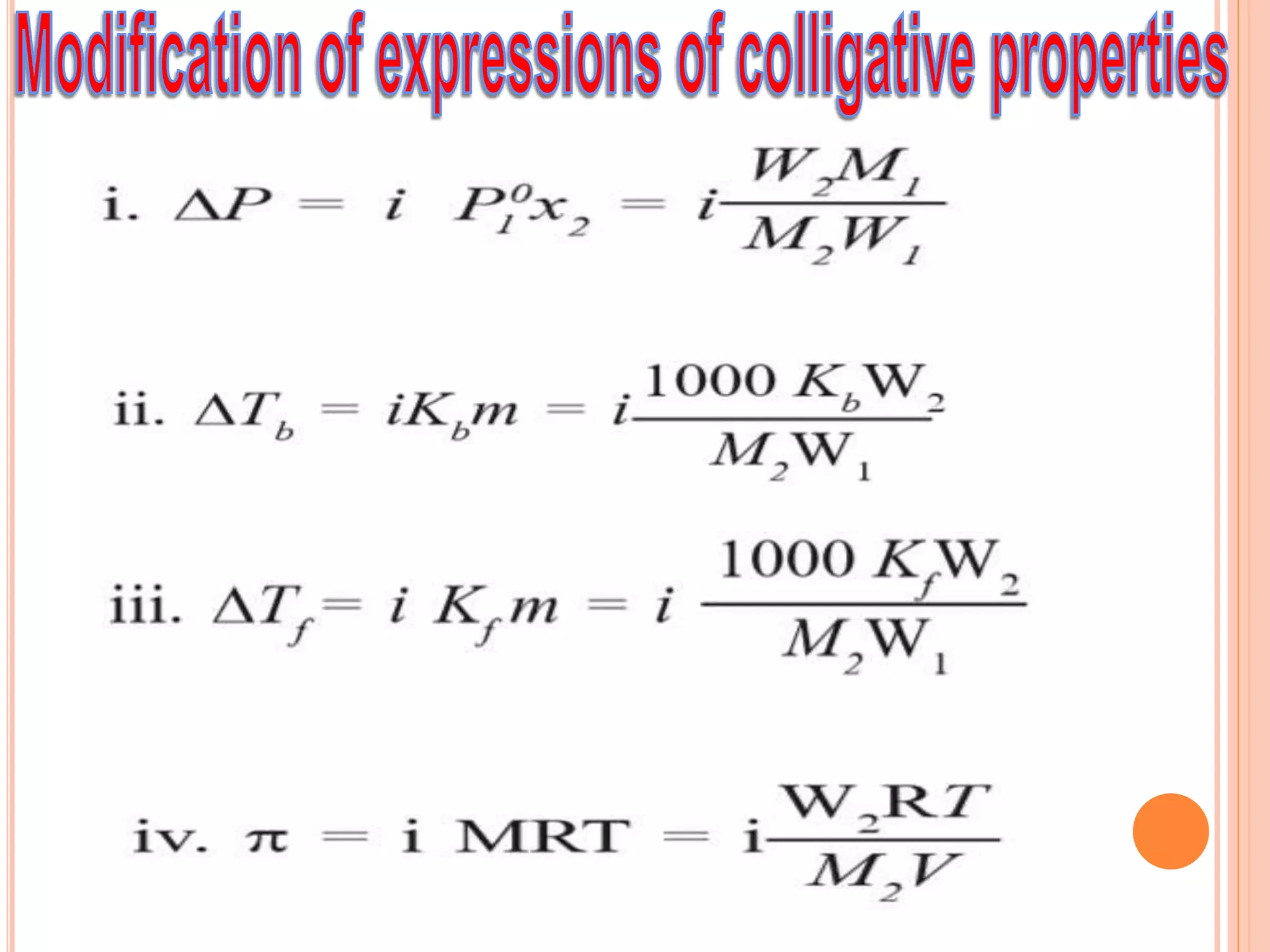
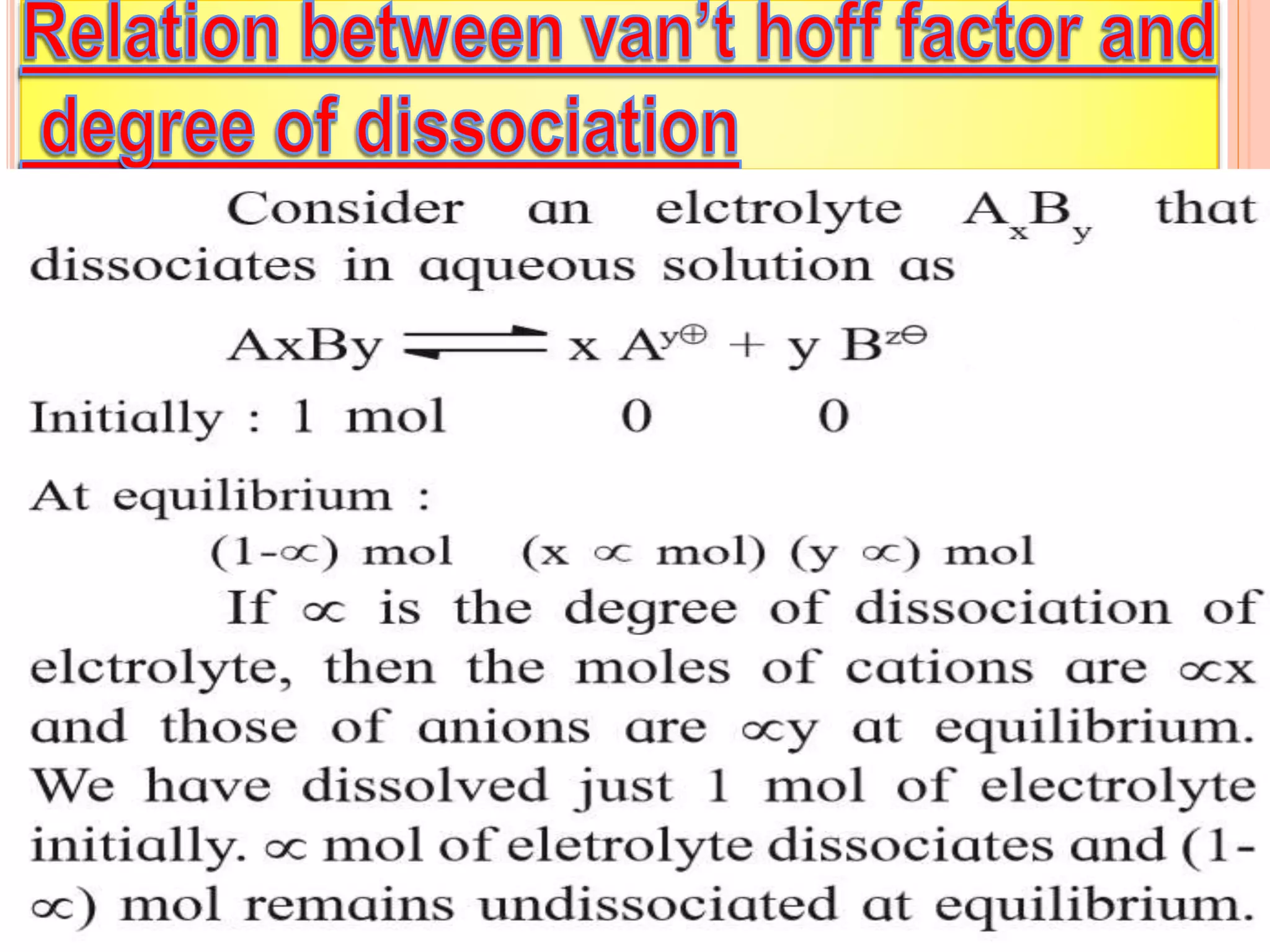
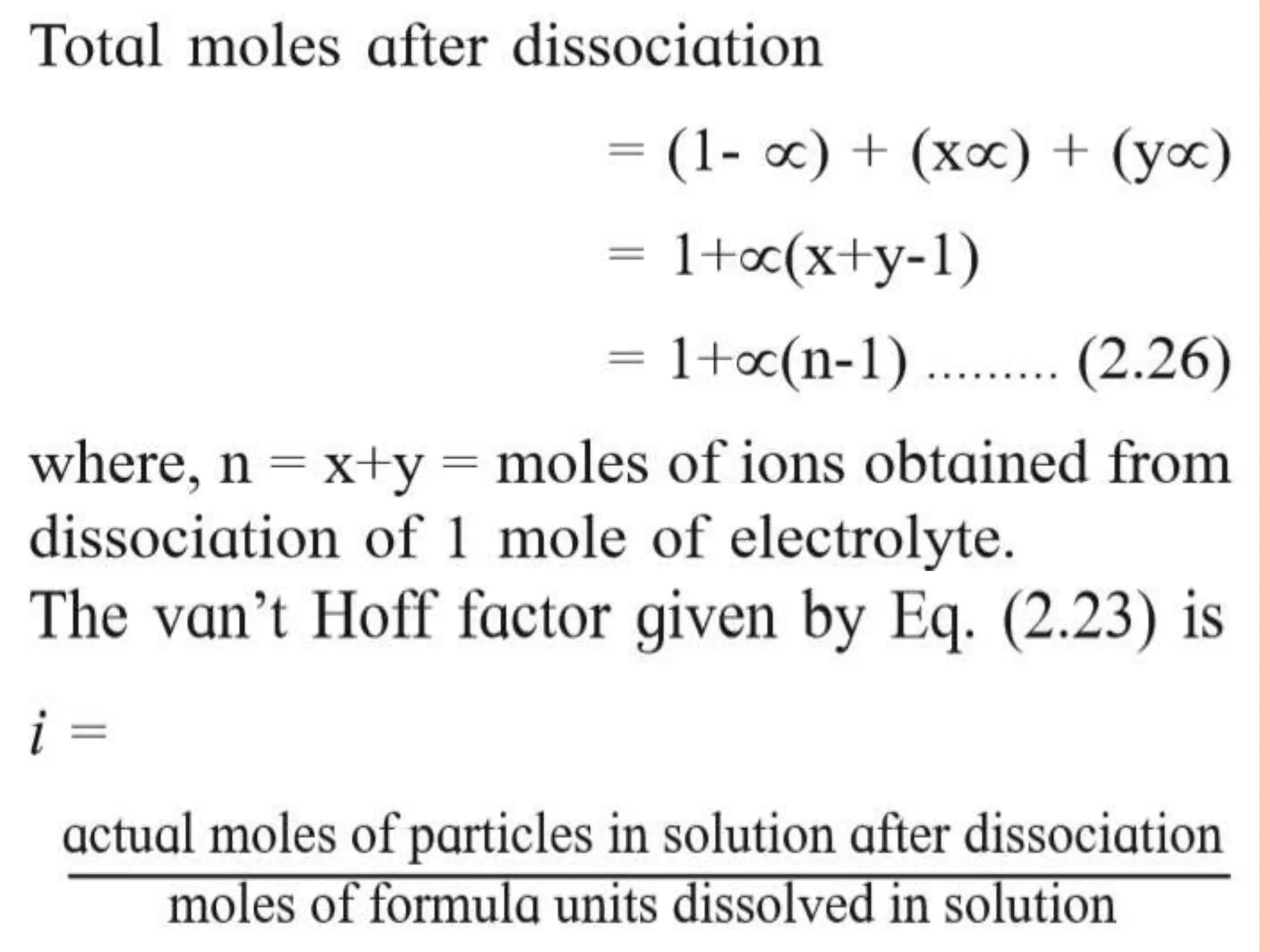
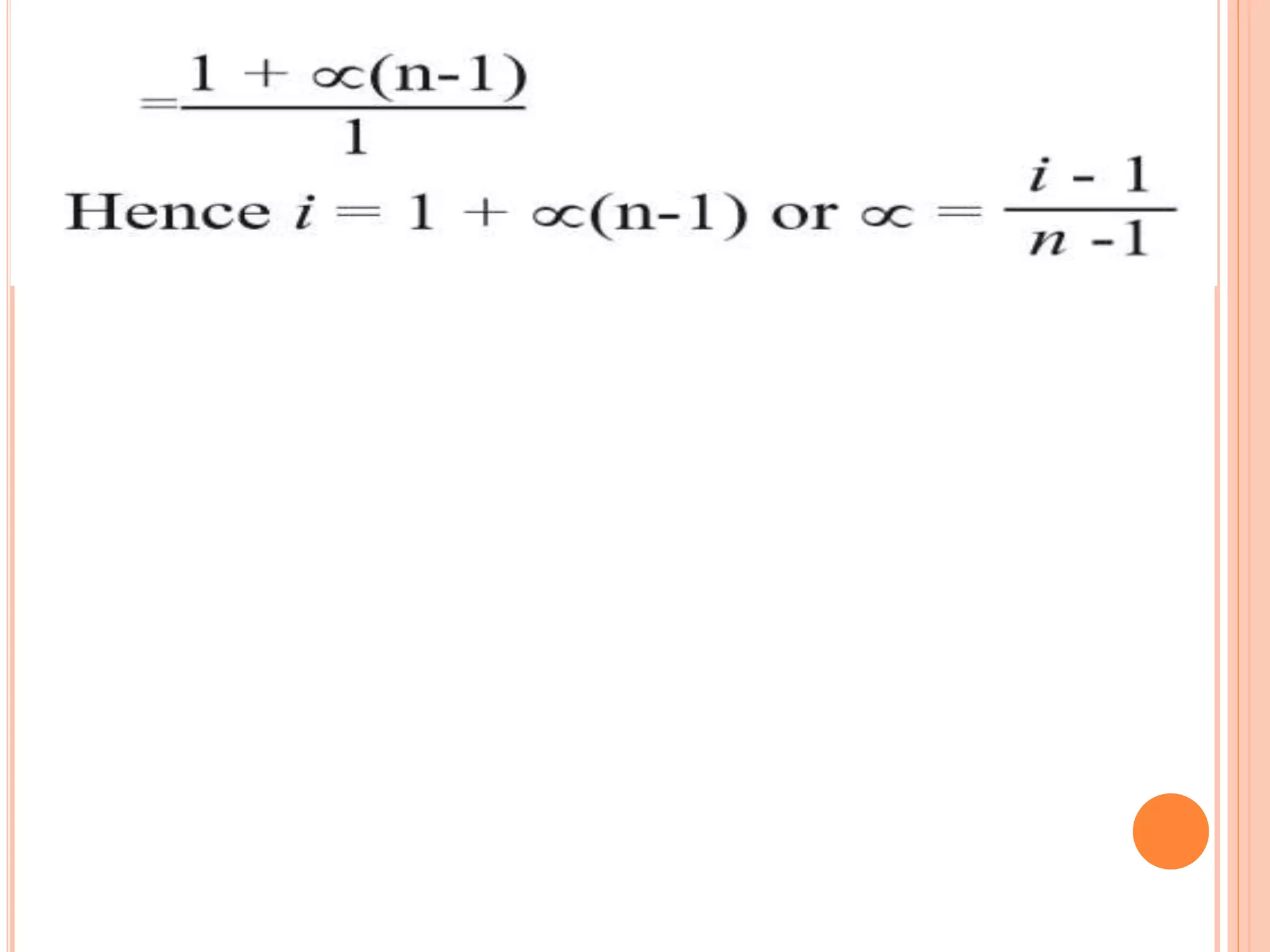
It is defined as the ratio of colligative property of a
solution of electrolyte divided by the colligative property
of non-electrolyte solution of the same concentration.
Where quantities without subscript refer to electrolytes
and those with subscript refer to nonelectrolyte.
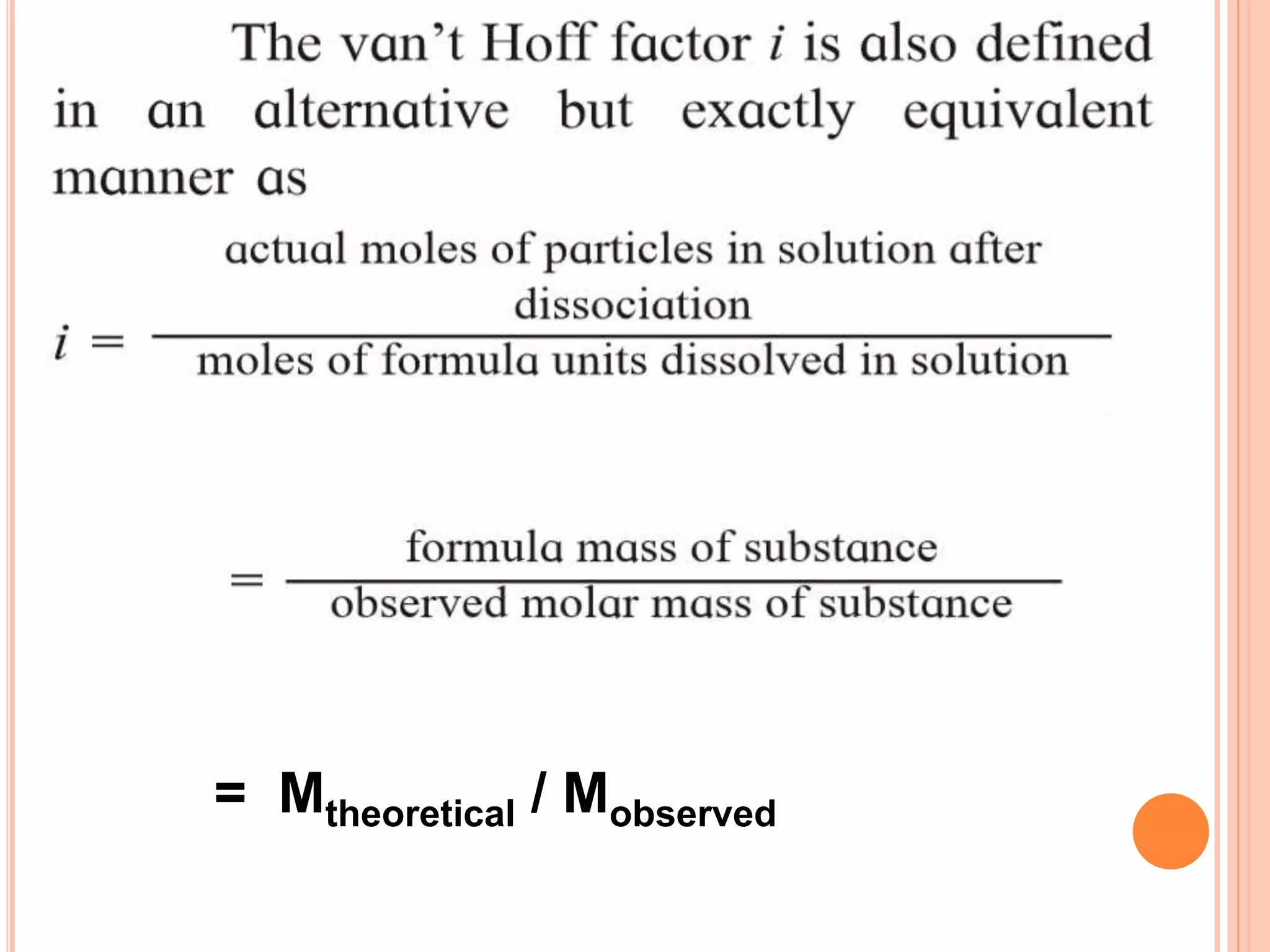
= Mtheoretical / Mobserved
Soluton and colligative properties

Soluton and colligative properties

  • 2.
    Solution: •A homogenous mixtureof two or more than two substances is called solution. •The component that is present in the largest quantity is called the solvent. •The component other than the solvent is called solute. •A solution which is composed of only two components is called binary solution.
  • 4.
    Mass Percentage (w/w): Themass percentage of a component of a solution is defined as the percentage of mass of the component in total mass of the solution. Volume Percentage (V/V): The volume percentage of a component is defined as the percentage of volume of the component in the total volume of the solution.
  • 5.
    Mass by VolumePercentage (w/V): The mass of the solute dissolved in 100 mL of solution is called mass by volume percentage. Parts Per Million (ppm): When a solute is present in trace quantities, it is convenient to express the concentration in parts per million.
  • 6.
    Mole Fraction (X):Mole fraction of a component is defined as the ratio of number of moles of the component to total number of moles of all the components. For example, in a binary mixture if the number of moles of A and B are nA and nB respectively then mole fraction of A will be given as follows:
  • 7.
    The solubility ofsolute is its amount per unit volume of saturated solution At a specific temperature. The solubility of a solute is its maximum concentration and expressed in the Concentration units mol L-1
  • 8.
    i) Nature ofsolute and solvent: Generally the compounds with the similar chemical character are more readily soluble in each other. “like dissolves like” ii)Effect of temperature on Solubility: a) endothermic :- solubility increases with increasing temperature b) exothermic :- solubility decreases with increasing temperature
  • 9.
    iii)Effect of pressureon solubility:- pressure has no effect on solubility of solid and liquid as they are incompressible. However, solubility of gas increases with increasing pressure.
  • 14.
    Vapour pressure isthe pressure exerted by vapours when they are in equilibrium with the liquid phase at a given temperature. It depends on the nature of the liquid and temperature. Vapour pressure of pure liquid is always greater than the vapour pressure of its solution. Vapour pressure of a liquid helps us to have an idea of forces of attraction between the molecules of a liquid. More the force of attraction, lower is the vapour pressure and vice versa. Vapour pressure of a liquid increases with increase in temperature due to increase in kinetic energy of molecules.
  • 15.
    It state thatthe partial vapour pressure of any volatile component of a solution is equal to the vapour pressure of the pure component multiplied by its mole fraction in the solution.
  • 16.
    Suppose that, for abinary solution of two volatile liquid A1 and A2 , P1 and P2 are their partial vapour pressure and x1 and x2 are their mole fraction in the solution. Then according to Raoult’s law. We write P1 = x1P1 0 and P2 = x2P2 0 …(2.2) Where P1 0 and P2 0 are vapour pressure of pure liquid A1 and A2, respectively.
  • 19.
    1. Ideal solutionobey Raoult,s law over entire range of concentration. 2. No heat is evolved or absorbed when two components forming an ideal solution are mixed. Thus, the enthalpy of the mixing is zero. 3. There is no volume change when two components forming an ideal solution are mixed. Thus volume of an ideal solution is equal to the sum of volumes of two components taken for mixing. 4. In ideal solution , solvent-solute, solute-solute and solvent-solvent molecule interactions are comparable. 5. The vapour pressure of ideal solution always lies vapour pressures of pure components.
  • 20.
    1. Nonideal solutiondo not obey Raoult,s law over entire range of concentration. 2.The vapour pressure of these solution can be higher or lower than those of pure component. 3.These solution shows two types of deviation from Raoult’s law. A) Positive deviation from Raoult’s law. The solution in which solvent-solute intermolecular attraction are weaker than those between solvent-solvent molecules and solute-solute molecules attraction.
  • 21.
    B) Negative deviationfrom Raoult’s law. The solution in which solvent-solute intermolecular attraction are stronger than those between solvent-solvent molecules and solute-solute molecules attraction.
  • 22.
  • 23.
    COLLIGATIVE PROPERTIES 2 3 Colligative propertiesdepend only on the number of solute particles present, not on the nature of the solute particles. Among colligative properties are Vapor pressure lowering Boiling point elevation depression of freezing point Osmotic pressure
  • 24.
    Vapour pressure oflowering is difference between vapour pressure of pure component and vapour pressure of its solution.
  • 25.
    Raoult’s law fornon-volatile solute
  • 31.
    The vapour pressureof pure benzene at a certain temperature is 0.850 bar. A non- volatile, non-electrolyte solid weighing 0.5 g when added to 39.0 g of benzene (molar mass 78 g mol-1). Vapour pressure of the solution, then, is 0.845 bar. What is the molar mass of the solid substance? Given: p0 1 = 0.850bar, p = 0.845bar, M1 = 78 mol-1, w2 = 0.5g and w1 = 39g Molar mass of solid substance can be calculated as follows:
  • 33.
    BOILING POINT ELEVATION 3 3 BOILINGPOINT Boiling point is definded as the temperature at which the vapour pressure of liquid becomes equal to the atmospheric pressure . Boiling point is a characteristic property of liquids and is criterion to check the purity of liquids. It increases with in external pressure . Liquids having grater intermolecular forces have high boiling point.
  • 35.
    The boiling pointelevation is directly proportional to the molality of the solution.
  • 36.
    We known that,……….(1)
  • 37.
    (1) 18 g ofglucose C6H12O6 is dissolved in 1 kg of water in a saucepan. At what temperature will water boil at 1.013 bar? Kb for water is 0.52 K kg mol-1.
  • 39.
    The boiling pointof benzene is 353.23 K. When 1.80 g of a non-volatile solute was dissolved in 90 g of benzene, the boiling point is raised to 354.11 K. Calculate the molar mass of the solute. Kb for benzene is 2.53 K kg mol-1.
  • 40.
    FREEZING POINT DEPRESSION FREEZINGPOINT  The temperature at which liquid state is converts into a solid state. It is opposite to melting point. Pressure increases freezing point also increases. Hence freezing point of a liquid is a temperture at which the vapour pressure of soild is equal to the vapour pressure of liquid.
  • 41.
  • 42.
    As varified experimentallyfor a dilute solution the freezing point depresson is directly proportional to the molality of solution. Thus, (1)
  • 43.
  • 44.
    45 g ofethylene glycol (C2H6O2 )is mixed with 600 g of water. Calculate (a)the freezing point depression and (b) the freezing point of the solution. Answer: First of all, we need to find molality of ethylene glycol.
  • 45.
    1.00 g ofa non-electrolyte solute dissolved in 50 g of benzene lowered the freezing point of benzene by 0.40 K. The freezing point depression constant of benzene is 5.12 K kg mol-1. Find the molar mass of the solute.
  • 46.
    OSMASIS • Osmosis isthe movement of water or other solvent through a plasma membrane from a region of low solute concentration to a region of high solute concentration. • Osmosis is passive transport, meaning it does not require energy to be applied
  • 47.
    It is aprocess where in a pressure greater than the osmotic pressure is added on the solution side of the semipermeable membrane to cause the pure solvent to pass through the semipermeable membrane and gather in a separate area.
  • 48.
    SEMI PERMEABLE MEMBRANE •A semipermeable membrane is a barrier that will only allow solvent molecules to pass through while blocking the passage of solute molecules. A semipermeable barrier essentially acts as a filter. • Different types of semipermeable membranes can block out different sized molecules. A semipermeable membrane can be made out of biological or synthetic material.
  • 49.
    Oceans hold about97 percent of Earth's water supply, but their high salt content makes them unusable for drinking or agriculture. Salt can be removed by placing seawater in contact with a semipermeable membrane, then subjecting it to great pressure. Under these conditions, reverse osmosis occurs, by which pressure is used to push water from a more concentrated solution to a less concentrated solution. The process is just the reverse of the normal process of osmosis. In desalination, reverse osmosis is used to push water mole-cules out of seawater into a reservoir of pure wate 4 9
  • 50.
  • 51.
  • 52.
  • 53.
  • 54.
    The excess ofpressure on the side of solution that stop the net flow of solvent into the solution through semi-permeable membrane is called osmotic pressure. The flow of solvent from solvent side to solution side (across a semi-permeable membrane) can be stopped by applying some extra pressure. The pressure which is just enough to stop osmosis is called osmotic pressure of the solution.
  • 59.
    LAW OF OSMOTICPRESSURE Boyle-van’t Hoff Law Vant Hoff Charles Law
  • 60.
    BOYLE-VAN’T HOFF LAW Osmoticpressure (π) of a solution at a constant temperature is directly proportional to its concentration C (i.e., moles per liter) π∝C π∝n/v where n is the number of moles of solute present in volume V liters of solution.
  • 61.
    VANT HOFF CHARLESLAW • For a solution of fixed concentration, the osmotic pressure (π) of a solution is directly proportional to its absolute temperature (T). π∝T π∝nT/v The constant of proportionality also turns out to be the same as gas constant R. Thus, π = nRT/v
  • 62.
  • 63.
  • 64.
    It is definedas the ratio of colligative property of a solution of electrolyte divided by the colligative property of non-electrolyte solution of the same concentration. Where quantities without subscript refer to electrolytes and those with subscript refer to nonelectrolyte.
  • 65.