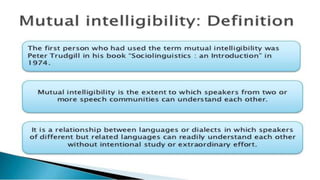
• As already mentioned, the commonly cited criterion used to determine if two
varieties are dialects of the same language or distinct languages is that of mutual
intelligibility: if speakers can understand each other, they are speaking dialects of
the same language; if they cannot, they are speaking different languages.
• However, there are several problems with this criterion.
• For one thing, mutual intelligibility is not an objectively determined fact (Salzman
et al. 2012, p.170). For example, some speakers of (standard) German can
understand (standard) Dutch, while others may find it incomprehensible.
• Your ability to understand someone who speaks differently from you may vary
according to your experience with different ways of speaking.
• Lets discuss the different reasons why this criteria is not useful for distinguishing
between a dialect and a language.
Mutual Intelligibility Problems: Dialect Continuum
• Speakers of some varieties of German can understand varieties of Dutch better than they can understand
other varieties of German!
• Historically, there was a continuum of dialects which included what we now call the different languages of
German and Dutch (Netherlands).
• The varieties which became standardized as the languages of the Germany and Netherlands, Standard
German and Standard Dutch, are no longer mutually intelligible for many speakers.
• However, in the border area, speakers of the local varieties of Dutch and German still exist within a dialect
continuum and remain largely intelligible to one another.
• People on one side of the border say they speak a variety of Dutch and those on the other side say they
speak a variety of German, but linguistically these varieties are very similar.
• Thus, situations in which there is a dialect continuum make it apparent that the lines drawn between
languages are not based on linguistic criteria.
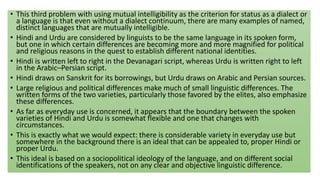
• This third problem with using mutual intelligibility as the criterion for status as a dialect or
a language is that even without a dialect continuum, there are many examples of named,
distinct languages that are mutually intelligible.
• Hindi and Urdu are considered by linguists to be the same language in its spoken form,
but one in which certain differences are becoming more and more magnified for political
and religious reasons in the quest to establish different national identities.
• Hindi is written left to right in the Devanagari script, whereas Urdu is written right to left
in the Arabic–Persian script.
• Hindi draws on Sanskrit for its borrowings, but Urdu draws on Arabic and Persian sources.
• Large religious and political differences make much of small linguistic differences. The
written forms of the two varieties, particularly those favored by the elites, also emphasize
these differences.
• As far as everyday use is concerned, it appears that the boundary between the spoken
varieties of Hindi and Urdu is somewhat flexible and one that changes with
circumstances.
• This is exactly what we would expect: there is considerable variety in everyday use but
somewhere in the background there is an ideal that can be appealed to, proper Hindi or
proper Urdu.
• This ideal is based on a sociopolitical ideology of the language, and on different social
identifications of the speakers, not on any clear and objective linguistic difference.
A Fourth Problem with Mutual Intelligibility Concept…
• The fourth reason that mutual intelligibility cannot be used as the sole means of distinguishing dialect versus
language status is that there are sometimes unintelligible dialects which are identified by their speakers as
being the same language.
• A particularly interesting instance of unintelligibility of dialects occurs with what we call Chinese, which is
generally accepted to include two main sub-categories of varieties, Cantonese and Mandarin.
• Although they share a writing system, Mandarin and Cantonese are not mutually intelligible in spoken
discourse; written characters are pronounced differently in these varieties although they maintain the same
meaning.
• Yet speakers of Mandarin and Cantonese consider themselves speakers of different 32 Languages and
Communities dialects of the same language, for to the Chinese a shared writing system and a strong tradition
of political, social, and cultural unity form essential parts of their definition of language (Kurpaska 2010).
• Likewise, speakers of different regional varieties of Arabic often cannot understand one another’s dialects,
but are all oriented toward common standard forms (Modern Standard Arabic, with its basis in Classical
Arabic).
• Although some native speakers of some varieties of Arabic might not understand a radio broadcast in Modern
Standard Arabic (Kaye 2001), no one questions the categorization of these disparate dialects as one language,
because of the religious, social, historical, and political ties between the cultures in which they are spoken.
https://www.slideshare.net/AllahAkbarAkbar/mutual-intelligibility
https://www.slideshare.net/SapnaThakur5/standard-form-of-language-and-dialects
https://www.slideshare.net/ImranRabbane/dialect-regiolect-socilec
https://slideplayer.com/slide/3211193/

3. MUTUAL INTELLIGIBILITY.pptx

  • 5.
    • As alreadymentioned, the commonly cited criterion used to determine if two varieties are dialects of the same language or distinct languages is that of mutual intelligibility: if speakers can understand each other, they are speaking dialects of the same language; if they cannot, they are speaking different languages. • However, there are several problems with this criterion. • For one thing, mutual intelligibility is not an objectively determined fact (Salzman et al. 2012, p.170). For example, some speakers of (standard) German can understand (standard) Dutch, while others may find it incomprehensible. • Your ability to understand someone who speaks differently from you may vary according to your experience with different ways of speaking. • Lets discuss the different reasons why this criteria is not useful for distinguishing between a dialect and a language.
  • 8.
    Mutual Intelligibility Problems:Dialect Continuum • Speakers of some varieties of German can understand varieties of Dutch better than they can understand other varieties of German! • Historically, there was a continuum of dialects which included what we now call the different languages of German and Dutch (Netherlands). • The varieties which became standardized as the languages of the Germany and Netherlands, Standard German and Standard Dutch, are no longer mutually intelligible for many speakers. • However, in the border area, speakers of the local varieties of Dutch and German still exist within a dialect continuum and remain largely intelligible to one another. • People on one side of the border say they speak a variety of Dutch and those on the other side say they speak a variety of German, but linguistically these varieties are very similar. • Thus, situations in which there is a dialect continuum make it apparent that the lines drawn between languages are not based on linguistic criteria.
  • 10.
    • This thirdproblem with using mutual intelligibility as the criterion for status as a dialect or a language is that even without a dialect continuum, there are many examples of named, distinct languages that are mutually intelligible. • Hindi and Urdu are considered by linguists to be the same language in its spoken form, but one in which certain differences are becoming more and more magnified for political and religious reasons in the quest to establish different national identities. • Hindi is written left to right in the Devanagari script, whereas Urdu is written right to left in the Arabic–Persian script. • Hindi draws on Sanskrit for its borrowings, but Urdu draws on Arabic and Persian sources. • Large religious and political differences make much of small linguistic differences. The written forms of the two varieties, particularly those favored by the elites, also emphasize these differences. • As far as everyday use is concerned, it appears that the boundary between the spoken varieties of Hindi and Urdu is somewhat flexible and one that changes with circumstances. • This is exactly what we would expect: there is considerable variety in everyday use but somewhere in the background there is an ideal that can be appealed to, proper Hindi or proper Urdu. • This ideal is based on a sociopolitical ideology of the language, and on different social identifications of the speakers, not on any clear and objective linguistic difference.
  • 12.
    A Fourth Problemwith Mutual Intelligibility Concept… • The fourth reason that mutual intelligibility cannot be used as the sole means of distinguishing dialect versus language status is that there are sometimes unintelligible dialects which are identified by their speakers as being the same language. • A particularly interesting instance of unintelligibility of dialects occurs with what we call Chinese, which is generally accepted to include two main sub-categories of varieties, Cantonese and Mandarin. • Although they share a writing system, Mandarin and Cantonese are not mutually intelligible in spoken discourse; written characters are pronounced differently in these varieties although they maintain the same meaning. • Yet speakers of Mandarin and Cantonese consider themselves speakers of different 32 Languages and Communities dialects of the same language, for to the Chinese a shared writing system and a strong tradition of political, social, and cultural unity form essential parts of their definition of language (Kurpaska 2010). • Likewise, speakers of different regional varieties of Arabic often cannot understand one another’s dialects, but are all oriented toward common standard forms (Modern Standard Arabic, with its basis in Classical Arabic). • Although some native speakers of some varieties of Arabic might not understand a radio broadcast in Modern Standard Arabic (Kaye 2001), no one questions the categorization of these disparate dialects as one language, because of the religious, social, historical, and political ties between the cultures in which they are spoken.
  • 13.